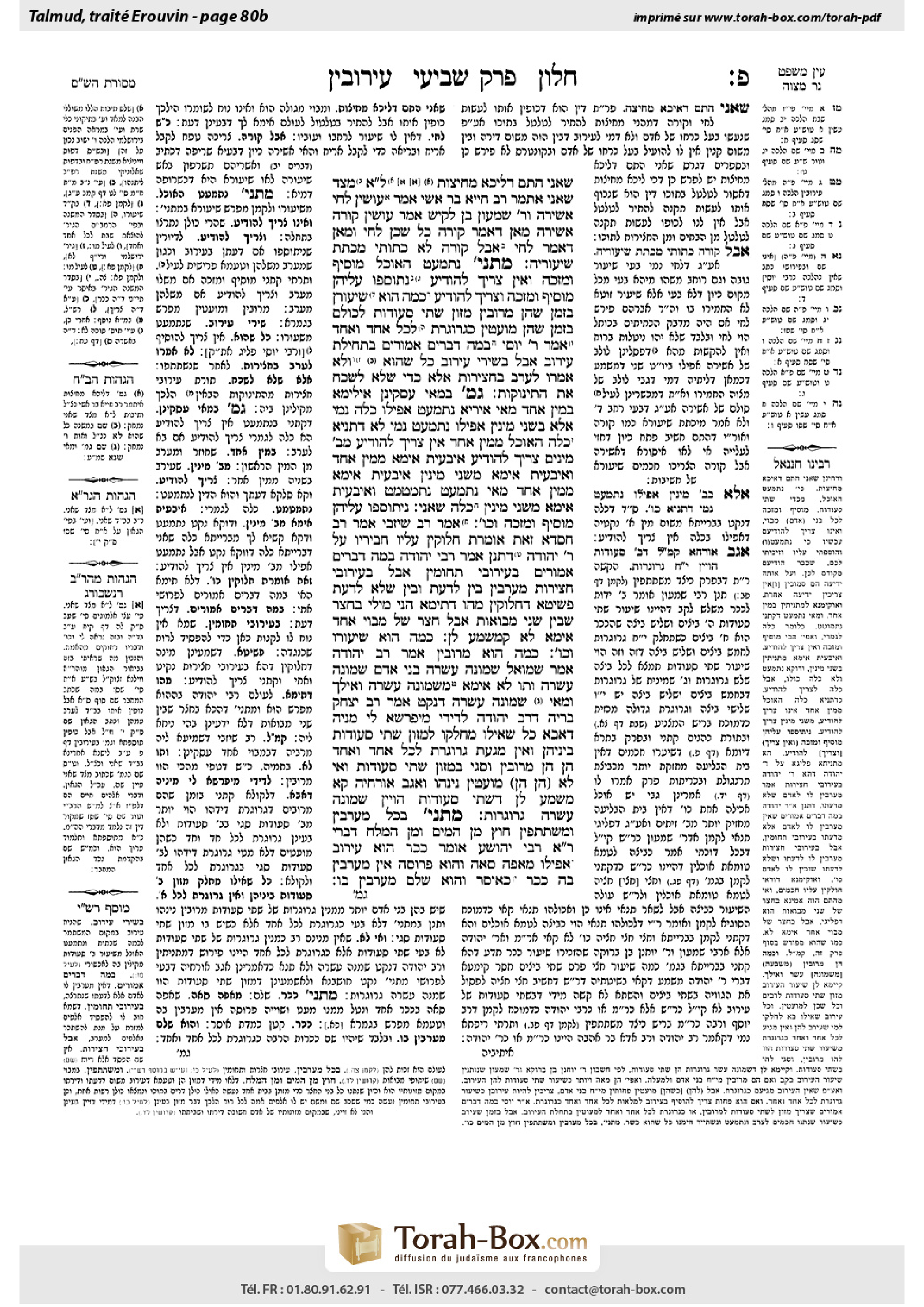
Eruvin 80b: Talmud study for Daf Yomi
Study the Talmud for Daf Yomi with scanned pages, Hebrew text, English translations from Sefaria and AI-generated French translations.
Passage selection and English or AI-generated French translation are available where the scan has annotations. Daf Study is independent of Torah-Box and Sefaria.
Browse Eruvin · עירובין · All tractatesEruvin 80b text and translations
This page of Eruvin includes the Aramaic text, an English translation and an AI-generated French translation, alongside the scan above.
עירובין פ׳ ב · Aramaic and Hebrew text
שָׁאנֵי הָתָם דְּלֵיכָּא מְחִיצוֹת.
לִישָּׁנָא אַחֲרִינָא, מְצָד שָׁאנֵי.
אִתְּמַר, רַב חִיָּיא בַּר אָשֵׁי אָמַר: עוֹשִׂין לֶחִי אֲשֵׁירָה. וְרַבִּי שִׁמְעוֹן בֶּן לָקִישׁ אָמַר: עוֹשִׂין קוֹרָה אֲשֵׁירָה.
מַאן דְּאָמַר קוֹרָה — כׇּל שֶׁכֵּן לֶחִי, וּמַאן דְּאָמַר לֶחִי — אֲבָל קוֹרָה לָא. כַּתּוֹתֵי מְכַתַּת שִׁיעוּרֵיהּ.
מַתְנִי׳ נִתְמַעֵט הָאוֹכֶל — מוֹסִיף וּמְזַכֶּה, וְאֵין צָרִיךְ לְהוֹדִיעַ. נִתּוֹסְפוּ עֲלֵיהֶן — מוֹסִיף וּמְזַכֶּה, וְצָרִיךְ לְהוֹדִיעַ.
כַּמָּה הוּא שִׁיעוּרָן? בִּזְמַן שֶׁהֵן מְרוּבִּין — מְזוֹן שְׁתֵּי סְעוּדוֹת לְכוּלָּם. בִּזְמַן שֶׁהֵן מוּעָטִין — כִּגְרוֹגֶרֶת לְכׇל אֶחָד וְאֶחָד.
אָמַר רַבִּי יוֹסֵי: בַּמֶּה דְּבָרִים אֲמוּרִים — בִּתְחִילַּת עֵירוּב, אֲבָל בִּשְׁיָרֵי עֵירוּב — כׇּל שֶׁהוּא.
וְלֹא אָמְרוּ לְעָרֵב בַּחֲצֵירוֹת אֶלָּא כְּדֵי שֶׁלֹּא לְשַׁכֵּחַ אֶת הַתִּינוֹקוֹת.
גְּמָ׳ בְּמַאי עָסְקִינַן? אִילֵימָא בְּמִין אֶחָד, מַאי אִירְיָא נִתְמַעֵט? אֲפִילּוּ כָּלָה נָמֵי!
אֶלָּא בִּשְׁנֵי מִינִין, אֲפִילּוּ נִתְמַעֵט נָמֵי לָא! דְּתַנְיָא: כָּלָה הָאוֹכֶל, מִמִּין אֶחָד — אֵין צָרִיךְ לְהוֹדִיעַ, מִשְּׁנֵי מִינִים — צָרִיךְ לְהוֹדִיעַ!
אִיבָּעֵית אֵימָא: מִמִּין אֶחָד, וְאִיבָּעֵית אֵימָא: מִשְּׁנֵי מִינִין. אִיבָּעֵית אֵימָא: מִמִּין אֶחָד, מַאי נִתְמַעֵט — נִתְמַטְמֵט.
וְאִיבָּעֵית אֵימָא: מִשְּׁנֵי מִינִין, כָּלָה שָׁאנֵי.
נִיתּוֹסְפוּ עֲלֵיהֶן מוֹסִיף וּמְזַכֶּה וְכוּ׳. אָמַר רַב שֵׁיזְבִי אָמַר רַב חִסְדָּא: זֹאת אוֹמֶרֶת חֲלוּקִין עָלָיו חֲבֵירָיו עַל רַבִּי יְהוּדָה.
דִּתְנַן: אָמַר רַבִּי יְהוּדָה: בַּמֶּה דְּבָרִים אֲמוּרִים — בְּעֵירוּבֵי תְחוּמִין, אֲבָל בְּעֵירוּבֵי חֲצֵירוֹת — מְעָרְבִין בֵּין לְדַעַת וּבֵין שֶׁלֹּא לְדַעַת. פְּשִׁיטָא דַּחֲלוּקִין!
מַהוּ דְּתֵימָא: הָנֵי מִילֵּי בְּחָצֵר שֶׁבֵּין שְׁנֵי מְבוֹאוֹת, אֲבָל חָצֵר שֶׁל מָבוֹי אֶחָד, אֵימָא לָא. קָמַשְׁמַע לַן.
כַּמָּה הוּא שִׁיעוּרוֹ וְכוּ׳. כַּמָּה הוּא מְרוּבִּין? אָמַר רַב יְהוּדָה אָמַר שְׁמוּאֵל: שְׁמוֹנֶה עֶשְׂרֵה בְּנֵי אָדָם. שְׁמוֹנֶה עֶשְׂרֵה, וְתוּ לָא: אֵימָא מִשְּׁמוֹנֶה עֶשְׂרֵה וְאֵילָךְ.
וּמַאי שְׁמוֹנֶה עֶשְׂרֵה דְּנָקֵט? אָמַר רַב יִצְחָק בְּרֵיהּ דְּרַב יְהוּדָה: לְדִידִי מִיפָּרְשָׁא לִי מִנֵּיהּ דְּאַבָּא: כׇּל שֶׁאִילּוּ מְחַלְּקוֹ לִמְזוֹן שְׁתֵּי סְעוּדוֹת בֵּינֵיהֶן וְאֵין מַגַּעַת גְּרוֹגֶרֶת לְכׇל אֶחָד וְאֶחָד — הֵן הֵן מְרוּבִּין, וְסַגִּי בִּמְזוֹן שְׁתֵּי סְעוּדוֹת. וְאִי לָא — (הֵן הֵן) מוּעָטִין נִינְהוּ.
וְאַגַּב אוֹרְחֵיהּ קָא מַשְׁמַע לַן דִּשְׁתֵּי סְעוּדוֹת הָוְיָין שְׁמוֹנֶה עֶשְׂרֵה גְּרוֹגְרוֹת.
מַתְנִי׳ בַּכֹּל מְעָרְבִין וּמִשְׁתַּתְּפִין, חוּץ מִן הַמַּיִם וּמִן הַמֶּלַח, דִּבְרֵי רַבִּי אֱלִיעֶזֶר. רַבִּי יְהוֹשֻׁעַ אוֹמֵר: כִּכָּר הוּא עֵירוּב, אֲפִילּוּ מַאֲפֶה סְאָה, וְהוּא פְּרוּסָה — אֵין מְעָרְבִין בָּהּ. כִּכָּר כְּאִיסָּר וְהוּא שָׁלֵם — מְעָרְבִין בּוֹ.
Eruvin 80b · English translation
The Gemara answers: It is different there, as there are no partitions. That alley is breached, and it is therefore fitting to compel its residents to establish some sort of partition, if only for the sake of protection. However, if there are partitions, one is not obligated to join in a merging of alleyways.
Another version of this explanation: From the side it is different, i.e., the preparation of an eiruv does not involve an adjustment to the alleyway itself, but rather it is a side issue. Consequently, an individual cannot be forced to participate in its preparation (Meir Netiv).
It is stated that the amora’im disputed this issue. Rav Ḥiyya bar Ashi said: One may build a side post from the wood of an asheira. Although it is prohibited to benefit from the tree and it must be burned, setting up a side post is a mitzva, and mitzvot were not given for benefit, i.e., the fulfillment of a mitzva is not in itself considered a benefit. And Rabbi Shimon ben Lakish said: One may build a cross beam from the wood of an asheira.
The Gemara clarifies their opinions: With regard to the one who said that one may build a cross beam from the wood of an asheira, Rabbi Shimon ben Lakish, all the more so he would permit a side post to be prepared from an asheira. And the one who said that one may build a side post from an asheira, Rav Ḥiyya bar Ashi, spoke only of a side post; but as for a cross beam, no, he did not permit one to build it from an asheira. The reason is that an asheira must be burned, and it is therefore as though its size has already been crushed. Consequently, a cross beam, which must be at least a handbreadth in size, may not be prepared from an asheira. With regard to a side post, by contrast, a minimum width suffices, which means that even wood from an asheira is fit, despite the fact that it is viewed as burned.
MISHNA: If the food in the barrel for the merging of the alleyway diminished and was less than the requisite measure, one may add a little of his own and confer possession to the others, and he need not inform them of his addition. However, if new residents were added to the residents of the alleyway, he may add food on behalf of those residents and confer possession to them, and he must inform the new residents of their inclusion in the merging of alleyways.
What is the measure of food required for a merging of the alleyways? When the residents of the alley are numerous, food for two meals is sufficient for all of them; when they are few, less than a certain number, a dried fig-bulk for each and every one of them is enough.
Rabbi Yosei said: In what case is this statement said? It is said with regard to the beginning of an eiruv, when it is initially established. However, with regard to the remnants of an eiruv, e.g., if the eiruv decreased in size on Shabbat, it remains valid if even any amount remains.
And in general they said that it is necessary to join the courtyards, even though a merging of the alleyways was already in place, only so that the halakhic category of eiruv will not be forgotten by the children, i.e., so that the next generation should be aware that an eiruv can be established for a courtyard, for otherwise they would be entirely unaware of this halakhic category.
GEMARA: The mishna stated: If the food in the barrel for the merging of the alleyway diminished and was less than the requisite measure, one may add to it without informing the others. The Gemara poses a question: With what case are we dealing here? If you say that he added the same type of food that had initially been used for the merging of the alleyway, why specify this particular case where the food decreased in measure? Even if the food was entirely finished, he should likewise not be obligated to inform them.
Rather, perhaps it is referring to two types of food, i.e., one added a different kind of food that had not been used beforehand. If so, even if it only decreased in measure, no, he should also not be permitted to add to the merging of the alleyway without informing them. As it was taught in a baraita: If the food of a merging of the alleyway was entirely finished, and he added the same type of food to it, he need not inform the other residents; however, if the amount he added was from two types of food, i.e., if the added food was different from the original, he must inform them. The Gemara assumes that the same halakha is in effect even if the food of the merging of the alleyway only decreased in measure.
The Gemara answers: If you wish, say that the mishna is referring to a case where his addition was from the same kind of food, and if you wish, say instead that it was from two kinds. The Gemara clarifies the previous statement: If you wish, say that it is referring to a case where his addition was from the same kind of food, and what is the meaning of decreased? It means that the food entirely crumbled away, so that nothing at all remained.
And if you wish, say instead that the mishna is referring to a case where his addition was from two kinds of food, for if the eiruv was entirely finished, the halakha is different. That is to say, the halakha of the baraita that he must inform the others is in effect only if the food was entirely finished, but if any of it remains there is no need to inform them of his addition, and he may confer possession of even a different kind of food.
We learned in the mishna: If other residents were added to the residents of the alleyway, he may add food for those residents and confer possession to them, but he must inform the new residents of their inclusion in the merging of the alleyway. Rav Sheizvi said that Rav Ḥisda said: That is to say, i.e., we can infer from the mishna, that Rabbi Yehuda’s colleagues disagree with him.
As we learned in a mishna that Rabbi Yehuda said: In what case is this statement, that an eiruv may be established for a person only with his knowledge, said? It is said with regard to a joining of Shabbat boundaries; however, with regard to a joining of courtyards, one may establish an eiruv for another person either with his knowledge or without his knowledge. Rabbi Yehuda’s opinion conflicts with that of the tanna of the mishna, who does not permit a person to be included in a joining of courtyards without his knowledge. The Gemara is surprised at this statement: It is obvious that they disagree; why did Rav Ḥisda find it necessary to teach us something so evident?
The Gemara answers: It was nonetheless necessary, lest you say that this ruling, i.e., that he must inform them, applies only to a courtyard that is situated between two alleyways, in which case the residents of the courtyard may join in a merging of alleyways with whichever alleyway they prefer. Consequently, he must inform them with which alleyway he prepared the merging, in case they preferred to join the other alleyway. However, with regard to a courtyard that opens into only one alleyway, the merging of the alleyway only benefits them and does not harm them in any way, and you might therefore say no, that even the tanna of the mishna concedes that it is not necessary to inform them. Rav Ḥisda therefore teaches us that the tanna of the mishna maintains that he must inform them in all cases, contrary to the opinion of Rabbi Yehuda.
The mishna continues: What is the measure of food required for a merging of the alleyways? It then specifies different amounts when the residents of the alley are numerous and when they are few. The Gemara asks: How many are numerous, and how many are considered few? Rav Yehuda said that Shmuel said: Eighteen people are considered numerous. The Gemara registers surprise: Eighteen and no more? The Gemara answers: Say: From eighteen upward.
The Gemara asks: And what is the significance of the number eighteen that he cited? Why this figure in particular? The Gemara answers that Rav Yitzḥak, son of Rav Yehuda, said: It was explained to me personally by my father, Rav Yehuda: Any case where, if one were to divide the food of two meals between them and it does not amount to the measure of a dried fig for each and every one of them, these are the very ones the tanna called numerous, and in this case food for two meals suffices for all of them. And if not, these are the very ones the tanna termed few, which means food in the measure of a dried fig is required for each of them.
And Rav Yehuda incidentally teaches us that food for two meals consists of a measure equal to eighteen dried figs. Consequently, if there were numerous residents in the alley, then eighteen dried figs, which is food sufficient for two meals, is enough for them.
MISHNA: One may join courtyards and merge alleyways with all types of food, except for water and salt, as they are not considered foods. This is the statement of Rabbi Eliezer. Rabbi Yehoshua says that a different limitation applies: A whole loaf may be used for an eiruv. With regard to a baked product even the size of a se’a, if it consists of pieces, one may not join courtyards with it. However, with regard to a loaf, even one the size of an issar, if it is whole, one may join courtyards with it.
Eruvin 80b · Traduction française (IA)
Le Guemara répond : C’est différent là-bas, car il n’y a pas de cloisons. Cet allée est brisée, et il est donc convenable d’obliger ses habitants à établir une sorte de cloison, si ce n’est que pour la protection. Cependant, si des cloisons existent, on n’est pas tenu de participer à la fusion des allées.
Une autre version de cette explication : Du côté, c’est différent, c’est-à-dire la préparation d’un eiruv ne suppose pas un ajustement à l’allée elle-même, mais plutôt une question latérale. Ainsi, un individu ne peut pas être contraint de participer à sa préparation (Meir Netiv).
Il est dit que les amora’im ont disputé cette question. Rav Ḥiyya bar Ashi a dit : On peut ériger un poteau latéral en bois d’une ashera. Bien que l’arbre soit interdit d’être utilisé et qu’il doive être brûlé, ériger un poteau latéral est une mitsva, et les mitsvot n’ont pas été données pour le bénéfice, c’est-à-dire que la réalisation d’une mitsva n’est pas elle-même considérée comme un bénéfice. Et Rabbi Shimon ben Lakish a dit : On peut ériger une poutre en bois d’une ashera.
Le Guemara clarifie leurs opinions : Concernant celui qui a dit qu'on peut ériger une poutre en bois d'une ashera, Rabbi Shimon ben Lakish, tout autant qu'il permettrait un poteau latéral à être préparé à partir d'une ashera. Et celui qui a dit qu'on peut ériger un poteau latéral à partir d'une ashera, Rav Ḥiyya bar Ashi, parlait uniquement du poteau latéral ; mais concernant la poutre, non, il n'a pas permis d'en ériger une à partir d'une ashera. La raison est que l'asherah doit être brûlée, et c'est donc comme si sa taille avait déjà été réduite. Ainsi, une poutre, qui doit avoir au moins la taille d'un tefach, ne peut pas être préparée à partir d'une ashera. Concernant le poteau latéral, en revanche, une largeur minimale suffit, ce qui signifie que même du bois d'une ashera est adapté, malgré le fait qu'il soit considéré comme brûlé.
MICHNA : Si la nourriture dans le tonneau pour la fusion des allées diminuait et était inférieure à la mesure requise, on peut ajouter un peu de son propre compte et conférer la possession aux autres, et il n'a pas besoin d'informer les autres de son ajout. Cependant, si des nouveaux habitants sont ajoutés aux habitants de l'allée, il peut ajouter de la nourriture à leur intention et conférer la possession à ceux-ci, et il doit informer les nouveaux habitants de leur inclusion dans la fusion des allées.
Quelle est la mesure de nourriture requise pour la fusion des allées ? Lorsque les habitants de l'allée sont nombreux, deux repas suffisent pour tous ; lorsqu'ils sont peu nombreux, moins qu'un certain nombre, une quantité de figue sèche suffit pour chacun d'eux.
Rabbi Yosei a dit : Dans quel cas cette déclaration est-elle faite ? C’est lors de la création d’un eiruv, lorsqu’il est initialement établi. Cependant, concernant les restes d’un eiruv, c’est-à-dire si l’eiruv a diminué en taille le sabbat, il reste valide si même une quantité minimale reste.
Et en général, ils ont dit qu'il était nécessaire de joindre les courtyards, même si une fusion des allées était déjà en place, uniquement afin que la catégorie halakhique d'eiruv ne soit pas oubliée par les enfants, c'est-à-dire afin que la génération suivante sache qu'un eiruv peut être établi pour un courtil, autrement ils ne connaîtraient pas cette catégorie halakhique.
GUEMARA : La mishna a dit : Si la nourriture dans le tonneau pour la fusion des allées diminuait et était inférieure à la mesure requise, on peut y ajouter sans informer les autres. Le Guemara pose une question : De quel cas s'agit-il ici ? Si vous dites qu'il a ajouté la même nourriture que celle utilisée initialement pour la fusion des allées, pourquoi spécifier ce cas particulier où la nourriture a diminué en quantité ? Même si la nourriture était entièrement terminée, il ne devrait pas être tenu d'informer les autres.
Plutôt, peut-être il s’agit de deux types de nourriture, c’est-à-dire qu’on a ajouté une nourriture différente de celle utilisée initialement. Si c’est ainsi, même si la quantité a diminué, non, il ne devrait pas être autorisé à ajouter à la fusion des allées sans informer les autres. Comme il a été enseigné dans une baraïta : Si la nourriture d’une fusion des allées était entièrement terminée, et qu’il a ajouté la même nourriture à celle-ci, il n’a pas besoin d’informer les autres habitants ; cependant, si la quantité qu’il a ajouté provenait de deux types de nourriture, c’est-à-dire si la nourriture ajoutée était différente de l’originale, il doit informer les autres. Le Guemara suppose que la même halakha s’applique même si la nourriture de la fusion des allées a seulement diminué en quantité.
Le Guemara répond : Si vous le souhaitez, dites que la mishna fait référence à un cas où son ajout provenait du même type de nourriture, et si vous le souhaitez, dites plutôt qu’il provenait de deux types. Le Guemara clarifie l’affirmation précédente : Si vous le souhaitez, dites qu’il s’agit d’un cas où son ajout provenait du même type de nourriture, et quelle est la signification de « diminué » ? Cela signifie que la nourriture s’est entièrement évanouie, de sorte que rien ne restait.
Et si vous le souhaitez, dites plutôt que la mishna fait référence à un cas où son ajout provenait de deux types de nourriture, car si l’eiruv était entièrement terminé, la halakha est différente. C’est-à-dire, la halakha de la baraïta selon laquelle il doit informer les autres s’applique uniquement si la nourriture était entièrement terminée, mais si une partie restait, il n’y a pas besoin d’informer les autres de son ajout, et il peut conférer la possession même d’un type de nourriture différent.
Nous avons appris dans la Michna : Si d’autres habitants sont ajoutés aux habitants de l’allée, il peut ajouter de la nourriture pour ces nouveaux habitants et conférer la possession à ceux-ci, mais il doit informer les nouveaux habitants de leur inclusion dans la fusion des allées. Rav Sheizvi a dit que Rav Ḥisda a dit : Cela signifie, c’est-à-dire, nous pouvons en déduire de la Michna que les collègues de Rabbi Yehuda s’opposent à lui.
Comme nous avons appris dans une mitsva que Rabbi Yéhuda a dit : Dans quel cas cette déclaration, selon laquelle un eiruv peut être établi pour une personne uniquement avec son consentement, est-elle formulée ? Elle est formulée concernant un rapprochement des limites du Shabbat ; cependant, concernant un rapprochement de courtyards, on peut établir un eiruv pour une autre personne soit avec son consentement, soit sans son consentement. L'opinion de Rabbi Yéhuda entre en conflit avec celle du tanna de la mitsva, qui ne permet pas à une personne d'être incluse dans un rapprochement de courtyards sans son consentement. La Guemara est surprise par cette déclaration : Il est évident qu'ils divergent ; pourquoi Rav Hischda a-t-il jugé nécessaire de nous enseigner quelque chose d'aussi évident ?
La Guemara répond : Il était néanmoins nécessaire, afin que vous ne disiez pas que cette décision, c'est-à-dire qu'il faut les informer, s'applique uniquement à un courtyard situé entre deux ruelles, dans lequel cas les habitants du courtyard peuvent s'unir à la fusion des ruelles avec celle qu'ils préfèrent. Par conséquent, il faut les informer de la ruelle avec laquelle il a préparé la fusion, en cas de préférence pour l'autre ruelle. Cependant, concernant un courtyard ouvrant uniquement sur une ruelle, la fusion de la ruelle ne leur profite que et ne les nuise en aucun cas, et vous pourriez donc dire non, que même le tanna de la mitsva reconnaît qu'il n'est pas nécessaire de les informer. Rav Hischda enseigne donc que le tanna de la mitsva maintient qu'il faut les informer dans tous les cas, contrairement à l'opinion de Rabbi Yéhuda.
La mitsva continue : Quelle quantité de nourriture est requise pour une fusion des ruelles ? Elle précise ensuite des quantités différentes lorsque les habitants de la ruelle sont nombreux ou peu nombreux. La Guemara demande : Combien sont considérés comme nombreux, et combien sont considérés comme peu ? Rav Yéhuda a dit que Shmuel a dit : Dix-huit personnes sont considérées comme nombreux. La Guemara exprime une surprise : Dix-huit et pas plus ? La Guemara répond : Dites : À partir de dix-huit.
La Guemara demande : Et quelle est l'importance du nombre dix-huit que l'on a cité ? Pourquoi ce chiffre en particulier ? La Guemara répond que Rav Yitzhak, fils de Rav Yéhuda, a dit : On m'a expliqué personnellement par mon père, Rav Yéhuda : Tout cas où, si l'on divise la nourriture de deux repas entre eux et cela ne représente pas la mesure d'une figue sèche pour chacun d'eux, ces sont précisément ceux que le tanna a appelés nombreux, et dans ce cas, la nourriture pour deux repas suffit à tous. Et si ce n'est pas le cas, ces sont précisément ceux que le tanna a appelés peu, ce qui signifie que la mesure d'une figue sèche est requise pour chacun d'eux.
Et Rav Yéhuda enseigne incidentellement que la nourriture pour deux repas est égale à la mesure de dix-huit figues sèches. Par conséquent, si les habitants de la ruelle étaient nombreux, alors dix-huit figues sèches, qui est la nourriture suffisante pour deux repas, suffirait à eux.
MICHNA : On peut rapprocher des courtyards et fusionner des ruelles avec tous les types de nourriture, sauf l'eau et le sel, car ils ne sont pas considérés comme des aliments. C'est l'opinion de Rabbi Eliezer. Rabbi Yéhoshua dit qu'une limitation différente s'applique : un pain entier peut être utilisé pour un eiruv. Concernant un produit cuit même de la taille d'un se'a, si celui-ci est en morceaux, on ne peut pas rapprocher des courtyards avec lui. Cependant, concernant un pain, même de la taille d'un issar, si celui-ci est entier, on peut rapprocher des courtyards avec lui.
Traduction française générée par IA à partir de l’édition anglaise de Sefaria. Vérifie toujours un passage avec le texte source.
Text from Sefaria: William Davidson Edition - Vocalized Aramaic (CC BY NC); William Davidson Edition - English (CC BY NC).