Eruvin 81a: Talmud study for Daf Yomi
Study the Talmud for Daf Yomi with scanned pages, Hebrew text, English translations from Sefaria and AI-generated French translations.
Passage selection and English or AI-generated French translation are available where the scan has annotations. Daf Study is independent of Torah-Box and Sefaria.
Browse Eruvin · עירובין · All tractatesEruvin 81a text and translations
This page of Eruvin includes the Aramaic text, an English translation and an AI-generated French translation, alongside the scan above.
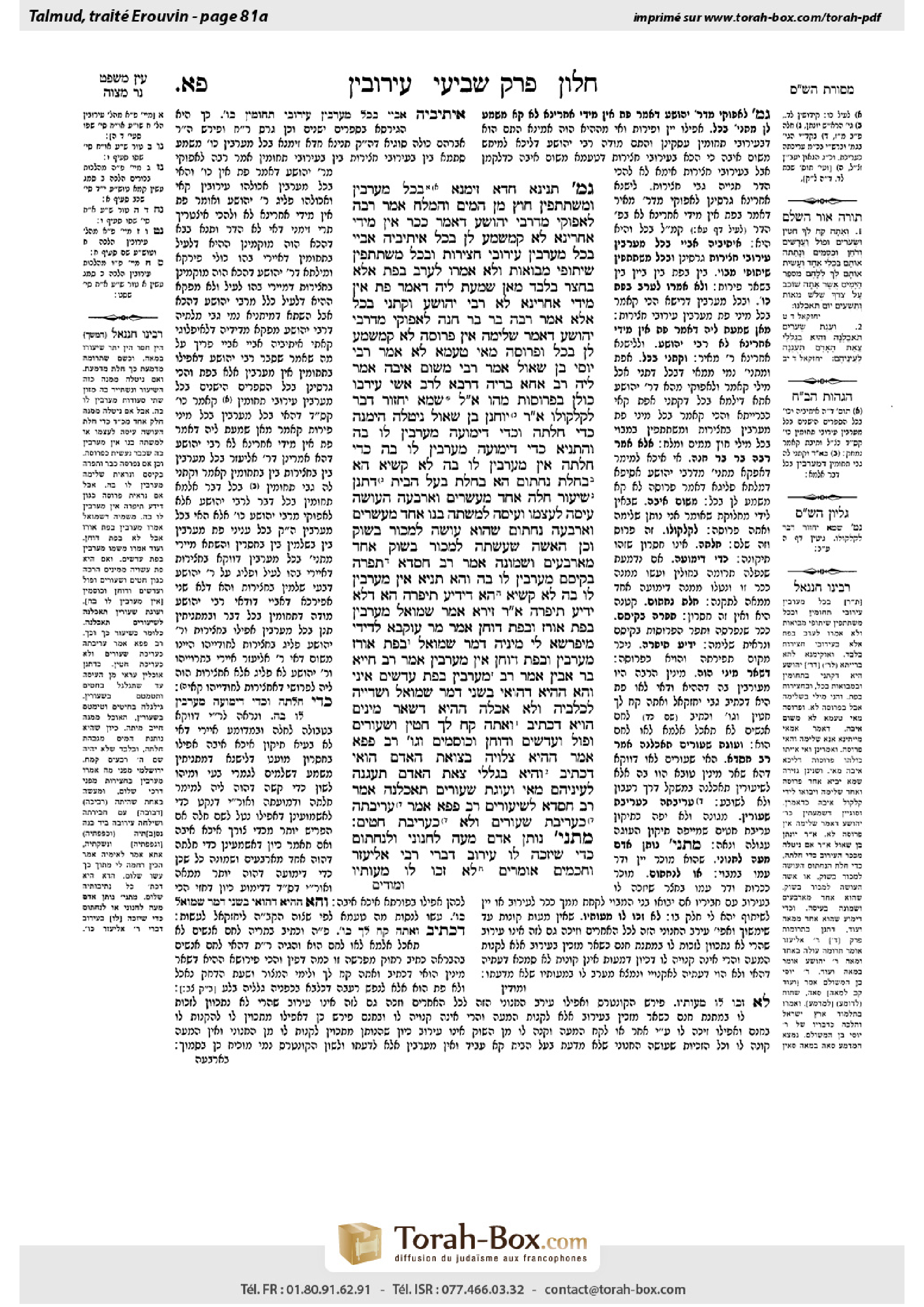
עירובין פ״א א · Aramaic and Hebrew text
גְּמָ׳ תְּנֵינָא חֲדָא זִימְנָא: בַּכֹּל מְעָרְבִין וּמִשְׁתַּתְּפִין, חוּץ מִן הַמַּיִם וְהַמֶּלַח!
אָמַר רַבָּה: לְאַפּוֹקֵי מִדְּרַבִּי יְהוֹשֻׁעַ, דְּאָמַר: כִּכָּר — אִין, מִידֵּי אַחֲרִינָא — לָא, קָמַשְׁמַע לַן ״בַּכֹּל״.
אֵיתִיבֵיהּ אַבָּיֵי: בַּכֹּל מְעָרְבִין עֵירוּבֵי חֲצֵירוֹת וּבַכֹּל מִשְׁתַּתְּפִין שִׁיתּוּפֵי מְבוֹאוֹת, וְלֹא אָמְרוּ לְעָרֵב בְּפַת אֶלָּא בֶּחָצֵר בִּלְבַד. מַאן שָׁמְעַתְּ לֵיהּ דְּאָמַר פַּת — אִין, מִידֵּי אַחֲרִינָא — לָא, רַבִּי יְהוֹשֻׁעַ, וְקָתָנֵי ״בַּכֹּל״!
אֶלָּא אָמַר רַבָּה בַּר בַּר חָנָה: לְאַפּוֹקֵי מִדְּרַבִּי יְהוֹשֻׁעַ, דְּאָמַר שְׁלֵימָה — אִין, פְּרוּסָה — לָא, קָמַשְׁמַע לַן ״בַּכֹּל״.
וּפְרוּסָה מַאי טַעְמָא לָא? אָמַר רַבִּי יוֹסֵי בֶּן שָׁאוּל אָמַר רַבִּי: מִשּׁוּם אֵיבָה.
אֲמַר לֵיהּ רַב אַחָא בְּרֵיהּ דְּרָבָא לְרַב אָשֵׁי: עֵירְבוּ כּוּלָּן בִּפְרוּסוֹת מַהוּ? אֲמַר לֵיהּ: שֶׁמָּא יַחְזוֹר דָּבָר לְקִלְקוּלוֹ.
אָמַר רַבִּי יוֹחָנָן בֶּן שָׁאוּל: נִיטְּלָה הֵימֶנָּה כְּדֵי חַלָּתָהּ וּכְדֵי דִימּוּעָהּ — מְעָרְבִין לוֹ בָּהּ.
וְהָתַנְיָא: כְּדֵי דִימּוּעָהּ — מְעָרְבִין לוֹ בָּהּ, כְּדֵי חַלָּתָהּ — אֵין מְעָרְבִין לוֹ בָּהּ!
לָא קַשְׁיָא: הָא — בְּחַלַּת נַחְתּוֹם, הָא — בְּחַלַּת בַּעַל הַבַּיִת.
דִּתְנַן: שִׁיעוּר חַלָּה אֶחָד מֵעֶשְׂרִים וְאַרְבָּעָה. הָעוֹשֶׂה עִיסָּה לְעַצְמוֹ וְעִיסָּה לְמִשְׁתֵּה בְנוֹ, אֶחָד מֵעֶשְׂרִים וְאַרְבָּעָה. נַחְתּוֹם שֶׁהוּא עוֹשֶׂה לִמְכּוֹר בַּשּׁוּק, וְכֵן הָאִשָּׁה שֶׁעָשְׁתָה לִמְכּוֹר בַּשּׁוּק — אֶחָד מֵאַרְבָּעִים וּשְׁמוֹנָה.
אָמַר רַב חִסְדָּא: תְּפָרָהּ בְּקֵיסָם מְעָרְבִין לוֹ בָּהּ. וְהָא תַּנְיָא אֵין מְעָרְבִין לוֹ בָּהּ! לָא קַשְׁיָא, הָא — דִּידִיעַ תִּיפְרָהּ, הָא — דְּלָא יְדִיעַ תִּיפְרָהּ.
אָמַר רַבִּי זֵירָא אָמַר שְׁמוּאֵל: מְעָרְבִין בְּפַת אוֹרֶז וּבְפַת דּוֹחַן. אָמַר מָר עוּקְבָא: לְדִידִי מִיפָּרְשָׁא לִי מִינֵּיהּ דְּמָר שְׁמוּאֵל, בְּפַת אוֹרֶז — מְעָרְבִין, וּבְפַת דּוֹחַן — אֵין מְעָרְבִין.
אָמַר רַב חִיָּיא בַּר אָבִין אָמַר רַב: מְעָרְבִין בְּפַת עֲדָשִׁים. אִינִי?! וְהָא הָהִיא דַּהֲוַאי בִּשְׁנֵי דְּמָר שְׁמוּאֵל, וְשַׁדְיַיהּ לְכַלְבֵּיהּ וְלָא אַכְלַהּ!
הָהִיא דִּשְׁאָר מִינִים הָוְיָא, דִּכְתִיב: ״וְאַתָּה קַח לְךָ חִטִּין וּשְׂעוֹרִים וּפוֹל וַעֲדָשִׁים וְדוֹחַן וְכוּסְּמִים וְגוֹ׳״.
רַב פָּפָּא אָמַר: הָהִיא צְלוּיָה בְּצוֹאַת הָאָדָם הֲוַאי, דִּכְתִיב: ״וְהִיא בְּגֶלְלֵי צֵאַת הָאָדָם תְּעֻגֶנָה לְעֵינֵיהֶם״.
מַאי ״וְעוּגַת שְׂעֹרִים תֹּאכְלֶנָּה״? אָמַר רַב חִסְדָּא: לְשִׁיעוּרִים. רַב פָּפָּא אָמַר: עֲרִיבָתָהּ כַּעֲרִיבַת שְׂעוֹרִים, וְלֹא כַּעֲרִיבַת חִטִּים.
מַתְנִי׳ נוֹתֵן אָדָם מָעָה לַחֶנְוָנִי וְלַנַּחְתּוֹם כְּדֵי שֶׁיְּזַכֶּה לוֹ עֵירוּב, דִּבְרֵי רַבִּי אֱלִיעֶזֶר.
וַחֲכָמִים אוֹמְרִים: לֹא זָכוּ לוֹ מְעוֹתָיו.
Eruvin 81a · English translation
GEMARA: With regard to the mishna’s ruling concerning the foods which may or may not be used for an eiruv and to merge alleyways, the Gemara poses a question: This ruling is apparently superfluous, as we have already learned it once before in another mishna: One may establish an eiruv and a merging of alleyways with all kinds of food, except for water and salt.
Rabba said: This addition comes to exclude the opinion of Rabbi Yehoshua in the mishna, who said that a loaf, yes, it may be used for an eiruv; but anything else, no, other foods may not be used. Therefore, the mishna teaches us that an eiruv may be established with all kinds of food, not only bread.
Abaye raised an objection from a baraita: One may establish a joining of courtyards with all kinds of food, and likewise one may establish a merging of alleyways with all kinds of food. They said that one must establish an eiruv with bread only with regard to an eiruv of a courtyard. Who did you hear that said that bread, yes, it may be used for an eiruv, but anything else, no, it may not be used? It was Rabbi Yehoshua, and yet the baraita teaches: With all kinds of food. This proves that the phrase: One may establish an eiruv with all kinds of food, does not necessarily exclude Rabbi Yehoshua’s opinion.
Rather, Rabba bar bar Ḥana said: It comes to exclude a different aspect of the opinion of Rabbi Yehoshua, as Rabbi Yehoshua said: A whole loaf, yes, it is fit to be used as an eiruv, but a broken loaf, no, it is not suitable for this purpose. The mishna therefore teaches us that one may prepare an eiruv with all kinds of bread, even a broken loaf.
The Gemara analyzes Rabbi Yehoshua’s position itself: And with regard to a broken loaf of bread, what is the reason that it may not be used for an eiruv? Rabbi Yosei ben Shaul said that Rabbi Yehuda HaNasi said: The reason is due to potential enmity between neighbors. To avoid a situation where one person says to the other: You contributed a mere slice of bread, while I donated an entire loaf, the Sages instituted that each person should provide a whole loaf.
Rav Aḥa, son of Rava, said to Rav Ashi: If they all established the eiruv with broken loaves of bread, what is the halakha? In this case there is no cause for enmity. Rav Ashi said to him: There is nonetheless a concern lest the problem recur, as one of them might give an entire loaf and proceed to complain about his neighbor who donated only a partial loaf.
A portion of dough, known as ḥalla, must be set aside and given to the priests. If ḥalla was not set aside from the dough, it must be separated from the baked bread. Moreover, if one part teruma fell into a hundred parts non-sacred produce, a proportionate amount must be removed from the mixture and given to a priest, after which the remainder may be eaten. Rabbi Yoḥanan ben Shaul said: If one removed from the loaf as much as must be set aside for its ḥalla, or as much as must be separated from a mixture of teruma and non-sacred produce, he may establish an eiruv with that loaf. The reason is that in this case people would not complain that he did not give a whole loaf, as they would assume the loaf had a small part missing because ḥalla had been separated from it, or because teruma had fallen into the dough, which necessitated the separation of a certain portion. However, if more than this amount was missing, people would suspect him of eating from the eiruv.
The Gemara raises a difficulty: Wasn’t it was taught otherwise in a baraita: If a loaf was missing as much as must be removed from a mixture of teruma and non-sacred produce, one may establish an eiruv with it, but if it was missing as much as must be removed for its ḥalla, one may not establish an eiruv with it?
The Gemara answers: This is not difficult, as the two sources are not dealing with the same amounts. In this case, where the tanna permitted a loaf that was missing the amount that must be removed for ḥalla, he is referring to a baker’s ḥalla, which is a smaller amount and is therefore not considered a significant reduction of the loaf. However, in that case, where the tanna did not permit a loaf that was lacking the amount that must be removed for ḥalla, it is referring to an ordinary homeowner’s ḥalla. This ḥalla portion is larger in size, and consequently the loaf may not be used for an eiruv if it is missing such a large amount.
The Gemara explains that this is as we learned in a mishna: The measure of ḥalla fixed by the Sages is one twenty-fourth of the dough. Consequently, one who prepares dough for himself or dough for his son’s wedding feast, the measure for ḥalla is one twenty-fourth. However, a baker who prepares dough for sale in the market, and likewise a woman who prepares dough for sale in the market, is required to separate only one forty-eighth of the dough, as the Sages were lenient with those who sell their wares so that they should not suffer loss.
Rav Ḥisda said: With regard to one who connected the two portions of a broken loaf with a wood chip, one may establish an eiruv with it, as it looks whole. The Gemara raises a difficulty: But wasn’t it taught in a baraita with regard to a case of this kind that one may not establish an eiruv with it? The Gemara answers: This is not difficult, as in this case, where it may not be used for an eiruv, we are dealing with a situation where the seam is conspicuous; however, in that case, where it may be used for an eiruv, the reference is to a situation where the seam is not conspicuous.
Rabbi Zeira said that Shmuel said: One may establish an eiruv even with rice bread or with millet bread. Mar Ukva said: This ruling was explained to me by Mar Shmuel himself. With rice bread one may establish an eiruv, but with millet bread one may not establish an eiruv, as it is difficult to bake edible bread out of millet.
Rav Ḥiyya bar Avin said that Rav said: One may establish an eiruv with lentil bread. The Gemara raises a difficulty: Is that so? Is such bread edible? But there was that lentil bread in the days of Mar Shmuel, which he threw to his dog, and even it would not eat it. Clearly, lentil bread is not fit for human consumption.
The Gemara answers: That bread which the dog refused to eat was a mixture of various types of grain. It was baked in order to discover the taste of a bread of mixed ingredients and was similar to that which the prophet Ezekiel was commanded to eat, as it is written: “Take you for yourself wheat, and barley, and beans, and lentils, and millet, and spelt, and put them in one vessel, and make them for yourself into bread” (Ezekiel 4:9). This bread is unfit for human consumption, as even a dog at times will not eat it. However, bread prepared from lentils alone is edible.
Rav Pappa said: That bread of Ezekiel’s was roasted in human excrement, as it is written: “And you shall eat it as barley cakes, and you shall bake it with human excrement, in their sight” (Ezekiel 4:12).
Having mentioned this verse, the Gemara asks a related question: What is the meaning of: “And you shall eat it as barley [seorim] cakes”? Rav Ḥisda said: The verse means that he should eat it in small measures [leshiurim], not as a satisfying meal. Rav Pappa said: Its preparation must be like the preparation of barley bread, coarse bread with regard to which one invests little effort, and not like the preparation of wheat bread.
MISHNA: A person may give a ma’a coin to a grocer or a baker, if they live in the same alleyway or courtyard, so that the grocer or baker will confer upon him possession of wine or bread for a merging of the alleyway or an eiruv, if other residents come to them to purchase these products for that purpose. This is the statement of Rabbi Eliezer.
And the Rabbis say: His money did not confer possession on him, as the transfer of money alone is not a valid mode of acquisition and cannot confer possession. One must perform a valid mode of acquisition, e.g., pulling an article into one’s possession, to transfer ownership.
Eruvin 81a · Traduction française (IA)
GUEMARA : Concernant la décision de la Michna concernant les aliments qui peuvent ou ne peuvent pas être utilisés pour un eiruv et pour la fusion des ruelles, la Guemara pose une question : Cette décision semble superflue, car nous avons déjà appris cela une fois auparavant dans une autre Michna : On peut établir un eiruv et la fusion des ruelles avec tous les types d'aliments, sauf l'eau et le sel.
Rabba dit : Cette addition vise à exclure l'opinion de Rabbi Yéhoshua dans la Michna, qui disait qu'un pain, oui, il peut être utilisé pour un eiruv ; mais tout autre aliment, non, d'autres aliments ne peuvent pas être utilisés. Ainsi, la Michna nous apprend que l'eiruv peut être établi avec tous les types d'aliments, pas seulement le pain.
Abaye souleva un objet à partir d'une baraïta : On peut établir la fusion des courtyards avec tous les types d'aliments, et de même on peut établir la fusion des ruelles avec tous les types d'aliments. Ils dirent qu'on doit établir un eiruv uniquement avec du pain concernant un eiruv de courtyards. Qui avez-vous entendu dire que le pain, oui, il peut être utilisé pour un eiruv, mais tout autre aliment, non, il ne peut pas être utilisé ? C'était Rabbi Yéhoshua, et pourtant la baraïta enseigne : Avec tous les types d'aliments. Cela prouve que la phrase : On peut établir un eiruv avec tous les types d'aliments, ne nécessite pas nécessairement d'exclure l'opinion de Rabbi Yéhoshua.
Plutôt, Rabba bar bar Ḥana dit : Cela vise à exclure un autre aspect de l'opinion de Rabbi Yéhoshua, car Rabbi Yéhoshua dit : Un pain entier, oui, il est adapté à être utilisé comme eiruv, mais un pain cassé, non, il n'est pas adapté à cette fin. La michna nous apprend ainsi que l'on peut préparer un eiruv avec tous les types de pain, même un pain cassé.
La Guemara analyse la position de Rabbi Yéhoshua lui-même : Et concernant un pain cassé, quelle est la raison qu'il ne puisse pas être utilisé pour un eiruv ? Rabbi Yosei ben Shaul dit que Rabbi Yéhuda HaNasi dit : La raison est due à un potentiel conflit entre voisins. Pour éviter une situation où une personne dit à l'autre : Tu as contribué une simple tranche de pain, tandis que j'ai donné un pain entier, les Sages ont institué que chacun devait fournir un pain entier.
Rav Acha, fils de Rava, dit à Rav Ashi : Si tous ont établi l'eiruv avec des pains cassés, quelle est la halakha ? Dans ce cas, il n'y a pas de cause de conflit. Rav Ashi dit à lui : Il y a toutefois une préoccupation pour que le problème ne se répète pas, car l'un d'eux pourrait donner un pain entier et se plaindre de son voisin qui a seulement donné une partie du pain.
Une portion de pâte, connue sous le nom de ḥalla, doit être séparée et donnée aux prêtres. Si la ḥalla n'avait pas été séparée de la pâte, il faut la séparer du pain cuit. De plus, si une partie de terouma était tombée dans cent parties de produits non sacrés, une quantité proportionnelle doit être retirée du mélange et donnée à un prêtre, après quoi le reste peut être mangé. Rabbi Yoḥanan ben Shaul dit : Si l'on a retiré de la baguette une quantité égale à ce qui doit être séparé pour sa ḥalla, ou une quantité égale à ce qui doit être séparé d'un mélange de terouma et de produits non sacrés, il peut établir un eiruv avec cette baguette. La raison est que dans ce cas, les gens ne soupçonneraient pas qu'il n'a pas donné un pain entier, car ils supposeraient que la baguette manquait d'une petite partie parce que la ḥalla avait été séparée d'elle, ou parce que la terouma était tombée dans la pâte, ce qui nécessitait la séparation d'une certaine quantité. Cependant, si une quantité supérieure avait été manquante, les gens soupçonneraient qu'il a mangé de l'eiruv.
La Guemara soulève une difficulté : N'était-ce pas enseigné autrement dans une baraïta : Si une baguette manquait d'une quantité égale à ce qui doit être retiré d'un mélange de terouma et de produits non sacrés, on peut établir un eiruv avec elle, mais si elle manquait d'une quantité égale à ce qui doit être retiré pour sa ḥalla, on ne peut pas établir un eiruv avec elle ?
La Guemara répond : Ce n'est pas difficile, car les deux sources ne traitent pas des mêmes quantités. Dans ce cas, où le tanna permet une baguette manquant de la quantité à retirer pour la ḥalla, il s'agit d'une ḥalla de boulanger, qui est une quantité plus petite et donc ne constitue pas une réduction significative de la baguette. Cependant, dans ce cas où le tanna ne permet pas une baguette manquant de la quantité à retirer pour la ḥalla, il s'agit d'une ḥalla d'un ménage ordinaire. Cette portion de ḥalla est plus grande en taille, et par conséquent la baguette ne peut pas être utilisée pour un eiruv si elle manque d'une telle quantité.
La Guemara explique que cela correspond à ce que nous avons appris dans une michna : La mesure de la ḥalla fixée par les Sages est un vingt-quatrième de la pâte. Ainsi, celui qui prépare de la pâte pour lui-même ou pour le mariage de son fils, la mesure de la ḥalla est un vingt-quatrième. Cependant, un boulanger qui prépare de la pâte pour la vendre sur le marché, ainsi qu'une femme qui prépare de la pâte pour la vendre sur le marché, est tenu de séparer seulement un quarante-huitième de la pâte, car les Sages ont été plus indulgents envers ceux qui vendent leurs marchandises afin qu'ils ne subissent pas de perte.
Rav Ḥisda dit : Concernant celui qui a relié les deux parties d'une baguette cassée avec une pique de bois, on peut établir un eiruv avec elle, car elle semble entière. La Guemara soulève une difficulté : Mais n'était-ce pas enseigné dans une baraïta concernant un cas de ce genre que l'on ne peut pas établir un eiruv avec elle ? La Guemara répond : Ce n'est pas difficile, car dans ce cas, où l'on ne peut pas utiliser la baguette pour un eiruv, on s'occupe d'une situation où la couture est visible ; cependant, dans ce cas où l'on peut utiliser la baguette pour un eiruv, la référence est à une situation où la couture n'est pas visible.
Rabbi Zéira dit que Shmuel dit : On peut établir un eiruv même avec du pain de riz ou avec du pain de millet. Mar Ukva dit : Cette décision m'a été expliquée par Mar Shmuel lui-même. Avec du pain de riz, on peut établir un eiruv, mais avec du pain de millet, on ne peut pas établir un eiruv, car il est difficile de cuire un pain comestible à partir de millet.
Rav Ḥiyya bar Avin a dit que Rav avait dit : On peut établir un eiruv avec du pain de lentilles. La Guemara soulève une difficulté : Est-ce vrai ? Ce pain est-il comestible ? Mais il y avait ce pain de lentilles aux jours de Mar Shmuel, qu'il jetait à son chien, et même ce chien ne le mangeait pas. Évidemment, le pain de lentilles n'est pas adapté à la consommation humaine.
La Guemara répond : Ce pain que le chien refusait de manger était un mélange de diverses céréales. Il avait été cuit afin de découvrir le goût d'un pain à base de mélanges et était semblable à celui que le prophète Ézéchiel avait été commandé de manger, comme il est écrit : « Prends-toi du blé, et de l'orge, et des haricots, et des lentilles, et du mil, et du seigle, et mets-les dans un seul récipient, et fais-en du pain » (Ézéchiel 4:9). Ce pain n'est pas adapté à la consommation humaine, car même un chien ne le mange parfois pas. Cependant, le pain préparé uniquement à partir de lentilles est comestible.
Rav Pappa a dit : Ce pain d'Ézéchiel avait été cuit dans les excrements humains, comme il est écrit : « Et tu en mangeras comme des galettes d'orge, et tu le cuiras dans les excrements humains, devant eux » (Ézéchiel 4:12).
Ayant mentionné cette versette, la Guemara pose une question liée : Quelle est la signification de : « Et tu en mangeras comme des galettes d'orge » ? Rav Ḥisda a dit : Ce verset signifie qu'il devait le manger en petites quantités [leshiurim], pas comme un repas rassurant. Rav Pappa a dit : Sa préparation devait être comme la préparation du pain d'orge, un pain grossier concernant lequel on investit peu d'efforts, et pas comme la préparation du pain de blé.
MICHNA : Une personne peut donner une monnaie de ma’a à un marchand ou un boulanger, si ils habitent dans le même passage ou cour, afin que le marchand ou le boulanger lui confère la possession du vin ou du pain pour la fusion du passage ou l'eiruv, si d'autres habitants viennent chez eux pour acheter ces produits à cet effet. C'est la déclaration de Rabbi Élazar.
Et les Sages disent : Son argent n'a pas conféré la possession à lui, car le transfert d'argent seul n'est pas un mode valide d'acquisition et ne peut conférer la possession. On doit effectuer un mode valide d'acquisition, par exemple, tirer un objet dans sa possession, pour transférer la propriété.
Traduction française générée par IA à partir de l’édition anglaise de Sefaria. Vérifie toujours un passage avec le texte source.
Text from Sefaria: William Davidson Edition - Vocalized Aramaic (CC BY NC); William Davidson Edition - English (CC BY NC).