Eruvin 81b: Talmud study for Daf Yomi
Study the Talmud for Daf Yomi with scanned pages, Hebrew text, English translations from Sefaria and AI-generated French translations.
Passage selection and English or AI-generated French translation are available where the scan has annotations. Daf Study is independent of Torah-Box and Sefaria.
Browse Eruvin · עירובין · All tractatesEruvin 81b text and translations
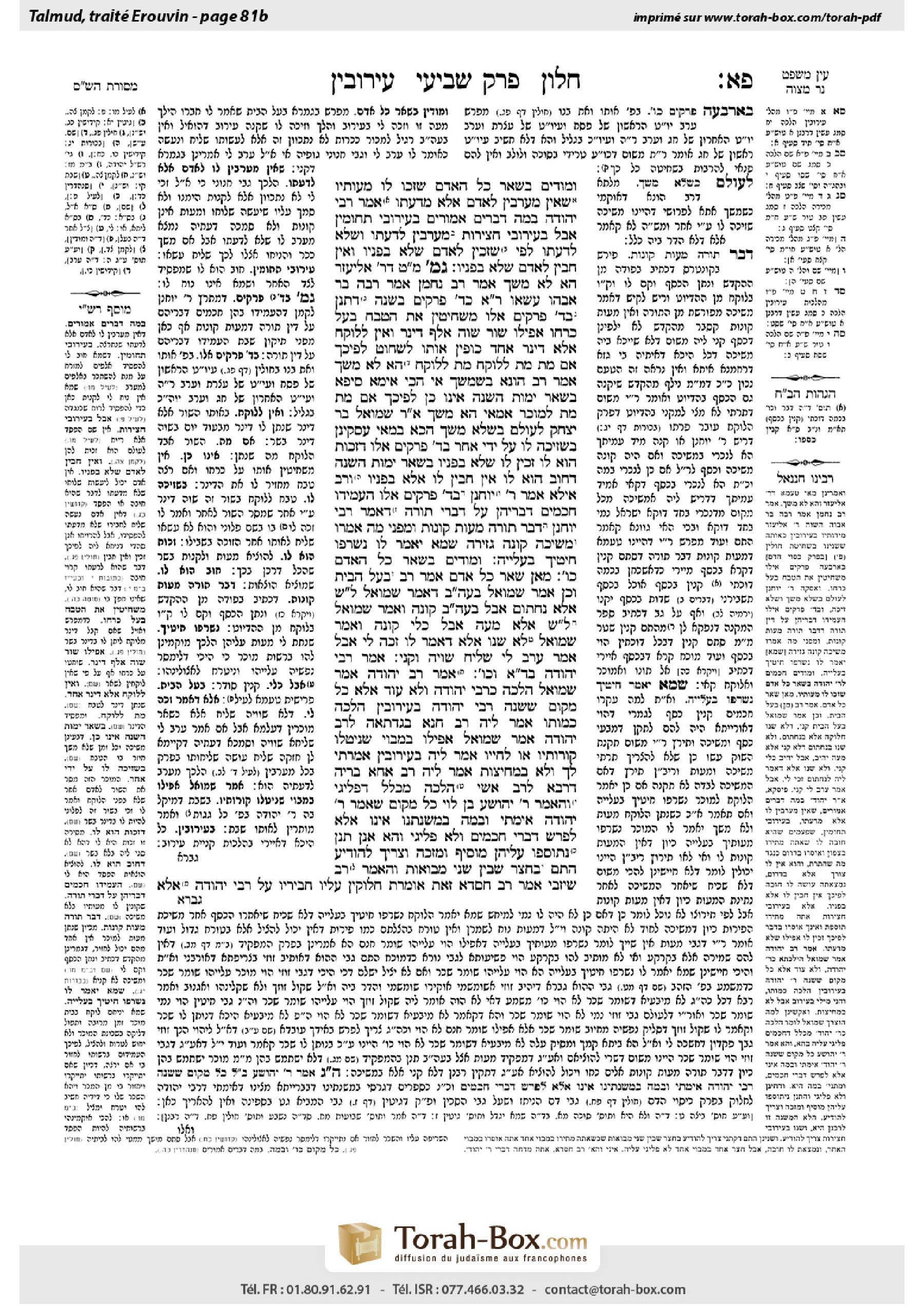
This page of Eruvin includes the Aramaic text, an English translation and an AI-generated French translation, alongside the scan above.
עירובין פ״א ב · Aramaic and Hebrew text
וּמוֹדִים בִּשְׁאָר כׇּל הָאָדָם, שֶׁזָּכוּ לוֹ מְעוֹתָיו. שֶׁאֵין מְעָרְבִין לָאָדָם אֶלָּא מִדַּעְתּוֹ.
אָמַר רַבִּי יְהוּדָה: בַּמֶּה דְּבָרִים אֲמוּרִים בְּעֵירוּבֵי תְחוּמִין, אֲבָל בְּעֵירוּבֵי חֲצֵירוֹת — מְעָרְבִין לְדַעְתּוֹ וְשֶׁלֹּא לְדַעְתּוֹ, לְפִי שֶׁזָּכִין לָאָדָם שֶׁלֹּא בְּפָנָיו, וְאֵין חָבִין לָאָדָם שֶׁלֹּא בְּפָנָיו.
גְּמָ׳ מַאי טַעְמָא דְּרַבִּי אֱלִיעֶזֶר? הָא לֹא מָשַׁךְ!
אָמַר רַב נַחְמָן אָמַר רַבָּה בַּר אֲבָהוּ: עֲשָׂאוֹ רַבִּי אֱלִיעֶזֶר כְּאַרְבָּעָה פְּרָקִים בַּשָּׁנָה, דִּתְנַן: בְּאַרְבָּעָה פְּרָקִים אֵלּוּ מַשְׁחִיטִין אֶת הַטַּבָּח בְּעַל כׇּרְחוֹ. אֲפִילּוּ שׁוֹר שָׁוֶה אֶלֶף דִּינָר וְאֵין לַלּוֹקֵחַ אֶלָּא דִּינָר אֶחָד — כּוֹפִין אוֹתוֹ לִשְׁחוֹט.
לְפִיכָךְ אִם מֵת, מֵת לַלּוֹקֵחַ. מֵת לַלּוֹקֵחַ? הָא לֹא מָשַׁךְ! אָמַר רַב הוּנָא: בְּשֶׁמָּשַׁךְ.
אִי הָכִי, אֵימָא סֵיפָא: בִּשְׁאָר יְמוֹת הַשָּׁנָה אֵינוֹ כֵּן. לְפִיכָךְ אִם מֵת, מֵת לַמּוֹכֵר. אַמַּאי? הָא מָשַׁךְ!
אָמַר רַבִּי שְׁמוּאֵל בַּר יִצְחָק: לְעוֹלָם בְּשֶׁלֹּא מָשַׁךְ, הָכָא בְּמַאי עָסְקִינַן בְּשֶׁזִּיכָּה לוֹ עַל יְדֵי אַחֵר.
בְּאַרְבָּעָה פְּרָקִים אֵלּוּ דִּזְכוּת הוּא לוֹ — זָכִין לוֹ שֶׁלֹּא בְּפָנָיו. בִּשְׁאָר יְמוֹת הַשָּׁנָה, דְּחוֹב הוּא לוֹ — אֵין חָבִין לוֹ אֶלָּא בְּפָנָיו.
וְרַב אִילָא אָמַר רַבִּי יוֹחָנָן: בְּאַרְבָּעָה פְּרָקִים אֵלּוּ הֶעֱמִידוּ חֲכָמִים דִּבְרֵיהֶן עַל דִּבְרֵי תוֹרָה. דְּאָמַר רַבִּי יוֹחָנָן: דְּבַר תּוֹרָה, מָעוֹת קוֹנוֹת.
וּמִפְּנֵי מָה אָמְרוּ מְשִׁיכָה קוֹנָה — גְּזֵירָה שֶׁמָּא יֹאמַר לוֹ: נִשְׂרְפוּ חִיטֶּיךָ בָּעֲלִיָּיה.
וּמוֹדִים בִּשְׁאָר כׇּל הָאָדָם כּוּ׳. מַאן שְׁאָר כׇּל אָדָם? אָמַר רַב: בַּעַל הַבַּיִת.
וְכֵן אָמַר שְׁמוּאֵל: בַּעַל הַבַּיִת. דְּאָמַר שְׁמוּאֵל: לֹא שָׁנוּ אֶלָּא נַחְתּוֹם, אֲבָל בַּעַל הַבַּיִת — קוֹנֶה. וְאָמַר שְׁמוּאֵל: לֹא שָׁנוּ אֶלָּא מָעָה, אֲבָל כְּלִי — קוֹנֶה.
וְאָמַר שְׁמוּאֵל: לֹא שָׁנוּ אֶלָּא דְּאָמַר לוֹ ״זְכֵה לִי״, אֲבָל אָמַר ״עָרֵב לִי״, שָׁלִיחַ שַׁוְּיֵהּ, וְקָנֵי.
אָמַר רַבִּי יְהוּדָה: בַּמֶּה דְּבָרִים אֲמוּרִים וְכוּ׳. אָמַר רַב יְהוּדָה אָמַר שְׁמוּאֵל: הֲלָכָה כְּרַבִּי יְהוּדָה, וְלֹא עוֹד אֶלָּא כׇּל מָקוֹם שֶׁשָּׁנָה רַבִּי יְהוּדָה בְּעֵירוּבִין הֲלָכָה כְּמוֹתוֹ.
אֲמַר לֵיהּ רַב חָנָא בַּגְדָּתָאָה לְרַב יְהוּדָה: אָמַר שְׁמוּאֵל אֲפִילּוּ בְּמָבוֹי שֶׁנִּיטְּלוּ קוֹרוֹתָיו אוֹ לְחָיָיו?
אֲמַר לֵיהּ: בְּעֵירוּבִין אָמַרְתִּי לְךָ, וְלֹא בִּמְחִיצוֹת.
אֲמַר לֵיהּ רַב אַחָא בְּרֵיהּ דְּרָבָא לְרַב אָשֵׁי: ״הֲלָכָה״, מִכְּלָל דִּפְלִיגִי. וְהָאָמַר רַבִּי יְהוֹשֻׁעַ בֶּן לֵוִי: כׇּל מָקוֹם שֶׁאָמַר רַבִּי יְהוּדָה ״אֵימָתַי״ וּ״בַמֶּה״ בְּמִשְׁנָתֵנוּ — אֵינוֹ אֶלָּא לְפָרֵשׁ דִּבְרֵי חֲכָמִים!
וְלָא פְּלִיגִי? וְהָא אֲנַן תְּנַן: נִתּוֹסְפוּ עֲלֵיהֶן — מוֹסִיף וּמְזַכֶּה, וְצָרִיךְ לְהוֹדִיעַ!
הָתָם בְּחָצֵר שֶׁבֵּין שְׁנֵי מְבוֹאוֹת.
וְהָאָמַר רַב שֵׁיזְבִי אָמַר רַב חִסְדָּא: זֹאת אוֹמֶרֶת חֲלוּקִין עָלָיו חֲבֵירָיו עַל רַבִּי יְהוּדָה.
אֶלָּא:
Eruvin 81b · English translation
And the Rabbis concede with regard to all other people, apart from grocers and bakers, that if one gave them money for the food of an eiruv, his money confers possession upon him, as one may establish an eiruv for a person only with his knowledge and at his bidding. With regard to a grocer or baker, the person giving the money does not intend to appoint the grocer or the baker as his agent and the money itself does not effect an acquisition, and consequently, he did not accomplish anything. With regard to anyone else, however, there is no doubt that he must have intended to appoint him his agent, and his act is effective.
Rabbi Yehuda said: In what case is this statement said? It is said with regard to a joining of Shabbat boundaries, but with regard to a joining of courtyards, one may establish an eiruv for a person either with his knowledge or without his knowledge. The reason is because one may act for a person’s benefit in his absence, but one may not act to a person’s disadvantage in his absence. As a participant in a joining of courtyards benefits from his inclusion in the eiruv, his consent is not required. However, with regard to a joining of Shabbat boundaries, although it enables one to go farther in one direction, he loses the option of traveling in the opposite direction. When an action is to a person’s disadvantage, or if it entails both benefits and disadvantages, one may act on that person’s behalf only if he has been explicitly appointed his agent.
GEMARA: The Gemara poses a question: What is the reason for Rabbi Eliezer’s opinion that one who gave money to a grocer or a baker has acquired possession of the food for the eiruv? This ruling is difficult, as he did not perform a transaction by pulling the food into his possession, and one can acquire an object only by performing a valid act of acquisition.
Rav Naḥman said that Rabba bar Abbahu said: Rabbi Eliezer established this acquisition so that it should be like the four times during the year that the payment of money effects acquisition, as we learned in a mishna: On these four times every year, on the eves of Passover, Shavuot, Rosh HaShana, and the Eighth Day of Assembly, one who paid for meat may force the butcher to slaughter an animal against his will. Even if his ox was worth a thousand dinar, and the customer has paid for only one dinar’s worth of meat, the customer may force the butcher to slaughter it, so that the buyer can receive his meat. The reason is that on these four occasions everyone buys meat, and therefore the butcher who promised to supply the customer with meat must give it to him, even if this causes the butcher a considerable loss.
Therefore, if the ox died, it died at the buyer’s expense. That is to say, he must bear the loss and is not entitled to get his dinar back. The Gemara asks: Why is this so? The customer did not pull the ox into his possession. As he did not perform an act of acquisition, he has not acquired any part of the ox, and his dinar should therefore be restored to him. Rav Huna said: We are dealing here with a case where he did pull the ox into his possession.
The Gemara raises a difficulty: If so, say the latter clause of that mishna as follows: With regard to the rest of the days of the year, it is not so. Therefore, if the animal died, it died at the seller’s expense. If, as Rav Huna claims, the mishna is referring to a case where the purchaser had already pulled the animal into his possession, why must the seller suffer the loss? Since the customer pulled it into his possession and has acquired it, the ox died in his possession.
Rabbi Shmuel bar Yitzḥak said: Actually, the mishna is referring to a case where the customer did not pull the animal into his possession. With what are we dealing here? We are dealing with a case where the butcher conferred possession upon his customer by means of another person, i.e., the butcher conferred possession upon the customer by instructing another person to acquire a dinar’s worth of the ox’s meat on his behalf, without having obtained his consent.
Consequently, at these four times, when it is for his benefit, as everyone wishes to buy meat on these days, one may act for his benefit in his absence, and the acquisition is valid. With regard to the rest of the days of the year, when it is to his disadvantage, as it obligates him in payment and he might have no interest in this purchase, one may act to his disadvantage only in his presence.
And Rav Ila said that Rabbi Yoḥanan said: At these four times, the Sages based their statement on Torah law, i.e., they ruled in accordance with Torah law. As Rabbi Yoḥanan said: By Torah law, the payment of money is an effective act of acquisition, which acquires movable property. Merchandise that is purchased with money is immediately transferred to the ownership of the buyer.
And why, then, did the Sages say that the mode of acquisition of pulling, not monetary payment, acquires movable goods? It is a decree issued by the Sages, lest the seller say to a buyer who has already paid for his merchandise: Your wheat was burned in the upper story of my house, and you have lost everything. According to Torah law, once the buyer pays, he owns the merchandise wherever it is located. As this state of affairs can lead to fraud, the Sages instituted that only an act of physical transfer of the item purchased can finalize the sale. On these four occasions, however, the Sages ordained that Torah law remains in effect. Rabbi Eliezer maintains that this enactment applies to an eiruv as well.
The mishna stated: The Rabbis concede with regard to all other people that if he gave them money for food for an eiruv, his money confers possession upon him. The Gemara asks: Who is included among all other people? Rav said: The reference is to an ordinary homeowner, not a merchant, who was asked by someone to receive possession of food for an eiruv on his behalf, by means of the money that he provided.
And likewise, Shmuel said: The reference is to an ordinary homeowner. As Shmuel said: They taught this halakha only with regard to a baker, but an ordinary homeowner may acquire the food on behalf of another person. And Shmuel also said: They taught this halakha only in a case where he gave him a ma’a, but if he gave him a utensil, he acquires the food for the eiruv by the mode of acquisition known as exchange. By handing over the utensil in exchange for the food of the eiruv, he acquires that food wherever it is located. However, one cannot perform the mode of acquisition of exchange with money.
And Shmuel further said: They taught this halakha only in a case where he said to the grocer or baker: Confer possession upon me; but if he said to him: Establish an eiruv on my behalf, he clearly intended to appoint him his agent to establish an eiruv on his behalf, and therefore the eiruv is acquired by means of his agency.
We learned in the mishna: Rabbi Yehuda said: In what case is this statement, that one may establish an eiruv only with a person’s knowledge, said? This halakha applies to a joining of Shabbat boundaries, but not a joining of courtyards. Rav Yehuda said that Shmuel said: The halakha is in accordance with the opinion of Rabbi Yehuda in this regard, and not only that, but any place where Rabbi Yehuda taught a halakha with regard to eiruvin, the halakha is in accordance with his opinion.
Rav Ḥana from Baghdad said to Rav Yehuda: Did Shmuel state this ruling even with regard to an alleyway whose cross beam or side post was removed during Shabbat? Rabbi Yehuda maintains that it is permitted to carry in this alleyway on that same Shabbat.
He said to him: I spoke to you with regard to the acquisition of eiruvin, and not with regard to partitions. The halakhot of partitions are not considered part of the halakhot of eiruvin, as they touch upon several areas of halakha, only one of which is the issue of an eiruv. With regard to partitions, the halakha is not in accordance with Rabbi Yehuda.
Rav Aḥa, son of Rava, said to Rav Ashi: As it is stated that the halakha is in accordance with Rabbi Yehuda, this proves by inference that there is a dispute concerning this issue. But didn’t Rabbi Yehoshua ben Levi say: Any place where Rabbi Yehuda says when, or in what case is this, in the Mishna, he intends only to explain the earlier statement of the Rabbis, not to disagree with them. Why, then, did Shmuel say that the halakha is in accordance with the opinion of Rabbi Yehuda, when according to Rabbi Yehoshua ben Levi he is merely clarifying the opinion of the Rabbis, and there is no dispute between them?
Before addressing this question, the Gemara expresses surprise over the claim itself: And do Rabbi Yehuda and the Sages not dispute this issue? Didn’t we learn in an earlier mishna: If new residents were added to the original residents of the alleyway, he may add to the eiruv for those residents and confer possession on them, and he must inform the new residents of their inclusion in the merging of alleyways. Apparently, this tanna maintains that one must inform them even with regard to a joining of courtyards. This ruling contradicts the opinion of Rabbi Yehuda, which proves that there is at least one Sage who does not accept his opinion.
The Gemara answers: There, the mishna is referring to a courtyard situated between two alleyways, in which case the residents of the courtyard may join a merging with whichever alleyway they prefer. As their participation in the merging involves a certain disadvantage, for perhaps the residents of the courtyard would not want to establish a merging of alleyways with one alleyway and lose out on a potential merging with the other, it is necessary to inform them.
The Gemara raises a further difficulty: Didn’t Rav Sheizvi say that Rav Ḥisda said with regard to that same mishna: That is to say that Rabbi Yehuda’s colleagues disagree with him over the need to inform the other residents about the eiruv? This statement indicates that at least some Sages hold that the matter is in dispute, and not everyone agrees with Rabbi Yehuda.
Rather, the Gemara resolves both difficulties together:
Eruvin 81b · Traduction française (IA)
Et les Sages reconnaissent que, concernant tous les autres, à l'exception des marchands de légumes et des boulangeries, si l'on donne de l'argent pour la nourriture d'un eiruv, cet argent confère la possession à celui qui a donné l'argent, car on peut établir un eiruv pour une personne uniquement avec son consentement et selon ses ordres. En ce qui concerne un marchand de légumes ou un boulanger, celui qui donne l'argent ne veut pas nécessairement désigner le marchand ou le boulanger comme son agent, et l'argent lui-même ne constitue pas une acquisition, et par conséquent, il n'a accompli rien. En ce qui concerne tout autre, cependant, il n'y a pas de doute que l'on doit considérer qu'il a voulu désigner cet autre comme son agent, et son acte est efficace.
Rabbi Yehuda a dit : Dans quel cas cette déclaration est-elle faite ? Elle est faite concernant la jonction des limites du Shabbat, mais concernant la jonction des courtyards, on peut établir un eiruv pour une personne soit avec son consentement, soit sans son consentement. La raison est que l'on peut agir en faveur d'une personne en son absence, mais l'on ne peut pas agir contre son intérêt en son absence. Comme un participant à la jonction des courtyards bénéficie de son inclusion dans l'eiruv, son consentement n'est pas requis. Cependant, concernant la jonction des limites du Shabbat, bien qu'elle permette de se déplacer plus loin dans une direction, il perd l'option de se déplacer dans l'autre direction. Lorsqu'une action est à l'avantage d'une personne, ou si elle comporte à la fois des avantages et des inconvénients, l'on peut agir en son nom uniquement s'il a été explicitement désigné comme son agent.
GUEMARA : La Guemara pose une question : Quelle est la raison de l'opinion de Rabbi Eliezer selon laquelle celui qui a donné de l'argent à un marchand de légumes ou à un boulanger a acquis la possession de la nourriture pour l'eiruv ? Cette décision est difficile, car il n'a pas accompli une transaction en tirant la nourriture dans sa possession, et l'on peut acquérir un objet uniquement en accomplissant un acte valide d'acquisition.
Rav Naḥman a dit que Rabba bar Abbahu a dit : Rabbi Eliezer a établi cette acquisition de sorte qu'elle soit comme les quatre fois par an où le paiement d'argent constitue une acquisition, comme nous l'avons appris dans une mitsna : Sur ces quatre fois chaque année, aux veilles de Pessah, de Shavuot, de Rosh HaShana et de la Chabbat, celui qui a payé pour de la viande peut forcer le boucher à sacrifier un animal contre sa volonté. Même si son bœuf valait mille dinars, et que le client a payé pour seulement un dinar de viande, le client peut forcer le boucher à le sacrifier, afin que le client puisse recevoir sa viande. La raison est que sur ces quatre occasions, tout le monde achète de la viande, et par conséquent, le boucher qui a promis de fournir de la viande au client doit la lui donner, même si cela cause au boucher une perte considérable.
Par conséquent, si le bœuf est mort, il est mort à l'expense du client. C'est-à-dire qu'il doit supporter la perte et n'est pas autorisé à récupérer son dinar. La Guemara pose une question : Pourquoi est-ce ainsi ? Le client n'a pas tiré le bœuf dans sa possession. Comme il n'a pas accompli un acte d'acquisition, il n'a pas acquis aucune partie du bœuf, et son dinar devrait donc être restitué à lui. Rav Huna a dit : Nous sommes ici dans un cas où il a tiré le bœuf dans sa possession.
La Guemara soulève une difficulté : Si c'est ainsi, disons la fin de cette mitsna ainsi : Concernant les autres jours de l'année, ce n'est pas ainsi. Par conséquent, si l'animal est mort, il est mort à l'expense du vendeur. Si, comme Rav Huna le dit, la mitsna fait référence à un cas où l'acheteur avait déjà tiré l'animal dans sa possession, pourquoi le vendeur doit-il subir la perte ? Comme l'acheteur a tiré l'animal dans sa possession et l'a acquis, le bœuf est mort en sa possession.
Rabbi Shmuel bar Yitzḥak a dit : En réalité, la mitsna fait référence à un cas où l'acheteur n'a pas tiré l'animal dans sa possession. Avec quels cas sommes-nous ici ? Nous sommes ici dans un cas où le boucher a conféré la possession à son client par le biais d'une autre personne, c'est-à-dire que le boucher a conféré la possession à son client en instruisant une autre personne d'acquérir un dinar de viande de l'animal à sa place, sans avoir obtenu son consentement.
Par conséquent, à ces quatre occasions, lorsque c'est à son avantage, comme tout le monde veut acheter de la viande à ces jours, l'on peut agir en son nom en son absence, et l'acquisition est valide. Concernant les autres jours de l'année, lorsque c'est à son désavantage, comme cela l'oblige à payer et qu'il pourrait n'avoir aucun intérêt pour cette acquisition, l'on peut agir contre son intérêt uniquement en sa présence.
Et Rav Ila a dit que Rabbi Yoḥanan a dit : À ces quatre occasions, les Sages ont fondé leur déclaration sur la loi divine, c'est-à-dire qu'ils ont rendu un jugement conformément à la loi divine. Comme Rabbi Yoḥanan a dit : Selon la loi divine, le paiement d'argent constitue un acte efficace d'acquisition, qui acquiert les biens mobiliers. Les marchandises achetées avec de l'argent sont immédiatement transférées à la propriété de l'acheteur.
Et pourquoi, alors, les Sages ont-ils dit que l'acquisition par le tirage, et non le paiement monétaire, acquiert les biens mobiliers ? C'est un décret émis par les Sages, afin que le vendeur ne dise pas à un acheteur qui a déjà payé pour ses marchandises : Votre blé a brûlé dans l'étage supérieur de ma maison, et vous avez perdu tout. Selon la loi divine, une fois que l'acheteur paie, il possède les marchandises où qu'elles soient. Comme cette situation peut mener à la fraude, les Sages ont institué que seul un acte de transfert physique de l'objet acheté peut finaliser la vente. Cependant, à ces quatre occasions, les Sages ont ordonné que la loi divine reste en vigueur. Rabbi Eliezer maintient que cet édict s'applique également à un eiruv.
La mitsva a dit : Les Sages reconnaissent concernant tous les autres que si l'on leur donne de l'argent pour la nourriture d'un eiruv, cet argent confère la possession à celui qui a donné l'argent. La Guemara pose une question : Qui est inclus parmi tous les autres ? Rav a dit : La référence est à un propriétaire ordinaire, pas un marchand, qui a été demandé par quelqu'un de recevoir la possession de la nourriture d'un eiruv à sa place, par le biais de l'argent qu'il a fourni.
Et de même, Shmuel a dit : La référence est à un propriétaire ordinaire. Comme Shmuel a dit : Ils ont enseigné cette halakha uniquement concernant un boulanger, mais un propriétaire ordinaire peut acquérir les aliments au nom d'une autre personne. Et Shmuel a aussi dit : Ils ont enseigné cette halakha uniquement dans le cas où il lui donnait un ma’a, mais si il lui donnait un ustensile, il acquiert les aliments de l'eiruv par le mode d'acquisition appelé échange. En remettant l'ustensile en échange des aliments de l'eiruv, il acquiert ces aliments là où ils se trouvent. Cependant, on ne peut pas effectuer le mode d'acquisition d'échange avec de l'argent.
Et Shmuel a dit de plus : Ils ont enseigné cette halakha uniquement dans le cas où il disait au marchand ou au boulanger : Conferme la possession à moi ; mais s'il disait à lui : Établis un eiruv à mon nom, il voulait clairement le désigner comme son agent pour établir un eiruv à son nom, et par conséquent l'eiruv est acquis par l'intermédiaire de son mandat.
Nous avons appris dans la mishna : Rabbi Yehuda a dit : Dans quel cas cette déclaration, selon laquelle l'on peut établir un eiruv uniquement avec la connaissance de la personne, est-elle dite ? Cette halakha s'applique à la jonction des limites du Shabbat, mais pas à la jonction des courtyards. Rav Yehuda a dit que Shmuel a dit : La halakha suit l'opinion de Rabbi Yehuda à ce sujet, et non seulement cela, mais tout lieu où Rabbi Yehuda a enseigné une halakha concernant les eiruvin, la halakha suit son opinion.
Rav Ḥana de Bagdad a dit à Rav Yehuda : A-t-il dit cette décision même concernant un passage dont le poteau transversal ou le montant latéral a été retiré pendant le Shabbat ? Rabbi Yehuda affirme que l'on peut transporter dans ce passage pendant ce même Shabbat.
Il a dit à lui : J'ai parlé à toi concernant l'acquisition des eiruvin, et non concernant les cloisons. Les halakhot des cloisons ne sont pas considérées comme faisant partie des halakhot des eiruvin, car elles touchent plusieurs domaines de halakha, seul l'un d'entre eux étant la question de l'eiruv. Concernant les cloisons, la halakha ne suit pas Rabbi Yehuda.
Rav Aḥa, fils de Rava, a dit à Rav Ashi : Comme il est dit que la halakha suit Rabbi Yehuda, cela prouve par déduction qu'il y a un désaccord concernant cette question. Mais n'a-t-il pas dit Rabbi Yehoshua ben Levi : Tout lieu où Rabbi Yehuda dit quand, ou dans quel cas est-ce, dans la Michna, il veut simplement expliquer l'affirmation précédente des Rabbins, et non pas contredire ceux-ci. Pourquoi, alors, Shmuel a-t-il dit que la halakha suit l'opinion de Rabbi Yehuda, alors que selon Rabbi Yehoshua ben Levi il n'explique que l'opinion des Rabbins, et qu'il n'y a pas de désaccord entre eux ?
Avant d'aborder cette question, la Guemara exprime une surprise concernant cette affirmation elle-même : Et Rabbi Yehuda et les Sages ne disputent-ils pas cette question ? N'avons-nous pas appris dans une Michna précédente : Si des nouveaux résidents ont été ajoutés aux résidents originaux du passage, il peut ajouter à l'eiruv pour ces résidents et conférer la possession à ceux-ci, et il doit informer les nouveaux résidents de leur inclusion dans la jonction des passages. Apparemment, ce tanna maintient qu'il faut les informer même concernant la jonction des courtyards. Cette décision contredit l'opinion de Rabbi Yehuda, ce qui prouve qu'il existe au moins un Sage qui ne suit pas son opinion.
La Guemara répond : Là, la Michna fait référence à un courtil situé entre deux passages, dans lequel cas les résidents du courtil peuvent joindre une jonction avec n'importe quel passage qu'ils préfèrent. Comme leur participation à la jonction implique un certain désavantage, car peut-être les résidents du courtil ne veulent pas établir une jonction de passages avec un passage et perdent ainsi une potentielle jonction avec l'autre, il est nécessaire d'informer les résidents.
La Guemara soulève une difficulté supplémentaire : N'a-t-il pas dit Rav Sheizvi que Rav Ḥisda a dit concernant cette même Michna : Cela signifie que les collègues de Rabbi Yehuda s'opposent à lui concernant la nécessité d'informer les autres résidents sur l'eiruv ? Cette déclaration indique que certains Sages maintiennent que la question est en désaccord, et que tout le monde ne suit pas Rabbi Yehuda.
Plutôt, la Guemara résout les deux difficultés de manière conjointe :
Traduction française générée par IA à partir de l’édition anglaise de Sefaria. Vérifie toujours un passage avec le texte source.
Text from Sefaria: William Davidson Edition - Vocalized Aramaic (CC BY NC); William Davidson Edition - English (CC BY NC).