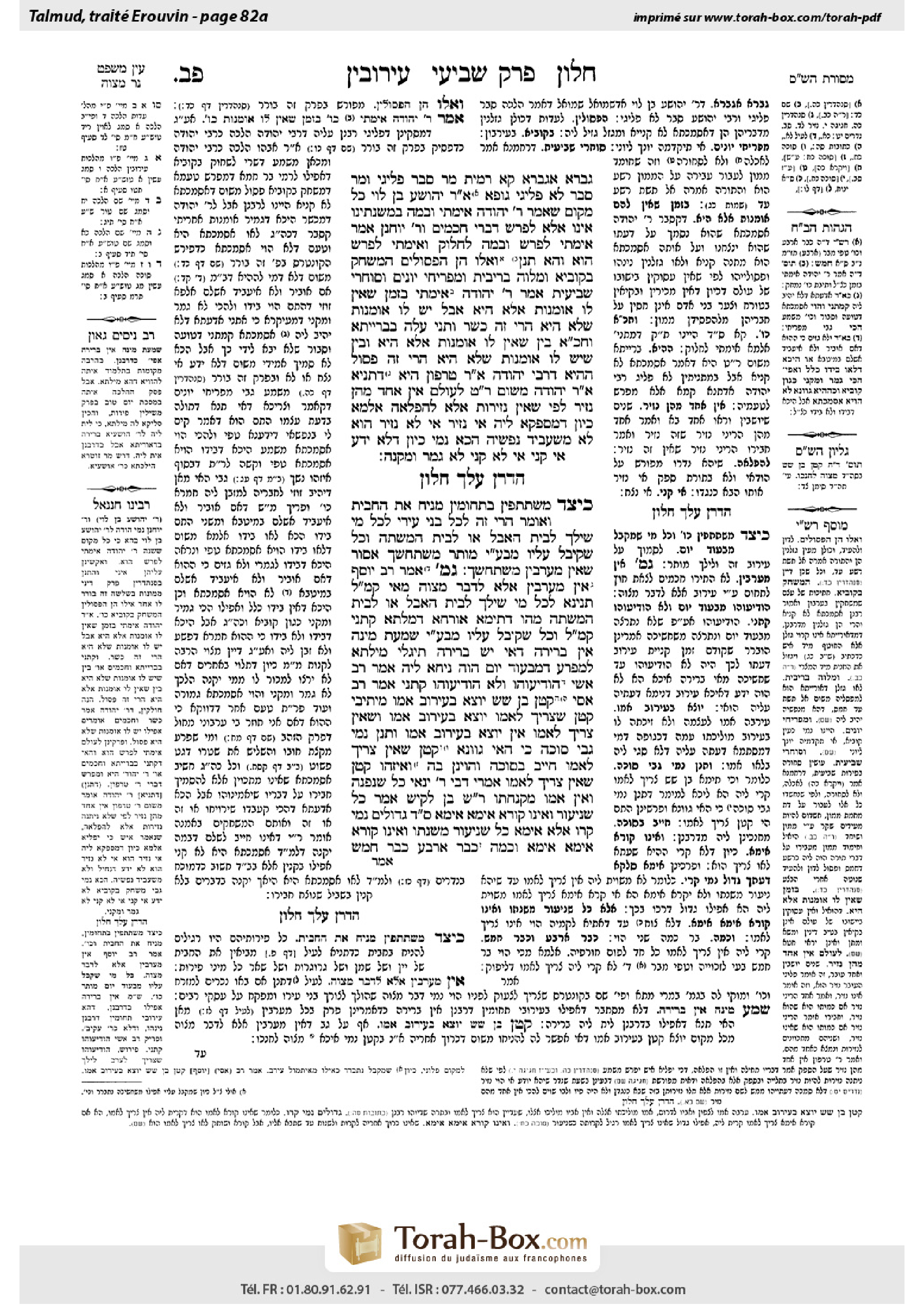
Eruvin 82a: Talmud study for Daf Yomi
Study the Talmud for Daf Yomi with scanned pages, Hebrew text, English translations from Sefaria and AI-generated French translations.
Passage selection and English or AI-generated French translation are available where the scan has annotations. Daf Study is independent of Torah-Box and Sefaria.
Browse Eruvin · עירובין · All tractatesEruvin 82a text and translations
This page of Eruvin includes the Aramaic text, an English translation and an AI-generated French translation, alongside the scan above.
עירובין פ״ב א · Aramaic and Hebrew text
גַּבְרָא אַגַּבְרָא קָא רָמֵית?! מָר סָבַר פְּלִיגִי, וּמָר סָבַר לָא פְּלִיגִי.
גּוּפָא, אָמַר רַבִּי יְהוֹשֻׁעַ בֶּן לֵוִי: כׇּל מָקוֹם שֶׁאָמַר רַבִּי יְהוּדָה ״אֵימָתַי״ וּ״בַמֶּה״ בְּמִשְׁנָתֵינוּ — אֵינוֹ אֶלָּא לְפָרֵשׁ דִּבְרֵי חֲכָמִים. וְרַבִּי יוֹחָנָן אָמַר: ״אֵימָתַי״ לְפָרֵשׁ, וּ״בַמֶּה״ לַחֲלוֹק.
וְ״אֵימָתַי״ לְפָרֵשׁ הוּא? וְהָא תְּנַן: וְאֵלּוּ הֵן הַפְּסוּלִים: הַמְשַׂחֵק בְּקוּבְיָא, וּמַלְוֶה בְּרִיבִּית, וּמַפְרִיחֵי יוֹנִים, וְסוֹחֲרֵי שְׁבִיעִית.
אָמַר רַבִּי יְהוּדָה: אֵימָתַי — בִּזְמַן שֶׁאֵין לוֹ אוּמָּנוּת אֶלָּא הִיא, אֲבָל יֵשׁ לוֹ אוּמָּנוּת שֶׁלֹּא הִיא — הֲרֵי זֶה כָּשֵׁר.
וְתָנֵי עֲלַהּ בְּבָרַיְיתָא, וַחֲכָמִים אוֹמְרִים: בֵּין שֶׁאֵין לוֹ אוּמָּנוּת אֶלָּא הִיא, וּבֵין שֶׁיֵּשׁ לוֹ אוּמָּנוּת שֶׁלֹּא הִיא — הֲרֵי זֶה פָּסוּל.
הָהִיא דְּרַבִּי יְהוּדָה אָמַר רַבִּי טַרְפוֹן הִיא.
דְּתַנְיָא, אָמַר רַבִּי יְהוּדָה מִשּׁוּם רַבִּי טַרְפוֹן: לְעוֹלָם אֵין אֶחָד מֵהֶן נָזִיר, לְפִי שֶׁאֵין נְזִירוּת אֶלָּא לְהַפְלָאָה.
אַלְמָא כֵּיוָן דִּמְסַפְּקָא לֵיהּ אִי נָזִיר אִי לָא נָזִיר הוּא — לָא מְשַׁעְבֵּיד נַפְשֵׁיהּ. הָכָא נָמֵי: כֵּיוָן דְּלָא יָדַע אִי קָנֵי אִי לָא קָנֵי — לָא גָּמַר וּמַקְנֵה.
הַדְרָן עֲלָךְ חַלּוֹן
מַתְנִי׳ כֵּיצַד מִשְׁתַּתְּפִין בִּתְחוּמִין? מַנִּיחַ אֶת הֶחָבִית, וְאוֹמֵר: הֲרֵי זֶה לְכׇל בְּנֵי עִירִי, לְכׇל מִי שֶׁיֵּלֵךְ לְבֵית הָאֵבֶל אוֹ לְבֵית הַמִּשְׁתֶּה. וְכׇל שֶׁקִּיבֵּל עָלָיו מִבְּעוֹד יוֹם — מוּתָּר, מִשֶּׁתֶּחְשַׁךְ — אָסוּר. שֶׁאֵין מְעָרְבִין מִשֶּׁתֶּחְשַׁךְ.
גְּמָ׳ אָמַר רַב יוֹסֵף: אֵין מְעָרְבִין אֶלָּא לִדְבַר מִצְוָה. מַאי קָא מַשְׁמַע לַן? תְּנֵינָא: לְכׇל מִי שֶׁיֵּלֵךְ לְבֵית הָאֵבֶל אוֹ לְבֵית הַמִּשְׁתֶּה!
מַהוּ דְּתֵימָא: אוֹרְחָא דְמִלְּתָא קָתָנֵי, קָא מַשְׁמַע לַן.
וְכֹל שֶׁקִּיבֵּל עָלָיו מִבְּעוֹד יוֹם. שָׁמְעַתְּ מִינַּהּ אֵין בְּרֵירָה, דְּאִי יֵשׁ בְּרֵירָה — תִּיגַּלֵּי מִילְּתָא לְמַפְרֵעַ דְּמִבְּעוֹד יוֹם הֲוָה נִיחָא לֵיהּ!
אָמַר רַב אָשֵׁי: ״הוֹדִיעוּהוּ״ וְ״לֹא הוֹדִיעוּהוּ״ קָתָנֵי.
אָמַר רַב אַסִּי: קָטָן בֶּן שֵׁשׁ יוֹצֵא בְּעֵירוּב אִמּוֹ. מֵיתִיבִי: קָטָן שֶׁצָּרִיךְ לְאִמּוֹ — יוֹצֵא בְּעֵירוּב אִמּוֹ, וְשֶׁאֵין צָרִיךְ לְאִמּוֹ — אֵין יוֹצֵא בְּעֵירוּב אִמּוֹ.
וּתְנַן נָמֵי גַּבֵּי סוּכָּה כִּי הַאי גַוְונָא: קָטָן שֶׁאֵין צָרִיךְ לְאִמּוֹ — חַיָּיב בְּסוּכָּה.
וְהָוֵינַן בַּהּ: וְאֵיזֶהוּ קָטָן שֶׁאֵין צָרִיךְ לְאִמּוֹ? אָמְרִי דְּבֵי רַבִּי יַנַּאי: כׇּל שֶׁנִּפְנֶה וְאֵין אִמּוֹ מְקַנַּחְתּוֹ.
רַבִּי שִׁמְעוֹן בֶּן לָקִישׁ אָמַר: כׇּל שֶׁנֵּיעוֹר וְאֵינוֹ קוֹרֵא ״אִימָּא״. ״אִימָּא״ סָלְקָא דַּעְתָּךְ? גְּדוֹלִים, נָמֵי קָרוּ. אֶלָּא אֵימָא: כָּל שֶׁנֵּיעוֹר מִשְּׁנָתוֹ וְאֵינוֹ קוֹרֵא ״אִימָּא, אִימָּא״.
וְכַמָּה? כְּבַר אַרְבַּע, כְּבַר חָמֵשׁ.
Eruvin 82a · English translation
Are you raising a contradiction between the opinion of one person and that of another? In other words, a difficulty cannot be raised from the statement of one amora against those of another. One Sage, Shmuel, maintains that Rabbi Yehuda and the Sages disagree, and one other Sage, Rabbi Yehoshua ben Levi, maintains that they do not disagree.
The Gemara analyzes the statement of Rabbi Yehoshua ben Levi cited in the course of the previous discussion. With regard to the matter itself: Rabbi Yehoshua ben Levi said that any place where Rabbi Yehuda says when, or in what case are these, in the Mishna, he intends only to explain the earlier statement of the Rabbis, not to disagree with them. And Rabbi Yoḥanan said: The term when indicates that Rabbi Yehuda comes to explain, but the phrase in what case is this, indicates that he intends to disagree.
The Gemara raises a difficulty: Is the word when invariably a sign that Rabbi Yehuda merely seeks to explain? Didn’t we learn in a mishna: The following people are disqualified by the Sages from giving testimony, as they are people who commit transgressions for profit: One who plays with dice [kubiyya] for money, and one who lends money at interest, and those who fly pigeons, i.e., people who arrange competitions between pigeons while placing wagers on which bird will fly faster. The reason for their disqualification is that those who play games of chance do not fully relinquish ownership of their gambling money, as they expect to win their bet. Consequently, one who accepts money in such circumstances has effectively taken something that the giver has not wholeheartedly handed over, and he is therefore like a robber, at least by rabbinic decree. The list of those disqualified from giving testimony includes merchants who trade in the produce of the Sabbatical Year, which may be eaten but may not be sold as an object of commerce.
Rabbi Yehuda said: When is this so? When he has no occupation other than this one, but if he has a worthy occupation other than this, although he also earns money by these means, this person is qualified to give testimony. Rabbi Yehuda maintains that one who earns money by means of games of chance is not a criminal or a robber. Rather, the reason why these people are disqualified from giving testimony is because they are not occupied in the constructive development of the world. As they earn their money without effort, they do not care about the monetary losses of others. Consequently, if they have any other occupation, they are valid witnesses.
The Gemara resumes its difficulty: According to the above principle with regard to statements introduced with the term when, Rabbi Yehuda’s statement should be understood merely as an explanation of the previous opinion. However, a baraita was taught about the mishna: And the Rabbis say: Whether he has no occupation other than this one, or whether he has a fitting occupation other than this, this person is disqualified from giving testimony. Apparently, Rabbi Yehuda is disagreeing rather than explaining, even though he introduced his statement with the term when.
The Gemara answers: That opinion in the baraita, with regard to those disqualified from providing testimony, is not the opinion of the Rabbis of the mishna. Rather, it is that of Rabbi Yehuda, who maintained that Rabbi Tarfon said this opinion. The Rabbis of the mishna, however, agree with Rabbi Yehuda in this regard, and his statement serves to explain their position.
As it was taught in a baraita with regard to naziriteship: Rabbi Yehuda said in the name of Rabbi Tarfon: In a case where two people accepted a bet, with each undertaking to become a nazirite if he lost the wager, and a doubt arose as to who won, neither one of them can possibly be a nazirite, as there is no acceptance of naziriteship without clear and definitive pronunciation. A vow of naziriteship is only binding if it was expressly pronounced, i.e., if it was clear from the outset that the person intended to become a nazirite.
Consequently, it can be inferred that since he is in doubt as to whether he is a nazirite or he is not a nazirite, he does not submit himself to and accept his vow of naziriteship. Here, too, Rabbi Yehuda disqualifies those who play games of chance from delivering testimony due to the fact that they are robbers. Since the player does not know whether he will win and acquire the money or whether he will lose and not acquire it, he does not fully transfer ownership of the money with which he plays to others, which means that the one who gains from these games receives money that was not wholeheartedly given to him. He is therefore likened to a robber, at least on the rabbinic level, which disqualifies him from giving testimony.
MISHNA: How does one participate in the joining of Shabbat boundaries? One who wishes to establish a joining of Shabbat boundaries for himself and others places a barrel of food in the location he designates as their place of residence, and says: This is for all the residents of my town, for anyone who wishes to go on Shabbat to a house of mourning or to a house of a wedding feast situated beyond the Shabbat limit. Anyone who accepted upon himself while it was still day, i.e., before the onset of Shabbat, that he will rely on the eiruv, is permitted to rely upon it; but if one did so only after nightfall, he is prohibited to rely upon it, as the principle is that one may not establish an eiruv after nightfall.
GEMARA: Rav Yosef said: One may establish a joining of Shabbat boundaries only for the purpose of a mitzva, i.e., to enable the fulfillment of a religious obligation, but not for an optional activity. The Gemara asks: What novel element is he teaching us by this? We explicitly learned this idea in the mishna from the phrase: For anyone who wishes to go on Shabbat to a house of mourning or to a house of a wedding feast. This mishna indicates that an eiruv may be established only for the purpose of a mitzva, e.g., in order to comfort mourners or to celebrate a wedding, but not for any other reason.
The Gemara answers: This teaching is necessary, lest you say that the mishna merely teaches the usual case. Generally, a group of people would establish an eiruv in order to walk beyond the Shabbat limit only for a special purpose, such as a wedding, but one might be permitted to establish an eiruv even for an optional activity as well. Rav Yosef therefore teaches us that an eiruv may indeed be established only for the purpose of a mitzva.
We learned in the mishna: Anyone who accepted upon himself while it was still day that he will rely upon the eiruv is permitted to rely upon it on Shabbat. The Gemara comments: Apparently, learn from here that there is no halakhic principle of retroactive clarification. That is to say, there is no halakhic assumption that an uncertain state of affairs can be retroactively clarified. A later statement or action cannot retroactively clarify one’s earlier intentions as though he had explicitly stated those intentions at the outset. For if there is a halakhic principle of retroactive clarification, the eiruv should be effective even if one relied upon it only after nightfall, as it is retroactively revealed that he wanted the eiruv while it was still day.
Rav Ashi said that the mishna teaches: While it was still day. This phrase does not require one to make the decision to rely on the eiruv before Shabbat. Rather, the criterion for using the eiruv on Shabbat is whether they informed him or they did not inform him of the existence of the eiruv prior to Shabbat. In other words, if one knew about the eiruv while it was still day, he may rely on it, even if he decided to use it only after the onset of Shabbat, as the halakhic principle of retroactive clarification is accepted. However, if one was unaware of the existence of the eiruv when it came into effect at the onset of Shabbat, the matter cannot be retroactively clarified.
Rav Asi said: A six-year-old child may go out by means of his mother’s eiruv. As he is subordinate to her, he is included in her eiruv and does not require his own eiruv. The Gemara raises an objection from a baraita: A child who needs his mother may go out by means of his mother’s eiruv, but one who does not need his mother may not go out by means of his mother’s eiruv.
And we also learned a similar halakha in a mishna with regard to a sukka: A child who does not need his mother is obligated in the mitzva of sukka by rabbinical law, so that he will be trained in the observance of mitzvot.
And we discussed this mishna and raised a question: But who is the child who does not need his mother? The Sages of the school of Rabbi Yannai said: This is referring to any child who defecates and his mother does not wipe him. A child who can clean himself is considered sufficiently mature for the purposes of the halakha of sukka.
Rabbi Shimon ben Lakish said: Any child who wakens from sleep and does not call: Mother, is obligated in the mitzva of sukka. The Gemara expresses surprise at this statement: Can it enter your mind that every child who cries: Mother is considered to be one who needs his mother? Much older children also call out to their mothers for assistance when they awaken. Rather, say that the halakha includes any child who wakens from sleep and does not persistently call: Mother, Mother. A minor who arises only when his mother comes is classified as one who needs his mother.
The Gemara continues. The Sages who discussed the mishna asked: And at what age is a child no longer considered to be in need of his mother? Such a child is one about four years old or about five years old, as some children become independent of their mothers earlier than others. This poses a difficulty to the opinion of Rav Asi, who maintains that even a six-year-old child is considered to be in need of his mother, and may go out by means of his mother’s eiruv.
Eruvin 82a · Traduction française (IA)
Élevez-vous une contradiction entre l'opinion d'une personne et celle d'une autre ? Autrement dit, une difficulté ne peut être soulevée contre l'avis d'un amora par rapport à ceux d'un autre. Un sage, Shmuel, affirme que Rabbi Yehuda et les Sages sont en désaccord, et un autre sage, Rabbi Yehoshua ben Levi, affirme qu'ils ne sont pas en désaccord.
La Guemara analyse l'assertion de Rabbi Yehoshua ben Levi citée lors de la discussion précédente. En ce qui concerne la question elle-même : Rabbi Yehoshua ben Levi a dit que tout lieu où Rabbi Yehuda dit « quand » ou « dans quel cas » dans la Michna, il n'entend que commenter l'affirmation précédente des Rabbins, pas s'opposer à eux. Et Rabbi Yoḥanan a dit : Le terme « quand » indique que Rabbi Yehuda vient commenter, mais la phrase « dans quel cas est-ce », indique qu'il entend s'opposer.
La Guemara soulève une difficulté : Le mot « quand » indique-t-il toujours que Rabbi Yehuda cherche simplement à expliquer ? N'avons-nous pas appris dans une Michna : Les personnes suivantes sont disqualifiées par les Sages pour témoigner, car elles commettent des transgressions pour le profit : celui qui joue aux dés [kubiyya] pour de l'argent, et celui qui prête de l'argent à intérêt, et ceux qui font voler des pigeons, c'est-à-dire des personnes qui organisent des compétitions entre des pigeons tout en pariant sur lequel volera le plus vite. La raison de leur disqualification est que ceux qui jouent aux jeux de hasard ne renoncent pas entièrement à la propriété de leur argent de jeu, car ils attendent de gagner leur pari. Ainsi, celui qui accepte de l'argent dans de tels cas a effectivement pris quelque chose que le donneur n'a pas entièrement remis, et il est donc comme un voleur, au moins selon la déclaration rabbinique. La liste des personnes disqualifiées pour témoigner inclut les marchands qui commercent dans les produits de l'année sabbatique, qui peuvent être mangés mais ne peuvent pas être vendus comme objet de commerce.
Rabbi Yehuda a dit : Quand cela est-il le cas ? Quand il n'a pas d'occupation autre que celle-ci, mais s'il a une occupation digne autre que celle-ci, même s'il gagne de l'argent par ces moyens, cette personne est qualifiée pour témoigner. Rabbi Yehuda maintient que celui qui gagne de l'argent par des jeux de hasard n'est pas un criminel ou un voleur. Plutôt, la raison pour laquelle ces personnes sont disqualifiées pour témoigner est qu'elles ne sont pas occupées dans le développement constructif du monde. Comme elles gagnent leur argent sans effort, elles ne s'occupent pas des pertes financières des autres. Ainsi, si elles ont une autre occupation, elles sont des témoins valides.
La Guemara reprend sa difficulté : Selon le principe mentionné ci-dessus concernant les déclarations introduites par le terme « quand », la déclaration de Rabbi Yehuda devrait être entendue uniquement comme une explication de l'opinion précédente. Cependant, une baraïta a été enseignée sur la Michna : Et les Rabbins disent : Qu'il n'ait pas d'occupation autre que celle-ci, ou qu'il ait une occupation digne autre que celle-ci, cette personne est disqualifiée pour témoigner. Apparemment, Rabbi Yehuda s'oppose plutôt qu'il explique, même s'il a introduit sa déclaration avec le terme « quand ».
La Guemara répond : Cette opinion dans la baraïta, concernant ceux disqualifiés pour témoigner, n'est pas celle des Rabbins de la Michna. Plutôt, c'est celle de Rabbi Yehuda, qui affirmait que Rabbi Tarfon avait dit cette opinion. Les Rabbins de la Michna, cependant, sont d'accord avec Rabbi Yehuda à ce sujet, et sa déclaration sert à expliquer leur position.
Comme il a été enseigné dans une baraïta concernant la nazirité : Rabbi Yehuda a dit en nom de Rabbi Tarfon : Dans un cas où deux personnes ont accepté un pari, chacune s'engageant à devenir un nazirite si elle perd le pari, et un doute s'est produit sur qui a gagné, ni l'un ni l'autre ne peut être un nazirite, car il n'y a pas d'acceptation de nazirité sans déclaration claire et définitive. Une promesse de nazirité est seulement engageante si elle a été explicitement prononcée, c'est-à-dire si c'était clair dès le départ que la personne avait l'intention de devenir un nazirite.
Par conséquent, on peut en déduire que puisqu'il y a un doute sur le fait qu'il soit un nazirite ou non, il ne se soumet pas et ne s'engage pas à sa promesse de nazirité. Ici aussi, Rabbi Yehuda disqualifie ceux qui jouent aux jeux de hasard pour témoigner en raison du fait qu'ils sont des voleurs. Puisque le joueur ne sait pas s'il gagnera et obtiendra l'argent ou s'il perdra et ne l'obtiendra pas, il ne transfère pas entièrement la propriété de l'argent avec lequel il joue à d'autres, ce qui signifie que celui qui gagne de ces jeux reçoit de l'argent qui n'a pas été entièrement remis à lui. Il est donc comparé à un voleur, au moins au niveau rabbinique, ce qui disqualifie son témoignage.
MICHNA : Comment participer à l'établissement des limites de Shabbat ? Celui qui souhaite établir une connexion des limites de Shabbat pour lui-même et pour les autres place un tonneau de nourriture à l'endroit qu'il désigne comme leur lieu de résidence, et dit : Cela est pour tous les habitants de ma ville, pour quiconque souhaite aller le samedi à une maison de deuil ou à une maison de fête nuptiale située au-delà de la limite de Shabbat. Tout celui qui s'est engagé, pendant qu'il était encore jour, c'est-à-dire avant le début de Shabbat, à dépendre de l'eiruv, est autorisé à dépendre de celui-ci ; mais si l'on a fait cela seulement après le coucher du soleil, il est interdit de dépendre de celui-ci, car le principe est que l'on ne peut pas établir un eiruv après le coucher du soleil.
GUEMARA : Rav Yosef a dit : On peut établir une connexion des limites de Shabbat uniquement à la fin d'une mitsva, c'est-à-dire pour permettre la réalisation d'une obligation religieuse, mais pas pour une activité facultative. La Guemara demande : Quel élément nouveau enseigne-t-il par ce fait ? Nous avons explicitement appris cette idée de la Michna du terme : Pour quiconque souhaite aller le samedi à une maison de deuil ou à une maison de fête nuptiale. Cette Michna indique que l'eiruv peut être établi uniquement à la fin d'une mitsva, c'est-à-dire pour accompagner les veuves ou célébrer un mariage, mais pas pour toute autre raison.
Le Guemara répond : Cet enseignement est nécessaire, afin que vous ne disiez pas que la mitsna enseigne simplement le cas ordinaire. Généralement, un groupe de personnes établirait un eiruv afin de marcher au-delà de la limite du Shabbat uniquement pour une raison particulière, telle qu’un mariage, mais on pourrait être autorisé à établir un eiruv même pour une activité facultative. Rav Yosef nous apprend donc que l’eiruv peut effectivement être établi uniquement à l’effet d’une mitsva.
Nous avons appris dans la mitsna : Quiconque s’est engagé pendant qu’il faisait encore jour à se reposer sur l’eiruv est autorisé à se reposer sur celui-ci le Shabbat. Le Guemara commente : Apparemment, on peut en tirer la conclusion que le halakha ne reconnaît pas le principe de clarification rétrospective. Cela signifie qu’il n’y a pas d’hypothèse halakhique selon laquelle un état incertain peut être clarifié rétrospectivement. Une déclaration ou une action ultérieure ne peut pas clarifier rétrospectivement les intentions antérieures comme si l’on avait explicitement déclaré ces intentions dès le début. Car si le halakha reconnaissait un tel principe, l’eiruv serait efficace même si l’on s’y était référé uniquement après le coucher du soleil, car il serait rétrospectivement clair que l’on voulait l’eiruv pendant qu’il faisait encore jour.
Rav Ashi a dit que la mitsna enseigne : Pendant qu’il faisait encore jour. Cette phrase ne nécessite pas que l’on prenne la décision de se reposer sur l’eiruv avant le Shabbat. Plutôt, le critère pour utiliser l’eiruv le Shabbat est de savoir si l’on a été informé ou non de l’existence de l’eiruv avant le Shabbat. En d’autres termes, si l’on savait de l’eiruv pendant qu’il faisait encore jour, l’on peut se reposer sur celui-ci, même s’il a décidé de l’utiliser uniquement après le début du Shabbat, car le principe de clarification rétrospective est accepté. Cependant, si l’on était inconscient de l’existence de l’eiruv lorsqu’il est entré en vigueur au début du Shabbat, la question ne peut pas être clarifiée rétrospectivement.
Rav Asi a dit : Un enfant de six ans peut sortir grâce à l’eiruv de sa mère. Comme il est soumis à elle, il est inclus dans son eiruv et n’a pas besoin d’un eiruv propre. Le Guemara soulève une objection tirée d’une baraïta : Un enfant qui a besoin de sa mère peut sortir grâce à l’eiruv de sa mère, mais celui qui n’a pas besoin de sa mère ne peut pas sortir grâce à l’eiruv de sa mère.
Et nous avons également appris une halakha similaire dans une mitsna concernant un sukka : Un enfant qui n’a pas besoin de sa mère est tenu de la mitsva de sukka selon la loi rabbinique, afin qu’il soit formé à l’observance des mitsvot.
Et nous avons discuté de cette mitsna et avons soulevé une question : Mais qui est l’enfant qui n’a pas besoin de sa mère ? Les Sages de l’école de Rabbi Yannai ont dit : Il s’agit de tout enfant qui défèque et dont la mère ne le nettoie pas. Un enfant qui peut se nettoyer lui-même est considéré comme suffisamment mûr pour les besoins de la halakha du sukka.
Rabbi Shimon ben Lakish a dit : Tout enfant qui se réveille du sommeil sans appeler : Mère, est tenu de la mitsva du sukka. Le Guemara exprime une surprise à l’égard de cette déclaration : Pourriez-vous penser que chaque enfant qui crie : Mère est considéré comme celui qui a besoin de sa mère ? Les enfants plus âgés appellent également à leur mère lorsqu’ils se réveillent. Plutôt, dites que la halakha inclut tout enfant qui se réveille du sommeil sans appeler constamment : Mère, Mère. Un mineur qui se lève seulement lorsque sa mère arrive est classé comme celui qui a besoin de sa mère.
Le Guemara continue. Les Sages qui ont discuté de la mitsna ont demandé : À quel âge un enfant n’est plus considéré comme ayant besoin de sa mère ? Un tel enfant est celui qui a quatre ou cinq ans, car certains enfants deviennent indépendants de leurs mères plus tôt que d’autres. Cela pose un problème pour l’opinion de Rav Asi, qui maintient que même un enfant de six ans est considéré comme ayant besoin de sa mère et peut sortir grâce à l’eiruv de sa mère.
Traduction française générée par IA à partir de l’édition anglaise de Sefaria. Vérifie toujours un passage avec le texte source.
Text from Sefaria: William Davidson Edition - Vocalized Aramaic (CC BY NC); William Davidson Edition - English (CC BY NC).