Eruvin 82b: Talmud study for Daf Yomi
Study the Talmud for Daf Yomi with scanned pages, Hebrew text, English translations from Sefaria and AI-generated French translations.
Passage selection and English or AI-generated French translation are available where the scan has annotations. Daf Study is independent of Torah-Box and Sefaria.
Browse Eruvin · עירובין · All tractatesEruvin 82b text and translations
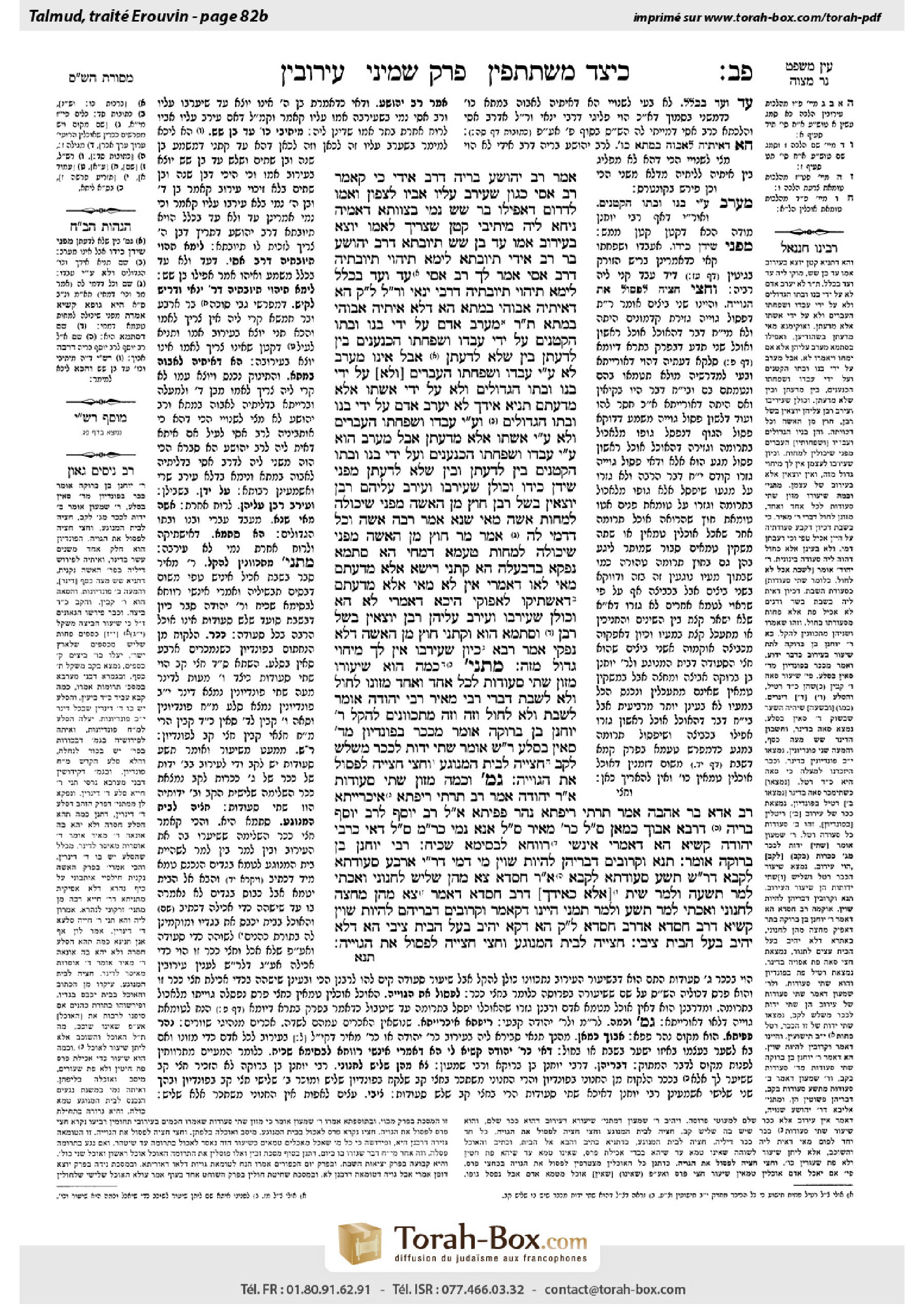
This page of Eruvin includes the Aramaic text, an English translation and an AI-generated French translation, alongside the scan above.
עירובין פ״ב ב · Aramaic and Hebrew text
אָמַר רַב יְהוֹשֻׁעַ בְּרֵיהּ דְּרַב אִידִי: כִּי קָאָמַר רַב אַסִּי — כְּגוֹן שֶׁעֵירַב עָלָיו אָבִיו לַצָּפוֹן וְאִמּוֹ לַדָּרוֹם, דַּאֲפִילּוּ בַּר שֵׁשׁ נָמֵי בְּצַוְותָּא דְאִמֵּיהּ נִיחָא לֵיהּ.
מֵיתִיבִי: קָטָן שֶׁצָּרִיךְ לְאִמּוֹ יוֹצֵא בְּעֵירוּב אִמּוֹ — עַד בֶּן שֵׁשׁ. תְּיוּבְתָּא דְּרַב יְהוֹשֻׁעַ בַּר רַב אִידִי תְּיוּבְתָּא.
לֵימָא תֶּיהְוֵי תְּיוּבְתֵּיהּ דְּרַב אַסִּי! אָמַר לְךָ רַב אַסִּי: ״עַד״, וְעַד בַּכְּלָל.
לֵימָא תֶּיהְוֵי תְּיוּבְתֵּיהּ דְּרַבִּי יַנַּאי וְרֵישׁ לָקִישׁ! לָא קַשְׁיָא, הָא — דְּאִיתֵיהּ אֲבוּהִי בְּמָתָא, הָא — דְּלָא אִיתֵיהּ אֲבוּהִי בְּמָתָא.
תָּנוּ רַבָּנַן: מְעָרֵב אָדָם עַל יְדֵי בְּנוֹ וּבִתּוֹ הַקְּטַנִּים, עַל יְדֵי עַבְדּוֹ וְשִׁפְחָתוֹ הַכְּנַעֲנִים, בֵּין לְדַעְתָּן בֵּין שֶׁלֹּא לְדַעְתָּן. אֲבָל אֵינוֹ מְעָרֵב לֹא עַל יְדֵי עַבְדּוֹ וְשִׁפְחָתוֹ הָעִבְרִים, [וְלֹא] עַל יְדֵי בְּנוֹ וּבִתּוֹ הַגְּדוֹלִים, וְלֹא עַל יְדֵי אִשְׁתּוֹ אֶלָּא מִדַּעְתָּם.
תַּנְיָא אִידַּךְ: לֹא יְעָרֵב אָדָם עַל יְדֵי בְּנוֹ וּבִתּוֹ הַגְּדוֹלִים, וְעַל יְדֵי עַבְדּוֹ וְשִׁפְחָתוֹ הָעִבְרִים, וְלֹא עַל יְדֵי אִשְׁתּוֹ אֶלָּא מִדַּעְתָּן. אֲבָל מְעָרֵב הוּא עַל יְדֵי עַבְדּוֹ וְשִׁפְחָתוֹ הַכְּנַעֲנִים, וְעַל יְדֵי בְּנוֹ וּבִתּוֹ הַקְּטַנִּים, בֵּין לְדַעְתָּן וּבֵין שֶׁלֹּא לְדַעְתָּן — מִפְּנֵי שֶׁיָּדָן כְּיָדוֹ.
וְכוּלָּן שֶׁעֵירְבוּ וְעֵירַב עֲלֵיהֶם רַבָּן — יוֹצְאִין בְּשֶׁל רַבָּן, חוּץ מִן הָאִשָּׁה, מִפְּנֵי שֶׁיְּכוֹלָה לִמְחוֹת.
אִשָּׁה מַאי שְׁנָא? אָמַר רַבָּה: אִשָּׁה וְכׇל דְּדָמֵי לַהּ.
אָמַר מָר: חוּץ מִן הָאִשָּׁה, מִפְּנֵי שֶׁיְּכוֹלָה לִמְחוֹת. טַעְמָא דְּמַחַי, הָא סְתָמָא — נָפְקָא בִּדְבַעְלַהּ. הָא קָתָנֵי רֵישָׁא ״אֶלָּא מִדַּעְתָּם״. מַאי לָאו, דְּאָמְרִי: ״אִין״!
לָא: מַאי ״אֶלָּא מִדַּעְתָּם״ — דְּאִשְׁתִּיקוּ. לְאַפּוֹקֵי הֵיכָא דְּאָמְרִי: ״לָא״.
הָא: וְכוּלָּן שֶׁעֵירְבוּ וְעֵירַב עֲלֵיהֶן רַבָּן — יוֹצְאִין בְּשֶׁל רַבָּן, וּסְתָמָא הוּא, וְקָתָנֵי: חוּץ מִן הָאִשָּׁה דְּלָא נָפְקִי!
אָמַר רָבָא: כֵּיוָן שֶׁעֵירְבוּ, אֵין לְךָ מִיחוּי גָּדוֹל מִזֶּה.
מַתְנִי׳ כַּמָּה הוּא שִׁיעוּרוֹ? מְזוֹן שְׁתֵּי סְעוּדוֹת לְכׇל אֶחָד וְאֶחָד. מְזוֹנוֹ לַחוֹל וְלֹא לַשַּׁבָּת, דִּבְרֵי רַבִּי מֵאִיר. רַבִּי יְהוּדָה אוֹמֵר: לַשַּׁבָּת וְלֹא לַחוֹל, וְזֶה וָזֶה מִתְכַּוְּונִים לְהָקֵל.
רַבִּי יוֹחָנָן בֶּן בְּרוֹקָה אוֹמֵר: מִכִּכָּר בְּפוּנְדְּיוֹן, מֵאַרְבַּע סְאִין בְּסֶלַע. רַבִּי שִׁמְעוֹן אוֹמֵר: שְׁתֵּי יָדוֹת לַכִּכָּר מִשָּׁלֹשׁ לַקַּב.
חֶצְיָיהּ, לַבַּיִת הַמְנוּגָּע. וַחֲצִי חֶצְיָיהּ, לִפְסוֹל אֶת הַגְּוִיָּיה.
גְּמָ׳ וְכַמָּה מְזוֹן שְׁתֵּי סְעוּדוֹת? אָמַר רַב יְהוּדָה אָמַר רַב: תַּרְתֵּי רִיפָתָא אִיכָּרְיָיתָא. רַב אַדָּא בַּר אַהֲבָה אָמַר: תַּרְתֵּי רִיפָתָא נְהַר פַּפָּיָתָא.
אֲמַר לֵיהּ רַב יוֹסֵף לְרַב יוֹסֵף בְּרֵיהּ דְּרָבָא: אֲבוּךְ כְּמַאן סְבִירָא לֵיהּ? כְּרַבִּי מֵאִיר סְבִירָא לֵיהּ. אֲנָא נָמֵי כְּרַבִּי מֵאִיר סְבִירָא לֵיהּ. דְּאִי כְּרַבִּי יְהוּדָה, קַשְׁיָא הָא דְּאָמְרִי אִינָשֵׁי: רַוְוחָא לִבְסִימָא שְׁכִיחַ.
רַבִּי יוֹחָנָן בֶּן בְּרוֹקָה אוֹמֵר. תָּנָא: וּקְרוֹבִים דִּבְרֵיהֶן לִהְיוֹת שָׁוִין. מִי דָּמֵי?! דְּרַבִּי יוֹחָנָן אַרְבַּע סְעוֹדָתָא לְקַבָּא, דְּרַבִּי שִׁמְעוֹן תֵּשַׁע סְעוֹדָתָא לְקַבָּא!
אָמַר רַב חִסְדָּא: צֵא מֵהֶן שְׁלִישׁ לַחֶנְוָנִי.
וְאַכַּתִּי לְמָר תִּשְׁעָה. וּלְמָר שֵׁית!
[אֶלָּא כְּאִידַּךְ] דְּרַב חִסְדָּא, דְּאָמַר: צֵא מֵהֶן מֶחֱצָה לַחֶנְוָנִי.
וְאַכַּתִּי: לְמָר תֵּשַׁע, וּלְמָר תַּמְנֵי! — הַיְינוּ דְּקָאָמַר ״וּקְרוֹבִים דִּבְרֵיהֶם לִהְיוֹת שָׁוִין״.
קַשְׁיָא דְּרַב חִסְדָּא אַדְּרַב חִסְדָּא! לָא קַשְׁיָא, הָא — דְּקָא יָהֵיב בַּעַל הַבַּיִת צִיבֵי. הָא — דְּלָא יָהֵיב בַּעַל הַבַּיִת צִיבֵי.
חֶצְיָיהּ לַבַּיִת הַמְנוּגָּע, וַחֲצִי חֶצְיָיהּ לִפְסוֹל אֶת הַגְּוִיָּיה.
Eruvin 82b · English translation
Rav Yehoshua, son of Rav Idi, said in answer: When Rav Asi said that this child may go out by means of his mother’s eiruv, he was referring to a case where his father established an eiruv on his behalf to the north, and his mother prepared an eiruv on his behalf to the south, as even a six-year-old prefers the company of his mother to that of his father. However, Rav Asi agrees that if they did not both establish an eiruv for him he is not subordinate to his mother.
The Gemara raises an objection from a baraita: A child who needs his mother may go out by means of his mother’s eiruv that she established for herself. Until what age may he do so? He can be up to the age of six. This baraita is a conclusive refutation of the opinion of Rav Yehoshua bar Rav Idi, who maintains that a six-year-old may go out by means of his mother’s eiruv only if she established an eiruv on his behalf as well? The Gemara concludes: This is indeed a conclusive refutation.
The Gemara comments: Let us say that this is also a refutation of the opinion of Rav Asi, as here it states: Until the age of six, which indicates that he can be up to, but not including, six years old, whereas Rav Asi maintains that even a six-year-old is included in this halakha. The Gemara states: Rav Asi can say to you that when the baraita states: Up to the age of six, it means up to and including six years old.
The Gemara comments: Let us say that this is also a refutation of the opinion of Rabbi Yannai and Reish Lakish, who maintain that a child in need of his mother is one who is up to age four or five. The Gemara explains: This is not difficult. Here Rabbi Yannai and Reish Lakish are referring to a situation when the child’s father is in town. As the child can go out with his father, he is no longer in need of his mother, even though he is younger than six. In contrast, there the baraita is referring to a case when his father is not in town. The child therefore needs his mother until he reaches the age of six.
Our Sages taught in a baraita: A person may establish an eiruv on behalf of his minor son or daughter, and on behalf of his Canaanite servant or maidservant, either with their knowledge or without their knowledge. However, he may not establish an eiruv, neither on behalf of his Hebrew servant or maidservant, nor on behalf of his adult son or daughter, nor on behalf of his wife, except with their knowledge.
It was taught in another baraita: A person may establish an eiruv on behalf of his adult son or daughter, and on behalf of his Hebrew servant or maidservant, and on behalf of his wife, only with their knowledge. However, he may establish an eiruv on behalf of his Canaanite servant or maidservant, and on behalf of his minor son or daughter, either with their knowledge or without their knowledge, as their hand is like his hand, i.e., their status and the domain in which they are located are determined by his status and domain.
And all of these who established an eiruv for themselves, and at the same time their master established an eiruv for them in a different direction, they may go out by means of their master’s eiruv, except for a wife, because she can object by saying that she does not want her husband’s eiruv.
The Gemara begins its analysis of the baraitot by posing a question: A wife, in what way is she different from an adult son or daughter? Why can’t they object? They are also of age and under their own authority. Rabba said: The reference is not only to a wife; the tanna is speaking of a wife and all who are similar to her in this regard, such as a Hebrew servant or an adult son.
The Master said in the baraita: These people may go out by means of their master’s eiruv, except for a wife, because she can object. The Gemara infers: The reason is due to the fact that she objected, but if he established an eiruv and she did not specify her feelings about it one way or another, she may go out by means of her husband’s eiruv. The Gemara raises an objection: Doesn’t the first clause of the baraita state that he may establish an eiruv only with their knowledge? What, is this not referring to a case where he asked them whether or not they want this eiruv, and they said yes? It can be inferred from here that if his wife did not say anything, she may not use the eiruv.
The Gemara rejects this argument: No; what is the meaning of the phrase: Only with their knowledge? It means that they were silent and said nothing in protest. This comes to exclude a case where they said no. If, however, they did not object, they may go out by means of the eiruv of the head of the family.
The Gemara raises an objection: Wasn’t it taught in that same baraita: And with regard to all of these who established an eiruv for themselves, and their master established an eiruv for them in a different direction, they may go out by means of their master’s eiruv. And that is referring to a situation when they did not specify their feelings, as it does not state that they objected, and yet the baraita states: Except for a wife, who may not go out by means of her husband’s eiruv. The baraita clearly indicates that even if she did not object, the husband’s eiruv is ineffective for his wife.
Rava said: Since they established an eiruv in a different direction, you have no protest greater than this. They need not register any other objection, as their actions prove that they do not wish to be part of their master’s eiruv.
MISHNA: What is the measure for a joining of Shabbat boundaries? It consists of a quantity of food sufficient for two meals for each and every one of those included in the eiruv. The tanna’im disagree with regard to the size of these two meals. It is referring to one’s food that he eats on a weekday and not on Shabbat; this is the statement of Rabbi Meir. Rabbi Yehuda says: It is referring to the amount he eats on Shabbat and not on a weekday. And both this Sage, Rabbi Meir, and that Sage, Rabbi Yehuda, intended to be lenient, as Rabbi Meir maintains that people eat more food on Shabbat, whereas Rabbi Yehuda believes that they consume more on a weekday.
Rabbi Yoḥanan ben Beroka says: Food for two meals is the size of a loaf bought with a pundeyon, which is one-forty-eighth of a sela, when four se’a of wheat are sold for a sela. Rabbi Shimon says: Food for two meals is two of three parts of a loaf, when three loaves are prepared from a kav of wheat. In other words, the measure is two-thirds of a loaf the size of one-third of a kav.
Having discussed measures with regard to a loaf of bread, the mishna states that half of this loaf is the amount called a half [peras], a measure relevant for the halakhot of a leprous house. If one enters a house afflicted with leprosy and remains there long enough to eat this amount of food, the clothes he is wearing become ritually impure. And half of its half, a quarter of this loaf, is the amount of ritually impure food that disqualifies the body. In other words, impure food of this amount imparts ritual impurity to the body of the eater, and disqualifies him by rabbinic law from eating teruma.
GEMARA: The Gemara asks: And how much is food for two meals according to the measures of Rabbi Yehuda and Rabbi Meir? Rav Yehuda said that Rav said: Two farmers’ [ikaryata] loaves of bread. Rav Adda bar Ahava said: Two standard loaves of bread baked in the region of the Pappa River.
Rav Yosef said to Rav Yosef, son of Rava: Your father, in accordance with whose opinion does he hold, that of Rabbi Yehuda or Rabbi Meir? He replied: He holds in accordance with the opinion of Rabbi Meir. Rav Yosef added: I too agree with the ruling of Rabbi Meir, because if the halakha is in accordance with Rabbi Yehuda, a difficulty would arise from the popular saying: There is always room for sweets. It is generally accepted that one dining on delicacies eats more, and therefore, the amount of food in Shabbat meals is greater than that of weekdays, as they include more sweet foods.
We learned in the mishna that Rabbi Yoḥanan ben Beroka says that one measure is the amount of food for two meals, while Rabbi Shimon established a different amount. A Sage taught in the Tosefta: And their statements are close to being identical. The Gemara expresses surprise at this: Are they really identical? According to the opinion of Rabbi Yoḥanan there are four meals to a kav. He maintains that food for two meals is equivalent to a loaf that can be purchased with a pundeyon, which is one-forty-eighth of a sela, when four se’a are bought for a sela. As there are twenty-four kav in four se’a, a loaf purchased with a pundeyon is half of a kav. This means that each meal is a quarter of a kav, or that there are four meals in a kav. In contrast, according to the opinion of Rabbi Shimon, there are nine meals to a kav. Rabbi Shimon maintains that food for two meals is two-thirds of a loaf equal in size to one-third of a kav. By this calculation, one meal is one-third of a loaf that itself is one-third of a kav in size, which amounts to nine meals in a kav.
Rav Ḥisda said in explanation of Rabbi Yoḥanan ben Beroka’s opinion: Deduct one-third for the grocer’s markup, as he takes one-third as profit. This adds one half to the total cost.
The Gemara asks: Even after allowing for this adjustment, it remains the case that according to this Sage, Rabbi Shimon, there are nine meals to a kav, whereas according to the other Sage, Rabbi Yoḥanan, although it suffices for more than four meals, there are only six meals to a kav. According to the measure of Rabbi Yoḥanan ben Beroka, each meal is two-thirds of a quarter kav, i.e., one sixth of a kav, which still leaves a considerable discrepancy between their measures.
Rather, we must explain in accordance with that other statement of Rav Ḥisda, as he said: Deduct one half for the grocer’s markup. If the calculation is based on the assumption that the grocer takes half the sum as profit, the two measures are indeed close.
The Gemara asks: But it remains the case that according to this Sage, there are nine meals to a kav, whereas according to the other Sage, there are only eight meals to a kav, as each meal is one half of a quarter kav, or one-eighth of a kav. The Gemara answers: This is the meaning of that which was stated in the Tosefta: And their rulings are close to being identical. Although their measures are not exactly the same, there is no great difference between them.
The Gemara comments: Nonetheless, there is a contradiction between one statement of Rav Ḥisda and the other statement of Rav Ḥisda concerning the size of the grocer’s profit. The Gemara answers: This is not difficult, as in this case, the homeowner provides the wood for baking bread, and the grocer therefore marks up the price by one-third as compensation for his efforts. Whereas in that case, the homeowner does not provide the wood; the grocer is entitled to reimbursement for the cost of the wood in addition to the work of baking, and consequently he marks up the price by one half.
We learned in the mishna that the time it takes to eat half the loaf is the time it takes for the clothes of one who entered a leprous house to become ritually impure, and half of its half, of the loaf, is the amount of ritually impure food that disqualifies the body from eating teruma.
Eruvin 82b · Traduction française (IA)
Rav Yéhoshua, fils de Rav Idi, répondit ainsi : Lorsque Rav Asi affirmait que ce petit enfant peut sortir grâce à l'eiruv de sa mère, il faisait référence à un cas où son père avait établi un eiruv à son intention vers le nord, et sa mère avait préparé un eiruv à son intention vers le sud, car même un enfant de six ans préfère la compagnie de sa mère à celle de son père. Cependant, Rav Asi admet que si ni l'un ni l'autre n'avaient établi un eiruv à son intention, il n'est pas soumis à la volonté de sa mère.
Le Guemara soulève un contre-argument tiré d'une baraïta : Un enfant qui a besoin de sa mère peut sortir grâce à l'eiruv qu'elle a établi pour elle-même. Jusqu'à quel âge peut-il le faire ? Il peut être jusqu'à l'âge de six ans. Cette baraïta constitue une réfutation définitive de l'opinion de Rav Yéhoshua bar Rav Idi, qui maintient que l'enfant de six ans peut sortir grâce à l'eiruv de sa mère uniquement si elle a établi un eiruv à son intention. Le Guemara conclut : C'est effectivement une réfutation définitive.
Le Guemara commente : Disons que cela constitue également une réfutation de l'opinion de Rav Asi, car ici il est dit : Jusqu'à l'âge de six ans, ce qui indique qu'il peut être jusqu'à six ans, mais pas avant. Rav Asi peut répondre que lorsque la baraïta dit : Jusqu'à l'âge de six ans, cela signifie jusqu'à six ans inclus.
Le Guemara commente : Disons que cela constitue également une réfutation de l'opinion de Rabbi Yannai et de Reish Lakish, qui affirment qu'un enfant qui a besoin de sa mère est celui qui n'a pas encore atteint l'âge de quatre ou cinq ans. Le Guemara explique : Ce n'est pas difficile. Ici, Rabbi Yannai et Reish Lakish parlent d'une situation où le père de l'enfant est en ville. Comme l'enfant peut sortir avec son père, il n'a plus besoin de sa mère, même s'il est plus jeune que six ans. À l'inverse, la baraïta parle d'un cas où le père n'est pas en ville. L'enfant a donc besoin de sa mère jusqu'à l'âge de six ans.
Nos Sages enseignèrent dans une baraïta : Une personne peut établir un eiruv à l'intention de son fils ou de sa fille mineure, ainsi que de son serviteur cananéen ou de sa servante, soit avec leur consentement, soit sans. Cependant, il ne peut pas établir un eiruv à l'intention de son serviteur hébreu ou de sa servante, ni à l'intention de son fils ou de sa fille adulte, ni à l'intention de sa femme, sans leur consentement.
Il fut également enseigné dans une autre baraïta : Une personne peut établir un eiruv à l'intention de son fils ou de sa fille adulte, ainsi que de son serviteur hébreu ou de sa servante, et à l'intention de sa femme, uniquement avec leur consentement. Cependant, il peut établir un eiruv à l'intention de son serviteur cananéen ou de sa servante, ainsi que de son fils ou de sa fille mineure, soit avec leur consentement, soit sans, car leur statut et le domaine dans lequel ils se trouvent sont déterminés par son statut et son domaine.
Et tous ceux qui ont établi un eiruv pour eux-mêmes, et en même temps leur maître a établi un eiruv pour eux dans une autre direction, ils peuvent sortir grâce à l'eiruv de leur maître, sauf pour la femme, car elle peut protester en disant qu'elle ne veut pas l'eiruv de son mari.
Le Guemara commence son analyse des baraitot en posant une question : La femme, dans quel sens est-elle différente d'un fils ou d'une fille adulte ? Pourquoi ne peuvent-ils pas protester ? Ils sont également majeurs et sous leur propre autorité. Rabba dit : La référence n'est pas seulement à la femme ; le tanna parle de la femme et de tous ceux qui sont semblables à elle dans ce sens, comme un serviteur hébreu ou un fils adulte.
Le Maître dit dans la baraïta : Ces personnes peuvent sortir grâce à l'eiruv de leur maître, sauf pour la femme, car elle peut protester. Le Guemara en déduit : La raison est que elle a protesté, mais si l'homme a établi un eiruv et qu'elle n'a pas exprimé son avis, elle peut sortir grâce à l'eiruv de son mari. Le Guemara soulève un contre-argument : N'est-ce pas dit dans la première partie de la baraïta que l'eiruv peut être établi uniquement avec leur consentement ? Qu'est-ce que cela signifie, que cela ne fait référence qu'aux cas où il a demandé s'ils souhaitaient cet eiruv et qu'ils ont dit oui ? On peut en déduire ici que si sa femme n'a pas dit quelque chose, elle ne peut pas utiliser l'eiruv.
Le Guemara rejette cet argument : Non ; que signifie la phrase : Seulement avec leur connaissance ? Cela signifie qu'ils étaient silencieux et n'ont pas protesté. Cela vise à exclure le cas où ils ont dit non. Si, cependant, ils n'ont pas protesté, ils peuvent sortir grâce à l'eiruv du chef de famille.
Le Guemara soulève un contre-argument : N'était-ce pas enseigné dans la même baraïta : Et concernant tous ceux qui ont établi un eiruv pour eux-mêmes, et leur maître a établi un eiruv pour eux dans une autre direction, ils peuvent sortir grâce à l'eiruv de leur maître. Et cela fait référence à un cas où ils n'ont pas exprimé leur avis, car il n'est pas dit qu'ils ont protesté, et pourtant la baraïta dit : Sauf pour la femme, qui ne peut pas sortir grâce à l'eiruv de son mari. La baraïta indique clairement que même si elle n'a pas protesté, l'eiruv de son mari est inefficace pour sa femme.
Rava dit : Puisque l'eiruv a été établi dans une autre direction, vous n'avez pas de protestation plus forte que celle-ci. Ils n'ont pas besoin d'exprimer une autre objection, car leurs actions montrent qu'ils ne souhaitent pas être inclus dans l'eiruv de leur maître.
MISHNE : Quelle est la mesure d’un mélange de limites de Shabbat ? Il s’agit d’une quantité de nourriture suffisante pour deux repas pour chacun de ceux qui participent à l’eiruv. Les tannaïm s’entendent sur la taille de ces deux repas. Il s’agit de la nourriture que l’on mange durant la semaine et non le Shabbat ; c’est la déclaration du Rabbi Meir. Le Rabbi Yéhuda dit : Il s’agit de la quantité que l’on mange le Shabbat et non durant la semaine. Et les deux Sages, le Rabbi Meir et le Rabbi Yéhuda, souhaitaient être indulgents, car le Rabbi Meir affirme que les gens mangent plus de nourriture le Shabbat, tandis que le Rabbi Yéhuda pense qu’ils en consomment davantage durant la semaine.
Le Rabbi Yochanan ben Beroka dit : La nourriture pour deux repas est la taille d’un pain acheté avec un pundeyon, qui est un quatre-vingt-dix-huitième d’un sela, lorsque quatre se’a de blé sont vendus pour un sela. Le Rabbi Shimon dit : La nourriture pour deux repas est deux tiers d’un pain, lorsque trois pains sont préparés à partir d’un kav de blé. En d'autres termes, la mesure est deux tiers d’un pain dont la taille est un tiers d’un kav.
Ayant discuté des mesures concernant un pain, la mishna indique que la moitié de ce pain est la quantité appelée un demi [peras], une mesure pertinente pour les halakhot d’une maison souffrant de tzara’at. Si l’on entre dans une maison souffrant de tzara’at et y reste suffisamment longtemps pour manger cette quantité de nourriture, les vêtements qu’on porte deviennent impurs. Et la moitié de cette moitié, c’est-à-dire un quart de ce pain, est la quantité de nourriture impure qui disqualifie le corps. En d'autres termes, une nourriture impure de cette quantité transmet l’impureté rituelle au corps du mangeur, et le disqualifie, selon la loi rabbinique, de manger la terouma.
GUEMARA : La Guemara pose la question : Et combien est la nourriture pour deux repas selon les mesures du Rabbi Yéhuda et du Rabbi Meir ? Rav Yéhuda dit que Rav a dit : Deux pains de fermiers [ikaryata]. Rav Adda ben Ahava dit : Deux pains standards cuits dans la région du fleuve Pappa.
Rav Yosef a dit à Rav Yosef, fils de Rava : Votre père, selon quel avis tient-il compte, celui du Rabbi Yéhuda ou celui du Rabbi Meir ? Il a répondu : Il tient compte de l’avis du Rabbi Meir. Rav Yosef a ajouté : Je suis d’accord également avec la décision du Rabbi Meir, car si la halakha suit l’avis du Rabbi Yéhuda, une difficulté se présenterait à partir de la parole populaire : Il y a toujours de la place pour les sucreries. Il est généralement admis que celui qui mange des délices mange davantage, et donc la quantité de nourriture des repas du Shabbat est supérieure à celle des jours de semaine, car elle inclut davantage de sucreries.
Nous avons appris dans la mishna que le Rabbi Yochanan ben Beroka dit que la mesure est la quantité de nourriture pour deux repas, tandis que le Rabbi Shimon établit une mesure différente. Un Sage a enseigné dans la Tosefta : Et leurs déclarations sont proches d’être identiques. La Guemara exprime son étonnement à ce sujet : Sont-ils vraiment identiques ? Selon l’avis du Rabbi Yochanan, il y a quatre repas dans un kav. Il affirme que la nourriture pour deux repas est équivalente à un pain pouvant être acheté avec un pundeyon, qui est un quatre-vingt-dix-huitième d’un sela, lorsque quatre se’a sont achetés pour un sela. Comme il y a vingt-quatre kav dans quatre se’a, un pain acheté avec un pundeyon est la moitié d’un kav. Cela signifie que chaque repas est un quart d’un kav, ou que quatre repas sont dans un kav. En revanche, selon l’avis du Rabbi Shimon, il y a neuf repas dans un kav. Le Rabbi Shimon affirme que la nourriture pour deux repas est deux tiers d’un pain dont la taille est un tiers d’un kav. Selon ce calcul, un repas est un tiers d’un pain dont la taille est un tiers d’un kav, ce qui équivaut à neuf repas dans un kav.
Rav Hisda expliquait l’opinion du Rabbi Yochanan ben Beroka en disant : Réduisez un tiers pour la marge du marchand, car il prend un tiers comme profit. Cela ajoute la moitié au coût total.
La Guemara pose la question : Même après cet ajustement, il reste le cas que selon ce Sage, le Rabbi Shimon, il y a neuf repas dans un kav, tandis que selon l’autre Sage, le Rabbi Yochanan, bien qu’il suffise pour plus de quatre repas, il n’y a que six repas dans un kav. Selon la mesure du Rabbi Yochanan ben Beroka, chaque repas est deux tiers d’un quart de kav, c’est-à-dire un sixième de kav, ce qui laisse encore une grande différence entre leurs mesures.
Plutôt, nous devons expliquer selon l’autre déclaration de Rav Hisda, car il a dit : Réduisez la moitié pour la marge du marchand. Si le calcul est basé sur l’hypothèse que le marchand prend la moitié de la somme comme profit, les deux mesures sont effectivement proches.
La Guemara pose la question : Mais il reste le cas que selon ce Sage, il y a neuf repas dans un kav, tandis que selon l’autre Sage, il n’y a que huit repas dans un kav, car chaque repas est la moitié d’un quart de kav, soit un huitième de kav. La Guemara répond : C’est la signification de ce qui a été dit dans la Tosefta : Et leurs décisions sont proches d’être identiques. Bien que leurs mesures ne soient pas exactement les mêmes, il n’y a pas de grande différence entre elles.
La Guemara commente : Néanmoins, il y a une contradiction entre l’une des déclarations de Rav Hisda et l’autre concernant la taille de la marge du marchand. La Guemara répond : Cela n’est pas difficile, car dans ce cas, le propriétaire fournit le bois pour cuire le pain, et le marchand marque donc le prix d’un tiers en compensation de ses efforts. En revanche, dans ce cas, le propriétaire ne fournit pas le bois ; le marchand est dû une rémunération pour le coût du bois en plus du travail de cuisson, et il marque donc le prix d’une moitié.
Nous avons appris dans la mishna que le temps nécessaire pour manger la moitié du pain est le temps nécessaire pour que les vêtements d’une personne entrant dans une maison souffrant de tzara’at deviennent impurs, et la moitié de cette moitié, c’est-à-dire un huitième du pain, est la quantité de nourriture impure qui disqualifie le corps de manger la terouma.
Traduction française générée par IA à partir de l’édition anglaise de Sefaria. Vérifie toujours un passage avec le texte source.
Text from Sefaria: William Davidson Edition - Vocalized Aramaic (CC BY NC); William Davidson Edition - English (CC BY NC).