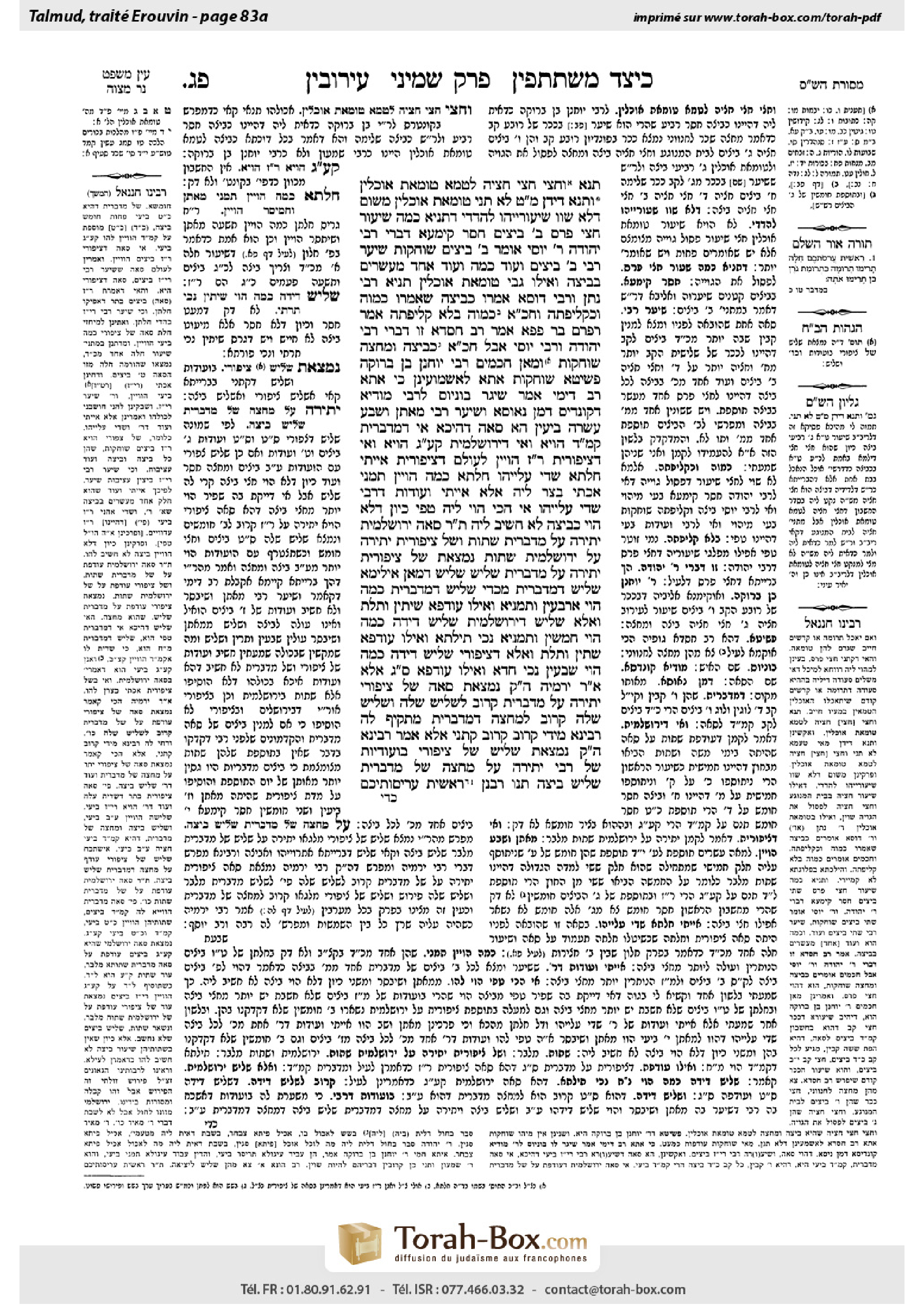
Eruvin 83a: Talmud study for Daf Yomi
Study the Talmud for Daf Yomi with scanned pages, Hebrew text, English translations from Sefaria and AI-generated French translations.
Passage selection and English or AI-generated French translation are available where the scan has annotations. Daf Study is independent of Torah-Box and Sefaria.
Browse Eruvin · עירובין · All tractatesEruvin 83a text and translations
This page of Eruvin includes the Aramaic text, an English translation and an AI-generated French translation, alongside the scan above.
עירובין פ״ג א · Aramaic and Hebrew text
תָּנָא: וַחֲצִי חֲצִי חֶצְיָהּ לְטַמֵּא טוּמְאַת אוֹכָלִין. וְתַנָּא דִּידַן מַאי טַעְמָא לָא תָּנֵי טוּמְאַת אוֹכָלִין? מִשּׁוּם דְּלָא שָׁווּ שִׁיעוּרַיְיהוּ לַהֲדָדֵי.
דְּתַנְיָא: כַּמָּה שִׁיעוּר חֲצִי פְרָס? שְׁתֵּי בֵיצִים חָסֵר קִימְעָא, דִּבְרֵי רַבִּי יְהוּדָה. רַבִּי יוֹסֵי אוֹמֵר: שְׁתֵּי בֵיצִים שׂוֹחֲקוֹת. שִׁיעֵר רַבִּי, שְׁתֵּי בֵיצִים וָעוֹד. כַּמָּה וָעוֹד? אֶחָד מֵעֶשְׂרִים בַּבֵּיצָה.
וְאִילּוּ גַּבֵּי טוּמְאַת אוֹכָלִין תַּנְיָא: רַבִּי נָתָן וְרַבִּי דּוֹסָא אָמְרוּ: כְּבֵיצָה שֶׁאָמְרוּ כָּמוֹהָ וְכִקְלִיפָּתָהּ, וַחֲכָמִים אוֹמְרִים: כָּמוֹהָ בְּלֹא קְלִיפָּתָהּ.
אָמַר רַפְרָם בַּר פָּפָּא אָמַר רַב חִסְדָּא: זוֹ דִּבְרֵי רַבִּי יְהוּדָה וְרַבִּי יוֹסֵי. אֲבָל חֲכָמִים אוֹמְרִים: כְּבֵיצָה וּמֶחֱצָה שׂוֹחֲקוֹת. וּמַאן חֲכָמִים — רַבִּי יוֹחָנָן בֶּן בְּרוֹקָה.
פְּשִׁיטָא! שׂוֹחֲקוֹת אֲתָא לְאַשְׁמוֹעִינַן.
כִּי אֲתָא רַב דִּימִי, אָמַר: שִׁיגֵּר בּוֹנְיוֹס לְרַבִּי מוֹדְיָא דְקוֹנְדֵּיס דְּמִן נְאוּסָא, וְשִׁיעֵר רַבִּי מָאתַן וּשְׁבַע עֶשְׂרֵה בֵּיעִין.
הָא סְאָה דְּהֵיכָא? אִי דְּמִדְבָּרִית, מֵאָה אַרְבָּעִים וְאַרְבַּע הָוְיָא!
וְאִי דִּירוּשַׁלְמִית, מֵאָה שִׁבְעִים וְשָׁלֹשׁ הָוְיָא!
וְאִי דְּצִיפּוֹרִית, מָאתַיִם וְשֶׁבַע הָוְיָין!
לְעוֹלָם דְּצִיפּוֹרִית, אַיְיתִי חַלְּתָא שְׁדִי עֲלַיְיהוּ.
חַלְּתָא כַּמָּה הָוְיָין? תַּמְנֵי, אַכַּתִּי בָּצַר לֵיהּ!
אֶלָּא אַיְיתִי וְעוֹדוֹת דְּרַבִּי שְׁדִי עֲלַיְיהוּ.
אִי הָכִי, הָוֵי לֵיהּ טְפֵי! כֵּיוָן דְּלָא הָוֵי כְּבֵיצָה, לָא חָשֵׁיב לֵיהּ.
תָּנוּ רַבָּנַן סְאָה יְרוּשַׁלְמִית יְתֵירָה עַל מִדְבָּרִית שְׁתוּת. וְשֶׁל צִיפּוֹרִית יְתֵירָה עַל יְרוּשַׁלְמִית שְׁתוּת. נִמְצֵאת שֶׁל צִיפּוֹרִית יְתֵירָה עַל מִדְבָּרִית שְׁלִישׁ.
שְׁלִישׁ דְּמַאן? אִילֵּימָא שְׁלִישׁ דְּמִדְבָּרִית, מִכְּדִי שְׁלִישׁ דְּמִדְבָּרִית כַּמָּה הָוֵי — אַרְבְּעִין וּתְמָנְיָא, וְאִילּוּ עוּדְפָּא, שִׁיתִּין וּתְלָת.
וְאֶלָּא שְׁלִישׁ דִּירוּשַׁלְמִית: שְׁלִישׁ דִּידַהּ כַּמָּה הָוֵי — חַמְשִׁין וּתְמָנְיָא נְכֵי תִּילְתָּא, וְאִילּוּ עוּדְפָּא, שִׁתִּין וּתְלָת. וְאֶלָּא דְּצִיפּוֹרִי: שְׁלִישׁ דִּידַהּ כַּמָּה הָוֵי — שִׁבְעִין נְכֵי חֲדָא, וְאִילּוּ עוּדְפָּא, שִׁשִּׁים וְשָׁלֹשׁ.
אֶלָּא אָמַר רַבִּי יִרְמְיָה, הָכִי קָאָמַר: נִמְצֵאת סְאָה שֶׁל צִיפּוֹרִי יְתֵירָה עַל מִדְבָּרִית קָרוֹב לִשְׁלִישׁ שֶׁלָּהּ. וּשְׁלִישׁ שֶׁלָּהּ קָרוֹב לְמֶחֱצָה דְּמִדְבָּרִית.
מַתְקֵיף לַהּ רָבִינָא: מִידֵּי ״קָרוֹב״ ״קָרוֹב״ קָתָנֵי? אֶלָּא אָמַר רָבִינָא, הָכִי קָאָמַר: נִמְצֵאת שְׁלִישׁ שֶׁל צִיפּוֹרִי בִּוְעוֹדָיוֹת שֶׁל רַבִּי יְתֵירָה עַל מֶחֱצָה שֶׁל מִדְבָּרִית שְׁלִישׁ בֵּיצָה.
תָּנוּ רַבָּנַן: ״רֵאשִׁית עֲרִיסוֹתֵיכֶם״,
Eruvin 83a · English translation
A Sage taught in the Tosefta: And half of one half of its half, one-eighth of this loaf, is the minimum measure of food that contracts the ritual impurity of foods. The Gemara asks: And our tanna, in the mishna, for what reason did he did not teach the measure of the impurity of foods? The Gemara answers: He did not state this halakha because their measures are not precisely identical. The measure for the impurity of foods is not exactly half the amount of ritually impure food that disqualifies one from eating teruma.
As it was taught in a baraita: How much is half a peras? Two eggs minus a little; this is the statement of Rabbi Yehuda. Rabbi Yosei says: Two large eggs, slightly larger ones than average. Rabbi Yehuda HaNasi measured the amount of half a peras after calculating the number of kav in the se’a brought before him, and found it to be a little more than two eggs. The tanna asks: How much is this little more? One-twentieth of an egg.
In contrast, concerning the impurity of foods, it was taught in a baraita: Rabbi Natan and Rabbi Dosa said that the measure of an egg-bulk, which the Sages said is the amount that contracts the impurity of foods, is equivalent to it, i.e., the egg, and its shell. And the Rabbis say: It is equivalent to it without its shell. These amounts are not precisely half of any of the measurements given for half a peras.
As for the issue itself, Rafram bar Pappa said that Rav Ḥisda said: This baraita that clarifies the measure of half a peras is in accordance with the statements of Rabbi Yehuda and Rabbi Yosei, a measure that is identical to that of Rabbi Shimon in the mishna. But the Rabbis say: One and one half large egg-bulks. And who are these Rabbis? Rabbi Yoḥanan ben Beroka.
The Gemara registers surprise: This is obvious, as Rabbi Yoḥanan ben Beroka maintains that half a loaf is three egg-bulks, half of which is an egg-bulk and one half. The Gemara explains: The novel aspect of this teaching is not the amount itself; rather, he came to teach us that the measurement is performed with large eggs.
The Gemara relates that when Rav Dimi came from Eretz Yisrael to Babylonia, he said: A person named Bonyos sent Rabbi Yehuda HaNasi a measure [modya] of a se’a from a place called Na’usa, where they had a tradition that it was an ancient and accurate measure (Ritva). And Rabbi Yehuda HaNasi measured it and found it contained 217 eggs.
The Gemara asks: This se’a, from where is it, i.e., on what measure is it based? If it is based on the wilderness se’a, the standard measure used by Moses in the wilderness, which is the basis for all the Torah’s measurements of volume, the difficulty is that a se’a is composed of six kav, where each kav is equivalent to four log and each log is equivalent to six egg-bulks. This means that a se’a is equivalent to a total of 144 egg-bulks.
And if it is the Jerusalem se’a, then the se’a is only 173 egg-bulks, as they enlarged the measures in Jerusalem by adding a fifth to the measures of the wilderness.
And if it is a se’a of Tzippori, as the measures were once again increased in Tzippori, where another fifth was added to the Jerusalem measure, the se’a is 207 egg-bulks. The se’a measured by Rabbi Yehuda HaNasi does not correspond to any of these measures of a se’a.
The Gemara answers: Actually, this measure is based on the se’a of Tzippori, but you must bring the amount of the ḥalla given to a priest, and add it to them. That is to say, although this measure is slightly larger than a se’a, if it is used for flour and you deduct the amount due as ḥalla, you are left with exactly one se’a, or 207 egg-bulks.
The Gemara raises an objection: The amount of ḥalla, how many egg-bulks is it? Approximately eight egg-bulks, one-twenty-fourth of 207. Yet in that case, it remains less than 217 egg-bulks, for even if we were to add another eight egg-bulks for ḥalla to the 207 egg-bulks, we would have only 215 egg-bulks, almost 216 to be more precise, which is still less than 217.
Rather, you must bring the excess amounts of Rabbi Yehuda HaNasi, the little more he included in his measure, and add these to them. In Rabbi Yehuda HaNasi’s calculations, he did not factor in the ḥalla that had to be separated. Instead, the egg-bulks he used to measure the se’a were small egg-bulks. Consequently, one-twentieth of an egg-bulk must be added for each egg-bulk. Since one-twentieth of 207 egg-bulks is roughly ten, the total amount equals 217 egg-bulks.
The Gemara raises an objection: If so, it is still slightly more than 217 egg-bulks, by seven-twentieths of an egg-bulk, to be precise. The Gemara answers: Since it is not more than 217 egg-bulks by a whole egg, he did not count it.
The Sages taught in a baraita: A Jerusalem se’a is larger than a wilderness se’a by one-sixth, and that of Tzippori is larger than a Jerusalem se’a by one-sixth. Consequently, a se’a of Tzippori is larger than a wilderness se’a by one-third.
The Gemara inquires: One-third of which measurement? If you say it means one-third of a wilderness se’a, now you must consider: One-third of a wilderness se’a, how much is it? Forty-eight egg-bulks, and yet the difference between the wilderness se’a and the Tzippori se’a is sixty-three egg-bulks. As stated above, a Tzippori se’a is 207 egg-bulks, whereas a wilderness se’a is only 144 egg-bulks.
But rather, this one-third mentioned in the baraita is referring to one-third of a Jerusalem se’a, which is 173 egg-bulks, as stated above. The Gemara again examines the calculation: One-third of that se’a, how much is it? Fifty-eight less one-third, and yet the difference between the wilderness and the Tzippori se’a is sixty-three. Rather, you must say that it is referring to one-third of a Tzippori se’a. One-third of that se’a, how much is it? Seventy less one-third, and yet the difference between the wilderness se’a and the Tzippori se’a is sixty-three egg-bulks. The difference between the measures is not exactly one-third according to any of the known se’a measurements.
Rather, Rabbi Yirmeya said that this is what the tanna is saying: Consequently, a se’a of Tzippori is larger than a wilderness se’a by sixty-three egg-bulks, which is close to one-third of a Tzippori se’a of sixty-nine egg-bulks. And one-third of it, sixty-nine egg-bulks, is close to half of a wilderness se’a of seventy-two egg-bulks.
Ravina raised an objection to the opinion of Rabbi Yirmeya: Does the baraita state either: Close to one-third of a Tzippori se’a or: Close to half of a wilderness se’a? The wording of the baraita indicates an exact amount. Rather, Ravina said that this is what the tanna is saying: Consequently, one-third of a Tzippori se’a together with the excess amounts of Rabbi Yehuda HaNasi is greater than half of a wilderness se’a of seventy-two egg-bulks by only one-third of an egg. In other words, a Tzippori se’a of 207 egg-bulks added to the excess amounts of Rabbi Yehuda HaNasi of one-twentieth of an egg-bulk for each egg-bulk amounts to a total of 217 egg-bulks, one-third of which is seventy-two and one-third egg-bulks.
Our Sages taught a baraita: The verse states: “You shall set apart a cake of the first of your dough as a gift; like the gift of the threshing floor, so shall you set it apart” (Numbers 15:20).
Eruvin 83a · Traduction française (IA)
Un sage a enseigné dans la Tosefta : Et la moitié d'une moitié de sa moitié, c'est-à-dire un huitième de ce pain, est la mesure minimale de nourriture qui contracte l'impureté rituelle des aliments. La Guemara pose la question : Et notre tanna, dans la mishna, pourquoi n'a-t-il pas enseigné la mesure de l'impureté des aliments ? La Guemara répond : Il n'a pas mentionné cette halakha car ces mesures ne sont pas exactement identiques. La mesure de l'impureté des aliments n'est pas exactement la moitié de la quantité d'aliments rituellement impurs qui rend une personne inéligible à la terouma.
Comme il a été enseigné dans une baraïta : Combien fait une moitié de peras ? Deux œufs moins un peu ; c'est la déclaration de Rabbi Yéhuda. Rabbi Yosei dit : Deux œufs grands, légèrement plus grands que la moyenne. Rabbi Yéhuda HaNasi a mesuré la quantité d'une moitié de peras après avoir calculé le nombre de kav dans la se’a apportée devant lui, et a trouvé qu'il s'agissait d'un peu plus de deux œufs. Le tanna pose la question : Quel est ce petit plus ? Un vingtième d'œuf.
En revanche, concernant l'impureté des aliments, il a été enseigné dans une baraïta : Rabbi Natan et Rabbi Dosa disent que la mesure d'un œuf, qui est la quantité qui contracte l'impureté des aliments, est équivalente à celle-ci, c'est-à-dire l'œuf et sa coquille. Et les Rabbins disent : Elle est équivalente à celle-ci sans sa coquille. Ces quantités ne sont pas exactement la moitié de n'aucune des mesures données pour une moitié de peras.
En ce qui concerne la question elle-même, Rafram bar Pappa a dit que Rav Ḥisda a dit : Cette baraïta qui clarifie la mesure d'une moitié de peras est en accord avec les déclarations de Rabbi Yéhuda et de Rabbi Yosei, une mesure identique à celle de Rabbi Shimon dans la mishna. Mais les Rabbins disent : Un et un demi œufs grands. Et qui sont ces Rabbins ? Rabbi Yoḥanan ben Beroka.
La Guemara exprime une surprise : Cela est évident, car Rabbi Yoḥanan ben Beroka affirme que la moitié d'un pain est trois œufs, la moitié de laquelle est un œuf et la moitié. La Guemara explique : L'originalité de cette enseignement ne réside pas dans la quantité elle-même ; plutôt, il a voulu nous enseigner que la mesure est effectuée avec des œufs grands.
La Guemara rapporte que lorsqu'Rav Dimi est venu de la Terre d'Israël vers Babylone, il a dit : Un homme nommé Bonyos a envoyé à Rabbi Yéhuda HaNasi une mesure [modya] d'une se’a d'un lieu appelé Na’usa, où ils avaient une tradition qu'il s'agissait d'une mesure ancienne et précise (Ritva). Et Rabbi Yéhuda HaNasi a mesuré et a trouvé qu'il contenait 217 œufs.
La Guemara pose la question : Cette se’a, d'où vient-elle, c'est-à-dire sur quelle mesure est-elle basée ? Si elle est basée sur la se’a du désert, la mesure standard utilisée par Moïse dans le désert, qui est la base de toutes les mesures de volume de la Torah, la difficulté est que la se’a est composée de six kav, chaque kav étant équivalent à quatre log et chaque log à six œufs de bulbe. Cela signifie que la se’a est équivalente à un total de 144 œufs de bulbe.
Et si c'est la se’a de Jérusalem, alors la se’a est seulement de 173 œufs de bulbe, car les mesures ont été augmentées à Jérusalem en ajoutant un cinquième aux mesures du désert.
Et si c'est une se’a de Tzippori, car les mesures ont été encore augmentées à Tzippori, où un autre cinquième a été ajouté à la mesure de Jérusalem, la se’a est de 207 œufs de bulbe. La mesure établie par Rabbi Yéhuda HaNasi ne correspond à aucune de ces mesures de se’a.
La Guemara répond : En réalité, cette mesure est basée sur la se’a de Tzippori, mais vous devez apporter la quantité de la ḥalla donnée au prêtre et l'ajouter. C'est-à-dire, bien que cette mesure soit légèrement plus grande qu'une se’a, si elle est utilisée pour le blé et que vous déduisez la quantité due en ḥalla, vous restez avec exactement une se’a, ou 207 œufs de bulgère.
La Guemara soulève une objection : La quantité de ḥalla, combien de bulgères cela fait-il ? Environ huit bulgères, un vingt-quatrième de 207. Cependant, dans ce cas, il reste moins de 217 bulgères, car même si nous ajoutions un autre huit bulgères pour la ḥalla aux 207 bulgères, nous aurions seulement 215 bulgères, presque 216 pour être précis, ce qui est encore moins que 217.
Plutôt, vous devez apporter les excès de Rabbi Yéhuda HaNasi, le petit plus qu'il a inclus dans sa mesure, et les ajouter. Dans les calculs de Rabbi Yéhuda HaNasi, il n'a pas pris en compte la ḥalla qui devait être séparée. Au contraire, les bulgères qu'il a utilisés pour mesurer la se’a étaient de petits bulgères. Par conséquent, un vingtième de bulgère doit être ajouté pour chaque bulgère. Puisque un vingtième de 207 bulgères est approximativement dix, le total est de 217 bulgères.
La Guemara soulève une objection : Si c'est ainsi, il reste légèrement plus de 217 œufs, précisément sept vingtièmes d'œuf. La Guemara répond : Puisque cela n'est pas plus de 217 œufs d'un œuf entier, il ne l'a pas compté.
Les Sages ont enseigné dans une baraïta : Une se’a de Jérusalem est plus grande qu'une se’a du désert de un sixième, et celle de Tzippori est plus grande qu'une se’a de Jérusalem de un sixième. Ainsi, une se’a de Tzippori est plus grande qu'une se’a du désert de un tiers.
La Guemara pose la question : Un tiers de quelle mesure ? Si vous dites qu'il s'agit d'un tiers d'une se’a du désert, il faut maintenant considérer : Un tiers d'une se’a du désert, combien cela fait-il ? Quarante-huit œufs, et pourtant la différence entre une se’a du désert et une se’a de Tzippori est de soixante-trois œufs. Comme mentionné ci-dessus, une se’a de Tzippori est de 207 œufs, tandis qu'une se’a du désert n'est que de 144 œufs.
Mais plutôt, ce tiers mentionné dans la baraïta fait référence à un tiers d'une se'a de Jérusalem, qui est équivalent à 173 unités d'œuf, comme indiqué ci-dessus. La Guemara examine à nouveau le calcul : un tiers de cette se'a, combien cela représente-t-il ? Cinquante-huit moins un tiers, et pourtant la différence entre la se'a du désert et la se'a de Tzippori est de soixante-trois unités d'œuf. Plutôt, vous devez dire qu'il s'agit d'un tiers d'une se'a de Tzippori. Un tiers de cette se'a, combien cela représente-t-il ? Soixante-dix moins un tiers, et pourtant la différence entre la se'a du désert et la se'a de Tzippori est de soixante-trois unités d'œuf. La différence entre les mesures n'est pas exactement un tiers selon aucune des mesures connues de se'a.
Plutôt, Rabbi Yirmeya a dit que c'est ce que le tanna dit : Par conséquent, une se'a de Tzippori est plus grande qu'une se'a du désert de soixante-trois unités d'œuf, ce qui est proche d'un tiers d'une se'a de Tzippori de soixante-neuf unités d'œuf. Et un tiers de celle-ci, soixante-neuf unités d'œuf, est proche de la moitié d'une se'a du désert de soixante-seize unités d'œuf.
Ravina a soulevé un objection contre l'opinion de Rabbi Yirmeya : La baraïta dit-elle : Proche d'un tiers d'une se'a de Tzippori ou : Proche de la moitié d'une se'a du désert ? La formulation de la baraïta indique une quantité exacte. Plutôt, Ravina a dit que c'est ce que le tanna dit : Par conséquent, un tiers d'une se'a de Tzippori, ensemble avec les excédents mentionnés par Rabbi Yehuda HaNasi, est supérieur à la moitié d'une se'a du désert de soixante-seize unités d'œuf seulement d'un tiers d'œuf. En d'autres termes, une se'a de Tzippori de 207 unités d'œuf, additionné aux excédents mentionnés par Rabbi Yehuda HaNasi d'un vingtième d'unité d'œuf pour chaque unité d'œuf, donne un total de 217 unités d'œuf, un tiers desquelles est soixante-douze et un tiers d'unité d'œuf.
Nos Sages ont enseigné une baraïta : La Paracha dit : « Tu sépareras un gâteau de la première de ton farine en offrande ; comme l'offrande du moulin, ainsi tu le sépareras » (Nombres 15:20).
Traduction française générée par IA à partir de l’édition anglaise de Sefaria. Vérifie toujours un passage avec le texte source.
Text from Sefaria: William Davidson Edition - Vocalized Aramaic (CC BY NC); William Davidson Edition - English (CC BY NC).