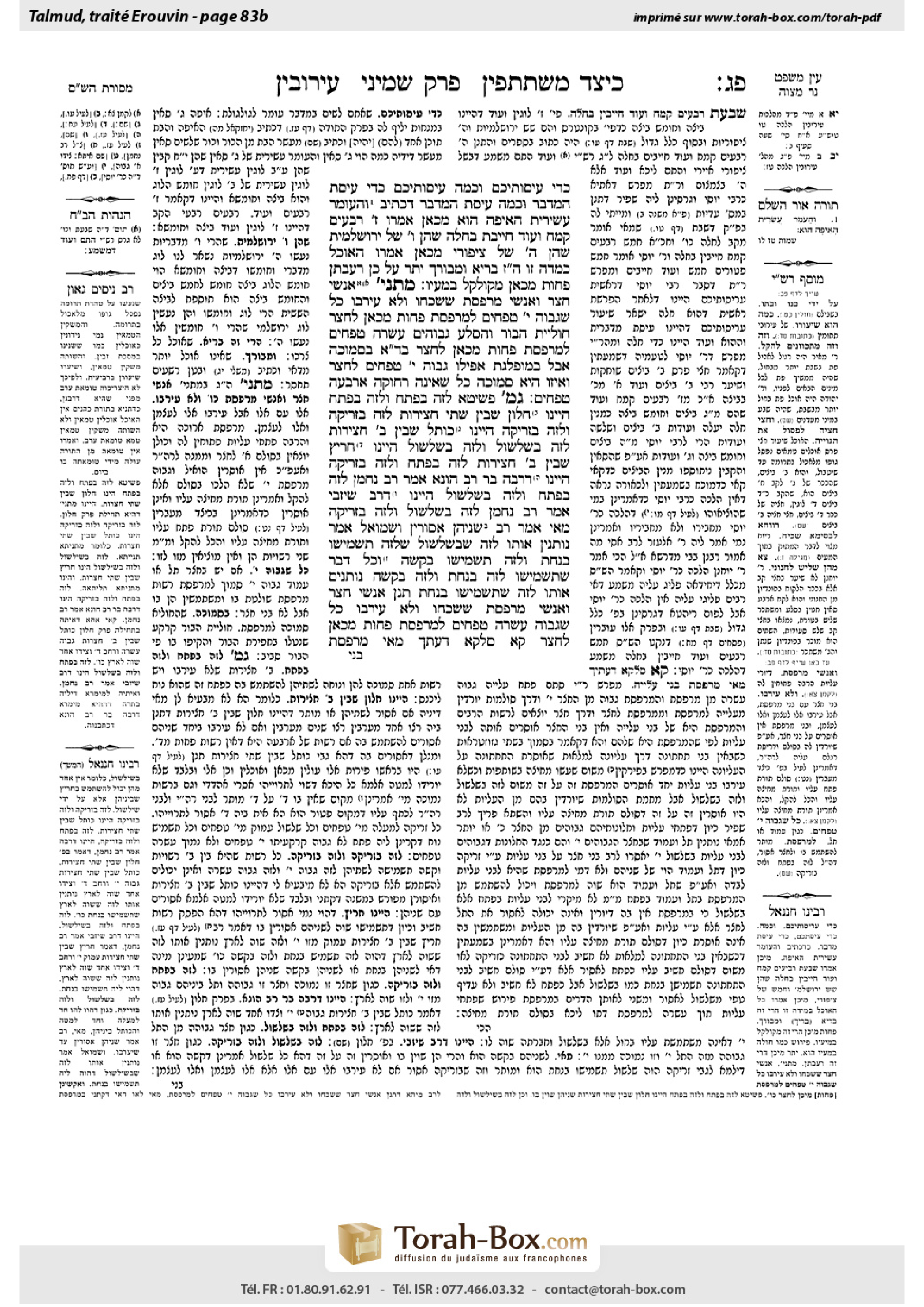
Eruvin 83b: Talmud study for Daf Yomi
Study the Talmud for Daf Yomi with scanned pages, Hebrew text, English translations from Sefaria and AI-generated French translations.
Passage selection and English or AI-generated French translation are available where the scan has annotations. Daf Study is independent of Torah-Box and Sefaria.
Browse Eruvin · עירובין · All tractatesEruvin 83b text and translations
This page of Eruvin includes the Aramaic text, an English translation and an AI-generated French translation, alongside the scan above.
עירובין פ״ג ב · Aramaic and Hebrew text
כְּדֵי עִיסּוֹתֵיכֶם, וְכַמָּה עִיסּוֹתֵיכֶם? כְּדֵי עִיסַּת הַמִּדְבָּר. וְכַמָּה עִיסַּת הַמִּדְבָּר?
דִּכְתִיב: ״וְהָעוֹמֶר עֲשִׂירִית הָאֵיפָה הוּא״. מִכָּאן אָמְרוּ, שִׁבְעָה רְבָעִים קֶמַח וָעוֹד חַיֶּיבֶת בְּחַלָּה, שֶׁהֵן שִׁשָּׁה שֶׁל יְרוּשַׁלְמִית, שֶׁהֵן חֲמִשָּׁה שֶׁל צִיפּוֹרִי.
מִכָּאן אָמְרוּ: הָאוֹכֵל כְּמִדָּה זוֹ — הֲרֵי זֶה בָּרִיא וּמְבוֹרָךְ. יָתֵר עַל כֵּן — רַעַבְתָן. פָּחוֹת מִכָּאן — מְקוּלְקָל בְּמֵעָיו.
מַתְנִי׳ אַנְשֵׁי חָצֵר וְאַנְשֵׁי מִרְפֶּסֶת שֶׁשָּׁכְחוּ וְלֹא עֵירְבוּ, כׇּל שֶׁגָּבוֹהַּ עֲשָׂרָה טְפָחִים — לְמִרְפֶּסֶת. פָּחוֹת מִכָּאן — לֶחָצֵר.
חוּלְיַית הַבּוֹר וְהַסֶּלַע, גְּבוֹהִים עֲשָׂרָה טְפָחִים — לַמִּרְפֶּסֶת, פָּחוֹת מִכָּאן — לֶחָצֵר.
בַּמֶּה דְּבָרִים אֲמוּרִים — בִּסְמוּכָה, אֲבָל בְּמוּפְלֶגֶת — אֲפִילּוּ גָּבוֹהַּ עֲשָׂרָה טְפָחִים — לֶחָצֵר. וְאֵיזוֹ הִיא סְמוּכָה — כׇּל שֶׁאֵינָהּ רְחוֹקָה אַרְבָּעָה טְפָחִים.
גְּמָ׳ פְּשִׁיטָא, לָזֶה בְּפֶתַח וְלָזֶה בְּפֶתַח — הַיְינוּ חַלּוֹן שֶׁבֵּין שְׁתֵּי חֲצֵירוֹת.
לָזֶה בִּזְרִיקָה וְלָזֶה בִּזְרִיקָה — הַיְינוּ כּוֹתֶל שֶׁבֵּין שְׁתֵּי חֲצֵירוֹת. לָזֶה בְּשִׁלְשׁוּל וְלָזֶה בְּשִׁלְשׁוּל — הַיְינוּ חָרִיץ שֶׁבֵּין שְׁתֵּי חֲצֵירוֹת.
לָזֶה בְּפֶתַח וְלָזֶה בִּזְרִיקָה — הַיְינוּ דְּרַבָּה בַּר רַב הוּנָא אָמַר רַב נַחְמָן. לָזֶה בְּפֶתַח וְלָזֶה בְּשִׁלְשׁוּל — הַיְינוּ דְּרַב שֵׁיזְבִי אָמַר רַב נַחְמָן.
לָזֶה בְּשִׁלְשׁוּל וְלָזֶה בִּזְרִיקָה, מַאי?
אָמַר רַב: שְׁנֵיהֶן אֲסוּרִין. וּשְׁמוּאֵל אָמַר: נוֹתְנִין אוֹתוֹ לָזֶה שֶׁבְּשִׁלְשׁוּל. שֶׁלָּזֶה תַּשְׁמִישׁוֹ בְּנַחַת, וְלָזֶה תַּשְׁמִישׁוֹ בְּקָשֶׁה, וְכׇל דָּבָר שֶׁתַּשְׁמִישׁוֹ לָזֶה בְּנַחַת וְלָזֶה בְּקָשֶׁה — נוֹתְנִים אוֹתוֹ לָזֶה שֶׁתַּשְׁמִישׁוֹ בְּנַחַת.
תְּנַן: אַנְשֵׁי חָצֵר וְאַנְשֵׁי מִרְפֶּסֶת שֶׁשָּׁכְחוּ וְלֹא עֵירְבוּ, כָּל שֶׁגָּבוֹהַּ עֲשָׂרָה טְפָחִים — לַמִּרְפֶּסֶת, פָּחוֹת מִכָּאן — לֶחָצֵר.
קָא סָלְקָא דַּעְתָּךְ, מַאי מִרְפֶּסֶת —
Eruvin 83b · English translation
What is the quantity of dough from which ḥalla must be separated? The amount of “your dough.” And how much is “your dough”? This amount is left unspecified by the verse. The Gemara answers: It is as the amount of the dough of the wilderness. The Gemara again asks: And how much is the dough of the wilderness?
The Gemara responds: The Torah states that the manna, the dough of the wilderness, was “an omer a head” (Exodus 16:16). A later verse elaborates on that measure, as it is written: “And an omer is the tenth part of an eifa” (Exodus 16:36). An eifa is three se’a, which are eighteen kav or seventy-two log. An omer is one-tenth of this measure. From here, this calculation, Sages said that dough prepared from seven quarters of a kav of flour and more is obligated in ḥalla. This is equal to six quarter-kav of the Jerusalem measure, which is five quarter-kav of the Tzippori measure.
From here the Sages also said: One who eats roughly this amount each day, is healthy, as he is able to eat a proper meal; and he is also blessed, as he is not a glutton who requires more. One who eats more than this is a glutton, while one who eats less than this has damaged bowels and must see to his health.
MISHNA: If both the residents of houses that open directly into a courtyard and the residents of apartments that open onto a balcony from which stairs lead down to that courtyard forgot and did not establish an eiruv between them, anything in the courtyard that is ten handbreadths high, e.g., a mound or a post, is part of the balcony. The residents of the apartments open to the balcony may transfer objects to and from their apartments onto the mound or post. Any post or mound that is lower than this height is part of the courtyard.
A similar halakha applies to an embankment that surrounds a cistern or a rock: If the embankments that surround a cistern or rock are ten handbreadths high, they belong to the balcony; if they are lower than this, they may be used only by the inhabitants of the courtyard.
In what case are these matters, the halakha that anything higher than ten handbreadths belongs to the balcony, stated? When the mound or embankment is near the balcony. But in a case where the embankment or mound is distant from it, even if it is ten handbreadths high, the right to use the embankment or mound goes to the members of the courtyard. And what is considered near? Anything that is not four handbreadths removed from the balcony.
GEMARA: The Gemara comments: It is obvious that if the residents of two courtyards established separate eiruvin, and the residents of both courtyards have convenient access to a certain area, the residents of this courtyard through an entrance, and the residents of that courtyard through another entrance, this is similar to the case of a window between two courtyards. If the residents did not establish a joint eiruv, the use of this window is prohibited to the residents of both courtyards.
It is similarly obvious that if a place can be used by the residents of this courtyard only by throwing an object onto it and by the residents of that courtyard only by throwing, but it cannot be conveniently used by either set of residents, then this is equivalent to the case of a wall between two courtyards. If there is a wall between two courtyards, it may not be used by either courtyard. Likewise, if a place can be used by the residents of this courtyard only by lowering an object down to it and by the residents of that courtyard by a similar act of lowering, this is comparable to the halakha of a ditch between two courtyards, which may not be used by the residents of either courtyard.
It is likewise obvious that in a place that can be conveniently used by the residents of this courtyard through an entrance but can be used by the residents of that courtyard only by throwing an object onto it, this is governed by the ruling of Rabba bar Rav Huna, who said that Rav Naḥman said: This place may be used only by those who have access to the area by way of an entrance. Likewise, a place that can be conveniently used by the residents of this courtyard through an entrance but can be used by the residents of that courtyard only by lowering an object down to it, this is governed by the ruling of Rav Sheizvi, who said that Rav Naḥman said: This place may be used only by those who have convenient access to it.
The ruling in each of the aforementioned cases is clear. What is the halakha concerning a place that can be used by the residents of this courtyard only by lowering an object down to it and by the residents of that courtyard only by throwing an object on top of it? In other words, if an area is lower than one courtyard but higher than the other, so that neither set of residents has convenient access to it, which of them is entitled to use it?
Rav said: It is prohibited for both sets of residents to use it. As the use of the area is equally inconvenient to the residents of both courtyards, they retain equal rights to it and render it prohibited for the other group to use. And Shmuel said: The use of the area is granted to those who can reach it by lowering, as it is relatively easy for them to lower objects to it, and therefore its use is more convenient; whereas for the others, who must throw onto it, its use is more demanding. And there is a principle concerning Shabbat: Anything whose use is convenient for one party and more demanding for another party, one provides it to that one whose use of it is convenient.
In order to decide between these two opinions, the Gemara attempts to adduce a proof from the mishna: If the residents of houses that open directly into a courtyard and the residents of apartments that open onto a balcony from which stairs lead down to that courtyard forgot and did not establish an eiruv between them, anything in the courtyard that is ten handbreadths high belongs to the balcony, while anything that is less than this height belongs to the courtyard.
The Gemara first explains: It might have entered your mind to say: What is the meaning of the balcony mentioned in the mishna?
Eruvin 83b · Traduction française (IA)
Quelle quantité de farine doit-on séparer pour l'ḥalla ? La quantité de « votre farine ». Et combien est-ce que « votre farine » ? La quantité n'est pas spécifiée par la parole. La Guemara répond : C'est la quantité de la farine du désert. La Guemara pose à nouveau la question : Et combien est-ce que la farine du désert ?
La Guemara répond : La Torah dit que la manne, la farine du désert, était « un omer par personne » (Exode 16:16). Une autre parole précise cette mesure, car il est écrit : « Et un omer est dixième d'une eifa » (Exode 16:36). Une eifa est trois se'a, ce qui équivaut à dix-huit kav ou soixante-douze log. Un omer est dixième de cette mesure. D'après cela, les Sages ont dit que la farine préparée à partir de sept quarts de kav de farine et plus est obligatoire pour l'ḥalla. Cela équivaut à six quarts de kav selon la mesure de Jérusalem, ce qui est cinq quarts de kav selon la mesure de Tzippori.
D'après cela, les Sages ont aussi dit : Celui qui mange approximativement cette quantité chaque jour est sain, car il peut manger un repas correct ; il est aussi béni, car il n'est pas un gourmand qui a besoin de plus. Celui qui mange plus que cela est un gourmand, tandis que celui qui mange moins a des intestins endommagés et doit prendre soin de sa santé.
MICHNA : Si les habitants des maisons qui s'ouvrent directement sur un courtil et les habitants des appartements qui s'ouvrent sur un balcon d'où des escaliers mènent vers ce courtil ont oublié et n'ont pas établi un eiruv entre eux, tout ce qui est dans le courtil et qui est haut de dix paumes, par exemple une montagne ou un poteau, appartient au balcon. Les habitants des appartements qui s'ouvrent sur le balcon peuvent transférer des objets vers et depuis leurs appartements sur la montagne ou le poteau. Tout poteau ou montagne qui est plus bas que cette hauteur appartient au courtil.
Une même halakha s'applique à un talus qui entoure un puits ou une roche : Si les talus qui entourent un puits ou une roche sont hauts de dix paumes, ils appartiennent au balcon ; si ils sont plus bas, ils peuvent être utilisés uniquement par les habitants du courtil.
Dans quel cas ces matières, la halakha que tout ce qui est plus haut que dix paumes appartient au balcon, sont-elles énoncées ? Lorsque la montagne ou le talus est proche du balcon. Mais dans un cas où le talus ou la montagne est éloigné, même s'il est haut de dix paumes, le droit d'utilisation du talus ou de la montagne revient aux habitants du courtil. Et ce qui est considéré comme proche ? Tout ce qui n'est pas à quatre paumes de distance du balcon.
GUEMARA : La Guemara commente : Il est évident que si les habitants de deux courtils ont établi des eiruvin séparés, et que les habitants des deux courtils ont un accès facile à une certaine zone, les habitants de ce courtil par une entrée, et les habitants de l'autre courtil par une autre entrée, cela est comparable au cas d'une fenêtre entre deux courtils. Si les habitants n'ont pas établi un eiruv commun, l'utilisation de cette fenêtre est interdite aux habitants des deux courtils.
Il est également évident que si un lieu peut être utilisé par les habitants de ce courtil uniquement en jetant un objet dessus et par les habitants de l'autre courtil uniquement en jetant, mais qu'il ne peut pas être utilisé facilement par l'un ou l'autre groupe, cela est comparable au cas d'un mur entre deux courtils. Si un mur est entre deux courtils, il ne peut pas être utilisé par l'un ou l'autre courtil. De même, si un lieu peut être utilisé par les habitants de ce courtil uniquement en descendant un objet jusqu'à lui et par les habitants de l'autre courtil par un acte similaire de descente, cela est comparable à la halakha d'un fossé entre deux courtils, qui ne peut pas être utilisé par les habitants de l'un ou l'autre courtil.
Il est également évident que dans un lieu qui peut être utilisé facilement par les habitants de ce courtil par une entrée mais qui peut être utilisé par les habitants de l'autre courtil uniquement en jetant un objet dessus, cela est régulé par la décision de Rabba bar Rav Huna, qui a dit que Rav Naḥman a dit : Ce lieu peut être utilisé uniquement par ceux qui ont accès à la zone par une entrée. De même, un lieu qui peut être utilisé facilement par les habitants de ce courtil par une entrée mais qui peut être utilisé par les habitants de l'autre courtil uniquement en descendant un objet jusqu'à lui est régulé par la décision de Rav Sheizvi, qui a dit que Rav Naḥman a dit : Ce lieu peut être utilisé uniquement par ceux qui ont un accès facile à la zone.
La décision dans chacun des cas mentionnés ci-dessus est claire. Quelle est la halakha concernant un lieu qui peut être utilisé par les habitants de ce courtil uniquement en descendant un objet jusqu'à lui et par les habitants de l'autre courtil uniquement en jetant un object dessus ? En d'autres termes, si une zone est plus basse que l'un des courtils et plus haute que l'autre, de sorte que ni l'un ni l'autre groupe n'a un accès facile à elle, à qui appartient-elle ?
Rav a dit : Il est interdit aux deux groupes d'utiliser ce lieu. Comme l'utilisation de la zone est aussi inconvenante pour les habitants des deux courtils, ils conservent des droits égaux à cette zone et rendent cette zone interdite pour l'autre groupe. Et Shmuel a dit : L'utilisation de la zone est accordée à ceux qui peuvent l'atteindre en descendant, car c'est relativement facile pour eux de descendre des objets jusqu'à elle, et donc son utilisation est plus facile ; tandis que pour les autres, qui doivent jeter dessus, son utilisation est plus exigeante. Et il y a un principe concernant le Shabbat : Tout ce dont l'utilisation est facile pour un groupe et exigeante pour un autre groupe, on le donne à celui dont l'utilisation est facile.
Afin de décider entre ces deux opinions, la Guemara tente d'adduire une preuve à partir de la Michna : Si les habitants des maisons qui s'ouvrent directement sur un courtil et les habitants des appartements qui s'ouvrent sur un balcon d'où des escaliers mènent vers ce courtil ont oublié et n'ont pas établi un eiruv entre eux, tout ce qui est dans le courtil et qui est haut de dix paumes appartient au balcon, tandis que tout ce qui est moins haut appartient au courtil.
La Guemara commence par expliquer : Il pourrait avoir traversé votre esprit de penser : De quoi parle ce balcon mentionné dans la Michna ?
Traduction française générée par IA à partir de l’édition anglaise de Sefaria. Vérifie toujours un passage avec le texte source.
Text from Sefaria: William Davidson Edition - Vocalized Aramaic (CC BY NC); William Davidson Edition - English (CC BY NC).