Eruvin 84a: Talmud study for Daf Yomi
Study the Talmud for Daf Yomi with scanned pages, Hebrew text, English translations from Sefaria and AI-generated French translations.
Passage selection and English or AI-generated French translation are available where the scan has annotations. Daf Study is independent of Torah-Box and Sefaria.
Browse Eruvin · עירובין · All tractatesEruvin 84a text and translations
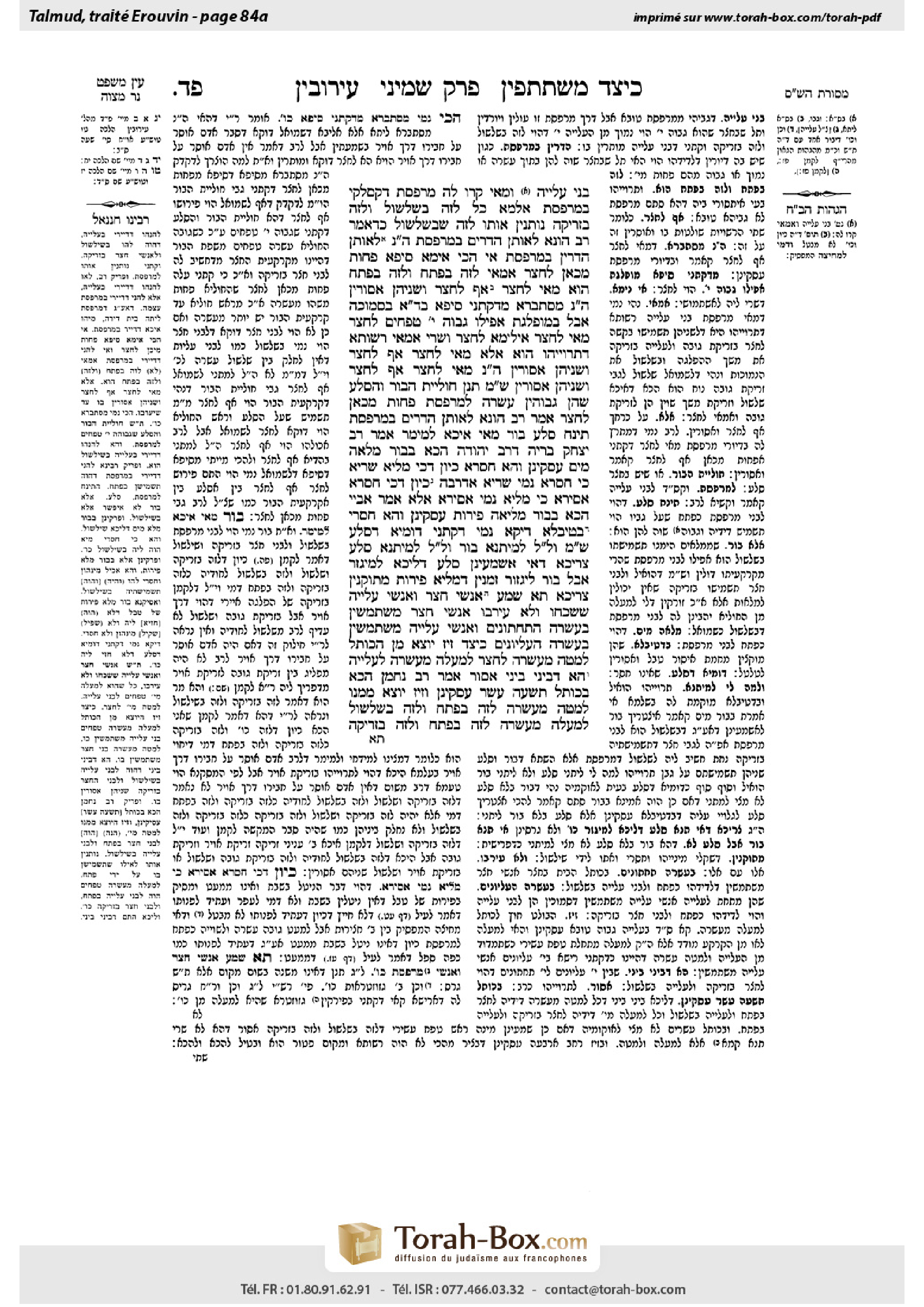
This page of Eruvin includes the Aramaic text, an English translation and an AI-generated French translation, alongside the scan above.
עירובין פ״ד א · Aramaic and Hebrew text
בְּנֵי עֲלִיָּיה. וּמַאי קָרוּ לַהּ מִרְפֶּסֶת? דְּקָסָלְקִי בְּמִרְפֶּסֶת, אַלְמָא: כָּל לָזֶה בְּשִׁלְשׁוּל וְלָזֶה בִּזְרִיקָה — נוֹתְנִין אוֹתוֹ לָזֶה שֶׁבְּשִׁלְשׁוּל!
כִּדְאָמַר רַב הוּנָא: לְאוֹתָן הַדָּרִים בַּמִּרְפֶּסֶת. הָכִי נָמֵי: לְאוֹתָן הַדָּרִין בַּמִּרְפֶּסֶת.
אִי הָכִי, אֵימָא סֵיפָא: פָּחוֹת מִכָּאן — לֶחָצֵר. אַמַּאי? לָזֶה בְּפֶתַח וְלָזֶה בְּפֶתַח הוּא!
מַאי ״לֶחָצֵר״? אַף לֶחָצֵר. וּשְׁנֵיהֶן אֲסוּרִין.
הָכִי נָמֵי מִסְתַּבְּרָא, מִדְּקָתָנֵי סֵיפָא: בַּמֶּה דְּבָרִים אֲמוּרִים בִּסְמוּכָה. אֲבָל בְּמוּפְלֶגֶת, אֲפִילּוּ גָּבוֹהַּ עֲשָׂרָה טְפָחִים — לֶחָצֵר. מַאי ״לֶחָצֵר״? אִילֵּימָא: לֶחָצֵר וּשְׁרֵי, אַמַּאי? רְשׁוּתָא דְּתַרְוַיְיהוּ הוּא!
אֶלָּא מַאי ״לֶחָצֵר״ — אַף לֶחָצֵר, וּשְׁנֵיהֶן אֲסוּרִין. הָכִי נָמֵי: מַאי ״לֶחָצֵר״ — אַף לֶחָצֵר, וּשְׁנֵיהֶן אֲסוּרִין. שְׁמַע מִינַּהּ.
תְּנַן: חוּלְיַית הַבּוֹר וְהַסֶּלַע שֶׁהֵן גְּבוֹהִין עֲשָׂרָה — לַמִּרְפֶּסֶת, פָּחוֹת מִכָּאן — לֶחָצֵר. אָמַר רַב הוּנָא: לְאוֹתָן הַדָּרִים בַּמִּרְפֶּסֶת.
תִּינַח סֶלַע. בּוֹר מַאי אִיכָּא לְמֵימַר?
אָמַר רַב יִצְחָק בְּרֵיהּ דְּרַב יְהוּדָה: הָכָא בְּבוֹר מְלֵאָה מַיִם עָסְקִינַן. וְהָא חָסְרָא!
כֵּיוָן דְּכִי מַלְיָא שַׁרְיָא — כִּי חָסְרָא נָמֵי שַׁרְיָא. אַדְּרַבָּה, כֵּיוָן דְּכִי חָסְרָא אֲסִירָא — כִּי מַלְיָא נָמֵי אֲסִירָא.
אֶלָּא אָמַר אַבָּיֵי: הָכָא בְּבוֹר מְלֵיאָה פֵּירוֹת עָסְקִינַן. וְהָא חָסְרִי.
בְּטִיבְלָא.
דַּיְקָא נָמֵי דְּקָתָנֵי דּוּמְיָא דְּסֶלַע. שְׁמַע מִינַּהּ.
וּלְמָה לִי לְמִיתְנֵא בּוֹר וּלְמָה לִי לְמִיתְנֵא סֶלַע? צְרִיכָא, דְּאִי אַשְׁמְעִינַן סֶלַע — דְּלֵיכָּא לְמִיגְזַר, אֲבָל בּוֹר — לִיגְזוֹר זִמְנִין דְּמַלְיָא פֵּירוֹת מְתוּקָּנִין, צְרִיכָא.
תָּא שְׁמַע: אַנְשֵׁי חָצֵר וְאַנְשֵׁי עֲלִיָּיה שֶׁשָּׁכְחוּ וְלֹא עֵירְבוּ — אַנְשֵׁי חָצֵר מִשְׁתַּמְּשִׁין בָּעֲשָׂרָה הַתַּחְתּוֹנִים, וְאַנְשֵׁי עֲלִיָּיה מִשְׁתַּמְּשִׁין בָּעֲשָׂרָה הָעֶלְיוֹנִים. כֵּיצַד? זִיז יוֹצֵא מִן הַכּוֹתֶל לְמַטָּה מֵעֲשָׂרָה — לֶחָצֵר, לְמַעְלָה מֵעֲשָׂרָה — לָעֲלִיָּיה.
הָא דְּבֵינֵי בֵּינֵי — אָסוּר!
אָמַר רַב נַחְמָן: הָכָא בְּכוֹתֶל תִּשְׁעָה עָשָׂר עָסְקִינַן, וְזִיז יוֹצֵא מִמֶּנּוּ. לְמַטָּה מֵעֲשָׂרָה — לָזֶה בְּפֶתַח, וְלָזֶה בְּשִׁלְשׁוּל. לְמַעְלָה מֵעֲשָׂרָה — לָזֶה בְּפֶתַח, וְלָזֶה בִּזְרִיקָה.
Eruvin 84a · English translation
It is referring to the residents of an upper story above the balcony; and if so, why do we call the upper story a balcony? Because the residents of the upper story ascend and descend to and from their apartments by way of the balcony. From here the Gemara infers: With regard to any place that can be used by one set of residents only by lowering an object down to it and by another set of residents only by throwing an object on top of it, we grant Shabbat use of it to those who can use it by lowering, as the residents of the upper story who use the area ten handbreadths high do so by means of lowering. Apparently, the mishna supports Shmuel and presents a difficulty to Rav.
The Gemara rejects this argument: As Rav Huna said with regard to a different issue discussed in a subsequent mishna, that the tanna is referring to those who live in apartments that open directly onto the balcony rather than those who live in an upper story; here too, the tanna is speaking of those who live in apartments that open directly onto the balcony. In this case, the use of an area ten handbreadths high is convenient for the residents of the balcony, as it is on their level; whereas its use is relatively inconvenient for the residents of the courtyard. Consequently, the right to use this area is granted to the residents of the balcony.
The Gemara raises an objection: If so, say the next clause of the mishna: Anything that is lower than this, i.e., lower than ten handbreadths, its use belongs to the courtyard. But why should this be the halakha? This is similar to a case of residents of two courtyards who have equally convenient access to a certain area. The residents of this courtyard access the area through one entrance, and the residents of that courtyard access the area through another entrance. In our case, the use of the area is equally convenient for the inhabitants of both the balcony and the courtyard; why should the latter be granted exclusive right of use?
The Gemara answers: What is the meaning of the phrase to the courtyard? It means also to the courtyard. In other words, even the residents of the courtyard can make use of this mound or post, and therefore residents of both the courtyard and the balcony are prohibited. If residents of two domains can conveniently use a single area and they did not establish an eiruv between their domains, they are all prohibited to carry in that area.
The Gemara comments: So too, it is reasonable to explain the mishna in this manner, as it was taught in the latter clause of the mishna: In what case is this statement said? When the mound or embankment is near the balcony; but in a case where it is distant from it, even if it is ten handbreadths high, its use belongs to the courtyard. What, then, is the meaning of the phrase to the courtyard in this context? If you say it means to the residents of courtyard, and therefore the use of the mound or embankment is permitted to them, why should this be so? It is the domain of the residents of both the courtyard and the balcony, as the mound or embankment is positioned near enough to the balcony for its residents to use it as well.
Rather, what is the meaning of the phrase to the courtyard? It means also to the courtyard. And, consequently, as the residents of both the courtyard and the balcony can use it, both are prohibited to carry there on Shabbat. Here too, in the earlier part of the mishna, what is the meaning of the clause to the courtyard? It likewise means also to the courtyard, and therefore both sets of residents are prohibited to carry. The Gemara concludes: Indeed, learn from this that this is the correct interpretation of this phrase.
The Gemara attempts to adduce further proof from the mishna to resolve the dispute between Rav and Shmuel. We learned in the mishna: The embankments that surround a cistern or a rock that are ten handbreadths high may be used by the balcony; if they are lower than that height, the right to use them belongs to the courtyard. The Gemara assumes that the phrase to the balcony is referring to the residents of an upper story, who access their apartments through the balcony. The mishna indicates that if one set of residents can make use of a place by lowering and another set of residents can use it by throwing, the use of the place is granted to those who lower their objects, in accordance with the opinion of Shmuel and contrary to the opinion of Rav. The Gemara answers: Rav Huna said that the phrase to the balcony is to be understood here literally as referring to those who live in apartments that open directly onto the balcony.
The Gemara asks: Granted, in the case of a rock, the residents of the balcony can use it conveniently, as its surface is more or less level with the balcony itself. But with regard to a cistern, what can be said? The water in the cistern is lower than the balcony and can be reached only by lowering a bucket down to it. How, then, can it be argued that the cistern is conveniently used by the residents of the balcony but not by the residents of the courtyard?
Rav Yitzḥak, son of Rav Yehuda, said: We are dealing here with a cistern full of water, as the water can be drawn from the cistern’s upper portion, near the balcony. The Gemara raises an objection: But doesn’t the cistern gradually lose its water as the liquid near the surface is drawn out? Although the water might at first reach the balcony, the water level gradually recedes. Eventually, the only way to reach the water will be by lowering a bucket into the cistern.
The Gemara answers: Since it is permitted to draw water from the cistern when it is full, it is likewise permitted even when it is lacking. The Gemara counters this argument: On the contrary, you should say that since the cistern is prohibited when it is lacking, it should likewise be prohibited even when it is full.
Rather, Abaye said: Here we are dealing with a cistern full of produce, as the upper produce is near the balcony. The Gemara raises an objection: But doesn’t the amount of produce also diminish, as the produce is removed, increasing the distance between the pile and the balcony?
The Gemara answers: This teaching is referring to untithed produce, which one may not tithe on Shabbat. Since this produce may not be used, the height of the pile will remain constant for the duration of Shabbat.
The Gemara comments: The language of the mishna is also precise, as it teaches the halakha of an embankment of a cistern together with that of a rock. Just as in the case of the rock only the upper surface is used, so too, in the case of the embankment of the cistern, the mishna is referring to the use of the surface of the cistern and not its contents. The Gemara concludes: Indeed, learn from this that this is the correct explanation.
The Gemara asks: But if this is indeed correct, and the cistern and rock are similar in all respects, why do I need the tanna to state the case of a cistern, and why do I need him to state the case of a rock as well? The Gemara answers: It was necessary to teach both cases. As had the mishna taught us only about a rock, one might have said that only a rock may be used by the residents of the balcony, as there is no need to decree in case its height is diminished. But with regard to a cistern, perhaps we should decree and prohibit its use, as at times it might be filled with tithed produce, which may be removed and eaten, thereby diminishing its height. It was therefore necessary to teach us that this is not a concern, and a cistern, as well as a rock, may be used by the residents of the balcony.
Returning to the dispute between Rav and Shmuel, the Gemara suggests a different proof: Come and hear a baraita: If the residents of houses opening directly into a courtyard and the residents of apartments in an upper story forgot and did not establish an eiruv together, the residents of the courtyard may use the lower ten handbreadths of the wall near them, and the residents of the upper story may use the upper ten handbreadths adjacent to them. How so? If a ledge protrudes from the wall below ten handbreadths from the ground, its use is for the residents of the courtyard; but if it protrudes above ten handbreadths, its use is for the residents of the upper story.
The Gemara infers: Consequently, a ledge situated between this and between the other, i.e., in-between the courtyard and the upper story, is prohibited. This middle area has the status of a place that can be used by one set of residents by lowering and by another set of residents by throwing, and yet they are both prohibited, in accordance with the opinion of Rav and in opposition to the opinion of Shmuel.
Rav Naḥman said: No proof can be adduced from this teaching, as here we are dealing with a wall of nineteen handbreadths that has a protruding ledge. If the ledge protrudes below ten handbreadths from the ground, for this set of residents, those of the courtyard, it can be used as an entrance, and for that set of residents, those of the upper story, it can be used only by lowering. If the ledge protrudes above ten handbreadths, for this set of residents, those in the balcony, it can be accessed as an entrance, and for that set of residents, those of the courtyard, it can be used only by throwing. In this case, there is no middle area between the ten-handbreadths available to each set of residents. Consequently, this case cannot serve as a proof with regard to the dispute between Rav and Shmuel.
Eruvin 84a · Traduction française (IA)
Il s'agit des résidents d'un étage supérieur par rapport à la balustrade ; et si c'est ainsi, pourquoi appelons-nous l'étage supérieur une balustrade ? Parce que les résidents de l'étage supérieur montent et descendent vers leurs appartements par la balustrade. De là, la Guemara déduit : Concernant toute place qui peut être utilisée par un groupe de résidents uniquement en abaissant un objet vers elle et par un autre groupe de résidents uniquement en jetant un object sur elle, nous accordons l'utilisation du sabbat à ceux qui peuvent l'utiliser en abaissant, car les résidents de l'étage supérieur qui utilisent cette zone à dix tefachim de hauteur le font en abaissant. Apparemment, la Michna soutient Shmuel et présente une difficulté à Rav.
La Guemara rejette cet argument : Comme Rav Huna a dit concernant une autre question discutée dans une Michna ultérieure, que le tanna fait référence à ceux qui habitent dans des appartements ouvrant directement sur la balustrade plutôt qu'à ceux qui habitent dans un étage supérieur ; ici aussi, le tanna parle de ceux qui habitent dans des appartements ouvrant directement sur la balustrade. Dans ce cas, l'utilisation d'une zone à dix tefachim de hauteur est pratique pour les résidents de la balustrade, car elle est à leur niveau ; tandis que son utilisation est relativement peu pratique pour les résidents du courtil. Ainsi, le droit d'utiliser cette zone est accordé aux résidents de la balustrade.
La Guemara soulève une objection : Si c'est ainsi, disent la suite de la Michna : Tout ce qui est plus bas que cela, c'est-à-dire plus bas que dix tefachim, son utilisation appartient au courtil. Mais pourquoi devrait-ce être la halakha ? Cela ressemble à un cas de résidents de deux courtils qui ont un accès aussi pratique à une certaine zone. Les résidents de ce courtil accèdent à la zone par une entrée, et les résidents de l'autre courtil accèdent à la zone par une autre entrée. Dans notre cas, l'utilisation de la zone est aussi pratique pour les habitants des deux courtils et de la balustrade ; pourquoi devrait le second être accordé un droit exclusif d'utilisation ?
La Guemara répond : Qu'entend-on par la phrase « au courtil » ? Cela signifie aussi le courtil. En d'autres termes, même les résidents du courtil peuvent utiliser ce monticule ou cette butte, et donc les résidents des deux courtils et de la balustrade sont interdits. Si des résidents de deux domaines peuvent utiliser facilement une seule zone et qu'ils n'ont pas établi un eiruv entre leurs domaines, ils sont tous interdits de porter dans cette zone.
La Guemara commente : De même, il est raisonnable d'expliquer la Michna ainsi, comme il a été enseigné dans la clause ultérieure de la Michna : Dans quel cas cette déclaration est-elle dite ? Lorsque le monticule ou l'embâcle est proche de la balustrade ; mais dans un cas où il est éloigné de celle-ci, même si elle est à dix tefachim de hauteur, son utilisation appartient au courtil. Qu'entend-on alors par la phrase « au courtil » dans ce contexte ? Si vous dites qu'elle signifie les résidents du courtil, et donc l'utilisation du monticule ou de l'embâcle est permise à ceux-ci, pourquoi devrait-ce être ainsi ? C'est le domaine des résidents des deux courtils et de la balustrade, car le monticule ou l'embâcle est suffisamment proche de la balustrade pour que ses résidents puissent l'utiliser également.
Plutôt, qu'entend-on par la phrase « au courtil » ? Cela signifie aussi le courtil. Et, par conséquent, comme les résidents des deux courtils et de la balustrade peuvent l'utiliser, les deux sont interdits de porter là le sabbat. Ici aussi, dans la première partie de la Michna, qu'entend-on par la clause « au courtil » ? Elle signifie aussi le courtil, et donc les deux groupes de résidents sont interdits de porter. La Guemara conclut : En effet, apprenez-en que c'est l'interprétation correcte de cette phrase.
La Guemara tente d'adduire une preuve supplémentaire à partir de la Michna pour résoudre le débat entre Rav et Shmuel. Nous avons appris dans la Michna : Les buttes qui entourent un puits ou une roche à dix tefachim de hauteur peuvent être utilisées par la balustrade ; si elles sont plus basses que cette hauteur, le droit d'utilisation appartient au courtil. La Guemara suppose que la phrase « à la balustrade » fait référence aux résidents d'un étage supérieur, qui accèdent à leurs appartements par la balustrade. La Michna indique que si un groupe de résidents peut utiliser une place en abaissant un objet et un autre groupe en jetant un objet, la place est accordée à ceux qui abaissent leurs objets, conformément à l'opinion de Shmuel et contrairement à celle de Rav. La Guemara répond : Rav Huna a dit que la phrase « à la balustrade » doit être entendue littéralement ici comme faisant référence à ceux qui habitent dans des appartements ouvrant directement sur la balustrade.
La Guemara pose la question : D'accord, dans le cas d'une roche, les résidents de la balustrade peuvent l'utiliser commodément, car sa surface est plus ou moins à niveau avec la balustrade elle-même. Mais concernant un puits, que peut-on dire ? L'eau du puits est plus basse que la balustrade et peut être atteinte uniquement en abaissant un seau vers elle. Comment alors peut-on argumenter que le puits est commodément utilisé par les résidents de la balustrade mais pas par ceux du courtil ?
Rav Yitzḥak, fils de Rav Yehuda, a dit : Nous sommes ici en présence d'un puits plein d'eau, car l'eau peut être tirée du haut du puits, près de la balustrade. La Guemara soulève une objection : Mais ne perd-t-il pas progressivement son eau lorsque l'eau du haut est tirée ? Bien que l'eau puisse d'abord atteindre la balustrade, le niveau d'eau recule progressivement. Finalement, la seule façon d'atteindre l'eau sera d'abaisser un seau dans le puits.
La Guemara répond : Puisque c'est permis de tirer de l'eau du puits lorsqu'il est plein, il est également permis même lorsqu'il est vide. La Guemara contredit cet argument : Au contraire, vous devriez dire que puisque le puits est interdit lorsqu'il est vide, il devrait l'être également lorsqu'il est plein.
Plutôt, Abaye a dit : Nous sommes ici en présence d'un puits plein de produits, car les produits du haut sont près de la balustrade. La Guemara soulève une objection : Mais ne diminue-t-il pas également la quantité de produits, car les produits sont retirés, augmentant la distance entre la pile et la balustrade ?
La Guemara répond : Cet enseignement fait référence aux produits non titrés, qu'on ne peut pas titrer le sabbat. Puisque ces produits ne peuvent pas être utilisés, la hauteur de la pile restera constante tout au long du sabbat.
La Guemara commente : La formulation de la Michna est aussi précise, car elle enseigne la halakha d'un talus d'un réservoir ainsi que celle d'une roche. Tout comme dans le cas de la roche, seule la surface supérieure est utilisée, de même, dans le cas du talus du réservoir, la Michna fait référence à l'utilisation de la surface du réservoir et non de son contenu. La Guemara conclut : En effet, apprenez-en que c'est l'explication correcte.
La Guemara pose la question : Mais si c'est effectivement correct, et que le réservoir et la roche sont similaires en tous points, pourquoi avons-nous besoin du tanna de mentionner le cas du réservoir, et pourquoi avons-nous besoin de mentionner celui de la roche également ? La Guemara répond : Il était nécessaire d'enseigner les deux cas. Si la Michna nous avait appris uniquement sur la roche, on aurait pu penser que seul la roche peut être utilisé par les résidents du balcon, car il n'y aurait pas besoin de décréter dans le cas où sa hauteur diminuerait. Mais concernant le réservoir, peut-être devrions-nous décréter et interdire son utilisation, car parfois il pourrait être rempli de produits titrés, qui peuvent être retirés et mangés, ce qui diminuerait sa hauteur. Il était donc nécessaire d'enseigner que cela n'est pas un problème, et que le réservoir, ainsi que la roche, peuvent être utilisés par les résidents du balcon.
En revenant au débat entre Rav et Shmuel, la Guemara suggère une autre preuve : Viens écouter une baraïta : Si les résidents des maisons ouvrant directement sur un cour d'honneur et les résidents des appartements d'un étage supérieur ont oublié et n'ont pas établi un eiruv ensemble, les résidents du cour d'honneur peuvent utiliser les dix tefachim inférieurs du mur près d'eux, et les résidents de l'étage supérieur peuvent utiliser les dix tefachim supérieurs adjacents à eux. Comment cela fonctionne-t-il ? Si un rebord saillant s'élève en dessous de dix tefachim du sol, son utilisation est pour les résidents du cour d'honneur ; mais si il s'élève au-dessus de dix tefachim, son utilisation est pour les résidents de l'étage supérieur.
La Guemara déduit : Par conséquent, un rebord situé entre celui-ci et celui-là, c'est-à-dire entre le cour d'honneur et l'étage supérieur, est interdit. Cette zone intermédiaire a le statut d'un lieu qui peut être utilisé par un groupe de résidents en le baissant et par un autre groupe en le jetant, et pourtant ils sont tous deux interdits, conformément à l'opinion de Rav et en opposition à l'opinion de Shmuel.
Rav Naḥman a dit : Aucune preuve ne peut être tirée de cette enseignement, car ici nous avons affaire à un mur de dix-neuf tefachim qui a un rebord saillant. Si le rebord saillant est en dessous de dix tefachim du sol, pour ce groupe de résidents, ceux du cour d'honneur, il peut être utilisé comme une entrée, et pour ce groupe de résidents, ceux de l'étage supérieur, il peut être utilisé uniquement en le baissant. Si le rebord saillant est au-dessus de dix tefachim, pour ce groupe de résidents, ceux du balcon, il peut être utilisé comme une entrée, et pour ce groupe de résidents, ceux du cour d'honneur, il peut être utilisé uniquement en le jetant. Dans ce cas, il n'y a pas de zone intermédiaire entre les dix tefachim disponibles pour chaque groupe de résidents. Par conséquent, ce cas ne peut pas servir de preuve concernant le débat entre Rav et Shmuel.
Traduction française générée par IA à partir de l’édition anglaise de Sefaria. Vérifie toujours un passage avec le texte source.
Text from Sefaria: William Davidson Edition - Vocalized Aramaic (CC BY NC); William Davidson Edition - English (CC BY NC).