Eruvin 84b: Talmud study for Daf Yomi
Study the Talmud for Daf Yomi with scanned pages, Hebrew text, English translations from Sefaria and AI-generated French translations.
Passage selection and English or AI-generated French translation are available where the scan has annotations. Daf Study is independent of Torah-Box and Sefaria.
Browse Eruvin · עירובין · All tractatesEruvin 84b text and translations
This page of Eruvin includes the Aramaic text, an English translation and an AI-generated French translation, alongside the scan above.
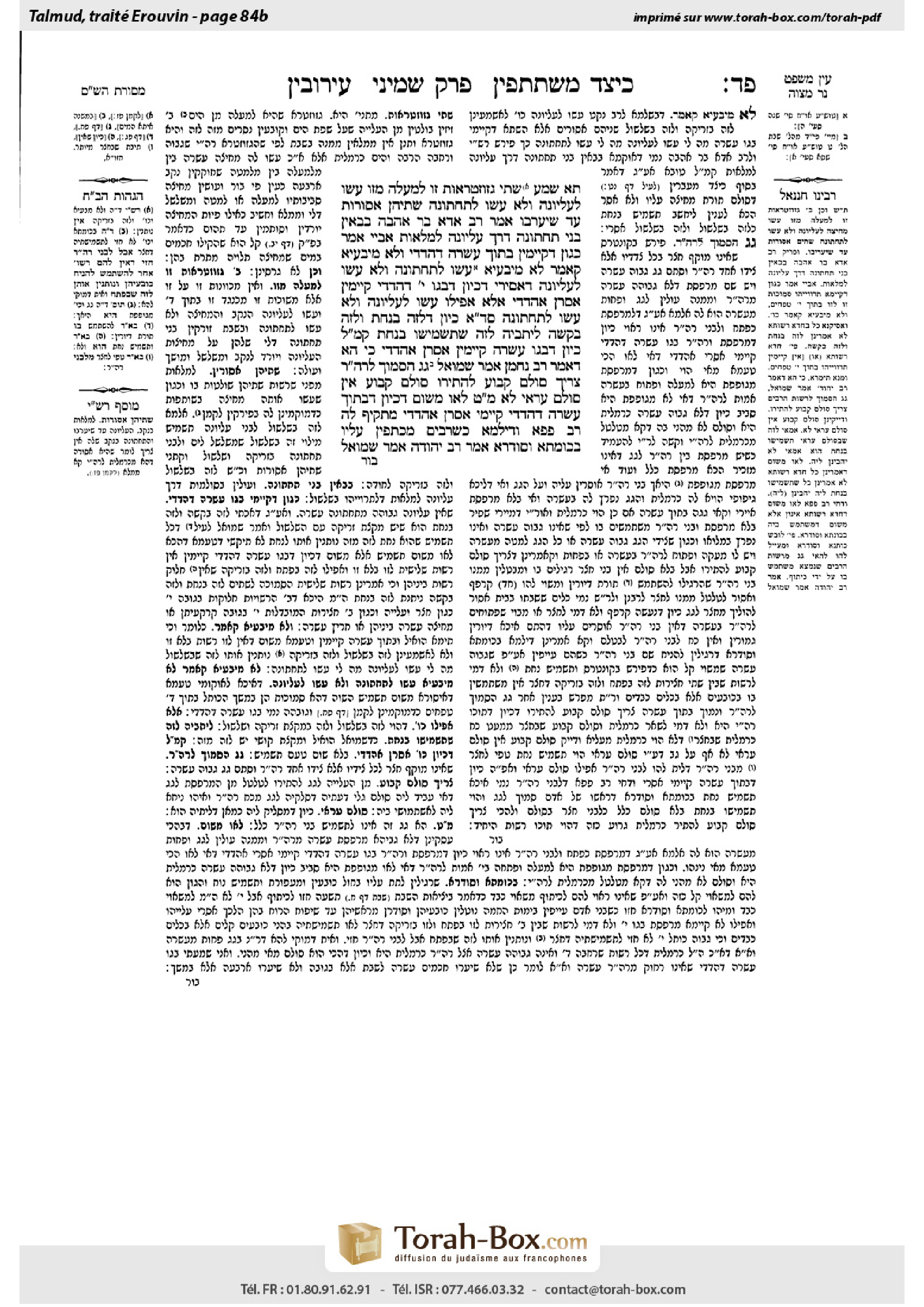
עירובין פ״ד ב · Aramaic and Hebrew text
תָּא שְׁמַע: שְׁתֵּי גְזוּזְטְרָאוֹת זוֹ לְמַעְלָה מִזּוֹ. עָשׂוּ לָעֶלְיוֹנָה, וְלֹא עָשׂוּ לַתַּחְתּוֹנָה — שְׁתֵּיהֶן אֲסוּרוֹת עַד שֶׁיְּעָרְבוּ!
אָמַר רַב אַדָּא בַּר אַהֲבָה: בְּבָאִין בְּנֵי תַחְתּוֹנָה דֶּרֶךְ עֶלְיוֹנָה לְמַלּאוֹת.
אַבָּיֵי אָמַר: כְּגוֹן דְּקַיָּימִין בְּתוֹךְ עֲשָׂרָה דַּהֲדָדֵי, וְלָא מִיבַּעְיָא קָאָמַר: לָא מִיבַּעְיָא עָשׂוּ לַתַּחְתּוֹנָה וְלֹא עָשׂוּ לָעֶלְיוֹנָה — דַּאֲסִירִי, דְּכֵיוָן דִּבְגוֹ עֲשָׂרָה דַּהֲדָדֵי קַיָּימִין — אָסְרָן אַהֲדָדֵי,
אֶלָּא אֲפִילּוּ עָשׂוּ לָעֶלְיוֹנָה וְלֹא עָשׂוּ לַתַּחְתּוֹנָה, סָלְקָא דַּעְתָּךְ אָמֵינָא: כֵּיוָן דְּלָזֶה בְּנַחַת וְלָזֶה בְּקָשֶׁה — לִיתְּבֵיהּ לָזֶה שֶׁתַּשְׁמִישׁוֹ בְּנַחַת, קָא מַשְׁמַע לַן: כֵּיוָן דִּבְגוֹ עֲשָׂרָה קַיָּימִין — אָסְרָן אַהֲדָדֵי.
כִּי הָא דְּאָמַר רַב נַחְמָן אָמַר שְׁמוּאֵל: גַּג הַסָּמוּךְ לִרְשׁוּת הָרַבִּים — צָרִיךְ סוּלָּם קָבוּעַ לְהַתִּירוֹ. סוּלָּם קָבוּעַ אִין, סוּלָּם עֲרַאי לָא. מַאי טַעְמָא? לָאו מִשּׁוּם דְּכֵיוָן דִּבְתוֹךְ עֲשָׂרָה דַּהֲדָדֵי קָיְימִי — אָסְרָן אַהֲדָדֵי!
מַתְקֵיף לַהּ רַב פָּפָּא: וְדִילְמָא כְּשֶׁרַבִּים מְכַתְּפִין עָלָיו, בְּכוּמְתָּא וְסוּדָרָא.
אָמַר רַב יְהוּדָה אָמַר שְׁמוּאֵל:
Eruvin 84b · English translation
The Gemara attempts to cite yet another proof to resolve the dispute between Rav and Shmuel. Come and hear a mishna: If a balcony extends over a body of water, and the residents of the balcony cut out a hole in the floor and constructed a partition ten handbreadths high around the hole, water may be drawn through the hole on Shabbat. If there are two balconies of this kind, one above the other, and they erected a partition for the upper balcony but they did not erect one for the lower one, they are both prohibited from drawing water, unless they establish an eiruv between them. This mishna apparently is referring to a case where the residents of the upper balcony draw water by lowering their buckets down, whereas the residents of the lower balcony hoist their bucket to the upper one and draw water from there, i.e., one balcony draws the water by lowering and the other by throwing. The mishna rules that they are both prohibited, in accordance with the opinion of Rav and contrary to the opinion of Shmuel.
Rav Adda bar Ahava said: Here we are dealing with a case where the residents of the lower balcony go up to the upper balcony by means of a ladder to draw their water from there. Since they themselves are located in the upper balcony when they draw their water, both sets of residents gain access to their water by lowering.
Abaye said: Here we are dealing with a case, where the two balconies are situated within ten handbreadths of each other, and the tanna was speaking in the style of: There is no need. In other words, the mishna should be understood in the following manner: There is no need to say that if they erect a partition for the lower balcony but they did not erect one for the upper one, they are both prohibited to draw water. The reason is that since they are positioned within ten handbreadths of each other, they render it prohibited for one another anyway.
Rather, the halakha is the same even if they established a partition for the upper balcony and they did not establish a partition for the lower one, despite the fact that it might have entered your mind to say the following: Since for this, the residents of the upper balcony, its use is convenient, while for that lower balcony, its use is demanding, as the lower balcony can draw water only by hoisting its bucket upward, the use of the hole should therefore be granted to the one whose use is convenient. This reasoning would render the hole permitted to the upper balcony and prohibited to the lower balcony. To counter this hypothetical argument, the mishna teaches us that since the upper and lower balconies are located within ten handbreadths of each other, they render it prohibited for one another.
This is similar to a teaching that Rav Naḥman said that Shmuel said: In the case of a roof that is adjacent to a public domain, there must be a fixed ladder from the courtyard to the roof to permit the use of the roof to the residents of the courtyard. The Gemara infers: If there is a fixed ladder, yes, the residents of the courtyard may use the roof; if there is merely a temporary ladder, no, they are prohibited to use it. What is the reason for this distinction? Is it not that since the balcony and the public domain are situated within ten handbreadths of each other, the residents of both render it prohibited for one another, in accordance with the opinion of Abaye? Since the residents of the balcony are located within ten handbreadths of the public domain, the presence of people in the public domain renders the use of the roof prohibited for the inhabitants of the balcony. The only way for the members of the balcony to be permitted to use the roof is by means of a fixed ladder that has the status of a proper door.
Rav Pappa strongly objected to this argument, claiming that this proof can be refuted: But perhaps this applies only to a roof upon which many people place their hats [kumta] and shawls when they are in need of rest. Even if the people in the public domain are not situated within ten handbreadths of the roof, they can still use it conveniently if they wish to place light objects upon it on a temporary basis. If there was not a fixed ladder, the residents of the courtyard would not be permitted to use the roof, as it serves the public domain as well. Consequently, no proof can be adduced from here either. In summary, no compelling proof has been found either for Rav’s opinion or for Shmuel’s opinion.
Rav Yehuda said that Shmuel said:
Eruvin 84b · Traduction française (IA)
La Guemara tente de citer un autre argument pour résoudre le débat entre Rav et Shmuel. Viens écouter une Michna : Si un balcon s'étend sur un corps d'eau, et les habitants du balcon percèrent un trou au plancher et construisirent une cloison de dix tefachim autour du trou, l'eau peut être tirée par le trou le sabbat. Si deux balcons de ce genre existent, l'un au-dessus de l'autre, et qu'ils construisirent une cloison pour le balcon supérieur mais pas pour le balcon inférieur, ils sont tous deux interdits de tirer l'eau, à moins qu'ils n'établissent un eiruv entre eux. Cette Michna semble se référer à un cas où les habitants du balcon supérieur tirent l'eau en descendant leurs seaux, tandis que les habitants du balcon inférieur montent leur seau vers le balcon supérieur pour tirer l'eau de là, c'est-à-dire que l'un tire l'eau en descendant et l'autre en lançant. La Michna déclare qu'ils sont tous deux interdits, conformément à l'opinion de Rav et contrairement à celle de Shmuel.
Rav Adda bar Ahava dit : Nous sommes ici dans un cas où les habitants du balcon inférieur montent sur le balcon supérieur par l'intermédiaire d'une échelle pour tirer leur eau de là. Puisqu'ils se trouvent eux-mêmes sur le balcon supérieur lorsqu'ils tirent leur eau, les deux groupes d'habitants ont accès à leur eau en descendant.
Abaye dit : Nous sommes ici dans un cas où les deux balcons sont situés à moins de dix tefachim l'un de l'autre, et le tanna parlait ainsi : Il n'y a pas besoin. En d'autres termes, la Michna devrait être comprise comme suit : Il n'y a pas besoin de dire que si ils construisirent une cloison pour le balcon inférieur mais pas pour le balcon supérieur, ils sont tous deux interdits de tirer l'eau. La raison est que puisqu'ils sont situés à moins de dix tefachim l'un de l'autre, ils rendent l'un l'autre interdits.
Au contraire, la halakha est la même, même s'ils ont établi une cloison pour le balcon supérieur et non pour le balcon inférieur, malgré le fait que cela pourrait entrer dans votre esprit de dire ceci : puisque pour celui-ci, l'utilisation est pratique, tandis que pour celui-là, l'utilisation est difficile, car le balcon inférieur peut tirer l'eau uniquement en montant son seau, l'utilisation du trou devrait donc être accordée à celui dont l'utilisation est pratique. Ce raisonnement rendrait le trou permis pour le balcon supérieur et interdit pour le balcon inférieur. Pour contredire ce raisonnement hypothétique, la mitsva nous enseigne que puisque les balcons supérieur et inférieur sont situés à moins de dix tefachim l'un de l'autre, ils rendent l'un l'autre interdits.
Cela ressemble à une enseignement que Rav Naḥman a dit que Shmuel a dit : dans le cas d'un toit adjacent à un domaine public, il faut une échelle fixe du jardin au toit pour permettre aux habitants du jardin d'utiliser le toit. La Guemara déduit : si une échelle fixe existe, oui, les habitants du jardin peuvent utiliser le toit ; si une échelle temporaire existe, non, ils sont interdits d'utiliser le toit. Quelle est la raison de cette distinction ? N'est-ce pas que puisque le balcon et le domaine public sont situés à moins de dix tefachim l'un de l'autre, les habitants des deux rendent l'un l'autre interdits, conformément à l'opinion d'Abaye ? Puisque les habitants du balcon sont situés à moins de dix tefachim du domaine public, la présence de personnes dans le domaine public rend l'utilisation du toit interdite pour les habitants du balcon. La seule façon pour les habitants du balcon d'être autorisés à utiliser le toit est par l'intermédiaire d'une échelle fixe qui a le statut d'une porte appropriée.
Rav Pappa s'opposa fermement à cet argument, affirmant que cette preuve peut être réfutée : Mais peut-être cela s'applique uniquement à un toit sur lequel beaucoup de personnes posent leurs chapeaux [kumta] et leurs manteaux lorsqu'ils ont besoin de repos. Même si les personnes du domaine public ne sont pas situées à moins de dix tefachim du toit, elles peuvent encore l'utiliser de manière pratique s'ils souhaitent poser des objets légers dessus de manière temporaire. Si une échelle fixe n'existait pas, les habitants du jardin ne seraient pas autorisés à utiliser le toit, car il sert aussi le domaine public. Ainsi, aucune preuve ne peut être tirée d'ici non plus. En résumé, aucune preuve solide n'a été trouvée ni pour l'opinion de Rav ni pour celle de Shmuel.
Rav Yehuda dit que Shmuel a dit :
Traduction française générée par IA à partir de l’édition anglaise de Sefaria. Vérifie toujours un passage avec le texte source.
Text from Sefaria: William Davidson Edition - Vocalized Aramaic (CC BY NC); William Davidson Edition - English (CC BY NC).