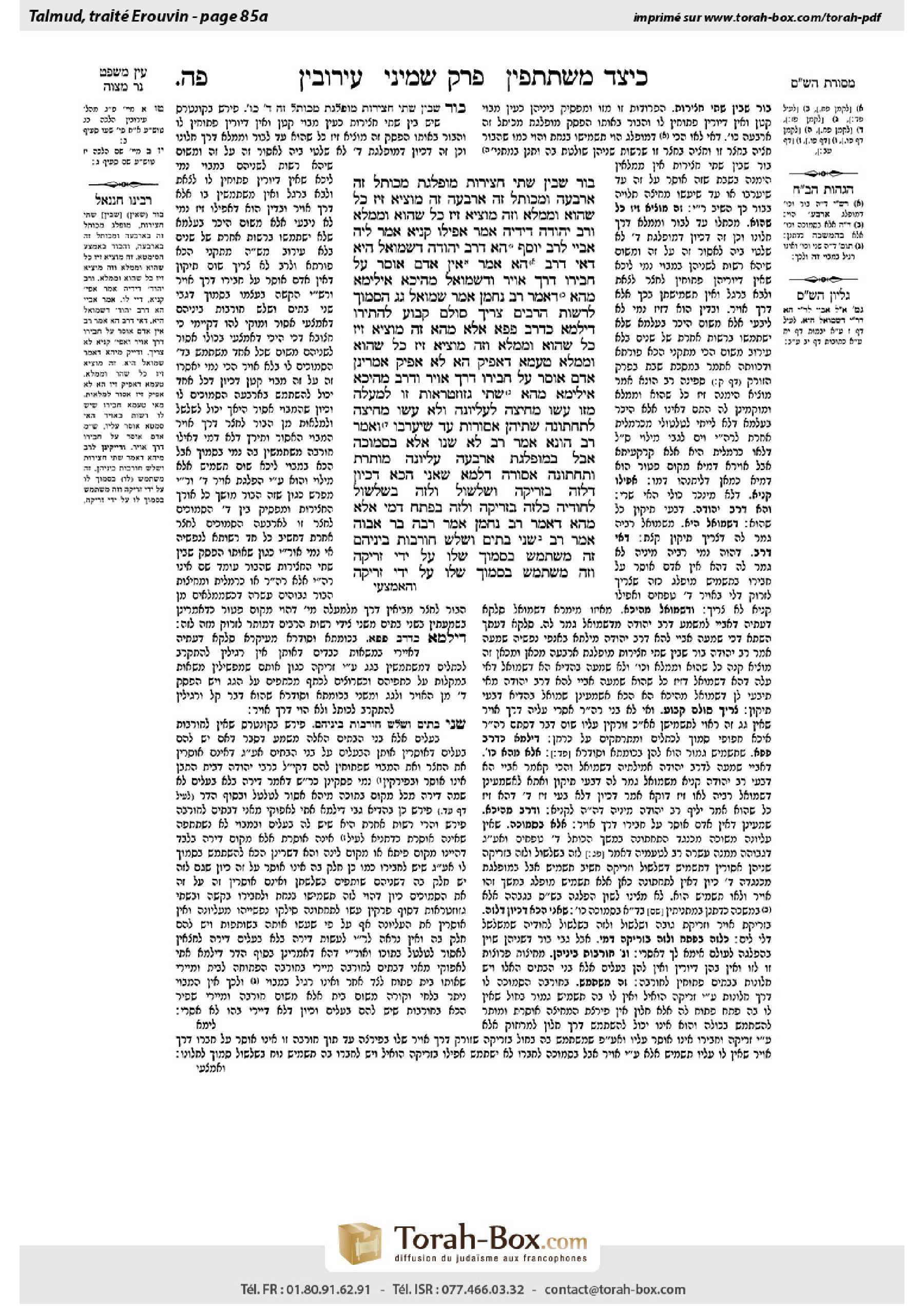
Eruvin 85a: Talmud study for Daf Yomi
Study the Talmud for Daf Yomi with scanned pages, Hebrew text, English translations from Sefaria and AI-generated French translations.
Passage selection and English or AI-generated French translation are available where the scan has annotations. Daf Study is independent of Torah-Box and Sefaria.
Browse Eruvin · עירובין · All tractatesEruvin 85a text and translations
This page of Eruvin includes the Aramaic text, an English translation and an AI-generated French translation, alongside the scan above.
עירובין פ״ה א · Aramaic and Hebrew text
בּוֹר שֶׁבֵּין שְׁתֵּי חֲצֵירוֹת, מוּפְלֶגֶת מִכּוֹתֶל זֶה אַרְבָּעָה וּמִכּוֹתֶל זֶה אַרְבָּעָה — זֶה מוֹצִיא זִיז כׇּל שֶׁהוּא וּמְמַלֵּא, וְזֶה מוֹצִיא זִיז כׇּל שֶׁהוּא וּמְמַלֵּא. וְרַב יְהוּדָה דִּידֵיהּ אָמַר: אֲפִילּוּ קַנְיָא.
אֲמַר לֵיהּ אַבָּיֵי לְרַב יוֹסֵף: הָא דְּרַב יְהוּדָה דִּשְׁמוּאֵל הִיא, דְּאִי דְּרַב, הָא אָמַר: אֵין אָדָם אוֹסֵר עַל חֲבֵירוֹ דֶּרֶךְ אֲוִיר.
וְדִשְׁמוּאֵל מֵהֵיכָא? אִילֵּימָא מֵהָא דְּאָמַר רַב נַחְמָן אָמַר שְׁמוּאֵל: גַּג הַסָּמוּךְ לִרְשׁוּת הָרַבִּים — צָרִיךְ סוּלָּם קָבוּעַ לְהַתִּירוֹ. דִּילְמָא כִּדְרַב פָּפָּא!
אֶלָּא מֵהָא: זֶה מוֹצִיא זִיז כׇּל שֶׁהוּא וּמְמַלֵּא, וְזֶה מוֹצִיא זִיז כׇּל שֶׁהוּא וּמְמַלֵּא. טַעְמָא דְּאַפֵּיק, הָא לָא אַפֵּיק — אָמְרִינַן: אָדָם אוֹסֵר עַל חֲבֵירוֹ דֶּרֶךְ אֲוִיר.
וּדְרַב מֵהֵיכָא? אִילֵּימָא מֵהָא: שְׁתֵּי גְזוּזְטְרָאוֹת זוֹ לְמַעְלָה מִזּוֹ, עָשׂוּ מְחִיצָה לָעֶלְיוֹנָה וְלֹא עָשׂוּ מְחִיצָה לַתַּחְתּוֹנָה — שְׁתֵּיהֶן אֲסוּרוֹת עַד שֶׁיַּעַרְבוּ.
וְאָמַר רַב הוּנָא אָמַר רַב: לֹא שָׁנוּ אֶלָּא בִּסְמוּכָה, אֲבָל בְּמוּפְלֶגֶת אַרְבָּעָה — עֶלְיוֹנָה מוּתֶּרֶת וְתַחְתּוֹנָה אֲסוּרָה.
דִּלְמָא שָׁאנֵי הָכָא, דְּכֵיוָן דְּלָזֶה בִּזְרִיקָה וְשִׁלְשׁוּל, וְלָזֶה בְּשִׁלְשׁוּל לְחוֹדֵיהּ — כְּלָזֶה בִּזְרִיקָה וְלָזֶה בְּפֶתַח דָּמֵי.
אֶלָּא מֵהָא דְּאָמַר רַב נַחְמָן אָמַר רַבָּה בַּר אֲבוּהּ אָמַר רַב: שְׁנֵי בָתִּים וְשָׁלֹשׁ חוֹרָבוֹת בֵּינֵיהֶם. זֶה מִשְׁתַּמֵּשׁ בַּסָּמוּךְ שֶׁלּוֹ עַל יְדֵי זְרִיקָה, וָזֶה מִשְׁתַּמֵּשׁ בַּסָּמוּךְ שֶׁלּוֹ עַל יְדֵי זְרִיקָה,
Eruvin 85a · English translation
If a cistern in a small alleyway between two courtyards is separated by four handbreadths from the wall of one courtyard and by four handbreadths from the wall of another courtyard, the resident of this courtyard may extend a ledge of minimal size from his window in the direction of the cistern, as a sign that he is not using the domain of the other, and he may subsequently proceed to draw water from the cistern through the window. And the resident of the other courtyard may likewise extend a ledge of minimal size and draw water from the cistern through his window. And Rav Yehuda himself said: An actual ledge is unnecessary, as it is enough even if one merely extends a simple reed.
Abaye said to Rav Yosef: This ruling of Rav Yehuda, that some minimal sort of adjustment is required, is in accordance with the opinion of his teacher, Shmuel. Since if he holds in accordance with the opinion of his other teacher, Rav, this would present a difficulty, as didn’t Rav say: One person does not render it prohibited for another person to perform an action by way of the air, if the place he is using is four handbreadths away from him? Consequently, not even a reed is required.
The Gemara asks: And from where is it ascertained that this is the opinion of Shmuel? If you say we learn it from that teaching which Rav Naḥman said that Shmuel said: With regard to a low roof adjacent to a public domain, there must be a fixed ladder from the courtyard to the roof in order to permit the use of the roof to the residents of the courtyard, it might be inferred from here that the people in the public domain render it prohibited to use the roof because they can use it through the air, by throwing. However, this proof is inconclusive. Perhaps, this halakha can be understood in accordance with the opinion of Rav Pappa: Here we are dealing with a roof upon which people in the public domain place their hats and shawls when in need of rest. That would mean that this halakha does not involve use of the airspace at all.
Rather, Shmuel’s opinion is learned from this statement: This one, the resident of one courtyard, may extend a ledge of minimal size and draw water from the cistern through his window; and the resident of the other courtyard may also extend a ledge of minimal size and draw water through his window. The reason for this halakha is that one extended a ledge, but if he did not extend a ledge, we say that one person renders it prohibited for another person by way of the air. One resident would be prohibited to draw water from the cistern due to the other resident, who has equal access to the water in the cistern by way of the air.
The Gemara asks: And from where is the opinion of Rav learned, that one person does not render it prohibited for another by way of the air? If you say it is derived from that which was taught in a mishna: If two balconies extend over a body of water, one above the other, and the residents erected a partition for the upper balcony but they did not erect a partition for the lower one, residents of both balconies are prohibited to draw water, unless they established an eiruv together.
The Gemara continues. And Rav Huna said that Rav said: They taught that the residents of one balcony render it prohibited for the residents of the other balcony to draw water only when one balcony is near the other, i.e., horizontally within four handbreadths. But if each balcony is four handbreadths removed from the other, so that each can use the other only by means of the air, the upper balcony is permitted to draw water, while the lower one is prohibited to do so. This teaching indicates that one person does not render it prohibited for use by another by way of the air.
However, this proof is inconclusive, as perhaps it is different here, since for the residents of this lower balcony, their use of the area is relatively inconvenient, as they can use it only by way of hoisting and lowering. The residents of the lower balcony must hoist the bucket from the lower balcony to the upper one before lowering it from there to draw water; whereas for the residents of the other one, i.e., the upper balcony, use of the water is convenient, as they can utilize it by way of lowering alone. Consequently, this case is similar to that of an area that can be used by the residents of one courtyard only by throwing and by the residents of another courtyard as an entrance. Since it is easier for the upper balcony to draw water, the lower balcony does not render it prohibited for the upper balcony in this particular case.
Rather, we can learn that this is the opinion of Rav from that teaching, which Rav Naḥman said that Rabba bar Avuh said that Rav said: If there are two houses with three ruins between them, the resident of this house may use the ruin adjacent to him by means of throwing into the ruin through his windows that open out to that ruin, and the resident of the other house may use the ruin adjacent to him by means of throwing through his windows,
Eruvin 85a · Traduction française (IA)
Si un puits est situé dans une petite rue entre deux courtyards, et s'il est séparé de quatre tefachim du mur d'un courtyard et de quatre tefachim du mur d'un autre courtyard, le résident de ce courtyard peut étendre un rebord de taille minimale depuis sa fenêtre dans la direction du puits, comme signe qu'il ne l'utilise pas dans le domaine de l'autre, et il peut ensuite procéder à tirer de l'eau du puits par la fenêtre. Et le résident du autre courtyard peut également étendre un rebord de taille minimale et tirer de l'eau du puits par sa fenêtre. Et Rav Yehuda lui-même a dit : Un rebord réel n'est pas nécessaire, car même un simple bambou suffit.
Abaye a dit à Rav Yosef : Cette décision de Rav Yehuda, selon laquelle un certain ajustement minimal est requis, est en conformité avec l'opinion de son maître, Shmuel. Car si il tenait compte de l'opinion de son autre maître, Rav, cela poserait un problème, car n'a-t-il pas dit : Une personne ne rend pas interdit à une autre de faire une action par l'air, si l'endroit qu'elle utilise est à quatre tefachim de lui ? Ainsi, même un bambou n'est pas nécessaire.
La Guemara pose la question : Et d'où est-il établi que c'est l'opinion de Shmuel ? Si vous dites que nous l'apprenons de cette enseignement que Rav Naḥman a dit que Shmuel a dit : Concernant un toit bas adjacent à un domaine public, il faut une échelle fixe du courtyard au toit afin de permettre l'utilisation du toit aux résidents du courtyard, on pourrait en déduire que les gens du domaine public rendent l'utilisation du toit interdite, car ils peuvent l'utiliser par l'air, en jetant. Cependant, cette preuve est insuffisante. Peut-être cette halakha peut-elle être comprise selon l'opinion de Rav Pappa : Ici, nous parlons d'un toit sur lequel les gens du domaine public posent leurs chapeaux et leurs manteaux lorsqu'ils ont besoin de repos. Cela signifierait que cette halakha ne concerne pas l'utilisation de l'air.
Plutôt, l'opinion de Shmuel est apprise à partir de cette déclaration : Celui-ci, le résident d'un courtyard, peut étendre un rebord de taille minimale et tirer de l'eau du puits par sa fenêtre ; et le résident de l'autre courtyard peut également étendre un rebord de taille minimale et tirer de l'eau par sa fenêtre. La raison de cette halakha est que l'un a étendu un rebord, mais si l'un n'avait pas étendu un rebord, nous disons qu'une personne rend l'utilisation interdite pour une autre par l'air. Un résident serait interdit de tirer de l'eau du puits en raison de l'autre résident, qui a un accès égal à l'eau du puits par l'air.
La Guemara pose la question : Et d'où est l'opinion de Rav, selon laquelle une personne ne rend pas interdite l'utilisation pour une autre par l'air ? Si vous dites qu'elle est tirée de celle qui a été enseignée dans une mitsva : Si deux balcons s'étendent sur un corps d'eau, l'un au-dessus de l'autre, et les résidents ont érigé une cloison pour le balcon supérieur mais pas pour le balcon inférieur, les résidents des deux balcons sont interdits de tirer de l'eau, sauf s'ils ont établi un eiruv ensemble.
La Guemara continue. Et Rav Huna a dit que Rav a dit : Ils ont enseigné que les résidents d'un balcon rendent l'utilisation interdite pour les résidents de l'autre balcon à tirer de l'eau seulement lorsque le balcon est proche de l'autre, c'est-à-dire horizontalement à quatre tefachim. Mais si chaque balcon est à quatre tefachim de l'autre, de sorte que chaque balcon peut utiliser l'autre uniquement par l'air, le balcon supérieur est autorisé à tirer de l'eau, tandis que le balcon inférieur est interdit de le faire. Cet enseignement indique que l'une personne ne rend pas l'utilisation interdite pour une autre par l'air.
Cependant, cette preuve est insuffisante, car peut-être c'est différent ici, car pour les résidents de ce balcon inférieur, leur utilisation de l'aire est relativement inconveniente, car ils peuvent l'utiliser uniquement par l'air, en levant et en abaissant. Les résidents du balcon inférieur doivent lever le seau du balcon inférieur vers le balcon supérieur avant de le baisser de là pour tirer de l'eau ; tandis que pour les résidents de l'autre, c'est-à-dire le balcon supérieur, l'utilisation de l'eau est facile, car ils peuvent l'utiliser simplement en abaissant. Ainsi, ce cas est similaire à celui d'une aire qui peut être utilisée par les résidents d'un courtyard uniquement par l'air et par les résidents d'un autre courtyard comme une entrée. Puisque l'utilisation est plus facile pour le balcon supérieur, le balcon inférieur ne rend pas l'utilisation interdite pour le balcon supérieur dans ce cas particulier.
Plutôt, nous pouvons apprendre que c'est l'opinion de Rav à partir de cette enseignement, que Rav Naḥman a dit que Rabba bar Avuh a dit que Rav a dit : Si deux maisons sont séparées par trois ruines, le résident de cette maison peut utiliser la ruine adjacente à lui par l'air, en jetant le seau depuis ses fenêtres qui donnent sur cette ruine, et le résident de l'autre maison peut utiliser la ruine adjacente à lui par l'air, en jetant depuis ses fenêtres,
Traduction française générée par IA à partir de l’édition anglaise de Sefaria. Vérifie toujours un passage avec le texte source.
Text from Sefaria: William Davidson Edition - Vocalized Aramaic (CC BY NC); William Davidson Edition - English (CC BY NC).