Eruvin 85b: Talmud study for Daf Yomi
Study the Talmud for Daf Yomi with scanned pages, Hebrew text, English translations from Sefaria and AI-generated French translations.
Passage selection and English or AI-generated French translation are available where the scan has annotations. Daf Study is independent of Torah-Box and Sefaria.
Browse Eruvin · עירובין · All tractatesEruvin 85b text and translations
This page of Eruvin includes the Aramaic text, an English translation and an AI-generated French translation, alongside the scan above.
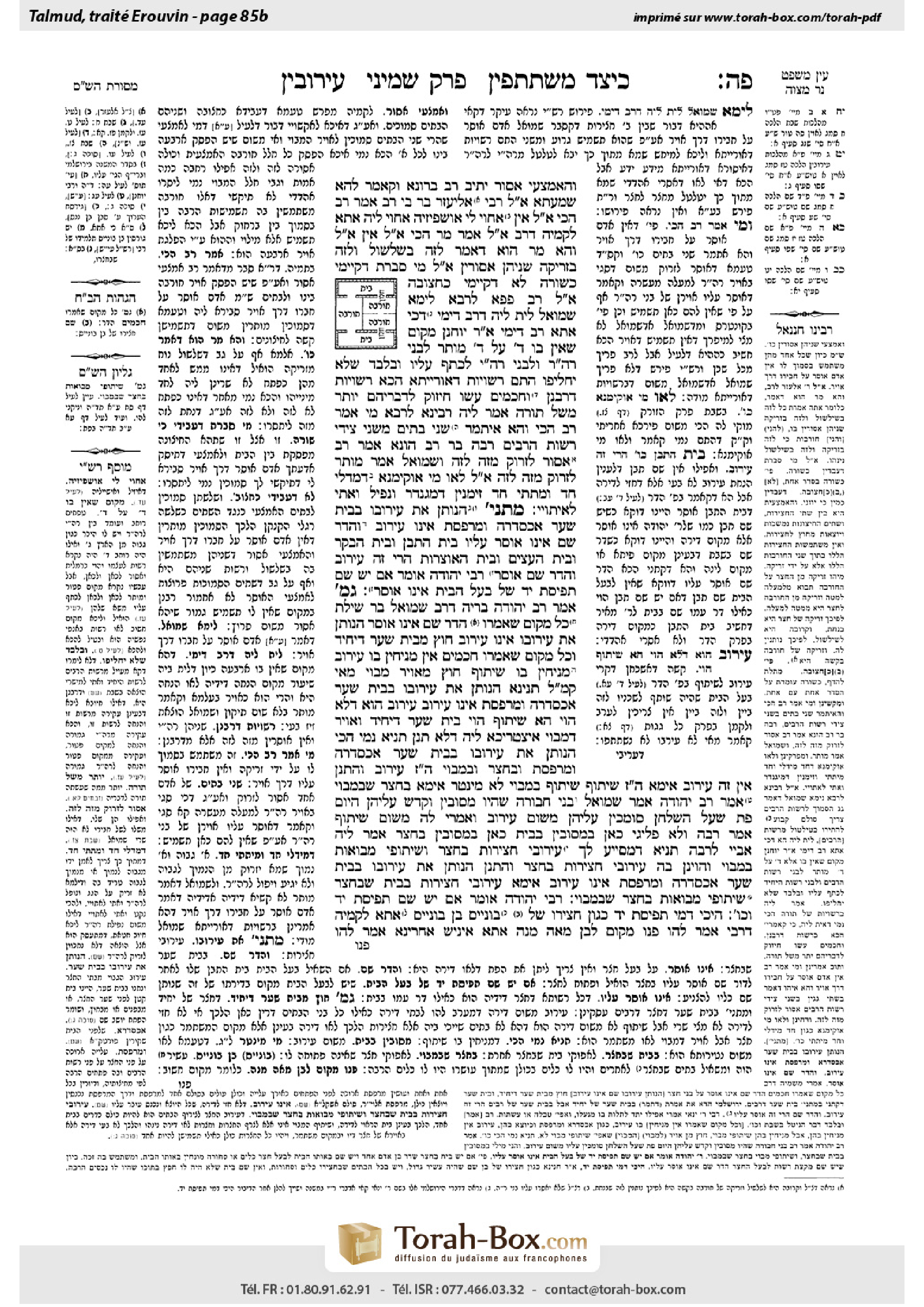
עירובין פ״ה ב · Aramaic and Hebrew text
וְהָאֶמְצָעִי — אָסוּר.
יָתֵיב רַב בְּרוֹנָא וְקָאָמַר לְהָא שְׁמַעְתָּא. אֲמַר לֵיהּ רַבִּי אֱלִיעֶזֶר בַּר בֵּי רַב: אָמַר רַב הָכִי? אֲמַר לֵיהּ: אִין. אַחְוִי לִי אוּשְׁפִּיזֵיהּ. אַחְוִי לֵיהּ. אֲתָא לְקַמֵּיהּ דְּרַב, אֲמַר לֵיהּ: אֲמַר מָר הָכִי? אֲמַר לֵיהּ: אִין.
אֲמַר לֵיהּ, וְהָא מָר הוּא דְּאָמַר: לָזֶה בְּשִׁלְשׁוּל וְלָזֶה בִּזְרִיקָה — שְׁנֵיהֶן אֲסוּרִין!
אֲמַר לֵיהּ: מִי סָבְרַתְּ דְּקָיְימִי כְּשׁוּרָה? לָא — דְּקָיְימִי כַּחֲצוּבָה.
אֲמַר לֵיהּ רַב פָּפָּא לְרָבָא: לֵימָא שְׁמוּאֵל לֵית לֵיהּ דְּרַב דִּימִי. דְּכִי אֲתָא רַב דִּימִי אָמַר רַבִּי יוֹחָנָן: מָקוֹם שֶׁאֵין בּוֹ אַרְבַּע עַל אַרְבַּע — מוּתָּר לִבְנֵי רְשׁוּת הָרַבִּים וְלִבְנֵי רְשׁוּת הַיָּחִיד לְכַתֵּף עָלָיו, וּבִלְבַד שֶׁלֹּא יַחֲלִיפוּ.
הָתָם — רְשׁוּיוֹת דְּאוֹרָיְיתָא, הָכָא — רְשׁוּיוֹת דְּרַבָּנַן. וַחֲכָמִים עָשׂוּ חִיזּוּק לְדִבְרֵיהֶם יוֹתֵר מִשֶּׁל תּוֹרָה.
אֲמַר לֵיהּ רָבִינָא לְרָבָא: מִי אָמַר רַב הָכִי? וְהָא אִיתְּמַר: שְׁנֵי בָתִּים מִשְּׁנֵי צִידֵּי רְשׁוּת הָרַבִּים, רַבָּה בַּר רַב הוּנָא אָמַר רַב: אָסוּר לִזְרוֹק מִזֶּה לָזֶה, וּשְׁמוּאֵל אָמַר: מוּתָּר לִזְרוֹק מִזֶּה לָזֶה!
אֲמַר לֵיהּ: לָאו מִי אוֹקֵימְנָא דְּמִדְּלֵי חַד וּמִתַּתֵּי חַד, זִימְנִין דְּמִגַּנְדַּר וְנָפֵיל, וְאָתֵי לְאֵיתוֹיֵי.
מַתְנִי׳ הַנּוֹתֵן אֶת עֵירוּבוֹ בְּבֵית שַׁעַר, אַכְסַדְרָה וּמִרְפֶּסֶת — אֵינוֹ עֵירוּב. וְהַדָּר שָׁם — אֵינוֹ אוֹסֵר עָלָיו.
בֵּית הַתֶּבֶן וּבֵית הַבָּקָר וּבֵית הָעֵצִים וּבֵית הָאוֹצָרוֹת — הֲרֵי זֶה עֵירוּב, וְהַדָּר שָׁם — אוֹסֵר. רַבִּי יְהוּדָה אוֹמֵר: אִם יֵשׁ שָׁם תְּפִיסַת יָד שֶׁל בַּעַל הַבַּיִת — אֵינוֹ אוֹסֵר.
גְּמָ׳ אָמַר רַב יְהוּדָה בְּרֵיהּ דְּרַב שְׁמוּאֵל בַּר שִׁילַת: כׇּל מָקוֹם שֶׁאָמְרוּ הַדָּר שָׁם אֵינוֹ אוֹסֵר — הַנּוֹתֵן אֶת עֵירוּבוֹ אֵינוֹ עֵירוּב, חוּץ מִבֵּית שַׁעַר דְּיָחִיד. וְכׇל מָקוֹם שֶׁאָמְרוּ חֲכָמִים אֵין מַנִּיחִין בּוֹ עֵירוּב — מַנִּיחִין בּוֹ שִׁיתּוּף, חוּץ מֵאֲוִיר מָבוֹי.
מַאי קָא מַשְׁמַע לַן? תְּנֵינָא: הַנּוֹתֵן אֶת עֵירוּבוֹ בְּבֵית שַׁעַר אַכְסַדְרָה וּמִרְפֶּסֶת — אֵינוֹ עֵירוּב. עֵירוּב הוּא דְּלָא הָוֵי, הָא שִׁיתּוּף הָוֵי?
בֵּית שַׁעַר דְּיָחִיד וַאֲוִיר דְּמָבוֹי אִיצְטְרִיכָא לֵיהּ, דְּלָא תְּנַן. תַּנְיָא נָמֵי הָכִי: הַנּוֹתֵן אֶת עֵירוּבוֹ בְּבֵית שַׁעַר אַכְסַדְרָה וּמִרְפֶּסֶת וּבְחָצֵר וּבְמָבוֹי — הֲרֵי זֶה עֵירוּב. וְהָתְנַן: אֵין זֶה עֵירוּב! אֵימָא: הֲרֵי זֶה שִׁיתּוּף.
שִׁיתּוּף בְּמָבוֹי לָא מִינְּטַר? אֵימָא: בְּחָצֵר שֶׁבְּמָבוֹי.
אָמַר רַב יְהוּדָה אָמַר שְׁמוּאֵל: בְּנֵי חֲבוּרָה שֶׁהָיוּ מְסוּבִּין וְקִדֵּשׁ עֲלֵיהֶן הַיּוֹם, פַּת שֶׁעַל הַשֻּׁלְחָן סוֹמְכִין עֲלֵיהֶן מִשּׁוּם עֵירוּב. וְאָמְרִי לַהּ: מִשּׁוּם שִׁיתּוּף.
אָמַר רַבָּה, וְלָא פְּלִיגִי: כָּאן — בִּמְסוּבִּין בַּבַּיִת, כָּאן — בִּמְסוּבִּין בֶּחָצֵר.
אֲמַר לֵיהּ אַבָּיֵי לְרַבָּה: תַּנְיָא דִּמְסַיַּיע לָךְ: עֵירוּבֵי חֲצֵירוֹת בֶּחָצֵר, וְשִׁיתּוּפֵי מְבוֹאוֹת בַּמָּבוֹי. וְהָוֵינַן בַּהּ, עֵירוּבֵי חֲצֵירוֹת בֶּחָצֵר? וְהָתְנַן: הַנּוֹתֵן אֶת עֵירוּבוֹ בְּבֵית שַׁעַר אַכְסַדְרָה וּמִרְפֶּסֶת אֵינוֹ עֵירוּב! אֵימָא: עֵירוּבֵי חֲצֵירוֹת — בַּבַּיִת שֶׁבֶּחָצֵר, שִׁיתּוּפֵי מְבוֹאוֹת — בֶּחָצֵר שֶׁבַּמָּבוֹי.
רַבִּי יְהוּדָה אוֹמֵר: אִם יֵשׁ שָׁם תְּפִיסַת יָד וְכוּ׳. הֵיכִי דָּמֵי תְּפִיסַת יָד? כְּגוֹן חֲצֵירוֹ שֶׁל בּוֹנְיָיס.
בֶּן בּוֹנְיָיס אֲתָא לְקַמֵּיהּ דְּרַבִּי, אֲמַר לְהוּ: פַּנּוּ מָקוֹם לְבֶן מֵאָה מָנֶה. אֲתָא אִינִישׁ אַחֲרִינָא, אֲמַר לְהוּ:
Eruvin 85b · English translation
and the middle ruin is prohibited to both of them.
Rav Beruna sat and stated this halakha in the name of Rav. Rabbi Elazar, a student of the Torah academy, said to him: Did Rav actually say this? Rav Beruna said to him: Yes, he did. He said to him: Show me his place of lodging, and I will go and ask him myself. He showed him where Rav lived. Rabbi Elazar came before Rav and said to him: Did the Master actually say this? He said to him: Yes, I did.
Rabbi Elazar then said to Rav: Since you prohibit using the middle ruin, you evidently maintain that one person renders it prohibited for another by way of the air. That being the case, it must be that you permit the resident of each house to use the adjacent ruin because one’s use of the ruin, while not convenient for him, is more convenient than the other person’s usage. But wasn’t it the Master himself who said: With regard to a place that can be used by the residents of the one courtyard only by lowering an object down to it and by the residents of another courtyard only by throwing an object on top of it, so that neither courtyard has convenient access to it, both sets of residents are prohibited from using it, although lowering an object is more convenient than throwing it?
Rav said to him: Do you think that we are dealing with a case of three ruins positioned alongside each other in a straight line? No. They are arranged in the form of a tripod, i.e. in a triangular form. In other words, two of the ruins, each adjacent to one of the houses, are located next to each other; the third is positioned adjacent to one side of the other two, near both houses. The middle ruin is prohibited to the residents of both houses because both houses have equally inconvenient but direct access to it. However, each of the other ruins is permitted to the resident of the adjacent house, as he has direct access to it, while the resident of the other house can reach it only through the air of the ruin nearest to him, and Rav maintains that one person does not render it prohibited for use by another by way of the air.
Rav Pappa said to Rava: Let us say that Shmuel, who maintains that one renders it prohibited for another by way of the air, does not agree with the opinion of Rav Dimi. When Rav Dimi came from Eretz Yisrael to Babylonia, he said that Rabbi Yoḥanan said: A place less than four by four handbreadths in size is an exempt domain with respect to carrying on Shabbat. Consequently, if this place is located between a public domain and a private domain, it is permitted for both the people in the public domain and the people in the private domain to adjust the burden on their shoulders in it, as long as they do not exchange objects with each other by way of the exempt domain. According to Shmuel’s opinion this should be prohibited due to the air of a different domain.
Rava replied: There, Rabbi Yoḥanan is dealing with an exempt domain situated between a public domain and a private domain, the two existing domains by Torah law. In that case, the Sages did not prohibit the use of the place due to the air. By contrast, here, with regard to the air between private domains, we are dealing with domains between which carrying is prohibited by rabbinic law, and the Sages reinforced their statements even more than those of the Torah; they added preventive measures in order to safeguard their decrees. Consequently, according to Shmuel, the Sages indeed decreed that one renders it prohibited for another by way of the air.
Ravina said to Rava: But did Rav actually say this, that one person does not render it prohibited for use by another by way of the air? But wasn’t it stated that amora’im disagreed with regard to two houses belonging to one person that stood on two opposite sides of a public domain. Rabba bar Rav Huna said that Rav said: It is prohibited to throw an object from one house to the other; and Shmuel said that it is permitted to throw from one to the other. Rav apparently forbade the act of throwing due to the prohibited air of the public domain that lies between the two houses.
Rava said to him: Wasn’t it established that one house was relatively higher and the other one was lower than the first? Rav prohibited throwing from one domain to the other, not due to the air of the public domain, but rather due to the difficulty of throwing from a low place to a higher one, as the thrown object might sometimes roll and fall back into the public domain and people might come to pick it up and carry it from the public domain to the private domain. It was for this reason that Rav prohibited throwing an object from one house to another.
MISHNA: With regard to one who placed his eiruv of courtyards in a gatehouse or in a portico, a roofed structure without walls or with incomplete walls, or one who deposited it in a balcony, this is not a valid eiruv. And one who resides there, in any of these structures, does not render it prohibited for the homeowner and the other residents of the courtyard to carry, even if he did not contribute to the eiruv.
If, however, one deposited his eiruv in a hay shed or in a cowshed or in a woodshed or in a storehouse, this is a valid eiruv, as it is located in a properly guarded place. And one who resides there with permission, if he neglected to contribute to the eiruv, he renders it prohibited for the homeowner and the other residents of the courtyard to carry. Rabbi Yehuda says: If the homeowner has there, in the hay shed or the other places listed above, a right of usage, i.e., if he is entitled to use all or part of the area for his own purposes, then the one who lives there does not render it prohibited for the homeowner, as the area is considered the homeowner’s quarters, and the person living there is classified as a member of his household.
GEMARA: Rav Yehuda, son of Rav Shmuel bar Sheilat, said: Any place with regard to which the Sages said that one who resides there does not render it prohibited for the other residents of the courtyard to carry, one who places his eiruv there, his is not a valid eiruv, except for a gatehouse that belongs to an individual. If a structure is used as a passageway by only one person, he does not render it prohibited for the other residents of the courtyard, and an eiruv placed there is a valid eiruv. And any place with regard to which the Sages said that a joining of courtyards may not be placed there, a merging of alleyways may be placed there, except for the airspace of an alleyway, which is not inside one of the courtyards.
The Gemara asks: What is he teaching us by this? We have already learned this in the mishna: With regard to one who placed his eiruv in a gatehouse or in a portico or in a balcony, it is not a valid eiruv. It can be inferred from the mishna that an eiruv, it is not, a merging of the alleyway, it is. What, then, is novel in this statement?
The Gemara answers: It was necessary for him to teach the halakha of a gatehouse that belongs to an individual and the halakha of the airspace of an alleyway, which we did not learn in the mishna. This was also taught in a baraita: One who placed his eiruv in a gatehouse, or in a portico, or in a balcony, or in a courtyard, or in an alleyway, this is a valid eiruv. But didn’t we learn in the mishna that this is not an eiruv? Rather, you must say that the baraita should read: This is a valid merging of the alleyway.
The Gemara raises a difficulty: But if one places the food of the merging of the alleyway in the alleyway itself, it is not properly guarded, which means that it is as though he has not placed the merging of the alleyway there at all. Rather, you must say that the baraita should read: If he placed his merging of the alleyway in a courtyard in the alleyway, it is valid.
Rav Yehuda said that Shmuel said: If there were a group of people who were dining together on Shabbat eve, and the day became sanctified for them, i.e., Shabbat began while they were eating, they may rely upon the bread on the table for an eiruv of courtyards, so that they are all permitted to carry in the courtyard. And some say they may rely on the bread for a merging of the alleyway.
Rabba said: The two versions do not disagree with regard to whether the bread counts as an eiruv or a merging of the alleyway. Rather, here, the teaching that states it can be used as an eiruv, is referring to a case where they are dining in the house, as food deposited in a house can be used as an eiruv for the courtyard. By contrast, there it is referring to a situation where they are dining in the courtyard, and they may therefore rely on the bread only as a merging of the alleyway but not as an eiruv.
Abaye said to Rabba: A baraita was taught that supports you. Joinings of courtyards are deposited in a courtyard, and mergings of alleyways are placed in an alleyway. And we discussed this baraita and raised a difficulty: How can it be that eiruvin of courtyards are deposited in a courtyard? But didn’t we learn in the mishna: If one deposited his eiruv in a gatehouse, or in a portico, or in a balcony it is not a valid eiruv? The mishna clearly indicates that the eiruv may not be deposited in the airspace of a courtyard. Rather, you must say that the baraita should read as follows: Eiruvin of a courtyard are placed in a house in that courtyard; whereas mergings of alleyways are placed in a courtyard that opens into that alleyway.
We learned in the mishna that Rabbi Yehuda says: If the homeowner has there, in the hay shed or one of the other places listed, a right of usage, the person living there does not render the courtyard prohibited. The Gemara asks: What are the circumstances of a right of usage? The Gemara answers: For example, the courtyard of a man named Bonyas, an extremely wealthy individual who allowed various people to take up residence on his property, and he kept some of his many possessions in the living quarters assigned to those people. As he retained the right to remove his articles from their apartments, those areas continued to be regarded as quarters belonging to Bonyas and the people living there were deemed members of his household.
The Gemara relates another incident involving Bonyas and his wealth: The son of Bonyas came before Rabbi Yehuda HaNasi. Realizing from his visitor’s clothing that he was dealing with a wealthy individual, Rabbi Yehuda HaNasi said to his attendants: Make way for one who possesses one hundred maneh, i.e., one hundred times one hundred zuz, as one of this status deserves to be honored in accordance with his riches. Later, another person came before him, and Rabbi Yehuda HaNasi once again turned to his attendants and said to them:
Eruvin 85b · Traduction française (IA)
et la ruine du milieu est interdite aux deux.
Rav Beruna s'est assis et a déclaré cette halakha au nom de Rav. Rabbi Elazar, un étudiant de l'académie de la Torah, lui a dit : Le Maître a-t-il vraiment dit cela ? Rav Beruna lui a répondu : Oui, il l'a dit. Il lui a dit : Montre-moi son lieu de résidence, et je vais aller le lui demander moi-même. Il lui a montré où habitait Rav. Rabbi Elazar est venu devant Rav et lui a dit : Le Maître a-t-il vraiment dit cela ? Il a répondu : Oui, je l'ai dit.
Rabbi Elazar a ensuite dit à Rav : Puisque vous interdisez l'utilisation de la ruine du milieu, vous maintenez visiblement que l'un rend l'autre interdit par l'air. Dans ce cas, il doit être que vous permettez à l'habitant de chaque maison d'utiliser la ruine adjacente, car l'utilisation de la ruine par l'un, bien qu'inconveniente pour lui, est plus pratique que celle de l'autre. Mais n'était-ce pas le Maître lui-même qui avait dit : En ce qui concerne un lieu qui peut être utilisé par les habitants d'un courtil seulement en descendant un objet jusqu'à lui et par les habitants d'un autre courtil seulement en jetant un objet sur lui, de sorte que ni courtil n'a un accès pratique à lui, les deux groupes d'habitants sont interdits d'utiliser ce lieu, même si descendre un objet est plus pratique que jeter un objet ?
Rav a répondu à lui : Pensez-vous que nous sommes en présence d’un cas de trois ruines alignées en ligne droite ? Non. Elles sont disposées en forme de trépied, c’est-à-dire en forme triangulaire. En d’autres termes, deux des ruines, chacune adjacente à une des maisons, sont situées l’une à côté de l’autre ; la troisième est placée adjacent à un côté de l’une des deux, près des deux maisons. La ruine du milieu est interdite aux habitants des deux maisons car les deux maisons ont un accès direct mais inconvenant à elle. Cependant, chaque des autres ruines est permise à l’habitant de la maison adjacente, car il a un accès direct à elle, tandis que l’habitant de l’autre maison peut y accéder uniquement par l’air de la ruine la plus proche, et Rav maintient que l’un ne rend pas l’autre interdit par l’air.
Rav Pappa a dit à Rava : Disons que Shmuel, qui affirme que l'un rend l'autre interdit par l'air, ne s'accorde pas avec l'opinion de Rav Dimi. Lorsque Rav Dimi est venu de la Terre d'Israël en Babylone, il a dit que Rabbi Yoḥanan a dit : Un lieu dont la taille est inférieure à quatre par quatre tefachim est un domaine exempt concernant le transport le sabbat. Ainsi, si ce lieu est situé entre un domaine public et un domaine privé, il est permis aux habitants du domaine public et aux habitants du domaine privé d'ajuster le fardeau sur leurs épaules en ce lieu, à condition qu'ils ne transmettent pas d'objets entre eux par le domaine exempt. Selon l'opinion de Shmuel, cela devrait être interdit en raison de l'air d'un autre domaine.
Rava répondit : Là, Rabbi Yoḥanan traite d'un domaine exempt situé entre un domaine public et un domaine privé, les deux existant selon la loi de la Torah. Dans ce cas, les Sages n'ont pas interdit l'utilisation de ce lieu en raison de l'air. À l'inverse, ici, concernant l'air entre des domaines privés, nous sommes en présence de domaines entre lesquels le transport est interdit selon la loi rabbinique, et les Sages ont renforcé leurs déclarations plus encore que ceux de la Torah ; ils ont ajouté des mesures préventives afin de protéger leurs décrets. Ainsi, selon Shmuel, les Sages ont effectivement décrété que l'un rend l'autre interdit par l'air.
Ravina dit à Rava : Mais le Maître a-t-il vraiment dit cela, que l'un ne rend pas l'autre interdit par l'air ? N'était-ce pas établi que les amoraïm s'opposaient concernant deux maisons appartenant à une même personne qui se trouvaient des deux côtés d'un domaine public. Rabba bar Rav Huna dit que Rav a dit : Il est interdit de jeter un objet d'une maison à l'autre ; et Shmuel a dit que cela est permis de jeter d'une maison à l'autre. Rav semble avoir interdit le jet d'objet en raison de l'air interdit du domaine public qui se trouve entre les deux maisons.
Rava dit à lui : N'était-ce pas établi qu'une maison était relativement plus haute et l'autre plus basse que la première ? Rav a interdit le jet d'un domaine à l'autre, pas en raison de l'air du domaine public, mais plutôt en raison de la difficulté de jeter d'un endroit bas vers un endroit plus haut, car l'objet jeté pourrait parfois rouler et retomber dans le domaine public et les gens pourraient venir le ramasser et le transporter du domaine public vers le domaine privé. C'est pour cette raison que Rav a interdit le jet d'un objet d'une maison à une autre.
MICHNA : En ce qui concerne celui qui a placé son eiruv de courtyards dans une porte, dans un porche, une structure toilée sans murs ou avec des murs incomplets, ou celui qui l'a déposé dans un balcon, cela n'est pas un eiruv valide. Et celui qui habite là, dans l'une de ces structures, ne rend pas interdit pour le propriétaire et les autres habitants du courtil de porter, même s'il n'a pas contribué à l'eiruv.
Cependant, si l'on a déposé son eiruv dans un grenier à foin, un étable, un tas de bois ou un entrepôt, cela est un eiruv valide, car il est situé dans un lieu correctement gardé. Et celui qui habite là avec la permission, s'il a négligé de contribuer à l'eiruv, il rend interdit pour le propriétaire et les autres habitants du courtil de porter. Rabbi Yehuda dit : Si le propriétaire a là, dans le grenier à foin ou les autres lieux mentionnés ci-dessus, un droit d'usage, c'est-à-dire s'il est autorisé à utiliser toute ou partie de la zone à ses propres fins, alors celui qui habite là ne rend pas interdit pour le propriétaire, car la zone est considérée comme les appartements du propriétaire, et la personne qui y habite est classée comme un membre de sa famille.
GUEMARA : Rav Yehuda, fils de Rav Shmuel bar Sheilat, dit : Tout lieu concernant lequel les Sages ont dit que celui qui y demeure ne rend pas ce lieu interdit aux autres habitants du courtil pour porter, celui qui y place son eiruv, son eiruv n'est pas valide, sauf pour une porte qui appartient à un individu. Si une structure est utilisée comme passage par une seule personne, elle ne rend pas ce lieu interdit aux autres habitants du courtil, et un eiruv placé là est un eiruv valide. Et tout lieu concernant lequel les Sages ont dit qu'on ne peut pas placer un rapprochement de courtils là, on peut placer un rapprochement de ruelles là, sauf pour l'espace aérien d'une ruelle, qui n'est pas à l'intérieur d'un des courtils.
La Guemara pose la question : Qu'est-ce que ce texte nous apprend ? Nous avons déjà appris cela dans la mitsna : Concernant celui qui a placé son eiruv dans une porte, ou dans un portique, ou dans un balcon, ce n'est pas un eiruv valide. On peut en déduire de la mitsna que l'eiruv n'est pas valide, mais le rapprochement de ruelles est valide. Qu'est-ce donc de nouveau dans cette déclaration ?
La Guemara répond : Il était nécessaire qu'il nous apprenne la halakha concernant une porte qui appartient à un individu et la halakha concernant l'espace aérien d'une ruelle, que nous n'avons pas appris dans la mitsna. Cela a également été enseigné dans une baraïta : Celui qui a placé son eiruv dans une porte, ou dans un portique, ou dans un balcon, ou dans un courtil, ou dans une ruelle, c'est un eiruv valide. Mais n'avons-nous pas appris dans la mitsna que cela n'est pas un eiruv ? Plutôt, vous devez dire que la baraïta devrait lire : C'est un rapprochement valide de ruelles.
La Guemara soulève une difficulté : Mais si l'on place les aliments du rapprochement de ruelles dans la ruelle elle-même, cela n'est pas suffisamment gardé, ce qui signifie qu'on peut considérer qu'il n'a pas placé le rapprochement de ruelles là du tout. Plutôt, vous devez dire que la baraïta devrait lire : Si l'on a placé son rapprochement de ruelles dans un courtil dans la ruelle, c'est valide.
Rav Yehuda dit que Shmuel a dit : Si un groupe de personnes dînait ensemble le soir du Shabbat, et que le jour est devenu sanctifié pour eux, c'est-à-dire que le Shabbat a commencé pendant qu'ils mangeaient, ils peuvent compter sur le pain sur la table pour un eiruv des courtils, afin qu'ils soient tous autorisés à porter dans le courtil. Et certains disent qu'ils peuvent compter sur le pain pour un rapprochement de ruelles.
Rabba dit : Les deux versions ne s'opposent pas quant à savoir si le pain compte comme un eiruv ou un rapprochement de ruelles. Plutôt, ici, la déclaration qui dit qu'il peut être utilisé comme un eiruv fait référence à un cas où ils dînent à la maison, car les aliments déposés dans une maison peuvent être utilisés comme un eiruv pour le courtil. À l'inverse, là, il fait référence à un cas où ils dînent dans le courtil, et ils peuvent donc compter sur le pain uniquement comme un rapprochement de ruelles mais pas comme un eiruv.
Abaye dit à Rabba : Une baraïta a été enseignée qui vous soutient. Les rapprochements de courtyards sont déposés dans un courtyard, et les rapprochements de ruelles sont placés dans une ruelle. Et nous avons discuté de cette baraïta et avons soulevé une difficulté : Comment peut-il être que des eiruvin de courtyards soient déposés dans un courtyard ? Mais n'avons-nous pas appris dans la mitsna : Si l'on dépose son eiruv dans une porte, ou dans un portique, ou dans un balcon, ce n'est pas un eiruv valide ? La mitsna indique clairement que l'eiruv ne peut pas être déposé dans l'espace aérien d'un courtyard. Plutôt, vous devez dire que la baraïta devrait lire ainsi : Les eiruvin d'un courtyard sont placés dans une maison dans ce courtyard ; tandis que les rapprochements de ruelles sont placés dans un courtyard qui s'ouvre sur cette ruelle.
Nous avons appris dans la mitsna que Rabbi Yehuda dit : Si le propriétaire a là, dans le grenier ou l'un des autres lieux mentionnés, un droit d'usage, la personne qui y demeure ne rend pas le courtyard interdit. La Guemara pose la question : Quelles sont les circonstances d'un droit d'usage ? La Guemara répond : Par exemple, le courtyard d'un homme nommé Bonyas, un homme extrêmement riche qui a permis à diverses personnes de s'installer sur sa propriété, et il a gardé certains de ses nombreux biens dans les appartements assignés à ces personnes. Comme il conservait le droit de retirer ses objets de leurs appartements, ces zones continuaient à être considérées comme des appartements appartenant à Bonyas et les personnes qui y demeuraient étaient considérées comme faisant partie de sa famille.
La Guemara rapporte un autre incident concernant Bonyas et sa richesse : Le fils de Bonyas est venu devant Rabbi Yehuda HaNasi. Reconnaissant à partir de ses vêtements qu'il s'agissait d'une personne riche, Rabbi Yehuda HaNasi a dit à ses serviteurs : Faites place à celui qui possède cent maneh, c'est-à-dire cent fois cent zuz, car une personne de ce statut mérite d'être honorée conformément à ses richesses. Plus tard, une autre personne est venue devant lui, et Rabbi Yehuda HaNasi a à nouveau tourné vers ses serviteurs et leur a dit :
Traduction française générée par IA à partir de l’édition anglaise de Sefaria. Vérifie toujours un passage avec le texte source.
Text from Sefaria: William Davidson Edition - Vocalized Aramaic (CC BY NC); William Davidson Edition - English (CC BY NC).