Eruvin 86a: Talmud study for Daf Yomi
Study the Talmud for Daf Yomi with scanned pages, Hebrew text, English translations from Sefaria and AI-generated French translations.
Passage selection and English or AI-generated French translation are available where the scan has annotations. Daf Study is independent of Torah-Box and Sefaria.
Browse Eruvin · עירובין · All tractatesEruvin 86a text and translations
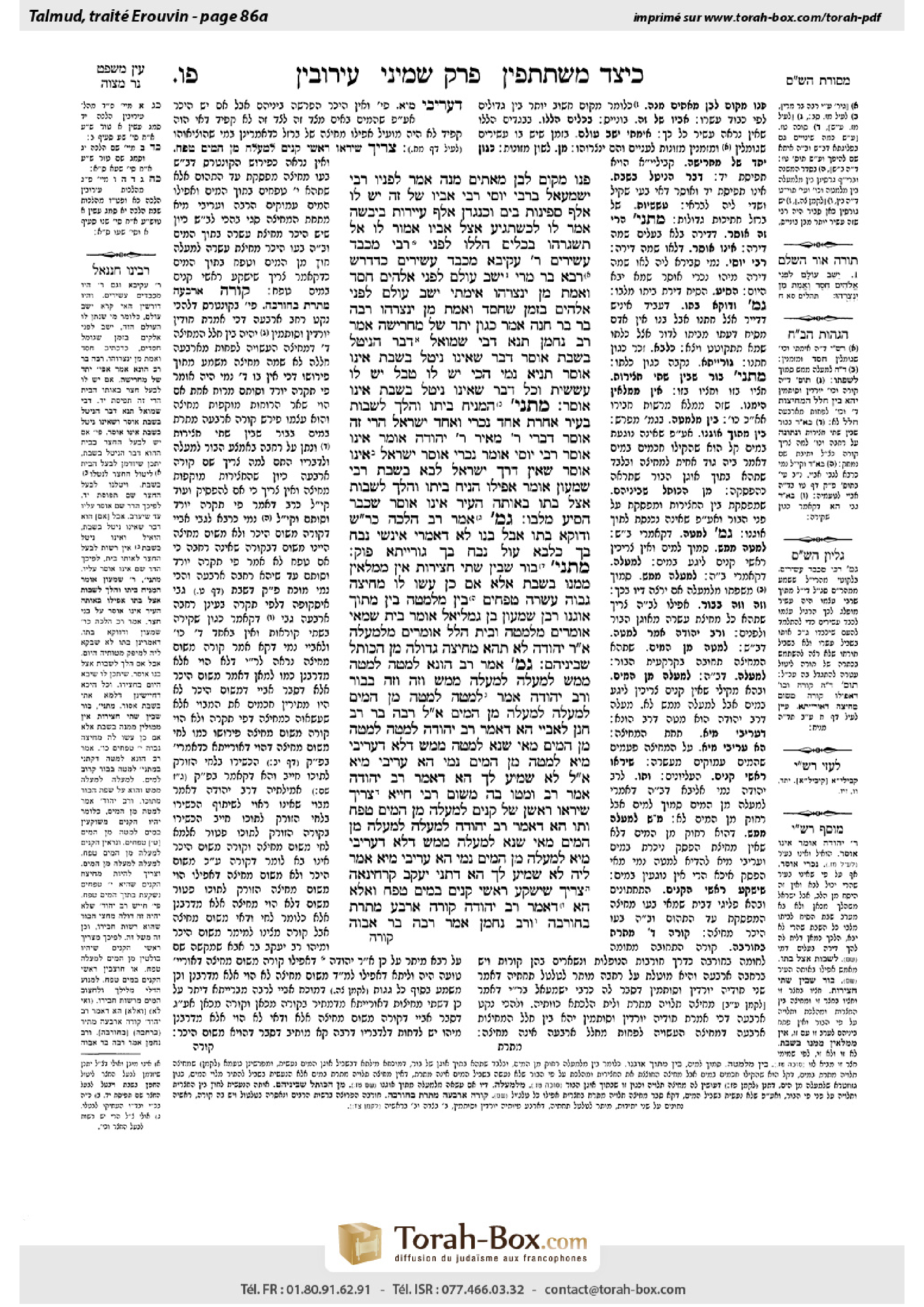
This page of Eruvin includes the Aramaic text, an English translation and an AI-generated French translation, alongside the scan above.
עירובין פ״ו א · Aramaic and Hebrew text
פַּנּוּ מָקוֹם לְבֶן מָאתַיִם מָנֶה. אָמַר לְפָנָיו רַבִּי יִשְׁמָעֵאל בְּרַבִּי יוֹסֵי: רַבִּי, אָבִיו שֶׁל זֶה יֵשׁ לוֹ אֶלֶף סְפִינוֹת בַּיָּם, וּכְנֶגְדָּן אֶלֶף עֲיָירוֹת בַּיַּבָּשָׁה. אָמַר לוֹ: לִכְשֶׁתַּגִּיעַ אֵצֶל אָבִיו אֱמוֹר לוֹ: אַל תְּשַׁגְּרֵהוּ בַּכֵּלִים הַלָּלוּ לְפָנַי.
רַבִּי מְכַבֵּד עֲשִׁירִים. רַבִּי עֲקִיבָא מְכַבֵּד עֲשִׁירִים. כִּדְדָרֵשׁ רָבָא בַּר מָרִי: ״יֵשֵׁב עוֹלָם לִפְנֵי אֱלֹהִים חֶסֶד וֶאֱמֶת מַן יִנְצְרֻהוּ״ — אֵימָתַי יֵשֵׁב עוֹלָם לִפְנֵי אֱלֹהִים? בִּזְמַן שֶׁחֶסֶד וֶאֱמֶת מַן יִנְצְרֻהוּ.
רַבָּה בַּר בַּר חָנָה אָמַר: כְּגוֹן יָתֵד שֶׁל מַחֲרֵישָׁה.
אָמַר רַב נַחְמָן, תָּנָא דְּבֵי שְׁמוּאֵל: דָּבָר הַנִּיטָּל בְּשַׁבָּת — אוֹסֵר. דָּבָר שֶׁאֵינוֹ נִיטָּל בְּשַׁבָּת — אֵינוֹ אוֹסֵר.
תַּנְיָא נָמֵי הָכִי: יֵשׁ לוֹ טֶבֶל, יֵשׁ לוֹ עֲשָׁשִׁית, וְכׇל דָּבָר שֶׁאֵינוֹ נִיטָּל בְּשַׁבָּת — אֵינוֹ אוֹסֵר.
מַתְנִי׳ הַמַּנִּיחַ בֵּיתוֹ וְהָלַךְ לִשְׁבּוֹת בְּעִיר אַחֶרֶת, אֶחָד נׇכְרִי וְאֶחָד יִשְׂרָאֵל — הֲרֵי זֶה אוֹסֵר, דִּבְרֵי רַבִּי מֵאִיר. רַבִּי יְהוּדָה אוֹמֵר: אֵינוֹ אוֹסֵר.
רַבִּי יוֹסֵי אוֹמֵר: נׇכְרִי — אוֹסֵר, יִשְׂרָאֵל — אֵינוֹ אוֹסֵר, שֶׁאֵין דֶּרֶךְ יִשְׂרָאֵל לָבֹא בַּשַּׁבָּת.
רַבִּי שִׁמְעוֹן אוֹמֵר: אֲפִילּוּ הִנִּיחַ בֵּיתוֹ וְהָלַךְ לִשְׁבּוֹת אֵצֶל בִּתּוֹ בְּאוֹתָהּ הָעִיר — אֵינוֹ אוֹסֵר, שֶׁכְּבָר הִסִּיעַ מִלִּבּוֹ.
גְּמָ׳ אָמַר רַב: הֲלָכָה כְּרַבִּי שִׁמְעוֹן. וְדַוְקָא בִּתּוֹ, אֲבָל בְּנוֹ — לָא. דְּאָמְרִי אִינָשֵׁי: נְבַח בָּךְ כַּלְבָּא — עוּל, נְבַח בָּךְ גּוּרַיְיתָא — פּוֹק.
מַתְנִי׳ בּוֹר שֶׁבֵּין שְׁתֵּי חֲצֵירוֹת — אֵין מְמַלְּאִין מִמֶּנּוּ בַּשַּׁבָּת, אֶלָּא אִם כֵּן עָשׂוּ לוֹ מְחִיצָה גְּבוֹהָ עֲשָׂרָה טְפָחִים, בֵּין מִלְּמַטָּה, בֵּין מִתּוֹךְ אוֹגְנוֹ.
רַבָּן שִׁמְעוֹן בֶּן גַּמְלִיאֵל אוֹמֵר: בֵּית שַׁמַּאי אוֹמְרִים מִלְּמַטָּה, וּבֵית הִלֵּל אוֹמְרִים מִלְּמַעְלָה. אָמַר רַבִּי יְהוּדָה: לֹא תְּהֵא מְחִיצָה גְּדוֹלָה מִן הַכּוֹתֶל שֶׁבֵּינֵיהֶם.
גְּמָ׳ אָמַר רַב הוּנָא: לְמַטָּה — לְמַטָּה מַמָּשׁ, לְמַעְלָה — לְמַעְלָה מַמָּשׁ, וְזֶה וָזֶה בְּבוֹר. וְרַב יְהוּדָה אָמַר: לְמַטָּה — לְמַטָּה מִן הַמַּיִם, לְמַעְלָה — לְמַעְלָה מִן הַמַּיִם.
אֲמַר לֵיהּ רַבָּה בַּר רַב חָנָן לְאַבָּיֵי: הָא דְּאָמַר רַב יְהוּדָה ״לְמַטָּה — לְמַטָּה מִן הַמַּיִם״, מַאי שְׁנָא לְמַטָּה מַמָּשׁ דְּלָא? דַּעֲרִיבִי מַיָּא. לְמַטָּה מִן הַמַּיִם נָמֵי, הָא עֲרִיבִי מַיָּא?!
אֲמַר לֵיהּ: לָא שְׁמִיעַ לָךְ הָא דְּאָמַר רַב יְהוּדָה אָמַר רַב, וּמָטוּ בָּהּ מִשּׁוּם רַבִּי חִיָּיא: צָרִיךְ שֶׁיֵּרָאוּ רֹאשָׁן שֶׁל קָנִים לְמַעְלָה מִן הַמַּיִם טֶפַח.
וְתוּ, הָא דְּאָמַר רַב יְהוּדָה: ״לְמַעְלָה — לְמַעְלָה מִן הַמַּיִם״. מַאי שְׁנָא לְמַעְלָה מַמָּשׁ דְּלָא? דַּעֲרִיבִי מַיָּא. לְמַעְלָה מִן הַמַּיִם נָמֵי, הָא עֲרִיבִי מַיָּא?! אֲמַר לֵיהּ: לָא שְׁמִיעַ לָךְ הָא דְּתָנֵי יַעֲקֹב קַרְחִינָאָה: צָרִיךְ שֶׁיְּשַׁקַּע רָאשֵׁי קָנִים בַּמַּיִם טֶפַח.
וְאֶלָּא הָא דְּאָמַר רַב יְהוּדָה: קוֹרָה אַרְבַּע מַתֶּרֶת בְּחוּרְבָּה, וְרַב נַחְמָן אָמַר רַבָּה בַּר אֲבוּהּ:
Eruvin 86a · English translation
Make way even more for one who possesses two hundred maneh. Rabbi Yishmael, son of Rabbi Yosei, said before him: My teacher, Bonyas, father of this one, has a thousand ships out at sea and, corresponding to them, a thousand towns on land. He should be granted pride of place due to his exorbitant wealth. Rabbi Yehuda HaNasi said to him: When you reach his father, tell him: Do not send him to me in these garments. Dress him in accordance with his wealth and status, so that he will be honored accordingly.
In explanation of this story, the Gemara comments: Rabbi Yehuda HaNasi would honor the wealthy, and Rabbi Akiva would likewise honor the wealthy, in accordance with Rava bar Mari’s interpretation of the verse: “May he be enthroned before God forever; appoint mercy and truth, that they may preserve him” (Psalms 61:8). When may he be enthroned before God forever? When he appoints [man] mercy and truth that they may preserve him. Rava bar Mari explains the word man as referring to portions of food and interprets the verse as follows: If one provides food to others, he deserves to be enthroned before God, to be shown honor and respect. Consequently, it is proper to honor the wealthy who bestow such kindnesses.
Rabba bar bar Ḥana said: What is considered a right of usage? For example, if the homeowner stores the pin of a plough in his tenant’s quarters. The tenant is prohibited to remove this pin from his residence on Shabbat due to its being set aside from use [muktze], and the homeowner therefore enjoys a fixed right of usage there.
Rav Naḥman said: A Sage of the school of Shmuel taught the following baraita: If the homeowner stores an object that can be moved on Shabbat with his tenant, the tenant’s residence renders the other residence prohibited if he neglected to join the eiruv. This is not considered a right of usage. If the object being stored is one that cannot be moved on Shabbat, the tenant’s residence does not render it prohibited for them to use the courtyard.
The Gemara adds: So too, it was taught in a baraita that if the tenant has untithed produce that may not be moved on Shabbat; or if he has lumps of glass or iron; or anything else that may not be moved on Shabbat that the homeowner deposited with him, the tenant does not render it prohibited for the other residents to use the courtyard.
MISHNA: One who leaves his house, which is located in a shared courtyard, and goes to spend Shabbat in a different town, whether he is a gentile or a Jew, he renders it prohibited for the other residents to use the courtyard as though he were still at home; this is the statement of Rabbi Meir. Rabbi Yehuda says: He does not render it prohibited for them, as he left behind him an empty residence.
Rabbi Yosei says: A gentile renders it prohibited but a Jew does not render it prohibited, as it is not the manner of a Jew to come home on Shabbat. A Jew will not return home, therefore his empty residence does not render it prohibited. By contrast, a gentile might return over the course of Shabbat. Therefore, he is not considered to have fully uprooted himself from his house, and he renders it prohibited.
Rabbi Shimon says: Even if the Jew left his house and went to spend Shabbat with his daughter who lived in the same town, he does not render it prohibited. Although he can return home at any time, it is assumed that he has already removed from his mind any thought of going back there and has established his Shabbat residence away from his home.
GEMARA: Rav said: The halakha is in accordance with the opinion of Rabbi Shimon. The Gemara comments: And this is the halakha only if one went to his daughter’s house; but if he went to his son’s house, no, this is not the halakha. One cannot be sure that he will be able to stay at his son’s house, for his daughter-in-law might object to his presence and force him to return home. As people say: If a dog barks at you, enter; if a female dog barks at you, leave. In other words, the objections of a female, such as one’s daughter-in-law, who will certainly not be opposed by her husband, are more powerful than those of a male, such as one’s son-in-law.
MISHNA: In the case of a cistern that is located between two courtyards, situated partly in each courtyard, one may not draw water from it on Shabbat, lest the residents of one courtyard draw water from the domain of the other courtyard, unless a partition ten handbreadths high was erected for it as a separation between the domains. This partition is effective whether it is below, in the water, or whether it is within the airspace of the cistern below the rim, above the surface of the water.
Rabban Shimon ben Gamliel said: This is the subject of an early dispute of tanna’im, as Beit Shammai said that the partition, which permits drawing water, must be placed below; and Beit Hillel said it should be positioned above. Rabbi Yehuda said: A partition is no better than the wall between them. A wall dividing the two courtyards passes over the cistern, therefore it is not necessary to erect an additional partition in the cistern’s airspace.
GEMARA: Rav Huna said: When Beit Shammai said below, they meant actually below, near the water; the partition need not touch the water itself. When Beit Hillel said above, they meant actually above, higher than the water and near the rim of the cistern. And both of these are within the airspace of the cistern. And Rav Yehuda said: Below means below the water, so that part of the partition is inside the water; whereas above means above the water, in such a manner that the partition does not come into contact with the water.
Rabba bar Rav Ḥanan said to Abaye: With regard to that which Rav Yehuda said: Below means below the water, what is different about a case where the partition is actually below, in the airspace of the cistern near the water, that led Rav Yehuda to say that one may not draw water in that case? It is because he was concerned lest the water of the two courtyards become intermingled beneath the partition. In a case where the partition is located below the water, near the bottom of the cistern, as well, won’t the water of the two courtyards become intermingled above it?
Abaye said to him: Didn’t you hear that which Rav Yehuda said that Rav said, and some arrived at this statement in the name of Rabbi Ḥiyya: The tops of the reeds of the partition must be visible a handbreadth above the surface of the water? This will ensure that there is a full partition between the two sides of the cistern.
And Rabba bar Rav Ḥanan further asked: With regard to that which Rav Yehuda said: Above means above the water, we can inquire: What is different about a case where the partition is actually above, i.e., near the rim of the cistern that led Rav Yehuda to say that one may not draw water in that case? It is because he was concerned lest the water of the two courtyards become intermingled beneath the partition. However, even if the partition is above the water below the rim of the cistern, the water of the two courtyards will also become intermingled beneath it. Abaye said to him: Haven’t you heard that which Ya’akov from Karḥina taught: The ends of the reeds of a partition must be immersed at least a handbreadth into the water, so that they divide the water in the cistern?
But the Gemara raises a further question. Rav Yehuda said: If there is a cross beam of four handbreadths, it permits one to carry underneath it in a ruin. If a crossbeam four handbreadths wide is laid across the walls of a ruin, its edges are viewed as though they descended to the ground on each side, thereby forming partitions that permit one to carry under the cross beam. And Rav Naḥman said that Rabba bar Avuh said:
Eruvin 86a · Traduction française (IA)
Faites place à celui qui possède deux cents maneh. Rabbi Yishmael, fils de Rabbi Yosei, lui dit : Mon maître, Bonyas, père de celui-ci, possède mille navires en mer et, correspondant à cela, mille villes sur terre. Il devrait être honoré en raison de sa richesse excessive. Rabbi Yehuda HaNasi lui dit : Quand tu atteindras son père, dis-lui : N'envoie pas celui-ci vers moi en ces vêtements. Habille-le selon sa richesse et son statut, afin qu'il soit honoré en conséquence.
En expliquant cette histoire, la Guemara commente : Rabbi Yehuda HaNasi honorait les riches, et Rabbi Akiva le faisait également, conformément à l'interprétation de Rava bar Mari de la parole : « Que lui soit donné un trône devant Dieu pour toujours ; établis la miséricorde et la vérité, afin qu'ils le préservent » (Psaumes 61:8). Quand peut-il être assis devant Dieu pour toujours ? Quand il établit [l'homme] la miséricorde et la vérité afin qu'ils le préservent. Rava bar Mari explique le mot « homme » comme désignant des portions de nourriture et interprète la parole ainsi : Si l'on nourrit les autres, il mérite d'être assis devant Dieu, d'être honoré et respecté. Ainsi, il est convenable d'honorer les riches qui prodiguent de tels bienfaits.
Rabba bar bar Ḥana dit : Qu'est-ce qui constitue un droit d'usage ? Par exemple, si le propriétaire stocke le pique d'une charrue dans les appartements de son locataire. Le locataire est interdit de retirer ce pique de son logement le sabbat en raison de son statut d'objet inutilisable [muktze], et le propriétaire jouit donc d'un droit d'usage fixe là.
Rav Naḥman dit : Un Sage de la maison de Shmuel enseigna la suivante baraïta : Si le propriétaire stocke un objet pouvant être déplacé le sabbat avec son locataire, la résidence du locataire rend la résidence de l'autre interdite si l'on néglige de former l'eiruv. Cela n'est pas considéré comme un droit d'usage. Si l'objet stocké est un objet ne pouvant être déplacé le sabbat, la résidence du locataire ne rend pas la résidence interdite pour qu'ils utilisent la cour.
La Guemara ajoute : De même, il a été enseigné dans une baraïta que si le locataire possède des produits non titrés qui ne peuvent être déplacés le sabbat ; ou s'il possède des morceaux de verre ou d'acier ; ou tout autre objet ne pouvant être déplacé le sabbat que le propriétaire a déposé chez lui, le locataire ne rend pas la cour interdite pour les autres résidents d'en utiliser.
MICHNA : Celui qui quitte sa maison, située dans une cour partagée, et va passer le sabbat dans une autre ville, qu'il soit gentil ou juif, rend la cour interdite pour les autres résidents d'en utiliser comme s'il était encore à la maison ; c'est l'opinion de Rabbi Meir. Rabbi Yehuda dit : Il ne rend pas la cour interdite pour eux, car il a laissé derrière lui une maison vide.
Rabbi Yosei dit : Le gentil rend la cour interdite, mais le juif ne la rend pas interdite, car ce n'est pas la manière des juifs de rentrer chez eux le sabbat. Le juif ne revient pas chez lui, donc sa maison vide ne rend pas la cour interdite. En revanche, le gentil pourrait revenir durant le sabbat. Ainsi, il n'est pas considéré comme avoir totalement désengagé de sa maison, et il rend la cour interdite.
Rabbi Shimon dit : Même si le juif a quitté sa maison et est allé passer le sabbat chez sa fille qui habitait dans la même ville, il ne rend pas la cour interdite. Bien qu'il puisse revenir chez lui à tout moment, on suppose qu'il a déjà retiré de son esprit toute pensée de retourner là-bas et qu'il a établi sa résidence sabbatique loin de sa maison.
GUEMARA : Rav dit : La halakha suit l'opinion de Rabbi Shimon. La Guemara commente : Et cela est la halakha seulement si l'on est allé chez sa fille ; mais si l'on est allé chez son fils, non, cela n'est pas la halakha. On ne peut pas être sûr qu'il puisse rester chez son fils, car sa belle-fille pourrait s'opposer à sa présence et le forcer à rentrer chez lui. Comme on dit : Si un chien aboie contre vous, entrez ; si une femelle chien aboie contre vous, partez. En d'autres termes, les objections d'une femme, comme sa belle-fille, qui ne sera pas opposée par son mari, sont plus puissantes que celles d'un homme, comme son gendre.
MICHNA : Dans le cas d'un puits situé entre deux cours, partiellement dans chaque cour, on ne peut pas tirer de l'eau de ce puits le sabbat, de peur que les habitants d'une cour tirent de l'eau du domaine de l'autre cour, à moins qu'un mur de dix paumes de haut ne soit érigé pour le séparer comme une division entre les domaines. Ce mur est efficace qu'il soit en dessous, dans l'eau, ou qu'il soit dans l'air du puits, en dessous du rebord, au-dessus de la surface de l'eau.
Rabban Shimon ben Gamliel dit : C'est la matière d'un débat précoce des tannaïm, car Beit Shammai dit que le mur, qui permet de tirer de l'eau, doit être placé en dessous ; et Beit Hillel dit qu'il doit être placé au-dessus. Rabbi Yehuda dit : Un mur n'est pas meilleur qu'un mur entre eux. Un mur divisant les deux cours passe sur le puits, donc il n'est pas nécessaire d'ériger un mur supplémentaire dans l'air du puits.
GUEMARA : Rav Huna dit : Quand Beit Shammai a dit en dessous, ils ont voulu dire effectivement en dessous, près de l'eau ; le mur n'a pas besoin de toucher l'eau elle-même. Quand Beit Hillel a dit au-dessus, ils ont voulu dire effectivement au-dessus, plus haut que l'eau et près du rebord du puits. Et tous deux sont dans l'air du puits. Et Rav Yehuda dit : En dessous signifie en dessous de l'eau, de sorte que partie du mur est à l'intérieur de l'eau ; tandis qu'au-dessus signifie au-dessus de l'eau, de telle sorte que le mur ne touche pas l'eau.
Rabba bar Rav Ḥanan dit à Abaye : Concernant ce que Rav Yehuda a dit : « En bas signifie en dessous de l'eau », que diffère le cas où la cloison est effectivement en dessous, dans l'air du puits près de l'eau, qui a conduit Rav Yehuda à dire qu'on ne peut pas tirer de l'eau dans ce cas ? C'est parce qu'il avait peur que l'eau des deux courtyards s'entremêle sous la cloison. Dans le cas où la cloison est située en dessous de l'eau, près du fond du puits, ne s'entremêlera-t-elle pas aussi l'eau des deux courtyards au-dessus d'elle ?
Abaye dit à lui : N'as-tu pas entendu ce que Rav Yehuda a dit que Rav a dit, et certains sont arrivés à cette déclaration au nom de Rabbi Ḥiyya : Les extrémités des roseaux de la cloison doivent être visibles d'un tefach au-dessus de la surface de l'eau ? Cela garantira qu'il y a une cloison complète entre les deux côtés du puits.
Et Rabba bar Rav Ḥanan a encore demandé : Concernant ce que Rav Yehuda a dit : « En haut signifie au-dessus de l'eau », nous pouvons poser la question : Que diffère le cas où la cloison est effectivement au-dessus, c'est-à-dire près du rebord du puits, qui a conduit Rav Yehuda à dire qu'on ne peut pas tirer de l'eau dans ce cas ? C'est parce qu'il avait peur que l'eau des deux courtyards s'entremêle sous la cloison. Cependant, même si la cloison est au-dessus de l'eau en dessous du rebord du puits, l'eau des deux courtyards s'entremêlera aussi sous elle. Abaye dit à lui : N'as-tu pas entendu ce que Ya'akov de Karḥina a enseigné : Les extrémités des roseaux d'une cloison doivent être immergées au moins d'un tefach dans l'eau, afin qu'ils divisent l'eau dans le puits ?
Mais la Guemara soulève une autre question. Rav Yehuda a dit : Si une traverse de quatre tefachim existe, cela permet de porter sous elle dans un ruine. Si une traverse de quatre tefachim est posée sur les murs d'un ruine, ses bords sont considérés comme s'ils descendaient jusqu'au sol de chaque côté, formant ainsi des cloisons qui permettent de porter sous la traverse. Et Rav Naḥman a dit que Rabba bar Avuh a dit :
Traduction française générée par IA à partir de l’édition anglaise de Sefaria. Vérifie toujours un passage avec le texte source.
Text from Sefaria: William Davidson Edition - Vocalized Aramaic (CC BY NC); William Davidson Edition - English (CC BY NC).