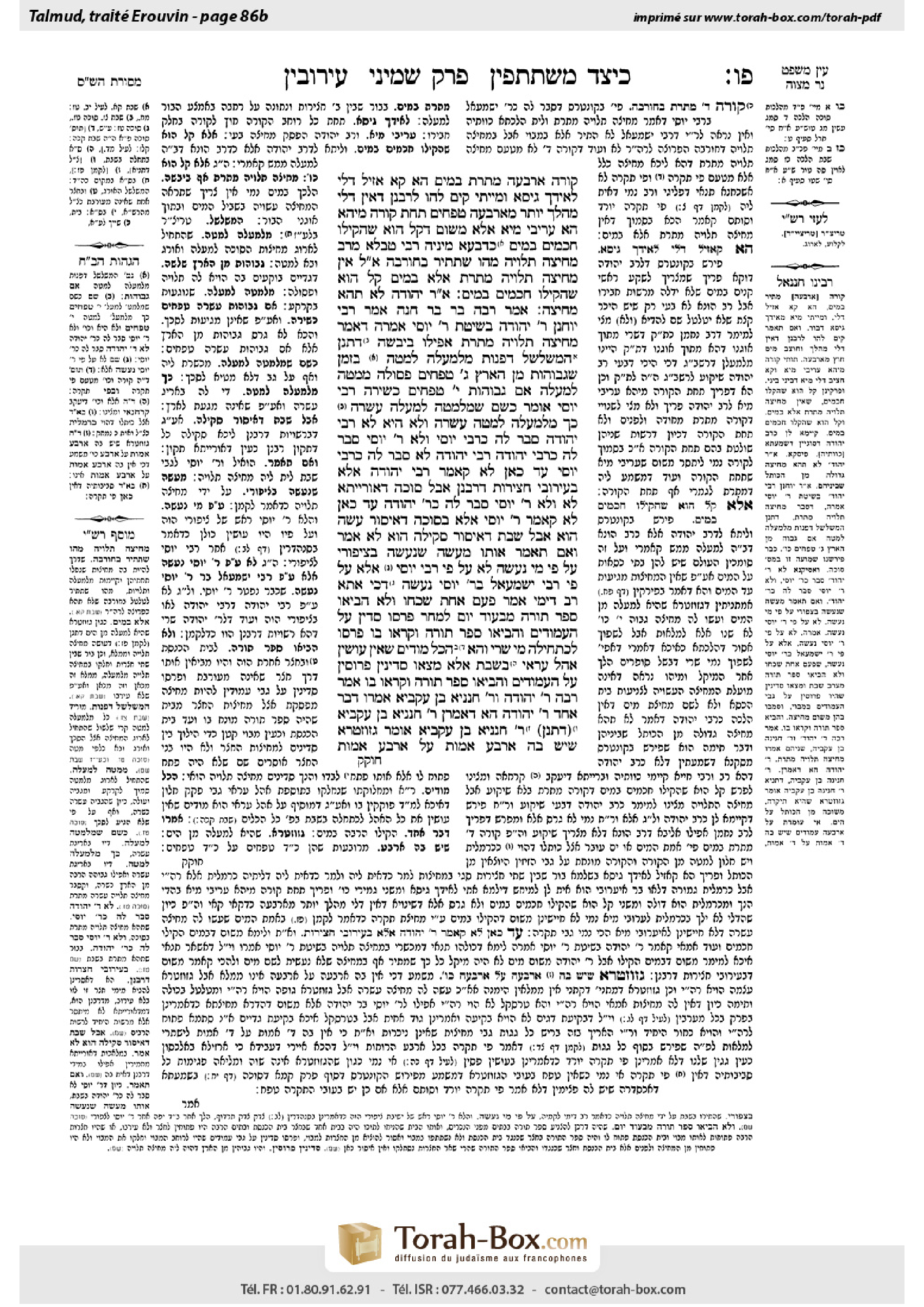
Eruvin 86b: Talmud study for Daf Yomi
Study the Talmud for Daf Yomi with scanned pages, Hebrew text, English translations from Sefaria and AI-generated French translations.
Passage selection and English or AI-generated French translation are available where the scan has annotations. Daf Study is independent of Torah-Box and Sefaria.
Browse Eruvin · עירובין · All tractatesEruvin 86b text and translations
This page of Eruvin includes the Aramaic text, an English translation and an AI-generated French translation, alongside the scan above.
עירובין פ״ו ב · Aramaic and Hebrew text
קוֹרָה אַרְבָּעָה מַתֶּרֶת בְּמַיִם.
הָא קָא אָזֵיל דְּלִי לְאִידַּךְ גִּיסָא, וּמַיְיתֵי? קִים לְהוּ לְרַבָּנַן דְּאֵין דְּלִי מְהַלֵּךְ יוֹתֵר מֵאַרְבָּעָה טְפָחִים.
תַּחַת קוֹרָה מִיהָא הָא עֲרִיבִי מַיָּא! אֶלָּא מִשּׁוּם דְּקַל הוּא שֶׁהֵקֵילּוּ חֲכָמִים בְּמַיִם. כְּדִבְעָא מִינֵּיהּ רַבִּי טַבְלָא מֵרַב: מְחִיצָה תְּלוּיָה, מַהוּ שֶׁתַּתִּיר בְּחוּרְבָּה? אֲמַר לֵיהּ: אֵין מְחִיצָה תְּלוּיָה מַתֶּרֶת אֶלָּא בְּמַיִם, קַל הוּא שֶׁהֵקֵילּוּ חֲכָמִים בַּמַּיִם.
אָמַר רַבִּי יְהוּדָה, לֹא תְּהֵא מְחִיצָה. אָמַר רַבָּה בַּר בַּר חָנָה אָמַר רַבִּי יוֹחָנָן: רַבִּי יְהוּדָה בְּשִׁיטַת רַבִּי יוֹסֵי אֲמָרָהּ, דְּאָמַר: מְחִיצָה תְּלוּיָה מַתֶּרֶת אֲפִילּוּ בַּיַּבָּשָׁה.
דִּתְנַן: הַמְשַׁלְשֵׁל דְּפָנוֹת מִלְּמַעְלָה לְמַטָּה, בִּזְמַן שֶׁגְּבוֹהוֹת מִן הָאָרֶץ שְׁלֹשָׁה טְפָחִים — פְּסוּלָה. מִמַּטָּה לְמַעְלָה, אִם גְּבוֹהוֹת עֲשָׂרָה טְפָחִים — כְּשֵׁירָה.
רַבִּי יוֹסֵי אוֹמֵר: כְּשֵׁם שֶׁמִּלְּמַטָּה לְמַעְלָה עֲשָׂרָה, כָּךְ מִלְּמַעְלָה לְמַטָּה עֲשָׂרָה.
וְלָא הִיא, לָא רַבִּי יְהוּדָה סָבַר לַהּ כְּרַבִּי יוֹסֵי וְלָא רַבִּי יוֹסֵי סָבַר לַהּ כְּרַבִּי יְהוּדָה.
רַבִּי יְהוּדָה לָא סָבַר לַהּ כְּרַבִּי יוֹסֵי: עַד כָּאן לָא קָאָמַר רַבִּי יְהוּדָה אֶלָּא בְּעֵירוּבֵי חֲצֵירוֹת דְּרַבָּנַן, אֲבָל סוּכָּה דְּאוֹרָיְיתָא — לָא.
וְלָא רַבִּי יוֹסֵי סָבַר לַהּ כְּרַבִּי יְהוּדָה: עַד כָּאן לָא קָאָמַר רַבִּי יוֹסֵי אֶלָּא בְּסוּכָּה דְּאִיסּוּר עֲשֵׂה הוּא, אֲבָל שַׁבָּת דְּאִיסּוּר סְקִילָה הוּא — לֹא אָמַר.
וְאִם תֹּאמַר: אוֹתוֹ מַעֲשֶׂה שֶׁנַּעֲשָׂה בְּצִיפּוֹרִי, עַל פִּי מִי נַעֲשָׂה? לֹא עַל פִּי רַבִּי יוֹסֵי, אֶלָּא עַל פִּי רַבִּי יִשְׁמָעֵאל בְּרַבִּי יוֹסֵי נַעֲשָׂה.
דְּכִי אֲתָא רַב דִּימִי, אָמַר: פַּעַם אַחַת שָׁכְחוּ וְלֹא הֵבִיאוּ סֵפֶר תּוֹרָה מִבְּעוֹד יוֹם. לְמָחָר פָּרְסוּ סָדִין עַל הָעַמּוּדִים, וְהֵבִיאוּ סֵפֶר תּוֹרָה וְקָרְאוּ בּוֹ.
פָּרְסוּ?! לְכַתְּחִילָּה מִי שְׁרֵי? וְהָא הַכֹּל מוֹדִים שֶׁאֵין עוֹשִׂין אֹהֶל עֲרַאי בְּשַׁבָּת.
אֶלָּא: מָצְאוּ סְדִינִין פְּרוּסִין עַל הָעַמּוּדִים, וְהֵבִיאוּ סֵפֶר תּוֹרָה וְקָרְאוּ בּוֹ.
אָמַר רַבָּה: רַבִּי יְהוּדָה וְרַבִּי חֲנַנְיָא בֶּן עֲקַבְיָא אָמְרוּ דָּבָר אֶחָד. רַבִּי יְהוּדָה, הָא דַּאֲמַרַן. רַבִּי חֲנַנְיָא בֶּן עֲקַבְיָא, (דִּתְנַן) רַבִּי חֲנַנְיָא בֶּן עֲקַבְיָא אוֹמֵר: גְּזוּזְטְרָא שֶׁיֵּשׁ בָּהּ אַרְבַּע אַמּוֹת עַל אַרְבַּע אַמּוֹת
Eruvin 86b · English translation
A cross beam of four handbreadths laid across a cistern located between two courtyards permits one to draw water from that cistern.
With this in mind, the following difficulty arises: The bucket he uses to draw the water might drift under the cross beam to the other side of the cistern and bring water from the other courtyard. The Gemara answers: The Sages have established that a bucket does not drift more than four handbreadths from the point where it was lowered, and it will therefore stay on its original side of the partition.
The Gemara raises a difficulty: Nonetheless, the water becomes intermingled under the cross beam, and consequently the bucket will bring up water from the other courtyard. Rather, it must be that the reason for the leniency is not that the cross beam actually prevents the flow of the water, but because the Sages were lenient with regard to water. They allowed a partition suspended above the water to be considered as though it blocked the flow of the water. As Rav Tavla asked of Rav: With regard to a suspended partition, does it permit carrying in a ruin? Do we say that the remnants of the walls suspended in the air are considered as though they descended to the ground and closed off the area, thereby rendering it a private domain? Rav said to him: A suspended partition of this kind permits carrying only in the case of water, as the Sages were lenient with regard to water.
The mishna teaches: Rabbi Yehuda said: There is no need for a partition in the cistern, as a partition inside a cistern is no better than the wall above it. Rabba bar bar Ḥana said that Rabbi Yoḥanan said: Rabbi Yehuda stated this in accordance with the opinion of Rabbi Yosei, who said: A suspended partition permits carrying even on land, as it is considered as though it descended to the ground and sealed off the area. Accordingly, there is no need to erect a partition inside the airspace of a cistern.
As we learned in a mishna: One who lowers sukka walls from above going downward, when the walls are three handbreadths higher than the ground, the sukka is invalid, as they are not considered partitions; but if he constructed walls from below going upward, if they are ten handbreadths high the sukka is valid, even if they do not reach the roofing.
Rabbi Yosei, however, says: Just as with regard to walls constructed from below going upward, ten handbreadths suffice, so too, in the case of walls built from above going downward, ten handbreadths are enough for it to be considered a whole wall, even if it more than three handbreadths above the ground. Similarly, Rabbi Yehuda maintains that a partition suspended above a cistern is considered as though it descended and sealed off the area.
The Gemara rejects this argument: But this is not so, for we can distinguish between the two opinions and claim that neither Rabbi Yehuda holds in accordance with Rabbi Yosei, nor does Rabbi Yosei hold in accordance with Rabbi Yehuda.
The Gemara elaborates: Rabbi Yehuda does not necessarily hold in accordance with Rabbi Yosei, as a distinction can be made between the two cases. Rabbi Yehuda stated his opinion only with regard to the joining of courtyards, which are required by rabbinic law, but in the case of a sukka, which is required by Torah law, no, he did not say that we can rely on suspended partitions.
And conversely, Rabbi Yosei does not necessarily hold in accordance with Rabbi Yehuda, as Rabbi Yosei stated his opinion only with regard to a sukka, which is a prohibition stated in the Torah from a positive commandment. The prohibition is not written as a negative commandment, but it can be inferred from a positive commandment. Neglect of the positive commandment of sukka is not punishable by the court, therefore we are not stringent in this regard. But with regard to Shabbat, which is a prohibition punishable by stoning, Rabbi Yosei did not state his opinion. Consequently, Rabbi Yosei might agree that we must be very stringent with regard to all halakhot of Shabbat, even those that are rabbinic in origin.
And if you ask: That incident, which occurred in Tzippori, when they relied on suspended partitions on land for Shabbat, on whose authority was it performed? It was done not on the authority of Rabbi Yosei, but rather it was performed on the authority of Rabbi Yishmael, son of Rabbi Yosei, who maintains that a suspended partition renders it permitted to carry even if it is over land and even on Shabbat.
The incident transpired in the following manner. As when Rav Dimi came from Eretz Yisrael to Babylonia, he said: It once happened that the people forgot and did not bring a Torah scroll to the synagogue on Friday while it was still day, which meant they were left without a scroll from which to read on Shabbat. On the following day, Shabbat, they spread a sheet over the pillars positioned between the house where the scroll was kept and the synagogue, thereby forming a corridor with partitions suspended on each side. And in this manner they brought the Torah scroll to the synagogue and read from it.
The Gemara expresses surprise at the wording of this account: Did they actually spread sheets on Shabbat? Is it permitted to do so ab initio? But doesn’t everyone agree that one may not erect a temporary tent on Shabbat ab initio? Spreading sheets over pillars is considered constructing a temporary tent.
Rather, what happened was that they found sheets spread over the pillars, which they used as partitions, and in this manner they brought the Torah scroll to the synagogue and read from it.
Rabba said: Rabbi Yehuda and Rabbi Ḥananya ben Akavya said the same thing. Both were very lenient with regard to the halakha of a partition over water. The ruling of Rabbi Yehuda is that which we just said, that the wall of the courtyard permits a cistern. The ruling of Rabbi Ḥananya ben Akavya is as we learned: Rabbi Ḥananya ben Akavya says: In the case of a balcony that contains four cubits by four cubits, which is suspended over water,
Eruvin 86b · Traduction française (IA)
Un montant transversal de quatre tefachim posé sur un puits situé entre deux courtyards permet de tirer de l'eau de ce puits.
Avec cela en tête, un doute se présente : le seau utilisé pour tirer l'eau pourrait flotter sous le montant transversal vers l'autre côté du puits et ramener de l'eau du courtyard opposé. La Guemara répond : les Sages ont établi que le seau ne flotte pas plus de quatre tefachim à partir du point où il a été descendu, et il restera donc du côté original de la séparation.
La Guemara soulève un doute : néanmoins, l'eau se mélange sous le montant transversal, et par conséquent le seau ramènera de l'eau du courtyard opposé. En réalité, il doit être que la raison de la leniencité n'est pas que le montant transversal empêche effectivement le courant de l'eau, mais parce que les Sages ont été lenis en ce qui concerne l'eau. Ils ont permis qu'une séparation suspendue au-dessus de l'eau soit considérée comme si elle bloquait le courant de l'eau. Comme Rav Tavla a demandé à Rav : concernant une séparation suspendue, permet-elle le transport dans un lieu en ruine ? Disons-nous que les restes des murs suspendus dans l'air sont considérés comme s'ils descendaient jusqu'au sol et fermaient la zone, rendant ainsi ce lieu un domaine privé ? Rav répondit à lui : une séparation suspendue de ce genre permet le transport uniquement dans le cas de l'eau, car les Sages ont été lenis en ce qui concerne l'eau.
La mitsna enseigne : Rabbi Yehuda dit : il n'y a pas besoin de séparation dans le puits, car une séparation à l'intérieur d'un puits n'est pas meilleure que le mur au-dessus d'elle. Rabba bar bar Ḥana dit que Rabbi Yoḥanan dit : Rabbi Yehuda a dit cela selon l'opinion de Rabbi Yosei, qui dit : une séparation suspendue permet le transport même sur terre, car elle est considérée comme si elle descendait jusqu'au sol et fermait la zone. Ainsi, il n'est pas nécessaire d'élever une séparation à l'intérieur de l'air d'un puits.
Comme nous avons appris dans une mitsna : celui qui abaisse les murs de la sukka depuis le haut vers le bas, lorsque les murs sont trois tefachim plus haut que le sol, la sukka est invalide, car ils ne sont pas considérés comme des séparations ; mais si l'on construit des murs depuis le bas vers le haut, si ils sont dix tefachim de haut, la sukka est valide, même s'ils n'atteignent pas le toit.
Rabbi Yosei, cependant, dit : justement comme concernant les murs construits depuis le bas vers le haut, dix tefachim suffisent, ainsi aussi, dans le cas des murs construits depuis le haut vers le bas, dix tefachim sont suffisants pour qu'ils soient considérés comme un mur entier, même s'ils sont plus de trois tefachim au-dessus du sol. De même, Rabbi Yehuda maintient qu'une séparation suspendue au-dessus d'un puits est considérée comme si elle descendait et fermait la zone.
La Guemara rejette cet argument : cela n'est pas vrai, car nous pouvons distinguer entre les deux opinions et affirmer que ni Rabbi Yehuda ne suit l'opinion de Rabbi Yosei, ni Rabbi Yosei ne suit celle de Rabbi Yehuda.
La Guemara développe : Rabbi Yehuda ne suit pas nécessairement l'opinion de Rabbi Yosei, car une distinction peut être faite entre les deux cas. Rabbi Yehuda a exprimé son opinion uniquement concernant la jonction des courtyards, qui sont requis par la loi rabbinique, mais dans le cas d'une sukka, qui est requis par la loi divine, il n'a pas dit que nous pouvons nous appuyer sur des séparations suspendues.
Et inversement, Rabbi Yosei ne suit pas nécessairement l'opinion de Rabbi Yehuda, car Rabbi Yosei a exprimé son opinion uniquement concernant une sukka, qui est une interdiction énoncée dans la Torah d'un commandement positif. L'interdiction n'est pas écrite comme une interdiction négative, mais elle peut être inférée d'un commandement positif. L'oubli du commandement positif de sukka n'est pas puni par la cour, donc nous ne sommes pas stricts à cet égard. Mais concernant le Shabbat, qui est une interdiction punie par la lapidation, Rabbi Yosei n'a pas exprimé son opinion. Par conséquent, Rabbi Yosei pourrait accepter que nous devons être très stricts concernant toutes les halakhot du Shabbat, même celles d'origine rabbinique.
Et si l'on demande : cet incident, qui s'est produit à Tzippori, lorsqu'ils ont utilisé des séparations suspendues sur terre pour le Shabbat, sur quel autorité a-t-il été accompli ? Il a été accompli non sur l'autorité de Rabbi Yosei, mais plutôt sur l'autorité de Rabbi Yishmael, fils de Rabbi Yosei, qui affirme qu'une séparation suspendue rend permis le transport même s'il est sur terre et même le Shabbat.
L'incident s'est déroulé ainsi. Lorsque Rav Dimi est venu de la Terre d'Israël vers Babylone, il a dit : Il s'est produit une fois que les gens ont oublié et n'ont pas apporté un rouleau de Torah à l'église le vendredi alors qu'il était encore jour, ce qui signifiait qu'ils étaient sans rouleau pour lire le Shabbat. Le lendemain, le Shabbat, ils ont étendu un linge sur les piliers situés entre la maison où le rouleau était gardé et l'église, formant ainsi un corridor avec des séparations suspendues sur chaque côté. Et ainsi ils ont apporté le rouleau de Torah à l'église et ont lu à partir de lui.
La Guemara exprime une surprise à propos de la formulation de ce récit : ont-ils vraiment étendu des linge le Shabbat ? Est-ce permis de le faire ab initio ? Mais ne sont-ils pas tous d'accord sur le fait qu'on ne peut pas ériger un abri temporaire le Shabbat ab initio ? Étendre des linge sur des piliers est considéré comme construire un abri temporaire.
En réalité, ce qui s'est produit est que des draps étaient étendus sur les piliers, qu'ils utilisaient comme cloisons, et ainsi ils ont apporté le rouleau de Torah à la synagogue et ont lu à partir de lui.
Rabba a dit : Rabbi Yéhuda et Rabbi Ḥananyah ben Akavya ont dit la même chose. Les deux étaient très accommodants concernant la halakha d'une cloison sur l'eau. La décision de Rabbi Yéhuda est celle que nous venons de dire, à savoir que la muraille du jardin autorise un cistern. La décision de Rabbi Ḥananyah ben Akavya est celle que nous avons apprise : Rabbi Ḥananyah ben Akavya dit : Dans le cas d'un balcon qui contient quatre coudées par quatre coudées, suspendu sur l'eau,
Traduction française générée par IA à partir de l’édition anglaise de Sefaria. Vérifie toujours un passage avec le texte source.
Text from Sefaria: William Davidson Edition - Vocalized Aramaic (CC BY NC); William Davidson Edition - English (CC BY NC).