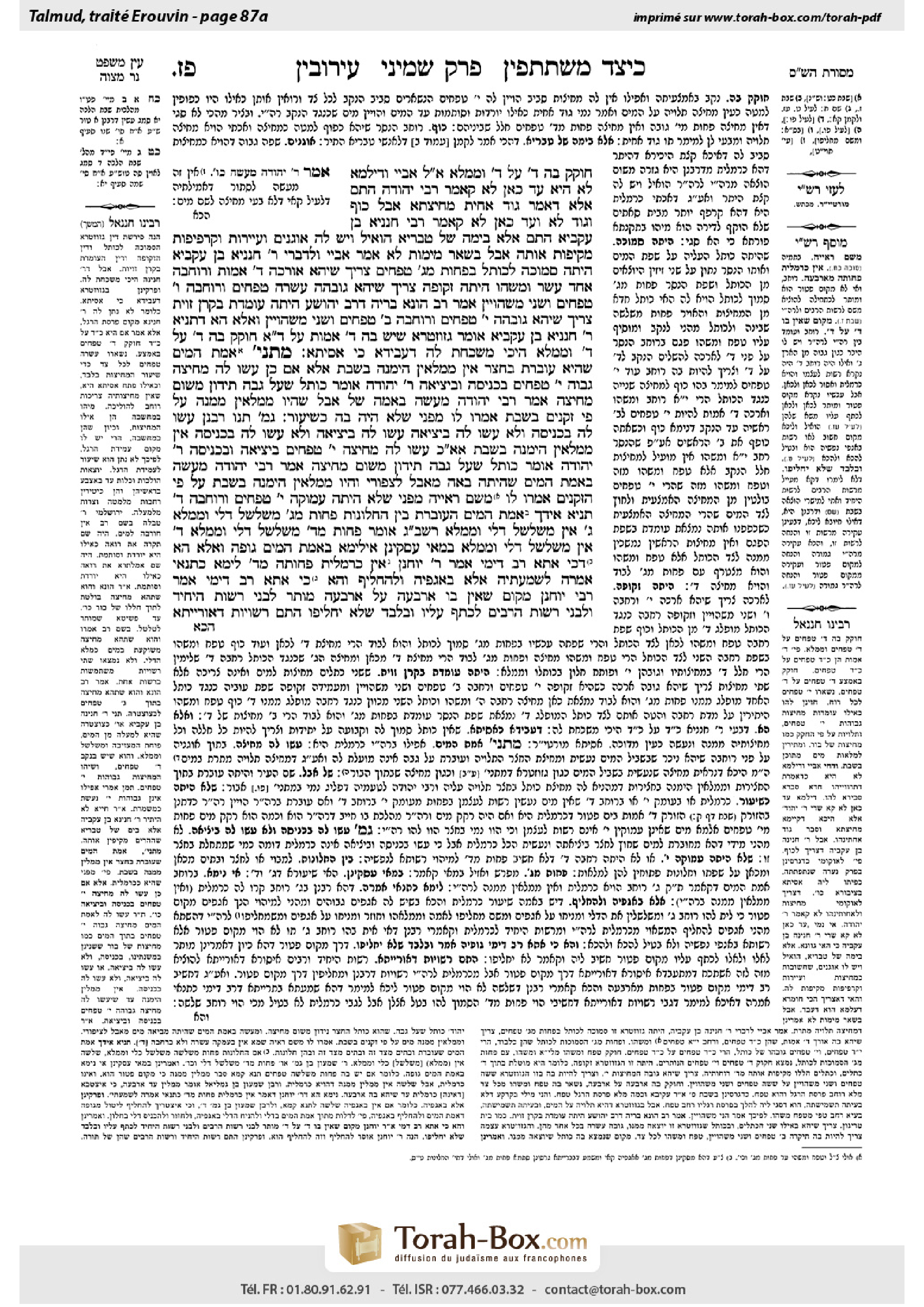
Eruvin 87a: Talmud study for Daf Yomi
Study the Talmud for Daf Yomi with scanned pages, Hebrew text, English translations from Sefaria and AI-generated French translations.
Passage selection and English or AI-generated French translation are available where the scan has annotations. Daf Study is independent of Torah-Box and Sefaria.
Browse Eruvin · עירובין · All tractatesEruvin 87a text and translations
This page of Eruvin includes the Aramaic text, an English translation and an AI-generated French translation, alongside the scan above.
עירובין פ״ז א · Aramaic and Hebrew text
חוֹקֵק בָּהּ אַרְבַּע עַל אַרְבַּע וּמְמַלֵּא.
אֲמַר לֵיהּ אַבָּיֵי: וְדִילְמָא לָא הִיא, עַד כָּאן לָא קָאָמַר רַבִּי יְהוּדָה הָתָם, אֶלָּא דְּאָמַר: ״גּוּד אַחֵית מְחִיצְתָּא״, אֲבָל ״כּוֹף וְגוּד״ — לָא.
וְעַד כָּאן לָא קָאָמַר רַבִּי חֲנַנְיָא בֶּן עֲקַבְיָא הָתָם, אֶלָּא בְּיַמָּהּ שֶׁל טְבֶרְיָא, הוֹאִיל וְיֵשׁ לָהּ אוֹגָנִים, וַעֲיָירוֹת וְקַרְפֵּיפוֹת מַקִּיפוֹת אוֹתָהּ, אֲבָל בִּשְׁאָר מֵימוֹת — לֹא.
אָמַר אַבָּיֵי: וּלְדִבְרֵי רַבִּי חֲנַנְיָא בֶּן עֲקַבְיָא, הָיְתָה סְמוּכָה לַכּוֹתֶל בְּפָחוֹת מִשְּׁלֹשָׁה טְפָחִים — צָרִיךְ שֶׁיְּהֵא אוֹרְכָּהּ אַרְבַּע אַמּוֹת, וְרוֹחְבָּהּ אַחַד עָשָׂר וּמַשֶּׁהוּ.
הָיְתָה זְקוּפָה — צָרִיךְ שֶׁיְּהֵא גּוֹבְהָהּ עֲשָׂרָה טְפָחִים, וְרוֹחְבָּהּ שִׁשָּׁה טְפָחִים וּשְׁנֵי מַשֶּׁהוּיִין.
אָמַר רַב הוּנָא בְּרֵיהּ דְּרַב יְהוֹשֻׁעַ: הָיְתָה עוֹמֶדֶת בְּקֶרֶן זָוִית — צָרִיךְ שֶׁיְּהֵא גּוֹבְהָהּ עֲשָׂרָה טְפָחִים, וְרוֹחְבָּהּ שְׁנֵי טְפָחִים וּשְׁנֵי מַשֶּׁהוּיִין.
וְאֶלָּא הָא דְּתַנְיָא, רַבִּי חֲנַנְיָא בֶּן עֲקַבְיָא אוֹמֵר: גְּזוּזְטְרָא שֶׁיֵּשׁ בָּהּ אַרְבַּע אַמּוֹת עַל אַרְבַּע אַמּוֹת — חוֹקֵק בָּהּ אַרְבָּעָה עַל אַרְבָּעָה וּמְמַלֵּא, הֵיכִי מַשְׁכַּחַתְּ לַהּ?
דַּעֲבִידָא כִּי אֲסִיתָא.
מַתְנִי׳ אַמַּת הַמַּיִם שֶׁהִיא עוֹבֶרֶת בֶּחָצֵר — אֵין מְמַלְּאִין הֵימֶנָּה בְּשַׁבָּת, אֶלָּא אִם כֵּן עָשׂוּ לָהּ מְחִיצָה גְּבוֹהָ עֲשָׂרָה טְפָחִים בִּכְנִיסָה וּבִיצִיאָה. רַבִּי יְהוּדָה אוֹמֵר: כּוֹתֶל שֶׁעַל גַּבָּהּ תִּידּוֹן מִשּׁוּם מְחִיצָה.
אָמַר רַבִּי יְהוּדָה: מַעֲשֶׂה בְּאַמָּה שֶׁל אָבֵל, שֶׁהָיוּ מְמַלְּאִין מִמֶּנָּה עַל פִּי זְקֵנִים בְּשַׁבָּת! אָמְרוּ לוֹ: מִפְּנֵי שֶׁלֹּא הָיָה בָּהּ כַּשִּׁיעוּר.
גְּמָ׳ תָּנוּ רַבָּנַן: עָשׂוּ לָהּ בִּכְנִיסָה וְלֹא עָשׂוּ לָהּ בִּיצִיאָה, עָשׂוּ לָהּ בִּיצִיאָה וְלֹא עָשׂוּ לָהּ בִּכְנִיסָה — אֵין מְמַלְּאִין הֵימֶנָּה בְּשַׁבָּת, אֶלָּא אִם כֵּן עָשׂוּ לָהּ מְחִיצָה עֲשָׂרָה טְפָחִים בִּיצִיאָה וּבִכְנִיסָה. רַבִּי יְהוּדָה אוֹמֵר: כּוֹתֶל שֶׁעַל גַּבָּהּ תִּידּוֹן מִשּׁוּם מְחִיצָה.
אָמַר רַבִּי יְהוּדָה: מַעֲשֶׂה בְּאַמַּת הַמַּיִם שֶׁהָיְתָה בָּאָה מֵאָבֵל לְצִפּוֹרִי, וְהָיוּ מְמַלְּאִין הֵימֶנָּה בְּשַׁבָּת עַל פִּי הַזְּקֵנִים.
אָמְרוּ לוֹ: מִשָּׁם רְאָיָיה?! מִפְּנֵי שֶׁלֹּא הָיְתָה עֲמוּקָּה עֲשָׂרָה טְפָחִים וְרוֹחְבָּהּ אַרְבָּעָה.
תַּנְיָא אִידַּךְ: אַמַּת הַמַּיִם הָעוֹבֶרֶת בֵּין הַחַלּוֹנוֹת, פָּחוֹת מִשְּׁלֹשָׁה — מְשַׁלְשֵׁל דְּלִי וּמְמַלֵּא. שְׁלֹשָׁה — אֵין מְשַׁלְשֵׁל דְּלִי וּמְמַלֵּא. רַבָּן שִׁמְעוֹן בֶּן גַּמְלִיאֵל אוֹמֵר: פָּחוֹת מֵאַרְבָּעָה — מְשַׁלְשֵׁל דְּלִי וּמְמַלֵּא, אַרְבָּעָה — אֵין מְשַׁלְשֵׁל דְּלִי וּמְמַלֵּא.
בְּמַאי עָסְקִינַן? אִילֵימָא: בְּאַמַּת הַמַּיִם גּוּפַהּ, וְאֶלָּא הָא דְּכִי אֲתָא רַב דִּימִי אָמַר רַבִּי יוֹחָנָן: אֵין כַּרְמְלִית פְּחוּתָה מֵאַרְבָּעָה —
לֵימָא כְּתַנָּאֵי אַמְרַהּ לִשְׁמַעְתֵּיהּ?
אֶלָּא בַּאֲגַפֶּיהָ, וּלְהַחְלִיף.
וְהָא כִּי אֲתָא רַב דִּימִי אָמַר רַבִּי יוֹחָנָן: מָקוֹם שֶׁאֵין בּוֹ אַרְבָּעָה עַל אַרְבָּעָה — מוּתָּר לִבְנֵי רְשׁוּת הַיָּחִיד וְלִבְנֵי רְשׁוּת הָרַבִּים לְכַתֵּף עָלָיו, וּבִלְבַד שֶׁלֹּא יַחְלִיפוּ.
הָתָם רְשׁוּיוֹת דְּאוֹרָיְיתָא,
Eruvin 87a · English translation
one may carve in it a hole of four by four handbreadths and draw water through it. Even if there are no actual partitions around the hole, the section surrounding the hole is considered as though it were bent downward and formed partitions ten handbreadths high on all sides. Consequently, it is permitted to draw water through the hole.
Abaye said to him: But perhaps that is not so, as we can distinguish between the opinions. It is possible that Rabbi Yehuda stated his opinion only there, with regard to the wall of the courtyard and the cistern, as he said that we rely on the halakhic principle of extend and lower the partition. The partition above the cistern is considered as though it descended to the bottom. But the principle of bend the partition and extend it downward, as suggested by Rabbi Ḥananya ben Akavya, no, he does not accept this principle.
And we can likewise say that Rabbi Ḥananya ben Akavya stated his opinion only there, in the case of the balcony, with regard to the Sea of Tiberias, i.e., the Sea of Galilee, since it has clearly defined banks around it, and towns and enclosures surround it on all sides. The Sea of Galilee is surrounded by clear boundaries on all sides and is therefore somewhat similar to a private domain in appearance. Consequently, even a minor adjustment is sufficient. However, with regard to other waters, no, Rabbi Ḥananya ben Akavya did not permit this practice.
Abaye said: And according to the statement of Rabbi Ḥananya ben Akavya, if the balcony was less than three handbreadths away from the wall, it is permitted to draw water from it in the following circumstances: Its length must be four cubits, and its width must be eleven handbreadths and any amount. By carving out a hole of slightly more than one handbreadth by four handbreadths on the side near the wall, alongside the other three handbreadths, one creates a hole of four handbreadths by four handbreadths. This hole is surrounded by partitions ten handbreadths high on each side. How so? The wall itself is one partition. The four-cubit length is viewed as bent down on both sides of the hole, forming two partitions of ten handbreadths; the remaining ten handbreadths of the width is seen as though it were bent down, which creates a partition on the fourth side of the balcony.
If the balcony was upright, i.e., it had upright partitions on all sides (Rabbeinu Ḥananel), the height of these partitions must be ten handbreadths, and the width of the balcony must be six handbreadths and two minimal amounts. This leaves slightly more than a handbreadth on each side of the hole of four handbreadths, on which he can stand.
Rav Huna, son of Rav Yehoshua, said: If it was positioned in a corner between two walls (Rabbeinu Ḥananel), the height of the partition must be ten handbreadths, and the requisite width of the balcony must be two handbreadths and two minimal amounts. As he is able to stand, he is provided with actual partitions.
The Gemara asks: However, with regard to that which is taught in a baraita that Rabbi Ḥananya ben Akavya said: If a balcony that has an area of four cubits by four cubits is suspended above water, one carves in it a hole of four by four handbreadths and then draws water through it, under what circumstances can a balcony with these dimensions be found?
The Gemara answers: It is necessary in the case of a balcony that is built in the shape of a mortar, where the balcony is positioned over the water on its own pillars and far removed from any wall. In that case, all of the partitions must be constructed from its floor space. And the balcony must be four cubits by four cubits in size.
MISHNA: With regard to a water channel that passes through a courtyard, the residents may not draw water from it on Shabbat, unless they erected for it a partition ten handbreadths high at the entrance and at the exit of the courtyard. Rabbi Yehuda says: There is no need for a special partition, as the wall that runs on top of it, i.e., the courtyard wall, is considered as a partition.
Rabbi Yehuda said: There was an incident involving a water channel that passed through the courtyards of the town of Avel, from which the residents would draw water from it on Shabbat by the authority of the Elders, relying on the courtyard wall suspended above it. They said to him: It is due to the fact that channel was not of the size that requires a partition, i.e., it was less than ten handbreadths deep or less than ten handbreadths wide, it was permitted to draw water from it even without a partition.
GEMARA: The Sages taught in a baraita: If they erected a partition for the water channel at the entrance but they did not erect one for it at the exit, or if they erected a partition for it at the exit but they did not erect one for it at the entrance, one may not draw water from it on Shabbat, unless they erected for it a partition ten handbreadths high both at the exit and at the entrance. Rabbi Yehuda says: The wall that runs on top of it, i.e., the courtyard wall, is considered as a partition. Therefore, there is no need for a special partition.
Rabbi Yehuda said: There was an incident involving the water channel that went from Avel to Tzippori, and the residents would draw water from it on Shabbat by the authority of the Elders, without any additional partition.
They said to him: Are you trying to bring a proof from there? That was either due to the fact that the channel was not ten handbreadths deep or because it was not four handbreadths wide. It lacked the requisite measure to be considered a domain in its own right. Everyone agrees that it is permitted to draw water from it even without an additional partition.
It was taught in another baraita: With regard to a water channel that passes between the windows of two houses, if it is less than three handbreadths, one may lower a bucket from the window and draw water from it; however, if it is three handbreadths, one may not lower a bucket and draw water from it. Rabban Shimon ben Gamliel says: If it is less than four handbreadths, one may lower a bucket and draw water from it; but if it is at least four handbreadths, one may not lower a bucket and draw water.
With regard to these measures of three and four handbreadths, the Gemara asks: With what are we dealing here? If you say this halakha is referring to the water channel itself, that it was three or four handbreadths wide, this presents a difficulty, for when Rav Dimi came from Eretz Yisrael to Babylonia, he said that Rabbi Yoḥanan said: A karmelit cannot be less than four handbreadths wide. The karmelit is an intermediate domain established by the Sages, whose status is between a public and a private domain. Any open area that is not a public thoroughfare, e.g., a field, sea, river, alleyway, or a lane, is classified as a karmelit. It is prohibited to carry an article four cubits within a karmelit, or to transfer an object from a private domain or a public domain to a karmelit, or vice versa. One who draws water through a window from a water channel into a house has carried from a karmelit to a private domain. Consequently, if the tanna’im of the baraita dispute the width of the channel, they are in effect disagreeing about the minimal size of a karmelit.
The Gemara resumes its question: Let us say, then, that the teaching that Rav Dimi cited, that a karmelit cannot be less than four handbreadths wide, was actually the subject of a dispute of tanna’im and not a unanimous halakha.
The Gemara rejects the previous explanation. Rather, the measure of three or four handbreadths is referring not to the channel itself but to the banks of the channel, and it is stated with regard to an act of exchange. The dispute here does not concern the measure of a karmelit, but the measure of an exempt domain. It is permitted to transfer the empty bucket from the window, which is a private domain, by way of the channel’s banks, which are exempt domains, to the water channel, which is a karmelit, and back again with the full bucket.
The Gemara raises a difficulty: But when Rav Dimi came from Eretz Yisrael to Babylonia, he said that Rabbi Yoḥanan said: A place that does not have an area of four by four handbreadths is an exempt domain. Consequently, if this place is situated between a public domain and a private domain, it is permitted for both the people of the private domain and for the people of the public domain to adjust the burdens on their shoulders on it, provided that they do not exchange objects between them via the exempt domain. How, then, can the bucket be transferred from the window to the channel, and vice versa, by means of the banks?
The Gemara answers: There, Rav Dimi is referring to domains by Torah law, i.e., this halakha involves the transfer of objects from a private domain to a public domain via an exempt domain. The Sages forbade this activity, so that people would not transfer objects directly from the private domain to the public domain.
Eruvin 87a · Traduction française (IA)
On peut percer un trou de quatre tefachim par quatre tefachim dans le mur et faire passer l'eau à travers. Même si les parois autour du trou n'existent pas, la zone entourant le trou est considérée comme si elle était courbée vers le bas et formait des parois de dix tefachim de haut sur les côtés. Par conséquent, il est permis de faire passer l'eau à travers du trou.
Abaye dit à lui : Mais peut-être que cela n'est pas ainsi, car nous pouvons distinguer entre les opinions. Il est possible que Rabbi Yehuda ait exprimé son opinion uniquement dans le cas des parois du cour de la maison et du réservoir, car il a dit que nous nous appuyons sur le principe halakhique de prolonger et d'abaisser la paroi. La paroi au-dessus du réservoir est considérée comme si elle descendait jusqu'au fond. Mais le principe de courber la paroi et de la prolonger vers le bas, comme suggéré par Rabbi Ḥananya ben Akavya, non, il ne l'accepte pas.
Et nous pouvons également dire que Rabbi Ḥananya ben Akavya a exprimé son opinion uniquement dans le cas de la balustrade, concernant la mer de Tibériade, c'est-à-dire la mer de Galilée, car elle a des rives clairement définies autour d'elle, et des villes et des enclos l'entourent de tous les côtés. La mer de Galilée est entourée de limites claires de tous les côtés et est donc quelque peu semblable à un domaine privé en apparence. Par conséquent, même une petite modification est suffisante. Cependant, concernant d'autres eaux, non, Rabbi Ḥananya ben Akavya n'a pas permis cette pratique.
Abaye dit : Et selon l'affirmation de Rabbi Ḥananya ben Akavya, si la balustrade était à moins de trois tefachim de la paroi, il est permis de tirer de l'eau d'elle dans les circonstances suivantes : sa longueur doit être de quatre cubits, et sa largeur de onze tefachim et n'importe quelle quantité. En perçant un trou de légèrement plus d'un tefachim par quatre tefachim sur le côté proche de la paroi, à côté des trois tefachim, on crée un trou de quatre tefachim par quatre tefachim. Ce trou est entouré de parois de dix tefachim de haut sur chaque côté. Comment cela ? La paroi elle-même est une paroi. La longueur de quatre cubits est considérée comme courbée sur les deux côtés du trou, formant deux parois de dix tefachim ; la largeur restante de dix tefachim est vue comme si elle était courbée, ce qui crée une paroi sur le quatrième côté de la balustrade.
Si la balustrade était droite, c'est-à-dire qu'elle avait des parois droites sur tous les côtés (Rabbeinu Ḥananel), la hauteur de ces parois doit être de dix tefachim, et la largeur de la balustrade doit être de six tefachim et deux minimaux. Cela laisse légèrement plus d'un tefachim sur chaque côté du trou de quatre tefachim, sur lequel il peut se tenir.
Rav Huna, fils de Rav Yehoshua, dit : Si elle était située dans un coin entre deux parois (Rabbeinu Ḥananel), la hauteur de la paroi doit être de dix tefachim, et la largeur nécessaire de la balustrade doit être de deux tefachim et deux minimaux. Comme il peut se tenir, il est fourni avec des parois réelles.
La Guemara pose la question : Cependant, concernant ce qui est enseigné dans une baraïta que Rabbi Ḥananya ben Akavya a dit : Si une balustrade ayant une surface de quatre cubits par quatre cubits est suspendue au-dessus de l'eau, on y perce un trou de quatre par quatre tefachim et ensuite on fait passer l'eau à travers, sous quelles circonstances peut-on trouver une balustrade ayant ces dimensions ?
La Guemara répond : Il est nécessaire dans le cas d'une balustrade construite en forme de moulin à huile, où la balustrade est positionnée sur l'eau sur ses piliers et éloignée de toute paroi. Dans ce cas, toutes les parois doivent être construites à partir de son espace au sol. Et la balustrade doit avoir une taille de quatre cubits par quatre cubits.
MICHNA : Concernant un canal d'eau passant par un cour, les habitants ne peuvent pas tirer de l'eau de ce canal le sabbat, sauf s'ils ont construit une paroi de dix tefachim de haut à l'entrée et à la sortie du cour. Rabbi Yehuda dit : Il n'y a pas besoin d'une paroi spéciale, car la paroi qui court au-dessus d'elle, c'est-à-dire la paroi du cour, est considérée comme une paroi.
Rabbi Yehuda dit : Il y avait un incident concernant un canal d'eau passant par les cours de la ville d'Avel, d'où les habitants tiraient de l'eau le sabbat en se basant sur l'autorité des Anciens, en se référant à la paroi du cour suspendue au-dessus. Ils dirent à lui : C'est à cause du fait que le canal n'avait pas la taille nécessitant une paroi, c'est-à-dire qu'il était moins profond de dix tefachim ou moins large de dix tefachim, qu'il était permis de tirer de l'eau de lui même sans paroi.
Les Sages enseignèrent dans une baraïta : Si on a construit une paroi pour le canal d'eau à l'entrée mais pas à la sortie, ou si on a construit une paroi pour lui à la sortie mais pas à l'entrée, on ne peut pas tirer de l'eau de lui le sabbat, sauf s'il a été construit une paroi de dix tefachim de haut à la fois à l'entrée et à la sortie. Rabbi Yehuda dit : La paroi qui court au-dessus d'elle, c'est-à-dire la paroi du cour, est considérée comme une paroi. Par conséquent, il n'y a pas besoin d'une paroi spéciale.
Rabbi Yehuda dit : Il y avait un incident concernant le canal d'eau qui allait d'Avel à Tzippori, et les habitants tiraient de l'eau de lui le sabbat en se basant sur l'autorité des Anciens, sans aucune paroi supplémentaire.
Ils lui dirent : Voulez-vous apporter une preuve de là ? C'était soit à cause du fait que le canal n'était pas profond de dix tefachim, soit à cause du fait qu'il n'était pas large de quatre tefachim. Il manquait la mesure nécessaire pour être considéré comme un domaine à part entière. Tout le monde convient qu'il est permis de tirer de l'eau de là même sans paroi supplémentaire.
Il a été enseigné dans une autre baraïta : Concernant un canal d'eau qui passe entre les fenêtres de deux maisons, si la largeur est inférieure à trois tefachim, on peut descendre un seau par la fenêtre et puis tirer de l'eau ; cependant, si la largeur est de trois tefachim, on ne peut pas descendre un seau et tirer de l'eau. Rabban Shimon ben Gamliel dit : Si la largeur est inférieure à quatre tefachim, on peut descendre un seau et tirer de l'eau ; mais si la largeur est d'au moins quatre tefachim, on ne peut pas descendre un seau et tirer de l'eau.
Concernant ces mesures de trois et quatre tefachim, le Guemara pose la question : De quoi est-on en train de parler ici ? Si vous dites que cette halakha fait référence à la largeur du canal lui-même, c'est-à-dire qu'il est de trois ou quatre tefachim, cela présente un problème, car lorsque Rav Dimi est venu de la Terre d'Israël vers Babylone, il a dit que Rabbi Yoḥanan a dit : Un karmelit ne peut pas être inférieur à quatre tefachim de largeur. Le karmelit est un domaine intermédiaire établi par les Sages, dont le statut est entre un domaine public et un domaine privé. Tout espace ouvert qui n'est pas une voie publique, par exemple un champ, une mer, un fleuve, un passage ou une allée, est classé comme un karmelit. Il est interdit de porter un objet de quatre cubits à l'intérieur d'un karmelit, ou de transférer un objet d'un domaine privé ou d'un domaine public vers un karmelit, ou inversement. Celui qui tire de l'eau par une fenêtre d'un canal d'eau vers une maison a transporté d'un karmelit vers un domaine privé. Ainsi, si les tanna’im de la baraïta disputent la largeur du canal, ils sont en fait en désaccord sur la taille minimale d'un karmelit.
Le Guemara reprend sa question : Disons alors que l'enseignement que Rav Dimi a cité, selon lequel un karmelit ne peut pas être inférieur à quatre tefachim de largeur, était en réalité la matière d'un débat entre les tanna’im et non une halakha unanime.
La Guemara rejette l'explication précédente. Plutôt, la mesure de trois ou quatre tefachim fait référence non à la largeur du canal lui-même, mais aux rives du canal, et il est dit concernant un acte d'échange. Le débat ici ne concerne pas la mesure d'un karmelit, mais la mesure d'un domaine exempt. Il est permis de transférer le seau vide par la fenêtre, qui est un domaine privé, par le biais des rives du canal, qui sont des domaines exemptes, vers le canal d'eau, qui est un karmelit, et à nouveau avec le seau plein.
La Guemara soulève une difficulté : Mais lorsque Rav Dimi est venu de la Terre d'Israël vers Babylone, il a dit que Rabbi Yoḥanan a dit : Un lieu qui n'a pas une surface de quatre par quatre tefachim est un domaine exempt. Ainsi, si ce lieu est situé entre un domaine public et un domaine privé, il est permis aux habitants du domaine privé et aux habitants du domaine public d'ajuster les charges sur leurs épaules dessus, à condition qu'ils ne transfèrent pas d'objets entre eux via le domaine exempt. Comment, alors, peut-on transférer le seau de la fenêtre vers le canal et inversement par le biais des rives ?
La Guemara répond : Là, Rav Dimi fait référence aux domaines selon la Loi divine, c'est-à-dire que cette halakha concerne le transfert d'objets d'un domaine privé vers un domaine public via un domaine exempt. Les Sages ont interdit cette activité afin que les gens ne transfèrent pas directement des objets du domaine privé vers le domaine public.
Traduction française générée par IA à partir de l’édition anglaise de Sefaria. Vérifie toujours un passage avec le texte source.
Text from Sefaria: William Davidson Edition - Vocalized Aramaic (CC BY NC); William Davidson Edition - English (CC BY NC).