Eruvin 87b: Talmud study for Daf Yomi
Study the Talmud for Daf Yomi with scanned pages, Hebrew text, English translations from Sefaria and AI-generated French translations.
Passage selection and English or AI-generated French translation are available where the scan has annotations. Daf Study is independent of Torah-Box and Sefaria.
Browse Eruvin · עירובין · All tractatesEruvin 87b text and translations
This page of Eruvin includes the Aramaic text, an English translation and an AI-generated French translation, alongside the scan above.
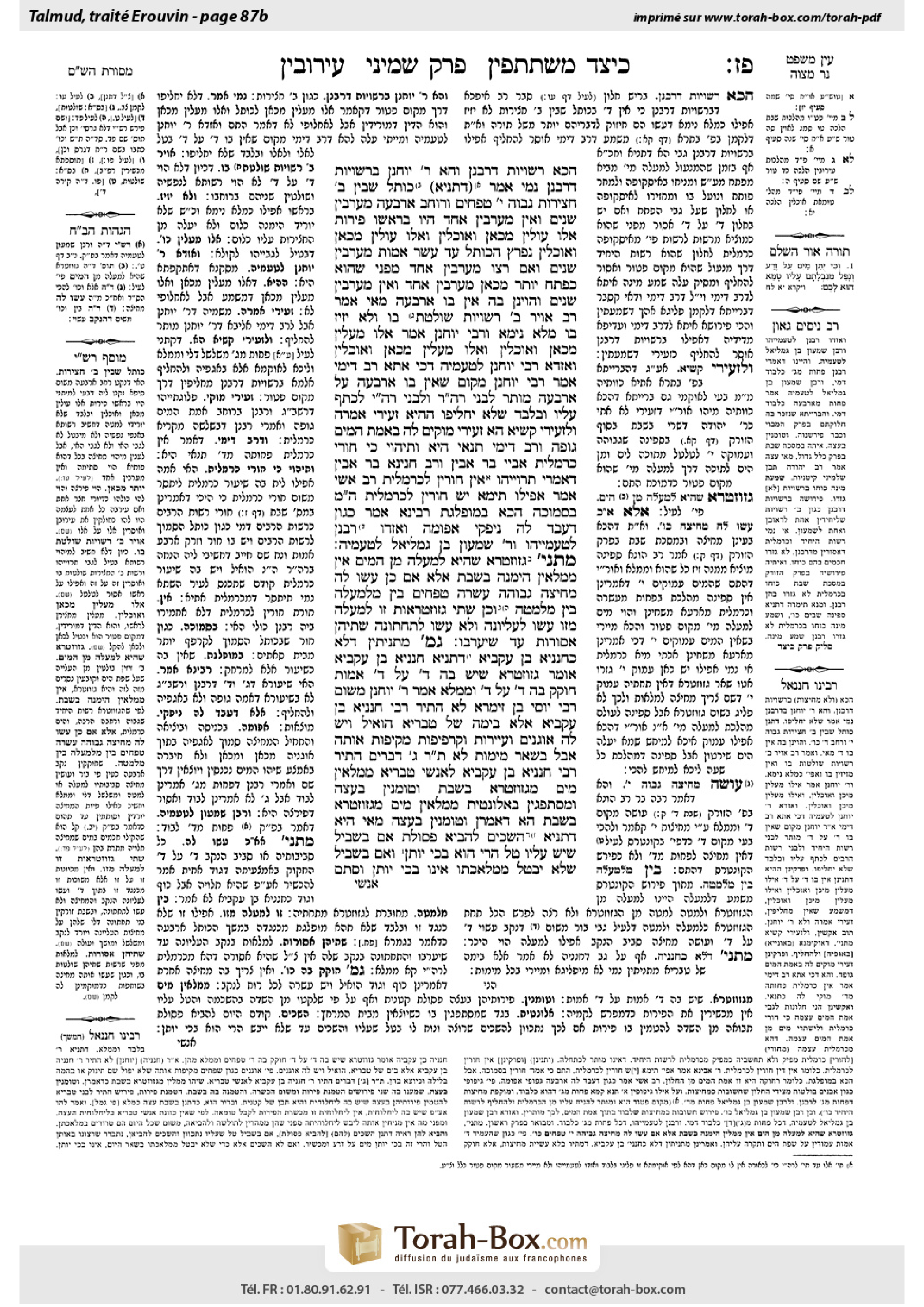
עירובין פ״ז ב · Aramaic and Hebrew text
הָכָא רְשׁוּיוֹת דְּרַבָּנַן.
וְהָא רַבִּי יוֹחָנָן בָּרְשׁוּיוֹת דְּרַבָּנַן נָמֵי אָמַר, (דְּתַנְיָא): כּוֹתֶל שֶׁבֵּין שְׁתֵּי חֲצֵירוֹת, גָּבוֹהַּ עֲשָׂרָה טְפָחִים וְרוֹחַב אַרְבָּעָה — מְעָרְבִין שְׁנַיִם, וְאֵין מְעָרְבִין אֶחָד.
הָיוּ בְּרֹאשׁוֹ פֵּירוֹת — אֵלּוּ עוֹלִין מִכָּאן וְאוֹכְלִין, וְאֵלּוּ עוֹלִין מִכָּאן וְאוֹכְלִין.
נִפְרַץ הַכּוֹתֶל, עַד עֶשֶׂר אַמּוֹת — מְעָרְבִין שְׁנַיִם, וְאִם רָצוּ מְעָרְבִין אֶחָד, מִפְּנֵי שֶׁהוּא כְּפֶתַח. יוֹתֵר מִכָּאן — מְעָרְבִין אֶחָד וְאֵין מְעָרְבִין שְׁנַיִם.
וְהָוֵינַן בַּהּ: אֵין בּוֹ אַרְבָּעָה מַאי? אָמַר רַב: אֲוִיר שְׁתֵּי רְשׁוּיוֹת שׁוֹלֶטֶת בּוֹ, וְלֹא יָזִיז בּוֹ מְלֹא נִימָא.
וְרַבִּי יוֹחָנָן אָמַר: אֵלּוּ מַעֲלִין מִכָּאן וְאוֹכְלִין, וְאֵלּוּ מַעֲלִין מִכָּאן וְאוֹכְלִין.
וְאַזְדָּא רַבִּי יוֹחָנָן לְטַעְמֵיהּ, דְּכִי אֲתָא רַב דִּימִי אָמַר רַבִּי יוֹחָנָן: מָקוֹם שֶׁאֵין בּוֹ אַרְבָּעָה עַל אַרְבָּעָה — מוּתָּר לִבְנֵי רְשׁוּת הָרַבִּים וְלִבְנֵי רְשׁוּת הַיָּחִיד לְכַתֵּף עָלָיו, וּבִלְבַד שֶׁלֹּא יַחֲלִיפוּ!
הָהִיא זְעֵירִי אַמְרַהּ. וְלִזְעֵירִי קַשְׁיָא הָא!
זְעֵירִי מוֹקֵים לַהּ בְּאַמַּת הַמַּיִם גּוּפַהּ. וְרַב דִּימִי תַּנָּאֵי הִיא.
וְתִיהְוֵי כִּי חוֹרֵי כַּרְמְלִית!
אַבָּיֵי בַּר אָבִין וְרַב חֲנִינָא בַּר אָבִין דְּאָמְרִי תַּרְוַיְיהוּ: אֵין חוֹרִין לְכַרְמְלִית.
רַב אָשֵׁי אָמַר: אֲפִילּוּ תֵּימָא יֵשׁ חוֹרִין לְכַרְמְלִית — הָנֵי מִילֵּי בִּסְמוּכָה. הָכָא, בְּמוּפְלֶגֶת.
רָבִינָא אָמַר: כְּגוֹן דַּעֲבַד לַהּ נִיפְקֵי אַפּוּמַּהּ.
וְאָזְדוּ רַבָּנַן לְטַעְמַיְיהוּ, וְרַבִּי שִׁמְעוֹן בֶּן גַּמְלִיאֵל לְטַעְמֵיהּ.
מַתְנִי׳ גְּזוּזְטְרָא שֶׁהִיא לְמַעְלָה מִן הַמַּיִם אֵין מְמַלְּאִין הֵימֶנָּה בְּשַׁבָּת אֶלָּא אִם כֵּן עָשׂוּ לָהּ מְחִיצָה גְּבוֹהָה עֲשָׂרָה טְפָחִים, בֵּין מִלְּמַעְלָה, בֵּין מִלְּמַטָּה.
וְכֵן שְׁתֵּי גְזוּזְטְרָאוֹת זוֹ לְמַעְלָה מִזּוֹ, עָשׂוּ לְעֶלְיוֹנָה וְלֹא עָשׂוּ לְתַחְתּוֹנָה — שְׁתֵּיהֶן אֲסוּרוֹת עַד שֶׁיְּעָרְבוּ.
גְּמָ׳ מַתְנִיתִין דְּלָא כַּחֲנַנְיָא בֶּן עֲקַבְיָא. דְּתַנְיָא, חֲנַנְיָא בֶּן עֲקַבְיָא אוֹמֵר: גְּזוּזְטְרָא שֶׁיֵּשׁ בָּהּ אַרְבַּע עַל אַרְבַּע אַמּוֹת חוֹקֵק בָּהּ אַרְבָּעָה עַל אַרְבָּעָה, וּמְמַלֵּא.
אָמַר רַבִּי יוֹחָנָן מִשּׁוּם רַבִּי יוֹסֵי בֶּן זִימְרָא: לֹא הִתִּיר רַבִּי חֲנַנְיָא בֶּן עֲקַבְיָא אֶלָּא בְּיַמָּהּ שֶׁל טְבֶרְיָא, הוֹאִיל וְיֵשׁ לָהּ אוֹגָנִים, וַעֲיָירוֹת וְקַרְפֵּיפוֹת מַקִּיפוֹת אוֹתָהּ, אֲבָל בִּשְׁאָר מֵימוֹת — לֹא.
תָּנוּ רַבָּנַן: שְׁלֹשָׁה דְּבָרִים הִתִּיר רַבִּי חֲנַנְיָא בֶּן עֲקַבְיָא לְאַנְשֵׁי טְבֶרְיָא: מְמַלְּאִין מַיִם מִגְּזוּזְטְרָא בַּשַּׁבָּת, וְטוֹמְנִין בְּעֵצָה, וּמִסְתַּפְּגִין בַּאֲלוּנְטִית.
מְמַלְּאִין מַיִם מִגְּזוּזְטְרָא בַּשַּׁבָּת: הָא דַּאֲמַרַן. וְטוֹמְנִין בְּעֵצָה מַאי הִיא, דְּתַנְיָא: הִשְׁכִּים לְהָבִיא פְּסוֹלֶת, אִם בִּשְׁבִיל שֶׁיֵּשׁ עָלָיו טַל — הֲרֵי הוּא בְּ״כִי יוּתַּן״,
וְאִם בִּשְׁבִיל שֶׁלֹּא יִבָּטֵל מִמְּלַאכְתּוֹ — אֵינוֹ בְּ״כִי יוּתַּן״. וּסְתָם
Eruvin 87b · English translation
However, here, Rav Dimi is referring to domains by rabbinic law. As the transfer of objects from a private domain to a karmelit is prohibited only by rabbinic decree, the Sages did not prohibit this transfer when it is accomplished by way of an exempt domain.
The Gemara raises a difficulty: But Rabbi Yoḥanan said that transferring objects from one domain to another by way of an exempt domain is prohibited even in the case of domains that apply by rabbinic law. As we learned in a mishna: In the case of a wall that is between two courtyards, if it is ten handbreadths high and four handbreadths wide, the residents establish two eiruvin, a separate one for each courtyard, but they do not establish one joint eiruv.
If there was produce on top of the wall, these, the residents of one courtyard, may ascend from this side and eat them, and those, the residents of the other courtyard, may ascend from the other side and eat them, provided that they do not bring the produce down from the top of the wall to the courtyards.
If the wall is breached, a distinction applies: If the breach is up to ten cubits wide, they may establish two eiruvin, and if they wish, they may establish one eiruv, for it is like an entrance. This breach is similar to any opening of less than ten cubits. If the breach is more than this, they may establish one eiruv, but they may not establish two eiruvin. A breach of this size nullifies the partition, as the two courtyards merge into a single domain.
And we discussed this mishna and raised a question: If this wall is not four handbreadths thick, what is the halakha? Rav said: In that case, the air of two domains controls it. As the wall is not broad enough to be considered a domain of its own, its top belongs to both courtyards, and it is therefore prohibited to both of them. Accordingly, one may not move anything on top of the wall even as much as a hairsbreadth.
And Rabbi Yoḥanan disagreed and said: These, the residents of one courtyard, may carry up their food from their courtyard to the top of the wall and eat it there, and those, the residents of the other courtyard, may likewise carry up their food from their courtyard and eat it there. The entire top of the wall has the status of an exempt domain that can be combined with either courtyard, provided that the residents of the different courtyards do not exchange food between them.
And Rabbi Yoḥanan follows his regular line of argument here, for when Rav Dimi came from Eretz Yisrael to Babylonia, he said that Rabbi Yoḥanan said: A place that contains less than four by four handbreadths is an exempt domain. Consequently, if this place is located between a public domain and a private domain, it is permitted for the people of the private domain and for the people of the public domain to load their burdens onto their shoulders in it, as long as they do not exchange objects with each other by way of the exempt domain. Apparently, Rabbi Yoḥanan prohibited exchanging articles between two domains, even if they are rabbinic domains.
The Gemara answers: That ruling concerning a wall between two courtyards, Ze’eiri stated it in the name of Rabbi Yoḥanan. Rav Dimi transmitted a different tradition of Rabbi Yoḥanan’s opinion. The Gemara raises a difficulty: Nonetheless, this halakha concerning a water channel between two windows is difficult according to Ze’eiri.
The Gemara answers: Ze’eiri explains that the measures mentioned in the baraita are referring to the water channel itself. That is to say, the dispute between Rabban Shimon ben Gamliel and the Sages does not concern the width of the banks of the channel but the width of the channel itself, as they dispute the basic parameters of a karmelit. And Ze’eiri maintains that the teaching of Rav Dimi, that a karmelit can be no less than four handbreadths wide, is in fact the subject of a dispute between tanna’im.
The Gemara raises a difficulty: And let the water channel that passes through the courtyard be treated at least like the cavities of a karmelit, even if it is not wide enough to be considered a karmelit on its own. Just as the cavities in the wall of a private domain are considered a private domain even if they do not include the prescribed measure of a private domain, the water channel passing through the courtyard should likewise be considered as a cavity of the larger water channel in the street. It should therefore have the status of a karmelit.
The Gemara answers: Abaye bar Avin and Rav Ḥanina bar Avin both said: There is no category of cavities for a karmelit. As a karmelit is only a rabbinic in origin, the halakha is not so stringent with regard to this domain. Consequently, a karmelit does not annex nearby cavities.
Rav Ashi said: You can even say that in general there are holes for a karmelit, but this applies only to holes that are adjacent to the karmelit, and are therefore nullified by it. Here, however, we are dealing with a water channel that is far removed from the karmelit. Therefore, it does not assume the status of the karmelit.
Ravina said a different explanation of the dispute between Rabban Shimon ben Gamliel and the Rabbis: The measures of three and four handbreadths refer neither to the width of the water trench nor to the width of its banks. Rather, we are dealing with a case where one fashioned outlets for the water channel at its ends, i.e., one formed gaps in the partitions to allow the water to flow.
And the Rabbis follow their regular line of argument, that the principle of lavud applies only to a gap less than three handbreadths wide. An opening less than three handbreadths is therefore considered completely closed, while one of four is not viewed as closed. And Rabban Shimon ben Gamliel follows his regular line of argument, that the principle of lavud applies even to a gap of four handbreadths.
MISHNA: With regard to a balcony that extends over a body of water, if a hole was opened in the floor, its residents may not draw water from it through the hole on Shabbat, unless they erected for it a partition ten handbreadths high around the hole. It is permitted to draw water by means of that partition, whether it is positioned above the balcony, in which case the partition is seen as descending downward, or whether it is placed below the balcony.
And likewise, with regard to two such balconies, one above the other, if they erected a partition for the upper balcony but they did not erect one for the lower one, the residents are both prohibited from drawing water through the upper one, unless they establish an eiruv between them.
GEMARA: The Gemara comments: The mishna is not in accordance with the opinion of Ḥananya ben Akavya, as it was taught in a baraita that Ḥananya ben Akavya says: If a balcony that contains four cubits by four cubits is suspended above water, one may carve out a hole of four handbreadths by four handbreadths in it and draw water through it. The section of the floor surrounding the hole is considered as though it bent downward and formed a partition ten handbreadths high on all sides. Consequently, no other partition is necessary.
Rabbi Yoḥanan said in the name of Rabbi Yosei ben Zimra: Rabbi Ḥananya ben Akavya permitted a balcony that is not surrounded by partitions only in the case of the Sea of Tiberias, the Sea of Galilee, as it has clearly defined banks that are visible on all sides, and towns and enclosures surround it. It is therefore considered part of an inhabited area. But with regard to other waters, such as larger seas, no, he did not permit them.
Our Sages taught a baraita: Rabbi Ḥananya ben Akavya permitted three activities to the inhabitants of Tiberias: They may draw water from the sea through a hole cut out of a balcony on Shabbat, and they may insulate produce in the pods of legumes, and they may dry themselves on Shabbat with a towel [aluntit].
The Gemara clarifies this baraita: They may draw water through a hole cut out of a balcony on Shabbat is the halakha that we stated above. And they may insulate produce in the pods of legumes; what is this halakha? As it was taught in a baraita: If one rose early in the morning to bring residue from the field, e.g., the straw of wheat or the stalks or pods of legumes, in order to store his produce in them, the following distinction applies: If he rose early because the residue still has dew on it, and he wants to use this moisture for his produce, this instance is considered to be in the following category: If any water be put. Food or produce can contract ritual impurity only if it has come into contact with a liquid, either directly through the action of its owner, or without his direct intervention but with his approval. This is derived from the verse: “But if any water be put on the seed, and any part of their carcass falls on it, it shall be unclean to you” (Leviticus 11:38). Returning to our issue, if this person rose early because the residue still has dew on it, the produce he stores in it is rendered susceptible to ritual impurity, as it has come into contact with the dew with its owner’s approval.
And if one rose early only in order not to neglect his usual work, this is not considered an instance of if it be put, as it was not his intention to place the dew on the produce. Unintended contact with a liquid does not render food susceptible to ritual impurity. And normally, unless they specify otherwise,
Eruvin 87b · Traduction française (IA)
Cependant, ici, Rav Dimi fait référence aux domaines par la loi rabbinique. Comme le transfert d'objets d'un domaine privé vers un karmelit est interdit uniquement par un décret rabbinique, les Sages n'ont pas interdit ce transfert lorsqu'il est accompli par l'intermédiaire d'un domaine exempt.
La Guemara soulève une difficulté : Mais Rabbi Yoḥanan a dit que le transfert d'objets d'un domaine à un autre par l'intermédiaire d'un domaine exempt est interdit même dans le cas de domaines applicables par la loi rabbinique. Comme nous l'avons appris dans une mitsna : Dans le cas d'un mur entre deux courtyards, si ce mur est haut de dix paumes et large de quatre paumes, les habitants établissent deux eiruvin, un pour chaque courtil, mais ils n'établissent pas un eiruv commun.
Si des produits étaient sur le sommet du mur, ceux des habitants d'un courtil peuvent monter de ce côté et les manger, et ceux des habitants de l'autre courtil peuvent monter de l'autre côté et les manger, à condition qu'ils ne descendent pas les produits du sommet du mur vers les courtils.
Si le mur est percé, une distinction s'applique : Si la brèche est jusqu'à dix coudées de large, ils peuvent établir deux eiruvin, et s'ils le souhaitent, ils peuvent établir un eiruv, car cela ressemble à une entrée. Cette brèche est semblable à toute ouverture inférieure à dix coudées. Si la brèche est plus grande, ils peuvent établir un eiruv, mais ils ne peuvent pas établir deux eiruvin. Une brèche de cette taille annule la séparation, car les deux courtils fusionnent en un seul domaine.
Et nous avons discuté de cette mitsva et soulevé une question : Si ce mur n'est pas épais de quatre paumes, quelle est la halakha ? Rav a dit : Dans ce cas, l'air des deux domaines le contrôle. Comme le mur n'est pas suffisamment large pour être considéré comme un domaine à part, son sommet appartient aux deux courtils, et il est donc interdit aux deux. Ainsi, on ne peut pas déplacer quoi que ce soit sur le sommet du mur même d'un cheveu.
Et Rabbi Yoḥanan a désaccordé et a dit : Ceux des habitants d'un courtil peuvent porter leur nourriture de leur courtil vers le sommet du mur et y manger, et ceux des habitants de l'autre courtil peuvent de même porter leur nourriture de leur courtil et y manger. L'ensemble du sommet du mur a le statut d'un domaine exempt qui peut être combiné avec l'un ou l'autre courtil, à condition que les habitants des courtils différents ne changent pas de nourriture entre eux.
Et Rabbi Yoḥanan suit ici sa ligne d'argumentation habituelle, car lorsque Rav Dimi est venu de la Terre d'Israël en Babylone, il a dit que Rabbi Yoḥanan a dit : Un lieu qui contient moins de quatre par quatre paumes est un domaine exempt. Par conséquent, si ce lieu est entre un domaine public et un domaine privé, il est permis aux habitants du domaine privé et aux habitants du domaine public de charger leurs fardeaux sur lui, à condition qu'ils ne changent pas d'objets entre eux par l'intermédiaire du domaine exempt. Apparemment, Rabbi Yoḥanan a interdit l'échange d'objets entre deux domaines, même s'ils sont des domaines rabbiniques.
La Guemara répond : Ce jugement concernant un mur entre deux courtils, Ze’eiri l'a formulé au nom de Rabbi Yoḥanan. Rav Dimi a transmis une tradition différente de l'opinion de Rabbi Yoḥanan. La Guemara soulève une difficulté : Néanmoins, cette halakha concernant un canal d'eau entre deux fenêtres est difficile selon Ze’eiri.
La Guemara répond : Ze’eiri explique que les mesures mentionnées dans la baraïta se réfèrent au canal d'eau lui-même. C'est-à-dire, le débat entre Rabban Shimon ben Gamliel et les Sages ne concerne pas la largeur des berges du canal mais la largeur du canal lui-même, car ils débattent des paramètres fondamentaux d'un karmelit. Et Ze’eiri maintient que la doctrine de Rav Dimi, selon laquelle un karmelit ne peut pas être moins large de quatre paumes, est en fait le sujet d'un débat entre les tannaïm.
La Guemara soulève une difficulté : Et le canal d'eau passant par le courtil doit être traité au moins comme les cavités d'un karmelit, même s'il n'est pas suffisamment large pour être considéré comme un karmelit à part. Comme les cavités dans le mur d'un domaine privé sont considérées comme un domaine privé même si elles ne contiennent pas la mesure prescrite d'un domaine privé, le canal d'eau passant par le courtil devrait donc être considéré comme une cavité du grand canal d'eau de la rue. Il devrait donc avoir le statut d'un karmelit.
La Guemara répond : Abaye bar Avin et Rav Ḥanina bar Avin ont tous les deux dit : Il n'existe pas de catégorie de cavités pour un karmelit. Comme un karmelit est d'origine rabbinique, la halakha n'est pas aussi stricte concernant ce domaine. Par conséquent, un karmelit ne s'annexe pas les cavités proches.
Rav Ashi a dit : On peut même dire qu'il existe en général des trous pour un karmelit, mais cela s'applique uniquement aux trous adjacents au karmelit et donc annulés par lui. Ici cependant, nous sommes en présence d'un canal d'eau éloigné du karmelit. Par conséquent, il ne prend pas le statut du karmelit.
Ravina a donné une autre explication du débat entre Rabban Shimon ben Gamliel et les Rabbins : Les mesures de trois et quatre paumes ne se réfèrent ni à la largeur du canal d'eau ni à la largeur de ses berges. Plutôt, nous sommes en présence d'un cas où l'on a fait des sorties pour le canal d'eau à ses extrémités, c'est-à-dire qu'on a formé des ouvertures dans les parois pour permettre à l'eau de couler.
Et les Rabbins suivent leur ligne d'argumentation habituelle, que le principe de lavud s'applique uniquement à une ouverture inférieure à trois paumes de large. Une ouverture inférieure à trois paumes est donc considérée comme entièrement fermée, tandis qu'une de quatre n'est pas vue comme fermée. Et Rabban Shimon ben Gamliel suit sa ligne d'argumentation habituelle, que le principe de lavud s'applique même à une ouverture de quatre paumes de large.
MICHNA : Concernant un balcon qui s'étend sur un corps d'eau, si un trou a été percé dans le plancher, ses habitants ne peuvent pas tirer de l'eau à travers ce trou le sabbat, à moins qu'ils n'aient érigé autour du trou un paratonnerre de dix paumes de haut. Il est permis de tirer de l'eau à travers ce paratonnerre, qu'il soit placé au-dessus du balcon, dans ce cas le paratonnerre est considéré comme descendant vers le bas, ou qu'il soit placé en dessous du balcon.
Et de même, concernant deux tels balcons, l'un au-dessus de l'autre, si ils ont érigé un paratonnerre pour le balcon supérieur mais pas pour celui du bas, les habitants sont tous deux interdits de tirer de l'eau à travers le supérieur, à moins qu'ils n'établissent un eiruv entre eux.
GUEMARA : La Guemara commente : La MICHNA n'est pas en accord avec l'opinion de Hananya ben Akavya, car il a été enseigné dans une baraïta que Hananya ben Akavya dit : Si un balcon qui contient quatre coudées par quatre coudées est suspendu au-dessus de l'eau, on peut percer un trou de quatre paumes par quatre paumes dans celui-ci et tirer de l'eau à travers. La partie du plancher autour du trou est considérée comme si elle s'inclinait vers le bas et formait un paratonnerre de dix paumes de haut sur tous les côtés. Ainsi, aucun autre paratonnerre n'est nécessaire.
Rabbi Yoḥanan a dit en nom de Rabbi Yosei ben Zimra : Rabbi Hananya ben Akavya a permis un balcon non entouré de paratonnerres uniquement dans le cas de la mer de Tibériade, la mer de Galilée, car elle possède des rives clairement définies visibles de tous côtés, et des villes et des enclos l'entourent. Elle est donc considérée comme faisant partie d'une zone habité. Mais concernant d'autres eaux, comme les grands lacs, non, il n'a pas permis cela.
Nos Sages ont enseigné une baraïta : Rabbi Hananya ben Akavya a permis trois activités aux habitants de Tibériade : ils peuvent tirer de l'eau de la mer à travers un trou percé dans un balcon le sabbat, ils peuvent conserver les produits dans les tiges des légumineuses, et ils peuvent se sécher le sabbat avec un chiffon [aluntit].
La Guemara clarifie cette baraïta : Ils peuvent tirer de l'eau à travers un trou percé dans un balcon le sabbat, c'est la halakha que nous avons évoquée ci-dessus. Et ils peuvent conserver les produits dans les tiges des légumineuses ; quelle est cette halakha ? Comme il a été enseigné dans une baraïta : Si l'on se lève tôt le matin pour apporter des résidus du champ, par exemple les épis de blé ou les tiges ou les gousses des légumineuses, afin de stocker ses produits dans ceux-ci, la distinction suivante s'applique : Si l'on se lève tôt parce que les résidus sont encore humides, et qu'on veut utiliser cette humidité pour ses produits, cette situation est considérée comme étant dans la catégorie suivante : Si l'eau est mise. Les aliments ou les produits peuvent contracter une impureté rituelle uniquement s'ils ont été en contact avec un liquide, soit directement par l'action de leur propriétaire, soit sans son intervention directe mais avec son accord. Cela est tiré de la parole : « Mais si l'eau est mise sur la semence, et si une partie de leurs cadavres tombe dessus, cela sera impur pour vous » (Lévitique 11:38). Retournons à notre cas, si cette personne se lève tôt parce que les résidus sont encore humides, les produits qu'il stocke dans ceux-ci deviennent sujets à l'impureté rituelle, car ils ont été en contact avec la rosée avec l'accord de leur propriétaire.
Et si l'on se lève tôt uniquement afin de ne pas négliger son travail habituel, cela n'est pas considéré comme un cas de si l'eau est mise, car il n'avait pas l'intention de placer la rosée sur les produits. Le contact accidentnel avec un liquide ne rend pas les aliments sujets à l'impureté rituelle. Et normalement, à moins qu'ils ne précise autre chose,
Traduction française générée par IA à partir de l’édition anglaise de Sefaria. Vérifie toujours un passage avec le texte source.
Text from Sefaria: William Davidson Edition - Vocalized Aramaic (CC BY NC); William Davidson Edition - English (CC BY NC).