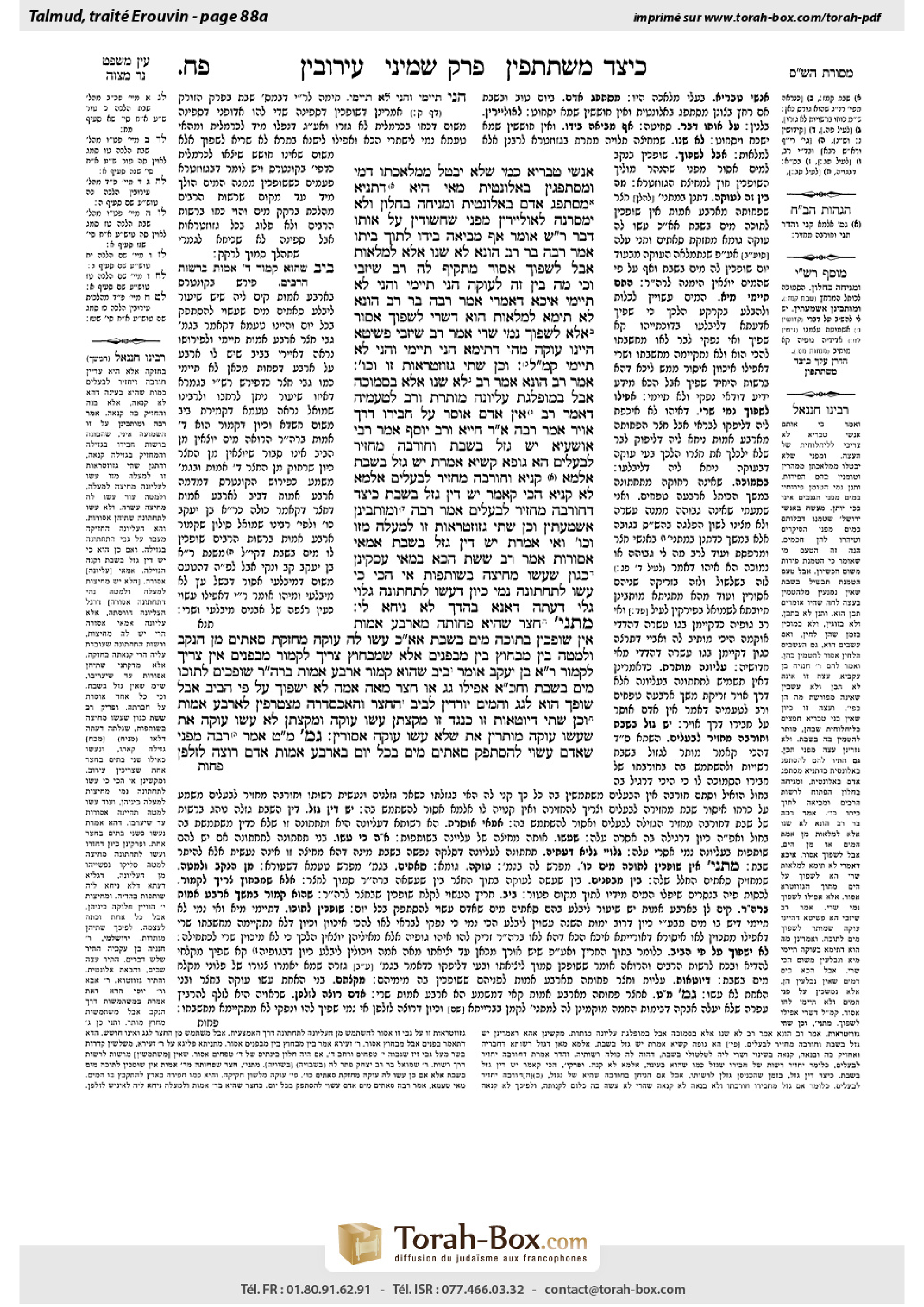
Eruvin 88a: Talmud study for Daf Yomi
Study the Talmud for Daf Yomi with scanned pages, Hebrew text, English translations from Sefaria and AI-generated French translations.
Passage selection and English or AI-generated French translation are available where the scan has annotations. Daf Study is independent of Torah-Box and Sefaria.
Browse Eruvin · עירובין · All tractatesEruvin 88a text and translations
This page of Eruvin includes the Aramaic text, an English translation and an AI-generated French translation, alongside the scan above.
עירובין פ״ח א · Aramaic and Hebrew text
אַנְשֵׁי טְבֶרְיָא כְּמִי שֶׁלֹּא יִבְטַל מִמְּלַאכְתּוֹ דָּמֵי.
וּמִסְתַּפְּגִין בַּאֲלוּנְטִית מַאי הִיא, דְּתַנְיָא: מִסְתַּפֵּג אָדָם בַּאֲלוּנְטִית, וּמַנִּיחָהּ בַּחַלּוֹן. וְלֹא יִמְסְרֶנָּה לָאוֹלְיָירִין מִפְּנֵי שֶׁחֲשׁוּדִין עַל אוֹתוֹ דָּבָר. רַבִּי שִׁמְעוֹן אוֹמֵר: אַף מְבִיאָהּ בְּיָדוֹ לְתוֹךְ בֵּיתוֹ.
אָמַר רַבָּה בַּר רַב הוּנָא: לֹא שָׁנוּ אֶלָּא לְמַלּאוֹת, אֲבָל לִשְׁפּוֹךְ — אָסוּר.
מַתְקֵיף לַהּ רַב שֵׁיזְבִי: וְכִי מָה בֵּין זֶה לְעוּקָה?
הָנֵי תָּיְימִי, וְהָנֵי לָא תָּיְימִי.
אִיכָּא דְּאָמְרִי, אָמַר רַבָּה בַּר רַב הוּנָא: לָא תֵּימָא לְמַלּאוֹת הוּא דִּשְׁרֵי, לִשְׁפּוֹךְ אָסוּר, אֶלָּא לִשְׁפּוֹךְ נָמֵי שְׁרֵי. אָמַר רַב שֵׁיזְבִי: פְּשִׁיטָא — הַיְינוּ עוּקָה! מַהוּ דְּתֵימָא: הָנֵי תָּיְימִי וְהָנֵי לָא תָּיְימִי, קָא מַשְׁמַע לַן.
וְכֵן שְׁתֵּי גְזוּזְטְרָאוֹת זוֹ וְכוּ׳. אָמַר רַב הוּנָא אָמַר רַב: לֹא שָׁנוּ אֶלָּא בִּסְמוּכָה, אֲבָל בְּמוּפְלֶגֶת — עֶלְיוֹנָה מוּתֶּרֶת.
וְרַב לְטַעְמֵיהּ, דַּאֲמַר רַב: אֵין אָדָם אוֹסֵר עַל חֲבֵירוֹ דֶּרֶךְ אֲוִיר.
אָמַר רַבָּה אָמַר רַבִּי חִיָּיא, וְרַב יוֹסֵף אָמַר רַבִּי אוֹשַׁעְיָא: יֵשׁ גָּזֵל בְּשַׁבָּת. וְחוּרְבָּה מַחֲזִיר לַבְּעָלִים.
הָא גוּפָא קַשְׁיָא: אָמְרַתְּ ״יֵשׁ גָּזֵל בְּשַׁבָּת״ — אַלְמָא קָנְיָא, ״וְחוּרְבָּה מַחֲזִיר לִבְעָלִים״ — אַלְמָא לָא קָנְיָא!
הָכִי קָאָמַר: יֵשׁ דִּין גָּזֵל בְּשַׁבָּת, כֵּיצַד — דְּחוּרְבָּה מַחֲזִיר לַבְּעָלִים.
אָמַר רַבָּה, וּמוֹתְבִינַן אַשְּׁמַעְתִּין: וְכֵן שְׁתֵּי גְזוּזְטְרָאוֹת זוֹ לְמַעְלָה מִזּוֹ וְכוּ׳. וְאִי אָמְרַתְּ יֵשׁ דִּין גָּזֵל בְּשַׁבָּת, אַמַּאי אֲסוּרוֹת?
אָמַר רַב שֵׁשֶׁת: הָכָא בְּמַאי עָסְקִינַן, כְּגוֹן שֶׁעָשׂוּ מְחִיצָה בְּשׁוּתָּפוּת.
אִי הָכִי, כִּי עָשׂוּ לַתַּחְתּוֹנָה נָמֵי!
כֵּיוָן דְּעָשׂוּ לַתַּחְתּוֹנָה — גַּלּוֹיֵי גַּלִּי דַּעְתַּהּ דַּאֲנָא בַּהֲדָךְ לָא נִיחָא לִי.
מַתְנִי׳ חָצֵר שֶׁהִיא פְּחוּתָה מֵאַרְבַּע אַמּוֹת — אֵין שׁוֹפְכִין בְּתוֹכָהּ מַיִם בְּשַׁבָּת, אֶלָּא אִם כֵּן עָשׂוּ לָהּ עוּקָה מַחְזֶקֶת סָאתַיִם מִן הַנֶּקֶב וּלְמַטָּה.
בֵּין מִבַּחוּץ, בֵּין מִבִּפְנִים. אֶלָּא שֶׁמִּבַּחוּץ — צָרִיךְ לִקְמוֹר, מִבִּפְנִים — אֵין צָרִיךְ לִקְמוֹר.
רַבִּי אֱלִיעֶזֶר בֶּן יַעֲקֹב אוֹמֵר: בִּיב שֶׁהוּא קָמוּר אַרְבַּע אַמּוֹת בִּרְשׁוּת הָרַבִּים — שׁוֹפְכִים לְתוֹכוֹ מַיִם בַּשַּׁבָּת. וַחֲכָמִים אוֹמְרִים: אֲפִילּוּ גַּג אוֹ חָצֵר מֵאָה אַמָּה — לֹא יִשְׁפּוֹךְ עַל פִּי הַבִּיב, אֲבָל שׁוֹפֵךְ הוּא לַגַּג, וְהַמַּיִם יוֹרְדִין לַבִּיב.
הֶחָצֵר וְהָאַכְסַדְרָה מִצְטָרְפִין לְאַרְבַּע אַמּוֹת. וְכֵן שְׁתֵּי דְיוֹטָאוֹת זוֹ כְּנֶגֶד זוֹ, מִקְצָתָן עָשׂוּ עוּקָה וּמִקְצָתָן לֹא עָשׂוּ עוּקָה, אֶת שֶׁעָשׂוּ עוּקָה — מוּתָּרִין, אֶת שֶׁלֹּא עָשׂוּ עוּקָה — אֲסוּרִין.
גְּמָ׳ מַאי טַעְמָא? אָמַר רַבָּה: מִפְּנֵי שֶׁאָדָם עָשׂוּי לְהִסְתַּפֵּק סָאתַיִם מַיִם בְּכׇל יוֹם, בְּאַרְבַּע אַמּוֹת — אָדָם רוֹצֶה לְזַלְּפָן,
Eruvin 88a · English translation
the inhabitants of Tiberias are considered like one who does so in order not to neglect his usual work. Most of them are ordinary laborers. It can be assumed that if they rose early to bring home straw or stalks in which to store their produce, they did so only to save work time.
The Gemara turns to the third activity that Rabbi Ḥananya ben Akavya permitted for the inhabitants of Tiberias: And they may dry themselves with a towel. What is this halakha? As it was taught in a baraita: A person who washed himself in cold water on Shabbat or a Festival may dry himself with a towel and place it on a window, as there is no concern that he perform the prohibited labor of wringing out the towel. And he may not give the towel to the bathhouse attendants [olayerin] because they are suspected with regard to that matter, as they might wring out the towel before giving it to other bathers. Furthermore, one may not bring the towel home because if he does so, he might forget and wring it out. Rabbi Shimon said: He may even bring the towel in his hand to his house, as there is no concern lest he wring it.
Rabba bar Rav Huna: They taught the leniency of partitions surrounding a hole in a balcony only with regard to drawing water through the hole; but to pour waste water down the hole, it is prohibited.
Rav Sheizvi raised an objection against this halakha: And what is the difference between this case of a hole in the balcony and that of a pit [uka] used in a courtyard for waste water? The Sages rule in the next mishna below that one who digs a pit with a capacity of two se’a in a small courtyard that is less than four cubits may pour waste water into the courtyard on Shabbat, even if the pit was full before Shabbat. He need not be concerned that this will cause water to flow out of the courtyard into the public domain on Shabbat.
The Gemara answers: These waters, which are poured out into the courtyard, are likely to be absorbed into the ground, and it is therefore uncertain that the water will indeed leave the courtyard. But these, the water poured through the hole into the body of water under the balcony, will not be absorbed. Therefore, one knows with certainty that the water will flow out beyond the permitted boundary.
Some say that Rabba bar Rav Huna actually said: You should not say that it is only drawing water through the hole in the balcony that is permitted, while pouring waste water through it is prohibited; rather, pouring waste water through the hole is also permitted. Rav Sheizvi said: This is obvious, as this is exactly the same as the halakha of the pit discussed in the next mishna. The Gemara rejects this argument: It is necessary to specify both halakhot, lest you say there is a difference between the cases, as these, the water poured in the courtyard, are likely to be absorbed into the ground, whereas these, the water poured through the hole in the balcony, will not be absorbed. Rabba bar Rav Huna therefore teaches us that we do not distinguish between the two cases.
We learned in the mishna: And likewise, if there are two balconies, one above the other, and a partition is erected for the upper balcony but is not erected for the lower one, it is prohibited for residents of both balconies to draw water through the upper one, unless they establish a joint eiruv between them. Rav Huna said that Rav said: They taught that one balcony renders it prohibited for residents of the other only where the one balcony is near the other, i.e., horizontally within four handbreadths. But if each balcony is separated by four handbreadths from the other, so that the residents of each balcony can use the other only by means of the air, the residents of the upper balcony are permitted to draw water, while the residents of the lower one are prohibited from doing so.
And Rav follows his regular line of argument here, as Rav said: One person does not impose restrictions upon another person by way of the air. Since the lower balcony is far from the higher one, it does not prohibit it, although it can make use of it by means of the vacant airspace between them, albeit with difficulty.
Rabba said that Rabbi Ḥiyya said, and Rav Yosef said that Rabbi Oshaya said: The halakha of stealing applies to Shabbat domains, and a ruin must be returned to its owner.
The Gemara registers surprise: This ruling itself is difficult, i.e., it is self-contradictory. You first said that the halakha of stealing applies to Shabbat domains, which at this point is understood by the Gemara as referring to the following case: A person’s house adjoins the ruin of another, and he observes that the ruin has been left deserted by its owner. If this person uses the ruin during the week, on Shabbat he may treat it as though it were his own, by carrying objects from his own house into the ruin and vice versa. From here we can infer that a stolen place is acquired for the purpose of Shabbat domains, although it does not belong to the person for other purposes. However, you subsequently said that a ruin must be returned to its owner, and from here we can infer that a ruin is not acquired for the purpose of Shabbat domains by the person who used it during the week, and therefore he may not carry objects from his own house into the ruin.
The Gemara answers: We should not understand this statement as suggested above, but rather this is what Rabbi Ḥiyya and Rabbi Oshaya are saying: The halakha of returning stolen property applies to Shabbat domains. How so? This means that a ruin must be returned to its owner. In other words, one who uses a ruin during the week does not acquire it even for the purpose of Shabbat domains.
Rabba said: And we ourselves raised an objection against our own teaching, as we learned in the mishna. And likewise, if there are two balconies, one above the other, they prohibit one another. But if you say that the halakha against stealing applies on Shabbat, which means one may not use the domain of another, and he acquires no rights to it if he does so, why are the two balconies prohibited from using it. The lower one has no right to make use of the upper one.
Rav Sheshet said: We are dealing here with a situation where, for example, the residents of the upper balcony and the residents of the lower balcony jointly erected a partition for the upper balcony. Consequently, the residents of the lower balcony share the right to use it with the residents of the upper one.
The Gemara raises a difficulty: If so, in a case where they erected a separate partition for the lower balcony, the residents of the upper balcony should likewise be prohibited to use it. As the residents of the lower one are partners in the upper one, they should prohibit its residents from using it.
The Gemara answers: Since they erected a separate partition for the lower balcony, they each thereby revealed their intention to the residents of the upper balcony that: It is not my wish to be partners with you. Consequently, they no longer prohibit the residents of the upper balcony from using it.
MISHNA: With regard to a courtyard that is less than four cubits by four cubits in area, one may not pour waste water into it on Shabbat, unless a pit was fashioned to receive the water, and the pit holds two se’a in volume from its edge below.
This halakha applies whether the pit was fashioned outside the courtyard or whether it was dug inside the courtyard itself. The only difference is as follows: If the pit was dug outside in the adjoining public domain, it is necessary to arch over it, so that the water will not flow into the public domain. If it was dug inside the courtyard, it is not necessary to arch over it.
Rabbi Eliezer ben Ya’akov says: In the case of a drainage ditch whose first four cubits are arched over in the public domain, one may pour waste water into it on Shabbat. And the Rabbis say: Even if a roof or a courtyard is a hundred cubits in area, one may not pour water directly onto the mouth of the drainage ditch. However, he may pour it upon the roof, from which the water spills into the drain of its own accord.
A courtyard and a portico, a roofed but unwalled structure in front of a house, combine for the four cubits by virtue of which it is permitted to pour water even into a courtyard that lacks a pit. And likewise, with regard to two upper stories [deyotaot], one opposite the other in the same small courtyard, if the residents of one of them fashioned a pit in the courtyard, and the residents of the other did not fashion a pit, those who fashioned a pit are permitted to pour their waste water into the courtyard, whereas those who did not fashion a pit are prohibited to do so.
GEMARA: The Gemara asks: What is the reason that a courtyard four by four cubits in area does not require a pit? Rabba said: Because a person ordinarily uses two se’a of water a day, and with regard to a courtyard of at least four cubits by four cubits, a person wants to sprinkle the water on the ground to prevent any dust from rising. Consequently, even if in practice the water does flow out of the courtyard, this effect is not necessarily his intention.
Eruvin 88a · Traduction française (IA)
les habitants de Tibériade sont considérés comme celui qui agit ainsi afin de ne pas négliger son travail habituel. La plupart d'entre eux sont des ouvriers ordinaires. On peut supposer que s'ils se sont levés tôt pour ramener des pailles ou des tiges dans lesquelles stocker leurs produits, ils l'ont fait uniquement pour économiser du temps de travail.
La Guemara aborde la troisième activité que le tanna Hanaanyah ben Akavya a permis aux habitants de Tibériade : ils peuvent se sécher avec un chiffon. Quelle est cette halakha ? Comme il a été enseigné dans une baraïta : une personne qui s'est lavé avec de l'eau froide le sabbat ou un jour de fête peut se sécher avec un chiffon et le poser sur une fenêtre, car il n'y a pas de crainte qu'il accomplisse le travail interdit de tordre le chiffon. Et il ne doit pas donner le chiffon aux employés de la salle de bain [olayerin], car ils sont soupçonnés à cet égard, car ils pourraient tordre le chiffon avant de le donner à d'autres baigneurs. De plus, on ne doit pas ramener le chiffon chez soi, car s'il le fait, il pourrait oublier et le tordre. Rabbi Shimon a dit : il peut même ramener le chiffon dans sa main chez lui, car il n'y a pas de crainte qu'il le tordra.
Rabba bar Rav Huna : Ils ont enseigné la leniété des cloisons entourant un trou dans un balcon uniquement concernant l'approvisionnement d'eau par le trou ; mais pour verser les eaux usées par le trou, cela est interdit.
Rav Sheizvi souleva une objection contre cette halakha : Et quelle est la différence entre ce cas de trou dans le balcon et celui d'un puits [uka] utilisé dans une cour pour les eaux usées ? Les Sages règlent dans la mishna suivante que celui qui creuse un puits d'une capacité de deux se'a dans une cour petite inférieure à quatre coudées peut verser les eaux usées dans la cour le sabbat, même si le puits était plein avant le sabbat. Il n'a pas à craindre que cela provoque que l'eau sorte de la cour dans le domaine public le sabbat.
La Guemara répond : ces eaux, qui sont versées dans la cour, sont susceptibles d'être absorbées par le sol, et il est donc incertain que l'eau sorte effectivement de la cour. Mais celles-ci, les eaux versées par le trou dans le corps d'eau sous le balcon, ne seront pas absorbées. Il est donc certain que l'eau sortira au-delà de la limite permise.
Certains disent que Rabba bar Rav Huna a en réalité dit : vous ne devriez pas dire que c'est seulement l'approvisionnement d'eau par le trou du balcon qui est permis, tandis que le versement des eaux usées par le trou est interdit ; plutôt, le versement des eaux usées par le trou est également permis. Rav Sheizvi dit : cela est évident, car c'est exactement la même halakha que celle du puits discutée dans la mishna suivante. La Guemara rejette cet argument : il est nécessaire de spécifier les deux halakhot, afin que l'on ne dise pas qu'il y a une différence entre les cas, car celles-ci, les eaux versées dans la cour, sont susceptibles d'être absorbées par le sol, tandis que celles-ci, les eaux versées par le trou du balcon, ne le seront pas. Rabba bar Rav Huna enseigne donc que nous ne faisons pas de distinction entre les deux cas.
Nous avons appris dans la mishna : et de même, si deux balcons existent, l'un au-dessus de l'autre, et une cloison est érigée pour le balcon supérieur mais pas pour le balcon inférieur, il est interdit aux habitants des deux balcons de tirer de l'eau par le supérieur, à moins qu'ils n'établissent un eiruv commun entre eux. Rav Huna a dit que Rav a dit : ils ont enseigné que l'un des balcons rend interdit aux habitants de l'autre uniquement là où le balcon est proche de l'autre, c'est-à-dire horizontalement à moins de quatre paumes. Mais si chaque balcon est séparé de l'autre par quatre paumes, de sorte que les habitants de chaque balcon peuvent utiliser l'autre uniquement par l'air, les habitants du balcon supérieur sont autorisés à tirer de l'eau, tandis que ceux du balcon inférieur sont interdits de le faire.
Et Rav suit sa ligne habituelle d'argumentation ici, car Rav a dit : une personne ne peut pas imposer des restrictions à une autre par l'air. Puisque le balcon inférieur est éloigné du balcon supérieur, il ne l'interdit pas, bien qu'il puisse en faire usage par l'espace aérien entre eux, bien que difficilement.
Rabba a dit que Rabbi Ḥiyya a dit, et Rav Yosef a dit que Rabbi Oshaya a dit : la halakha du vol s'applique aux domaines du sabbat, et un ruine doit être rendue à son propriétaire.
La Guemara exprime une surprise : cette décision elle-même est difficile, c'est-à-dire qu'elle est contradictoire. Vous avez d'abord dit que la halakha du vol s'applique aux domaines du sabbat, ce qui est compris par la Guemara à ce point comme faisant référence au cas suivant : la maison d'une personne est adjacente à la ruine d'une autre, et il observe que la ruine a été laissée vide par son propriétaire. Si cette personne utilise la ruine pendant la semaine, le sabbat il peut la considérer comme sienne, en transportant des objets de sa maison vers la ruine et vice versa. De là, on peut déduire que la propriété volée est acquise pour l'usage des domaines du sabbat, bien qu'elle ne soit pas la propriété de la personne pour d'autres usages. Cependant, vous avez ensuite dit que la ruine doit être rendue à son propriétaire, et de là on peut déduire que la ruine n'est pas acquise pour l'usage des domaines du sabbat par la personne qui l'a utilisée pendant la semaine, et donc il ne peut pas transporter des objets de sa maison vers la ruine.
La Guemara répond : nous ne devons pas comprendre cette déclaration comme suggéré ci-dessus, mais plutôt c'est ce que Rabbi Hiyah et Rabbi Oshaya disent : la halakha du retour des biens volés s'applique aux domaines du sabbat. Comment cela est-il possible ? Cela signifie que la ruine doit être rendue à son propriétaire. En d'autres termes, celui qui utilise une ruine pendant la semaine ne l'acquiert pas même pour l'usage des domaines du sabbat.
Rabba a dit : Et nous nous sommes nous-mêmes opposés à notre propre enseignement, comme nous l'avons appris dans la Michna. Et de même, si deux balcons sont l'un au-dessus de l'autre, ils s'interdisent mutuellement. Mais si l'on dit que la halakha concernant le vol s'applique le sabbat, ce qui signifie qu'on ne peut pas utiliser la propriété d'autrui, et qu'on ne gagne aucun droit sur celle-ci si l'on le fait, pourquoi les deux balcons sont-ils interdits d'utilisation. Le balcon inférieur n'a aucun droit d'utiliser le balcon supérieur.
Rav Sheshet a dit : Nous sommes ici dans un cas où, par exemple, les résidents du balcon supérieur et ceux du balcon inférieur ont construit ensemble une cloison pour le balcon supérieur. Ainsi, les résidents du balcon inférieur partagent le droit d'utilisation avec ceux du balcon supérieur.
La Guemara soulève une difficulté : Si tel est le cas, dans un cas où une cloison distincte a été construite pour le balcon inférieur, les résidents du balcon supérieur devraient également être interdits d'utiliser celui-ci. Comme les résidents du balcon inférieur sont associés au balcon supérieur, ils devraient interdire aux résidents du balcon supérieur d'en utiliser.
La Guemara répond : Puisque une cloison distincte a été érigée pour le balcon inférieur, ils ont ainsi manifesté à leurs résidents du balcon supérieur leur intention : Ce n'est pas mon souhait d'être associé à vous. Ainsi, ils n'interdisent plus aux résidents du balcon supérieur d'en utiliser.
MICHNA : En ce qui concerne un cour d'entrée dont la surface est inférieure à quatre cubits par quatre cubits, on ne peut pas verser les eaux usagées dedans le sabbat, sauf s'il y a un puits construit pour recevoir l'eau, et ce puits contient deux se'a de volume à partir de son bord inférieur.
Cette halakha s'applique qu'il s'agisse d'un puits construit en dehors du cour d'entrée ou qu'il ait été creusé à l'intérieur du cour d'entrée lui-même. La seule différence est la suivante : Si le puits a été creusé en dehors dans le domaine public, il est nécessaire de le surélever, afin que l'eau ne s'écoule pas dans le domaine public. Si le puits a été creusé à l'intérieur du cour d'entrée, il n'est pas nécessaire de le surélever.
Rabbi Eliezer ben Ya’akov dit : Dans le cas d'un canal d'évacuation dont les quatre premiers cubits sont surélevés dans le domaine public, on peut verser les eaux usagées dedans le sabbat. Et les Rabbins disent : Même si un toit ou un cour d'entrée a une surface de cent cubits, on ne peut pas verser l'eau directement sur la bouche du canal d'évacuation. Cependant, on peut verser l'eau sur le toit, de sorte que l'eau s'écoule naturellement dans le canal.
Un cour d'entrée et un portique, une structure toilée mais non murée devant une maison, combinés pour les quatre cubits grâce auxquels il est permis de verser l'eau même dans un cour d'entrée qui n'a pas de puits. Et de même, en ce qui concerne deux étages supérieurs [deyotaot], l'un face à l'autre dans le même petit cour d'entrée, si les résidents d'un d'entre eux ont construit un puits dans le cour d'entrée, et les résidents de l'autre n'ont pas construit de puits, ceux qui ont construit un puits sont autorisés à verser leurs eaux usagées dans le cour d'entrée, tandis que ceux qui n'ont pas construit de puits sont interdits de le faire.
GUEMARA : La Guemara pose une question : Quel est le motif pour lequel un cour d'entrée de quatre par quatre cubits n'a pas besoin d'un puits ? Rabba a dit : Parce qu'une personne utilise normalement deux se'a d'eau par jour, et concernant un cour d'entrée d'au moins quatre cubits par quatre cubits, une personne veut arroser l'eau sur le sol pour empêcher la poussière de s'élever. Ainsi, même si en pratique l'eau s'écoule du cour d'entrée, cet effet n'est pas nécessairement son intention.
Traduction française générée par IA à partir de l’édition anglaise de Sefaria. Vérifie toujours un passage avec le texte source.
Text from Sefaria: William Davidson Edition - Vocalized Aramaic (CC BY NC); William Davidson Edition - English (CC BY NC).