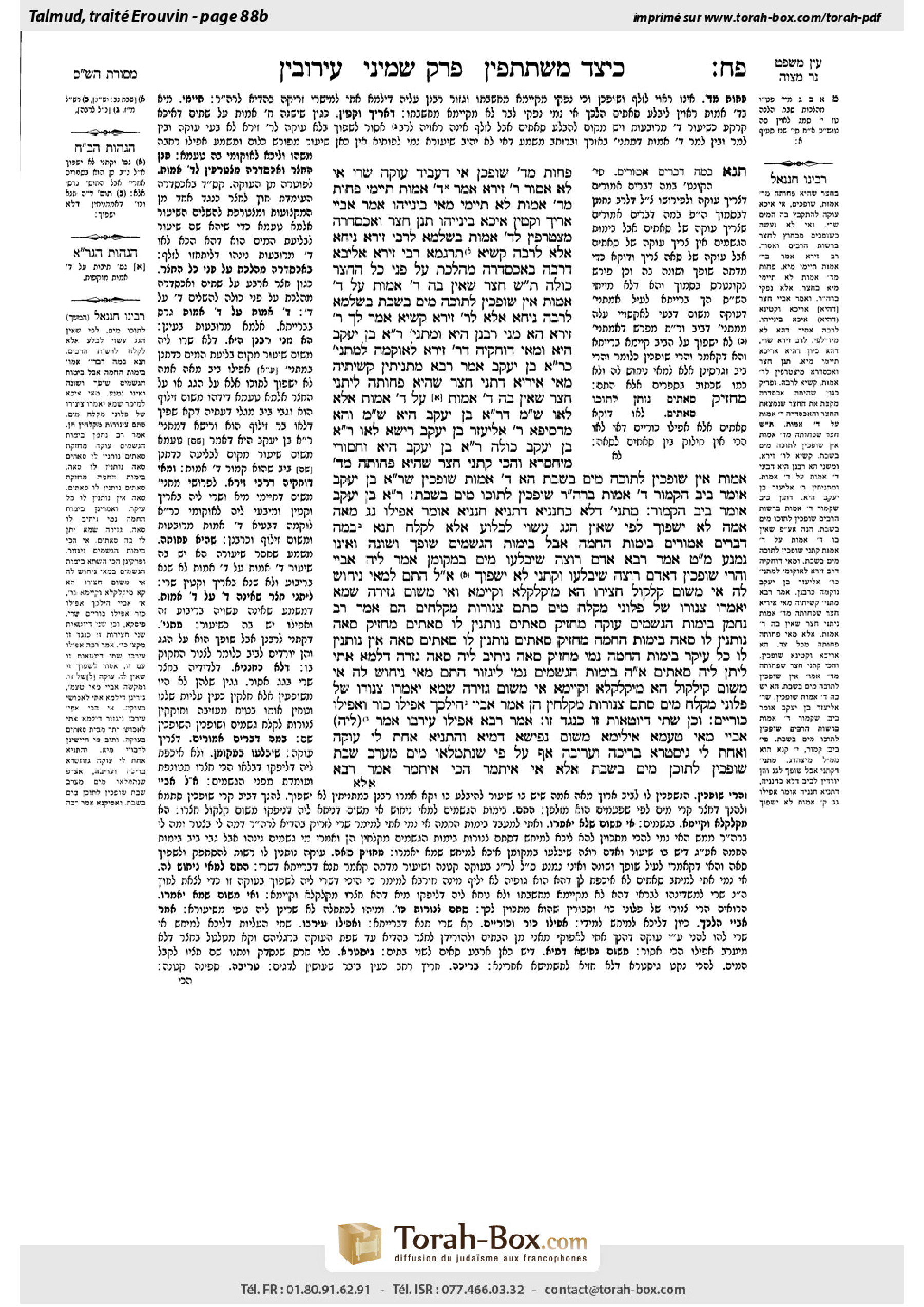
Eruvin 88b: Talmud study for Daf Yomi
Study the Talmud for Daf Yomi with scanned pages, Hebrew text, English translations from Sefaria and AI-generated French translations.
Passage selection and English or AI-generated French translation are available where the scan has annotations. Daf Study is independent of Torah-Box and Sefaria.
Browse Eruvin · עירובין · All tractatesEruvin 88b text and translations
This page of Eruvin includes the Aramaic text, an English translation and an AI-generated French translation, alongside the scan above.
עירובין פ״ח ב · Aramaic and Hebrew text
פָּחוֹת מֵאַרְבַּע — שׁוֹפְכָן. אִי דַּעֲבִיד עוּקָה — שְׁרֵי, אִי לָא — אָסוּר.
רַבִּי זֵירָא אָמַר: אַרְבַּע אַמּוֹת — תָּיְימִי, פָּחוֹת מֵאַרְבַּע אַמּוֹת — לָא תָּיְימִי.
מַאי בֵּינַיְיהוּ? אָמַר אַבָּיֵי: אֲרִיךְ וְקַטִּין אִיכָּא בֵּינַיְיהוּ.
תְּנַן: חָצֵר וְאַכְסַדְרָה מִצְטָרְפִין לְאַרְבַּע אַמּוֹת. בִּשְׁלָמָא לְרַבִּי זֵירָא נִיחָא, אֶלָּא לְרַבָּה קַשְׁיָא!
תַּרְגְּמָא רַבִּי זֵירָא אַלִּיבָּא דְרַבָּה בְּאַכְסַדְרָה מְהַלֶּכֶת עַל פְּנֵי כָּל הֶחָצֵר כּוּלָּהּ.
תָּא שְׁמַע: חָצֵר שֶׁאֵין בָּהּ אַרְבַּע אַמּוֹת עַל אַרְבַּע אַמּוֹת — אֵין שׁוֹפְכִין לְתוֹכָהּ מַיִם בַּשַּׁבָּת. בִּשְׁלָמָא לְרַבָּה נִיחָא, אֶלָּא לְרַבִּי זֵירָא קַשְׁיָא!
אָמַר לָךְ רַבִּי זֵירָא: הָא מַנִּי רַבָּנַן הִיא, וּמַתְנִיתִין רַבִּי אֱלִיעֶזֶר בֶּן יַעֲקֹב הִיא.
וּמַאי דּוּחְקֵיהּ דְּרַבִּי זֵירָא לְאוֹקֹמַהּ לְמַתְנִיתִין כְּרַבִּי אֱלִיעֶזֶר בֶּן יַעֲקֹב? אָמַר רָבָא: מַתְנִיתִין קְשִׁיתֵיהּ, מַאי אִירְיָא דְּתָנֵי ״חָצֵר שֶׁהִיא פְּחוּתָה״, לִיתְנֵי: ״חָצֵר שֶׁאֵין בָּהּ אַרְבַּע אַמּוֹת עַל אַרְבַּע אַמּוֹת״!
אֶלָּא לָאו שְׁמַע מִינַּהּ, דְּרַבִּי אֱלִיעֶזֶר בֶּן יַעֲקֹב הִיא. שְׁמַע מִינַּהּ.
וְהָא מִדְּסֵיפָא רַבִּי אֱלִיעֶזֶר בֶּן יַעֲקֹב, רֵישָׁא לָאו רַבִּי אֱלִיעֶזֶר בֶּן יַעֲקֹב!
כּוּלַּהּ רַבִּי אֱלִיעֶזֶר בֶּן יַעֲקֹב הִיא, וְחַסּוֹרֵי מִיחַסְּרָא, וְהָכִי קָתָנֵי: חָצֵר שֶׁהִיא פְּחוּתָה מֵאַרְבַּע אַמּוֹת — אֵין שׁוֹפְכִין לְתוֹכָהּ מַיִם בְּשַׁבָּת, הָא אַרְבַּע אַמּוֹת — שׁוֹפְכִין, שֶׁרַבִּי אֱלִיעֶזֶר בֶּן יַעֲקֹב אוֹמֵר: בִּיב הַקָּמוּר אַרְבַּע אַמּוֹת בִּרְשׁוּת הָרַבִּים — שׁוֹפְכִין לְתוֹכוֹ מַיִם בַּשַּׁבָּת.
רַבִּי אֱלִיעֶזֶר בֶּן יַעֲקֹב אוֹמֵר: בִּיב הַקָּמוּר.
מַתְנִיתִין דְּלָא כַּחֲנַנְיָא. דְּתַנְיָא, חֲנַנְיָא אוֹמֵר: אֲפִילּוּ גַּג מֵאָה אַמָּה — לֹא יִשְׁפּוֹךְ, לְפִי שֶׁאֵין הַגָּג עָשׂוּי לִבְלוֹעַ, אֶלָּא לְקַלֵּחַ.
תָּנָא: בַּמֶּה דְּבָרִים אֲמוּרִים — בִּימוֹת הַחַמָּה, אֲבָל בִּימוֹת הַגְּשָׁמִים — שׁוֹפֵךְ וְשׁוֹנֶה וְאֵינוֹ נִמְנָע. מַאי טַעְמָא? אָמַר רָבָא: אָדָם רוֹצֶה שֶׁיִּבָּלְעוּ מַיִם בִּמְקוֹמָן.
אֲמַר לֵיהּ אַבָּיֵי: וַהֲרֵי שׁוֹפְכִין, דְּאָדָם רוֹצֶה שֶׁיִּבָּלְעוּ, וְקָתָנֵי ״לֹא יִשְׁפּוֹךְ״!
אֲמַר לֵיהּ: הָתָם לְמַאי נֵיחוּשׁ לַהּ, אִי מִשּׁוּם קִלְקוּל חֲצֵירוֹ — הָא מִיקַּלְקְלָא וְקָיְימָא. וְאִי מִשּׁוּם גְּזֵירָה שֶׁמָּא יֹאמְרוּ ״צִנּוֹרוֹ שֶׁל פְּלוֹנִי מְקַלֵּחַ מַיִם״ — סְתָם צִנּוֹרוֹת מְקַלְּחִים הֵם.
אָמַר רַב נַחְמָן: בִּימוֹת הַגְּשָׁמִים, עוּקָה מַחֲזִיק סָאתַיִם — נוֹתְנִין לוֹ סָאתַיִם, מַחֲזִיק סְאָה — נוֹתְנִין לוֹ סְאָה. בִּימוֹת הַחַמָּה, מַחֲזִיק סָאתַיִם — נוֹתְנִין לוֹ סָאתַיִם, סְאָה — אֵין נוֹתְנִין לוֹ כָּל עִיקָּר.
בִּימוֹת הַחַמָּה נָמֵי, מַחֲזִיק סְאָה נִיתֵּיב לֵיהּ סְאָה! גְּזֵרָה דִּלְמָא אָתֵי לִיתֵּן לֵיהּ סָאתַיִם. אִי הָכִי בִּימוֹת הַגְּשָׁמִים נָמֵי לִיגְזוֹר!
הָתָם מַאי נֵיחוּשׁ לַהּ? אִי מִשּׁוּם קִילְקוּל — הָא מִיקַּלְקְלָא וְקָיְימָא. אִי מִשּׁוּם גְּזֵירָה ״שֶׁמָּא יֹאמְרוּ צִנּוֹרוֹ שֶׁל פְּלוֹנִי מְקַלֵּחַ מַיִם״ — סְתָם צִנּוֹרוֹת מְקַלְּחִין הֵן.
אָמַר אַבָּיֵי: הִילְכָּךְ, אֲפִילּוּ כּוֹר וַאֲפִילּוּ כּוֹרַיִים.
וְכֵן שְׁתֵּי דְיוֹטָאוֹת זוֹ כְּנֶגֶד זוֹ. אָמַר רָבָא: אֲפִילּוּ עֵירְבוּ.
אֲמַר (לֵיהּ) אַבָּיֵי: מַאי טַעְמָא? אִילֵּימָא מִשּׁוּם נְפִישָׁא דְמַיָּא, וְהָתַנְיָא: אַחַת לִי עוּקָה, וְאַחַת לִי גִּיסְטְרָא בְּרֵיכָה וַעֲרֵיבָה, אַף עַל פִּי שֶׁנִּתְמַלְּאוּ מַיִם מֵעֶרֶב שַׁבָּת — שׁוֹפְכִין לְתוֹכָן מַיִם בַּשַּׁבָּת!
אֶלָּא, אִי אִיתְּמַר, הָכִי אִיתְּמַר: אָמַר רָבָא
Eruvin 88b · English translation
But if the courtyard is less than four cubits by four cubits in area, one simply pours the water out, as the place is not fit for sprinkling. Therefore, if one fashioned a pit, it is permitted to pour out water; but if not, it is prohibited to do so, as one certainly intends for the water to flow outside.
Rabbi Zeira offered a different reason and said: In a courtyard of four cubits by four cubits, the water is likely to be absorbed into the ground. If it is less than four cubits in size, the water will not be absorbed but will flow out.
The Gemara asks: What is the practical difference between these two explanations? Abaye said: There is a difference between them with regard to a long and narrow courtyard. As the area of this courtyard is also sixteen square cubits, it likewise absorbs the water. Rabbi Zeira would therefore rule that it does not require a pit. However, as this courtyard is not in need of sprinkling, it requires a pit according to Rabba.
We learned in the mishna: A courtyard and a portico combine for the requisite four cubits, permitted the pouring of water into a courtyard that lacks a pit. The Gemara asks: Granted, according to the opinion of Rabbi Zeira, this works out well, as the total area is large enough to absorb the water. However, according to Rabba it is difficult, for when the courtyard is joined with the portico it is no longer in the shape of a square, and it is therefore unfit for sprinkling.
Rabbi Zeira explained the mishna in accordance with the opinion of Rabba, by saying that it is referring to a portico that extends along the entire courtyard, so that it adds to its width alone. Consequently, the courtyard and the portico together form a square of four by four cubits, an area that is fit for sprinkling.
The Gemara suggests: Come and hear a baraita that can decide this dispute. With regard to a courtyard that is not four cubits by four cubits in area, one may not pour water into it on Shabbat. The Gemara assumes that the baraita, which teaches that one may pour water only into a courtyard that it is four by four cubits, is precise in its wording. Granted, according to Rabba, this works out well, as he maintains that it is prohibited to pour water into a long and narrow courtyard. However, according to Rabbi Zeira, who maintains that the critical factor is the area of the courtyard, this is difficult.
The Gemara answers that Rabbi Zeira can say to you: In accordance with whose opinion is this baraita? It is in accordance with the opinion of the Rabbis at the end of the mishna, who maintain that the area of the courtyard is of no importance, whereas our unattributed mishna is in accordance with the opinion of Rabbi Eliezer ben Ya’akov, according to whom the area is the decisive factor.
The Gemara asks: And what forced Rabbi Zeira to establish the mishna in accordance with the opinion of Rabbi Eliezer ben Ya’akov? Rava said: The mishna was difficult for him. Why did the tanna specifically teach his ruling with respect to a courtyard that is less than four cubits, from which it can be inferred that if it has an area of four by four cubits it is permitted to pour water, even if it is not square in shape? Let the mishna teach: A courtyard that is not four cubits by four cubits, i.e., one that is not square shaped, even if it includes an area of sixteen square cubits.
Rather, shouldn’t one conclude from this argument that the unattributed section of the mishna is in accordance with the opinion of Rabbi Eliezer ben Ya’akov? The Gemara summarizes: Indeed, conclude from this that it is so.
The Gemara raises a difficulty with this conclusion: But from the fact that a latter clause of the mishna explicitly cites the opinion of Rabbi Eliezer ben Ya’akov, it can be inferred that the first clause does not represent the opinion of Rabbi Eliezer ben Ya’akov.
The Gemara rejects this argument: In fact, the entire mishna is in accordance with the opinion of Rabbi Eliezer ben Ya’akov, and as for its problematic style, the mishna is incomplete and it teaches the following: With regard to a courtyard that is less than four cubits in area, one may not pour waste water into it on Shabbat. Consequently, if it is four cubits in area, one may pour water into it, as Rabbi Eliezer ben Ya’akov says: If the first four cubits of a drainage ditch were arched over in the public domain, one may pour waste water into it on Shabbat.
We learned in the mishna that Rabbi Eliezer ben Ya’akov says: If the first four cubits of a drainage ditch were arched over in the public domain, it is permitted to pour waste water into it on Shabbat. However, the Rabbis say: One may pour water only upon the roof, from which it will spill into the drain of its own accord.
The Gemara comments: The mishna was not taught in accordance with the opinion of Ḥananya. For it was taught in a baraita that Ḥananya says: Even with regard to a roof one hundred cubits in area, one may not pour water onto it, because a roof is not apt to absorb the water. Rather, it causes it to run off. Consequently, pouring water onto this roof is equivalent to pouring it directly outside.
A tanna taught: In what case is this statement, that a pit is required, said? In the summer, but in the rainy season, one may pour and repeat, and he need not hold back. What is the reason? Rava said: A person is equally willing for the water to be absorbed on the spot, i.e., as there is abundant water in the courtyard during the rainy season, it will remain muddy in any case, and he therefore does not care whether the added waste water remains in the courtyard or if it flows out.
Abaye said to him: With regard to waste water poured into a drainage ditch, that a person wants it to be absorbed in the ditch itself, rather than flow out, and yet the mishna teaches that one may not pour water into the ditch.
Rava said to him: There, during the rainy season, there is no reason to prohibit the practice, for with regard to what need we be concerned? If you say he wants the water to flow out into the public domain because he is concerned about spoiling and sullying his courtyard, it is already spoiled by the rainwater. And if you say it should be prohibited due to a decree lest people say that so-and-so’s gutter is flowing with water on Shabbat, which might lead them to think he is watering his garden or violating some other prohibition, and they might act likewise even in the summer, this is not a relevant concern. As gutters ordinarily flow with water in the rainy season, people do not entertain this suspicion.
Rav Naḥman said: In the rainy season, with regard to a pit that holds two se’a, we grant him permission to pour two se’a of water into it. If it holds only one se’a, we grant him one se’a. However, in the summer, if the pit has a capacity of two se’a, we grant him two se’a; if it holds only one se’a, we do not grant him permission to pour any water at all.
The Gemara raises a difficulty: In the hot season as well, if the pit holds one se’a, let us grant him one se’a, for if he pours only this amount of water, it will not flow out into the public domain. The Gemara answers: This is prohibited due to a decree lest he come to put two se’a into it. The Gemara asks: If so, in the rainy season let us also apply the same preventive measure.
The Gemara answers: There, in the rainy season, there is no reason to prohibit the practice, for if one pours more water into a pit than it can take, about what need we be concerned? If you say he wants the waste water to flow out into the public domain because he is concerned about spoiling his courtyard, it is already spoiled by the rainwater. If you say it should be prohibited due to a decree lest people say that so-and-so’s gutter is flowing with water on Shabbat, gutters ordinarily gush with water in the rainy season, as stated above.
Abaye said: Therefore, in accordance with this reasoning, one can pour even a kor and even two kor of waste water into a small pit. As all gutters flow with water in the rainy season, there is no cause for any concern.
We learned in the mishna: And likewise, with regard to two upper stories, one opposite the other in the same courtyard, the residents of the one who dug a pit in the courtyard may pour water into it, while the residents of the other one who did not dig a pit in the courtyard are prohibited from doing so. Rava said: This halakha applies even if the residents of the two upper stories established an eiruv together.
Abaye said to him: What is the reason for this ruling? If you say it is due to the increase in the amount of water, as two upper stories pour out more water than one, wasn’t it taught in a baraita: The same halakha applies to a pit, and the same applies to a cracked earthenware vessel used as a receptacle for water, or a small pond, or a basin: Even though they were already filled with water on Shabbat eve, one may pour water into them on Shabbat. It is evident from here that as long as the pit is the requisite size, there is no concern about the amount of water that will flow out from it.
Rather, if it was stated it was stated as follows. Rava said:
Eruvin 88b · Traduction française (IA)
Mais si la cour est inférieure à quatre cubits par quatre cubits en surface, on jette simplement l'eau, car la place n'est pas adaptée pour l'aspersion. Ainsi, si l'on a creusé un puits, il est permis de jeter l'eau ; mais si ce n'est pas le cas, il est interdit de le faire, car l'intention est certainement que l'eau s'écoule à l'extérieur.
Rabbi Zeira a donné une autre raison et a dit : Dans une cour de quatre cubits par quatre cubits, l'eau a tendance à être absorbée par le sol. Si la cour est inférieure à quatre cubits en taille, l'eau ne sera pas absorbée mais s'écoulera.
Le Guemara pose la question : Quelle est la différence pratique entre ces deux explications ? Abaye a dit : Il y a une différence concernant une cour longue et étroite. Comme la surface de cette cour est également seize cubits carrés, elle absorbe également l'eau. Rabbi Zeira aurait donc jugé qu'il ne nécessitait pas de puits. Cependant, comme cette cour n'a pas besoin d'aspersion, elle nécessite un puits selon Rabba.
Nous avons appris dans la Michna : Une cour et un portique combinés donnent la mesure requise de quatre cubits, permettant l'aspersion d'eau dans une cour qui n'a pas de puits. La Guemara pose la question : Cela est admis selon l'opinion de Rabbi Zeira, car la surface totale est suffisante pour absorber l'eau. Cependant, selon Rabba, cela est difficile, car lorsque la cour est jointe au portique, elle n'est plus carrée et n'est donc pas adaptée à l'aspersion.
Rabbi Zeira a expliqué la Michna selon l'opinion de Rabba, en disant que cela fait référence à un portique qui s'étend tout le long de la cour, ajoutant uniquement à sa largeur. Ainsi, la cour et le portique forment ensemble un carré de quatre par quatre cubits, une surface adaptée à l'aspersion.
La Guemara suggère : Viens écouter une baraïta qui peut résoudre ce débat. Concernant une cour qui n'est pas de quatre cubits par quatre cubits en surface, on ne peut pas jeter l'eau le sabbat. La Guemara suppose que la baraïta, qui enseigne que l'eau peut être jetée uniquement dans une cour de quatre par quatre cubits, est précise dans son wording. Cela fonctionne bien selon Rabba, car il maintient que l'aspersion est interdite dans une cour longue et étroite. Cependant, selon Rabbi Zeira, qui considère la surface de la cour comme le facteur décisif, cela est difficile.
Le Guemara répond que Rabbi Zeira peut dire à vous : Selon quelle opinion est cette baraïta ? Elle est selon l'opinion des Rabbins à la fin de la mitsna, qui maintiennent que la surface de la cour n'a pas d'importance, tandis que notre mitsna non attribuée est selon l'opinion de Rabbi Eliezer ben Ya'akov, selon lequel la surface est le facteur décisif.
Le Guemara pose la question : Et qu'a forcé Rabbi Zeira à établir la mitsna selon l'opinion de Rabbi Eliezer ben Ya'akov ? Rava a dit : La mitsna était difficile pour lui. Pourquoi le tanna a-t-il spécifiquement enseigné sa décision concernant une cour inférieure à quatre cubits, d'où l'on peut déduire que si elle a une surface de quatre par quatre cubits, il est permis de jeter l'eau, même si elle n'est pas carrée en forme ? Que la mitsna enseigne : Une cour qui n'est pas de quatre cubits par quatre cubits, c'est-à-dire une cour qui n'est pas carrée, même si elle comprend une surface de seize cubits carrés.
Plutôt, ne devrait-on pas conclure de ce raisonnement que la section non attribuée de la mitsna est selon l'opinion de Rabbi Eliezer ben Ya'akov ? Le Guemara résume : En effet, concluez-en ainsi.
Le Guemara soulève une difficulté concernant cette conclusion : Mais à partir du fait que la clause ultérieure de la mitsna cite explicitement l'opinion de Rabbi Eliezer ben Ya'akov, on peut déduire que la première clause ne représente pas l'opinion de Rabbi Eliezer ben Ya'akov.
Le Guemara rejette cet argument : En réalité, toute la mitsna est selon l'opinion de Rabbi Eliezer ben Ya'akov, et concernant son style problématique, la mitsna est incomplète et elle enseigne ceci : Concernant une cour inférieure à quatre cubits en surface, on ne peut pas jeter l'eau de déchets le sabbat. Ainsi, si elle a une surface de quatre cubits, on peut jeter l'eau, car Rabbi Eliezer ben Ya'akov dit : Si les premiers quatre cubits d'un canal de drainage étaient couverts dans le domaine public, on peut jeter l'eau de déchets dans ce canal le sabbat.
Nous avons appris dans la mitsna que Rabbi Eliezer ben Ya'akov dit : Si les premiers quatre cubits d'un canal de drainage étaient couverts dans le domaine public, il est permis de jeter l'eau de déchets dans ce canal le sabbat. Cependant, les Rabbins disent : On peut jeter l'eau uniquement sur le toit, d'où il s'écoulera naturellement dans le drain.
Le Guemara commente : La mitsva n'a pas été enseignée selon l'opinion de Hananya. Car elle a été enseignée dans une baraïta que Hananya dit : Même concernant un toit d'une surface de cent cubits, on ne peut pas jeter l'eau dessus, car un toit n'est pas adapté à absorber l'eau. Plutôt, il cause son écoulement. Ainsi, jeter l'eau sur ce toit est équivalent à jeter l'eau directement à l'extérieur.
Un tanna a enseigné : Dans quel cas cette déclaration, que l'on a besoin d'un puits, est-elle dite ? En été, mais en saison des pluies, on peut jeter et répéter, et il n'est pas nécessaire de s'arrêter. Quelle est la raison ? Rava a dit : Une personne est également prête à ce que l'eau soit absorbée sur place, c'est-à-dire que comme il y a beaucoup d'eau dans la cour en saison des pluies, elle restera boueuse en tout cas, et il n'a donc pas d'importance que l'eau de déchet reste dans la cour ou s'écoule.
Abaye a dit à lui : Concernant l'eau de déchets jetée dans un canal de drainage, que l'on veut qu'elle soit absorbée dans le canal lui-même plutôt que de s'écouler, et pourtant la mitsva enseigne que l'on ne peut pas jeter l'eau dans le canal.
Rava dit à lui : Là, pendant la saison des pluies, il n'y a pas de raison de prohiber la pratique, car par rapport à quoi devons-nous nous inquiéter ? Si vous dites qu'il veut que l'eau s'écoule dans le domaine public parce qu'il craint de salir son courtil, l'eau de pluie a déjà sali le courtil. Et si vous dites qu'il faut la prohiber par décret de peur que les gens disent que la gouttière de tel ou tel coule de l'eau le sabbat, ce qui pourrait les faire penser qu'il arrose son jardin ou enfreint une autre interdiction, et qu'ils agissent ainsi même en été, cela n'est pas une préoccupation pertinente. Les gouttières coulent habituellement d'eau pendant la saison des pluies, donc les gens ne nourrissent pas cette suspicion.
Rav Naḥman dit : Pendant la saison des pluies, concernant un puits qui contient deux se'ot, nous autorisons à verser deux se'ot d'eau dedans. Si le puits ne contient qu'une se'ah, nous autorisons une se'ah. Cependant, en été, si le puits a une capacité de deux se'ot, nous autorisons deux se'ot ; si le puits ne contient qu'une se'ah, nous ne donnons pas l'autorisation de verser de l'eau du tout.
La Guemara soulève un problème : Même en saison chaude, si le puits contient une se'ah, autorisons-lui une se'ah, car s'il verse seulement cette quantité d'eau, elle ne coulera pas dans le domaine public. La Guemara répond : Cela est prohibé par décret de peur qu'il vienne à verser deux se'ot dedans. La Guemara demande : Si c'est ainsi, en saison des pluies, appliquons-nous aussi la même mesure préventive.
La Guemara répond : Là, en saison des pluies, il n'y a pas de raison de prohiber la pratique, car si l'on verse plus d'eau dans un puits que celui-ci ne peut contenir, à quoi devons-nous nous inquiéter ? Si vous dites qu'il veut que l'eau de décharge s'écoule dans le domaine public parce qu'il craint de salir son courtil, le courtil est déjà sali par l'eau de pluie. Si vous dites qu'il faut la prohiber par décret de peur que les gens disent que la gouttière de tel ou tel coule de l'eau le sabbat, les gouttières coulent habituellement d'eau en saison des pluies, comme mentionné ci-dessus.
Abaye dit : Par conséquent, selon cette raison, on peut verser même un kor et même deux kor d'eau de décharge dans un petit puits. Comme toutes les gouttières coulent d'eau en saison des pluies, il n'y a pas de cause d'inquiétude.
Nous avons appris dans la mitsna : Et de même, concernant deux étages supérieurs, l'un face à l'autre dans le même courtil, les habitants de celui qui a creusé un puits dans le courtil peuvent verser de l'eau dedans, tandis que ceux de l'autre qui n'ont pas creusé de puits dans le courtil sont interdits de le faire. Rava dit : Cette halakha s'applique même si les habitants des deux étages supérieurs ont établi un eiruv ensemble.
Abaye dit à lui : Quelle est la raison de cette décision ? Si vous dites qu'il s'agit de l'augmentation de la quantité d'eau, car deux étages supérieurs versent plus d'eau qu'un seul, n'a-t-il pas été enseigné dans une baraïta : La même halakha s'applique à un puits, et la même s'applique à un récipient en terre cassé utilisé pour contenir de l'eau, ou à un petit étang, ou à un bassin : Même s'ils étaient déjà remplis d'eau le soir du sabbat, on peut verser de l'eau dedans le sabbat. Il est évident d'ici que tant que le puits est de la taille requise, il n'y a pas de préoccupation concernant la quantité d'eau qui en sortira.
Plutôt, si cela a été dit de la sorte. Rava dit :
Traduction française générée par IA à partir de l’édition anglaise de Sefaria. Vérifie toujours un passage avec le texte source.
Text from Sefaria: William Davidson Edition - Vocalized Aramaic (CC BY NC); William Davidson Edition - English (CC BY NC).