Eruvin 89a: Talmud study for Daf Yomi
Study the Talmud for Daf Yomi with scanned pages, Hebrew text, English translations from Sefaria and AI-generated French translations.
Passage selection and English or AI-generated French translation are available where the scan has annotations. Daf Study is independent of Torah-Box and Sefaria.
Browse Eruvin · עירובין · All tractatesEruvin 89a text and translations
This page of Eruvin includes the Aramaic text, an English translation and an AI-generated French translation, alongside the scan above.
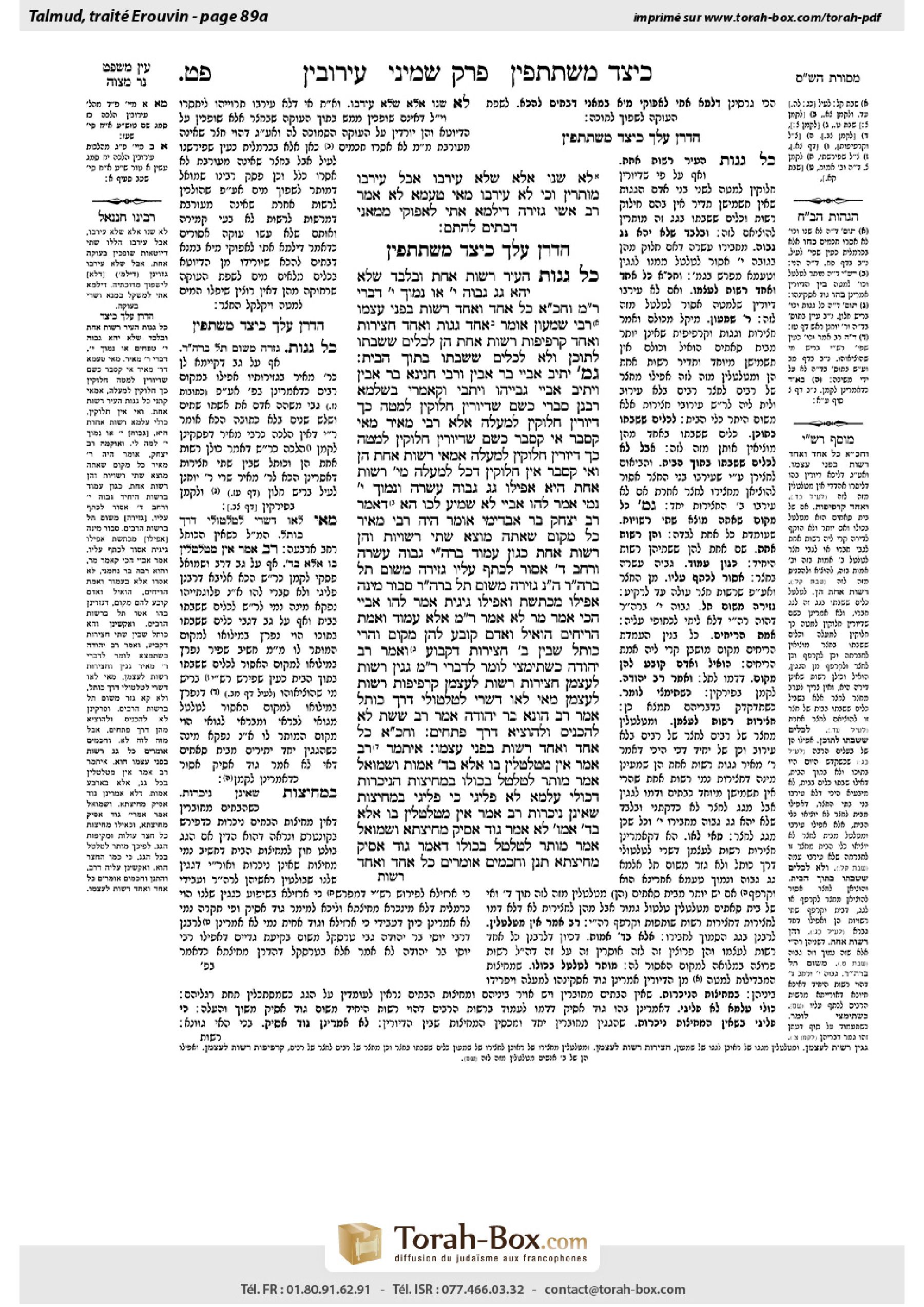
עירובין פ״ט א · Aramaic and Hebrew text
לֹא שָׁנוּ אֶלָּא שֶׁלֹּא עֵירְבוּ, אֲבָל עֵירְבוּ — מוּתָּרִין.
וְכִי לֹא עֵירְבוּ, מַאי טַעְמָא לָא? אָמַר רַב אָשֵׁי: גְּזֵירָה דִּילְמָא אָתֵי לְאַפּוֹקֵי מִמָּאנֵי דְבָתִּים לְהָתָם.
הַדְרָן עֲלָךְ כֵּיצַד מִשְׁתַּתְּפִין
מַתְנִי׳ כָּל גַּגּוֹת הָעִיר רְשׁוּת אַחַת, וּבִלְבַד שֶׁלֹּא יְהֵא גַּג גָּבוֹהַּ עֲשָׂרָה אוֹ נָמוּךְ עֲשָׂרָה, דִּבְרֵי רַבִּי מֵאִיר. וַחֲכָמִים אוֹמְרִים: כָּל אֶחָד וְאֶחָד רְשׁוּת בִּפְנֵי עַצְמוֹ.
רַבִּי שִׁמְעוֹן אוֹמֵר: אֶחָד גַּגּוֹת וְאֶחָד חֲצֵירוֹת וְאֶחָד קַרְפֵּיפוֹת — רְשׁוּת אַחַת הֵן לְכֵלִים שֶׁשָּׁבְתוּ לְתוֹכָן, וְלֹא לְכֵלִים שֶׁשָּׁבְתוּ בְּתוֹךְ הַבַּיִת.
גְּמָ׳ יָתֵיב אַבָּיֵי בַּר אָבִין וְרַבִּי חֲנִינָא בַּר אָבִין, וְיָתֵיב אַבָּיֵי גַּבַּיְיהוּ, וְיָתְבִי וְקָאָמְרִי: בִּשְׁלָמָא רַבָּנַן סָבְרִי כְּשֵׁם שֶׁדִּיּוּרִין חֲלוּקִין לְמַטָּה, כָּךְ דִּיּוּרִין חֲלוּקִין לְמַעְלָה.
אֶלָּא רַבִּי מֵאִיר מַאי קָסָבַר? אִי קָסָבַר: כְּשֵׁם שֶׁדִּיּוּרִין חֲלוּקִין לְמַטָּה, כָּךְ דִּיּוּרִין חֲלוּקִין לְמַעְלָה, אַמַּאי רְשׁוּת אַחַת הֵן? וְאִי קָסָבַר אֵין חֲלוּקִין, דְּכׇל לְמַעְלָה מֵעֲשָׂרָה רְשׁוּת אַחַת הִיא — אֲפִילּוּ גַּג גָּבוֹהַּ עֲשָׂרָה וְנָמוּךְ עֲשָׂרָה, נָמֵי!
אֲמַר לְהוּ אַבָּיֵי: לָא שְׁמִיעַ לְכוּ הָא דְּאָמַר רַב יִצְחָק בַּר אַבְדִּימִי, אוֹמֵר הָיָה רַבִּי מֵאִיר: כָּל מָקוֹם שֶׁאַתָּה מוֹצֵא שְׁתֵּי רְשׁוּיוֹת וְהֵן רְשׁוּת אַחַת, כְּגוֹן עַמּוּד בִּרְשׁוּת הַיָּחִיד גָּבוֹהַּ עֲשָׂרָה וְרָחָב אַרְבָּעָה — אָסוּר לְכַתֵּף עָלָיו, גְּזֵירָה מִשּׁוּם תֵּל בִּרְשׁוּת הָרַבִּים. הָכִי נָמֵי, גְּזֵירָה מִשּׁוּם תֵּל בִּרְשׁוּת הָרַבִּים.
סְבוּר מִינָּה אֲפִילּוּ מַכְתֶּשֶׁת וַאֲפִילּוּ גִּיגִית.
אֲמַר לְהוּ אַבָּיֵי, הָכִי אָמַר מָר: לֹא אָמַר רַבִּי מֵאִיר אֶלָּא עַמּוּד וְאַמַּת הָרֵיחַיִם, הוֹאִיל וְאָדָם קוֹבֵעַ לָהֶן מָקוֹם.
וַהֲרֵי כּוֹתֶל שֶׁבֵּין שְׁתֵּי חֲצֵירוֹת, דְּקָבוּעַ, וְאָמַר רַב יְהוּדָה: כְּשֶׁתִּימְצֵי לוֹמַר, לְדִבְרֵי רַבִּי מֵאִיר: גַּגִּין רְשׁוּת לְעַצְמָן, חֲצֵירוֹת רְשׁוּת לְעַצְמָן, קַרְפֵּיפוֹת רְשׁוּת לְעַצְמָן.
מַאי לָאו, דִּשְׁרֵי לְטַלְטוֹלֵי דֶּרֶךְ כּוֹתֶל!
אָמַר רַב הוּנָא בַּר יְהוּדָה אָמַר רַב שֵׁשֶׁת: לָא, לְהַכְנִיס וּלְהוֹצִיא דֶּרֶךְ פְּתָחִים.
וַחֲכָמִים אוֹמְרִים כָּל אֶחָד וְאֶחָד רְשׁוּת בִּפְנֵי עַצְמוֹ. אִיתְּמַר, רַב אָמַר: אֵין מְטַלְטְלִין בּוֹ אֶלָּא בְּאַרְבַּע אַמּוֹת, וּשְׁמוּאֵל אָמַר: מוּתָּר לְטַלְטֵל בְּכוּלּוֹ.
בִּמְחִיצוֹת הַנִּיכָּרוֹת — דְּכוּלֵּי עָלְמָא לָא פְּלִיגִי. כִּי פְּלִיגִי — בִּמְחִיצוֹת שֶׁאֵינָן נִיכָּרוֹת.
רַב אָמַר: אֵין מְטַלְטְלִין בּוֹ אֶלָּא בְּאַרְבַּע אַמּוֹת — לָא אָמַר: ״גּוּד אַסֵּיק מְחִיצְתָּא״. וּשְׁמוּאֵל אָמַר: מוּתָּר לְטַלְטֵל בְּכוּלּוֹ — דְּאָמַר: ״גּוּד אַסֵּיק מְחִיצְתָּא״.
תְּנַן, וַחֲכָמִים אוֹמְרִים: כָּל אֶחָד וְאֶחָד
Eruvin 89a · English translation
They taught this halakha only with regard to a case where the residents of the two upper stories did not establish an eiruv together, but if they established a joint eiruv, they are all permitted to pour water into the courtyard.
The Gemara asks: And where they did not establish an eiruv, what is the reason that the residents who did not dig a pit may not pour water into the courtyard? Rav Ashi said: It is a decree, lest people come to take out vessels filled with water from their houses into the courtyard, to pour into the pit. In the absence of an eiruv, this practice is prohibited.
MISHNA: All the roofs of the city are considered one domain. It is permitted to carry from one roof to another, even if the residents of the houses did not establish an eiruv between them. The Sages did not prohibit carrying between roofs, as it is rare to transfer an item from one roof to another. However, it is only permitted to transfer objects between roofs provided that one roof is neither ten handbreadths higher nor ten handbreadths lower than the adjacent roof. This is the statement of Rabbi Meir. And the Rabbis say: Each and every one of the roofs is a domain in and of itself. It is permitted to carry from one to the other only if the residents of both houses established an eiruv.
Rabbi Shimon says: Roofs, courtyards, and enclosures are all one domain with regard to vessels that were inside them when Shabbat began, and one may therefore carry from one of these areas to another. However, they are not one domain with regard to vessels that were inside the house when Shabbat began and were later taken into one of the above domains. A vessel that was inside the house when Shabbat began and subsequently carried to one of these areas may be carried from one roof, courtyard, or enclosure to another only if an eiruv had been established between the domains.
GEMARA: Abaye bar Avin and Rabbi Ḥanina bar Avin were sitting, and Abaye was sitting beside them, and they sat and said: Granted, the Rabbis maintain: Just as residents are divided into separate domains below, and they may not carry from house to house without an eiruv, so are residents divided into separate domains above, on the rooftops, and it is prohibited to carry from one roof to another without an eiruv.
However, Rabbi Meir, what does he maintain; what is the rationale for his opinion? If he maintains that just as residents are divided into separate domains below, so are residents divided into separate domains above, why, in his opinion, are they considered one domain? And if he maintains that they are not divided into separate domains, as any place above ten handbreadths off the ground is considered one domain, even if a roof is ten handbreadths higher or ten handbreadths lower than the adjacent roof, it should likewise be permitted to carry from one roof to the other.
Abaye said to them: Have you not heard that which Rav Yitzḥak bar Avdimi said that Rabbi Meir would say: Any place that you find two domains, i.e., places set apart from each other by disparity in height or by boundaries, and yet they are halakhically one domain, for example, a pillar ten handbreadths high and four handbreadths wide situated in a private domain, it is prohibited to adjust a burden on one’s shoulders upon it, by rabbinic decree, due to the concern lest he come to do the same thing on a mound in the public domain. The legal status of a mound ten handbreadths high and four handbreadths wide located in a public domain is that of a private domain. In that case, it is prohibited by Torah law to transfer an object from the public domain to the mound. Here too, in the case of roofs, Rabbi Meir prohibited transferring objects between roofs with a height disparity of ten handbreadths, by rabbinic decree, due to the concern lest one come to transfer an object from the public domain to a mound in a public domain.
Abaye and Ḥanina bar Avin understood by inference from this ruling that in the opinion of Rabbi Meir, it would be prohibited to adjust one’s burden even on a mortar and even on a vat that were overturned in a private domain and that are large enough to constitute private domains in their own right.
Abaye said to them: The Master, Rabba, said as follows: Rabbi Meir spoke only in the case of a pillar or the raised base of a millstone. Since a person fixes a place for them they are comparable to a mound in a public domain in that they are rarely moved. However, the Sages did not issue a decree in the case of portable objects.
The Gemara raises a difficulty. There is the case of a wall that is between two courtyards, which is fixed, and nevertheless Rav Yehuda said: When you analyze the matter, you will find that according to Rabbi Meir all roofs form a single domain in and of themselves, and likewise all courtyards form a single domain in and of themselves, and all enclosures form a single domain in and of themselves. It is permitted to carry from one courtyard to another, although it is not permitted to carry from a courtyard to a roof.
What, is it not that it is permitted to move objects from one courtyard to another via a dividing wall, even though it is ten handbreadths high? This poses a difficulty to the opinion of Rabbi Meir, who prohibits the transfer of an object from one place to a place ten handbreadths higher or lower.
Rav Huna bar Yehuda said that Rav Sheshet said: No, that explanation is incorrect, as Rav Yehuda meant to say that according to Rabbi Meir it is permitted to carry in and carry out between one courtyard and another, or from one enclosure to another, via the openings between them. However, Rabbi Meir concedes that one may not transfer objects over the wall that separates the two domains, as the wall is considered a domain in and of itself.
We learned in the mishna: And the Rabbis say that each and every one of the roofs is a domain in and of itself. It was stated that amora’im disagreed about the following issue. Rav said: According to the Rabbis, one may move objects on each roof only within four cubits. As, according to the Rabbis, the legal status of roofs is like that of courtyards, in that it is prohibited to carry from one roof to another, and each roof is fully open to a domain into which carrying is prohibited. Therefore, it is also prohibited to carry objects farther than four cubits on each roof. And Shmuel said: It is permitted to move objects throughout each entire roof.
The Gemara comments: With regard to partitions that are conspicuous, i.e., detached houses whose walls are distinct, everyone agrees that it is permitted to carry throughout each roof. Where they disagree is with regard to partitions that are not conspicuous, i.e., attached houses, which appear as though they share a common roof although they are owned by different people.
Rav said: One may carry on each roof only within four cubits. Rav does not state the principle: Extend and raise the partitions between the houses below, which states that the walls of the houses are considered to extend upward and create partitions between the roofs. And Shmuel said: It is permitted to carry throughout each entire roof, as he states the principle: Extend and raise the partitions.
The Gemara asks a question based on that which we learned in the mishna: And the Rabbis say that each and every one of the roofs
Eruvin 89a · Traduction française (IA)
Ils enseignèrent cette halakha uniquement dans le cas où les habitants des deux étages supérieurs n'avaient pas établi un eiruv ensemble, mais si ils avaient établi un eiruv commun, ils étaient tous autorisés à verser de l'eau dans la cour.
Le Guemara pose la question : Et dans le cas où ils n'avaient pas établi un eiruv, quelle est la raison pour laquelle les habitants qui n'avaient pas creusé un puits ne peuvent pas verser de l'eau dans la cour ? Rav Ashi dit : C'est une déclaration, afin que les gens ne viennent pas à transporter des récipients remplis d'eau de leurs maisons dans la cour pour les verser dans le puits. En l'absence d'un eiruv, cette pratique est interdite.
MICHNA : Tous les toits de la ville sont considérés comme un seul domaine. Il est permis de porter d'un toit à un autre, même si les habitants des maisons n'avaient pas établi un eiruv entre eux. Les Sages n'ont pas interdit de porter entre les toits, car c'est rare de transférer un objet d'un toit à un autre. Cependant, il est permis de transférer des objets entre les toits uniquement si un toit n'est ni dix tefachim plus haut ni dix tefachim plus bas que le toit adjacent. C'est l'opinion de Rabbi Meir. Et les Rabbins disent : Chaque toit est un domaine à part entière. Il est permis de porter d'un toit à un autre uniquement si les habitants des deux maisons avaient établi un eiruv.
Rabbi Shimon dit : Les toits, les cours et les enclos sont tous un seul domaine concernant les objets qui étaient à l'intérieur lors du début du sabbat, et on peut donc porter d'un de ces lieux à un autre. Cependant, ils ne sont pas un seul domaine concernant les objets qui étaient à l'intérieur de la maison lors du début du sabbat et qui ont été ensuite transportés dans l'un de ces domaines. Un objet qui était à l'intérieur de la maison lors du début du sabbat et qui a été ensuite transporté dans l'un de ces lieux peut être transporté d'un toit, d'une cour ou d'un enclos à un autre uniquement si un eiruv avait été établi entre les domaines.
GUEMARA : Abaye bar Avin et Rabbi Ḥanina bar Avin étaient assis, et Abaye était assis à côté d'eux, et ils dirent : C'est admis, les Rabbins maintiennent : Tout comme les habitants sont divisés en domaines séparés en dessous, et qu'ils ne peuvent pas porter d'une maison à une autre sans un eiruv, ainsi les habitants sont divisés en domaines séparés au-dessus, sur les toits, et il est interdit de porter d'un toit à un autre sans un eiruv.
Cependant, Rabbi Meir, qu'est-ce qu'il maintient ; quelle est la raison de son opinion ? Si il maintient que tout comme les habitants sont divisés en domaines séparés en dessous, ainsi les habitants sont divisés en domaines séparés au-dessus, pourquoi, selon son opinion, sont-ils considérés comme un seul domaine ? Et si il maintient qu'ils ne sont pas divisés en domaines séparés, comme tout lieu à dix tefachim au-dessus du sol est considéré comme un seul domaine, même si un toit est dix tefachim plus haut ou dix tefachim plus bas que le toit adjacent, il devrait également être permis de porter d'un toit à un autre.
Abaye dit à eux : N'avez-vous pas entendu ce que Rav Yitzḥak bar Avdimi a dit que Rabbi Meir disait : Tout lieu où l'on trouve deux domaines, c'est-à-dire des lieux séparés par une différence de hauteur ou par des limites, et pourtant halakhiquement ils forment un seul domaine, par exemple, un poteau dix tefachim de haut et quatre tefachim de large situé dans un domaine privé, il est interdit d'ajuster un fardeau sur ses épaules sur lui, par décret rabbinique, en raison de la crainte qu'on vienne à faire la même chose sur un monticule dans le domaine public. Le statut juridique d'un monticule dix tefachim de haut et quatre tefachim de large situé dans un domaine public est celui d'un domaine privé. Dans ce cas, il est interdit par la loi divine de transférer un objet du domaine public vers le monticule. Ici aussi, dans le cas des toits, Rabbi Meir a interdit le transfert d'objets entre les toits avec une différence de hauteur de dix tefachim, par décret rabbinique, en raison de la crainte qu'on vienne à transférer un objet du domaine public vers un monticule dans un domaine public.
Abaye et Ḥanina bar Avin ont compris par déduction de cette décision que, selon l'opinion de Rabbi Meir, il serait interdit d'ajuster son fardeau même sur un mortier et même sur un tonneau renversé dans un domaine privé et qui sont suffisamment grands pour constituer des domaines privés à part entière.
Abaye dit à eux : Le Maître, Rabba, a dit comme suit : Rabbi Meir parlait uniquement dans le cas d'un poteau ou de la base d'un moulin. Puisqu'une personne fixe un lieu pour eux, ils sont comparables à un monticule dans un domaine public, car ils sont rarement déplacés. Cependant, les Sages n'ont pas émis un décret dans le cas des objets portables.
Le Guemara soulève une difficulté. Il y a le cas d'un mur entre deux cours, qui est fixe, et pourtant Rav Yehuda a dit : Lorsque vous analysez la question, vous trouverez selon Rabbi Meir que tous les toits forment un seul domaine entre eux, de même que toutes les cours forment un seul domaine entre elles, et toutes les enclos forment un seul domaine entre eux. Il est permis de porter d'une cour à une autre, même si il n'est pas permis de porter d'une cour à un toit.
Qu'est-ce que cela signifie, qu'il est permis de déplacer des objets d'une cour à une autre via un mur, même s'il est dix tefachim de haut ? Cela pose une difficulté pour l'opinion de Rabbi Meir, qui interdit le transfert d'un objet d'un lieu à un lieu dix tefachim plus haut ou plus bas.
Rav Huna bar Yehuda a dit que Rav Sheshet a dit : Non, cette explication est incorrecte, car Rav Yehuda voulait dire que selon Rabbi Meir il est permis de porter d'une cour à une autre, ou de l'enclos à l'autre, via les ouvertures entre eux. Cependant, Rabbi Meir reconnaît qu'on ne peut pas transférer d'objets par-dessus le mur qui sépare les deux domaines, car le mur est considéré comme un domaine à part entière.
Nous avons appris dans la michna : Les Sages affirment que chaque toit est un domaine à part entière. Il a été dit que les amoraïm étaient en désaccord sur la question suivante. Rav dit : Selon les Sages, on peut transporter des objets sur chaque toit uniquement à l'intérieur de quatre cubits. En effet, selon les Sages, le statut juridique des toits est comparable à celui des courtyards, car il est interdit de transporter des objets d'un toit à un autre, et chaque toit est entièrement ouvert vers un domaine où le transport est interdit. Par conséquent, il est également interdit de transporter des objets à plus de quatre cubits sur chaque toit. Et Shmuel dit : Il est permis de transporter des objets sur l'ensemble de chaque toit.
La gemara commente : En ce qui concerne des cloisons visibles, c'est-à-dire des maisons séparées dont les murs sont distincts, tout le monde convient qu'il est permis de transporter des objets sur chaque toit. Cependant, ils divergent sur les cloisons non visibles, c'est-à-dire des maisons accolées, qui semblent partager un même toit, bien qu'elles soient propriété de personnes différentes.
Rav dit : On peut transporter des objets sur chaque toit uniquement à l'intérieur de quatre cubits. Rav ne formule pas le principe : Étendre et élever les cloisons entre les maisons en dessous, qui stipule que les murs des maisons sont considérés comme s'étendant vers le haut et créant des cloisons entre les toits. Et Shmuel dit : Il est permis de transporter des objets sur l'ensemble de chaque toit, car il formule le principe : Étendre et élever les cloisons.
La Guemara pose une question basée sur ce que nous avons appris dans la mishna : Et les Sages affirment que chaque toit est un domaine à part entière
Traduction française générée par IA à partir de l’édition anglaise de Sefaria. Vérifie toujours un passage avec le texte source.
Text from Sefaria: William Davidson Edition - Vocalized Aramaic (CC BY NC); William Davidson Edition - English (CC BY NC).