Eruvin 89b: Talmud study for Daf Yomi
Study the Talmud for Daf Yomi with scanned pages, Hebrew text, English translations from Sefaria and AI-generated French translations.
Passage selection and English or AI-generated French translation are available where the scan has annotations. Daf Study is independent of Torah-Box and Sefaria.
Browse Eruvin · עירובין · All tractatesEruvin 89b text and translations
This page of Eruvin includes the Aramaic text, an English translation and an AI-generated French translation, alongside the scan above.
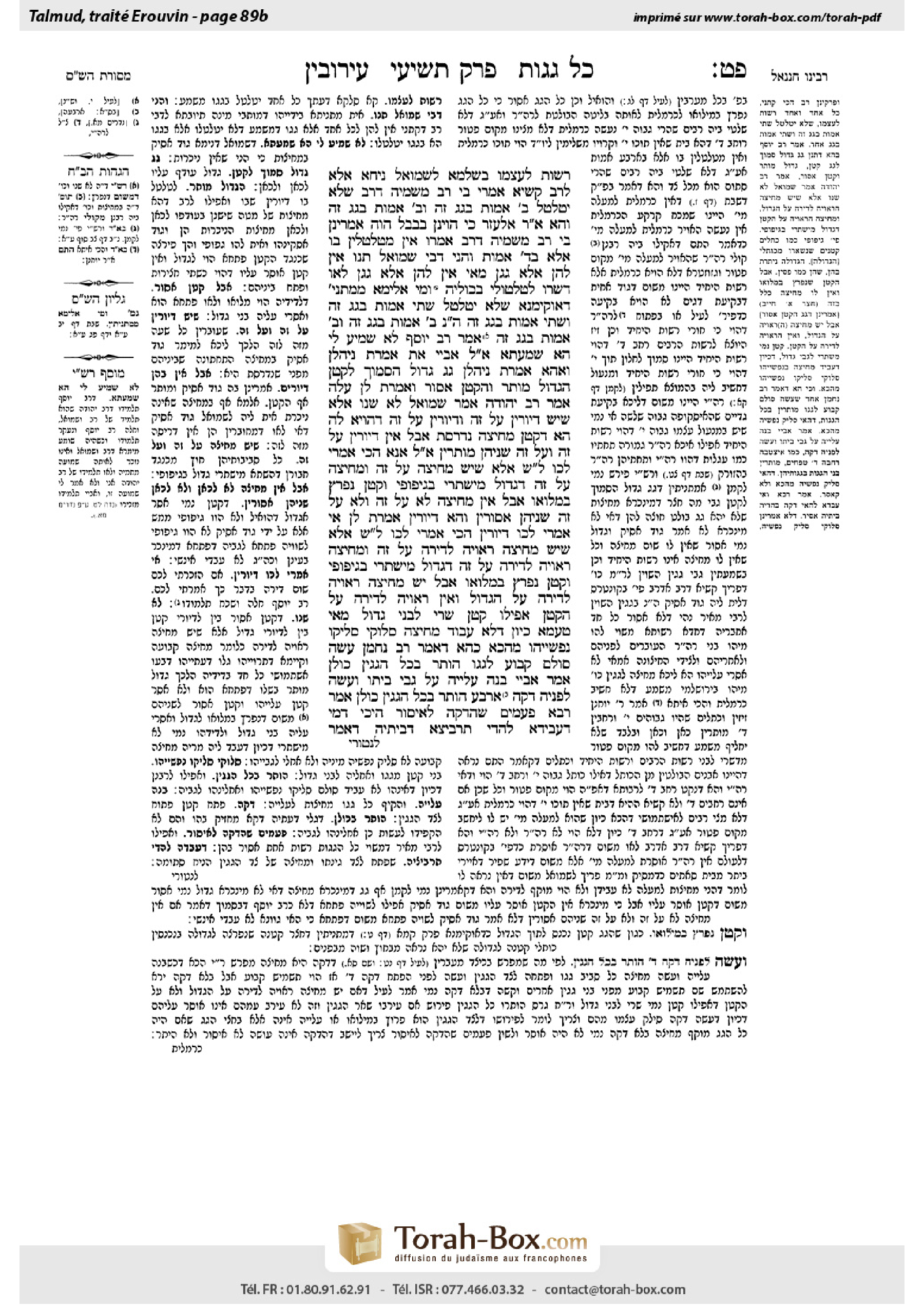
עירובין פ״ט ב · Aramaic and Hebrew text
רְשׁוּת לְעַצְמוֹ. בִּשְׁלָמָא לִשְׁמוּאֵל נִיחָא, אֶלָּא לְרַב קַשְׁיָא.
אָמְרִי בֵּי רַב מִשְּׁמֵיהּ דְּרַב: שֶׁלֹּא יְטַלְטֵל שְׁתֵּי אַמּוֹת בְּגַג זֶה, וּשְׁתֵּי אַמּוֹת בְּגַג זֶה.
וְהָא אָמַר רַבִּי אֶלְעָזָר: כִּי הֲוֵינַן בְּבָבֶל הֲוָה אָמְרִינַן: בֵּי רַב מִשְּׁמֵיהּ דְּרַב אָמְרוּ: אֵין מְטַלְטְלִין בּוֹ אֶלָּא בְּאַרְבַּע אַמּוֹת, וְהָנֵי דְּבֵי שְׁמוּאֵל תָּנוּ: אֵין לָהֶן אֶלָּא גַּגָּן.
מַאי ״אֵין לָהֶן אֶלָּא גַּגָּן״, לָאו דִּשְׁרוּ לְטַלְטוֹלֵי בְּכוּלֵּיהּ? וּמִי אַלִּימָא מִמַּתְנִיתִין, דְּאוֹקֵימְנָא שֶׁלֹּא יְטַלְטֵל שְׁתֵּי אַמּוֹת בְּגַג זֶה וּשְׁתֵּי אַמּוֹת בְּגַג זֶה?! הָכִי נָמֵי, שְׁתֵּי אַמּוֹת בְּגַג זֶה וּשְׁתֵּי אַמּוֹת בְּגַג זֶה.
אָמַר רַב יוֹסֵף: לָא שְׁמִיעַ לִי הָא שְׁמַעְתָּא. אֲמַר לֵיהּ אַבָּיֵי: אַתְּ אֲמַרְתְּ נִיהֲלַן, וְאַהָא אֲמַרְתְּ נִיהֲלַן: גַּג גָּדוֹל הַסָּמוּךְ לְקָטָן — הַגָּדוֹל מוּתָּר, וְהַקָּטָן אָסוּר.
וַאֲמַרְתְּ לַן עֲלַהּ: אָמַר רַב יְהוּדָה אָמַר שְׁמוּאֵל: לֹא שָׁנוּ אֶלָּא שֶׁיֵּשׁ דִּיּוּרִין עַל זֶה וְדִיּוּרִין עַל זֶה, דְּהָוְיָא לַהּ הָא דְּקָטָן מְחִיצָה נִדְרֶסֶת.
אֲבָל אֵין דִּיּוּרִין עַל זֶה וְעַל זֶה — שְׁנֵיהֶן מוּתָּרִין.
אֲמַר לֵיהּ: אֲנָא הָכִי אֲמַרִי לְכוּ: לֹא שָׁנוּ אֶלָּא שֶׁיֵּשׁ מְחִיצָה עַל זֶה וּמְחִיצָה עַל זֶה, דְּגָדוֹל מִישְׁתְּרֵי בְּגִיפּוּפֵי, וְקָטָן נִפְרָץ בִּמְלוֹאוֹ. אֲבָל אֵין מְחִיצָה לֹא עַל זֶה וְלֹא עַל זֶה — שְׁנֵיהֶן אֲסוּרִין.
וְהָא דִּיּוּרִין אֲמַרְתְּ לַן! אִי אֲמַרִי לְכוּ דִּיּוּרִין, הָכִי אֲמַרִי לְכוּ: לֹא שָׁנוּ אֶלָּא שֶׁיֵּשׁ מְחִיצָה רְאוּיָה לְדִירָה עַל זֶה וּמְחִיצָה רְאוּיָה לְדִירָה עַל זֶה, דְּגָדוֹל מִישְׁתְּרֵי בְּגִיפּוּפֵי וְקָטָן נִפְרָץ בִּמְלוֹאוֹ.
אֲבָל יֵשׁ מְחִיצָה רְאוּיָה לְדִירָה עַל הַגָּדוֹל, וְאֵין רְאוּיָה לְדִירָה עַל הַקָּטָן — אֲפִילּוּ קָטָן שְׁרֵי לִבְנֵי גָדוֹל. מַאי טַעְמָא? כֵּיוָן דְּלָא עֲבוּד מְחִיצָה, סַלּוֹקֵי סַלִּיקוּ נַפְשַׁיְיהוּ מֵהָכָא.
כְּהָא דְּאָמַר רַב נַחְמָן: עָשָׂה סוּלָּם קָבוּעַ לְגַגּוֹ — הוּתַּר בְּכׇל הַגַּגִּין כּוּלָּן.
אָמַר אַבָּיֵי: בָּנָה עֲלִיָּיה עַל גַּבֵּי בֵּיתוֹ וְעָשָׂה לְפָנֶיהָ דַּקָּה אַרְבַּע — הוּתַּר בְּכׇל הַגַּגִּין כּוּלָּן.
אָמַר רָבָא: פְּעָמִים שֶׁהַדַּקָּה לְאִיסּוּר, הֵיכִי דָּמֵי — דַּעֲבִידָא לַהֲדֵי תַּרְבִּיצָא דְבֵיתֵיהּ, דְּאָמַר
Eruvin 89b · English translation
is a domain in and of itself. This indicates that each roof constitutes a discrete domain, and one may carry throughout this entire domain. Granted according to the opinion of Shmuel, this works out well, but according to the opinion of Rav, it is difficult.
The Gemara answers that the Sages of the school of Rav said in the name of Rav: The ruling in the mishna is not a leniency permitting one to carry throughout the entire roof; rather, it is a stringency, ruling that one may not move an object two cubits on this roof and two cubits on that roof. The tanna rules that even the allowance to carry within four cubits is restricted to a single roof.
The Gemara raises a difficulty. But didn’t Rabbi Elazar say: When we were in Babylonia we would say that the Sages of the school of Rav said in the name of Rav: One may move an object on each roof only within four cubits, and those Sages of the school of Shmuel taught a baraita in accordance with their opinion: They have only their own roof.
The Gemara seeks to clarify this baraita. What is the meaning of the statement: They have only their own roof? Is it not that they are permitted to move an object throughout each entire roof? This baraita poses a difficulty to Rav. The Gemara rejects this contention: And is this baraita any stronger a proof than our mishna, which we established as a stringency, that one may not move an object two cubits on this roof and two cubits on that roof? So too, this baraita is teaching that one may not carry two cubits on this roof and two cubits on that roof.
Rav Yosef said, after an illness had caused him to forget his knowledge: I have not heard this halakha of Shmuel’s with regard to roofs. His student Abaye said to him: You yourself said it to us, and it was about this that you said it to us: With regard to a large roof that is adjacent to a small one, carrying on the large one is permitted, as its partitions are distinct where it extends beyond the small one, and carrying on the small one is prohibited, as it is breached along its entire length into the other roof, onto which it is prohibited to carry.
And you said to us about it: Rav Yehuda said that Shmuel said: They only taught this halakha in a case where there are residents on this roof and residents on that roof, as the extended, virtual partition of the small roof is considered a trampled partition. The residents trample this virtual partition as they move from one roof to the other, and the entire length of the small roof is considered breached into the large one.
However, if there are no residents on this roof and none on that one, carrying on both roofs is permitted. Presumably, Shmuel’s reasoning is that in this case the walls of the houses below extend upward and form partitions between the roofs, in accordance with the principle: Extend and raise the partitions.
Rav Yosef said to him: I remember it now. I said to you as follows: They taught this halakha, that carrying is prohibited on the small roof, only with regard to a case where there was an actual partition on all sides of this roof and an actual partition on all sides of that roof, not only between the two roofs. In that case, carrying on the large roof is permitted by means of the remnants of the partition on either side of the opening, and carrying on the small roof is prohibited because it is fully breached into the larger one. However, if there is no partition, neither on all sides of this roof nor on all sides of that roof, carrying on both of them is prohibited.
Abaye raised a difficulty: But didn’t you speak to us of residents? Rav Yosef replied: If I spoke to you of residents, this is what I said to you: They taught this halakha, that carrying is prohibited on the small roof, only in a case where there is an actual partition that renders the area fit for residence on all sides of this roof, and an actual partition that renders the area fit for residence on all sides of that roof, as carrying on the large roof is permitted by means of the remnants of the partition on either side of the opening, and carrying on the small roof is prohibited because it is fully breached into the larger one.
However, if there is a partition that renders the area fit for a residence on all sides of the large roof, but there is no partition that renders the area fit for a residence on the small roof, carrying even on the small roof is permitted for the residents of the large roof. What is the reason for this? Since the residents of the small roof did not erect a partition around their roof, they thereby removed themselves from here and transferred the right to their domain to the residents of the large roof.
This is in accordance with that which Rav Naḥman said: If one affixed a permanent ladder to his roof, while the owners of the neighboring roofs did not do so, it is permitted for him to carry on all the roofs. The failure of the other owners to erect a ladder indicates that they relinquished the right to their roofs to the one who affixed the permanent ladder.
Abaye said: If a person built an upper story atop his house, by surrounding the roof with walls, and erected before its entrance a small partition [dakka] four cubits high that opens to other roofs, it is permitted for him to carry on all the roofs. His construction of the partition is indicative of his plans to utilize the other roofs, while the failure of the other owners to do so indicates that they conceded use of their roofs to him.
Rava said: Sometimes the small partition leads to prohibition. What are the circumstances of this case? It is a case where the partition was erected facing toward the garden of his house and the sides facing the other roofs were sealed. The reason is that through his actions he said
Eruvin 89b · Traduction française (IA)
c'est un domaine en soi. Cela indique que chaque toit constitue un domaine distinct, et l'on peut porter à travers tout ce domaine. Selon l'opinion de Shmuel, cela fonctionne bien, mais selon l'opinion de Rav, cela est difficile.
La Guemara répond que les Sages de la maison de Rav dirent en nom de Rav : La décision de la mitsna n'est pas une facilité permettant de porter à travers tout le toit ; plutôt, c'est une restriction, établissant que l'on ne peut pas déplacer un objet de deux cubits sur ce toit et de deux cubits sur celui-ci. Le tanna établit que même l'autorisation de porter à l'intérieur de quatre cubits est limitée à un seul toit.
La Guemara soulève une difficulté. Mais n'aurait-il pas dit Rabbi Elazar : Quand nous étions en Babylone, nous disions que les Sages de la maison de Rav dirent en nom de Rav : On peut déplacer un objet sur chaque toit uniquement à l'intérieur de quatre cubits, et ces Sages de la maison de Shmuel enseignèrent une baraïta conformément à leur opinion : Ils n'ont que leur propre toit.
La Guemara cherche à clarifier cette baraïta. Qu'entend-on par la déclaration : Ils n'ont que leur propre toit ? N'est-ce pas que l'on est autorisé à déplacer un objet à travers chaque toit entier ? Cette baraïta pose une difficulté pour Rav. La Guemara rejette cette affirmation : Et cette baraïta est-elle un argument plus fort que notre mitsva, que nous avons établi comme une restriction, à savoir qu'on ne peut pas déplacer un objet de deux cubits sur ce toit et de deux cubits sur celui-là ? De même, cette baraïta enseigne que l'on ne peut pas porter deux cubits sur ce toit et deux cubits sur celui-là.
Rav Yosef dit, après une maladie qui avait causé l'oubli de ses connaissances : Je n'ai pas entendu cette halakha de Shmuel concernant les toits. Son élève Abaye lui dit : Tu as toi-même dit cela à nous, et c'est à ce sujet que tu as dit cela à nous : Concernant un toit grand adjacent à un toit petit, le port sur le grand est permis, car ses cloisons sont distinctes là où elles dépassent le petit, et le port sur le petit est interdit, car il est percé tout le long vers l'autre toit, sur lequel le port est interdit.
Et tu as dit à nous à ce sujet : Rav Yehuda dit que Shmuel dit : Ils ont enseigné cette halakha uniquement dans un cas où il y a des habitants sur ce toit et des habitants sur celui-ci, car la cloison virtuelle du petit toit est considérée comme une cloison foulée. Les habitants foulent cette cloison virtuelle lorsqu'ils passent d'un toit à l'autre, et toute la longueur du petit toit est considérée comme percée vers le grand.
Cependant, si aucun habitant ne se trouve sur ce toit et aucun sur celui-ci, le port sur les deux toits est permis. Probablement, la raison de Shmuel est que dans ce cas, les murs des maisons en dessous s'élèvent et forment des cloisons entre les toits, conformément au principe : Étends et élève les cloisons.
Rav Yosef dit à lui : Je me le rappelle maintenant. J'ai dit à toi comme suit : Ils ont enseigné cette halakha, que le port est interdit sur le petit toit, uniquement dans un cas où il y a une cloison réelle sur tous les côtés de ce toit et une cloison réelle sur tous les côtés de celui-ci, pas seulement entre les deux toits. Dans ce cas, le port sur le grand toit est permis grâce aux restes de la cloison des deux côtés de l'ouverture, et le port sur le petit toit est interdit car il est entièrement percé vers le grand. Cependant, si il n'y a pas de cloison, ni sur tous les côtés de ce toit ni sur tous les côtés de celui-ci, le port sur les deux est interdit.
Abaye souleva une difficulté : Mais n'as-tu pas parlé à nous des habitants ? Rav Yosef répondit : Si j'ai parlé à toi des habitants, c'est ce que j'ai dit à toi : Ils ont enseigné cette halakha, que le port est interdit sur le petit toit, uniquement dans un cas où il y a une cloison réelle qui rend l'aire adaptée à la résidence sur tous les côtés de ce toit et une cloison réelle qui rend l'aire adaptée à la résidence sur tous les côtés de celui-ci, car le port sur le grand toit est permis grâce aux restes de la cloison des deux côtés de l'ouverture, et le port sur le petit toit est interdit car il est entièrement percé vers le grand.
Cependant, si une cloison rend l'aire adaptée à la résidence sur tous les côtés du grand toit, mais pas sur le petit toit, le port même sur le petit toit est permis pour les habitants du grand toit. Quelle est la raison de cela ? Parce que les habitants du petit toit n'ont pas érigé une cloison autour de leur toit, ils ont ainsi déserté ce lieu et transféré le droit à leur domaine aux habitants du grand toit.
Cela correspond à ce que Rav Naḥman a dit : Si l'on a fixé une échelle permanente sur son toit, tandis que les propriétaires des toits voisins n'ont pas fait cela, il est permis de porter sur tous les toits. L'absence d'échelle des autres propriétaires indique qu'ils ont renoncé à leur droit sur leurs toits à celui qui a fixé l'échelle permanente.
Abaye dit : Si une personne a construit un étage au-dessus de sa maison, en entourant le toit de murs, et a érigé avant son entrée une petite cloison [dakka] de quatre cubits de haut qui s'ouvre vers d'autres toits, il est permis de porter sur tous les toits. Sa construction de la cloison indique ses intentions d'utiliser les autres toits, tandis que l'absence d'action des autres propriétaires indique qu'ils ont concédé l'utilisation de leurs toits à lui.
Rava dit : Parfois la petite cloison mène à l'interdiction. Quels sont les circonstances de ce cas ? C'est un cas où la cloison a été érigée face au jardin de sa maison et les côtés tournés vers les autres toits étaient scellés. La raison est que par ses actions, il a dit
Traduction française générée par IA à partir de l’édition anglaise de Sefaria. Vérifie toujours un passage avec le texte source.
Text from Sefaria: William Davidson Edition - Vocalized Aramaic (CC BY NC); William Davidson Edition - English (CC BY NC).