Eruvin 90a: Talmud study for Daf Yomi
Study the Talmud for Daf Yomi with scanned pages, Hebrew text, English translations from Sefaria and AI-generated French translations.
Passage selection and English or AI-generated French translation are available where the scan has annotations. Daf Study is independent of Torah-Box and Sefaria.
Browse Eruvin · עירובין · All tractatesEruvin 90a text and translations
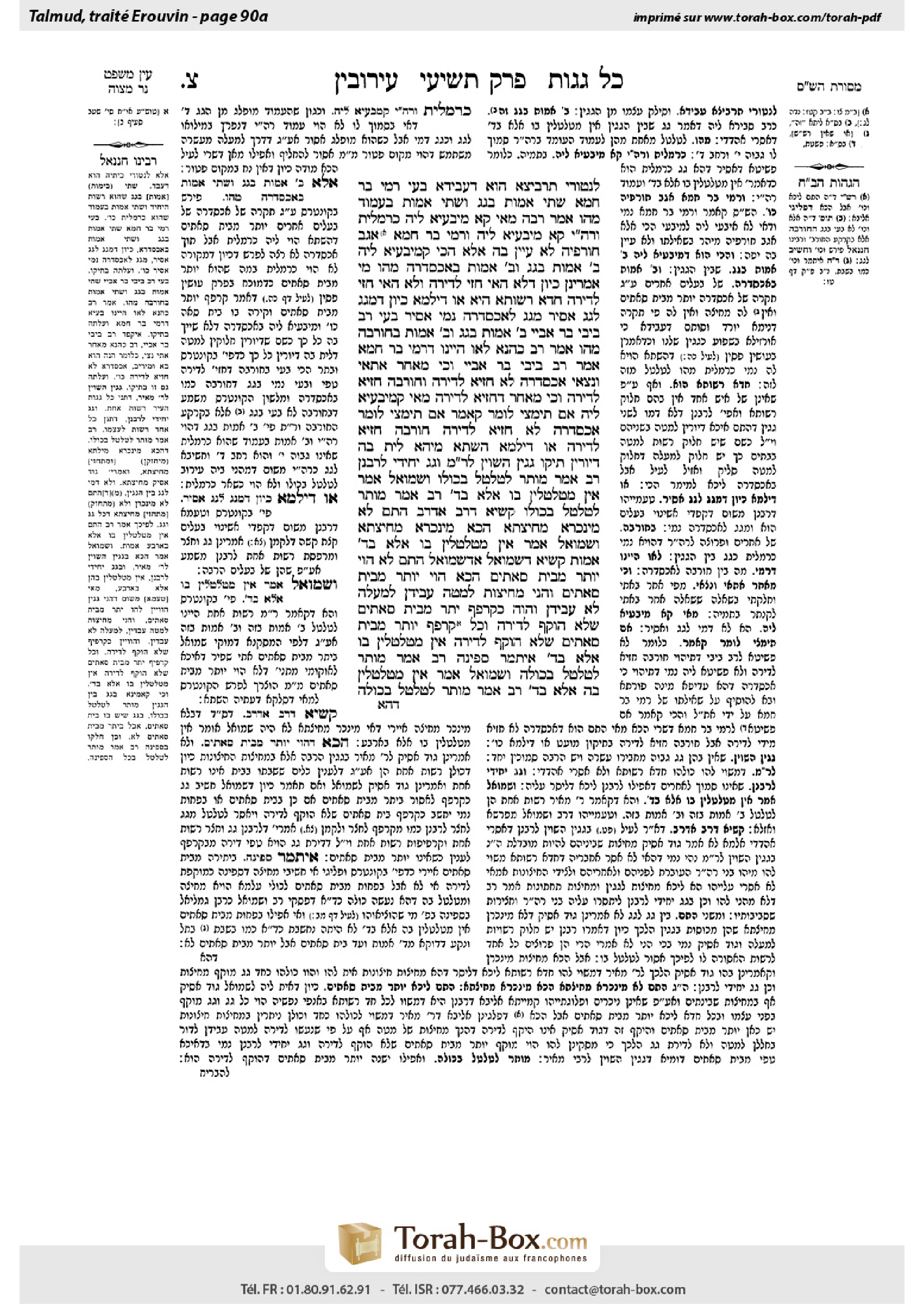
This page of Eruvin includes the Aramaic text, an English translation and an AI-generated French translation, alongside the scan above.
עירובין צ׳ א · Aramaic and Hebrew text
לְנַטּוֹרֵי תַּרְבִּיצָא הוּא דַּעֲבִידָא.
בְּעַי רָמֵי בַּר חָמָא: שְׁתֵּי אַמּוֹת בְּגַג וּשְׁתֵּי אַמּוֹת בְּעַמּוּד מַהוּ? אָמַר רַבָּה: מַאי קָא מִיבַּעְיָא לֵיהּ, כַּרְמְלִית וּרְשׁוּת הַיָּחִיד קָא מִיבַּעְיָא לֵיהּ?
וְרָמֵי בַּר חָמָא אַגַּב חוּרְפֵּיהּ לָא עַיֵּין בַּהּ, אֶלָּא הָכִי קָמִיבַּעְיָא לֵיהּ: שְׁתֵּי אַמּוֹת בְּגַג וּשְׁתֵּי אַמּוֹת בְּאַכְסַדְרָה, מַהוּ?
מִי אָמְרִינַן: כֵּיוָן דְּלָא הַאי חֲזֵי לְדִירָה וְלָא הַאי חֲזֵי לְדִירָה — חֲדָא רְשׁוּתָא הִיא. אוֹ דִילְמָא: כֵּיוָן דְּמִגַּג לְגַג אֲסִיר, מִגַּג לְאַכְסַדְרָה נָמֵי אֲסִיר.
בָּעֵי רַב בִּיבִי בַּר אַבָּיֵי: שְׁתֵּי אַמּוֹת בְּגַג וּשְׁתֵּי אַמּוֹת בְּחוּרְבָּה, מַהוּ?
אָמַר רַב כָּהֲנָא: לָאו הַיְינוּ דְּרָמֵי בַּר חָמָא?! אָמַר רַב בִּיבִי בַּר אַבָּיֵי: וְכִי מֵאַחֵר אֲתַאי וּנְצַאי? אַכְסַדְרָה לָא חַזְיָא לְדִירָה, וְחוּרְבָּה חַזְיָא לְדִירָה.
וְכִי מֵאַחַר דְּחַזְיָא לְדִירָה מַאי קָמִיבַּעְיָא לֵיהּ! ״אִם תִּימְצֵי לוֹמַר״ קָאָמַר: אִם תִּימְצֵי לוֹמַר אַכְסַדְרָה לָא חַזְיָא לְדִירָה — חוּרְבָּה חַזְיָא לְדִירָה? אוֹ דִילְמָא: הַשְׁתָּא מִיהָא לֵית בַּהּ דָּיוֹרִין. תֵּיקוּ.
גַּגִּין הַשָּׁוִין לְרַבִּי מֵאִיר, וְגַג יְחִידִי לְרַבָּנַן, רַב אָמַר: מוּתָּר לְטַלְטֵל בְּכוּלּוֹ, וּשְׁמוּאֵל אָמַר: אֵין מְטַלְטְלִין בּוֹ אֶלָּא בְּאַרְבַּע.
רַב אָמַר: מוּתָּר לְטַלְטֵל בְּכוּלּוֹ, קַשְׁיָא דְּרַב אַדְּרַב! הָתָם לָא מִינַּכְרָא מְחִיצְתָּא. הָכָא מִינַּכְרָא מְחִיצְתָּא.
וּשְׁמוּאֵל אָמַר: אֵין מְטַלְטְלִין בּוֹ אֶלָּא בְּאַרְבַּע אַמּוֹת, קַשְׁיָא דִּשְׁמוּאֵל אַדִּשְׁמוּאֵל! הָתָם, לָא הָוֵי יוֹתֵר מִבֵּית סָאתַיִם. הָכָא, הָוֵי יוֹתֵר מִבֵּית סָאתַיִם, וְהָנֵי מְחִיצוֹת לְמַטָּה עֲבִידָן, לְמַעְלָה לָא עֲבִידָן, וְהָוֵה כְּקַרְפֵּף יָתֵר מִבֵּית סָאתַיִם שֶׁלֹּא הוּקַּף לְדִירָה, וְכׇל קַרְפֵּף יוֹתֵר מִבֵּית סָאתַיִם שֶׁלֹּא הוּקַּף לְדִירָה — אֵין מְטַלְטְלִין בּוֹ אֶלָּא בְּאַרְבַּע.
אִיתְּמַר, סְפִינָה. רַב אָמַר: מוּתָּר לְטַלְטֵל בְּכוּלָּהּ, וּשְׁמוּאֵל אָמַר: אֵין מְטַלְטְלִין בָּהּ אֶלָּא בְּאַרְבַּע. רַב אָמַר: מוּתָּר לְטַלְטֵל בְּכוּלָּהּ —
Eruvin 90a · English translation
that he built the upper story to protect the garden [tarbitza], not to access the roofs.
Rami bar Ḥama raised a dilemma: According to Rav, who holds that one may carry only within four cubits on each roof, if he carries an object two cubits on a roof and another two cubits on a pillar ten handbreadths high and four handbreadths wide adjacent to the roof, what is the halakha? Rabba said: With regard to what matter is he raising a dilemma? Is it with regard to a karmelit and a private domain that he is raising a dilemma? The roof is a karmelit and the pillar is a private domain; certainly carrying from one to the other is prohibited.
The Gemara explains that this was not in fact the dilemma, and Rami bar Ḥama, due to his keen mind, did not analyze the dilemma carefully and was imprecise in its formulation. Rather, this is the dilemma he is raising: If one carries an object two cubits on the roof of a house, and another two cubits on the slanted roof of a portico, a roofed structure without walls, before a house belonging to someone else, what is the halakha?
The Gemara elaborates on Rami bar Ḥama’s dilemma: Do we say that since neither this roof is fit for residence, nor is this portico roof fit for residence, it is regarded as one domain, and therefore carrying between them is permitted? Or perhaps since carrying from a roof to another roof is prohibited, carrying from a roof to a portico is likewise prohibited, as the latter is also a domain in and of itself.
Rav Beivai bar Abaye raised a similar dilemma: If one carries two cubits on the roof of a house and another two cubits on the roof of a ruin belonging to someone else, one side of which was completely open to a public domain, what is the halakha?
Rav Kahana said: Is that not precisely the same dilemma raised by Rami bar Ḥama with regard to a portico? Rav Beivai bar Abaye said: And did I come late [me’aḥer] merely to quarrel, and meddle in other people’s questions? That is not the case, as the two dilemmas are not identical. A portico is not fit for residence, while a ruin is fit for residence. Therefore, the halakha might differ in each case.
The Gemara is surprised by this explanation: And now that it is fit for residence, what dilemma is he raising? The situation is comparable to the case of two standard roofs. The Gemara answers: Rav Beivai was unaware of the resolution to the dilemma raised by Rami bar Ḥama, and therefore, he states the dilemma employing the style: If you say. If you say that a portico is not fit for residence, and therefore carrying is permitted, it can be argued that as a ruin is fit for residence, the legal status of its roof should be like that of a standard roof. Or perhaps that is not the case, as now in any event there are no residents in the ruin, and therefore its roof is not comparable to a standard roof. No resolution was found for these dilemmas, and they stand unresolved.
The Gemara discusses a different question. With regard to roofs that are level, i.e., with a height disparity of less than ten handbreadths, according to the opinion of Rabbi Meir, or an isolated roof that does not border other roofs, according to the opinion of the Rabbis, Rav said: It is permitted to move an object throughout the entire roof; and Shmuel said: One may move an object in it only within four cubits.
The Gemara seeks to clarify the conflicting opinions. Rav said that it is permitted to move objects throughout the entire roof. This is difficult, as there is an apparent contradiction between one statement of Rav and another statement of Rav. With regard to level roofs, Rav said that according to the Rabbis one may carry on each roof only within four cubits. The Gemara answers: There, in the case of a roof among roofs, the inner partitions between the houses are not conspicuous, and therefore, are not taken into consideration. Here, however, the outer partitions of a single house or group of houses are conspicuous, meaning that they are considered to extend upward and delineate the edge of the roof.
The Gemara returns to discuss Shmuel’s ruling. And Shmuel said: One may carry only within four cubits. Once again, it is difficult, as there is an apparent contradiction between one statement of Shmuel and another statement of Shmuel, who said that in the case of level roofs, according to the Rabbis one may carry throughout each separate roof. The Gemara answers: There, the area of the roof is no greater than two beit se’a; whereas here, the area is greater than two beit se’a. And these partitions of the house were erected for use below as partitions for the residence itself; they were not erected to serve as partitions for use on the roof above. Consequently, even if the walls are viewed as extending upward so that they constitute surrounding partitions for the roof, the legal status of the roof is like that of an enclosure greater than two beit se’a that was not enclosed from the outset for the purpose of residence; and the principle is that with regard to any enclosure greater than two beit se’a that was not enclosed from the outset for the purpose of residence, one may move an object in it only within four cubits.
It was further stated that these same amora’im disagreed with regard to a large ship. Rav said: It is permitted to move an object throughout the entire ship, as it is all one domain; and Shmuel said: One may move an object in it only within four cubits. The Gemara proceeds to clarify their respective opinions. Rav said: It is permitted to move an object throughout the boat,
Eruvin 90a · Traduction française (IA)
qu'il avait construit l'étage supérieur pour protéger le jardin [tarbitza], et non pour accéder aux toits.
Rami bar Ḥama a posé un dilemme : Selon Rav, qui affirme qu'on ne peut transporter que dans un rayon de quatre cubits sur chaque toit, si l'on transporte un objet de deux cubits sur un toit et un autre de deux cubits sur une colonne de dix tefachim de haut et quatre tefachim de large adjacent au toit, quelle est la halakha ? Rabba a dit : À propos de quelle question pose-t-il ce dilemme ? Est-ce à propos d'un karmelit et d'un domaine privé qu'il pose ce dilemme ? Le toit est un karmelit et la colonne est un domaine privé ; certainement, transporter d'un à l'autre est interdit.
La Guemara explique que ce n'était pas en effet le dilemme, et Rami bar Ḥama, en raison de son esprit aigu, n'a pas analysé le dilemme avec soin et a formulé imprecisément la question. En réalité, c'est ce dilemme qu'il pose : Si l'on transporte un objet de deux cubits sur le toit d'une maison, et un autre de deux cubits sur le toit incliné d'un portique, une structure toilée sans murs, devant une maison appartenant à quelqu'un d'autre, quelle est la halakha ?
La Guemara développe le dilemme posé par Rami bar Ḥama : Disons-nous que puisque ni ce toit n'est adapté à la résidence, ni ce toit de portique n'est adapté à la résidence, il est considéré comme un seul domaine, et donc le transport entre eux est permis ? Ou bien disons-nous que le transport d'un toit à un autre toit est interdit, et donc le transport d'un toit à un portique est également interdit, car ce dernier est lui-même un domaine en soi ?
Rav Beivai bar Abaye a posé un dilemme similaire : Si l'on transporte deux cubits sur le toit d'une maison et deux cubits sur le toit d'un ruine appartenant à quelqu'un d'autre, dont un côté était entièrement ouvert vers un domaine public, quelle est la halakha ?
Rav Kahana a dit : Ce n'est pas précisément le même dilemme que celui posé par Rami bar Ḥama concernant un portique ? Rav Beivai bar Abaye a dit : Et suis-je venu tard [me’aḥer] uniquement pour discuter, et m'ingérer dans les questions d'autrui ? Ce n'est pas le cas, car les deux dilemmes ne sont pas identiques. Un portique n'est pas adapté à la résidence, tandis qu'un ruine est adapté à la résidence. Par conséquent, la halakha pourrait différer dans chaque cas.
La Guemara est surprise par cette explication : Et maintenant qu'il est adapté à la résidence, quel dilemme pose-t-il ? La situation est comparable à celle de deux toits normaux. La Guemara répond : Rav Beivai ne connaissait pas la résolution du dilemme posé par Rami bar Ḥama, et donc, il formule le dilemme en disant : Si tu dis. Si tu dis qu'un portique n'est pas adapté à la résidence, et donc le transport est permis, on peut arguer que comme un ruine est adapté à la résidence, le statut juridique de son toit devrait être comme celui d'un toit normal. Ou peut-être que ce n'est pas le cas, car maintenant, en tout cas, il n'y a plus de résidents dans le ruine, et donc son toit n'est pas comparable à un toit normal. Aucune résolution n'a été trouvée pour ces dilemmes, et ils restent sans solution.
La Guemara discute une autre question. Concernant les toits à niveau, c'est-à-dire avec une différence de hauteur inférieure à dix tefachim, selon l'opinion de Rabbi Meir, ou un toit isolé qui ne borde pas d'autres toits, selon l'opinion des Rabbins, Rav a dit : Il est permis de transporter un objet à travers l'ensemble du toit ; et Shmuel a dit : On peut transporter un objet à l'intérieur d'un rayon de quatre cubits.
La Guemara cherche à clarifier les opinions divergentes. Rav a dit que l'on peut transporter des objets à travers l'ensemble du toit. Cela est difficile, car il y a une contradiction apparente entre une déclaration de Rav et une autre. Concernant les toits à niveau, Rav a dit que selon les Rabbins, on ne peut transporter que dans un rayon de quatre cubits sur chaque toit. La Guemara répond : Là, dans le cas d'un toit parmi d'autres toits, les cloisons internes entre les maisons ne sont pas visibles, et donc ne sont pas prises en compte. Ici, cependant, les cloisons externes d'une seule maison ou d'un groupe de maisons sont visibles, ce qui signifie qu'elles sont considérées comme s'étendant vers le haut et délimitant la bordure du toit.
La Guemara reprend la discussion sur la décision de Shmuel. Et Shmuel a dit : On peut transporter uniquement à l'intérieur d'un rayon de quatre cubits. À nouveau, cela pose un problème, car il y a une contradiction apparente entre l'une des déclarations de Shmuel et l'autre. Shmuel a dit que dans le cas des toits à niveau, selon les Rabbins, on peut transporter à travers chaque toit séparé. La Guemara répond : Là, la surface du toit est inférieure à deux beit se’a ; ici, la surface est supérieure à deux beit se’a. Et ces cloisons de la maison ont été érigées pour l'usage en dessous comme cloisons pour la résidence elle-même ; elles n'ont pas été érigées pour servir de cloisons pour l'usage du toit au-dessus. Par conséquent, même si les murs sont vus comme s'étendant vers le haut de sorte qu'ils constituent des cloisons entourant le toit, le statut juridique du toit est comme celui d'un enclos supérieur à deux beit se’a qui n'a pas été enclos dès le départ à l'usage de la résidence ; et le principe est que concernant tout enclos supérieur à deux beit se’a qui n'a pas été enclos dès le départ à l'usage de la résidence, on peut transporter un objet à l'intérieur d'un rayon de quatre cubits.
Il a été dit en outre que ces mêmes amora’im étaient en désaccord concernant un grand navire. Rav a dit : Il est permis de transporter un objet à travers l'ensemble du navire, car c'est un seul domaine ; et Shmuel a dit : On peut transporter un objet à l'intérieur d'un espace de quatre cubits. La Guemara poursuit pour clarifier leurs opinions respectives. Rav a dit : Il est permis de transporter un objet à travers le navire,
Traduction française générée par IA à partir de l’édition anglaise de Sefaria. Vérifie toujours un passage avec le texte source.
Text from Sefaria: William Davidson Edition - Vocalized Aramaic (CC BY NC); William Davidson Edition - English (CC BY NC).