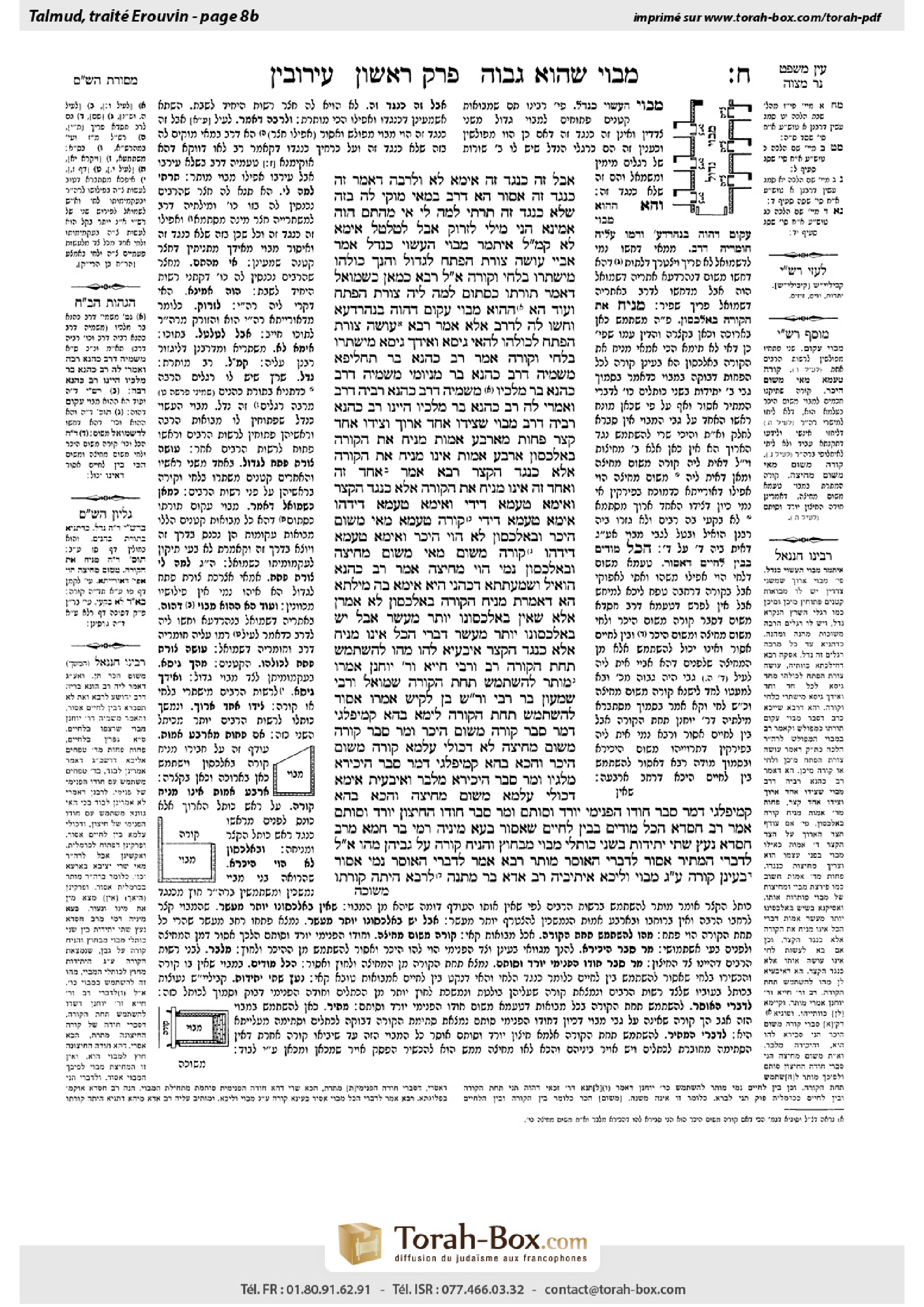
Eruvin 8b: Talmud study for Daf Yomi
Study the Talmud for Daf Yomi with scanned pages, Hebrew text, English translations from Sefaria and AI-generated French translations.
Passage selection and English or AI-generated French translation are available where the scan has annotations. Daf Study is independent of Torah-Box and Sefaria.
Browse Eruvin · עירובין · All tractatesEruvin 8b text and translations
This page of Eruvin includes the Aramaic text, an English translation and an AI-generated French translation, alongside the scan above.
עירובין ח׳ ב · Aramaic and Hebrew text
אֲבָל זֶה כְּנֶגֶד זֶה, אֵימָא לָא.
וּלְרַבָּה דְּאָמַר זֶה כְּנֶגֶד זֶה אָסוּר, הָא דְּרַב בְּמַאי מוֹקֵי לָהּ — בְּזֶה שֶׁלֹּא כְּנֶגֶד זֶה, תַּרְתֵּי לְמָה לִי?
אִי מֵהָתָם הֲוָה אָמֵינָא: הָנֵי מִילֵּי לִזְרוֹק, אֲבָל לְטַלְטֵל — אֵימָא לָא. קָא מַשְׁמַע לַן.
אִיתְּמַר: מָבוֹי הֶעָשׂוּי כְּנַדָּל, אָמַר אַבָּיֵי: עוֹשֶׂה צוּרַת הַפֶּתַח לַגָּדוֹל, וְהָנָךְ כּוּלְּהוּ מִישְׁתְּרוּ בְּלֶחִי וְקוֹרָה.
אֲמַר לֵיהּ רָבָא: כְּמַאן, כִּשְׁמוּאֵל דְּאָמַר תּוֹרָתוֹ כְּסָתוּם — לְמָה לֵיהּ צוּרַת הַפֶּתַח? וְעוֹד, הָא הָהוּא מָבוֹי עָקוֹם דַּהֲוָה בִּנְהַרְדְּעָא, וְחַשּׁוּ לָהּ לִדְרַב!
אֶלָּא אָמַר רָבָא: עוֹשֶׂה צוּרַת הַפֶּתַח לְכוּלְּהוּ לְהַאי גִּיסָא, וְאִידָּךְ גִּיסָא מִישְׁתְּרוּ בְּלֶחִי וְקוֹרָה.
אָמַר רַב כָּהֲנָא בַּר תַּחְלִיפָא מִשְּׁמֵיהּ דְּרַב כָּהֲנָא בַּר מִנְיוֹמֵי מִשְּׁמֵיהּ דְּרַב כָּהֲנָא בַּר מַלְכִּיּוֹ מִשְּׁמֵיהּ דְּרַב כָּהֲנָא רַבֵּיהּ דְּרַב, וְאָמְרִי לָהּ, רַב כָּהֲנָא בַּר מַלְכִּיּוֹ הַיְינוּ רַב כָּהֲנָא רַבֵּיהּ דְּרַב: מָבוֹי שֶׁצִּידּוֹ אֶחָד אָרוֹךְ וְצִידּוֹ אֶחָד קָצָר, פָּחוֹת מֵאַרְבַּע אַמּוֹת מַנִּיחַ אֶת הַקּוֹרָה בַּאֲלַכְסוֹן. אַרְבַּע אַמּוֹת — אֵינוֹ מַנִּיחַ אֶת הַקּוֹרָה אֶלָּא כְּנֶגֶד הַקָּצָר. רָבָא אָמַר: אֶחָד זֶה וְאֶחָד זֶה אֵינוֹ מַנִּיחַ אֶת הַקּוֹרָה אֶלָּא כְּנֶגֶד הַקָּצָר.
וְאֵימָא טַעְמָא דִידִי, וְאֵימָא טַעְמָא דִידְהוּ. אֵימָא טַעְמָא דִידִי: קוֹרָה טַעְמָא מַאי — מִשּׁוּם הֶיכֵּר, וּבַאֲלַכְסוֹן לָא הָוֵי הֶיכֵּר.
וְאֵימָא טַעְמָא דִידְהוּ, קוֹרָה מִשּׁוּם מַאי — מִשּׁוּם מְחִיצָה. וּבַאֲלַכְסוֹן נָמֵי הָוֵי מְחִיצָה.
אָמַר רַב כָּהֲנָא: הוֹאִיל וּשְׁמַעְתְּתָא דְכָהֲנֵי הִיא, אֵימָא בַּהּ מִילְּתָא. הָא דְּאָמְרַתְּ מַנִּיחַ הַקּוֹרָה בַּאֲלַכְסוֹן, לָא אֲמַרַן אֶלָּא שֶׁאֵין בַּאֲלַכְסוֹנוֹ יוֹתֵר מֵעֶשֶׂר, אֲבָל יֵשׁ בַּאֲלַכְסוֹנוֹ יוֹתֵר מֵעֶשֶׂר, דִּבְרֵי הַכֹּל אֵינוֹ מַנִּיחַ אֶלָּא כְּנֶגֶד הַקָּצָר.
אִיבַּעְיָא לְהוּ: מַהוּ לְהִשְׁתַּמֵּשׁ תַּחַת הַקּוֹרָה? רַב וְרַבִּי חִיָּיא וְרַבִּי יוֹחָנָן אָמְרוּ: מוּתָּר לְהִשְׁתַּמֵּשׁ תַּחַת הַקּוֹרָה. שְׁמוּאֵל וְרַבִּי שִׁמְעוֹן בַּר רַבִּי וְרַבִּי שִׁמְעוֹן בֶּן לָקִישׁ אָמְרוּ: אָסוּר לְהִשְׁתַּמֵּשׁ תַּחַת הַקּוֹרָה.
לֵימָא בְּהָא קָמִיפַּלְגִי, דְּמָר סָבַר: קוֹרָה מִשּׁוּם הֶיכֵּר, וּמָר סָבַר: קוֹרָה מִשּׁוּם מְחִיצָה.
לָא, דְּכוּלֵּי עָלְמָא קוֹרָה מִשּׁוּם הֶיכֵּר, וְהָכָא בְּהָא קָמִיפַּלְגִי, דְּמָר סָבַר: הֶיכֵּירָא מִלְּגָיו, וּמָר סָבַר: הֶיכֵּירָא מִלְּבַר.
וְאִיבָּעֵית אֵימָא: דְּכוּלֵּי עָלְמָא מִשּׁוּם מְחִיצָה, וְהָכָא בְּהָא קָמִיפַּלְגִי, דְּמָר סָבַר: חוּדּוֹ הַפְּנִימִי יוֹרֵד וְסוֹתֵם, וּמָר סָבַר: חוּדּוֹ הַחִיצוֹן יוֹרֵד וְסוֹתֵם.
אָמַר רַב חִסְדָּא: הַכֹּל מוֹדִים בְּבֵין לְחָיַיִם שֶׁאָסוּר.
בְּעָא מִינֵּיהּ רָמֵי בַּר חָמָא מֵרַב חִסְדָּא: נָעַץ שְׁתֵּי יְתֵידוֹת בִּשְׁנֵי כּוֹתְלֵי מָבוֹי מִבַּחוּץ, וְהִנִּיחַ קוֹרָה עַל גַּבֵּיהֶן, מַהוּ?
אֲמַר לֵיהּ: לְדִבְרֵי הַמַּתִּיר — אָסוּר, לְדִבְרֵי הָאוֹסֵר — מוּתָּר.
רָבָא אָמַר: לְדִבְרֵי הָאוֹסֵר נָמֵי אָסוּר — בָּעִינַן קוֹרָה עַל גַּבֵּי מָבוֹי, וְלֵיכָּא.
אֵיתִיבֵיהּ רַב אַדָּא בַּר מַתְנָה לְרָבָא: הָיְתָה קוֹרָתוֹ
Eruvin 8b · English translation
but if the two breaches are opposite one another, you might say that it is not considered a private domain even with regard to Shabbat. Rav therefore teaches us that even if the breaches of the courtyard line up with each other, carrying is nonetheless permitted therein.
The Gemara raises a difficulty: And according to Rabba, who said that where the alleyway terminates in a backyard and the breaches are one opposite another, carrying is prohibited, how does he construe Rav’s case? Rav’s ruling must refer to a case where the breaches are not one opposite another, and if so, why do I need two rulings? The essence of this halakha, that the yard is deemed a private domain with regard to Shabbat, was already stated in the Tosefta, so why did Rav need to teach another halakha with regard to the very same issue?
The Gemara explains that there is a novelty in Rav’s teaching: If one learned the halakha from there, the Tosefta, alone, I would have said that this ruling that the courtyard is a private domain with regard to Shabbat only applies to the issue of throwing, i.e., that one who throws from the public domain into this courtyard is liable, since it is considered a private domain according to Torah law. But to allow carrying in it like a proper private domain, you might say no, that the Sages forbade carrying in it, owing to the many people passing through it. Rav therefore teaches us that we are not concerned about this, and that carrying in the yard is permitted, even by rabbinic law.
It was stated that the amora’im disagree about the following matter: With regard to an alleyway that is shaped like a centipede, i.e., a long alleyway that opens to the public domain but with a series of small alleyways branching off of it on both of its sides, all of which also open to the public domain, Abaye said: An opening in the form of a doorway is made for the large alleyway, and all the small alleyways are permitted by means of a side post or a cross beam.
Rava said to him: According to whom do you state this halakha? Apparently according to the opinion of Shmuel, who said that the halakha of a crooked L-shaped alleyway is like that of an alleyway that is closed at one side. For in this case of an alleyway that is shaped like a centipede, when each of the smaller alleyways connects to the larger alleyway, it forms a crooked L-shaped alleyway. However, if the halakha is indeed in accordance with the opinion of Shmuel, why is the form of a doorway needed for it? According to Shmuel, an alleyway of this kind only requires a side post or a cross beam at each end in order to permit carrying within it. And furthermore, with regard to the crooked, L-shaped alleyway in Neharde’a, which was Shmuel’s place of residence, didn’t they take into consideration the position of Rav? This indicates that the halakha in practice follows Rav as opposed to Shmuel.
Rather, Rava said: An alleyway made like a centipede can be rendered fit for one to carry within it as follows: An opening in the form of a doorway is made for all of the small alleyways on this one of their sides, and the other side is permitted by means of a side post or a cross beam.
The Gemara considers a new case: Rav Kahana bar Taḥalifa said in the name of Rav Kahana bar Minyumi, who said in the name of Rav Kahana bar Malkiyu, who said in the name of Rav Kahana, the teacher of Rav; and some say that Rav Kahana bar Malkiyu is Rav Kahana, the teacher of Rav: With regard to an alleyway that opens into the public domain, its one side being long and its other side being short, i.e., one side juts out into the public domain more than the other, the halakha is as follows: If the difference in length between the two sides is less than four cubits, the cross beam is placed diagonally across the opening between the ends of the two walls of the alleyway. If, however, the difference is four cubits or more, the cross beam is placed straight across the alleyway at the end of the short side, i.e., at the end of the short side straight across toward the corresponding spot on the longer wall such that the beam is perpendicular to both walls, and no use may be made of the portion of the alleyway that lies beyond the cross beam. Rava disagreed and said: In both this case and in that case, the cross beam is placed straight across the alleyway at the end of the short side.
Rava added: I will state my reason, and I will state their reason. I will state my reason: What is the reason for a cross beam? To function as a conspicuous marker that separates the alleyway from the public domain, so that the residents of the alleyway should know the boundary within which carrying is permitted, and when placed diagonally, the cross beam is not sufficiently conspicuous. Those who see people carrying in the section extending past the short side will think that one is generally permitted to carry in a public domain.
I will state their reason as well: What is the reason for a cross beam? To function as a partition, that is to say, the cross beam is considered as though it descended to the ground, creating a fourth wall for the alleyway. Hence, even when placed diagonally, it is considered a partition.
Rav Kahana said: Since this involves halakhot of Sages named Kahana, I too will say something with regard to it: That which you said, that the cross beam is placed diagonally across the alleyway, this was only said in a case where the diagonal is no more than ten cubits. But if the diagonal is more than ten cubits, then even if the width of the alleyway itself is less than ten cubits, all agree that the cross beam must be placed straight across the alleyway at the end of the short side, for an entrance wider than ten cubits cannot be permitted by a cross beam, and here the entire length under the cross beam is considered an entrance.
A dilemma was raised before the Sages: What is the halakha with regard to utilizing and carrying in the area beneath the cross beam spanning the opening of an alleyway, which the beam permits carrying? Opinions differ on the matter. Rav, Rabbi Ḥiyya, and Rabbi Yoḥanan said: It is permitted to utilize the area beneath the cross beam. Shmuel, Rabbi Shimon bar Rabbi, and Rabbi Shimon ben Lakish said: It is prohibited to utilize the area beneath the cross beam.
The Gemara suggests a way to understand this dispute: Shall we say that these amora’im argue over the following issue, that Master, representing those who permit it, holds: A cross beam serves in an alleyway as a conspicuous marker that separates it from the public domain, and Master, representing those who prohibit it, holds: A cross beam serves as a partition.
The Gemara rejects this argument: No, everyone might agree that a cross beam serves as a conspicuous marker, but here they argue over the following: Master, representing those who forbid it, holds that the conspicuous marker is intended for those situated inside the alleyway, and hence the area outside the inner edge of the cross beam may not be used; and Master, representing those who permit it, holds that the conspicuous marker is intended for those outside in the public domain, and it is therefore permitted to carry up to the outer edge of the cross beam.
The Gemara proposes an alternative explanation: And if you wish, you can say that everyone agrees that a cross beam permits carrying as a partition, and here they argue over the following issue: As one Sage holds that the inner edge of the cross beam descends to the ground and seals off the alleyway, and therefore under the cross beam is not within the closed-off area; and the other Sage holds that the cross beam’s outer edge descends to the ground and seals off the alleyway, and therefore it is permitted to carry even in the area beneath the cross beam. Consequently, there is no need to connect the dispute with regard to utilizing the area beneath the cross beam to the dispute with regard to the nature of the cross beam.
Rav Ḥisda said: All concede that utilizing the area between the side posts placed at the entrance to an alleyway to permit carrying is prohibited, for a side post functions as a partition, and therefore one may only use the space up to its inner edge, but no further.
Rami bar Ḥama raised a dilemma before Rav Ḥisda: What is the halakha in a case where a person inserted two pegs in the two alleyway walls, one in each wall, on the outside of the entrance facing the public domain, and he placed a cross beam on top of the pegs, such that the beam is attached to the front of the alleyway walls instead of on top of them? Does this cross beam permit carrying within the alleyway?
Rav Ḥisda said to him: According to the statement of the one who permits utilizing the area beneath the cross beam, carrying within the alleyway is prohibited, for he holds that the cross beam’s outer edge is the critical one, and here this outer edge is positioned outside the alleyway and therefore cannot permit it. Whereas according to the statement of the authority who prohibits utilizing the area beneath the cross beam, carrying in the alleyway is permitted, for the cross beam’s inner edge is attached to the entrance of the alleyway.
Rava, however, disagreed and said: Even according to the opinion of the one who prohibits utilizing the area beneath the cross beam, carrying in the alleyway is prohibited, for we require that the cross beam that permits the alleyway be placed on top of the walls of the alleyway, and it is not. A cross beam that merely touches the alleyway from the outside does not permit it.
Rav Adda bar Mattana raised an objection to Rava from a baraita: If the cross beam being used to render an alleyway permitted for carrying is
Eruvin 8b · Traduction française (IA)
mais si les deux ouvertures sont opposées l'une à l'autre, on pourrait dire qu'il ne s'agit pas d'un domaine privé même en ce qui concerne le sabbat. Rav nous enseigne donc que même si les ouvertures du jardin s'alignent les unes avec les autres, le transport y est toutefois autorisé.
La Guemara soulève une difficulté : Et selon Rabba, qui affirmait que dans le cas où un passage s'achève dans un jardin et les ouvertures sont opposées l'une à l'autre, le transport est interdit, comment Rabba interprète-t-il le cas de Rav ? La décision de Rav doit concerner un cas où les ouvertures ne sont pas opposées l'une à l'autre, et si tel est le cas, pourquoi avons-nous besoin de deux décisions ? L'essence de cette halakha, à savoir que le jardin est considéré comme un domaine privé en ce qui concerne le sabbat, a déjà été énoncée dans la Tosefta, donc pourquoi Rav a-t-il besoin d'enseigner une autre halakha sur la même question ?
La Guemara explique qu'il y a une nouveauté dans l'enseignement de Rav : Si l'on a appris la halakha à partir de là, c'est-à-dire de la Tosefta, seul, je dirais que cette décision selon laquelle le jardin est un domaine privé en ce qui concerne le sabbat s'applique uniquement à la question du jet, c'est-à-dire que celui qui jette du domaine public dans ce jardin est puni, puisque ce jardin est considéré comme un domaine privé selon la loi divine. Mais pour permettre le transport dans ce jardin comme dans un domaine privé véritable, on pourrait dire non, que les Sages ont interdit le transport dans ce jardin en raison du passage fréquent de personnes. Rav nous enseigne donc que nous ne nous en préoccupons pas, et que le transport dans le jardin est autorisé, même selon la loi rabbinique.
Il a été dit que les amoraïm s'opposent sur la question suivante : En ce qui concerne un passage ayant la forme d'un centipède, c'est-à-dire un long passage s'ouvrant sur le domaine public mais avec une série de petits passages dérivant de chaque côté, tous également s'ouvrant sur le domaine public, Abaye a dit : On fait une ouverture en forme de porte pour le grand passage, et tous les petits passages sont autorisés grâce à une poutre latérale ou une traverse.
Rava a dit à lui : Selon quel avis énonces-tu cette halakha ? Apparemment selon l'opinion de Shmuel, qui a dit que la halakha d'un passage en L courbe est comme celle d'un passage fermé d'un côté. Dans ce cas d'un passage ayant la forme d'un centipède, lorsque chaque petit passage se connecte au grand passage, il forme un passage en L courbe. Cependant, si la halakha est effectivement selon l'opinion de Shmuel, pourquoi a-t-on besoin d'une ouverture en forme de porte pour cela ? Selon Shmuel, un passage de ce genre n'a besoin que d'une poutre latérale ou d'une traverse à chaque extrémité pour permettre le transport à l'intérieur. De plus, concernant le passage en L courbe à Neharde’a, qui était la résidence de Shmuel, n'ont-ils pas pris en compte la position de Rav ? Cela indique que la halakha en pratique suit Rav plutôt que Shmuel.
Plutôt, Rava a dit : Un passage ayant la forme d'un centipède peut être rendu apte au transport comme suit : On fait une ouverture en forme de porte pour tous les petits passages du côté de ceux-ci, et l'autre côté est autorisé grâce à une poutre latérale ou une traverse.
La Guemara considère un nouveau cas : Rav Kahana bar Taḥalifa a dit en nom de Rav Kahana bar Minyumi, qui a dit en nom de Rav Kahana bar Malkiyu, qui a dit en nom de Rav Kahana, le maître de Rav ; et certains disent que Rav Kahana bar Malkiyu est Rav Kahana, le maître de Rav : En ce qui concerne un passage s'ouvrant sur le domaine public, dont un côté est long et l'autre court, c'est-à-dire que l'un des côtés s'étend davantage dans le domaine public que l'autre, la halakha est la suivante : Si la différence de longueur entre les deux côtés est inférieure à quatre cubits, la traverse est placée diagonalement à travers l'ouverture entre les extrémités des deux murs du passage. Cependant, si la différence est d'au moins quatre cubits, la traverse est placée droit sur le passage à l'extrémité du côté court, c'est-à-dire à l'extrémité du côté court droit vers le point correspondant sur le mur long, de sorte que la traverse est perpendiculaire aux deux murs, et on ne peut pas utiliser la partie du passage qui se trouve au-delà de la traverse. Rava a désaccordé et a dit : Dans ce cas et dans celui-ci, la traverse est placée droit sur le passage à l'extrémité du côté court.
Rava a ajouté : Je vais énoncer ma raison, et je vais énoncer leur raison. Je vais énoncer ma raison : Quelle est la raison de la traverse ? Pour fonctionner comme un marqueur évident qui sépare le passage du domaine public, afin que les habitants du passage sachent la limite dans laquelle le transport est autorisé, et lorsqu'elle est placée diagonalement, la traverse n'est pas suffisamment évidente. Ceux qui voient des personnes transporter dans la section qui dépasse le côté court penseront que l'on est généralement autorisé à transporter dans un domaine public.
Je vais énoncer leur raison également : Quelle est la raison de la traverse ? Pour fonctionner comme une cloison, c'est-à-dire que la traverse est considérée comme si elle descendait jusqu'au sol, créant un quatrième mur pour le passage. Ainsi, même lorsqu'elle est placée diagonalement, elle est considérée comme une cloison.
Rav Kahana a dit : Puisque cela concerne les halakhot des Sages nommés Kahana, je dirai aussi quelque chose à ce sujet : Ce que tu as dit, que la traverse est placée diagonalement à travers le passage, cela a été dit uniquement dans le cas où la diagonale n'excède pas dix cubits. Mais si la diagonale est supérieure à dix cubits, alors même si la largeur du passage est inférieure à dix cubits, tous s'accordent sur le fait que la traverse doit être placée droit sur le passage à l'extrémité du côté court, car une entrée plus large que dix cubits ne peut pas être autorisée par une traverse, et ici l'ensemble de la longueur sous la traverse est considéré comme une entrée.
Un dilemme a été soulevé devant les Sages : Quelle est la halakha concernant l'utilisation et le transport dans la zone sous la traverse qui traverse l'ouverture d'un passage, et qui permet le transport ? Les opinions divergent à ce sujet. Rav, Rabbi Ḥiyya et Rabbi Yoḥanan dirent : Il est permis d'utiliser la zone sous la traverse. Shmuel, Rabbi Shimon bar Rabbi et Rabbi Shimon ben Lakish dirent : Il est interdit d'utiliser la zone sous la traverse.
La Guemara propose une manière de comprendre ce débat : Devons-nous dire que ces amora’im débattent de la question suivante, à savoir que le Maître, représentant ceux qui permettent, affirme : La traverse sert dans un passage comme un marqueur évident qui le sépare du domaine public, et le Maître, représentant ceux qui interdisent, affirme : La traverse sert de paroi.
La Guemara rejette cette argumentation : Non, tout le monde pourrait convenir que la traverse sert de marqueur évident, mais ici ils débattent de la question suivante : Le Maître, représentant ceux qui l'interdisent, affirme que le marqueur évident est destiné à ceux situés à l'intérieur du passage, et par conséquent la zone en dehors de l'extrémité interne de la traverse ne peut pas être utilisée ; et le Maître, représentant ceux qui le permettent, affirme que le marqueur évident est destiné à ceux en dehors, dans le domaine public, et il est donc permis de transporter jusqu'à l'extrémité externe de la traverse.
La Guemara propose une autre explication : Et si vous le souhaitez, vous pouvez dire que tout le monde convient que la traverse permet le transport en tant que paroi, et ici ils débattent de la question suivante : Un tanna affirme que l'extrémité interne de la traverse descend jusqu'au sol et ferme le passage, et par conséquent la zone sous la traverse n'est pas dans la zone fermée ; et l'autre tanna affirme que l'extrémité externe de la traverse descend jusqu'au sol et ferme le passage, et par conséquent il est permis de transporter même dans la zone sous la traverse. Ainsi, il n'est pas nécessaire de rattacher ce débat concernant l'utilisation de la zone sous la traverse à celui concernant la nature de la traverse.
Rav Ḥisda dit : Tout le monde convient que l'utilisation de la zone entre les poteaux latéraux placés à l'entrée d'un passage pour permettre le transport est interdite, car un poteau latéral fonctionne comme une paroi, et par conséquent on peut utiliser l'espace jusqu'à son extrémité interne, mais pas plus.
Rami bar Ḥama a soulevé un dilemme devant Rav Ḥisda : Quelle est la halakha dans le cas où une personne a inséré deux clous dans les deux murs du passage, un dans chaque mur, à l'extérieur de l'entrée, face au domaine public, et a placé une traverse sur les clous, de sorte que la traverse est attachée à l'avant des murs du passage plutôt que sur leurs sommets ? Cette traverse permet-elle le transport dans le passage ?
Rav Ḥisda répondit à lui : Selon l'affirmation de celui qui permet l'utilisation de la zone sous la traverse, le transport dans le passage est interdit, car il affirme que l'extrémité externe de la traverse est la déterminante, et ici cette extrémité est placée en dehors du passage et par conséquent ne permet pas le transport. En revanche, selon l'affirmation de l'autorité qui interdit l'utilisation de la zone sous la traverse, le transport dans le passage est permis, car l'extrémité interne de la traverse est attachée à l'entrée du passage.
Rava, cependant, s'est opposé et a dit : Même selon l'opinion de celui qui interdit l'utilisation de la zone sous la traverse, le transport dans le passage est interdit, car nous exigeons que la traverse qui permet le passage soit placée sur les murs du passage, et elle ne l'est pas. Une traverse qui touche simplement le passage de l'extérieur ne permet pas le transport.
Rav Adda bar Mattana a soulevé une objection contre Rava à partir d'une baraïta : Si la traverse utilisée pour rendre un passage permis au transport est
Traduction française générée par IA à partir de l’édition anglaise de Sefaria. Vérifie toujours un passage avec le texte source.
Text from Sefaria: William Davidson Edition - Vocalized Aramaic (CC BY NC); William Davidson Edition - English (CC BY NC).