Eruvin 9a: Talmud study for Daf Yomi
Study the Talmud for Daf Yomi with scanned pages, Hebrew text, English translations from Sefaria and AI-generated French translations.
Passage selection and English or AI-generated French translation are available where the scan has annotations. Daf Study is independent of Torah-Box and Sefaria.
Browse Eruvin · עירובין · All tractatesEruvin 9a text and translations
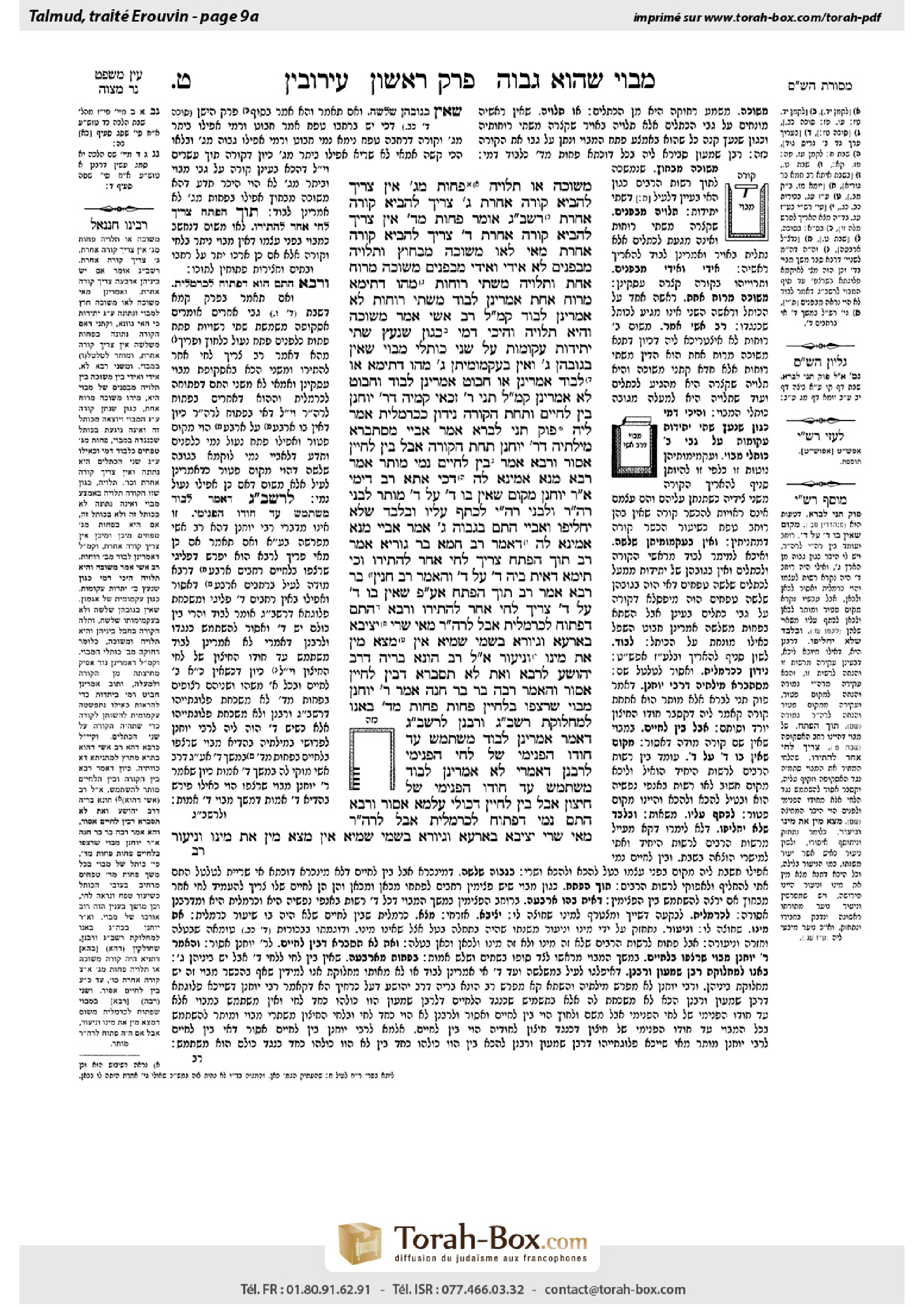
This page of Eruvin includes the Aramaic text, an English translation and an AI-generated French translation, alongside the scan above.
עירובין ט׳ א · Aramaic and Hebrew text
מְשׁוּכָה אוֹ תְּלוּיָה, פָּחוֹת מִשְּׁלֹשָׁה — אֵין צָרִיךְ לְהָבִיא קוֹרָה אַחֶרֶת. שְׁלֹשָׁה — צָרִיךְ לְהָבִיא קוֹרָה אַחֶרֶת. רַבָּן שִׁמְעוֹן בֶּן גַּמְלִיאֵל אוֹמֵר: פָּחוֹת מֵאַרְבָּעָה — אֵין צָרִיךְ לְהָבִיא קוֹרָה אַחֶרֶת, אַרְבָּעָה — צָרִיךְ לְהָבִיא קוֹרָה אַחֶרֶת.
מַאי לָאו — מְשׁוּכָה מִבַּחוּץ, וּתְלוּיָהּ מִבִּפְנִים!
לָא, אִידִי וְאִידִי מִבִּפְנִים. מְשׁוּכָה — מֵרוּחַ אַחַת, וּתְלוּיָה — מִשְׁתֵּי רוּחוֹת.
מַהוּ דְּתֵימָא: מֵרוּחַ אַחַת אָמְרִינַן לָבוּד, מִשְׁתֵּי רוּחוֹת — לָא אָמְרִינַן לָבוּד, קָא מַשְׁמַע לַן.
רַב אָשֵׁי אָמַר: מְשׁוּכָה וְהִיא תְּלוּיָה, וְהֵיכִי דָּמֵי? כְּגוֹן שֶׁנָּעַץ שְׁתֵּי יְתֵידוֹת עֲקוּמּוֹת עַל שְׁנֵי כּוֹתְלֵי מָבוֹי, שֶׁאֵין בְּגוֹבְהָן שְׁלֹשָׁה, וְאֵין בְּעַקְמוּמִיתָן שְׁלֹשָׁה. מַהוּ דְּתֵימָא: אוֹ ״לָבוּד״ אָמְרִינַן, אוֹ ״חֲבוֹט״ אָמְרִינַן, לָבוּד וַחֲבוֹט לָא אָמְרִינַן. קָא מַשְׁמַע לַן.
תָּנֵי רַבִּי זַכַּאי קַמֵּיהּ דְּרַבִּי יוֹחָנָן: בֵּין לְחָיַיִם וְתַחַת הַקּוֹרָה נִידּוֹן כְּכַרְמְלִית. אֲמַר לֵיהּ: פּוֹק תְּנִי לְבַרָּא.
אָמַר אַבָּיֵי: מִסְתַּבְּרָא מִילְּתֵיהּ דְּרַבִּי יוֹחָנָן תַּחַת הַקּוֹרָה, אֲבָל בֵּין לְחָיַיִן אָסוּר. וְרָבָא אָמַר: בֵּין לְחָיַיִם נָמֵי מוּתָּר.
אָמַר רָבָא: מְנָא אָמֵינָא לַהּ — דְּכִי אֲתָא רַב דִּימִי, אָמַר רַבִּי יוֹחָנָן: מָקוֹם שֶׁאֵין בּוֹ אַרְבָּעָה עַל אַרְבָּעָה, מוּתָּר לִבְנֵי רְשׁוּת הָרַבִּים וְלִבְנֵי רְשׁוּת הַיָּחִיד לְכַתֵּף עָלָיו, וּבִלְבַד שֶׁלֹּא יַחֲלִיפוּ.
וְאַבָּיֵי, הָתָם בְּגָבוֹהַּ שְׁלֹשָׁה.
אָמַר אַבָּיֵי מְנָא אָמֵינָא לַהּ — דְּאָמַר רַב חָמָא בַּר גּוּרְיָא אָמַר רַב: תּוֹךְ הַפֶּתַח, צָרִיךְ לֶחִי אַחֵר לְהַתִּירוֹ.
וְכִי תֵּימָא: דְּאִית בֵּיהּ אַרְבָּעָה עַל אַרְבָּעָה, וְהָאָמַר רַב חָנִין בַּר רָבָא אָמַר רַב: תּוֹךְ הַפֶּתַח, אַף עַל פִּי שֶׁאֵין בּוֹ אַרְבָּעָה עַל אַרְבָּעָה צָרִיךְ לֶחִי אַחֵר לְהַתִּירוֹ.
וְרָבָא — הָתָם דְּפָתוּחַ לְכַרְמְלִית.
אֲבָל לִרְשׁוּת הָרַבִּים מַאי — שְׁרֵי? יַצִּיבָא בְּאַרְעָא וְגִיּוֹרָא בִּשְׁמֵי שְׁמַיָּא!
אִין, מָצָא מִין אֶת מִינוֹ וְנֵיעוֹר.
אֲמַר לֵיהּ רַב הוּנָא בְּרֵיהּ דְּרַב יְהוֹשֻׁעַ לְרָבָא: וְאַתְּ לָא תִּסְבְּרָא דְּבֵין לְחָיַיִן אָסוּר? וְהָאָמַר רַבָּה בַּר בַּר חָנָה אָמַר רַבִּי יוֹחָנָן: מָבוֹי שֶׁרְצָפוֹ בִּלְחָיַיִן פָּחוֹת פָּחוֹת מֵאַרְבָּעָה — בָּאנוּ לְמַחְלוֹקֶת רַבָּן שִׁמְעוֹן בֶּן גַּמְלִיאֵל וְרַבָּנַן.
לְרַבָּן שִׁמְעוֹן בֶּן גַּמְלִיאֵל דְּאָמַר: אָמְרִינַן לָבוּד, מִשְׁתַּמֵּשׁ עַד חוּדּוֹ הַפְּנִימִי שֶׁל לֶחִי הַפְּנִימִי. לְרַבָּנַן, דְּאָמְרִי: לָא אָמְרִינַן לָבוּד, מִשְׁתַּמֵּשׁ עַד חוּדּוֹ הַפְּנִימִי שֶׁל חִיצוֹן. אֲבָל בֵּין לְחָיַיִן דְּכוּלֵּי עָלְמָא אָסוּר!
וְרָבָא, הָתָם נָמֵי דְּפָתוּחַ לְכַרְמְלִית.
אֲבָל לִרְשׁוּת הָרַבִּים מַאי — שְׁרֵי? יַצִּיבָא בְּאַרְעָא וְגִיּוֹרָא בִּשְׁמֵי שְׁמַיָּא! אִין, מָצָא מִין אֶת מִינוֹ וְנֵיעוֹר.
Eruvin 9a · English translation
drawn away from the alleyway walls or suspended in the air, the following distinction applies: If the cross beam is less than three handbreadths from the walls, one is not required to bring a different cross beam, for it is considered attached to the walls based on the principle of lavud, which views two solid surfaces as connected if the gap between them is less than three handbreadths wide. However, if the distance is three or more handbreadths from the walls, he is required to bring a different cross beam in order to permit carrying in the alleyway. Rabban Shimon ben Gamliel, who holds that the principle of lavud applies to a gap of up to four handbreadths wide, says: If the cross beam is less than four handbreadths from the wall, one is not required to bring a different cross beam; but if the distance is four handbreadths from the wall, he is required to bring a different cross beam.
The Gemara wishes to clarify the baraita: What, is it not that when the baraita speaks of a cross beam that is drawn away from the alleyway walls, it is referring to a cross beam that is distanced from the alleyway walls and situated on the outside in the public domain, similar to the case of the cross beam resting on pegs mentioned above? And when it speaks of a cross beam that is suspended, isn’t it referring to a cross beam that is distanced from the alleyway walls and placed on the inside in the alleyway? This interpretation contradicts Rava’s statement above that disqualifies such a cross beam.
The Gemara rejects this interpretation: No, both this, the cross beam that is drawn away, and that, the crossbeam that is suspended, are located on the inside of the alleyway. The difference between them is that the cross beam that is drawn away is distanced from the wall from one direction, while a suspended cross beam does not lie on the alleyway walls at all, but is distanced from them from both directions.
Lest you say that if the cross beam is distanced from the wall from one direction, we say that the principle of lavud applies, and it is as if the cross beam is joined to the wall; but if it is distanced from the wall from two directions, we do not say that the principle of lavud applies. The baraita, therefore, comes and teaches us that there is no difference in this regard.
Rav Ashi said: The baraita refers to a cross beam that is drawn away from the walls and also suspended in the air. And what are the circumstances where this would be the case? For example, where he inserted two bent pegs on the tops of the two alleyway walls, and the height of the pegs from the top of the walls is less than three handbreadths, and their bend inward is less than three handbreadths, and a cross beam rests on top of them. Lest you say that we either say lavud, i.e., we consider the cross beam to be virtually extended and thus connected to the wall, or we say ḥavut, pressed down, that we consider the cross beam to be pressed down vertically; but we do not say both lavud and ḥavut. The baraita therefore teaches us that even in that case we say that any item adjacent to another with a gap of less than three handbreadths between them is considered connected to it, whether to the side or below, and even in both directions at once.
Rabbi Zakkai taught the following baraita before Rabbi Yoḥanan: The area between the side posts and beneath the cross beam has the legal status of a karmelit, and it is forbidden to carry in it. Rabbi Yoḥanan said to him: Exit and teach this halakha outside, i.e., this baraita is not in accordance with the accepted halakha, and therefore it should not be made part of the regular learning in the study hall.
The Gemara records a dispute with regard to the scope of Rabbi Yoḥanan’s statement: Abaye said: Rabbi Yoḥanan’s statement is reasonable with regard to the area beneath the cross beam, as only the area beneath the cross beam should be considered a private domain, but between the side posts, carrying is indeed prohibited, in accordance with the opinion of Rabbi Zakkai. And Rava said: The entire statement of Rabbi Zakkai is to be rejected, as Rabbi Yoḥanan asserted, and even in the area between the side posts carrying is permitted.
Rava said: From where do I know to say this, that carrying is permitted even between the side posts? For when Rav Dimi came from Eretz Yisrael to Babylonia, he said that Rabbi Yoḥanan said: A place that has an area of less than four by four handbreadths and is located between a public and private domain but belongs to neither has the status of an exempt domain with regard to carrying on Shabbat. Therefore, it is permitted for both the people in the public domain as well as the people in the private domain to use it for loading their burdens onto their shoulders, so long as they do not exchange objects with one another. Therefore, a place having an area of less than four handbreadths is not considered a karmelit, but rather an exempt domain, where carrying is permitted. Consequently, the area between the side posts should likewise be considered an exempt domain, and carrying should be permitted within it.
And Abaye said that this offers no proof, as there, with regard to Rav Dimi’s statement, the area being discussed is at least three handbreadths high, setting it apart from the other domains. It is therefore considered a domain in its own right, and has the halakha of an exempt domain.
The Gemara considers the position of Abaye: Abaye said: From where do I know to say this, that the area between the side posts has the halakha of a karmelit? For Rav Ḥama bar Guria said that Rav said: The area within the opening, i.e., the doorway between two entrance posts that serve as side posts to permit carrying in the alleyway, requires another side post in order to permit carrying there, for the entrance posts alone do not suffice. This demonstrates that it is forbidden to carry in the space between the side posts without another side post.
And if you say that this is a case where the doorway has an area four by four handbreadths, and therefore an additional side post is required to permit carrying there, this is not a valid argument. For didn’t Rav Ḥanin bar Rava say that Rav said: The area within the opening itself, even if it does not have an area of four by four handbreadths, requires an additional side post in order to permit carrying within it. This indicates that the area between the side posts is not to be used.
And Rava replies that a distinction must be made between the cases: There, the case of Rav’s ruling refers to a scenario where the alleyway’s entrance opens to a karmelit, and thus the space between the entrance posts is also viewed as a karmelit, and an additional side post is required.
The Gemara poses a question: But if the entrance opens to a public domain, what would be the halakha? Would it be permitted to carry there even without an additional side post? If so, it follows that the halakha of a karmelit is more stringent than that of a public domain. However, this seems untenable, for carrying in a karmelit is prohibited only by rabbinic decree, owing to the similarity between a karmelit and the public domain. This is similar to a situation where a permanent resident is down on the ground, while a stranger is raised up to the highest heaven, the very opposite of the appropriate state of affairs.
The Gemara comments: Yes, it is possible that this is the ruling, for we can say that it has found its own type and been awakened. In other words, as the area within the entranceway is not a defined domain, it doesn’t have the status of an independent domain. Therefore, when it opens into a karmelit, to which it is similar, its status is negated, and it joins with the karmelit to form a single unit. However, when it opens into a public domain, it cannot join with it because it is not similar to a public domain, which has a totally different set of laws; and therefore it is considered part of the alleyway, and it is permitted to carry within it.
Rav Huna, the son of Rav Yehoshua, said to Rava: And you do not hold that in the area between the side posts carrying is prohibited? But didn’t Rabba bar bar Ḥana say that Rabbi Yoḥanan said: If an alleyway was lined with side posts, each one set more than three but less than four handbreadths apart from its neighbor, we have arrived in this matter at the dispute between Rabban Shimon ben Gamliel and the Rabbis with regard to the measure of lavud.
How so? According to Rabban Shimon ben Gamliel, who said that if the gap between two items is less than four handbreadths, we say that the principle of lavud applies; all the side posts are considered a single side post. He may therefore only utilize the alleyway up to the inner edge of the innermost side post, but no more. However, according to the Rabbis, who say that we do not say the principle of lavud applies unless the gap is less than three handbreadths, he may utilize the alleyway up to the inner edge of the outermost side post. This discussion demonstrates that the argument revolves around the question as to which side post establishes the permitted area. But with regard to the area between the side posts, all agree that carrying is prohibited.
And Rava answers that there too, it refers to a case where the alleyway’s entrance opens to a karmelit.
The Gemara raises a difficulty: But if the entrance opens to a public domain, what is its legal status – would carrying be permitted? If so, the halakha of a karmelit is more severe than that of a public domain. Once again, this can be likened to a situation where a permanent resident is down on the ground, while a stranger is raised up to the highest heaven. The Gemara answers: Yes, indeed, this is the ruling, but one should not be perplexed, as we have explained: it has found its own type and been awakened.
Eruvin 9a · Traduction française (IA)
Si la poutre est éloignée des murs de l'allée ou suspendue dans l'air, la distinction suivante s'applique : Si la poutre est à moins de trois tefachim des murs, on n'est pas tenu de ramener une autre poutre, car elle est considérée comme attachée aux murs selon le principe de lavud, qui considère deux surfaces solides comme connectées si la distance entre elles est inférieure à trois tefachim. Cependant, si la distance est de trois tefachim ou plus des murs, on est tenu de ramener une autre poutre afin de permettre le port dans l'allée. Rabban Shimon ben Gamliel, qui considère que le principe de lavud s'applique à une distance de jusqu'à quatre tefachim, dit : Si la poutre est à moins de quatre tefachim du mur, on n'est pas tenu de ramener une autre poutre ; mais si la distance est de quatre tefachim du mur, on est tenu de ramener une autre poutre.
Le Guemara souhaite clarifier la baraïta : Qu'est-ce que cela signifie, n'est-ce pas que lorsque la baraïta parle d'une poutre éloignée des murs de l'allée, elle fait référence à une poutre éloignée des murs de l'allée et située à l'extérieur dans le domaine public, semblable au cas de la poutre reposant sur des clous mentionné ci-dessus ? Et lorsque la baraïta parle d'une poutre suspendue, n'est-ce pas qu'elle fait référence à une poutre éloignée des murs de l'allée et placée à l'intérieur dans l'allée ? Cette interprétation contredit la déclaration de Rava ci-dessus qui invalide cette poutre.
Le Guemara rejette cette interprétation : Non, à la fois cette poutre éloignée et cette poutre suspendue sont situées à l'intérieur de l'allée. La différence entre elles est que la poutre éloignée est éloignée du mur d'un côté, tandis que la poutre suspendue ne repose pas du tout sur les murs de l'allée, mais est éloignée d'eux des deux côtés.
De peur que l'on dise que si la poutre est éloignée du mur d'un côté, nous disons que le principe de lavud s'applique, et elle est considérée comme jointe au mur ; mais si elle est éloignée du mur des deux côtés, nous ne disons pas que le principe de lavud s'applique. La baraïta, par conséquent, vient nous enseigner qu'il n'y a pas de différence à cet égard.
Rav Ashi dit : La baraïta fait référence à une poutre éloignée des murs et suspendue dans l'air. Et quels sont les cas où cela peut être le cas ? Par exemple, dans le cas où l'on a inséré deux clous courbés sur les sommets des deux murs de l'allée, et la hauteur des clous par rapport au sommet des murs est inférieure à trois tefachim, et leur courbure vers l'intérieur est inférieure à trois tefachim, et une poutre repose sur eux. De peur que l'on dise que nous disons lavud, c'est-à-dire que nous considérons la poutre comme prolongée et donc connectée au mur, ou ḥavut, écrasée, que nous considérons la poutre comme écrasée verticalement ; mais nous ne disons pas à la fois lavud et ḥavut. La baraïta nous enseigne donc que même dans ce cas, nous disons que tout objet adjacent à un autre avec une distance inférieure à trois tefachim entre eux est considéré comme connecté à celui-ci, que ce soit du côté ou en dessous, et même des deux côtés à la fois.
Rabbi Zakkai enseigna la suivante baraïta avant Rabbi Yoḥanan : L'espace entre les poteaux latéraux et sous la poutre a le statut juridique d'un karmelit, et il est interdit de porter dedans. Rabbi Yoḥanan dit à lui : Sortez et enseignez cette halakha à l'extérieur, c'est-à-dire que cette baraïta n'est pas conforme à la halakha acceptée, et par conséquent elle ne devrait pas faire partie de l'apprentissage régulier dans la salle de étude.
Le Guemara rapporte un débat concernant l'étendue de la déclaration de Rabbi Yoḥanan : Abaye dit : La déclaration de Rabbi Yoḥanan est raisonnable concernant l'espace sous la poutre, car seul cet espace devrait être considéré comme un domaine privé, mais entre les poteaux latéraux, le port est effectivement interdit, conformément à l'opinion de Rabbi Zakkai. Et Rava dit : L'ensemble de la déclaration de Rabbi Zakkai doit être rejetée, car Rabbi Yoḥanan l'a affirmée, et même dans l'espace entre les poteaux latéraux, le port est permis.
Rava dit : D'où sais-je dire cela, que le port est permis même entre les poteaux latéraux ? Car lorsque Rav Dimi est venu de la Terre d'Israël vers Babylone, il a dit que Rabbi Yoḥanan a dit : Un lieu ayant une surface inférieure à quatre par quatre tefachim et se situant entre un domaine public et un domaine privé mais appartenant à aucun d'eux a le statut d'un domaine exempt concernant le port le sabbat. Par conséquent, il est permis aux gens du domaine public ainsi qu'aux gens du domaine privé d'utiliser ce lieu pour charger leurs fardeaux sur leurs épaules, à condition qu'ils ne changent pas d'objets entre eux. Par conséquent, un lieu ayant une surface inférieure à quatre tefachim n'est pas considéré comme un karmelit, mais plutôt comme un domaine exempt, où le port est permis. Ainsi, l'espace entre les poteaux latéraux devrait également être considéré comme un domaine exempt, et le port devrait être permis à l'intérieur.
Et Abaye dit que cela ne constitue pas une preuve, car là, concernant la déclaration de Rav Dimi, l'espace en question est au moins trois tefachim de haut, le distinguant des autres domaines. Il est donc considéré comme un domaine à part entière, et a la halakha d'un domaine exempt.
Le Guemara examine la position d'Abaye : Abaye dit : D'où sais-je dire cela, que l'espace entre les poteaux latéraux a la halakha d'un karmelit ? Pour Rav Ḥama bar Guria a dit que Rav a dit : L'espace à l'intérieur de l'ouverture, c'est-à-dire la porte entre deux poteaux d'entrée servant de poteaux latéraux permettant le port dans l'allée, nécessite un autre poteau latéral afin de permettre le port là, car les poteaux d'entrée seules ne suffisent pas. Cela démontre que le port est interdit dans l'espace entre les poteaux latéraux sans un autre poteau latéral.
Et si vous dites que c'est un cas où la porte a une surface de quatre par quatre tefachim, et donc qu'un poteau latéral supplémentaire est requis pour permettre le transport là, cela n'est pas un argument valide. Car n'a-t-il pas dit Rav Ḥanin bar Rava que Rav a dit : La surface à l'intérieur de l'ouverture, même si elle ne possède pas une surface de quatre par quatre tefachim, exige un poteau latéral supplémentaire afin de permettre le transport à l'intérieur. Cela indique que la surface entre les poteaux latéraux n'est pas à utiliser.
Et Rava répond qu'une distinction doit être faite entre les cas : Là, le cas de la décision de Rav concerne un cas où l'entrée de la cour s'ouvre vers un karmelit, et donc l'espace entre les poteaux latéraux est également considéré comme un karmelit, et un poteau latéral supplémentaire est requis.
La Guemara pose une question : Mais si l'entrée s'ouvre vers un domaine public, quelle serait la halakha ? Serait-il permis de transporter là même sans un poteau latéral supplémentaire ? Si c'est le cas, cela implique que la halakha du karmelit est plus stricte que celle du domaine public. Cependant, cela semble inacceptable, car le transport dans un karmelit est interdit uniquement par un décret rabbinique, en raison de la similitude entre un karmelit et le domaine public. Cela ressemble à une situation où un résident permanent est à terre, tandis qu'un étranger est élevé jusqu'au ciel le plus haut, exactement l'inverse de l'état approprié.
La Guemara commente : Oui, cela est possible, car nous pouvons dire qu'il a trouvé son propre type et été réveillé. En d'autres termes, puisque la surface à l'intérieur de l'entrée n'est pas un domaine défini, elle ne possède pas le statut d'un domaine indépendant. Par conséquent, lorsqu'elle s'ouvre vers un karmelit, à laquelle elle est similaire, son statut est annulé, et elle s'unifie avec le karmelit pour former une seule unité. Cependant, lorsqu'elle s'ouvre vers un domaine public, elle ne peut pas s'unir avec celui-ci car elle n'est pas similaire à un domaine public, qui possède un ensemble entièrement différent de lois ; et par conséquent, elle est considérée comme faisant partie de la cour, et le portefeuille y est permis.
Rav Huna, fils de Rav Yehoshua, dit à Rava : Et vous ne considérez pas que le portefeuille est interdit dans l'espace entre les poteaux latéraux ? Mais n'a-t-il pas dit Rabba bar bar Ḥana que Rabbi Yoḥanan a dit : Si une cour était bordée de poteaux latéraux, chacun étant placé à plus de trois mais moins de quatre tefachim de distance de son voisin, nous sommes arrivés à ce point à la dispute entre Rabban Shimon ben Gamliel et les Rabbins concernant la mesure de lavud.
Comment cela ? Selon Rabban Shimon ben Gamliel, qui a dit que si la distance entre deux objets est inférieure à quatre tefachim, nous disons que le principe de lavud s'applique ; tous les poteaux latéraux sont considérés comme un seul poteau latéral. Il peut donc utiliser la cour jusqu'à l'extrémité interne du poteau latéral le plus intérieur, mais pas plus. Cependant, selon les Rabbins, qui disent que nous ne disons pas que le principe de lavud s'applique à moins que la distance ne soit inférieure à trois tefachim, il peut utiliser la cour jusqu'à l'extrémité interne du poteau latéral le plus externe. Cette discussion démontre que l'argument tourne autour de la question de savoir quel poteau latéral établit la zone permise. Cependant, concernant l'espace entre les poteaux latéraux, tous s'accordent sur le fait que le portefeuille est interdit.
Et Rava répond que cela aussi, il s'agit d'un cas où l'entrée de l'enclos s'ouvre vers un karmelit.
La Guemara soulève une difficulté : Mais si l'entrée s'ouvre vers un domaine public, quel est son statut juridique – le transport est-il permis ? Si c'est le cas, la halakha du karmelit est plus sévère que celle du domaine public. Une fois de plus, cela peut être comparé à une situation où un résident permanent est à terre, tandis qu'un étranger est élevé jusqu'au ciel le plus haut. La Guemara répond : Oui, effectivement, c'est la décision, mais on ne devrait pas être perplexe, car nous avons expliqué : il a trouvé son propre type et été réveillé.
Traduction française générée par IA à partir de l’édition anglaise de Sefaria. Vérifie toujours un passage avec le texte source.
Text from Sefaria: William Davidson Edition - Vocalized Aramaic (CC BY NC); William Davidson Edition - English (CC BY NC).