Eruvin 90b: Talmud study for Daf Yomi
Study the Talmud for Daf Yomi with scanned pages, Hebrew text, English translations from Sefaria and AI-generated French translations.
Passage selection and English or AI-generated French translation are available where the scan has annotations. Daf Study is independent of Torah-Box and Sefaria.
Browse Eruvin · עירובין · All tractatesEruvin 90b text and translations
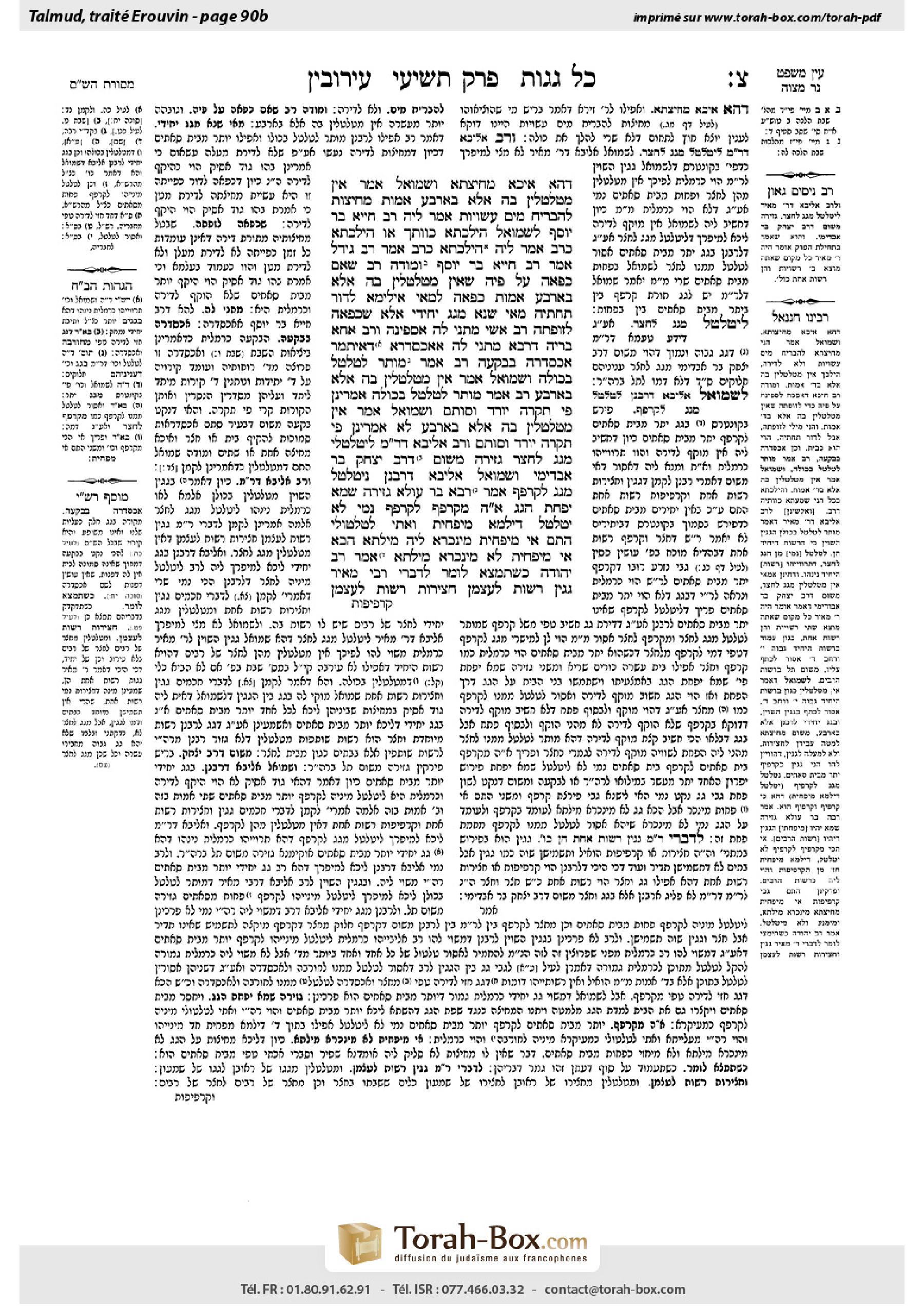
This page of Eruvin includes the Aramaic text, an English translation and an AI-generated French translation, alongside the scan above.
עירובין צ׳ ב · Aramaic and Hebrew text
דְּהָא אִיכָּא מְחִיצָתָא. וּשְׁמוּאֵל אָמַר: אֵין מְטַלְטְלִין בָּהּ אֶלָּא בְּאַרְבַּע אַמּוֹת — מְחִיצוֹת לְהַבְרִיחַ מַיִם עֲשׂוּיוֹת.
אֲמַר לֵיהּ רַב חִיָּיא בַּר יוֹסֵף לִשְׁמוּאֵל: הִילְכְתָא כְּווֹתָךְ אוֹ הִילְכְתָא כְּרַב? אֲמַר לֵיהּ: הִילְכְתָא כְּרַב.
אָמַר רַב גִּידֵּל אָמַר רַב חִיָּיא בַּר יוֹסֵף: וּמוֹדֶה רַב שֶׁאִם כְּפָאָהּ עַל פִּיהָ, שֶׁאֵין מְטַלְטְלִין בָּהּ אֶלָּא בְּאַרְבַּע אַמּוֹת. כְּפָאָהּ, לְמַאי? אִילֵימָא לָדוּר תַּחְתֶּיהָ, מַאי שְׁנָא מִגַּג יְחִידִי?
אֶלָּא שֶׁכְּפָאָהּ לְזוֹפְתָהּ.
רַב אָשֵׁי מַתְנֵי לַהּ אַסְּפִינָה, וְרַב אַחָא בְּרֵיהּ דְּרָבָא מַתְנֵי לַהּ אַאַכְסַדְרָא. דְּאִיתְּמַר, אַכְסַדְרָה בְּבִקְעָה. רַב אָמַר: מוּתָּר לְטַלְטֵל בְּכוּלָּהּ, וּשְׁמוּאֵל אָמַר: אֵין מְטַלְטְלִין בָּהּ אֶלָּא בְּאַרְבַּע.
רַב אָמַר: מוּתָּר לְטַלְטֵל בְּכוּלָּהּ — אָמְרִינַן פִּי תִקְרָה יוֹרֵד וְסוֹתֵם. וּשְׁמוּאֵל אָמַר: אֵין מְטַלְטְלִין בָּהּ אֶלָּא בְּאַרְבַּע — לָא אָמְרִינַן פִּי תִקְרָה יוֹרֵד וְסוֹתֵם.
וְרַב אַלִּיבָּא דְּרַבִּי מֵאִיר, לִיטַּלְטְלֵי מִגַּג לְחָצֵר?! גְּזֵירָה מִשּׁוּם דְּרַב יִצְחָק בַּר אַבְדִּימִי.
וּשְׁמוּאֵל אַלִּיבָּא דְרַבָּנַן, נִיטַּלְטֵל מִגַּג לְקַרְפֵּף. אָמַר רָבָא בַּר עוּלָּא: גְּזֵירָה שֶׁמָּא יִפָּחֵת הַגָּג.
אִי הָכִי, מִקַּרְפֵּף לְקַרְפֵּף נָמֵי לָא יְטַלְטֵל, דִּילְמָא מִיפְּחִית וְאָתֵי לְטַלְטוֹלֵי? הָתָם, אִי מִיפְּחִית מִינַּכְרָא לֵיהּ מִילְּתָא. הָכָא, אִי מִיפְּחִית לָא מִינַּכְרָא מִילְּתָא.
אָמַר רַב יְהוּדָה: כְּשֶׁתִּמְצָא לוֹמַר, לְדִבְרֵי רַבִּי מֵאִיר גַּגִּין רְשׁוּת לְעַצְמָן, חֲצֵירוֹת רְשׁוּת לְעַצְמָן,
Eruvin 90b · English translation
as there are partitions. And Shmuel said: One may move an object in it only within four cubits, as the partitions of the ship are not considered full-fledged partitions; they are erected only to keep water out, not to render it a residence.
Rav Ḥiyya bar Yosef said to Shmuel: Is the halakha in accordance with your opinion or is the halakha in accordance with the opinion of Rav? Shmuel said to him: The halakha is in accordance with the opinion of Rav, as his rationale is more convincing.
Rav Giddel said that Rav Ḥiyya bar Yosef said: And Rav concedes that if one overturned the ship onto its mouth, and it is more than ten handbreadths high, that one may move an object on it only within four cubits. The Gemara asks: For what purpose was the ship overturned? If you say it was overturned so that one may reside beneath it, what is the difference between it and an isolated roof? The legal status of the overturned ship should in every sense be that of a house, and therefore it should be permitted to carry throughout the entire ship.
Rather, it must be that he overturned it to tar it, i.e., to add a fresh coat to its underside. In that case, the boat certainly does not serve as a residence, and its sides are not considered full-fledged partitions.
Rav Ashi teaches Shmuel’s acceptance of Rav’s opposing view (Ritva) with regard to a ship, as stated above; and Rav Aḥa, son of Rava, teaches it with regard to a portico, as it was stated that amora’im disagreed with regard to a portico located in a field. A portico has a roof and either incomplete walls or no walls. Consequently, in the case of a portico located in a valley, which is a karmelit, it remains to be determined whether or not it is permitted to carry in it. Rav said: It is permitted to move an object throughout the entire portico, as it is a private domain. And Shmuel said: One may move an object in it only within four cubits.
The Gemara elaborates. Rav said: It is permitted to move an object throughout the entire portico, as we say: The edge of the roof descends to the ground and seals the portico on all sides, rendering it a private domain. And Shmuel said: One may move an object in it only within four cubits, as we do not say: The edge of the roof descends to the ground and seals the portico.
The Gemara asks: But according to Rav’s statement in accordance with the opinion of Rabbi Meir that one is permitted to carry from one roof to another if they are level, it should also be permitted to carry from a roof to a courtyard. Why then does Rabbi Meir rule that roofs and courtyards are separate domains and that carrying between them is prohibited? The Gemara answers: It is prohibited because Rabbi Meir issued a decree, due to the opinion of Rav Yitzḥak bar Avdimi. As stated previously, Rav Yitzḥak bar Avdimi rules that one may not transfer objects between two halakhically equivalent but physically distinct domains ten or more handbreadths high. This is a decree lest one standing in a public domain adjust a burden on a mound ten handbreadths high and four handbreadths wide, which is a private domain, an act prohibited by Torah law.
The Gemara continues: And according to Shmuel’s statement in accordance with the opinion of the Rabbis that the legal status of an isolated roof greater than two beit se’a is that of a karmelit, it should be permitted to move an object from an isolated roof to an enclosure within four cubits of the roof, as the legal status of the enclosure is also that of a karmelit. Why then do the Rabbis rule that roofs and enclosures are separate domains and carrying from one to the other is prohibited? Rava bar Ulla said: It is prohibited because the Rabbis issued a decree lest the area of the roof diminish to less than two beit se’a, in which case it would assume the status of a private domain, as it is prohibited to carry between a private domain and an enclosure.
The Gemara asks: If so, one should also not be permitted to move an object from one enclosure to another enclosure, due to the concern that perhaps the area of one of the enclosures will diminish and become a private domain, and he will come to move an object from one to the other as before. The Gemara answers: There, if the enclosure is diminished, the matter is conspicuous, as its walls are clearly visible. Here, however, if the roof is diminished, the matter is not conspicuous, as the roof does not have walls.
Rav Yehuda said: After careful analysis, you will find that you can say that according to the statement of Rabbi Meir, roofs are a domain in and of themselves, and one may carry from one roof to another; and likewise courtyards are considered a domain in and of themselves, and one may likewise carry from one courtyard to another.
Eruvin 90b · Traduction française (IA)
car il y a des cloisons. Et Shmuel dit : On peut déplacer un objet à l'intérieur seulement à quatre coudées, car les cloisons de la barque ne sont pas considérées comme des cloisons pleinement valides ; elles sont érigées uniquement pour empêcher l'eau d'entrer, pas pour la rendre un lieu de résidence.
Rav Hiyah bar Yosef dit à Shmuel : La halakha suit-elle votre opinion ou celle de Rav ? Shmuel dit à lui : La halakha suit l'opinion de Rav, car sa raison est plus convaincante.
Rav Giddel dit que Rav Hiyah bar Yosef dit : Et Rav reconnaît que si l'on renverse la barque sur sa bouche, et qu'elle est plus haute de dix paumes, on peut déplacer un objet à l'intérieur seulement à quatre coudées. La Guemara pose la question : Pour quelle raison a-t-on renversé la barque ? Si vous dites que c'est pour permettre de résider sous elle, quelle est la différence avec un toit isolé ? Le statut juridique de la barque renversée devrait être, en tout point, celui d'une maison, et par conséquent, il devrait être permis de porter à travers toute la barque.
Au contraire, il faut comprendre qu'il l'a renversée pour la recouvrir de peinture, c'est-à-dire pour ajouter une couche fraîche à son dessous. Dans ce cas, la barque ne sert certainement pas de résidence, et ses côtés ne sont pas considérés comme des cloisons pleinement valides.
Rav Ashi enseigne l'acceptation de Shmuel envers l'opposition de Rav (Ritva) concernant une barque, comme mentionné ci-dessus ; et Rav Acha, fils de Rava, enseigne cela concernant un portique, comme il a été dit que les amoraïm étaient en désaccord concernant un portique situé dans un champ. Un portique a un toit et des murs incomplets ou pas de murs. Par conséquent, dans le cas d'un portique situé dans une vallée, qui est un karmelit, il reste à déterminer si l'on peut porter à l'intérieur. Rav dit : On peut déplacer un objet à travers tout le portique, car c'est un domaine privé. Et Shmuel dit : On peut déplacer un objet à l'intérieur seulement à quatre coudées.
La Guemara développe. Rav dit : On peut déplacer un objet à travers tout le portique, car nous disons : L'extrémité du toit descend jusqu'au sol et scelle le portique de tous les côtés, le rendant un domaine privé. Et Shmuel dit : On peut déplacer un objet à l'intérieur seulement à quatre coudées, car nous ne disons pas : L'extrémité du toit descend jusqu'au sol et scelle le portique.
La Guemara pose la question : Mais selon l'affirmation de Rav conformément à l'opinion de Rabbi Meir qui permet de porter d'un toit à un autre si ceux-ci sont à la même hauteur, cela devrait aussi être permis de porter d'un toit à un cour d'air. Pourquoi alors Rabbi Meir déclare-t-il que les toits et les cours sont des domaines distincts et que le port entre eux est interdit ? La Guemara répond : C'est interdit car Rabbi Meir a émis un décret, en raison de l'opinion de Rav Yitzhak bar Avdimi. Comme mentionné précédemment, Rav Yitzhak bar Avdimi déclare qu'on ne peut pas transférer des objets entre deux domaines halakhiquement équivalents mais physiquement distincts de dix ou plus paumes de haut. C'est un décret afin de prévenir qu'une personne se trouvant dans un domaine public ajuste un fardeau sur un monticule de dix paumes de haut et de quatre paumes de large, qui est un domaine privé, une action interdite par la Loi divine.
La Guemara continue : Et selon l'affirmation de Shmuel conformément à l'opinion des Rabbins qui considère un toit isolé supérieur à deux beit se'a comme un karmelit, il devrait être permis de déplacer un objet d'un toit isolé vers un enclos à quatre coudées du toit, car le statut juridique de l'enclos est aussi celui d'un karmelit. Pourquoi alors les Rabbins déclarent-ils que les toits et les enclos sont des domaines distincts et que le port entre eux est interdit ? Rava bar Ulla dit : C'est interdit car les Rabbins ont émis un décret afin de prévenir que la surface du toit diminue à moins de deux beit se'a, dans lequel cas il prendrait le statut d'un domaine privé, car il est interdit de porter entre un domaine privé et un enclos.
La Guemara pose la question : Si c'est ainsi, on ne devrait pas non plus être autorisé à déplacer un objet d'un enclos à un autre enclos, en raison de la crainte que l'aire de l'un des enclos diminue et devienne un domaine privé, et qu'on viendrait à déplacer un objet d'un à l'autre comme avant. La Guemara répond : Là, si l'enclos est diminué, la chose est évidente, car ses murs sont clairement visibles. Ici, cependant, si le toit est diminué, la chose n'est pas évidente, car le toit n'a pas de murs.
Rav Yehuda dit : Après une analyse approfondie, vous trouverez que vous pouvez dire que selon l'affirmation de Rabbi Meir, les toits sont des domaines en eux-mêmes, et on peut porter d'un toit à un autre ; de même, les cours sont considérés comme des domaines en eux-mêmes, et on peut également porter d'un cour à un autre.
Traduction française générée par IA à partir de l’édition anglaise de Sefaria. Vérifie toujours un passage avec le texte source.
Text from Sefaria: William Davidson Edition - Vocalized Aramaic (CC BY NC); William Davidson Edition - English (CC BY NC).