Eruvin 92b: Talmud study for Daf Yomi
Study the Talmud for Daf Yomi with scanned pages, Hebrew text, English translations from Sefaria and AI-generated French translations.
Passage selection and English or AI-generated French translation are available where the scan has annotations. Daf Study is independent of Torah-Box and Sefaria.
Browse Eruvin · עירובין · All tractatesEruvin 92b text and translations
This page of Eruvin includes the Aramaic text, an English translation and an AI-generated French translation, alongside the scan above.
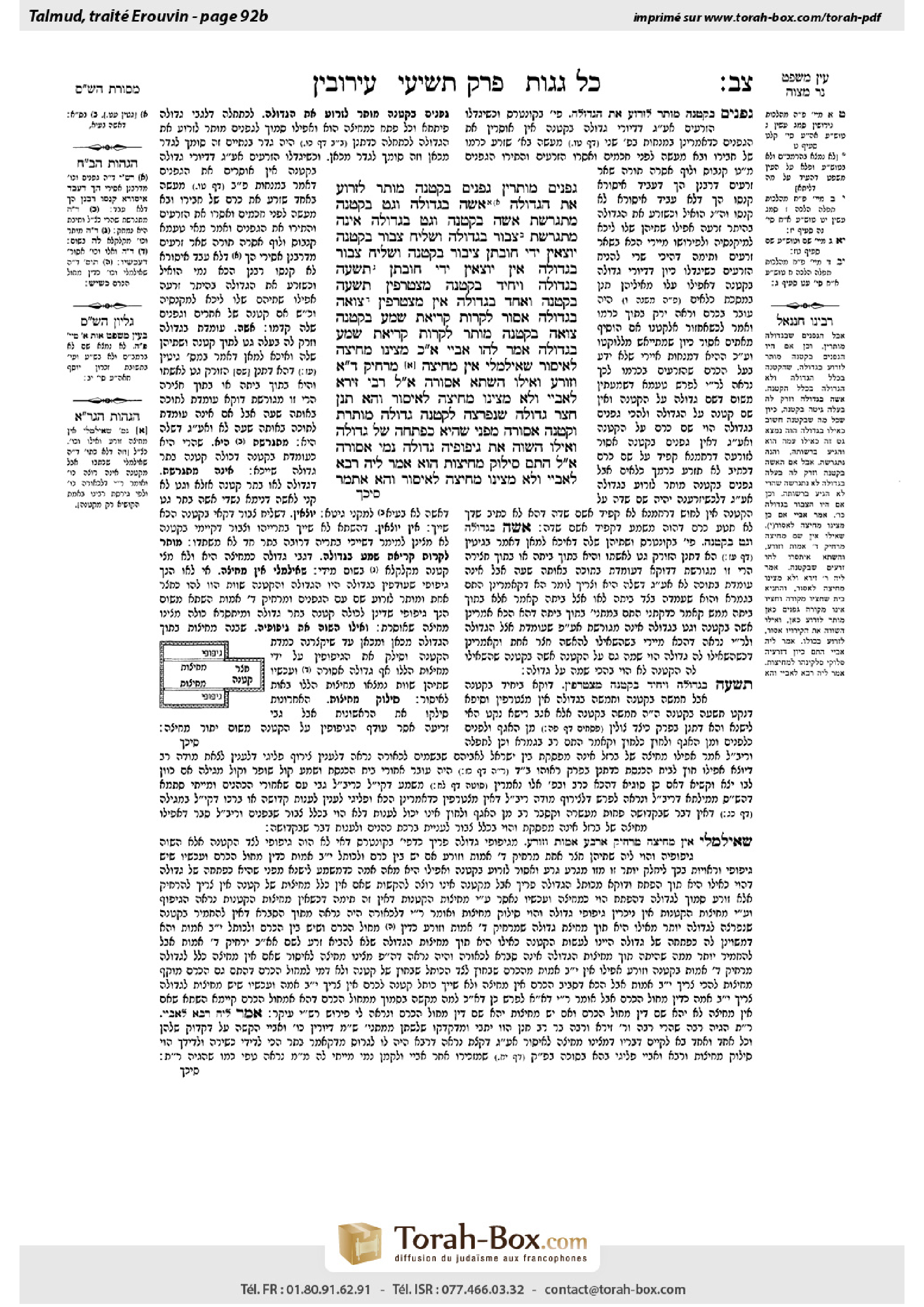
עירובין צ״ב ב · Aramaic and Hebrew text
גְּפָנִים מוּתָּרִין. גְּפָנִים בַּקְּטַנָּה — מוּתָּר לִזְרוֹעַ אֶת הַגְּדוֹלָה.
אִשָּׁה בַּגְּדוֹלָה וָגֵט בַּקְּטַנָּה — מִתְגָּרֶשֶׁת. אִשָּׁה בַּקְּטַנָּה וְגֵט בַּגְּדוֹלָה — אֵינָהּ מִתְגָּרֶשֶׁת.
צִבּוּר בַּגְּדוֹלָה וּשְׁלִיחַ צִבּוּר בַּקְּטַנָּה — יוֹצְאִין יְדֵי חוֹבָתָן. צִיבּוּר בַּקְּטַנָּה וּשְׁלִיחַ צִבּוּר בַּגְּדוֹלָה — אֵין יוֹצְאִין יְדֵי חוֹבָתָן.
תִּשְׁעָה בַּגְּדוֹלָה וְיָחִיד בַּקְּטַנָּה — מִצְטָרְפִין. תִּשְׁעָה בַּקְּטַנָּה וְאֶחָד בַּגְּדוֹלָה — אֵין מִצְטָרְפִין.
צוֹאָה בַּגְּדוֹלָה — אָסוּר לִקְרוֹת קְרִיאַת שְׁמַע בַּקְּטַנָּה. צוֹאָה בַּקְּטַנָּה — מוּתָּר לִקְרוֹת קְרִיאַת שְׁמַע בַּגְּדוֹלָה.
אֲמַר לְהוּ אַבָּיֵי: אִם כֵּן, מָצִינוּ מְחִיצָה לְאִיסּוּר. שֶׁאִילְמָלֵי אֵין מְחִיצָה, מַרְחִיק אַרְבַּע אַמּוֹת וְזוֹרֵעַ, וְאִילּוּ הַשְׁתָּא אֲסוּרָה!
אֲמַר לֵיהּ רַבִּי זֵירָא לְאַבָּיֵי: וְלֹא מָצִינוּ מְחִיצָה לְאִיסּוּר?! וְהָא תְּנַן: חָצֵר גְּדוֹלָה שֶׁנִּפְרְצָה לִקְטַנָּה — גְּדוֹלָה מוּתֶּרֶת וּקְטַנָּה אֲסוּרָה, מִפְּנֵי שֶׁהִיא כְּפִתְחָהּ שֶׁל גְּדוֹלָה.
וְאִילּוּ הִשְׁוָה אֶת גִּיפּוּפֶיהָ גְּדוֹלָה נָמֵי אֲסוּרָה!
אֲמַר לֵיהּ, הָתָם סִילּוּק מְחִיצּוֹת הוּא.
אֲמַר לֵיהּ רָבָא לְאַבָּיֵי: וְלֹא מָצִינוּ מְחִיצָה לְאִיסּוּר? וְהָא אִתְּמַר:
Eruvin 92b · English translation
The vines, however, are permitted, as the small courtyard does not extend into and impact upon the large one. The converse is also true: If there are vines in the small courtyard, it is permitted to sow other crops in the large one ab initio, even if they are not planted four cubits away from the vines, because the vines are not considered to be located in the larger courtyard, and therefore there is no prohibition whatsoever.
Likewise, if there were two adjacent courtyards, and a wife, who owned both courtyards, was standing in the large courtyard, and her husband threw her a bill of divorce into the small courtyard, she is divorced. Her presence in the larger courtyard extends to the smaller one, and she is therefore considered to be standing in the small courtyard. If, however, the wife was in the small courtyard and the bill of divorce was thrown into the large one, she is not divorced.
Likewise, with regard to communal prayer, if the congregation was in the large courtyard, and the prayer leader was in the small one, they fulfill their obligation through his prayer, as the congregation is considered to be in the small one as well. However, if the congregation was in the small courtyard, and the prayer leader was in the large one, they do not fulfill their obligation.
The same principle applies to a prayer quorum: If there were nine men in the large courtyard and one man in the small one, they join together to form the necessary quorum of ten, as the small courtyard is subsumed within the large one, and the individual is considered to be in the large courtyard. However, if there were nine men in the small courtyard and one in the large one, they do not join together.
Furthermore, if there was excrement in the large courtyard, it is prohibited to recite Shema in the small one, as the excrement is considered to be in the small courtyard as well, and it is prohibited to recite Shema in the presence of excrement. If, however, there was excrement in the small courtyard, it is permitted to recite Shema in the large one.
Abaye said to them: If so, we have found a partition that causes prohibition. According to these principles, the existence of a partition renders sowing crops prohibited; in the absence of a partition sowing the crops would have been permitted due to their distance from the vines. Ostensibly, this is a counterintuitive conclusion. As, were there no partition at all, it would be sufficient to distance oneself four cubits from the vine and sow the crop, whereas now that the area is divided into two courtyards by means of a partition, it is prohibited to sow the crop in the entire small courtyard.
Rabbi Zeira said to Abaye: And didn’t we find a partition that causes prohibition? But didn’t we learn in the mishna: With regard to a large courtyard that was breached into a small one, it is permitted for the residents of the large courtyard to carry, but it is prohibited for the residents of the small one to do so. That is because in that case, the legal status of the breach is like that of the entrance of the large courtyard.
And if he were to even its protrusions by constructing partitions in the larger courtyard so that the large courtyard no longer protruded beyond the smaller one, carrying in the large courtyard would also be prohibited, as it would now be completely breached into the smaller courtyard. Apparently, in this case, construction of additional partitions causes prohibition.
Abaye said to Rabbi Zeira: The two cases are not comparable, as there, adding partitions in order to even the protrusions is not considered establishment of partitions. On the contrary, it is effectively the removal of partitions. These partitions are designed to negate the original partitions of the courtyard.
Rava said to Abaye: And didn’t we find a partition that causes prohibition? But wasn’t it stated:
Eruvin 92b · Traduction française (IA)
Les vigne, cependant, sont permises, car le petit courtil ne s'étend pas dans le grand et n'affecte pas celui-ci. L'inverse est également vrai : si des vigne sont présentes dans le petit courtil, il est permis de semer d'autres cultures dans le grand courtil dès le début, même si elles ne sont pas plantées à quatre coudées de distance des vigne, car les vigne ne sont pas considérées comme étant situées dans le grand courtil, et donc il n'y a aucune interdiction du tout.
De même, si deux courtils adjacents existaient, et une femme, propriétaire des deux courtils, se tenait dans le grand courtil, et son mari lui lançait un document de divorce dans le petit courtil, elle est divorcée. Sa présence dans le grand courtil s'étend au petit courtil, et elle est donc considérée comme se tenant dans le petit courtil. Cependant, si la femme était dans le petit courtil et le document de divorce était lancé dans le grand courtil, elle n'est pas divorcée.
De même, concernant la prière communautaire, si la congrégation était dans le grand courtil et le leader de la prière était dans le petit courtil, ils remplissent leur obligation grâce à sa prière, car la congrégation est considérée comme étant dans le petit courtil également. Cependant, si la congrégation était dans le petit courtil et le leader de la prière était dans le grand courtil, ils ne remplissent pas leur obligation.
Le même principe s'applique à un quorum de prière : si neuf hommes étaient dans le grand courtil et un homme dans le petit courtil, ils se joignent ensemble pour former le quorum nécessaire de dix, car le petit courtil est inclus dans le grand courtil, et l'individu est considéré comme étant dans le grand courtil. Cependant, si neuf hommes étaient dans le petit courtil et un dans le grand courtil, ils ne se joignent pas.
De plus, si des déjections étaient présentes dans le grand courtil, il est interdit de réciter le Chéma dans le petit courtil, car les déjections sont considérées comme étant présentes dans le petit courtil également, et il est interdit de réciter le Chéma en présence de déjections. Cependant, si des déjections étaient présentes dans le petit courtil, il est permis de réciter le Chéma dans le grand courtil.
Abaye dit à ceux-ci : Si c'est ainsi, nous avons trouvé une séparation qui cause une interdiction. Selon ces principes, l'existence d'une séparation rend le semis de cultures interdit ; en l'absence de séparation, le semis des cultures aurait été permis en raison de leur distance des vigne. Apparemment, cette conclusion est contre-intuitive. Car, s'il n'y avait pas de séparation du tout, il suffirait de s'éloigner de quatre coudées des vigne et de semer la culture, alors que maintenant que l'espace est divisé en deux courtils par une séparation, il est interdit de semer la culture dans l'ensemble du petit courtil.
Rabbi Zeira dit à Abaye : Et n'avons-nous pas trouvé une séparation qui cause une interdiction ? Mais n'avons-nous pas appris dans la mitsna : Concernant un grand courtil percé dans un petit courtil, il est permis aux habitants du grand courtil de porter, mais il est interdit aux habitants du petit courtil de le faire. C'est parce que dans ce cas, le statut juridique de la percée est comme celui de l'entrée du grand courtil.
Et s'il nivelait ses saillies en construisant des séparations dans le grand courtil afin que le grand courtil ne s'étende plus au-delà du petit courtil, le port dans le grand courtil serait également interdit, car il serait désormais entièrement percé dans le petit courtil. Apparemment, dans ce cas, la construction de séparations supplémentaires cause une interdiction.
Abaye dit à Rabbi Zeira : Les deux cas ne sont pas comparables, car là, l'ajout de séparations afin de niveler les saillies n'est pas considéré comme l'établissement de séparations. Au contraire, c'est effectivement la suppression de séparations. Ces séparations sont conçues pour annuler les séparations originelles du courtil.
Rava dit à Abaye : Et n'avons-nous pas trouvé une séparation qui engendre une interdiction ? Mais n'était-il pas dit :
Traduction française générée par IA à partir de l’édition anglaise de Sefaria. Vérifie toujours un passage avec le texte source.
Text from Sefaria: William Davidson Edition - Vocalized Aramaic (CC BY NC); William Davidson Edition - English (CC BY NC).