Eruvin 93a: Talmud study for Daf Yomi
Study the Talmud for Daf Yomi with scanned pages, Hebrew text, English translations from Sefaria and AI-generated French translations.
Passage selection and English or AI-generated French translation are available where the scan has annotations. Daf Study is independent of Torah-Box and Sefaria.
Browse Eruvin · עירובין · All tractatesEruvin 93a text and translations
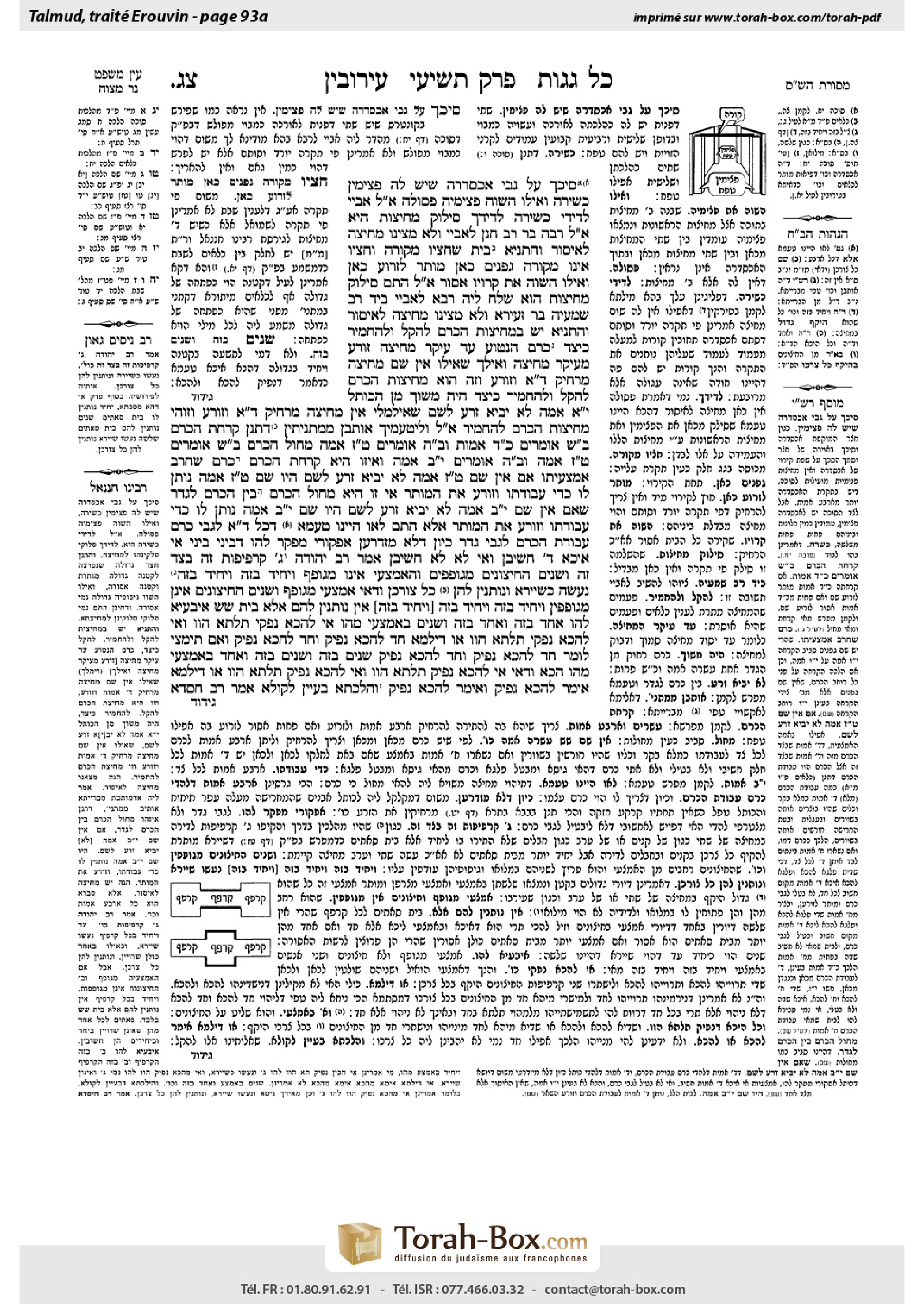
This page of Eruvin includes the Aramaic text, an English translation and an AI-generated French translation, alongside the scan above.
עירובין צ״ג א · Aramaic and Hebrew text
סִיכֵּךְ עַל גַּבֵּי אַכְסַדְרָה שֶׁיֵּשׁ לָהּ פַּצִּימִין — כְּשֵׁירָה. וְאִילּוּ הִשְׁוָה פַּצִּימֶיהָ — פְּסוּלָה.
אֲמַר לֵיהּ אַבָּיֵי: לְדִידִי כְּשֵׁירָה, לְדִידָךְ סִילּוּק מְחִיצּוֹת הִיא.
אֲמַר לֵיהּ רַבָּה בַּר רַב חָנָן לְאַבָּיֵי: וְלֹא מָצִינוּ מְחִיצָה לְאִיסּוּר? וְהָתַנְיָא: בַּיִת שֶׁחֶצְיוֹ מְקוֹרֶה וְחֶצְיוֹ אֵינוֹ מְקוֹרֶה, גְּפָנִים כָּאן — מוּתָּר לִזְרוֹעַ כָּאן.
וְאִילּוּ הִשְׁוָה אֶת קֵרוּיוֹ — אָסוּר. אֲמַר לֵיהּ: הָתָם סִילּוּק מְחִיצּוֹת הוּא.
שְׁלַח לֵיהּ רָבָא לְאַבָּיֵי בְּיַד רַב שְׁמַעְיָה בַּר זְעֵירָא: וְלֹא מָצִינוּ מְחִיצָה לְאִיסּוּר? וְהָתַנְיָא: יֵשׁ בִּמְחִיצוֹת הַכֶּרֶם לְהָקֵל וּלְהַחֲמִיר, כֵּיצַד? כֶּרֶם הַנָּטוּעַ עַד עִיקַּר מְחִיצָה — זוֹרֵעַ מֵעִיקַּר מְחִיצָה וְאֵילָךְ. שֶׁאִילּוּ אֵין שָׁם מְחִיצָה מַרְחִיק אַרְבַּע אַמּוֹת וְזוֹרֵעַ, וְזֶה הוּא מְחִיצּוֹת הַכֶּרֶם לְהָקֵל.
וּלְהַחֲמִיר כֵּיצַד? הָיָה מָשׁוּךְ מִן הַכּוֹתֶל אַחַת עֶשְׂרֵה אַמָּה — לֹא יָבִיא זֶרַע לְשָׁם, שֶׁאִילְמָלֵי אֵין מְחִיצָה מַרְחִיק אַרְבַּע אַמּוֹת וְזוֹרֵעַ, וְזוֹהִי מְחִיצוֹת הַכֶּרֶם לְהַחְמִיר.
אֲמַר לֵיהּ: וְלִיטַעְמָיךְ, אוֹתְבַן מִמַּתְנִיתִין, דִּתְנַן: קָרַחַת הַכֶּרֶם, בֵּית שַׁמַּאי אוֹמְרִים: עֶשְׂרִים וְאַרְבַּע אַמּוֹת, וּבֵית הִלֵּל אוֹמְרִים: שֵׁשׁ עֶשְׂרֵה אַמָּה. מְחוֹל הַכֶּרֶם, בֵּית שַׁמַּאי אוֹמְרִים: שֵׁשׁ עֶשְׂרֵה אַמָּה, וּבֵית הִלֵּל אוֹמְרִים: שְׁתֵּים עֶשְׂרֵה אַמָּה.
וְאֵיזוֹ הִיא קָרַחַת הַכֶּרֶם? כֶּרֶם שֶׁחָרַב אֶמְצָעִיתוֹ. אִם אֵין שָׁם שֵׁשׁ עֶשְׂרֵה אַמָּה — לֹא יָבִיא זֶרַע לְשָׁם, הָיוּ שָׁם שֵׁשׁ עֶשְׂרֵה אַמָּה — נוֹתֵן לוֹ כְּדֵי עֲבוֹדָתוֹ, וְזוֹרֵעַ אֶת הַמּוֹתָר.
אֵי זוֹ הִיא מְחוֹל הַכֶּרֶם? בֵּין הַכֶּרֶם לַגָּדֵר. שֶׁאִם אֵין שָׁם שְׁתֵּים עֶשְׂרֵה אַמָּה — לֹא יָבִיא זֶרַע לְשָׁם, הָיוּ שָׁם שְׁתֵּים עֶשְׂרֵה אַמָּה — נוֹתֵן לוֹ כְּדֵי עֲבוֹדָתוֹ, וְזוֹרֵעַ אֶת הַמּוֹתָר.
אֶלָּא — הָתָם לָאו הַיְינוּ טַעְמָא, דְּכֹל אַרְבַּע אַמּוֹת לְגַבֵּי כֶרֶם עֲבוֹדַת הַכֶּרֶם. לְגַבֵּי גָדֵר, כֵּיוָן דְּלָא מִזְדַּרְעָן — אַפְקוֹרֵי מַפְקַר לְהוּ. דְּבֵינֵי בֵּינֵי, אִי אִיכָּא אַרְבַּע — חֲשִׁיבָן, וְאִי לָא — לָא חֲשִׁיבָן.
אָמַר רַב יְהוּדָה: שְׁלֹשָׁה קַרְפֵּיפוֹת זֶה בְּצַד זֶה, וּשְׁנַיִם הַחִיצוֹנִים מְגוּפָּפִים, וְהָאֶמְצָעִי אֵינוֹ מְגוּפָּף, וְיָחִיד בָּזֶה וְיָחִיד בָּזֶה — נַעֲשֶׂה כִּשְׁיָירָא, וְנוֹתְנִין לָהֶן כׇּל צוֹרְכָּן וַדַּאי.
אֶמְצָעִי מְגוּפָּף וּשְׁנַיִם הַחִיצוֹנִים אֵינָן מְגוּפָּפִין, וְיָחִיד בָּזֶה וְיָחִיד זֶה [וְיָחִיד בָּזֶה] — אֵין נוֹתְנִין לָהֶם אֶלָּא בֵּית שֵׁשׁ.
אִיבַּעְיָא לְהוּ: אֶחָד בָּזֶה וְאֶחָד בָּזֶה וּשְׁנַיִם בָּאֶמְצָעִי, מַהוּ? אִי לְהָכָא נָפְקִי — תְּלָתָא הָווּ, וְאִי לְהָכָא נָפְקִי — תְּלָתָא הָווּ.
אוֹ דִילְמָא: חַד לְהָכָא נָפֵיק, וְחַד לְהָכָא נָפֵיק.
וְאִם תִּימְצֵי לוֹמַר חַד לְהָכָא נָפֵיק וְחַד לְהָכָא נָפֵיק, שְׁנַיִם בָּזֶה וּשְׁנַיִם בָּזֶה וְאֶחָד בְּאֶמְצָעִי מַהוּ? הָכָא וַדַּאי, אִי לְהָכָא נָפֵיק — תְּלָתָא הָווּ, וְאִי לְהָכָא נָפֵיק — תְּלָתָא הָווּ, אוֹ דִילְמָא: אֵימַר לְהָכָא נָפֵיק, וְאֵימַר לְהָכָא נָפֵיק.
וְהִלְכְתָא בַּעְיַין לְקוּלָּא.
אָמַר רַב חִסְדָּא:
Eruvin 93a · English translation
If one placed roofing on top of a portico that has doorposts, i.e., a portico with two parallel walls that are valid for a sukka, as well as posts in the corners supporting the portico and protruding like doorposts, which are considered as sealing the other two sides of the portico, it is a valid sukka. However, if he evened the doorposts by constructing walls adjacent to the existing walls, obscuring the posts so that they do not protrude, the sukka is invalid. This teaching indicates that the creation of a partition can cause prohibition.
Abaye said to him: In my opinion, with regard to that case of a portico, the sukka is valid. However, even according to your opinion, this is another instance of the removal of partitions. Evening the doorposts does not render the sukka invalid through the establishment of new partitions, but because it negates the original partitions of the sukka.
Rabba bar Rav Ḥanan said to Abaye: And didn’t we find that a partition causes prohibition? But wasn’t it taught in a baraita: With regard to a house, half of which is roofed and half unroofed, if there are vines here, under the roofed section of the house, it is permitted to sow crops there, in the open section. The reason is that it is as though the edge of the roof descends to the ground and forms a partition between the two sections of the house.
And if he evened its roofing, by extending the roof to cover the entire house, it would be prohibited to sow other crops there. It is evident that the very placement of a partition, in this case a roof, causes prohibition. Abaye said to him: There too it is an instance of the removal of partitions. It is prohibited to sow not due to the added roofing; rather, it is prohibited due to the negation of the imaginary partition.
Rava sent a different proof to Abaye by means of Rav Shemaya bar Ze’eira, with regard to the same issue. And didn’t we find a partition causes prohibition? But wasn’t it taught in a baraita: There is an element in the partitions of a vineyard that causes leniency with regard to diverse kinds of seeds and an element that causes stringency. How so? With regard to a vineyard that is planted until the very base of a partition, one sows crops from the base of the other side of the partition onward. This is a leniency, as were there no partition there, he would be required to distance himself four cubits from the last vine and only then sow there. And this is an element in partitions of a vineyard that causes leniency.
And as for an element in partitions that causes stringency, how so? If the vineyard was distanced eleven cubits from a wall, one may not bring the seeds of other crops there, between the vineyard and the wall, and sow that area. This is a stringency, as were there no partition, it would suffice to distance himself four cubits from the last vine, and sow there. This is an element of partitions in a vineyard that causes stringency, a clear situation of a partition that causes prohibition.
Abaye said to him: And according to your reasoning that this presents a difficulty, raise an objection against our opinion from a mishna, rather than a less authoritative baraita, as we learned in a mishna: With regard to a clearing in a vineyard, Beit Shammai say: Its measure is twenty-four cubits, and Beit Hillel say: Sixteen cubits. With regard to the perimeter of a vineyard, Beit Shammai say: Sixteen cubits, and Beit Hillel say: Twelve cubits.
The mishna explains: And what is a clearing in a vineyard? It is referring to a vineyard whose middle section was laid bare of vines. If there are not sixteen cubits across in the clearing, one may not bring foreign seeds and sow them there, due to the Torah prohibition against sowing other crops in a vineyard (Deuteronomy 22:9). If there were sixteen cubits across in the clearing, one provides the vineyard with its requisite work area, i.e., four cubits along either side of the vines are left unsown to facilitate cultivation of the vines, and he sows the rest of the cleared area with foreign crops.
The mishna continues: What is the perimeter of a vineyard? It is the vacant area between the vineyard and the fence surrounding it. If there are not twelve cubits in that area, one may not bring foreign seeds and sow them there. If there are twelve cubits in that area, he provides the vineyard with its requisite work area, four cubits, and he sows the rest. However, were the vineyard not surrounded by a fence, all he would need to do is distance himself four cubits from the last vine. It is clear from this halakha that the partition causes prohibition.
Rather, the objection was not raised from there because there, isn’t this the reason that the partition is not considered to cause prohibition? It is because the entire area of four cubits alongside a vineyard is considered the vineyard’s work area, and is therefore an actual part of it. Likewise, with regard to the four cubits alongside the fence surrounding the vineyard, since they cannot easily be sown due to the wall, he renounces ownership over the area. With regard to the space in between, if it is four cubits, it is deemed significant in its own right, and if not, it is not significant and is nullified relative to the rest, and it is prohibited to sow there. A similar reasoning applies to the baraita. The stringency is not due to the fact that the partition causes prohibition, but because the partition impedes cultivation of the vineyard.
Rav Yehuda said: If there are three enclosures alongside one another, and the two outer ones protrude, i.e., they are wider than the middle one, so that there are partitions on both sides of the breach between them and the middle enclosure, and the middle one does not protrude, and there are no partitions between it and the outer enclosures, as it is totally breached, and there is one person in this one and one person in that one and yet another person in the third enclosure, the people in the enclosures are considered as though they are all living in one large enclosure. Consequently, the legal status of the group becomes like that of a caravan, and one provides them with all the space that they require. In other words, they may use the entire enclosure even if it is very large, just as there are no limits to the size of the enclosed area in which members of a caravan may carry.
However, if the middle enclosure protruded, and the two outer ones did not protrude, i.e., they were narrower than the middle enclosure, so that their entire width was breached into it, and there is one person in this one and one person in that one and yet another in the third, one provides them only an area of six beit se’a, in accordance with the halakha of individuals in a field, who may enclose an area of only two beit se’a per person. As the middle enclosure is larger than the two outer ones, it determines their status, in accordance with the principle stated above, not the other way around. Consequently, the person in the middle enclosure is regarded as though he established residence in only one of the outer enclosures, constituting a group of no more than two, which does not have the legal status of a caravan.
Based on these assumptions, a dilemma was raised before the Sages: If there is one person in this outer enclosure, and one person in the other outer enclosure, and two people in the middle enclosure, what is the halakha? Is the ruling that if the pair exit to here, one of the outer enclosures, they are three people in one place, and if they exit to there, the other outer enclosure, they are three people in one place, and three people are considered a caravan and provided with all the space they require, as stated above?
Or perhaps, as one may exit to here and the other may exit to there, in which case there would be no more than two people in each enclosure, they are provided with only two beit se’a per person.
And if you say that one may exit to here and one may exit to there, if there were two people in this outer enclosure, and two people in that outer enclosure, and one person in the middle enclosure, what is the halakha? Is the ruling that here, certainly, if he exits to here they are three, and if he exits to there they are likewise three, and consequently they should be provided with all the space they require in any case? Or perhaps, in this case too there is uncertainty, as say that he might exit to here, and say that he might exit to there. As the direction in which he will leave his enclosure is undetermined, they should be provided with only two beit se’a each.
These dilemmas were essentially left unresolved, but the halakha is that these dilemmas are decided leniently, and they are provided with all the space they require in these cases.
Rav Ḥisda said:
Eruvin 93a · Traduction française (IA)
Si l'on a recouvert un porche qui possède des poteaux, c'est-à-dire un porche avec deux murs parallèles valides pour une succah, ainsi que des poteaux aux angles qui soutiennent le porche et qui s'élèvent comme des poteaux, considérés comme scellant les deux autres côtés du porche, alors c'est une succah valide. Cependant, si l'on a nivelé les poteaux en construisant des murs adjacents aux murs existants, masquant les poteaux de sorte qu'ils ne s'élèvent plus, la succah est invalide. Cet enseignement indique que la création d'une partition peut causer une interdiction.
Abaye dit à lui : Selon mon avis, concernant ce cas de porche, la succah est valide. Cependant, même selon votre avis, c'est un autre cas de suppression de partitions. Niveler les poteaux ne rend la succah invalide pas à cause de la création de nouvelles partitions, mais parce qu'il annule les partitions originales de la succah.
Rabba bar Rav Hanan dit à Abaye : Et n'avons-nous pas trouvé que la partition cause une interdiction ? Et n'a-t-on pas appris dans une baraïta : Concernant une maison, la moitié de laquelle est toilée et l'autre non, si des vignes sont ici, sous la partie toilée de la maison, il est permis de semer des cultures là, dans la partie ouverte. La raison est que cela ressemble à ce que la bordure du toit descend jusqu'au sol et forme une partition entre les deux sections de la maison.
Et si l'on avait nivelé son toit, en étendant le toit pour couvrir toute la maison, il serait interdit de semer d'autres cultures là. Il est évident que la simple mise en place d'une partition, dans ce cas un toit, cause une interdiction. Abaye dit à lui : Là aussi, c'est un cas de suppression de partitions. Il est interdit de semer non à cause du toit ajouté, mais à cause de la négation de la partition imaginaire.
Rava a envoyé une preuve différente à Abaye par l'intermédiaire de Rav Shemaya bar Ze’eira, concernant la même question. Et n'avons-nous pas trouvé que la partition cause une interdiction ? Et n'a-t-on pas appris dans une baraïta : Il y a un élément dans les partitions d'un vignoble qui cause une leniency concernant les diverses sortes de semences et un élément qui cause une stringence. Comment cela ? Concernant un vignoble planté jusqu'à la base d'une partition, on sème des cultures à partir de la base de l'autre côté de la partition. C'est une leniency, car s'il n'y avait pas de partition, il aurait été nécessaire de s'éloigner de quatre cubits du dernier cep et seulement alors de semer là. Et c'est un élément dans les partitions d'un vignoble qui cause une leniency.
Et concernant un élément dans les partitions qui cause une stringence, comment cela ? Si le vignoble était distancé de onze cubits d'un mur, on ne peut pas apporter les semences d'autres cultures là, entre le vignoble et le mur, et semer cette zone. C'est une stringence, car s'il n'y avait pas de partition, il suffirait de s'éloigner de quatre cubits du dernier cep et de semer là. C'est un élément des partitions d'un vignoble qui cause une stringence, une situation claire d'une partition qui cause une interdiction.
Abaye dit à lui : Et selon votre raisonnement qui présente un problème, soulevez un objection contre notre opinion à partir d'une mitsva, plutôt qu'une baraïta moins autoritaire, comme nous avons appris dans une mitsva : Concernant un espace libre dans un vignoble, Beit Shammai disent : Sa mesure est vingt-quatre cubits, et Beit Hillel disent : Seize cubits. Concernant la périphérie d'un vignoble, Beit Shammai disent : Seize cubits, et Beit Hillel disent : Douze cubits.
La mitsva explique : Et qu'est-ce qu'un espace libre dans un vignoble ? C'est ce qui fait référence à un vignoble dont la section centrale a été dégagée des vignes. Si la largeur n'est pas seize cubits dans l'espace libre, on ne peut pas apporter des semences étrangères et les semer là, en raison de l'interdiction divine de semer d'autres cultures dans un vignoble (Deutéronome 22:9). Si la largeur est seize cubits dans l'espace libre, on fournit au vignoble son espace de travail, c'est-à-dire quatre cubits sur les côtés des vignes sont laissés non semés pour faciliter la culture des vignes, et on sème le reste de la zone dégagée avec des cultures étrangères.
La mitsva continue : Qu'est-ce que la périphérie d'un vignoble ? C'est la zone vide entre le vignoble et le mur qui l'entoure. Si la largeur n'est pas douze cubits dans cette zone, on ne peut pas apporter des semences étrangères et les semer là. Si la largeur est douze cubits dans cette zone, on fournit au vignoble son espace de travail, quatre cubits, et on sème le reste. Cependant, si le vignoble n'était pas entouré d'un mur, il aurait suffi de s'éloigner de quatre cubits du dernier cep. Il est clair à partir de cette halakha que la partition cause une interdiction.
Plutôt, l'objection n'a pas été soulevée à partir de là, car là, n'est-ce pas la raison pour laquelle la partition n'est pas considérée comme causant une interdiction ? C'est parce que l'ensemble de la zone de quatre cubits à côté d'un vignoble est considérée comme l'espace de travail du vignoble, et est donc une partie réelle de celui-ci. De même, concernant les quatre cubits à côté du mur entourant le vignoble, puisque ceux-ci ne peuvent pas facilement être semés en raison du mur, il renonce à la propriété de la zone. Concernant la zone entre, si elle est de quatre cubits, elle est considérée comme importante en soi, et si non, elle n'est pas importante et est annulée par rapport au reste, et il est interdit de semer là. Un raisonnement similaire s'applique à la baraïta. La stringence n'est pas due au fait que la partition cause une interdiction, mais parce que la partition entrave la culture du vignoble.
Rav Yehuda a dit : Si trois enclos sont côte à côte, et les deux extérieurs s'élargissent, c'est-à-dire qu'ils sont plus larges que le milieu, de sorte qu'il y a des cloisons des deux côtés de la brèche entre eux et l'enclos central, et que l'enclos central ne s'élargit pas, et qu'il n'y a pas de cloisons entre lui et les enclos extérieurs, car il est totalement brisé, et qu'il y a une personne dans cet enclos, une autre dans celui-ci et une troisième dans l'autre, les personnes dans les enclos sont considérées comme si elles vivaient toutes dans un grand enclos. Par conséquent, le statut juridique du groupe devient celui d'une caravane, et l'on leur fournit tout l'espace dont ils ont besoin. En d'autres termes, ils peuvent utiliser l'ensemble de l'enclos même s'il est très vaste, tout comme il n'y a pas de limites à la taille de la zone enclose dans laquelle les membres d'une caravane peuvent se déplacer.
Cependant, si l'enclos central s'élargissait, et que les deux extérieurs ne s'élargissent pas, c'est-à-dire qu'ils étaient plus étroits que l'enclos central, de sorte que toute leur largeur était brisée dans celui-ci, et qu'il y a une personne dans cet enclos, une autre dans celui-ci et une troisième dans l'autre, l'on fournit à ces personnes uniquement une surface de six beit se'a, conformément à la halakha des individus dans un champ, qui peuvent enclore une surface de deux beit se'a par personne. Comme l'enclos central est plus grand que les deux extérieurs, il détermine leur statut, conformément au principe mentionné ci-dessus, et non l'inverse. Par conséquent, la personne dans l'enclos central est considérée comme si elle avait établi son domicile dans l'un des enclos extérieurs, ce qui constituerait un groupe de deux personnes au plus, qui n'a pas le statut juridique d'une caravane.
Sur la base de ces hypothèses, un dilemme a été soulevé devant les Sages : s'il y a une personne dans cet enclos extérieur, une autre dans l'autre enclos extérieur, et deux personnes dans l'enclos central, quelle est la halakha ? La décision est-elle celle-ci : si la paire sort vers ici, l'un des enclos extérieurs, ils sont trois personnes dans un même lieu, et si ils sortent vers là, l'autre enclos extérieur, ils sont trois personnes dans un même lieu, et trois personnes sont considérées comme une caravane et fournies avec tout l'espace dont ils ont besoin, comme mentionné ci-dessus ?
Ou peut-être que l'un peut sortir ici et l'autre peut sortir là, dans ce cas il n'y aurait pas plus de deux personnes dans chaque enclos, ils sont donc fournis avec seulement deux beit se’a par personne.
Et si vous dites que l'un peut sortir ici et l'autre peut sortir là, si deux personnes étaient dans cet enclos extérieur, et deux personnes dans cet autre enclos extérieur, et une personne dans l'enclos central, quelle est la halakha ? La décision est-elle que dans ce cas, certainement, s'il sort ici, ils sont trois, et s'il sort là, ils sont également trois, et par conséquent ils devraient être fournis avec tout l'espace nécessaire dans tous les cas ? Ou peut-être que dans ce cas également il y a une incertitude, car l'un dit qu'il peut sortir ici et l'autre dit qu'il peut sortir là. Comme la direction dans laquelle il va quitter son enclos est indéterminée, ils devraient être fournis avec seulement deux beit se’a chacun.
Ces dilemmes n'ont pas été résolus de manière définitive, mais la halakha est qu'ils sont décidés de manière clémente, et ils sont fournis avec tout l'espace nécessaire dans ces cas.
Rav Ḥisda a dit :
Traduction française générée par IA à partir de l’édition anglaise de Sefaria. Vérifie toujours un passage avec le texte source.
Text from Sefaria: William Davidson Edition - Vocalized Aramaic (CC BY NC); William Davidson Edition - English (CC BY NC).