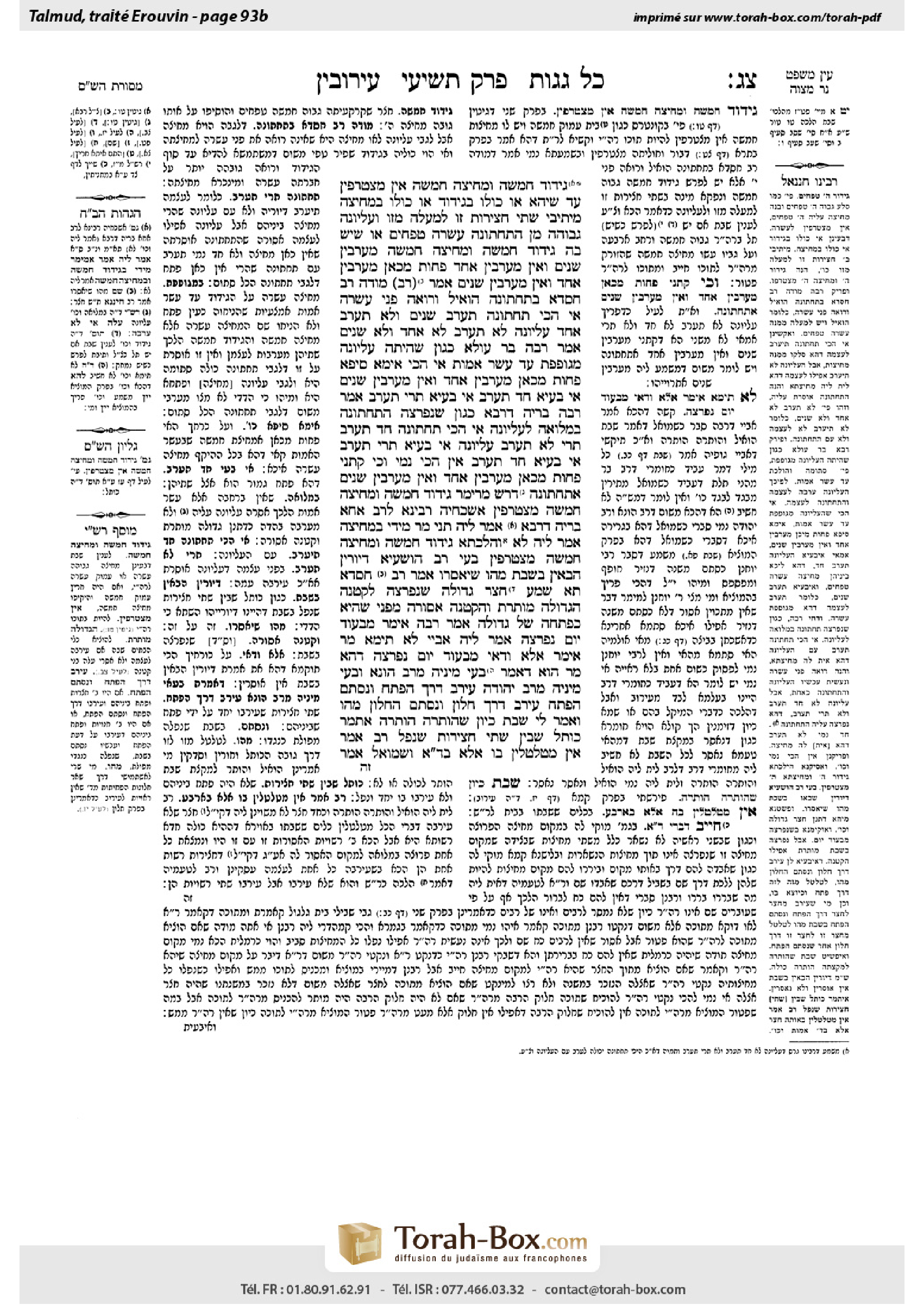
Eruvin 93b: Talmud study for Daf Yomi
Study the Talmud for Daf Yomi with scanned pages, Hebrew text, English translations from Sefaria and AI-generated French translations.
Passage selection and English or AI-generated French translation are available where the scan has annotations. Daf Study is independent of Torah-Box and Sefaria.
Browse Eruvin · עירובין · All tractatesEruvin 93b text and translations
This page of Eruvin includes the Aramaic text, an English translation and an AI-generated French translation, alongside the scan above.
עירובין צ״ג ב · Aramaic and Hebrew text
גִּידּוּד חֲמִשָּׁה וּמְחִיצָה חֲמִשָּׁה — אֵין מִצְטָרְפִין עַד שֶׁיְּהֵא אוֹ כּוּלּוֹ בְּגִידּוּד אוֹ כּוּלּוֹ בִּמְחִיצָה.
מֵיתִיבִי: שְׁתֵּי חֲצֵירוֹת זוֹ לְמַעְלָה מִזּוֹ וְעֶלְיוֹנָה גְּבוֹהָה מִן הַתַּחְתּוֹנָה עֲשָׂרָה טְפָחִים, אוֹ שֶׁיֵּשׁ בָּהּ גִּידּוּד חֲמִשָּׁה וּמְחִיצָה חֲמִשָּׁה — מְעָרְבִין שְׁנַיִם, וְאֵין מְעָרְבִין אֶחָד. פָּחוֹת מִכָּאן מְעָרְבִין אֶחָד, וְאֵין מְעָרְבִין שְׁנַיִם!
אָמַר (רַב): מוֹדֶה רַב חִסְדָּא בַּתַּחְתּוֹנָה, הוֹאִיל וְרוֹאֶה פְּנֵי עֲשָׂרָה. אִי הָכִי: תַּחְתּוֹנָה — תְּעָרֵב שְׁנַיִם וְלֹא תְּעָרֵב אֶחָד, עֶלְיוֹנָה — לֹא תְּעָרֵב לֹא אֶחָד וְלֹא שְׁנַיִם.
אָמַר רַבָּה בַּר עוּלָּא: כְּגוֹן שֶׁהָיְתָה עֶלְיוֹנָה מְגוּפֶּפֶת עַד עֶשֶׂר אַמּוֹת.
אִי הָכִי, אֵימָא סֵיפָא: פָּחוֹת מִכָּאן — מְעָרְבִין אֶחָד וְאֵין מְעָרְבִין שְׁנַיִם, אִי בָּעֲיָא — חַד תְּעָרֵב, אִי בָּעֲיָא — תְּרֵי תְּעָרֵב!
אָמַר רַבָּה בְּרֵיהּ דְּרָבָא: כְּגוֹן שֶׁנִּפְרְצָה הַתַּחְתּוֹנָה בִּמְלוֹאָהּ לָעֶלְיוֹנָה.
אִי הָכִי, תַּחְתּוֹנָה חַד תְּעָרֵב, תְּרֵי לָא תְּעָרֵב. עֶלְיוֹנָה, אִי בָּעֲיָא — תְּרֵי תְּעָרֵב, אִי בָּעֲיָא — חַד תְּעָרֵב.
אִין הָכִי נָמֵי. וְכִי קָתָנֵי ״פָּחוֹת מִכָּאן מְעָרְבִין אֶחָד וְאֵין מְעָרְבִין שְׁנַיִם״, אַתַּחְתּוֹנָה.
דְּרַשׁ מָרִימָר: גִּידּוּד חֲמִשָּׁה וּמְחִיצָה חֲמִשָּׁה — מִצְטָרְפִין. אַשְׁכְּחֵיהּ רָבִינָא לְרַב אַחָא בְּרֵיהּ דְּרָבָא, אֲמַר לֵיהּ: תָּנֵי מָר מִידֵּי בִּמְחִיצָה? אֲמַר לֵיהּ: לָא. וְהִלְכְתָא: גִּידּוּד חֲמִשָּׁה וּמְחִיצָה חֲמִשָּׁה מִצְטָרְפִין.
בָּעֵי רַב הוֹשַׁעְיָא: דָּיוֹרִין הַבָּאִין בְּשַׁבָּת, מַהוּ שֶׁיֵּאָסְרוּ?
אָמַר רַב חִסְדָּא, תָּא שְׁמַע: חָצֵר גְּדוֹלָה שֶׁנִּפְרְצָה לִקְטַנָּה — הַגְּדוֹלָה מוּתֶּרֶת וְהַקְּטַנָּה אֲסוּרָה, מִפְּנֵי שֶׁהִיא כְּפִתְחָהּ שֶׁל גְּדוֹלָה. אָמַר רַבָּה: אֵימַר מִבְּעוֹד יוֹם נִפְרְצָה.
אֲמַר לֵיהּ אַבָּיֵי: לָא תֵּימָא מָר ״אֵימַר״, אֶלָּא וַדַּאי מִבְּעוֹד יוֹם נִפְרְצָה. דְּהָא מָר הוּא דְּאָמַר, בְּעַי מִינֵּיהּ מֵרַב הוּנָא וּבְעַי מִינֵּיהּ מֵרַב יְהוּדָה: עֵירַב דֶּרֶךְ הַפֶּתַח וְנִסְתַּם הַפֶּתַח, עֵירַב דֶּרֶךְ חַלּוֹן וְנִסְתַּם הַחַלּוֹן, מַהוּ? וְאָמַר לִי: שַׁבָּת, כֵּיוָן שֶׁהוּתְּרָה הוּתְּרָה.
אִתְּמַר, כּוֹתֶל שֶׁבֵּין שְׁתֵּי חֲצֵירוֹת שֶׁנָּפַל, רַב אָמַר: אֵין מְטַלְטְלִין בּוֹ אֶלָּא בְּאַרְבַּע אַמּוֹת.
וּשְׁמוּאֵל אָמַר:
Eruvin 93b · English translation
An embankment, a height disparity between two surfaces of five handbreadths, and an additional partition of five handbreadths do not join together to form a partition of ten handbreadths, the minimum height for a partition to enclose a private domain. It is regarded as a partition of ten handbreadths only if the barrier is composed entirely of the embankment or if it is composed entirely of a partition.
The Gemara raises an objection from a baraita: If there were two courtyards, one above the other, and the upper one was ten handbreadths higher than the lower one, or if it had an embankment of five handbreadths and a partition of five handbreadths, the two courtyards are considered separate domains and they establish two eiruvin, one for each courtyard, and they do not establish one eiruv. If the height disparity was less than ten handbreadths, the two areas are considered a single domain, and they establish one eiruv and they do not establish two eiruvin.
Rav said: Rav Ḥisda concedes that an embankment and a partition combine with regard to the lower courtyard, since it faces a wall of ten, i.e., there is a full partition of ten handbreadths before its residents. The Gemara raises a difficulty: If so, according to this reasoning, the residents of the lower courtyard, from whose perspective there is a valid partition, should establish two eiruvin, i.e., an independent eiruv, and do not establish one eiruv together with the upper courtyard, while the residents of the upper courtyard establish neither one eiruv nor two. The residents of the upper courtyard neither establish an eiruv on their own, as it is breached into the lower one, nor can they establish an eiruv together with the lower courtyard, because the latter is separated from it.
Rabba bar Ulla said: The baraita is referring to a case where the upper courtyard had full-fledged ten-handbreadth-high walls that protruded on both sides of the section of the partition that was merely five handbreadths high, a protrusion that extended up to ten cubits. In this case, the upper courtyard is properly enclosed by a partition ten handbreadths high, while the section that is only five handbreadths high is deemed an entrance. Consequently, even the residents of the upper courtyard can establish an eiruv on their own. But the two courtyards cannot be merged by a single eiruv, because the lower courtyard is enclosed by a partition from which there is no entrance to the upper courtyard.
The Gemara raises a difficulty: If so, say the latter clause of that same baraita: If the height disparity was less than ten handbreadths, they are considered a single domain, and the residents therefore establish one eiruv, but they do not establish two eiruvin. According to the explanation suggested above, that there is a partition ten handbreadths high between the courtyards with an entrance of sorts between them, if they wish, they establish one eiruv, and if they wish, they establish two eiruvin. That is the halakha in a case of two courtyards with an entrance between them.
Rabba, son of Rava, said: The baraita refers to a case where the lower courtyard was fully breached into the upper one, i.e., the gap in the wall spanned the entire width of the lower courtyard. In that case, the residents of the lower courtyard establish a joint eiruv with the upper courtyard; however, they may not establish an eiruv of their own, in accordance with the mishna in which we learned that if a large courtyard is breached into a smaller one, it is permitted for the residents of the large courtyard to carry, but it is prohibited for the residents of the small one to do so.
The Gemara raises a difficulty: If so, the halakha should be that the residents of the lower courtyard establish one eiruv together with the upper one, but they do not establish two eiruvin, i.e., the residents cannot establish an independent eiruv for their courtyard. However, with regard to the upper one, if its residents wish, they establish one eiruv together with the lower courtyard, and if they wish, they establish two eiruvin. The residents of the upper courtyard can establish an independent eiruv for their courtyard, as the larger courtyard renders it prohibited for the residents of the smaller courtyard to carry, but not vice versa.
The Gemara answers: Yes, it is indeed so; that is the halakha. And when the baraita teaches: If the height disparity was less than ten handbreadths, the residents establish one eiruv, but they do not establish two eiruvin, this statement is not referring to both courtyards, but only to the lower one.
Mareimar taught: An embankment of five handbreadths and an additional partition of five handbreadths above it combine to form a partition of ten handbreadths. Ravina met Rav Aḥa, son of Rava, and said to him: Has the Master taught anything with regard to this partition, whether it is effective or not? He said to him: No. The Gemara concludes: The halakha is that an embankment of five handbreadths and a partition of five handbreadths combine to form an effective partition of ten handbreadths.
Rav Hoshaya raised a dilemma: What is the ruling with regard to residents who arrive on Shabbat, i.e., who join the residents of a courtyard on Shabbat, e.g., if the wall between two courtyards collapsed on Shabbat so that new residents arrive in one courtyard from the other. Had these people arrived before Shabbat they would have rendered it prohibited for the residents to carry in the courtyard unless they participated with the original residents in their eiruv. Do these residents render it prohibited for the original residents to carry in the courtyard, even if they arrive on Shabbat itself?
Rav Ḥisda said: Come and hear a resolution to the dilemma from the mishna: With regard to a large courtyard that was breached into a small courtyard, it is permitted for the residents of the large courtyard to carry, but it is prohibited for the residents of the small one to do so. It is permitted to carry in the large courtyard because the breach is regarded like the entrance of the large courtyard. Apparently, even if the breach occurred on Shabbat, it is prohibited for the residents of the small courtyard to carry. Rabba said: Say that the mishna is dealing with a case where it was breached while it was still day, i.e., on Friday. However, there is no prohibition if the breach occurred on Shabbat itself.
Abaye said to him: The Master should not state: Say, indicating that it is possible to explain the mishna in this manner. Rather, the mishna is certainly referring to a case where the courtyard was breached while it was still day. As Master, you are the one who said: I raised a dilemma before Rav Huna, and I raised a dilemma before Rav Yehuda: If one established an eiruv to join one courtyard to another via a certain opening, and that opening was sealed on Shabbat, or if one established an eiruv via a certain window, and that window was sealed on Shabbat, what is the halakha? May one continue to rely on this eiruv and carry from one courtyard to the other via other entrances? And he said to me: Once it was permitted to carry from courtyard to courtyard at the onset of Shabbat, it was permitted and remains so until the conclusion of Shabbat. According to this principle, if a breach that adds residents occurs on Shabbat, the breach does not render prohibited activities that were permitted when Shabbat began.
It is stated that amora’im disagreed: With regard to a wall between two courtyards, whose residents did not establish a joint eiruv, that collapsed on Shabbat, Rav said: One may carry in the joint courtyard only within four cubits, as carrying in each courtyard is prohibited due to the other, because they did not establish an eiruv together. Rav does not accept the principle that an activity that was permitted at the start of Shabbat remains permitted until the conclusion of Shabbat.
And Shmuel said:
Eruvin 93b · Traduction française (IA)
Un talus, une différence de niveau entre deux surfaces de cinq handbreadths, et un mur supplémentaire de cinq handbreadths ne forment pas ensemble un mur de dix handbreadths, la hauteur minimale requise pour encadrer un domaine privé. On le considère comme un mur de dix handbreadths uniquement si le mur est composé entièrement du talus ou s'il est composé entièrement d'un mur.
Le Guemara soulève une objection tirée d'une baraïta : Si deux courtyards, l'un au-dessus de l'autre, étaient tels que le supérieur était de dix handbreadths plus haut que le bas, ou s'il avait un talus de cinq handbreadths et un mur de cinq handbreadths, les deux courtyards sont considérés comme des domaines séparés et ils établissent deux eiruvin, l'un pour chaque courtyard, et ils n'établissent pas un seul eiruv. Si la différence de niveau était inférieure à dix handbreadths, les deux zones sont considérées comme un seul domaine, et ils établissent un seul eiruv et ne n'établissent pas deux eiruvin.
Rav dit : Rav Ḥisda reconnaît que le talus et le mur s'ajoutent concernant le courtyard inférieur, puisqu'il fait face à un mur de dix, c'est-à-dire qu'il y a un mur complet de dix handbreadths avant ses habitants. Le Guemara soulève une difficulté : Si c'est ainsi, selon cette raisonnement, les habitants du courtyard inférieur, dont le point de vue est un mur valide, devraient établir deux eiruvin, c'est-à-dire un eiruv indépendant, et ne pas établir un seul eiruv avec le courtyard supérieur, tandis que les habitants du courtyard supérieur n'établissent ni un eiruv ni deux. Les habitants du courtyard supérieur n'établissent pas un eiruv sur leur propre compte, car il est percé vers le bas, ni ne peuvent établir un eiruv avec le courtyard inférieur, car ce dernier est séparé de lui.
Rabba bar Ulla dit : La baraïta fait référence à un cas où le courtyard supérieur avait des murs de dix paumes de haut qui s'étendaient des deux côtés de la section du mur qui était seulement de cinq paumes de haut, une extension qui s'étendait jusqu'à dix coudées. Dans ce cas, le courtyard supérieur est correctement encadré par un mur de dix paumes de haut, tandis que la section qui est seulement de cinq paumes de haut est considérée comme une entrée. Ainsi, même les habitants du courtyard supérieur peuvent établir un eiruv sur leur propre compte. Cependant, les deux courtyards ne peuvent pas être fusionnés par un seul eiruv, car le courtyard inférieur est encadré par un mur sans entrée vers le courtyard supérieur.
Le Guemara soulève une difficulté : Si c'est ainsi, disent les dernières phrases de cette même baraïta : Si la différence de hauteur était inférieure à dix paumes, ils sont considérés comme un seul domaine, et les habitants établissent donc un seul eiruv, mais ne n'établissent pas deux eiruvin. Selon l'explication suggérée ci-dessus, où il y a un mur de dix paumes de haut entre les courtyards avec une entrée entre eux, s'ils le souhaitent, ils établissent un seul eiruv, et s'ils le souhaitent, ils établissent deux eiruvin. C'est la halakha dans le cas de deux courtyards avec une entrée entre eux.
Rabba, fils de Rava, dit : La baraïta fait référence à un cas où le courtyard inférieur était entièrement percé dans le supérieur, c'est-à-dire que la brèche dans le mur s'étendait sur toute la largeur du courtyard inférieur. Dans ce cas, les habitants du courtyard inférieur établissent un eiruv commun avec le supérieur ; cependant, ils ne peuvent pas établir un eiruv propre à leur courtyard, conformément à la mishna où nous avons appris que si un grand courtyard est percé dans un petit, il est permis aux habitants du grand courtyard de porter, mais il est interdit aux habitants du petit de le faire.
Le Guemara soulève une difficulté : Si c'est ainsi, la halakha devrait être que les habitants du courtil inférieur établissent un seul eiruv avec celui du supérieur, mais ne n'établissent pas deux eiruvin, c'est-à-dire que les habitants ne peuvent pas établir un eiruv indépendant pour leur courtil. Cependant, concernant celui du supérieur, si ses habitants le souhaitent, ils établissent un eiruv avec le courtil inférieur, et s'ils le souhaitent, ils établissent deux eiruvin. Les habitants du courtil supérieur peuvent établir un eiruv indépendant pour leur courtil, car le grand courtil rend interdit aux habitants du petit courtil de porter, mais pas l'inverse.
Le Guemara répond : Oui, c'est effectivement ainsi ; c'est la halakha. Et lorsque la baraïta enseigne : Si la différence de niveau était inférieure à dix handbreadths, les habitants établissent un seul eiruv, mais ne n'établissent pas deux eiruvin, cette déclaration ne fait pas référence aux deux courtils, mais uniquement au bas.
Mareimar enseigna : Un talus de cinq handbreadths et un mur supplémentaire de cinq handbreadths au-dessus forment ensemble un mur de dix handbreadths. Ravina rencontra Rav Aḥa, fils de Rava, et lui dit : A-t-il enseigné quelque chose à ce sujet, concernant ce mur, s'il est efficace ou non ? Il lui dit : Non. Le Guemara conclut : La halakha est que un talus de cinq handbreadths et un mur de cinq handbreadths forment ensemble un mur efficace de dix handbreadths.
Rav Hoshaya souleva un dilemme : Quel est le statut concernant les habitants qui arrivent le sabbat, c'est-à-dire qui rejoignent les habitants d'un courtyard le sabbat, par exemple, si le mur entre deux courtyards s'effondre le sabbat, de sorte que de nouveaux habitants arrivent dans un courtyard à partir de l'autre. Si ces personnes étaient arrivées avant le sabbat, ils auraient rendu le courtyard interdit pour que les habitants portent, à moins qu'ils ne participent avec les habitants originaires à leur eiruv. Ces habitants rendent-ils le courtyard interdit pour les habitants originaires, même s'ils arrivent le sabbat même ?
Rav Ḥisda a dit : Viens entendre une résolution de ce dilemme tirée de la Michna : En ce qui concerne un grand jardin qui a été percé dans un petit jardin, il est permis aux habitants du grand jardin de porter, mais il est interdit aux habitants du petit jardin de le faire. Il est permis de porter dans le grand jardin car la percée est considérée comme l'entrée du grand jardin. Apparemment, même si la percée s'est produite le sabbat, il est interdit aux habitants du petit jardin de porter. Rabba a dit : Dis que la Michna traite d'un cas où la percée s'est produite pendant la journée, c'est-à-dire le vendredi. Cependant, il n'y a pas d'interdiction si la percée s'est produite le sabbat lui-même.
Abaye a dit à lui : Le Maître ne devrait pas dire : Dis, indiquant que cela peut être expliqué ainsi. Plutôt, la Michna traite certainement d'un cas où le jardin a été percé pendant la journée. Comme Maître, vous avez dit : J'ai posé un dilemme devant Rav Huna, et j'ai posé un dilemme devant Rav Yéhuda : Si l'on a établi un eiruv pour relier un jardin à un autre via une certaine ouverture, et que cette ouverture a été scellée le sabbat, ou si l'on a établi un eiruv via une certaine fenêtre, et que cette fenêtre a été scellée le sabbat, quelle est la halakha ? Peut-on continuer à s'appuyer sur cet eiruv et porter d'un jardin à l'autre via d'autres entrées ? Et il a dit à moi : Une fois que porter d'un jardin à l'autre au début du sabbat était permis, il restait permis jusqu'à la fin du sabbat. Selon ce principe, si une percée qui ajoute des habitants s'effectue le sabbat, la percée ne rend pas interdits les actes qui étaient permis au début du sabbat.
Il est dit que les amoraïm étaient en désaccord : En ce qui concerne un mur entre deux courtyards, dont les habitants n'avaient pas établi un eiruv commun, qui s'est effondré le sabbat, Rav a dit : On peut porter dans le jardin commun seulement à quatre cubits, car porter dans chaque jardin est interdit en raison de l'autre, car ils n'avaient pas établi un eiruv commun. Rav ne reconnaît pas le principe selon lequel une activité permise au début du sabbat reste permise jusqu'à la fin du sabbat.
Et Shmuel a dit :
Traduction française générée par IA à partir de l’édition anglaise de Sefaria. Vérifie toujours un passage avec le texte source.
Text from Sefaria: William Davidson Edition - Vocalized Aramaic (CC BY NC); William Davidson Edition - English (CC BY NC).