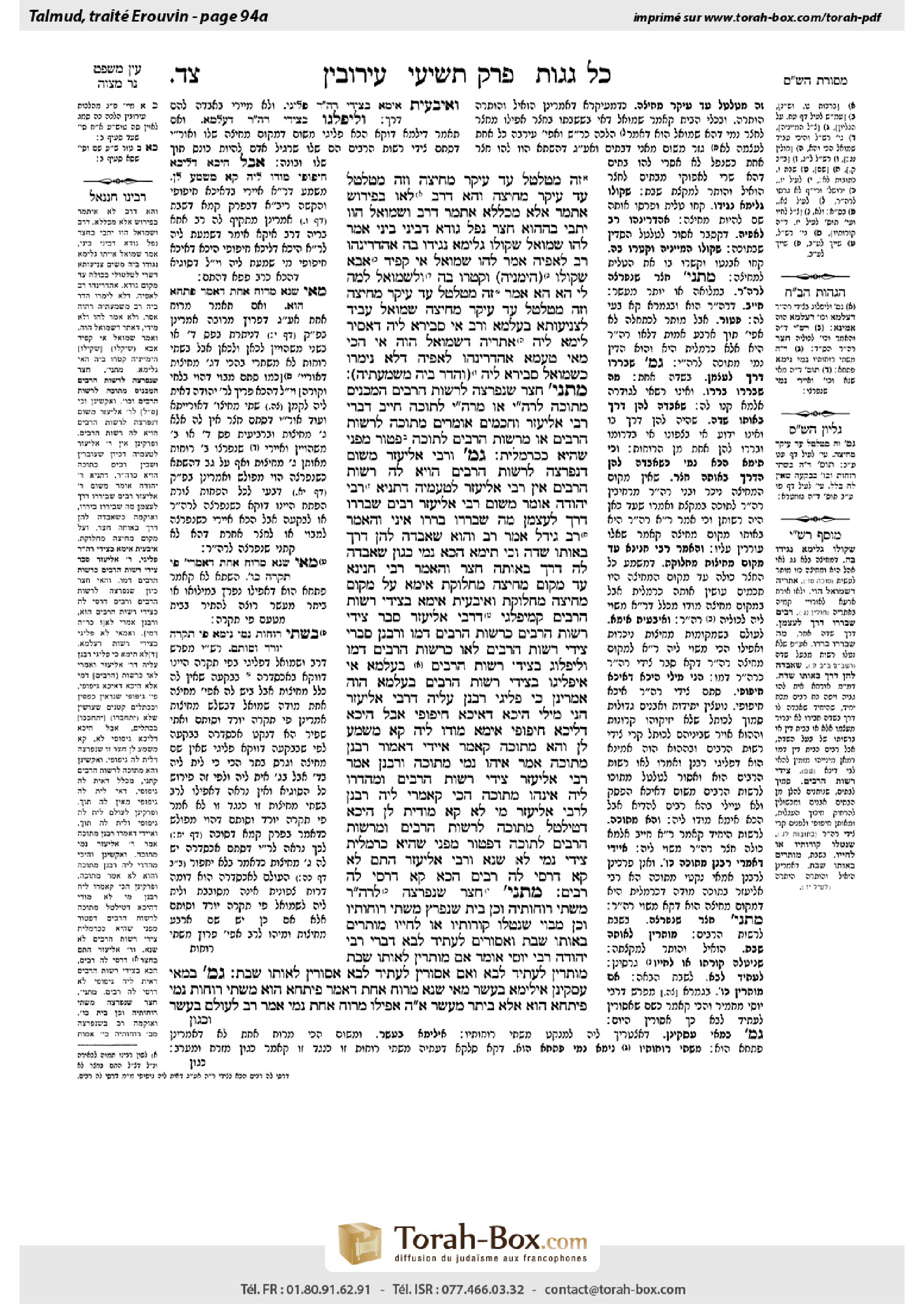
Eruvin 94a: Talmud study for Daf Yomi
Study the Talmud for Daf Yomi with scanned pages, Hebrew text, English translations from Sefaria and AI-generated French translations.
Passage selection and English or AI-generated French translation are available where the scan has annotations. Daf Study is independent of Torah-Box and Sefaria.
Browse Eruvin · עירובין · All tractatesEruvin 94a text and translations
This page of Eruvin includes the Aramaic text, an English translation and an AI-generated French translation, alongside the scan above.
עירובין צ״ד א · Aramaic and Hebrew text
זֶה מְטַלְטֵל עַד עִיקַּר מְחִיצָה, וְזֶה מְטַלְטֵל עַד עִיקַּר מְחִיצָה.
וְהָא דְּרַב לָאו בְּפֵירוּשׁ אִתְּמַר, אֶלָּא מִכְּלָלָא אִתְּמַר. דְּרַב וּשְׁמוּאֵל הֲווֹ יָתְבִי בְּהָהוּא חָצֵר, נְפַל גּוּדָּא דְּבֵינֵי בֵּינֵי, אֲמַר לְהוּ שְׁמוּאֵל: שְׁקוּלוּ גְּלִימָא, נְגִידוּ בַּהּ.
אַהְדְּרִינְהוּ רַב לְאַפֵּיהּ. אֲמַר לְהוּ שְׁמוּאֵל: אִי קָפֵיד אַבָּא, שְׁקוּלוּ הֶמְיָינֵיהּ וּקְטַרוּ בָּהּ.
וְלִשְׁמוּאֵל לְמָה לִי הָא? הָא אָמַר: זֶה מְטַלְטֵל עַד עִיקַּר מְחִיצָה וְזֶה מְטַלְטֵל עַד עִיקַּר מְחִיצָה!
שְׁמוּאֵל עָבֵיד לִצְנִיעוּתָא בְּעָלְמָא.
וְרַב, אִי סְבִירָא לֵיהּ דַּאֲסִיר — לֵימָא לֵיהּ! אַתְרֵיהּ דִּשְׁמוּאֵל הֲוָה.
אִי הָכִי, מַאי טַעְמָא אַהְדְּרִינְהוּ לְאַפֵּיהּ? דְּלָא נֵימְרוּ כִּשְׁמוּאֵל סְבִירָא לֵיהּ (וַהֲדַר בֵּיהּ מִשְּׁמַעְתֵּיהּ).
מַתְנִי׳ חָצֵר שֶׁנִּפְרְצָה לִרְשׁוּת הָרַבִּים — הַמַּכְנִיס מִתּוֹכָהּ לִרְשׁוּת הַיָּחִיד, אוֹ מֵרְשׁוּת הַיָּחִיד לְתוֹכָהּ — חַיָּיב, דִּבְרֵי רַבִּי אֱלִיעֶזֶר.
וַחֲכָמִים אוֹמְרִים: מִתּוֹכָהּ לִרְשׁוּת הָרַבִּים אוֹ מֵרְשׁוּת הָרַבִּים לְתוֹכָהּ — פָּטוּר, מִפְּנֵי שֶׁהִיא כְּכַרְמְלִית.
גְּמָ׳ וְרַבִּי אֱלִיעֶזֶר, מִשּׁוּם דְּנִפְרְצָה לִרְשׁוּת הָרַבִּים הָוְיָא לַהּ רְשׁוּת הָרַבִּים?! אִין, רַבִּי אֱלִיעֶזֶר לְטַעְמֵיהּ,
דְּתַנְיָא, רַבִּי יְהוּדָה אוֹמֵר מִשּׁוּם רַבִּי אֱלִיעֶזֶר: רַבִּים שֶׁבֵּרְרוּ דֶּרֶךְ לְעַצְמָן, מַה שֶּׁבֵּרְרוּ בֵּרְרוּ.
אִינִי?! וְהָאָמַר רַב גִּידֵּל אָמַר רַב: וְהוּא שֶׁאָבְדָה לָהֶן דֶּרֶךְ בְּאוֹתוֹ שָׂדֶה.
וְכִי תֵּימָא: הָכָא נָמֵי כְּגוֹן שֶׁאָבְדָה לָהֶן דֶּרֶךְ בְּאוֹתָהּ חָצֵר, וְהָאָמַר רַבִּי חֲנִינָא: עַד מְקוֹם מְחִיצָה מַחֲלוֹקֶת.
אֵימָא: עַל מְקוֹם מְחִיצָה מַחֲלוֹקֶת.
וְאִיבָּעֵית אֵימָא, בְּצִידֵּי רְשׁוּת הָרַבִּים קָמִיפַּלְגִי, דְּרַבִּי אֱלִיעֶזֶר סָבַר: צִידֵּי רְשׁוּת הָרַבִּים — כִּרְשׁוּת הָרַבִּים דָּמוּ, וְרַבָּנַן סָבְרִי צִידֵּי רְשׁוּת הָרַבִּים — לָאו כִּרְשׁוּת הָרַבִּים דָּמוּ.
וְלִיפְלוֹג בְּצִידֵּי רְשׁוּת הָרַבִּים בְּעָלְמָא? אִי אִיפְּלִיגוּ בְּצִידֵּי רְשׁוּת הָרַבִּים בְּעָלְמָא, הֲוָה אָמְרִינַן: כִּי פְּלִיגִי רַבָּנַן עֲלֵיהּ דְּרַבִּי אֱלִיעֶזֶר — הָנֵי מִילֵּי הֵיכָא דְּאִיכָּא חִיפּוּפֵי, אֲבָל הֵיכָא דְּלֵיכָּא חִיפּוּפֵי — אֵימָא מוֹדוּ לֵיהּ, קָא מַשְׁמַע לַן.
וְהָא ״מִתּוֹכָהּ״ קָאָמַר!
אַיְּידֵי דַּאֲמוּר רַבָּנַן ״מִתּוֹכָהּ״, אָמַר אִיהוּ נָמֵי ״מִתּוֹכָהּ״.
וְרַבָּנַן, אָמַר רַבִּי אֱלִיעֶזֶר צִידֵּי רְשׁוּת הָרַבִּים, וּמַהְדְּרוּ לֵיהּ אִינְהוּ ״מִתּוֹכָהּ״!
הָכִי קָאָמְרִי לֵיהּ רַבָּנַן לְרַבִּי אֱלִיעֶזֶר: מִי לָא קָא מוֹדֵית לַן הֵיכָא דְּטִילְטֵל מִתּוֹכָהּ לִרְשׁוּת הָרַבִּים, וּמֵרְשׁוּת הָרַבִּים לְתוֹכָהּ — דְּפָטוּר, מִפְּנֵי שֶׁהִיא כַּרְמְלִית? צִידֵּי נָמֵי לָא שְׁנָא.
וְרַבִּי אֱלִיעֶזֶר, הָתָם לָא קָא דָרְסִי לַהּ רַבִּים, הָכָא קָא דָרְסִי לַהּ רַבִּים.
מַתְנִי׳ חָצֵר שֶׁנִּפְרְצָה לִרְשׁוּת הָרַבִּים מִשְׁתֵּי רוּחוֹתֶיהָ, וְכֵן בַּיִת שֶׁנִּפְרַץ מִשְׁתֵּי רוּחוֹתָיו, וְכֵן מָבוֹי שֶׁנִּטְּלוּ קוֹרוֹתָיו אוֹ לְחָיָיו — מוּתָּרִים בְּאוֹתוֹ שַׁבָּת, וַאֲסוּרִים לֶעָתִיד לָבֹא, דִּבְרֵי רַבִּי יְהוּדָה.
רַבִּי יוֹסֵי אוֹמֵר: אִם מוּתָּרִין לְאוֹתוֹ שַׁבָּת — מוּתָּרִין לֶעָתִיד לָבֹא, וְאִם אֲסוּרִין לֶעָתִיד לָבֹא — אֲסוּרִין לְאוֹתוֹ שַׁבָּת.
גְּמָ׳ בְּמַאי עָסְקִינַן? אִילֵימָא בְּעֶשֶׂר, מַאי שְׁנָא מֵרוּחַ אַחַת דְּאָמַר פִּיתְחָא הוּא, מִשְׁתֵּי רוּחוֹת נָמֵי פִּיתְחָא הוּא! אֶלָּא בְּיָתֵר מֵעֶשֶׂר, אִי הָכִי — אֲפִילּוּ מֵרוּחַ אַחַת נָמֵי!
אָמַר רַב: לְעוֹלָם בְּעֶשֶׂר,
Eruvin 94a · English translation
This one may carry to the base of the former partition, and that one may likewise carry to the base of the partition, as he maintains that since it was permitted at the beginning of Shabbat, it remains permitted until the conclusion of Shabbat.
The Gemara comments: And this ruling of Rav was not stated explicitly; rather, it was stated by inference; i.e., it was inferred by his students from another one of his teachings. As once Rav and Shmuel were sitting in a certain courtyard on Shabbat, and the wall between the two courtyards fell. Shmuel said to the people around him: Take a cloak and suspend it on the remnant of the partition.
Rav turned his face away, displaying his displeasure with Shmuel’s opinion, as Rav maintained it was prohibited to carry a cloak in this courtyard. Shmuel said to them in a humorous vein: If Abba, Rav, is particular, take his belt and tie it to the cloak, to secure it to the partition.
The Gemara asks: And according to Shmuel, why was it necessary to suspend the cloak? He himself said: If a wall between two courtyards collapsed on Shabbat, this one may carry to the base of the former partition, and that one may likewise carry to the base of the partition.
The Gemara answers: Shmuel did not do so to render it permitted to carry in the courtyard. He did so merely for the purpose of privacy, as he did not want the residents of the other courtyard to see into his own courtyard.
The Gemara asks: And Rav, if he maintains that in this case carrying is prohibited, he should have said so to him explicitly. The Gemara answers: It was Shmuel’s place. Rav did not want to disagree with his colleague in his jurisdiction, as he accepted the opinion of the local authority.
The Gemara asks: If so, if he accepted the jurisdiction of the local rabbinic authority, why did he turn his face away? The Gemara answers: He acted in this manner so that people would not say that he holds in accordance with the opinion of Shmuel, and that he retracted his opinion with regard to this halakha.
MISHNA: With regard to a courtyard that was breached into the public domain, and the breach was more than ten cubits wide, so that it cannot be considered an entrance, one who carries an object from inside the courtyard into the private domain, or from the private domain into it, is liable, as it ceases to be a private domain and is subsumed into the public domain. This is the statement of Rabbi Eliezer.
And the Rabbis disagree and say: One who carries from inside the courtyard into the public domain, or from the public domain into it, is exempt, because its legal status is like that of a karmelit. Although it ceases to be a private domain, it does not become a full-fledged public domain.
GEMARA: The Gemara asks: And according to Rabbi Eliezer, due to the fact that the courtyard was breached into the public domain, does it become the public domain? The Gemara answers: Yes, as in this regard the opinion of Rabbi Eliezer conforms to his standard line of reasoning.
As it was taught in a baraita that Rabbi Yehuda said in the name of Rabbi Eliezer: In a situation where the multitudes selected a path for themselves in a field, or between fields, the path that they selected, they selected, and they retain the right to traverse this path even if the place belongs to an individual. Here too, as the partition of the courtyard was breached to the extent that the public can enter, its status is that of a public domain.
The Gemara expresses surprise at this opinion: Is that so? But didn’t Rav Giddel say that Rav said: And this applies only if they had misplaced a path in that field. Generally speaking, the public does not have the right to establish a path wherever it chooses. The baraita is referring to a case where a public path used to run through that field, but it fell into disuse, and no one remembers its precise course. In this case the public may once again select a path through the field.
And if you say: Here too, the mishna is dealing with a case where the public misplaced a path in that courtyard. They do not remember the exact position of the partition that once separated the courtyard and the public domain. The public claims that the residents of the courtyard appropriated that part of their domain. It is only this area that Rabbi Eliezer says is considered a public domain. The Gemara asks: But didn’t Rabbi Ḥanina say: The dispute between Rabbi Eliezer and the Rabbis is with regard to the entire courtyard to [ad] the place of the fallen partition, not only the small section that might have been a public path.
The Gemara rejects this argument: Say that Rabbi Ḥanina stated that Rabbi Eliezer and the Rabbis disagree over [al] the place of the partition, i.e., the dispute does not concern the entire courtyard, but only the former location of the partition, where a public path might once have passed.
And if you wish, say instead that the mishna is dealing with a case where the location of the original partition is known, and the tanna’im disagree with regard to the legal status of the sides of a public domain. As Rabbi Eliezer maintains that the sides of a public domain are considered like a public domain, i.e., the areas adjacent to the public domain are subsumed into the public domain. The same applies to the place of the partition that once separated the courtyard and the public domain but was breached. And the Rabbis maintain that the sides of a public domain are not considered like a public domain.
The Gemara asks: If so, let them disagree with regard to the sides of a public domain in general; why did they disagree about this particular case? The Gemara answers: Had they disagreed with regard to the sides of a public domain in general, we would have said: When do the Rabbis disagree with Rabbi Eliezer? This dispute applies only where there are stakes alongside the houses, which interfere with the use of the sides of the public domain. However, where there are no such stakes, say that they concede to him that the sides of a public domain are considered like a public domain. By formulating the dispute with regard to a courtyard that was breached into the public domain, the mishna is teaching us that they disagree in all cases.
The Gemara raises a difficulty: But didn’t Rabbi Eliezer say with regard to a courtyard that was breached into the public domain, that one who carries an object from inside the courtyard into the private domain is liable? Apparently, he is liable if he carries an article into the private domain from anywhere in the courtyard, not only from the area adjacent to the public domain, as the entire courtyard is considered a public domain.
The Gemara answers: As the Rabbis said: From inside the courtyard, Rabbi Eliezer also said: From inside the courtyard. No conclusion can be inferred from his use of the term, as he was referring only to the section adjacent to the public domain.
The Gemara asks: But, if that is the case, the statement of the Rabbis is difficult. Rabbi Eliezer said that the legal status of the sides of the public domain is like that of a public domain, and they replied to him by referring to: From inside the entire courtyard? They appear to be addressing two different cases.
The Gemara answers: This is what the Rabbis are saying to Rabbi Eliezer: Don’t you concede to us with regard to a case where he carried an object from inside the courtyard to the public domain, or from the public domain to the courtyard, that he is exempt, because the courtyard is considered like a karmelit? The sides of the public domain are no different, and should have the status of a karmelit as well.
And how does Rabbi Eliezer counter this argument? There, the public does not tread on the courtyard; here, the public treads on the edge of the courtyard adjacent to the public domain, and therefore its status is that of a public domain in every sense.
MISHNA: With regard to a courtyard that was breached on Shabbat into a public domain from two of its sides, and likewise with regard to a house that was breached from two of its sides, and likewise with regard to an alleyway whose cross beams or side posts were removed on Shabbat, the residents of that domain are permitted to carry there on that Shabbat, but are prohibited from doing so in the future. This is the statement of Rabbi Yehuda.
Rabbi Yosei says: This cannot be the halakha, as if they are permitted to carry there on that Shabbat, they are likewise permitted to do so in the future, and if they are prohibited from carrying there in the future, they are also prohibited from carrying there on that Shabbat.
GEMARA: The Gemara poses a question: With what case are we dealing? If you say the mishna is referring to a case where the breach was up to ten cubits wide, in what way is a breach on only one side different? It is due to the fact that we say: It is an entrance rather than a breach, and carrying is therefore permitted. If so, if it was breached on two sides as well, say: It is an entrance, and there are entrances on two sides of the courtyard. Rather, the mishna is certainly dealing with a breach that is greater than ten cubits. If so, it should be prohibited to carry even if the courtyard was breached on only one side, as a breach that size negates all the partitions.
Rav said: Actually, the mishna is dealing with a breach that is no wider than ten cubits,
Eruvin 94a · Traduction française (IA)
Celui-ci peut porter jusqu'au bas de la première cloison, et celui-ci peut également porter jusqu'au bas de la cloison, car il affirme que puisque cela était permis au début du Shabbat, cela reste permis jusqu'à la fin du Shabbat.
La Guemara commente : La décision de Rav n'a pas été formulée explicitement ; elle a été déduite par inférence ; c'est-à-dire qu'elle a été inférée par ses élèves à partir d'un autre de ses enseignements. Un jour, Rav et Shmuel étaient assis dans un certain patio le Shabbat, et la cloison entre les deux patios s'effondra. Shmuel dit aux personnes autour de lui : Prenez une couverture et suspendez-la sur le reste de la cloison.
Rav tourna le visage, montrant son mécontentement à l'égard de l'opinion de Shmuel, car Rav affirmait que porter une couverture dans ce patio était interdit. Shmuel dit à ceux-ci avec humour : Si Abba, Rav, est exigeant, prenez sa ceinture et attachez-la à la couverture, pour la fixer à la cloison.
La Guemara demande : Et selon Shmuel, pourquoi avait-il besoin de suspendre la couverture ? Il a dit : Si une cloison entre deux courtyards s'effondre le sabbat, celui-ci peut porter jusqu'au bas de la première cloison, et celui-ci peut également porter jusqu'au bas de la cloison.
La Guemara répond : Shmuel ne l'a pas fait pour rendre permis de porter dans le courtyard. Il l'a fait uniquement à des fins de confidentialité, car il ne voulait pas que les habitants du courtyard opposé puissent voir dans son courtyard.
La Guemara demande : Et Rav, s'il maintenait que dans ce cas le port était interdit, il aurait dû le lui dire explicitement. La Guemara répond : C'était la place de Shmuel. Rav ne voulait pas contredire son collègue dans son territoire, car il acceptait l'opinion de l'autorité locale.
La Guemara demande : Si tel est le cas, pourquoi celui qui a accepté la juridiction de l'autorité rabbinique locale a-t-il tourné le visage ? La Guemara répond : Il agissait ainsi pour que les gens ne disent pas qu'il adoptait l'opinion de Shmuel, et qu'il avait rétracté son opinion concernant cette halakha.
MICHNA : Concernant un patio percé dans le domaine public, et le percement était plus large que dix coudées, de sorte qu'il ne peut être considéré comme une entrée, celui qui porte un objet du patio vers le domaine privé, ou du domaine privé vers le patio, est punissable, car il cesse d'être un domaine privé et est intégré au domaine public. C'est l'opinion de Rabbi Eliezer.
Et les Rabbins s'opposent et disent : Celui qui porte un objet du patio vers le domaine public, ou du domaine public vers le patio, est exempt, car son statut légal est celui d'un karmelit. Bien qu'il cesse d'être un domaine privé, il ne devient pas un domaine public complet.
GUEMARA : La Guemara demande : Selon Rabbi Eliezer, en raison du fait que le patio avait été percé dans le domaine public, devient-il un domaine public ? La Guemara répond : Oui, car selon cette question, l'opinion de Rabbi Eliezer correspond à sa ligne de raisonnement habituelle.
Comme il a été enseigné dans une baraïta que Rabbi Yéhuda a dit en nom de Rabbi Eliezer : Dans un cas où les multitudes ont choisi un chemin dans un champ, ou entre les champs, le chemin qu'ils ont choisi, ils le conservent, et ils peuvent parcourir ce chemin même si la place appartient à un individu. Ici aussi, comme la cloison du patio a été percée à tel point que le public peut entrer, son statut est celui d'un domaine public.
La Guemara exprime une surprise à l'égard de cette opinion : Est-ce vrai ? Mais n'a-t-il pas dit Rav Giddel que Rav a dit : Et cela s'applique uniquement si un chemin avait été perdu dans ce champ. Généralement, le public n'a pas le droit d'établir un chemin là où il veut. La baraïta fait référence à un cas où un chemin public passait par ce champ, mais il est tombé en désuétude, et personne ne se souvient de son exacte trajectoire. Dans ce cas, le public peut à nouveau choisir un chemin à travers le champ.
Et si vous dites : Ici aussi, la Michna traite d'un cas où le public a perdu un chemin dans ce patio. Ils ne se souviennent pas de la position exacte de la cloison qui séparait le patio et le domaine public. Le public affirme que les habitants du patio ont approprié cette partie de leur domaine. C'est seulement cette zone que Rabbi Eliezer dit être considérée comme un domaine public. La Guemara demande : Mais n'a-t-il pas dit Rabbi Ḥanina : Le débat entre Rabbi Eliezer et les Rabbins concerne l'ensemble du patio jusqu'au lieu de la cloison tombée, et non seulement la petite section qui pourrait avoir été un chemin public.
La Guemara rejette cet argument : Dites que Rabbi Ḥanina a dit que Rabbi Eliezer et les Rabbins s'opposent au lieu de la cloison, c'est-à-dire que le débat ne concerne pas l'ensemble du patio, mais seulement l'ancien lieu de la cloison, où un chemin public pourrait avoir un jour traversé.
Et si vous voulez, dites plutôt que la Michna traite d'un cas où la position de la cloison originale est connue, et les tannaïm s'opposent concernant le statut légal des côtés d'un domaine public. Comme Rabbi Eliezer maintient que les côtés d'un domaine public sont considérés comme un domaine public, c'est-à-dire les zones adjacentes au domaine public sont intégrées au domaine public. La même chose s'applique au lieu de la cloison qui séparait le patio et le domaine public mais qui a été percé. Et les Rabbins maintiennent que les côtés d'un domaine public ne sont pas considérés comme un domaine public.
La Guemara pose la question : Si c’est ainsi, qu’ils diffèrent concernant les côtés d’un domaine public en général ; pourquoi diffèrent-ils dans ce cas particulier ? La Guemara répond : Si ils différaient concernant les côtés d’un domaine public en général, nous aurions dit : Quand les Rabbins diffèrent-ils avec Rabbi Eliezer ? Ce débat s’applique uniquement là où il y a des piquets aux côtés des maisons, qui entravent l’utilisation des côtés du domaine public. Cependant, là où il n’y a pas de tels piquets, disons qu’ils reconnaissent qu’ils sont considérés comme un domaine public. En formulant le débat concernant un courtil percé dans le domaine public, la mitsva nous apprend que leur débat s’applique à tous les cas.
La Guemara soulève une difficulté : Mais n’a-t-il pas dit Rabbi Eliezer concernant un courtil percé dans le domaine public, que celui qui transporte un objet du courtil vers le domaine privé est puni ? Apparemment, il est puni s’il transporte un objet du courtil vers le domaine privé, non seulement depuis la zone adjacente au domaine public, comme l’ensemble du courtil est considéré comme un domaine public.
La Guemara répond : Comme les Rabbins dirent : De l’intérieur du courtil, Rabbi Eliezer dit aussi : De l’intérieur du courtil. On ne peut en tirer aucune conclusion, car il faisait référence uniquement à la section adjacente au domaine public.
La Guemara pose la question : Mais, si c’est ainsi, la déclaration des Rabbins est difficile. Rabbi Eliezer dit que les côtés du domaine public sont considérés comme un domaine public, et ils lui répondent en faisant référence à : De l’intérieur de l’ensemble du courtil ? Ils semblent s’adresser à deux cas différents.
La Guemara répond : C’est ce que les Rabbins disent à Rabbi Eliezer : Ne reconnais-tu pas que tu dois nous reconnaître dans le cas où l’on transporte un objet de l’intérieur du courtil vers le domaine public, ou du domaine public vers le courtil, que l’on est exempt, car le courtil est considéré comme un karmelit ? Les côtés du domaine public ne sont pas différents, et devraient avoir le statut de karmelit également.
Et comment Rabbi Eliezer contredit-il cet argument ? Là, le public ne marche pas sur le courtil ; ici, le public marche sur le bord du courtil adjacent au domaine public, et donc son statut est celui d’un domaine public en tous points.
MICHNA: Concerning a courtyard that was breached on Shabbat into a public domain from two of its sides, and likewise concerning a house that was breached from two of its sides, and likewise concerning an alleyway whose cross beams or side posts were removed on Shabbat, the residents of that domain are permitted to carry there on that Shabbat, but are prohibited from doing so in the future. This is the statement of Rabbi Yehuda.
Rabbi Yosei says: This cannot be the halakha, as if they are permitted to carry there on that Shabbat, they are likewise permitted to do so in the future, and if they are prohibited from carrying there in the future, they are also prohibited from carrying there on that Shabbat.
GUEMARA: The Guemara poses a question: With what case are we dealing? If you say the mishna is referring to a case where the breach was up to ten cubits wide, in what way is a breach on only one side different? It is due to the fact that we say: It is an entrance rather than a breach, and carrying is therefore permitted. If so, if it was breached on two sides as well, say: It is an entrance, and there are entrances on two sides of the courtyard. Rather, the mishna is certainly dealing with a breach that is greater than ten cubits. If so, it should be prohibited to carry even if the courtyard was breached on only one side, as a breach that size negates all the partitions.
Rav dit : En réalité, la mitsva traite d'une ouverture dont la largeur ne dépasse pas dix coudées,
Traduction française générée par IA à partir de l’édition anglaise de Sefaria. Vérifie toujours un passage avec le texte source.
Text from Sefaria: William Davidson Edition - Vocalized Aramaic (CC BY NC); William Davidson Edition - English (CC BY NC).