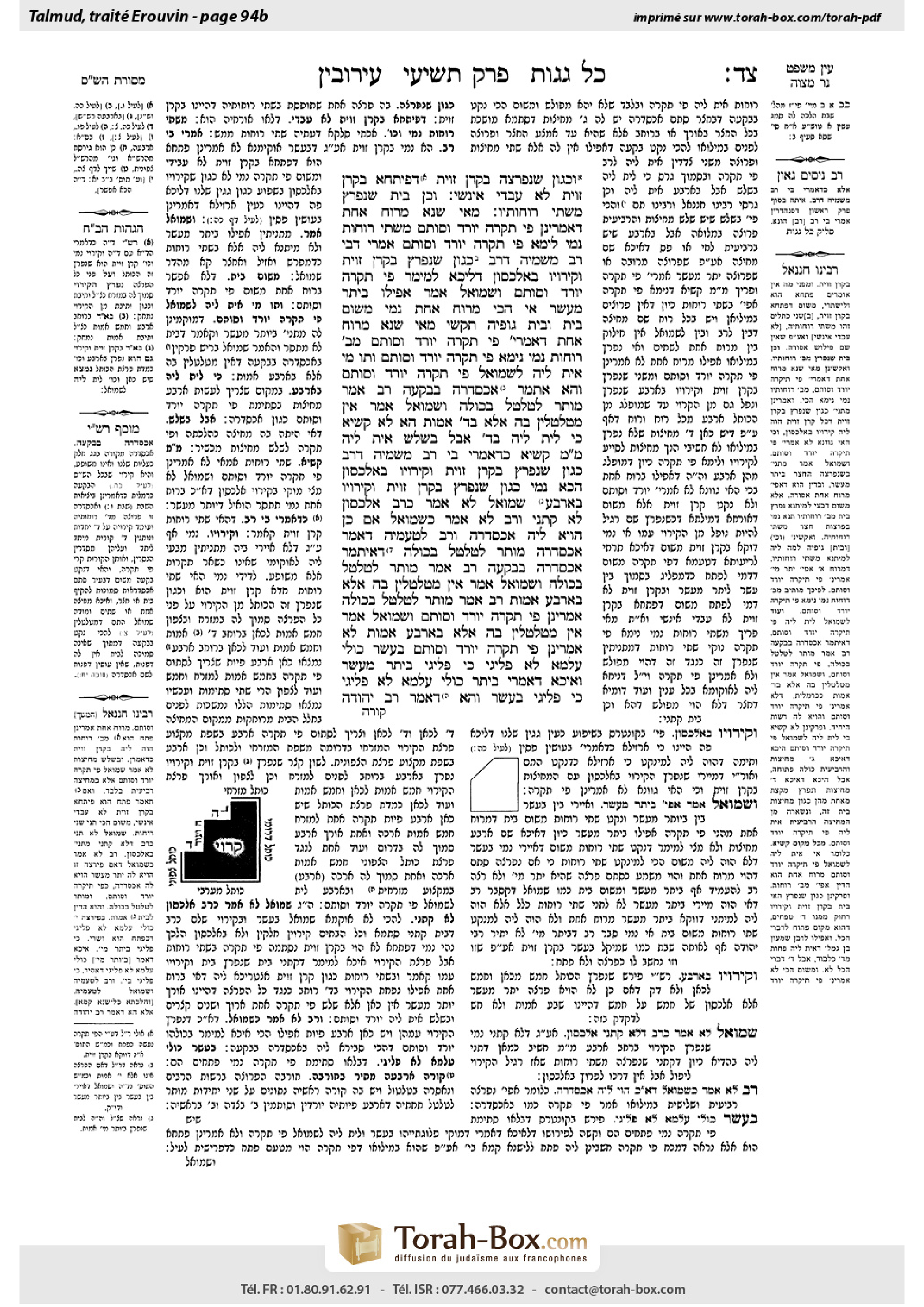
Eruvin 94b: Talmud study for Daf Yomi
Study the Talmud for Daf Yomi with scanned pages, Hebrew text, English translations from Sefaria and AI-generated French translations.
Passage selection and English or AI-generated French translation are available where the scan has annotations. Daf Study is independent of Torah-Box and Sefaria.
Browse Eruvin · עירובין · All tractatesEruvin 94b text and translations
This page of Eruvin includes the Aramaic text, an English translation and an AI-generated French translation, alongside the scan above.
עירובין צ״ד ב · Aramaic and Hebrew text
וּכְגוֹן שֶׁנִּפְרְצָה בְּקֶרֶן זָוִית. דְּפִיתְחָא בְּקֶרֶן זָוִית לָא עָבְדִי אִינָשֵׁי.
וְכֵן בַּיִת שֶׁנִּפְרַץ מִשְׁתֵּי רוּחוֹתָיו. מַאי שְׁנָא מֵרוּחַ אַחַת, דְּאָמְרִינַן: פִּי תִקְרָה יוֹרֵד וְסוֹתֵם. מִשְׁתֵּי רוּחוֹת נָמֵי לֵימָא: פִּי תִקְרָה יוֹרֵד וְסוֹתֵם!
אָמְרִי דְּבֵי רַב מִשְּׁמֵיהּ דְּרַב: כְּגוֹן שֶׁנִּפְרַץ בְּקֶרֶן זָוִית וְקֵירוּיוֹ בַּאֲלַכְסוֹן, דְּלֵיכָּא לְמֵימַר פִּי תִקְרָה יוֹרֵד וְסוֹתֵם.
וּשְׁמוּאֵל אָמַר: אֲפִילּוּ בְּיָתֵר מֵעֶשֶׂר. אִי הָכִי, מֵרוּחַ אַחַת נָמֵי!
מִשּׁוּם בַּיִת.
וּבַיִת גּוּפֵיהּ תִּקְשֵׁי: מַאי שְׁנָא מֵרוּחַ אַחַת, דְּאָמְרִינַן פִּי תִקְרָה יוֹרֵד וְסוֹתֵם, מִשְּׁתֵּי רוּחוֹת נָמֵי נֵימָא: פִּי תִקְרָה יוֹרֵד וְסוֹתֵם!
וְתוּ: מִי אִית לֵיהּ לִשְׁמוּאֵל פִּי תִקְרָה יוֹרֵד וְסוֹתֵם? וְהָא אִתְּמַר: אַכְסַדְרָה בְּבִקְעָה, רַב אָמַר: מוּתָּר לְטַלְטֵל בְּכוּלָּהּ, וּשְׁמוּאֵל אָמַר: אֵין מְטַלְטְלִין בָּהּ אֶלָּא בְּאַרְבַּע אַמּוֹת!
הָא לָא קַשְׁיָא: כִּי לֵית לֵיהּ — בְּאַרְבַּע, אֲבָל בְּשָׁלֹשׁ — אִית לֵיהּ.
מִכׇּל מָקוֹם קַשְׁיָא!
כִּדְאָמְרִי בֵּי רַב מִשְּׁמֵיהּ דְּרַב: כְּגוֹן שֶׁנִּפְרַץ בְּקֶרֶן זָוִית וְקֵירוּיוֹ בַּאֲלַכְסוֹן, הָכָא נָמֵי, כְּגוֹן שֶׁנִּפְרַץ בְּקֶרֶן זָוִית וְקֵירוּיוֹ בְּאַרְבַּע.
שְׁמוּאֵל לֹא אָמַר כְּרַב, אֲלַכְסוֹן לָא קָתָנֵי. וְרַב לָא אָמַר כִּשְׁמוּאֵל, אִם כֵּן הָוְיָא לֵיהּ אַכְסַדְרָה, וְרַב לְטַעְמֵיהּ דְּאָמַר: אַכְסַדְרָה מוּתָּר לְטַלְטֵל בְּכוּלָּהּ.
דְּאִיתְּמַר, אַכְסַדְרָה בְּבִקְעָה. רַב אָמַר: מוּתָּר לְטַלְטֵל בְּכוּלָּהּ. וּשְׁמוּאֵל אָמַר: אֵין מְטַלְטְלִין בָּהּ אֶלָּא בְּאַרְבַּע אַמּוֹת.
רַב אָמַר: מוּתָּר לְטַלְטֵל בְּכוּלָּהּ, אָמְרִינַן פִּי תִקְרָה יוֹרֵד וְסוֹתֵם. וּשְׁמוּאֵל אָמַר: אֵין מְטַלְטְלִין בָּהּ אֶלָּא בְּאַרְבַּע אַמּוֹת, לָא אָמְרִינַן פִּי תִקְרָה יוֹרֵד וְסוֹתֵם.
בְּעֶשֶׂר — כּוּלֵּי עָלְמָא לָא פְּלִיגִי. כִּי פְּלִיגִי — בְּיָתֵר מֵעֶשֶׂר.
וְאִיכָּא דְּאָמְרִי, בְּיָתֵר — כּוּלֵּי עָלְמָא לָא פְּלִיגִי. כִּי פְּלִיגִי — בְּעֶשֶׂר.
וְהָא דְּאָמַר רַב יְהוּדָה:
Eruvin 94b · English translation
and with a case where the courtyard was breached in a corner, so that it is breached on two sides. Although the opening is no more than ten cubits wide, it cannot be considered an entrance, as people do not build an entrance in a corner. It is therefore clear that this is a breach that negates the partition.
We learned in the mishna: And likewise, with regard to a house that was breached on Shabbat from two of its sides into a public domain, the residents are permitted to carry in the house on that Shabbat, but not a future Shabbat. The Gemara asks: In what way is a breach on one side different? The difference is due to the fact that we say: The edge of the roof descends and seals the house, as if there were a full-fledged partition there. So too, when it is breached on two sides, let us say: The edge of the roof descends and seals.
The Gemara answers: The Sages of the school of Rav said in the name of Rav: The mishna is referring to a case where the house was breached in a corner, and its roofing was inclined, as in that case, one cannot say: The edge of the roof descends and seals, as the edge of an inclined roof does not appear to be the beginning of a partition.
And Shmuel said: The mishna is referring to a breach that is even wider than ten cubits. The Gemara asks: If so, why did the mishna cite a case where it is breached from two sides? It should be prohibited to carry there even if it were breached from one side.
The Gemara answers: The reason that it is prohibited only if it is breached from two sides is due to the fact that it is a house. In the case of a courtyard, the same halakha would apply even if it were breached on only one side. However, the mishna sought to teach the halakha of a house as well, in which case, it is prohibited to carry only if it is breached on two sides. If it is breached on one side, the edge of the roof descends and seals, and carrying is permitted.
The Gemara asks: But the halakha of a house itself should pose a difficulty according to this explanation. In what way is a breach on one side different? It is due to the fact that we say: The edge of the roof descends and seals the house, as if there were a full-fledged partition there. So too, when it is breached on two sides, let us say: The edge of the roof descends and seals.
And furthermore: Is Shmuel of the opinion that there is a principle: The edge of a roof descends and seals? But wasn’t it stated that there is an amoraic dispute with regard to a portico located in a valley, which has the status of a karmelit. Rav said: It is permitted to carry in the entire portico, as he maintains that the edge of the roof of the portico descends and seals, rendering it a private domain. And Shmuel said: One may carry only within four cubits. Apparently, Shmuel does not accept the principle: The edge of a roof descends and seals.
The Gemara answers: This is not a difficulty. Where Shmuel is not of the opinion that this principle is applied, it is with regard to a structure where walls on all four sides are formed in that manner. However, with regard to a structure where only three sides are formed in that manner and the fourth side is an actual wall, he is of the opinion that the principle is applied.
The Gemara comments: In any case, this is difficult. Although the contradiction between the two statements of Shmuel was resolved, the question remains: Why do we not apply the principle: The edge of a roof descends and seals, to two sides of the house?
The Gemara answers: The reason is as the Sages of the school of Rav said in the name of Rav: The mishna is referring to a case where the house was breached in a corner, and its roofing was inclined, as in that case, one cannot say: The roof of the house descends and seals. Here too, Shmuel’s opinion can be explained in a similar manner: The mishna is dealing with a case where the house was breached in a corner, and its roof is at a distance of at least four handbreadths from the breach, and is uneven. In that case, the principle: The edge of a roof descends and seals, would have to be applied to four corners, and Shmuel is of the opinion that it may not be applied in that case.
The Gemara explains: Shmuel did not say his explanation of the mishna in accordance with the opinion of Rav, as the mishna does not teach that the roof was slanted, which is the crux of Rav’s explanation. And Rav did not say his explanation of the mishna in accordance with the opinion of Shmuel, as if so, even if the roof was breached on several sides, its legal status would be that of a portico, and Rav conforms to his standard line of reasoning, as he said: With regard to a portico, it is permitted to carry throughout the entire portico.
The Gemara proceeds to cite the dispute between Rav and Shmuel in a more comprehensive manner. As it was stated that Rav said: It is permitted to carry in the entire portico as it is considered sealed. And Shmuel said: One may carry only within four cubits. As the portico does not have actual partitions it is subsumed into the field, and shares its status of a karmelit.
The Gemara elaborates on their respective opinions. Rav said: It is permitted to carry in the entire portico, as he maintains that we say: The edge of the roof descends and seals the portico to form a partition. As there is a roof over the portico, it is considered sealed with partitions on all four sides. And Shmuel said: One may carry only within four cubits, as we do not say: The edge of the ceiling descends and seals.
The Gemara elaborates further: If the openings on the sides of the portico are no wider than ten cubits, everyone agrees that they are considered sealed, as the status of even an unroofed breach of ten cubits or less is that of an entrance, and one is permitted to carry throughout the entire domain. They disagree only in a case where the openings are more than ten cubits wide.
And some say: On the contrary, if the openings are more than ten cubits wide, everyone agrees that they are considered breaches, and the principle: The edge of the roof descends and seals, is not applied. They disagree only in a case where the openings are no wider than ten cubits.
And that which Rav Yehuda said:
Eruvin 94b · Traduction française (IA)
et avec un cas où la cour était percée dans un coin, de sorte qu'elle est percée sur deux côtés. Bien que l'ouverture ne soit pas plus large que dix coudées, elle ne peut pas être considérée comme une entrée, car les gens ne construisent pas d'entrée dans un coin. Il est donc clair que c'est une percée qui annule la séparation.
Nous avons appris dans la mitsna : Et de même, concernant une maison percée le sabbat depuis deux de ses côtés vers un domaine public, les habitants sont autorisés à porter des objets à l'intérieur de la maison ce sabbat-là, mais pas un sabbat futur. La Guemara pose la question : De quelle manière une percée sur un seul côté diffère-t-elle ? La différence réside dans le fait que nous disons : La bordure du toit descend et scelle la maison, comme si elle avait une séparation complète là. De même, lorsque la maison est percée sur deux côtés, disons : La bordure du toit descend et scelle.
La Guemara répond : Les Sages de l'école de Rava dirent en nom de Rava : La mitsna fait référence à un cas où la maison était percée dans un coin, et son toit était incliné, comme dans ce cas-là, on ne peut pas dire : La bordure du toit descend et scelle, car la bordure d'un toit incliné ne semble pas être le début d'une séparation.
Et Shmuel dit : La mitsva fait référence à une percée même plus large que dix coudées. La Guemara pose la question : Si c'est ainsi, pourquoi la mitsva cite un cas où la percée est sur deux côtés ? Il devrait être interdit de porter là même si la percée était sur un seul côté.
La Guemara répond : La raison pour laquelle il est interdit uniquement si la percée est sur deux côtés réside dans le fait que c'est une maison. Dans le cas d'une cour, la même halakha s'appliquerait même si la percée était sur un seul côté. Cependant, la mitsva a voulu enseigner la halakha concernant une maison également, dans ce cas, il est interdit de porter uniquement si la percée est sur deux côtés. Si la percée est sur un seul côté, la bordure du toit descend et scelle, et le port est autorisé.
La Guemara pose la question : Mais la halakha concernant la maison elle-même devrait poser un problème selon cette explication. De quelle manière une percée sur un seul côté diffère-t-elle ? C'est en raison du fait que nous disons : La bordure du toit descend et scelle la maison, comme si elle avait une séparation complète là. De même, lorsque la percée est sur deux côtés, disons : La bordure du toit descend et scelle.
Et de plus : Est-ce que Shmuel est de l'avis qu'il y a un principe : La bordure du toit descend et scelle ? Mais n'était-il pas dit qu'il y a un débat entre les amoraïm concernant un portique situé dans une vallée, qui a le statut d'un karmelit ? Rava dit : Il est permis de porter dans l'ensemble du portique, car il maintient que la bordure du toit du portique descend et scelle, le rendant un domaine privé. Et Shmuel dit : On peut porter uniquement dans quatre coudées. Apparemment, Shmuel ne reconnaît pas le principe : La bordure d'un toit descend et scelle.
La Guemara répond : Ce n'est pas un problème. Où Shmuel n'est pas d'avis que ce principe s'applique, c'est concernant une structure où les murs sur les quatre côtés sont formés ainsi. Cependant, concernant une structure où seulement trois côtés sont formés ainsi et le quatrième côté est un mur réel, il est d'avis que le principe s'applique.
La Guemara commente : En tout cas, cela est difficile. Bien que le conflit entre les deux déclarations de Shmuel ait été résolu, la question reste : Pourquoi ne pas appliquer le principe : La bordure d'un toit descend et scelle, aux deux côtés de la maison ?
La Guemara répond : La raison est comme les Sages de l'école de Rav dirent en nom de Rav : La mitsna fait référence à un cas où la maison était percée dans un coin, et son toit était incliné, comme dans ce cas-là, on ne peut pas dire : Le toit de la maison descend et scelle. Ici aussi, l'opinion de Shmuel peut être expliquée de manière similaire : La mitsna traite d'un cas où la maison était percée dans un coin, et son toit est à au moins quatre tefachim de distance de la percée, et est irrégulier. Dans ce cas, le principe : La bordure d'un toit descend et scelle, devrait être appliqué aux quatre coins, et Shmuel est d'avis qu'il ne peut pas être appliqué dans ce cas.
La Guemara explique : Shmuel n'a pas dit son explication de la mitsna conformément à l'opinion de Rav, car la mitsna ne dit pas que le toit était incliné, ce qui est le point crucial de l'explication de Rav. Et Rav n'a pas dit son explication de la mitsna conformément à l'opinion de Shmuel, car si c'était le cas, même si le toit était percé sur plusieurs côtés, son statut juridique serait celui d'un portique, et Rav suit sa ligne de raisonnement habituelle, car il a dit : Concernant un portique, il est permis de porter dans l'ensemble du portique.
La Guemara poursuit en citant le débat entre Rav et Shmuel d'une manière plus complète. Comme il a été dit que Rav dit : Il est permis de porter dans l'ensemble du portique, car il est considéré comme scellé. Et Shmuel dit : On peut porter uniquement dans quatre coudées. Comme le portique n'a pas de partitions réelles, il est inclus dans le champ, et partage son statut de karmelit.
La Guemara développe leurs opinions respectives. Rava dit : Il est permis de porter dans l'ensemble du portique, car il maintient que nous disons : La bordure du toit descend et scelle le portique pour former une séparation. Comme il y a un toit sur le portique, il est considéré comme scellé avec des séparations sur les quatre côtés. Et Shmuel dit : On peut porter uniquement dans quatre coudées, car nous ne disons pas : La bordure du plafond descend et scelle.
La Guemara développe davantage : Si les ouvertures sur les côtés du portique ne sont pas plus larges que dix coudées, tout le monde convient qu'elles sont considérées comme scellées, car le statut d'une percée non toilée de dix coudées ou moins est celui d'une entrée, et on est autorisé à porter dans l'ensemble du domaine. Ils ne s'entendent que dans le cas où les ouvertures sont plus larges que dix coudées.
Et certains disent : Au contraire, si les ouvertures sont plus de dix coudées de large, tous conviennent qu'elles sont considérées comme des fissures, et le principe : La bordure du toit descend et scelle, n'est pas appliqué. Ils ne s'entendent que dans le cas où les ouvertures ne sont pas plus larges que dix coudées.
Et ce que Rav Yéhuda a dit :
Traduction française générée par IA à partir de l’édition anglaise de Sefaria. Vérifie toujours un passage avec le texte source.
Text from Sefaria: William Davidson Edition - Vocalized Aramaic (CC BY NC); William Davidson Edition - English (CC BY NC).