Eruvin 95a: Talmud study for Daf Yomi
Study the Talmud for Daf Yomi with scanned pages, Hebrew text, English translations from Sefaria and AI-generated French translations.
Passage selection and English or AI-generated French translation are available where the scan has annotations. Daf Study is independent of Torah-Box and Sefaria.
Browse Eruvin · עירובין · All tractatesEruvin 95a text and translations
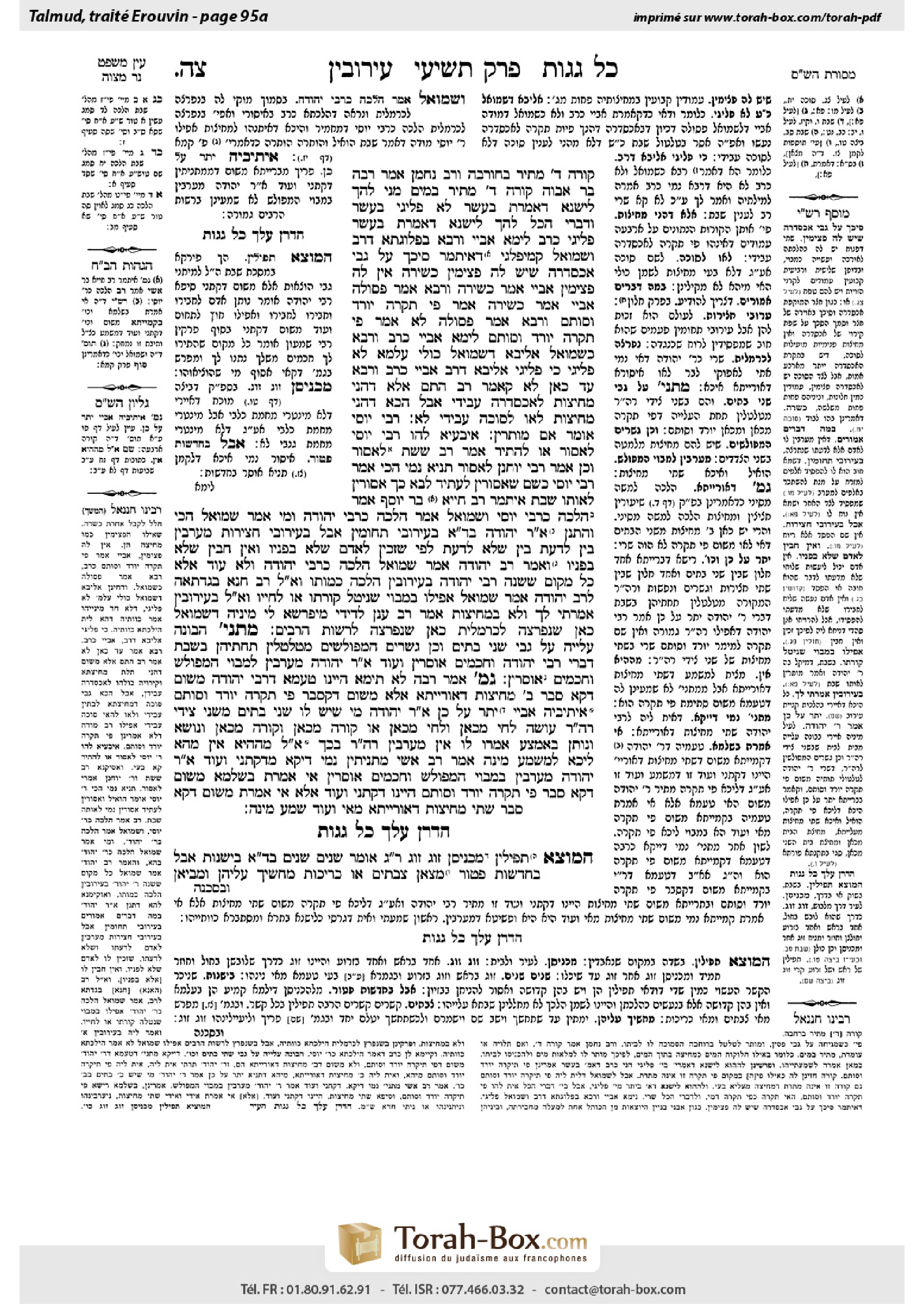
This page of Eruvin includes the Aramaic text, an English translation and an AI-generated French translation, alongside the scan above.
עירובין צ״ה א · Aramaic and Hebrew text
קוֹרָה אַרְבָּעָה מַתִּיר בְּחוּרְבָּה, וְרַב נַחְמָן אָמַר רַבָּה בַּר אֲבוּהּ: קוֹרָה אַרְבָּעָה מַתִּיר בְּמַיִם, מַנִּי?
לְהַךְ לִישָּׁנָא דְּאָמְרַתְּ בְּעֶשֶׂר לָא פְּלִיגִי: בְּעֶשֶׂר, וְדִבְרֵי הַכֹּל. לְהַךְ לִישָּׁנָא דְּאָמְרַתְּ בְּעֶשֶׂר פְּלִיגִי: כְּרַב.
לֵימָא אַבָּיֵי וְרָבָא בִּפְלוּגְתָּא דְּרַב וּשְׁמוּאֵל קָמִיפַּלְגִי, דְּאִיתְּמַר: סִיכֵּךְ עַל גַּבֵּי אַכְסַדְרָה שֶׁיֵּשׁ לָהּ פַּצִּימִין — כְּשֵׁירָה, אֵין לָהּ פַּצִּימִין, אַבָּיֵי אָמַר: כְּשֵׁירָה, וְרָבָא אָמַר: פְּסוּלָה.
אַבָּיֵי אָמַר כְּשֵׁירָה, אָמַר פִּי תִקְרָה יוֹרֵד וְסוֹתֵם. וְרָבָא אָמַר פְּסוּלָה, לָא אָמַר פִּי תִקְרָה יוֹרֵד וְסוֹתֵם. לֵימָא אַבָּיֵי כְּרַב, וְרָבָא כִּשְׁמוּאֵל?
אַלִּיבָּא דִשְׁמוּאֵל כּוּלֵּי עָלְמָא לָא פְלִיגִי. כִּי פְּלִיגִי אַלִּיבָּא דְרַב: אַבָּיֵי כְּרַב. וְרָבָא — עַד כָּאן לָא קָאָמַר רַב הָתָם, אֶלָּא דְּהָנֵי מְחִיצוֹת לְאַכְסַדְרָה עֲבִידִי. אֲבָל הָכָא, דְּהָנֵי מְחִיצוֹת לָאו לְסוּכָּה עֲבִידִי — לָא.
רַבִּי יוֹסֵי אוֹמֵר: אִם מוּתָּרִין. אִיבַּעְיָא לְהוּ רַבִּי יוֹסֵי לֶאֱסוֹר, אוֹ לְהַתִּיר?
אָמַר רַב שֵׁשֶׁת: לֶאֱסוֹר. וְכֵן אָמַר רַבִּי יוֹחָנָן: לֶאֱסוֹר. תַּנְיָא נָמֵי הָכִי, אָמַר רַבִּי יוֹסֵי: כְּשֵׁם שֶׁאֲסוּרִין לֶעָתִיד לָבֹא, כָּךְ אֲסוּרִין לְאוֹתוֹ שַׁבָּת.
אִיתְּמַר, רַב חִיָּיא בַּר יוֹסֵף אָמַר: הֲלָכָה כְּרַבִּי יוֹסֵי, וּשְׁמוּאֵל אָמַר: הֲלָכָה כְּרַבִּי יְהוּדָה.
וּמִי אָמַר שְׁמוּאֵל הָכִי?! וְהָתְנַן, אָמַר רַבִּי יְהוּדָה: בַּמֶּה דְּבָרִים אֲמוּרִים, בְּעֵירוּבֵי תְחוּמִין. אֲבָל בְּעֵירוּבֵי חֲצֵירוֹת — מְעָרְבִין בֵּין לְדַעַת בֵּין שֶׁלֹּא לְדַעַת, לְפִי שֶׁזָּכִין לְאָדָם שֶׁלֹּא בְּפָנָיו, וְאֵין חָבִין שֶׁלֹּא בְּפָנָיו.
וְאָמַר רַב יְהוּדָה אָמַר שְׁמוּאֵל: הֲלָכָה כְּרַבִּי יְהוּדָה. וְלֹא עוֹד, אֶלָּא כׇּל מָקוֹם שֶׁשָּׁנָה רַבִּי יְהוּדָה בְּעֵירוּבִין — הֲלָכָה כְּמוֹתוֹ.
וַאֲמַר לֵיהּ רַב חָנָא בַּגְדָּתָאָה לְרַב יְהוּדָה: אָמַר שְׁמוּאֵל אֲפִילּוּ בְּמָבוֹי שֶׁנִּיטַּל קוֹרָתוֹ אוֹ לְחָיָיו? וַאֲמַר לֵיהּ: בְּעֵירוּבִין אָמַרְתִּי לְךָ, וְלֹא בִּמְחִיצוֹת.
אָמַר רַב עָנָן: לְדִידִי מִיפָּרְשָׁא לִי מִינֵּיהּ דִּשְׁמוּאֵל: כָּאן שֶׁנִּפְרְצָה לְכַרְמְלִית, כָּאן שֶׁנִּפְרְצָה לִרְשׁוּת הָרַבִּים.
מַתְנִי׳ הַבּוֹנֶה עֲלִיָּיה עַל גַּבֵּי שְׁנֵי בָתִּים, וְכֵן גְּשָׁרִים הַמְפוּלָּשִׁים — מְטַלְטְלִין תַּחְתֵּיהֶן בַּשַּׁבָּת, דִּבְרֵי רַבִּי יְהוּדָה. וַחֲכָמִים אוֹסְרִין.
וְעוֹד אָמַר רַבִּי יְהוּדָה: מְעָרְבִין לְמָבוֹי הַמְפוּלָּשׁ. וַחֲכָמִים אוֹסְרִין.
גְּמָ׳ אָמַר רַבָּה: לָא תֵּימָא הַיְינוּ טַעְמָא דְּרַבִּי יְהוּדָה מִשּׁוּם דְּקָא סָבַר שְׁתֵּי מְחִיצוֹת דְּאוֹרָיְיתָא. אֶלָּא מִשּׁוּם דְּקָסָבַר: פִּי תִקְרָה יוֹרֵד וְסוֹתֵם.
אֵיתִיבֵיהּ אַבָּיֵי: יָתֵר עַל כֵּן אָמַר רַבִּי יְהוּדָה: מִי שֶׁיֵּשׁ לוֹ שְׁנֵי בָתִּים מִשְּׁנֵי צִידֵּי רְשׁוּת הָרַבִּים, עוֹשֶׂה לֶחִי מִכָּאן וְלֶחִי מִכָּאן, אוֹ קוֹרָה מִכָּאן וְקוֹרָה מִכָּאן, וְנוֹשֵׂא וְנוֹתֵן בָּאֶמְצַע. אָמְרוּ לוֹ: אֵין מְעָרְבִין רְשׁוּת הָרַבִּים בְּכָךְ!
אֲמַר לֵיהּ: מֵהַהִיא — אִין, מֵהָא — לֵיכָּא לְמִשְׁמַע מִינַּהּ.
אָמַר רַב אָשֵׁי: מַתְנִיתִין נָמֵי דַּיְקָא, מִדְּקָתָנֵי: וְעוֹד אָמַר רַבִּי יְהוּדָה: מְעָרְבִין בְּמָבוֹי הַמְפוּלָּשׁ, וַחֲכָמִים אוֹסְרִין.
אִי אָמְרַתְּ בִּשְׁלָמָא מִשּׁוּם דְּקָא סָבַר פִּי תִקְרָה יוֹרֵד וְסוֹתֵם — הַיְינוּ דְּקָתָנֵי ״וְעוֹד״.
אֶלָּא אִי אָמְרַתְּ מִשּׁוּם דְּקָא סָבַר שְׁתֵּי מְחִיצוֹת דְּאוֹרָיְיתָא — מַאי ״וְעוֹד״?! שְׁמַע מִינַּהּ.
הַדְרָן עֲלָךְ כׇּל גַּגּוֹת
מַתְנִי׳ הַמּוֹצֵא תְּפִילִּין — מַכְנִיסָן זוּג זוּג. רַבָּן גַּמְלִיאֵל אוֹמֵר: שְׁנַיִם שְׁנַיִם. בַּמֶּה דְּבָרִים אֲמוּרִים — בִּישָׁנוֹת, אֲבָל בַּחֲדָשׁוֹת — פָּטוּר.
מְצָאָן צְבָתִים אוֹ כְרִיכוֹת — מַחְשִׁיךְ עֲלֵיהֶן וּמְבִיאָן.
Eruvin 95a · English translation
A cross beam four handbreadths wide renders carrying in a ruin that is breached into a public domain permitted, as the edge of the cross beam is considered to descend and seal the breach. And that which Rav Naḥman said that Rabba bar Avuh said: A cross beam four handbreadths wide renders carrying in water permitted like a partition. In accordance with whose opinion were these rulings stated?
The Gemara explains: According to this version that you stated, that Rav and Shmuel agree with regard to an opening no wider than ten cubits, here it is referring to a cross beam that is no longer than ten cubits, and everyone, both Rav and Shmuel, agrees with these rulings. According to that other version that you stated, that they disagree with regard to an opening no wider than ten cubits, these rulings are in accordance with the opinion of Rav alone.
The Gemara suggests: Let us say that Abaye and Rava are disagreeing with regard to the point that was the subject of a dispute between Rav and Shmuel. As it was stated: If one placed roofing on top of a portico that has doorposts, i.e., pillars that form the beginnings of partitions, it is a valid sukka. If, however, he placed the roofing atop a portico that has no doorposts, there is a dispute. Abaye said: It is a valid sukka. And Rava said: It is invalid.
The Gemara elaborates: Abaye said: It is valid. As he said: The edge of a roof descends and seals. Since the portico is roofed, it is considered to have partitions as well. And Rava said: It is invalid, as he did not say: The edge of a roof descends and seals. Let us say that Abaye holds in accordance with the opinion of Rav, and Rava holds in accordance with the opinion of Shmuel?
The Gemara answers: According to the opinion of Shmuel, everyone, including Abaye, agrees that this sukka is invalid. Where they disagree is according to the opinion of Rav. Abaye holds in accordance with the opinion of Rav in a straightforward manner. And Rava claims: Rav stated his opinion, that the edge of the portico descends and seals, only there, where those partitions formed by the roof were built for the portico, and they are therefore viewed as sealing it. However, here, where these partitions were not built for the mitzva of sukka, no, even Rav would agree that the partitions are not sufficiently significant to utilize for the purpose of this mitzva.
We learned in the mishna: Rabbi Yosei says: If they are permitted to carry there on that Shabbat, they are likewise permitted to do so in the future, and if they are prohibited from carrying there in the future, they are also prohibited from carrying there on that Shabbat A dilemma was raised before the Sages: Did Rabbi Yosei intend to prohibit carrying even on that Shabbat, or to permit carrying even in the future?
Rav Sheshet said: His intention was to prohibit carrying even on that Shabbat. And similarly, Rabbi Yoḥanan said: His intention was to prohibit carrying even on that Shabbat. This opinion was also taught in a baraita: Rabbi Yosei said: Just as they are prohibited from carrying in the future, so are they prohibited from carrying on that Shabbat.
It was stated: Rav Ḥiyya bar Yosef said that the halakha is in accordance with the opinion of Rabbi Yosei, while Shmuel said that the halakha is in accordance with the opinion of Rabbi Yehuda.
The Gemara expresses surprise: But did Shmuel really say this? Didn’t we learn in a mishna that Rabbi Yehuda said: In what case are these matters, that an eiruv may be established for a person only with his knowledge, stated? It is with regard to a joining of Shabbat boundaries, but with regard to a joining of courtyards, one may establish an eiruv for another person both with his knowledge and without his knowledge, because one may act in a person’s interest even when not in his presence, but one may act to his disadvantage only in his presence. One may take unilateral action on another’s behalf when it is to that other person’s benefit. However, if it is to that person’s disadvantage, or when the action entails both benefits and disadvantages, he may act on the other person’s behalf only if he was explicitly appointed as his agent. A joining of courtyards is always to a person’s benefit, and therefore it can be established even without his knowledge. However, with regard to a joining of Shabbat boundaries, any distance that a person gains in one direction he forfeits in the opposite direction. Consequently, this type of eiruv may be established only with his knowledge.
And Rav Yehuda said that Shmuel said: The halakha is in accordance with the opinion of Rabbi Yehuda. And furthermore, anyplace where Rabbi Yehuda taught with regard to the halakhot of eiruv, the halakha is in accordance with his opinion.
And Rav Ḥana of Baghdad said to Rav Yehuda: Did Shmuel state this ruling even with regard to an alleyway whose cross beam or side post was removed during Shabbat? And Rav Yehuda said to him: I spoke to you with regard to the acquisition of an eiruv, and not with regard to partitions. The Gemara asks: How, then, could Shmuel rule that the halakha is in accordance with the opinion of Rabbi Yehuda in this case, after explicitly stating that the halakha is not in accordance with his opinion in the case of fallen partitions?
Rav Anan said: This matter was explained to me personally by Shmuel himself: Here, where Shmuel rules in accordance with the opinion of Rabbi Yehuda, it is in a case where the courtyard was breached into a karmelit. In that case the halakha is lenient, as there is no concern lest one transgress a Torah prohibition. There, where Shmuel states that the halakha is not in accordance with the opinion of Rabbi Yehuda, it is in a case where the courtyard was breached into a public domain, and the halakha is therefore stringent, due to the concern lest one transgress a Torah prohibition.
MISHNA: With regard to one who builds an upper story atop two houses on opposite sides of a public domain that passes beneath it, and likewise bridges with a thoroughfare beneath them that rest on walls on opposite sides of a public domain, one may carry beneath the upper story and beneath the bridge on Shabbat. This is the statement of Rabbi Yehuda, who maintains that these areas are considered private domains. And the Rabbis prohibit carrying in these areas.
And furthermore, Rabbi Yehuda said: One may establish an eiruv even for an alleyway that is open at both ends, with no need for any additional measures, and the Rabbis prohibit doing so.
GEMARA: Rabba said: Do not say this is Rabbi Yehuda’s reason; that he maintains that by Torah law two partitions constitute a private domain, i.e., the areas beneath the upper story and the bridge are considered private domains, as each has two partitions, one on each side of the public domain. Rather, the reason for Rabbi Yehuda’s opinion is because he maintains that the edge of a roof descends and seals. The edges of the upper story and the bridge are considered to seal the areas beneath them.
Abaye raised an objection to Rabba from a baraita: Furthermore, Rabbi Yehuda said: With regard to one who has two houses on two sides of a public domain and seeks to carry from one house to the other on Shabbat via the public domain, he places a side post from here, adjacent to one of the houses, and another side post from there, adjacent to the other house, or he places a cross beam from here and another cross beam from there, and he may subsequently carry objects and place them in the middle of the area, as he transformed it into a private domain. His colleagues said to him: One cannot establish an eiruv to transform a public domain into a private domain in this manner. Clearly, the rationale for Rabbi Yehuda’s opinion in that case is not that the edge of the roof descends and seals, as the area is not covered. Rather, he apparently holds that by Torah law, two walls suffice to form a private domain.
Rabba said to him: From that baraita, yes, it is indeed possible to arrive at this conclusion. But from this, the mishna, nothing can be learned from this source, as there could be a different reason for Rabbi Yehuda’s opinion.
Rav Ashi said: The mishna is also precise in its wording, as it indicates that the rationale for Rabbi Yehuda’s opinion is that the edge of a roof descends and seals. As the mishna teaches: And furthermore, Rabbi Yehuda said: One may establish an eiruv even for an alleyway that is open at both ends, and the Rabbis prohibit doing so.
Granted, if you say that the reason for Rabbi Yehuda’s leniency with regard to carrying beneath an upper story and a bridge is that he maintains that the edge of a roof descends and seals, that is why the mishna states: And furthermore, to introduce the ruling for an alleyway. In other words, the tanna of our mishna is saying that the ruling applies not only to a roofed area, but also to an unroofed alleyway, despite the fact that the reason there is that two partitions suffice to create a private domain by Torah law.
However, if you say that Rabbi Yehuda permitted the first case as well because he maintains that by Torah law two partitions suffice to create a private domain, what is the need for the introduction: And furthermore? The rationale for the second ruling is no different from the rationale for the first. The Gemara concludes: Indeed, learn from here that this is correct.
MISHNA: One who finds phylacteries outside the city on Shabbat, where they are in danger of becoming lost or damaged, brings them in to his house pair by pair by donning them in the manner in which they are typically donned for the mitzva. Rabban Gamliel says: He brings them in two pairs by two pairs. In what case is this statement that one is permitted to carry phylacteries inside said? It is with regard to old phylacteries, which have already been used and are designated for the mitzva. However, with regard to new ones, as it is unclear whether they are phylacteries or merely amulets in the form of phylacteries, he is exempt from performing the task.
If one finds phylacteries tied in bundles or in wrapped piles, in which case he is unable to carry them in pairs, he sits there and waits with them until dark, guarding them until the conclusion of Shabbat, and then brings them in to his house.
Eruvin 95a · Traduction française (IA)
Un poteau de quatre tefachim de large permet la portée dans un lieu ruiné percé dans un domaine public, car la bordure du poteau est considérée comme descendant et scellant la percée. Et ce que Rav Naḥman a dit que Rabba bar Avuh a dit : Un poteau de quatre tefachim de large permet la portée dans l'eau comme une séparation. Selon quel avis ces décisions ont-elles été émises ?
La Guemara explique : Selon cette version que vous avez émise, que Rav et Shmuel s'accordent sur une ouverture ne dépassant pas dix coudées, ici il s'agit d'un poteau dont la longueur ne dépasse pas dix coudées, et tout le monde, à la fois Rav et Shmuel, s'accorde sur ces décisions. Selon cette autre version que vous avez émise, qu'ils s'opposent sur une ouverture ne dépassant pas dix coudées, ces décisions sont selon l'avis de Rav seul.
La Guemara suggère : Disons que Abaye et Rava s'opposent sur le point qui était l'objet d'un débat entre Rav et Shmuel. Comme il a été dit : Si l'on place un toit sur un porche qui a des colonnes, c'est-à-dire des piliers qui forment le début des séparations, c'est un sukka valide. Si, cependant, l'on place le toit sur un porche qui n'a pas de colonnes, il y a un débat. Abaye a dit : C'est un sukka valide. Et Rava a dit : C'est invalide.
La Guemara développe : Abaye a dit : C'est valide. Comme il a dit : L'extrémité du toit descend et scelle. Puisque le porche est toisé, il est considéré comme ayant des séparations également. Et Rava a dit : C'est invalide, car il n'a pas dit : L'extrémité du toit descend et scelle. Disons que Abaye tient l'avis de Rav, et Rava tient l'avis de Shmuel ?
La Guemara répond : Selon l'avis de Shmuel, tout le monde, y compris Abaye, s'accorde sur le fait que ce sukka est invalide. C'est là qu'ils s'opposent selon l'avis de Rav. Abaye tient l'avis de Rav de manière directe. Et Rava affirme : Rav a exprimé son avis, que l'extrémité du porche descend et scelle, uniquement là où ces séparations formées par le toit ont été construites pour le porche, et qu'elles sont donc considérées comme le scellant. Cependant, ici, où ces séparations n'ont pas été construites pour la mitsva du sukka, non, même Rav serait d'accord que les séparations ne sont pas suffisamment importantes pour être utilisées à cet effet.
Nous avons appris dans la mitsna : Rabbi Yosei dit : Si on est autorisé à porter là le sabbat, on l'est également à l'avenir, et si on est interdit de porter là à l'avenir, on l'est également le sabbat. Un dilemme a été soulevé devant les Sages : Rabbi Yosei voulait-il interdire le portage même le sabbat, ou autoriser le portage même à l'avenir ?
Rav Sheshet a dit : Son intention était d'interdire le portage même ce sabbat. Et de même, Rabbi Yoḥanan a dit : Son intention était d'interdire le portage même ce sabbat. Cette opinion a également été enseignée dans une baraïta : Rabbi Yosei a dit : Comme ils sont interdits de porter à l'avenir, ils sont également interdits de porter ce sabbat.
Il a été dit : Rav Ḥiyya bar Yosef a dit que la halakha suit l'avis de Rabbi Yosei, tandis que Shmuel a dit que la halakha suit l'avis de Rabbi Yehuda.
La Guemara exprime une surprise : Mais Shmuel a-t-il vraiment dit cela ? N'avons-nous pas appris dans une mitsna que Rabbi Yehuda a dit : Dans quel cas ces matières, que l'eiruv peut être établi pour une personne seulement avec son consentement, sont-elles énoncées ? C'est dans le cas d'une jonction des limites du sabbat, mais dans le cas d'une jonction de courtyards, on peut établir un eiruv pour un autre personne avec ou sans son consentement, car on peut agir en faveur d'une personne même en son absence, mais on peut agir à son détriment seulement en sa présence. On peut agir unilatéralement en faveur d'un autre quand c'est à son avantage. Cependant, si c'est à son détriment, ou si l'action comporte à la fois des avantages et des désavantages, on peut agir en son nom seulement si l'on a été explicitement désigné comme son agent. Une jonction de courtyards est toujours à l'avantage d'une personne, et par conséquent elle peut être établie même sans son consentement. Cependant, dans le cas d'une jonction des limites du sabbat, toute distance que l'on gagne dans une direction on la perd dans l'autre. Par conséquent, ce type d'eiruv peut être établi seulement avec son consentement.
Et Rav Yehuda a dit que Shmuel a dit : La halakha suit l'avis de Rabbi Yehuda. Et de plus, partout où Rabbi Yehuda a enseigné sur les halakhot de l'eiruv, la halakha suit son avis.
Et Rav Ḥana de Bagdad a dit à Rav Yehuda : A-t-il dit cette décision même concernant un passage dont le poteau ou la colonne latérale a été retiré le sabbat ? Et Rav Yehuda a dit à lui : J'ai parlé à toi concernant l'acquisition de l'eiruv, et non concernant les séparations. La Guemara demande : Comment alors Shmuel a-t-il pu décider que la halakha suit l'avis de Rabbi Yehuda dans ce cas, après avoir explicitement dit que la halakha ne suit pas son avis dans le cas des séparations tombées ?
Rav Anan a dit : Cette affaire m'a été expliquée personnellement par Shmuel lui-même : Ici, où Shmuel décide selon l'avis de Rabbi Yehuda, c'est dans le cas où le courtil était percé dans un karmelit. Dans ce cas, la halakha est clémente, car il n'y a pas de crainte de transgresser une interdiction divine. Là, où Shmuel dit que la halakha ne suit pas l'avis de Rabbi Yehuda, c'est dans le cas où le courtil était percé dans un domaine public, et la halakha est donc stricte, en raison de la crainte de transgresser une interdiction divine.
MICHNA : Concernant celui qui construit un étage supérieur sur deux maisons situées des deux côtés d'un domaine public qui passe sous lui, et de même construit un pont sur une voie publique qui repose sur des murs situés des deux côtés d'un domaine public, on peut porter sous l'étage supérieur et sous le pont le sabbat. C'est la déclaration de Rabbi Yéhuda, qui considère que ces zones sont des domaines privés. Et les Sages interdisent de porter dans ces zones.
Et de plus, Rabbi Yéhuda a dit : On peut établir un eiruv même pour un passage qui est ouvert aux deux extrémités, sans avoir besoin de mesures supplémentaires, et les Sages interdisent de le faire.
GUEMARA : Rabba a dit : N'entendez pas cela comme la raison de Rabbi Yéhuda ; c'est-à-dire qu'il considère que par la Loi, deux cloisons constituent un domaine privé, c'est-à-dire que les zones sous l'étage supérieur et le pont sont considérées comme des domaines privés, car chacune a deux cloisons, l'une de chaque côté du domaine public. Plutôt, la raison de l'opinion de Rabbi Yéhuda est qu'il considère que la bordure d'un toit descend et scelle. Les bordures de l'étage supérieur et du pont sont considérées comme scellant les zones sous eux.
Abaye souleva une objection contre Rabba à partir d'une baraïta : De plus, Rabbi Yéhuda dit : Concernant celui qui possède deux maisons des deux côtés d'un domaine public et souhaite porter des objets d'une maison à l'autre le sabbat en passant par le domaine public, il place une poutre latérale d'ici, adjacente à l'une des maisons, et une autre poutre latérale d'ici, adjacente à l'autre maison, ou il place une poutre transversale d'ici et une autre poutre transversale d'ici, et il peut ensuite porter des objets et les placer au milieu de la zone, car il l'a transformé en un domaine privé. Ses collègues lui dirent : On ne peut pas établir un eiruv pour transformer un domaine public en un domaine privé de cette manière. Évidemment, la raison de l'opinion de Rabbi Yéhuda dans ce cas n'est pas que la bordure du toit descend et scelle, car la zone n'est pas couverte. Plutôt, il semble qu'il considère que, selon la Loi, deux murs suffisent pour former un domaine privé.
Rabba lui répondit : À partir de cette baraïta, oui, on peut en arriver à cette conclusion. Mais à partir de cela, la Michna, on ne peut rien en tirer, car il pourrait y avoir une autre raison pour l'opinion de Rabbi Yéhuda.
Rav Ashi dit : La Michna est aussi précise dans son expression, car elle indique que la raison de l'opinion de Rabbi Yéhuda est que la bordure d'un toit descend et scelle. Comme la Michna enseigne : Et de plus, Rabbi Yéhuda dit : On peut établir un eiruv même pour un passage ouvert aux deux extrémités, et les Sages l'interdisent.
D'accord, si vous dites que la raison de la leniencité de Rabbi Yéhuda concernant le portage sous un étage supérieur et un pont est qu'il considère que la bordure d'un toit descend et scelle, c'est pourquoi la Michna dit : Et de plus, pour introduire la décision concernant un passage. En d'autres termes, le tanna de notre Michna dit que la décision s'applique non seulement à une zone toilée, mais aussi à un passage non toilé, malgré le fait que la raison y est que deux cloisons suffisent pour créer un domaine privé par la Loi.
Cependant, si vous dites que Rabbi Yéhuda a permis le premier cas également parce qu'il considère que par la Loi, deux cloisons suffisent pour créer un domaine privé, quelle est la nécessité de l'introduction : Et de plus ? La raison de la décision du deuxième cas n'est pas différente de celle du premier. La Guemara conclut : En effet, apprenez-en ici que c'est correct.
MICHNA : Celui qui trouve des phylactères en dehors de la ville le sabbat, où ils sont en danger de se perdre ou de se détériorer, les amène chez lui par paires, en les revêtant de la manière habituelle pour la mitsva. Rabban Gamliel dit : Il les amène par paires de deux par deux. Dans quel cas cette déclaration qui permet de porter les phylactères à l'intérieur est-elle dite ? C'est concernant des phylactères anciens, déjà utilisés et désignés pour la mitsva. Cependant, concernant des nouveaux, comme il est incertain s'ils sont des phylactères ou simplement des amulettes en forme de phylactères, il est exempt de faire cette tâche.
Si l'on trouve des phylactères liés en bouquets ou en piles enveloppées, dans le cas où l'on ne peut pas les porter par paires, l'on reste là et les garde jusqu'au crépuscule, les protégeant jusqu'à la fin du sabbat, et ensuite on les amène chez soi.
Traduction française générée par IA à partir de l’édition anglaise de Sefaria. Vérifie toujours un passage avec le texte source.
Text from Sefaria: William Davidson Edition - Vocalized Aramaic (CC BY NC); William Davidson Edition - English (CC BY NC).