Eruvin 95b: Talmud study for Daf Yomi
Study the Talmud for Daf Yomi with scanned pages, Hebrew text, English translations from Sefaria and AI-generated French translations.
Passage selection and English or AI-generated French translation are available where the scan has annotations. Daf Study is independent of Torah-Box and Sefaria.
Browse Eruvin · עירובין · All tractatesEruvin 95b text and translations
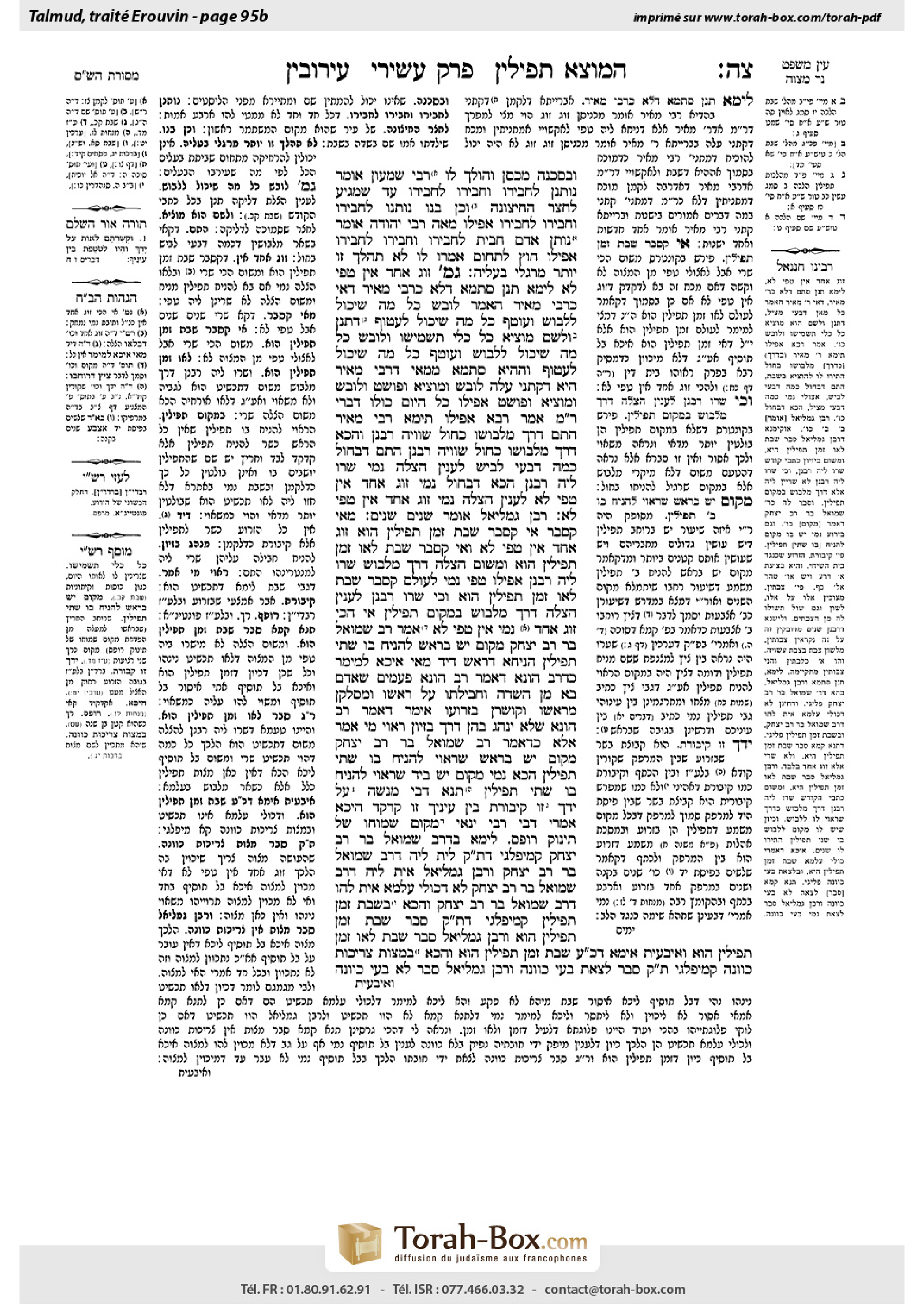
This page of Eruvin includes the Aramaic text, an English translation and an AI-generated French translation, alongside the scan above.
עירובין צ״ה ב · Aramaic and Hebrew text
וּבַסַּכָּנָה — מְכַסָּן וְהוֹלֵךְ לוֹ.
רַבִּי שִׁמְעוֹן אוֹמֵר: נוֹתְנָן לַחֲבֵירוֹ, וַחֲבֵירוֹ לַחֲבֵירוֹ, עַד שֶׁמַּגִּיעַ לֶחָצֵר הַחִיצוֹנָה.
וְכֵן בְּנוֹ — נוֹתְנוֹ לַחֲבֵירוֹ, וַחֲבֵירוֹ לַחֲבֵירוֹ, אֲפִילּוּ מֵאָה. רַבִּי יְהוּדָה אוֹמֵר: נוֹתֵן אָדָם חָבִית לַחֲבֵירוֹ, וַחֲבֵירוֹ לַחֲבֵירוֹ, אֲפִילּוּ חוּץ לַתְּחוּם. אָמְרוּ לוֹ: לֹא תְּהַלֵּךְ זוֹ יוֹתֵר מֵרַגְלֵי בְעָלֶיהָ.
גְּמָ׳ זוּג אֶחָד אִין, טְפֵי — לָא. לֵימָא תְּנַן סְתָמָא דְּלָא כְּרַבִּי מֵאִיר?
דְּאִי כְּרַבִּי מֵאִיר, הָאָמַר: לוֹבֵשׁ כׇּל מַה שֶּׁיָּכוֹל לִלְבּוֹשׁ, וְעוֹטֵף כׇּל מַה שֶּׁיָּכוֹל לַעֲטוֹף. דִּתְנַן: וּלְשָׁם מוֹצִיא כׇּל כְּלֵי תַשְׁמִישׁוֹ, וְלוֹבֵשׁ כׇּל מַה שֶּׁיָּכוֹל לִלְבּוֹשׁ, וְעוֹטֵף כׇּל מַה שֶּׁיָּכוֹל לַעֲטוֹף.
וְהַהִיא סְתָמָא, מִמַּאי דְּרַבִּי מֵאִיר הִיא? דְּקָתָנֵי עֲלַהּ: לוֹבֵשׁ וּמוֹצִיא וּפוֹשֵׁט, וְלוֹבֵשׁ וּמוֹצִיא וּפוֹשֵׁט, אֲפִילּוּ כׇּל הַיּוֹם כּוּלּוֹ, דִּבְרֵי רַבִּי מֵאִיר.
אָמַר רָבָא: אֲפִילּוּ תֵּימָא רַבִּי מֵאִיר, הָתָם דֶּרֶךְ מַלְבּוּשׁוֹ — כְּחוֹל שַׁוְויֻהּ רַבָּנַן, וְהָכָא דֶּרֶךְ מַלְבּוּשׁוֹ — כְּחוֹל שַׁוְויֻהּ רַבָּנַן.
הָתָם דִּבְחוֹל כַּמָּה דְּבָעֵי לָבֵישׁ, לְעִנְיַן הַצָּלָה נָמֵי שָׁרוּ לֵיה רַבָּנַן. הָכָא דִּבְחוֹל נָמֵי זוּג אֶחָד — אִין, טְפֵי — לָא, לְעִנְיַן הַצָּלָה נָמֵי זוּג אֶחָד — אִין, טְפֵי — לָא.
רַבָּן גַּמְלִיאֵל אוֹמֵר: שְׁנַיִם שְׁנַיִם. מַאי קָסָבַר? אִי קָסָבַר שַׁבָּת זְמַן תְּפִילִּין הוּא, זוּג אֶחָד — אִין, טְפֵי — לָא.
וְאִי קָסָבַר שַׁבָּת לָאו זְמַן תְּפִילִּין הוּא, וּמִשּׁוּם הַצָּלָה דֶּרֶךְ מַלְבּוּשׁ שָׁרוּ לֵיהּ רַבָּנַן, אֲפִילּוּ טְפֵי נָמֵי!
לְעוֹלָם קָסָבַר שַׁבָּת לָאו זְמַן תְּפִילִּין הוּא, וְכִי שְׁרוֹ רַבָּנַן לְעִנְיַן הַצָּלָה — דֶּרֶךְ מַלְבּוּשׁ בִּמְקוֹם תְּפִילִּין.
אִי הָכִי זוּג אֶחָד נָמֵי — אֵין, טְפֵי — לָא! אָמַר רַב שְׁמוּאֵל בַּר רַב יִצְחָק: מָקוֹם יֵשׁ בָּרֹאשׁ לְהַנִּיחַ בּוֹ שְׁתֵּי תְפִילִּין.
הָנִיחָא דְּרֹאשׁ, דְּיָד מַאי אִיכָּא לְמֵימַר?
כִּדְרַב הוּנָא, דְּאָמַר רַב הוּנָא: פְּעָמִים שֶׁאָדָם בָּא מִן הַשָּׂדֶה וַחֲבִילָתוֹ עַל רֹאשׁוֹ, וּמְסַלְּקָן מֵרֹאשׁוֹ וְקוֹשְׁרָן בִּזְרוֹעוֹ.
אֵימַר דְּאָמַר רַב הוּנָא, שֶׁלֹּא יִנְהַג בָּהֶן דֶּרֶךְ בִּזָּיוֹן. רָאוּי מִי אָמַר?
אֶלָּא כִּדְאָמַר רַב שְׁמוּאֵל בַּר רַב יִצְחָק: מָקוֹם יֵשׁ בָּרֹאשׁ שֶׁרָאוּי לְהַנִּיחַ בּוֹ שְׁתֵּי תְפִילִּין. הָכָא נָמֵי, מָקוֹם יֵשׁ בַּיָּד שֶׁרָאוּי לְהַנִּיחַ בּוֹ שְׁתֵּי תְפִילִּין.
תַּנָּא דְבֵי מְנַשֶּׁה: ״עַל יָדְךָ״ — זוֹ קִיבּוֹרֶת, ״בֵּין עֵינֶיךָ״ — זוֹ קׇדְקֹד. הֵיכָא? אָמְרִי דְּבֵי רַבִּי יַנַּאי: מְקוֹם שֶׁמּוֹחוֹ שֶׁל תִּינוֹק רוֹפֵס.
לֵימָא בִּדְרַב שְׁמוּאֵל בַּר רַב יִצְחָק קָמִיפַּלְגִי, דְּתַנָּא קַמָּא לֵית לֵיהּ דְּרַב שְׁמוּאֵל בַּר רַב יִצְחָק, וְרַבָּן גַּמְלִיאֵל אִית לֵיהּ דְּרַב שְׁמוּאֵל בַּר רַב יִצְחָק?
לָא, דְּכוּלֵּי עָלְמָא אִית לְהוּ דְּרַב שְׁמוּאֵל בַּר רַב יִצְחָק, וְהָכָא בְּשַׁבָּת זְמַן תְּפִילִּין קָמִיפַּלְגִי. דְּתַנָּא קַמָּא סָבַר: שַׁבָּת זְמַן תְּפִילִּין הוּא.
וְרַבָּן גַּמְלִיאֵל סָבַר: שַׁבָּת לָאו זְמַן תְּפִילִּין הוּא.
וְאִיבָּעֵית אֵימָא: דְּכוּלֵּי עָלְמָא שַׁבָּת זְמַן תְּפִילִּין הוּא, וְהָכָא בְּמִצְוֹת צְרִיכוֹת כַּוּוֹנָה קָמִיפַּלְגִי. תַּנָּא קַמָּא סָבַר: לָצֵאת בָּעֵי כַּוּוֹנָה.
וְרַבָּן גַּמְלִיאֵל סָבַר: לָא בָּעֵי כַּוּוֹנָה.
Eruvin 95b · English translation
And in a time of danger, when it is dangerous to tarry outside town, he covers the phylacteries and proceeds on his way.
Rabbi Shimon says that there is an alternative method of transferring the phylacteries: One gives them to another who is less than four cubits from him, and the other passes them to another, until the phylacteries reach the outermost courtyard of the city. Since carrying less than four cubits in a public domain is not prohibited by Torah law, in this case, the Sages permitted carrying in that manner due to the sanctity of the phylacteries.
And similarly, with regard to one’s son who was born in a field and may not be carried on Shabbat, since that is akin to carrying a burden in the public domain: One gives him to another, and the other passes him to another, even if it requires a hundred people. Rabbi Yehuda says: A person may even give a barrel to another, and the other may pass it to another, and in that way even take it beyond the Shabbat limit, provided that no one person carries it more than four cubits. They said to him: This barrel may not go a greater distance than the feet of its owner, i.e., it may not be carried any farther than its owner may walk.
GEMARA: We learned in the mishna that a person who finds phylacteries in a field may carry them by pairs, indicating that one pair, yes, it may be carried; however, more than one pair, no, they may not be carried. The Gemara asks: Let us say that we learned the unattributed mishna not in accordance with the opinion of Rabbi Meir, despite the principle that an unattributed mishna usually reflects Rabbi Meir’s opinion.
As, if you say that the mishna is in accordance with the opinion of Rabbi Meir, didn’t Rabbi Meir say: In order to rescue items from a fire, one is permitted to remove items from his house by wearing them, and he dons all the clothes that he can wear, and wraps himself in all items in which he can wrap himself. As we learned in a mishna: And one removes all the utensils to the courtyard adjacent to the fire, and dons all the garments that he can wear, and wraps himself in all the items in which he can wrap himself in order to rescue his property.
The Gemara asks: And from where do we know that this unattributed mishna with regard to Shabbat is a reflection of the opinion of Rabbi Meir? As it teaches with regard to that mishna: If there are many garments there, one dons garments, and takes them out to a safe place, and removes them there, and returns to the fire, and dons other garments, and takes them out and removes them. And he may do so even all day long; this is the statement of Rabbi Meir. Apparently, according to Rabbi Meir, one may don many garments at once.
In answer to the question, Rava said: Even if you say that the mishna is in accordance with the opinion of Rabbi Meir, there is a distinction between the cases. There, if he dons the clothes in the manner that he typically wears them, the Sages rendered the legal status of wearing garments on Shabbat like the status of wearing garments during the week and permitted him to remove clothes from his house by wearing them in that manner. And here, too, if he dons phylacteries in the manner that he typically dons them, the Sages rendered the legal status of donning phylacteries on Shabbat like the status of donning phylacteries during the week.
Consequently, there, where during the week he may wear as many clothes as he wishes, with regard to rescue from a fire the Sages likewise permitted him to wear as many clothes as he wishes. However, here, in the case of phylacteries, even during the week, donning one pair, yes, one may do so, but donning more than one pair, no, he may not do so. Therefore, with regard to rescue as well, the Sages said: Donning one pair, yes, one may do so; however, donning more than one pair, no, he may not.
We learned in the mishna that Rabban Gamliel says: He brings the phylacteries in two pairs by two pairs. The Gemara asks: What does he hold? What is the rationale for this halakha? If he holds that Shabbat is a time for phylacteries, and one is permitted or even obligated to don phylacteries on Shabbat, then the ruling should be: Donning one pair, yes, this is permitted; donning more, no, it is prohibited. It should be prohibited to wear more than one pair as there is room to don only one set of phylacteries on one’s head.
And if he holds that Shabbat is not a time for phylacteries, and it was only due to the fact that rescue was permitted only in the manner that one typically wears clothing that the Sages permitted him to don phylacteries, he should likewise be permitted to don even more than two pairs. He should be permitted to don as many pairs of phylacteries as possible, not only two.
The Gemara answers: Actually, he holds that Shabbat is not a time for phylacteries, and when the Sages permitted one to don phylacteries for the purpose of rescue, it was only by donning them in the manner that one typically wears clothing, i.e., in the appropriate place for phylacteries. He may not don them anywhere else on his body, as in that case he is considered to be carrying, not wearing them.
The Gemara raises a difficulty: If so, then one pair, yes, it should be permitted, but more, no, it should not be permitted, as the second pair is necessarily positioned out of place. Rav Shmuel bar Rav Yitzḥak said: There is room on one’s head to place two phylacteries. One can place two phylacteries on his head and don them both in the proper manner.
The Gemara asks: It works out well with regard to donning two phylacteries of the head, as there is room; however, with regard to the phylacteries of the arm, what is there to say? How can one wear two phylacteries on his arm simultaneously?
The Gemara answers that even when one dons two phylacteries on his arm, he is regarded as donning them in the typical manner, in accordance with the opinion of Rav Huna. As Rav Huna said: Sometimes a person comes from the field with his bundle on his head, and in order not to crush the phylacteries, he removes them from his head and binds them on his arm. This indicates that there is room for additional phylacteries on his arm.
The Gemara rejects this: Say that Rav Huna said that one may remove the phylacteries from his head and tie them on his arm so that he will not come to treat them in a degrading manner by placing a bundle on top of them. However, did he say that the spot on his arm is fit for two phylacteries? Can proof be cited from here that one may don additional phylacteries on his arm ab initio?
Rather, it is in accordance with that which Rav Shmuel bar Rav Yitzḥak said: There is room on one’s head to place two phylacteries. Here, too, there is room on the arm to place two phylacteries.
The Gemara comments: The school of Menashe taught the following. The verse states: “And you shall bind them for a sign on your arm, and they shall be as frontlets between your eyes” (Deuteronomy 6:8). “On your arm,” this is the biceps muscle of the arm; “between your eyes,” this is the crown of the head. The Gemara asks: Where exactly on the crown of the head? The school of Rabbi Yannai say: Phylacteries are placed on the spot where a baby’s head is soft after birth.
The Gemara asks: Let us say that the tanna’im of the mishna disagree about the principle of Rav Shmuel bar Rav Yitzḥak, such that the first tanna is not of the opinion that the ruling is in accordance with the opinion of Rav Shmuel bar Rav Yitzḥak that there is room on one’s head for two phylacteries, while Rabban Gamliel is of the opinion that the ruling is in accordance with the opinion of Rav Shmuel bar Rav Yitzḥak, and therefore one is permitted to bring in two pairs of phylacteries at a time.
The Gemara rejects this: No, everyone is of the opinion of Rav Shmuel bar Rav Yitzḥak, and here they disagree with regard to whether or not Shabbat is a time for phylacteries. The first tanna holds that Shabbat is a time for phylacteries. Although one may don one pair of phylacteries, he may not add to the mitzva by donning an extra pair. If he does so, it is tantamount to carrying a prohibited burden.
And Rabban Gamliel holds that Shabbat is not a time for phylacteries. Consequently, one may don more than one pair, as the day itself is not at all suitable for donning phylacteries. When he dons the second pair, he is not adding to the mitzva. With regard to rescuing them, the phylacteries have the legal status of an ornament that he is permitted to don, provided that he dons no more than two pairs.
And if you wish, say instead that the dispute should be understood as follows. Everyone agrees that Shabbat is a time for phylacteries, and here they disagree with regard to whether or not fulfillment of mitzvot requires intent. The first tanna holds: To fulfill a mitzva one needs intent. Therefore, if one dons phylacteries without intent to fulfill the mitzva, no mitzva is performed, and he is merely carrying a burden. However, if he has intent to fulfill the mitzva, he may don no more than one pair. If he does so, he violates the prohibition against adding to mitzvot.
And Rabban Gamliel holds: In order to fulfill a mitzva, one does not need intent. Therefore, if one dons two pairs of phylacteries he fulfills his obligation with one of them, but does not violate the prohibition against adding to mitzvot with the other. In order to do so, he would require specific intent to fulfill a second mitzva with the additional pair.
Eruvin 95b · Traduction française (IA)
Et dans une époque de danger, lorsque c'est dangereux de rester en dehors de la ville, il recouvre les phylactères et entreprend son chemin.
Rabbi Shimon dit qu'il existe une autre méthode de transférer les phylactères : on les donne à un autre qui est à moins de quatre coudées de lui, et celui-ci les transmet à un autre, jusqu'à ce que les phylactères atteignent le cour de la ville. Puisque transporter moins de quatre coudées dans un domaine public n'est pas interdit par la loi divine, dans ce cas, les Sages ont permis ce mode de transport en raison de la sainteté des phylactères.
Et de même, concernant son fils né dans un champ et qui ne peut pas être porté le sabbat, puisque cela ressemble à porter un fardeau dans un domaine public : on le donne à un autre, et celui-ci le transmet à un autre, même si cela nécessite cent personnes. Rabbi Yehuda dit : une personne peut même donner un tonneau à un autre, et celui-ci peut le transmettre à un autre, et ainsi prendre le tonneau au-delà de la limite du sabbat, à condition que personne ne porte le tonneau plus de quatre coudées. Ils dirent à lui : ce tonneau ne peut pas être porté plus loin que les pieds de son propriétaire, c'est-à-dire qu'il ne peut pas être porté plus loin que ce que son propriétaire peut marcher.
GUEMARA : Nous avons appris dans la Michna que la personne qui trouve des phylactères dans un champ peut les porter par paires, indiquant qu'une paire, oui, elle peut être portée ; cependant, plus d'une paire, non, elles ne peuvent pas être portées. La Guemara pose la question : disons que nous avons appris la Michna non attribuée selon l'opinion de Rabbi Meir, malgré le principe que la Michna non attribuée reflète généralement l'opinion de Rabbi Meir.
Car, si vous dites que la Michna est selon l'opinion de Rabbi Meir, n'a-t-il pas dit : afin de sauver des objets d'un feu, on est autorisé à enlever des objets de sa maison en les portant, et il s'habille de tous les vêtements qu'il peut porter, et s'enveloppe de tous les objets dans lesquels il peut s'envelopper. Comme nous avons appris dans une Michna : et il enlève tous les ustensiles vers le cour adjacent au feu, et s'habille de tous les vêtements qu'il peut porter, et s'enveloppe de tous les objets dans lesquels il peut s'envelopper afin de sauver ses biens.
La Guemara pose la question : d'où savons-nous que cette Michna non attribuée concernant le sabbat reflète l'opinion de Rabbi Meir ? Comme elle enseigne concernant cette Michna : s'il y a beaucoup de vêtements là, il s'habille de vêtements, et les sort vers un lieu sûr, et les y enlève, et retourne au feu, et s'habille d'autres vêtements, et les sort et les y enlève. Et il peut le faire toute la journée ; c'est l'opinion de Rabbi Meir. Apparemment, selon Rabbi Meir, on peut s'habiller de nombreux vêtements à la fois.
En réponse à cette question, Rava dit : même si vous dites que la mitsva est selon l'opinion de Rabbi Meir, il y a une distinction entre les cas. Là, si l'on s'habille des vêtements de la manière dont il les porte habituellement, les Sages ont rendu le statut juridique de porter des vêtements le sabbat semblable au statut de porter des vêtements pendant la semaine et lui ont permis d'enlever des vêtements de sa maison en les portant ainsi. Et ici aussi, si l'on s'habille des phylactères de la manière dont il les s'habille habituellement, les Sages ont rendu le statut juridique de s'habiller des phylactères le sabbat semblable au statut de s'habiller des phylactères pendant la semaine.
Par conséquent, là, pendant la semaine, il peut porter autant de vêtements qu'il veut, et concernant la sauvegarde du feu, les Sages ont également permis de porter autant de vêtements qu'il veut. Cependant, ici, dans le cas des phylactères, même pendant la semaine, porter une paire, oui, on peut le faire, mais porter plus d'une paire, non, on ne peut pas le faire. Par conséquent, concernant la sauvegarde également, les Sages ont dit : porter une paire, oui, on peut le faire ; cependant, porter plus d'une paire, non, on ne peut pas.
Nous avons appris dans la mitsva que Rabban Gamliel dit : il amène les phylactères par paires, par paires. La Guemara pose la question : qu'est-ce qu'il maintient ? Quel est le fondement de cette halakha ? Si il maintient que le sabbat est un temps pour les phylactères, et qu'on est autorisé ou même obligé de les porter le sabbat, alors la décision devrait être : porter une paire, oui, c'est permis ; porter plus, non, c'est interdit. Il devrait être interdit de porter plus d'une paire car il y a de la place pour porter seulement un ensemble de phylactères sur la tête.
Et s'il affirme que le sabbat n'est pas un temps pour les phylactères, et que c'était seulement en raison du fait que la sauvegarde était permise uniquement dans la manière dont on s'habille habituellement que les Sages ont permis de porter les phylactères, il devrait être autorisé à porter même plus de deux paires. Il devrait être autorisé à porter autant de paires de phylactères qu'il est possible, pas seulement deux.
La Guemara répond : en réalité, il affirme que le sabbat n'est pas un temps pour les phylactères, et lorsque les Sages ont permis de porter les phylactères à des fins de sauvegarde, c'était uniquement en les portant de la manière dont on s'habille habituellement, c'est-à-dire à l'endroit approprié pour les phylactères. Il ne peut pas les porter ailleurs sur son corps, car dans ce cas, on le considère comme transportant, et non comme les portant.
La Guemara soulève une difficulté : si c'est ainsi, alors une paire, oui, elle devrait être permise, mais plus, non, elle devrait être interdite, car la deuxième paire est nécessairement mal placée. Rav Shmuel bar Rav Yitzḥak a dit : il y a de la place sur la tête pour placer deux phylactères. On peut placer deux phylactères sur sa tête et les porter tous les deux de manière appropriée.
La Guemara pose la question : cela fonctionne bien concernant le port de deux phylactères de la tête, car il y a de la place ; cependant, concernant les phylactères de l'avant-bras, que dire ? Comment peut-on porter deux phylactères sur son avant-bras en même temps ?
La Guemara répond que même lorsqu'une personne porte deux phylactères sur son bras, elle est considérée comme les portant de la manière habituelle, conformément à l'opinion de Rav Huna. Comme Rav Huna a dit : Parfois, une personne vient du champ avec son fardeau sur la tête, et afin de ne pas écraser les phylactères, il les enlève de sa tête et les attache sur son bras. Cela montre qu'il y a de la place pour d'autres phylactères sur son bras.
La Guemara rejette cela : Dites que Rav Huna a dit qu'on peut enlever les phylactères de sa tête et les attacher sur son bras afin de ne pas les traiter de manière dégradante en les plaçant sous un fardeau. Cependant, a-t-il dit que la place sur son bras est adaptée pour deux phylactères ? Peut-on invoquer une preuve ici pour affirmer qu'on peut porter des phylactères supplémentaires sur son bras dès le début ?
Au contraire, c'est selon ce que dit Rav Shmuel bar Rav Yitzḥak : Il y a de la place sur la tête d'une personne pour deux phylactères. Ici aussi, il y a de la place sur le bras pour deux phylactères.
La Guemara commente : L'école de Menashe a enseigné ce qui suit. La Parashah dit : « Et tu les attacheras en signe sur ton bras, et ils seront comme des frontlets entre tes yeux » (Deutéronome 6:8). « Sur ton bras », c'est le muscle du biceps ; « entre tes yeux », c'est le sommet de la tête. La Guemara pose la question : Où précisément sur le sommet de la tête ? L'école de Rabbi Yannai dit : Les phylactères sont placés sur la zone où la tête d'un nouveau-né est molle après la naissance.
La Guemara pose la question : Disons que les tannaïm de la mitsva s'entendent sur le principe de Rav Shmuel bar Rav Yitzḥak, de sorte que le premier tanna n'est pas d'avis que la décision est en conformité avec l'opinion de Rav Shmuel bar Rav Yitzḥak que la tête peut accueillir deux phylactères, tandis que Rabban Gamliel est d'avis que la décision est en conformité avec l'opinion de Rav Shmuel bar Rav Yitzḥak, et donc on est autorisé à porter deux paires de phylactères à la fois.
La Guemara rejette cela : Non, tout le monde est d'avis que l'opinion de Rav Shmuel bar Rav Yitzḥak est la bonne, et ici ils s'entendent sur le fait que le Shabbat est un moment pour les phylactères. Le premier tanna considère que le Shabbat est un moment pour les phylactères. Bien qu'on puisse porter une paire de phylactères, on ne peut pas ajouter à la mitsva en portant une autre paire. Si l'on le fait, cela équivaut à porter un fardeau interdit.
Et Rabban Gamliel affirme que le Shabbat n'est pas un moment pour les phylactères. Par conséquent, on peut porter plus d'une paire, car la journée elle-même n'est pas du tout adaptée pour porter les phylactères. Lorsqu'il porte la deuxième paire, il ne rajoute pas à la mitsva. En ce qui concerne la protection, les phylactères ont le statut juridique d'un ornement qu'il est permis de porter, à condition qu'il n'en porte pas plus de deux paires.
Et si vous le souhaitez, dites plutôt que le débat devrait être compris ainsi. Tout le monde est d'accord sur le fait que le Shabbat est un moment pour les phylactères, et ici ils s'entendent sur le fait que la performance des mitsvot exige l'intention. Le premier tanna affirme : Pour accomplir une mitsva, on a besoin d'intention. Par conséquent, si l'on porte des phylactères sans intention d'accomplir la mitsva, aucune mitsva n'est accomplie, et l'on est simplement en train de porter un fardeau. Cependant, si l'on a l'intention d'accomplir la mitsva, on ne peut porter qu'une seule paire. Si l'on le fait, l'on viole l'interdiction d'ajouter à la mitsva.
Et Rabban Gamliel affirme : Pour accomplir une mitsva, on n'a pas besoin d'intention. Par conséquent, si l'on porte deux paires de phylactères, on accomplit son obligation avec l'une d'entre elles, mais on ne viole pas l'interdiction d'ajouter à la mitsva avec l'autre. Pour cela, il faudrait une intention spécifique pour accomplir une deuxième mitsva avec la paire supplémentaire.
Traduction française générée par IA à partir de l’édition anglaise de Sefaria. Vérifie toujours un passage avec le texte source.
Text from Sefaria: William Davidson Edition - Vocalized Aramaic (CC BY NC); William Davidson Edition - English (CC BY NC).