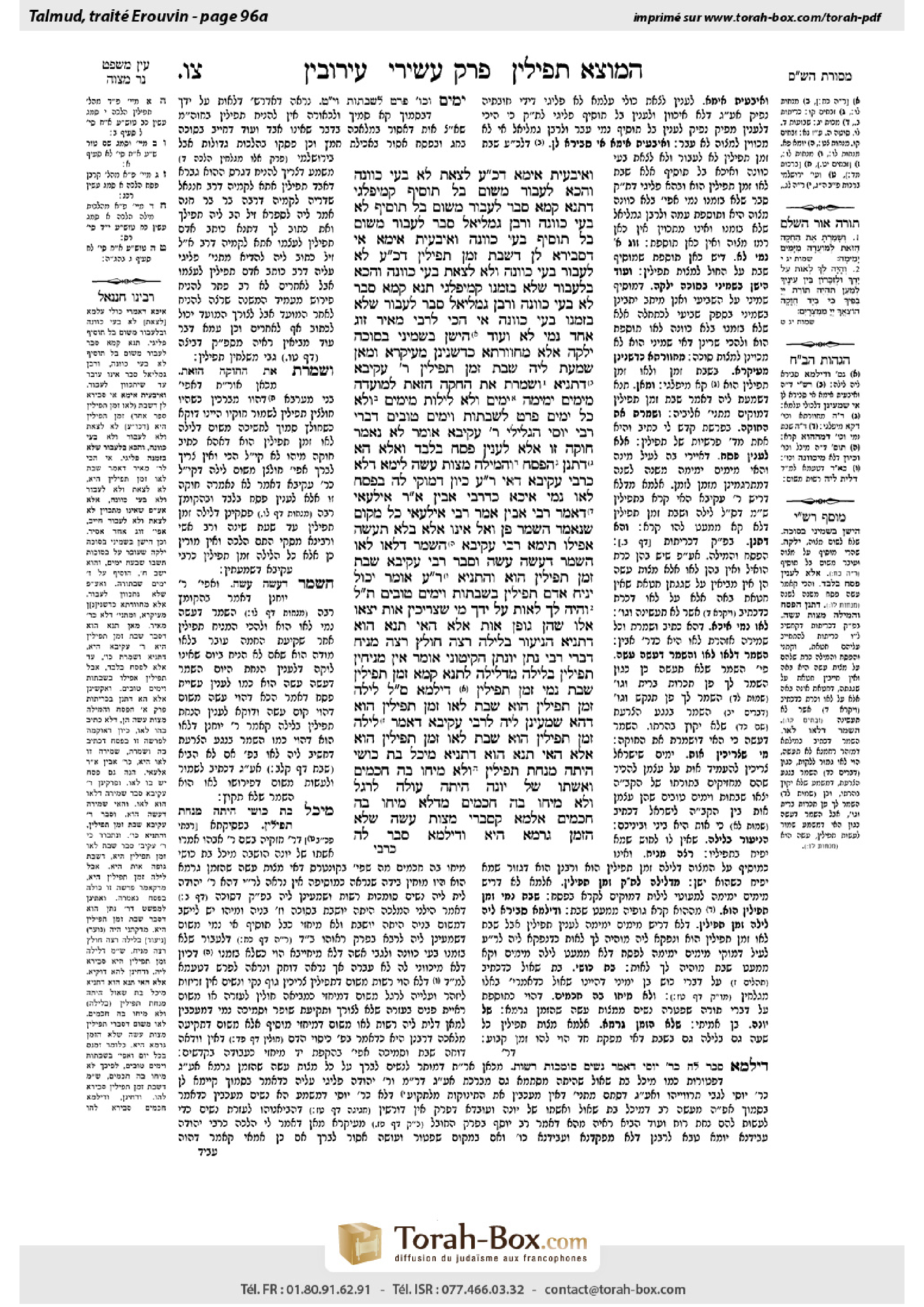
Eruvin 96a: Talmud study for Daf Yomi
Study the Talmud for Daf Yomi with scanned pages, Hebrew text, English translations from Sefaria and AI-generated French translations.
Passage selection and English or AI-generated French translation are available where the scan has annotations. Daf Study is independent of Torah-Box and Sefaria.
Browse Eruvin · עירובין · All tractatesEruvin 96a text and translations
This page of Eruvin includes the Aramaic text, an English translation and an AI-generated French translation, alongside the scan above.
עירובין צ״ו א · Aramaic and Hebrew text
וְאִיבָּעֵית אֵימָא: דְּכוּלֵּי עָלְמָא לָצֵאת לָא בָּעֵי כַּוּוֹנָה, וְהָכָא לַעֲבוֹר מִשּׁוּם ״בַּל תּוֹסִיף״ קָמִיפַּלְגִי, דְּתַנָּא קַמָּא סָבַר: לַעֲבוֹר מִשּׁוּם ״בַּל תּוֹסִיף״ לָא בָּעֵי כַּוּוֹנָה. וְרַבָּן גַּמְלִיאֵל סָבַר: לַעֲבוֹר מִשּׁוּם ״בַּל תּוֹסִיף״ בָּעֵי כַּוּוֹנָה.
וְאִיבָּעֵית אֵימָא: אִי דִּסְבִירָא לַן דְּשַׁבָּת זְמַן תְּפִילִּין — דְּכוּלֵּי עָלְמָא לָא לַעֲבוֹר בָּעֵי כַּוּוֹנָה וְלָא לָצֵאת בָּעֵי כַּוּוֹנָה.
וְהָכָא בְּ״לַעֲבוֹר שֶׁלֹּא בִּזְמַנּוֹ״ קָמִיפַּלְגִי. תַּנָּא קַמָּא סָבַר: לָא בָּעֵי כַּוּוֹנָה. וְרַבָּן גַּמְלִיאֵל סָבַר: לַעֲבוֹר שֶׁלֹּא בִּזְמַנּוֹ בָּעֵי כַּוּוֹנָה.
אִי הָכִי, לְרַבִּי מֵאִיר זוּג אֶחָד נָמֵי לָא.
וְעוֹד: הַיָּשֵׁן בַּשְּׁמִינִי בְּסוּכָּה יִלְקֶה! אֶלָּא מְחַוַּורְתָּא כִדְשַׁנִּינַן מֵעִיקָּרָא.
וּמַאן שָׁמְעַתְּ לֵיהּ שַׁבָּת זְמַן תְּפִילִּין? רַבִּי עֲקִיבָא. דְּתַנְיָא: ״וְשָׁמַרְתָּ אֶת הַחֻקָּה הַזֹּאת לְמוֹעֲדָהּ מִיָּמִים יָמִימָה״. ״יָמִים״ — וְלֹא לֵילוֹת. ״מִיָּמִים״ — וְלֹא כׇּל יָמִים, פְּרָט לְשַׁבָּתוֹת וְיָמִים טוֹבִים, דִּבְרֵי רַבִּי יוֹסֵי הַגְּלִילִי.
רַבִּי עֲקִיבָא אוֹמֵר: לֹא נֶאֱמַר חוּקָּה זוֹ אֶלָּא לְעִנְיַן פֶּסַח בִּלְבַד.
וְאֶלָּא הָא דִּתְנַן: הַפֶּסַח וְהַמִּילָה מִצְוַת עֲשֵׂה — לֵימָא דְּלָא כְּרַבִּי עֲקִיבָא, דְּאִי רַבִּי עֲקִיבָא — כֵּיוָן דְּמוֹקֵי לָהּ בְּפֶסַח, לָאו נָמֵי אִיכָּא, כִּדְרַבִּי אָבִין אָמַר רַבִּי אִילְעַאי. דְּאָמַר רַבִּי אָבִין אָמַר רַבִּי אִילְעַאי: כׇּל מָקוֹם שֶׁנֶּאֱמַר ״הִשָּׁמֶר״ ״פֶּן״ וְ״אַל״ — אֵינוֹ אֶלָּא בְּלֹא תַּעֲשֶׂה!
אֲפִילּוּ תֵּימָא רַבִּי עֲקִיבָא, ״הִשָּׁמֶר״ דְּלָאו — לָאו, ״הִשָּׁמֶר״ דַּעֲשֵׂה — עֲשֵׂה.
וְסָבַר רַבִּי עֲקִיבָא שַׁבָּת זְמַן תְּפִילִּין הוּא?! וְהָתַנְיָא, רַבִּי עֲקִיבָא אוֹמֵר: יָכוֹל יַנִּיחַ אָדָם תְּפִילִּין בְּשַׁבָּתוֹת וְיָמִים טוֹבִים, תַּלְמוּד לוֹמַר: ״וְהָיָה לְךָ לְאוֹת עַל יָדְךָ״, מִי שֶׁצְּרִיכִין אוֹת, יָצְאוּ אֵלּוּ — שֶׁהֵן גּוּפָן אוֹת.
אֶלָּא הַאי תַּנָּא הוּא דְּתַנְיָא: הַנֵּיעוֹר בַּלַּיְלָה, רָצָה — חוֹלֵץ, רָצָה — מַנִּיחַ, דִּבְרֵי רַבִּי נָתָן. יוֹנָתָן הַקִּיטוֹנִי אוֹמֵר: אֵין מַנִּיחִין תְּפִילִּין בַּלַּיְלָה. מִדְּלַיְלָה לְתַנָּא קַמָּא זְמַן תְּפִילִּין — שַׁבָּת נָמֵי זְמַן תְּפִילִּין.
דִּילְמָא סְבִירָא לֵיהּ לַיְלָה זְמַן תְּפִילִּין הוּא, שַׁבָּת לָאו זְמַן תְּפִילִּין הוּא. דְּהָא שָׁמְעִינַן לֵיהּ לְרַבִּי עֲקִיבָא דְּאָמַר: לַיְלָה זְמַן תְּפִילִּין הוּא, שַׁבָּת לָאו זְמַן תְּפִילִּין הוּא!
אֶלָּא הַאי תַּנָּא הוּא דְּתַנְיָא: מִיכַל בַּת כּוּשִׁי הָיְתָה מַנַּחַת תְּפִילִּין וְלֹא מִיחוּ בָּהּ חֲכָמִים, וְאִשְׁתּוֹ שֶׁל יוֹנָה הָיְתָה עוֹלָה לָרֶגֶל וְלֹא מִיחוּ בָּהּ חֲכָמִים. מִדְּלֹא מִיחוּ בָּהּ חֲכָמִים — אַלְמָא קָסָבְרִי מִצְוַת עֲשֵׂה שֶׁלֹּא הַזְּמַן גְּרָמָא הִיא.
וְדִילְמָא סָבַר לַהּ
Eruvin 96a · English translation
And if you wish, say instead that everyone agrees that to fulfill a mitzva one does not need intent, and here they disagree with regard to the condition needed to violate the prohibition: Do not add to mitzvot of the Torah. As the first tanna holds that one does not need intent to violate the prohibition: Do not add to mitzvot. One who dons another pair of phylacteries transgresses the prohibition against adding to mitzvot even if he does not don them with the intention of fulfilling the mitzva. And Rabban Gamliel holds that in order to violate the prohibition: Do not add to mitzvot, one needs intent to perform a mitzva. Since in this case one’s intention is merely to move the phylacteries to a safer place, he may don a second pair.
And if you wish, say instead that the dispute may be explained as follows. If we were to maintain that Shabbat is a fit time for donning phylacteries, everyone would agree that one does not need intent to violate the prohibition against adding to mitzvot, nor does one need intent to fulfill a mitzva. In this case, one’s intention has no bearing on his action.
However, here, they disagree with regard to the condition for violating the prohibition against adding to a mitzva not in its proper time, i.e., when a mitzva is performed not at its prescribed time. The first tanna holds that if the act of a mitzva is performed not in its proper time, one does not need intent; that is, even if one does not intend to perform the mitzva he nonetheless violates the prohibition against adding to mitzvot by his action alone. Consequently, in this case, a person may not don more than one pair of phylacteries. And Rabban Gamliel holds that to violate the prohibition against adding to a mitzva not in its proper time, one needs intent to fulfill the mitzva. Without such intent one does not violate the prohibition, and therefore in this case he may don a second pair of phylacteries.
With regard to this last explanation the Gemara asks: If so, according to the opinion of Rabbi Meir one should not even don one pair of phylacteries. According to Rabbi Meir’s opinion, one who does so violates the prohibition against adding to mitzvot merely by donning one pair, since he is fulfilling the mitzva of phylacteries at a time when he is not commanded to do so.
And furthermore, according to this opinion, one who sleeps in a sukka on the Eighth Day of Assembly should be flogged for violating the prohibition against adding to mitzvot, as he adds to the mitzva of: “You shall dwell in booths for seven days” (Leviticus 23:42). Yet the Sages instituted that outside of Eretz Yisrael, Jews must observe Sukkot for eight days, even though one who sleeps in a sukka on the eighth night outside of Eretz Yisrael transgresses a Torah law. Rather, it is clear as we originally answered, i.e., you must accept one of the other explanations.
Since the topic of phylacteries was discussed, the Gemara continues to explore this issue. Whom did you hear who said that Shabbat is a fit time for donning phylacteries? It is Rabbi Akiva, as it was taught in a baraita with regard to the end of the section in the Torah beginning with: “Sanctify all firstborns to me” (Exodus 13:2), which deals with the mitzvot of the Paschal lamb and phylacteries: “And you shall observe this ordinance in its season from year [miyamim] to year” (Exodus 13:10), which indicates that these mitzvot apply during the days [yamim] and not during the nights. Furthermore, the letter mem in “from year” [miyamim] teaches: But not on all days; this excludes Shabbat and Festivals, on which phylacteries are not worn. This is the statement of Rabbi Yosei HaGelili.
Rabbi Akiva says: This ordinance is stated only with regard to the Paschal lamb, and it does not refer to phylacteries at all. According to Rabbi Akiva, there is no reason to refrain from donning phylacteries on Shabbat and Festivals.
The Gemara asks: But with regard to that which we learned in a mishna that the Paschal lamb and circumcision are positive mitzvot, let us say that this statement is not in accordance with the opinion of Rabbi Akiva. The reason for this claim is that if you say this teaching is in accordance with the opinion of Rabbi Akiva, since he establishes this verse as referring to the Paschal lamb, this would mean that in failure to bring this offering there is also the violation of a negative mitzva, in accordance with the principle that Rabbi Avin said that Rabbi Elai said. As Rabbi Avin said that Rabbi Elai said: Any place where it is stated: Observe, lest, or do not, this means nothing other than a negative mitzva, as these are negative terms. Consequently, the verse “You shall observe this ordinance,” which refers to the Paschal lamb, constitutes a negative mitzva.
The Gemara rejects this: Even if you say that Rabbi Akiva holds that no negative mitzva applies to the Paschal lamb, it is not difficult, as an additional principle must be taken into account. Although it is true that the term observe with regard to a negative mitzva indicates the presence of another negative mitzva; that same term observe with regard to a positive mitzva has the force of a positive mitzva, as the Torah is warning adherents to take special care in the observance of a mitzva. The word observe in connection with the Paschal lamb is an example of this type of positive mitzva.
The Gemara returns to the issue at hand: And does Rabbi Akiva really hold that Shabbat is a time for donning phylacteries? Wasn’t it taught in a baraita that Rabbi Akiva says: I might have thought that a person should don phylacteries on Shabbatot and Festivals. Therefore, the verse states: “And it shall be for a sign for you on your arm, and for a remembrance between your eyes, so that God’s law shall be in your mouth; for with a strong arm God brought you out of Egypt” (Exodus 13:9). The obligation to don phylacteries applies when Jews require a sign to assert their Judaism and their status as the Chosen People, i.e., during the week, excluding Shabbat and Festivals, as they are themselves signs of Israel’s status as the Chosen People and a remembrance of the exodus from Egypt. Consequently, no further sign is required on these days. This teaching proves that Rabbi Akiva maintains that Shabbat is not a fit time for donning phylacteries.
Rather, it is this tanna, Rabbi Natan, who maintains that Shabbat is a fit time for donning phylacteries, as it was taught in a baraita: With regard to one who is awake at night, if he wishes he may remove his phylacteries, and if he wishes he may continue to don them, and he need not worry about violating the prohibition against adding to mitzvot. This is the statement of Rabbi Natan. Yonatan HaKitoni says: One may not don phylacteries at night. From the fact that according to the first tanna, Rabbi Natan, night is a fit time for phylacteries, it may be inferred that Shabbat, too, is a time for donning phylacteries, as Rabbi Natan evidently does not accept Rabbi Yosei HaGelili’s limitation based on the phrase: From year to year.
The Gemara rejects this contention: This is not a conclusive proof, as perhaps he holds that although night is a fit time for phylacteries, Shabbat is not a fit time for phylacteries. As we have heard that Rabbi Akiva said that night is a time for phylacteries, because he does not accept the limitation of “from days to days,” and yet he maintains that Shabbat is not a time for phylacteries, as no sign is required on Shabbat. It is therefore possible that Rabbi Natan holds the same opinion.
Rather, we must say that it is this tanna who maintains that Shabbat is a time for phylacteries, as it was taught in a baraita: Michal, daughter of Kushi, King Saul, would don phylacteries, and the Sages did not protest against her behavior, as she was permitted to do so. And similarly, Jonah’s wife would undertake the Festival pilgrimage and the Sages did not protest against her practice. From the fact that the Sages did not protest against Michal’s donning phylacteries, it is apparent that these Sages hold that phylacteries is a positive mitzva not bound by time, i.e., it is a mitzva whose performance is mandated at all times, including nights and Shabbat. There is an accepted principle that women are obligated in all positive mitzvot not bound by time.
The Gemara rejects this contention: But perhaps that tanna holds
Eruvin 96a · Traduction française (IA)
Et si tu veux, dis plutôt que tout le monde est d'accord sur le fait que pour accomplir une mitsva, on n'a pas besoin d'intention, et ici ils s'entendent sur la condition nécessaire pour enfreindre la prohibition : Ne fais pas de mitsva à l'excès. Comme le premier tanna considère que l'on n'a pas besoin d'intention pour enfreindre la prohibition : Ne fais pas de mitsva à l'excès. Celui qui porte un autre couple de phylactères transgresse la prohibition de faire de mitsva à l'excès même s'il ne les porte pas avec l'intention d'accomplir la mitsva. Et Rabban Gamliel considère que pour enfreindre la prohibition : Ne fais pas de mitsva à l'excès, on a besoin d'intention d'accomplir une mitsva. Puisque dans ce cas l'intention est simplement de déplacer les phylactères vers un endroit plus sûr, il peut porter un second couple.
Et si tu veux, dis plutôt que ce débat peut être expliqué ainsi. Si nous avions maintenu que le Sabbat est un moment approprié pour porter les phylactères, tout le monde serait d'accord sur le fait que l'on n'a pas besoin d'intention pour enfreindre la prohibition de faire de mitsva à l'excès, ni d'intention pour accomplir une mitsva. Dans ce cas, l'intention n'a pas d'effet sur l'action.
Cependant, ici, ils s'entendent sur la condition pour enfreindre la prohibition de faire de mitsva à l'excès en dehors du moment approprié, c'est-à-dire lorsque la mitsva est accomplie en dehors du moment prescrit. Le premier tanna considère que si l'acte d'une mitsva est accompli en dehors du moment approprié, l'on n'a pas besoin d'intention ; c'est-à-dire, même si l'on n'a pas l'intention d'accomplir la mitsva, l'on enfreint la prohibition de faire de mitsva à l'excès par l'action seule. Ainsi, dans ce cas, une personne ne doit pas porter plus d'un couple de phylactères. Et Rabban Gamliel considère que pour enfreindre la prohibition de faire de mitsva à l'excès en dehors du moment approprié, l'on a besoin d'intention d'accomplir la mitsva. Sans cette intention, l'on ne transgresse pas la prohibition, et par conséquent, dans ce cas, il peut porter un second couple de phylactères.
Concernant cette dernière explication, le Guemara pose la question : Si c'est ainsi, selon l'opinion de Rabbi Meir, on ne devrait même pas porter un seul couple de phylactères. Selon l'opinion de Rabbi Meir, celui qui le fait transgresse la prohibition de l'ajout à la mitsva simplement en portant un seul couple, car il accomplit la mitsva des phylactères à un moment où il n'est pas commandé à le faire.
Et de plus, selon cette opinion, celui qui dort dans une sukkah le huitième jour de la fête doit être battu pour avoir enfreint la prohibition de l'ajout à la mitsva, car il ajoute à la mitsva : « Vous habiterez dans des huttes sept jours » (Lévitique 23:42). Cependant, les Sages ont institué que hors de la Terre d'Israël, les Juifs doivent observer la fête de la Sucot pendant huit jours, même si celui qui dort dans une sukkah le huitième nuit hors de la Terre d'Israël transgresse une loi de la Torah. Plutôt, il est clair comme nous l'avons déjà répondu, c'est-à-dire que vous devez accepter l'une des autres explications.
Puisque le sujet des phylactères a été discuté, le Guemara continue à explorer cette question. Qui as-tu entendu dire que le Sabbat est un moment approprié pour porter les phylactères ? C'est Rabbi Akiva, comme il a été enseigné dans une baraïta concernant la fin de la section du Torah commençant par : « Sanctifie tous les premiers-nés à moi » (Exode 13:2), qui traite des mitsvot duagne et des phylactères : « Et tu observeras cette ordonnance en son temps de l'année à l'année » (Exode 13:10), ce qui indique que ces mitsvot s'appliquent aux jours [yamim] et non aux nuits. De plus, la lettre mem dans « de l'année » [miyamim] enseigne : Mais pas sur tous les jours ; cela exclut le Sabbat et les fêtes, auxquels les phylactères ne sont pas portés. C'est la déclaration de Rabbi Yosei HaGelili.
Rabbi Akiva dit : Cette ordonnance est mentionnée uniquement concernant leagne, et elle ne s'applique pas du tout aux phylactères. Selon Rabbi Akiva, il n'y a pas de raison de ne pas porter les phylactères le Sabbat et les fêtes.
Le Guemara pose la question : Mais concernant ce que nous avons appris dans une mitsna que leagne et la circoncision sont des mitsvot positives, disons que cette déclaration ne correspond pas à l'opinion de Rabbi Akiva. La raison de cette affirmation est que si tu dis que cette enseignement correspond à l'opinion de Rabbi Akiva, puisque il établit cette verset concernant leagne, cela signifierait que l'absence de ce sacrifice entraîne aussi la violation d'une mitsva négative, selon le principe que Rabbi Avin a dit que Rabbi Elai a dit. Comme Rabbi Avin a dit que Rabbi Elai a dit : Tout lieu où il est dit : Observe, que, ou ne, cela ne signifie rien d'autre qu'une mitsva négative, car ces sont des termes négatifs. Ainsi, le verset « Tu observeras cette ordonnance », qui concerne leagne, constitue une mitsva négative.
Le Guemara rejette cela : Même si tu dis que Rabbi Akiva considère que aucune mitsva négative ne s'applique auagne, cela n'est pas difficile, car un autre principe doit être pris en compte. Bien que ce soit vrai que le terme « observe » concernant une mitsva négative indique la présence d'une autre mitsva négative ; le même terme « observe » concernant une mitsva positive a la force d'une mitsva positive, car la Torah est avertie de prendre soin de l'observance d'une mitsva. Le mot « observe » en lien avec leagne est un exemple de ce type de mitsva positive.
La Guemara reprend l’affaire en question : Rabbi Akiva affirme-t-il vraiment que le Shabbat est un moment approprié pour porter les phylactères ? N’a-t-il pas été enseigné dans une baraïta que Rabbi Akiva dit : Je craignais que l’on doive porter les phylactères le Shabbat et les fêtes. Par conséquent, la Sainte Écriture dit : « Et cela sera pour toi un signe sur ton bras, et un souvenir entre tes yeux, afin que la loi de Dieu soit sur ta bouche ; car c’est avec un bras puissant que Dieu t’a tiré d’Égypte » (Exode 13:9). L’obligation de porter les phylactères s’applique lorsque les Juifs ont besoin d’un signe pour affirmer leur judaïsme et leur statut de peuple élu, c’est-à-dire durant la semaine, excluant le Shabbat et les fêtes, car ceux-ci sont eux-mêmes des signes du statut de peuple élu des Israélites et un souvenir de l’Exode d’Égypte. Ainsi, aucun autre signe n’est requis ces jours-là. Cet enseignement démontre que Rabbi Akiva considère que le Shabbat n’est pas un moment approprié pour porter les phylactères.
Au contraire, c’est ce tanna, Rabbi Natan, qui affirme que le Shabbat est un moment approprié pour porter les phylactères, comme il a été enseigné dans une baraïta : Concernant celui qui est réveillé la nuit, s’il le souhaite, il peut ôter ses phylactères, et s’il le souhaite, il peut continuer à les porter, et il n’a pas à craindre de violer l’interdiction d’ajouter à la Mitsva. C’est la déclaration de Rabbi Natan. Yonatan HaKitoni dit : On ne peut pas porter les phylactères la nuit. D’après le premier tanna, Rabbi Natan, la nuit est un moment approprié pour les phylactères, on peut en déduire que le Shabbat l’est aussi, car Rabbi Natan ne semble pas accepter la limitation basée sur la phrase : « De jour en jour ».
La Guemara rejette cette argumentation : Ce n’est pas une preuve concluante, car peut-être il considère que bien que la nuit soit un moment approprié pour porter les phylactères, le Shabbat ne l’est pas. Comme nous avons entendu que Rabbi Akiva disait que la nuit est un moment approprié pour porter les phylactères, car il ne reconnaît pas la limitation de « de jour en jour », et pourtant il considère que le Shabbat n’est pas un moment approprié pour porter les phylactères, car aucun signe n’est requis le Shabbat. Il est donc possible que Rabbi Natan partage l’opinion de Rabbi Akiva.
Au contraire, nous devons dire que c’est ce tanna qui affirme que le Shabbat est un moment approprié pour porter les phylactères, comme il a été enseigné dans une baraïta : Michal, fille de Kushi, roi Saül, portait les phylactères, et les Sages n’ont pas protesté contre son comportement, car elle était autorisée à le faire. De même, la femme de Jonas entreprenait le pèlerinage festif et les Sages n’ont pas protesté contre sa pratique. Le fait que les Sages n’aient pas protesté contre le port des phylactères par Michal montre clairement que ces Sages considèrent que le port des phylactères est une Mitsva positive non soumise à la limitation du temps, c’est-à-dire une Mitsva dont l’accomplissement est requis à tout moment, y compris la nuit et le Shabbat. Il existe un principe reconnu selon lequel les femmes sont tenues de toutes les Mitsvot positives non soumises à la limitation du temps.
La Guemara rejette cette argumentation : Mais peut-être que ce tanna considère que
Traduction française générée par IA à partir de l’édition anglaise de Sefaria. Vérifie toujours un passage avec le texte source.
Text from Sefaria: William Davidson Edition - Vocalized Aramaic (CC BY NC); William Davidson Edition - English (CC BY NC).