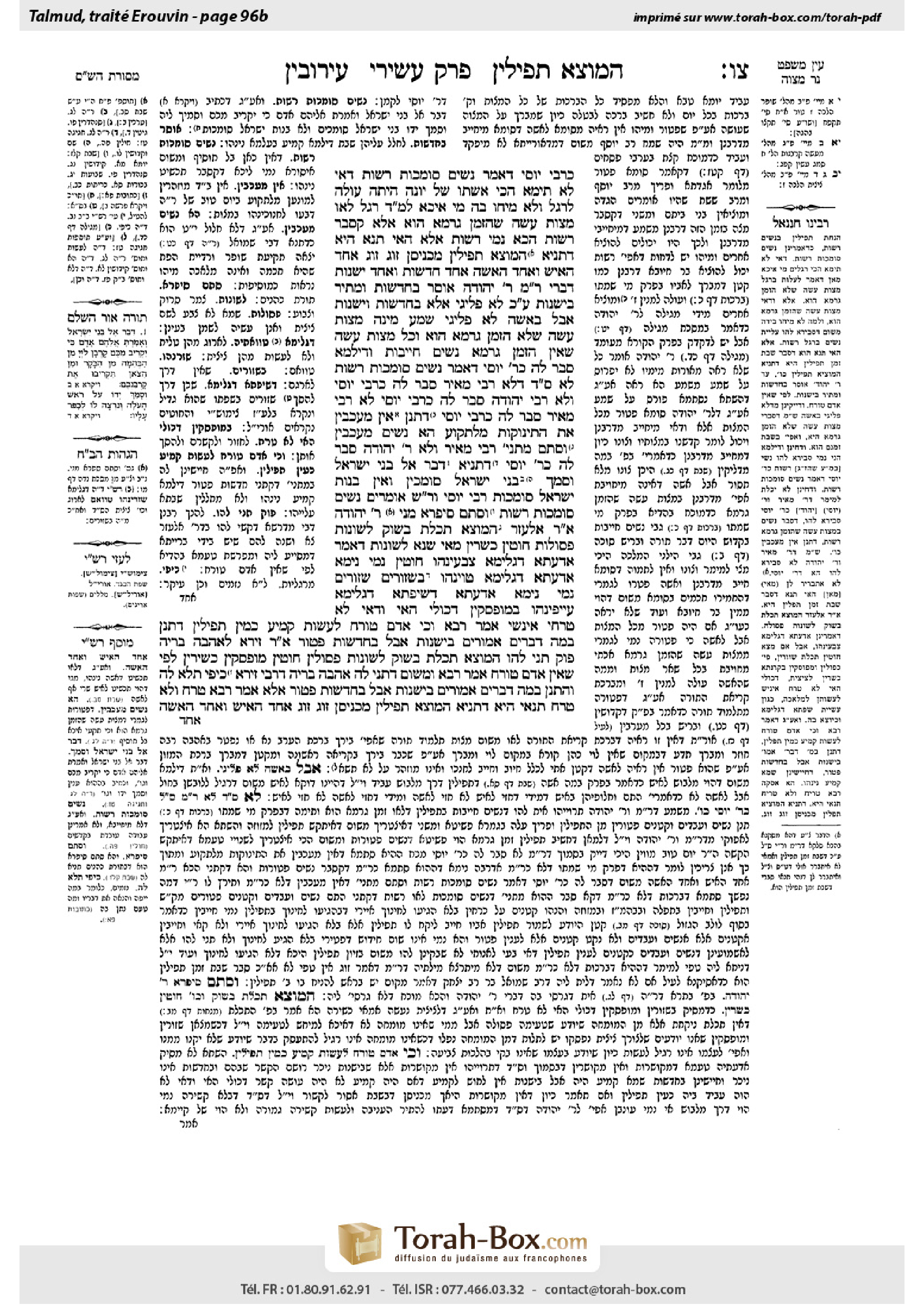
Eruvin 96b: Talmud study for Daf Yomi
Study the Talmud for Daf Yomi with scanned pages, Hebrew text, English translations from Sefaria and AI-generated French translations.
Passage selection and English or AI-generated French translation are available where the scan has annotations. Daf Study is independent of Torah-Box and Sefaria.
Browse Eruvin · עירובין · All tractatesEruvin 96b text and translations
This page of Eruvin includes the Aramaic text, an English translation and an AI-generated French translation, alongside the scan above.
עירובין צ״ו ב · Aramaic and Hebrew text
כְּרַבִּי יוֹסֵי, דְּאָמַר: נָשִׁים סוֹמְכוֹת רְשׁוּת.
דְּאִי לָא תֵּימָא הָכִי, אִשְׁתּוֹ שֶׁל יוֹנָה הָיְתָה עוֹלָה לָרֶגֶל וְלֹא מִיחוּ בָּהּ, מִי אִיכָּא לְמַאן דְּאָמַר רֶגֶל לָאו מִצְוַת עֲשֵׂה שֶׁהַזְּמַן גְּרָמָא הוּא? אֶלָּא קָסָבַר רְשׁוּת, הָכָא נָמֵי רְשׁוּת.
אֶלָּא הַאי תַּנָּא הִיא דְּתַנְיָא: הַמּוֹצֵא תְּפִילִּין, מַכְנִיסָן זוּג זוּג. אֶחָד הָאִישׁ וְאֶחָד הָאִשָּׁה, אֶחָד חֲדָשׁוֹת וְאֶחָד יְשָׁנוֹת, דִּבְרֵי רַבִּי מֵאִיר. רַבִּי יְהוּדָה אוֹסֵר בַּחֲדָשׁוֹת, וּמַתִּיר בִּישָׁנוֹת.
עַד כָּאן לָא פְּלִיגִי אֶלָּא בַּחֲדָשׁוֹת וִישָׁנוֹת, אֲבָל בְּאִשָּׁה לָא פְּלִיגִי. שְׁמַע מִינַּהּ מִצְוַת עֲשֵׂה שֶׁלֹּא הַזְּמַן גְּרָמָא הוּא, וְכׇל מִצְוַת עֲשֵׂה שֶׁאֵין הַזְּמַן גְּרָמָא נָשִׁים חַיָּיבוֹת.
וְדִילְמָא סָבַר לַהּ כְּרַבִּי יוֹסֵי, דְּאָמַר: נָשִׁים סוֹמְכוֹת רְשׁוּת? לָא סָלְקָא דַעְתָּךְ דְּלָא רַבִּי מֵאִיר סָבַר לַהּ כְּרַבִּי יוֹסֵי, וְלָא רַבִּי יְהוּדָה סָבַר לַהּ כְּרַבִּי יוֹסֵי
לָא רַבִּי מֵאִיר סָבַר לַהּ כְּרַבִּי יוֹסֵי, דִּתְנַן: אֵין מְעַכְּבִין אֶת הַתִּינוֹקוֹת מִלִּתְקוֹעַ. הָא נָשִׁים מְעַכְּבִין — וּסְתָם מַתְנִיתִין רַבִּי מֵאִיר.
וְלָא רַבִּי יְהוּדָה סָבַר לַהּ כְּרַבִּי יוֹסֵי, דְּתַנְיָא: ״דַּבֵּר אֶל בְּנֵי יִשְׂרָאֵל ... וְסָמַךְ״, בְּנֵי יִשְׂרָאֵל סוֹמְכִין וְאֵין בְּנוֹת יִשְׂרָאֵל סוֹמְכוֹת. רַבִּי יוֹסֵי וְרַבִּי שִׁמְעוֹן אוֹמְרִים: נָשִׁים סוֹמְכוֹת רְשׁוּת.
וּסְתָם סִיפְרָא מַנִּי — רַבִּי יְהוּדָה.
אָמַר רַבִּי אֶלְעָזָר: הַמּוֹצֵא תְּכֵלֶת בַּשּׁוּק, לְשׁוֹנוֹת — פְּסוּלוֹת, חוּטִין — כְּשֵׁרִין.
מַאי שְׁנָא לְשׁוֹנוֹת, דְּאָמַר: אַדַּעְתָּא דִגְלִימָא צַבְעִינְהוּ? חוּטִין נָמֵי, נֵימָא: אַדַּעְתָּא דִגְלִימָא טְוִינְהוּ! בִּשְׁזוּרִים.
שְׁזוּרִים נָמֵי, נֵימָא: אַדַּעְתָּא דְשִׂיפְתָּא דִגְלִימָא עַיְיפִינְהוּ! בְּמוּפְסָקִין, דְּכוּלֵּי הַאי וַדַּאי לָא טָרְחִי אִינָשֵׁי.
אָמַר רָבָא: וְכִי אָדָם טוֹרֵחַ לַעֲשׂוֹת קָמֵיעַ כְּמִין תְּפִילִּין? דִּתְנַן: בַּמֶּה דְּבָרִים אֲמוּרִים, בִּישָׁנוֹת. אֲבָל בַּחֲדָשׁוֹת — פָּטוּר.
אָמַר רַבִּי זֵירָא לְאַהֲבָה בְּרֵיהּ: פּוֹק תְּנִי לְהוּ: הַמּוֹצֵא תְּכֵלֶת בַּשּׁוּק, לְשׁוֹנוֹת — פְּסוּלִין, חוּטִין מוּפְסָקִין — כְּשֵׁירִין, לְפִי שֶׁאֵין אָדָם טוֹרֵחַ.
אָמַר רָבָא: וּמִשּׁוּם דְּתָנֵי לַהּ אַהֲבָה בְּרֵיהּ דְּרַבִּי זֵירָא כֵּיפֵי תְּלָא לַהּ?! וְהָתְנַן: בַּמֶּה דְּבָרִים אֲמוּרִים — בִּישָׁנוֹת, אֲבָל בַּחֲדָשׁוֹת — פָּטוּר!
אֶלָּא אָמַר רָבָא: טָרַח וְלָא טָרַח — תַּנָּאֵי הִיא.
דְּתַנְיָא: הַמּוֹצֵא תְּפִילִּין — מַכְנִיסָן זוּג זוּג, אֶחָד הָאִישׁ וְאֶחָד הָאִשָּׁה,
Eruvin 96b · English translation
in accordance with the opinion of Rabbi Yosei, who said: It is optional for women to place their hands on the head of a sacrificial animal before it is slaughtered. Although only men have this obligation, women may perform that rite if they wish. Similarly, women may perform other mitzvot that they have no obligation to fulfill.
As, if you do not say so, that this tanna holds in accordance with the opinion of Rabbi Yosei, the baraita states that Jonah’s wife would ascend to Jerusalem for the Festival pilgrimage and the Sages did not reprimand her. Is there anyone who says that the mitzva of Festival pilgrimage is not a time-bound positive mitzva and that women are obligated to fulfill it? Rather, he holds that she did not embark on the pilgrimage as an obligation, but that it was optional; here, too, with regard to phylacteries, it is optional. Consequently, no proof can be cited from this baraita as to whether or not Shabbat is a fit time for phylacteries.
Rather, who is the tanna who maintains that Shabbat is a time for phylacteries? It is this tanna who taught the halakha, as it was taught in the Tosefta: One who finds phylacteries brings them in pair by pair, whether the finder is a man or whether she is a woman, and whether the phylacteries are new or whether they are old. This is the statement of Rabbi Meir. Rabbi Yehuda prohibits bringing in new phylacteries since they might merely be amulets in the form of phylacteries, but he permits bringing in old ones, which are certainly valid phylacteries.
Analysis of this Tosefta indicates that Rabbi Meir and Rabbi Yehuda disagree only with regard to the issue of new phylacteries and old ones; however, with regard to a woman bringing in the phylacteries, they do not disagree that it is permitted. Learn from it that this tanna maintains that donning phylacteries is a positive mitzva not bound by time, and since women are obligated in every positive mitzva not bound by time, a woman may don these phylacteries and walk into the town.
The Gemara attempts to refute this. But perhaps that tanna holds in accordance with the opinion of Rabbi Yosei, who said: It is optional for women to place their hands on the head of a sacrificial animal before it is slaughtered. Here too, perhaps it is optional for women to don phylacteries. The Gemara answers: This cannot enter your mind, as neither Rabbi Meir holds in accordance with the opinion of Rabbi Yosei, nor does Rabbi Yehuda hold in accordance with the opinion of Rabbi Yosei, as the Gemara proceeds to prove.
Neither Rabbi Meir holds in accordance with the opinion of Rabbi Yosei, as we learned in a mishna: One need not prevent children from sounding the shofar on Rosh HaShana. Although there is an element of prohibition in sounding the shofar when there is no obligation to do so, since the children will one day be obligated to sound the shofar, one need not prevent them from doing so and learning. It may be inferred from here that one must prevent women from sounding the shofar. And an unattributed mishna is in accordance with the opinion of Rabbi Meir, indicating that according to Rabbi Meir, a woman does not even have the option of performing a time-bound positive mitzva.
Nor does Rabbi Yehuda hold in accordance with the opinion of Rabbi Yosei, as it was taught in the Sifra, the halakhic midrash on Leviticus. The verse states: “Speak to the sons of Israel…and he shall place his hands on the head of the burnt-offering” (Leviticus 1:2–4). By inference, the sons of Israel place their hands, but the daughters of Israel do not place their hands. Rabbi Yosei and Rabbi Shimon say: It is optional for women to place their hands on the head of a sacrificial animal before it is slaughtered.
And who is the author of an unattributed Sifra? It is Rabbi Yehuda. This teaching proves that Rabbi Yehuda maintains that women do not have the option of placing their hands on a sacrifice. Neither Rabbi Meir nor Rabbi Yehuda accepts Rabbi Yosei’s opinion that it is optional for women to perform time-bound positive mitzvot; therefore, the tanna who cited their opinions that a woman may bring in phylacteries on Shabbat maintains that the mitzva of phylacteries is not time-bound and is in effect even on Shabbat, which is why even women are obligated.
Rabbi Elazar said: With regard to one who one finds fabric dyed sky blue in the marketplace, if he found strips of combed and dyed wool they are unfit for use as ritual fringes. The sky blue threads used in ritual fringes must be spun and dyed for the purpose of the mitzva, and these strips might have been dyed for a different purpose. However, if one found sky blue threads, they are fit for use in ritual fringes, as it can be assumed they were prepared for that purpose.
The Gemara asks: What is different about strips that renders them unfit? It is because Rabbi Elazar said: One dyed the strips with the intent to use them for a cloak. If so, with regard to threads as well, let us say: One spun them with the intent to use them for a cloak. In that case, they too would be deemed unfit. The Gemara answers: Here, it is referring to threads that are twisted, which are not typically used for weaving.
The Gemara asks: With regard to twisted threads as well, let us say that one twisted them with the intent of attaching them to the hem of a cloak as ornamentation. The Gemara answers: It is referring to twisted threads that were cut into short strings suitable for use as ritual fringes, as people certainly do not exert themselves and fashion fringes of a cloak to resemble ritual fringes.
Rava said: The assertion that people do not exert themselves is problematic, as by the same token, does a person exert himself to fashion an amulet in the form of phylacteries? Nevertheless, the Sages were concerned that an object that appears to be phylacteries might actually be a different object. As we learned in a mishna: In what case is this statement that one is permitted to carry phylacteries inside on Shabbat said? It is with regard to old phylacteries. However, with regard to new ones, he is exempt from the obligation to bring them in, as it is possible that they are not phylacteries but amulets in the form of phylacteries. Similarly, there should be concern lest people fashion items similar to objects used for a mitzva, even if exertion is involved.
Rabbi Zeira said to his son Ahava: Go out and teach this baraita to the Sages. With regard to one who finds fabric dyed sky blue in the marketplace, if he finds strips, they are unfit for use in ritual fringes; however, if he finds threads cut into short strings, they are fit for use in ritual fringes because a person does not exert himself. Apparently, that is the reason for the halakha.
Rava said: And because Ahava, son of Rabbi Zeira, taught this halakha, has he hung ornamental rings on that line of reasoning, i.e., does that constitute an absolute proof? The difficulty posed by Rava from the mishna is not resolved by the baraita, as we learned: In what case is this statement that one is permitted to carry phylacteries inside said? It is with regard to old phylacteries. However, with regard to new ones, he is exempt. Apparently, there is concern lest one exert himself to fashion an object similar to one used in a mitzva.
Rather, Rava said: The sources are not contradictory, as the question of whether one exerts himself or does not exert himself is the subject of a dispute between tanna’im. Some hold that one exerts himself as indicated by the mishna with regard to phylacteries, whereas others hold that one does not exert himself as stated with regard to sky blue dye.
As it was taught in the Tosefta: One who finds phylacteries in a field brings them in to the town pair by pair, whether the finder is a man or a woman,
Eruvin 96b · Traduction française (IA)
selon l'opinion du Rabbi Yosei, qui disait : il est facultatif pour les femmes de poser leurs mains sur la tête d'un animal sacrifié avant qu'il ne soit tué. Bien que cette obligation appartienne uniquement aux hommes, les femmes peuvent effectuer ce rite si elles le souhaitent. De même, les femmes peuvent accomplir d'autres mitsvot qu'elles n'ont pas d'obligation de remplir.
Car, si l'on ne dit pas cela, c'est-à-dire que ce tanna suit l'opinion du Rabbi Yosei, la baraïta dit que la femme de Jonas montait à Jérusalem pour le pèlerinage des fêtes et les Sages ne l'ont pas réprimandée. Y a-t-il quelqu'un qui dise que la mitsva du pèlerinage des fêtes n'est pas une mitsva positive liée à un temps et que les femmes sont tenues de l'accomplir ? Plutôt, il maintient qu'elle n'a pas entrepris le pèlerinage en vertu d'une obligation, mais qu'il s'agissait d'une option ; ici aussi, concernant les phylactères, il s'agit d'une option. Ainsi, aucune preuve ne peut être tirée de cette baraïta pour savoir si le Shabbat est un moment approprié pour les phylactères.
Plutôt, qui est le tanna qui affirme que le Shabbat est un moment pour les phylactères ? C'est ce tanna qui a enseigné la halakha, comme il est dit dans la Tosefta : celui qui trouve des phylactères les apporte par paires, qu'il s'agisse d'un homme ou d'une femme, et qu'ils soient nouveaux ou anciens. C'est la déclaration du Rabbi Meir. Le Rabbi Yehuda interdit d'apporter des phylactères nouveaux, car ils pourraient simplement être des amulettes en forme de phylactères, mais il permet d'apporter des phylactères anciens, qui sont certainement valides.
L'analyse de cette Tosefta indique que le Rabbi Meir et le Rabbi Yehuda ne s'opposent que concernant la question des phylactères nouveaux et anciens ; cependant, concernant la femme qui apporte les phylactères, ils ne s'opposent pas sur le fait qu'il est permis. Apprenez-en que ce tanna maintient que le port des phylactères est une mitsva positive non liée à un temps, et puisque les femmes sont tenues de toute mitsva positive non liée à un temps, une femme peut porter ces phylactères et marcher dans la ville.
La Guemara tente de réfuter cela. Mais peut-être que ce tanna suit l'opinion du Rabbi Yosei, qui disait : il est facultatif pour les femmes de poser leurs mains sur la tête d'un animal sacré avant qu'il ne soit tué. Ici aussi, peut-être il est facultatif pour les femmes de porter les phylactères. La Guemara répond : cela ne peut pas entrer dans votre esprit, car ni le Rabbi Meir ne suit l'opinion du Rabbi Yosei, ni le Rabbi Yehuda ne suit l'opinion du Rabbi Yosei, comme la Guemara continue à prouver.
Ni le Rabbi Meir ne suit l'opinion du Rabbi Yosei, comme nous l'avons appris dans une mitsna : on ne doit pas empêcher les enfants de sonner le cor à la Nouvelle Année. Bien qu'il y ait un élément de prohibition dans le son du cor lorsqu'il n'y a pas d'obligation de le faire, puisque les enfants seront un jour tenus de sonner le cor, on ne doit pas les empêcher de le faire et d'apprendre. On peut en déduire ici qu'on doit empêcher les femmes de sonner le cor. Et une mitsna non attribuée suit l'opinion du Rabbi Meir, indiquant que selon le Rabbi Meir, une femme n'a même pas l'option de accomplir une mitsva positive liée à un temps.
Ni le Rabbi Yehuda ne suit l'opinion du Rabbi Yosei, comme il a été enseigné dans la Sifra, le midrash halakhique sur le Lévitique. La versette dit : « Parle aux enfants d'Israël... et il posera ses mains sur la tête de l'holocauste » (Lévitique 1:2-4). Par déduction, les enfants d'Israël posent leurs mains, mais les filles d'Israël ne posent pas leurs mains. Le Rabbi Yosei et le Rabbi Shimon disent : il est facultatif pour les femmes de poser leurs mains sur la tête d'un animal sacré avant qu'il ne soit tué.
Et qui est l'auteur d'une Sifra non attribuée ? C'est le Rabbi Yehuda. Cet enseignement prouve que le Rabbi Yehuda maintient que les femmes n'ont pas l'option de poser leurs mains sur un sacrifice. Ni le Rabbi Meir ni le Rabbi Yehuda ne suivent l'opinion du Rabbi Yosei selon laquelle il est facultatif pour les femmes d'accomplir des mitsvot positives liées à un temps ; donc, le tanna qui a cité leurs opinions selon lesquelles une femme peut apporter des phylactères le sabbat maintient que la mitsva des phylactères n'est pas liée à un temps et est en vigueur même le sabbat, ce qui explique pourquoi même les femmes sont tenues.
Le Rabbi Elazar dit : concernant celui qui trouve un tissu teinté d'azur dans le marché, si il a trouvé des bandes de laine cardée et teintes, elles sont inutilisables comme franges rituelles. Les fils d'azur utilisés pour les franges rituelles doivent être tissés et teints à l'usage de la mitsva, et ces bandes pourraient avoir été teintes à d'autres fins. Cependant, si l'on trouve des fils d'azur, ils sont adaptés à l'usage en franges rituelles, car on peut supposer qu'ils ont été préparés à cet effet.
La Guemara demande : Qu'est-ce qui rend les bandes inutilisables ? C'est parce que le Rabbi Elazar dit : l'on a teint les bandes avec l'intention de les utiliser comme manteau. Si tel est le cas, concernant les fils également, disons : l'on a tissé les fils avec l'intention de les utiliser comme manteau. Dans ce cas, ils seraient également considérés comme inutilisables. La Guemara répond : ici, il s'agit de fils tordus, qui ne sont pas typiquement utilisés pour la tissage.
La Guemara demande : concernant les fils tordus également, disons que l'on a tordu les fils avec l'intention de les attacher au bas d'un manteau comme ornement. La Guemara répond : il s'agit de fils tordus qui ont été coupés en petits morceaux adaptés à l'usage en franges rituelles, car les gens ne se donnent pas la peine de faire des franges de manteau ressemblant aux franges rituelles.
Rava a dit : L'affirmation selon laquelle les gens ne se donnent pas de peine est problématique, car, par la même logique, un individu se donne-t-il lui-même la peine de fabriquer un amulet en forme de phylactères ? Cependant, les Sages avaient peur qu'un objet qui ressemble à des phylactères puisse en réalité être un autre objet. Comme nous l'avons appris dans une mitsna : Dans quel cas cette déclaration selon laquelle on est autorisé à transporter des phylactères à l'intérieur le sabbat est-elle dite ? C'est en ce qui concerne des phylactères anciens. Cependant, en ce qui concerne les nouveaux, il est dispensé de l'obligation de les ramener, car il est possible qu'ils ne soient pas des phylactères mais des amulets en forme de phylactères. De même, il y a lieu de craindre que les gens fabriquent des objets semblables à ceux utilisés pour une mitsva, même si la peine est impliquée.
Rabbi Zéira a dit à son fils Ahava : Sortez et enseignez cette baraïta aux Sages. En ce qui concerne celui qui trouve un tissu teinté d'un bleu ciel au marché, s'il trouve des bandes, elles ne sont pas adaptées à l'utilisation dans les franges rituelles ; cependant, s'il trouve des fils coupés en petits morceaux, ils sont adaptés à l'utilisation dans les franges rituelles car une personne ne se donne pas de peine. Apparemment, c'est la raison de cette halakha.
Rava a dit : Et puisque Ahava, fils de Rabbi Zéira, a enseigné cette halakha, a-t-il suspendu des anneaux décoratifs sur cette ligne de raisonnement, c'est-à-dire cela constituerait-il une preuve absolue ? La difficulté posée par Rava dans la mitsna n'est pas résolue par la baraïta, comme nous l'avons appris : Dans quel cas cette déclaration selon laquelle on est autorisé à transporter des phylactères à l'intérieur est-elle dite ? C'est en ce qui concerne des phylactères anciens. Cependant, en ce qui concerne les nouveaux, il est dispensé. Apparemment, il y a lieu de craindre que l'on se donne de la peine pour fabriquer un objet semblable à celui utilisé pour une mitsva.
Plutôt, Rava a dit : Les sources ne sont pas contradictoires, car la question de savoir si l'on se donne ou non de la peine est l'objet d'un débat entre les tannaïm. Certains pensent que l'on se donne de la peine, comme indiqué par la mitsna concernant les phylactères, tandis que d'autres pensent que l'on ne se donne pas de la peine, comme dit concernant la teinture bleue ciel.
Comme il a été enseigné dans la Tosefta : Celui qui trouve des phylactères dans un champ les apporte à la ville par paires, que le trouvère soit un homme ou une femme,
Traduction française générée par IA à partir de l’édition anglaise de Sefaria. Vérifie toujours un passage avec le texte source.
Text from Sefaria: William Davidson Edition - Vocalized Aramaic (CC BY NC); William Davidson Edition - English (CC BY NC).