Eruvin 97a: Talmud study for Daf Yomi
Study the Talmud for Daf Yomi with scanned pages, Hebrew text, English translations from Sefaria and AI-generated French translations.
Passage selection and English or AI-generated French translation are available where the scan has annotations. Daf Study is independent of Torah-Box and Sefaria.
Browse Eruvin · עירובין · All tractatesEruvin 97a text and translations
This page of Eruvin includes the Aramaic text, an English translation and an AI-generated French translation, alongside the scan above.
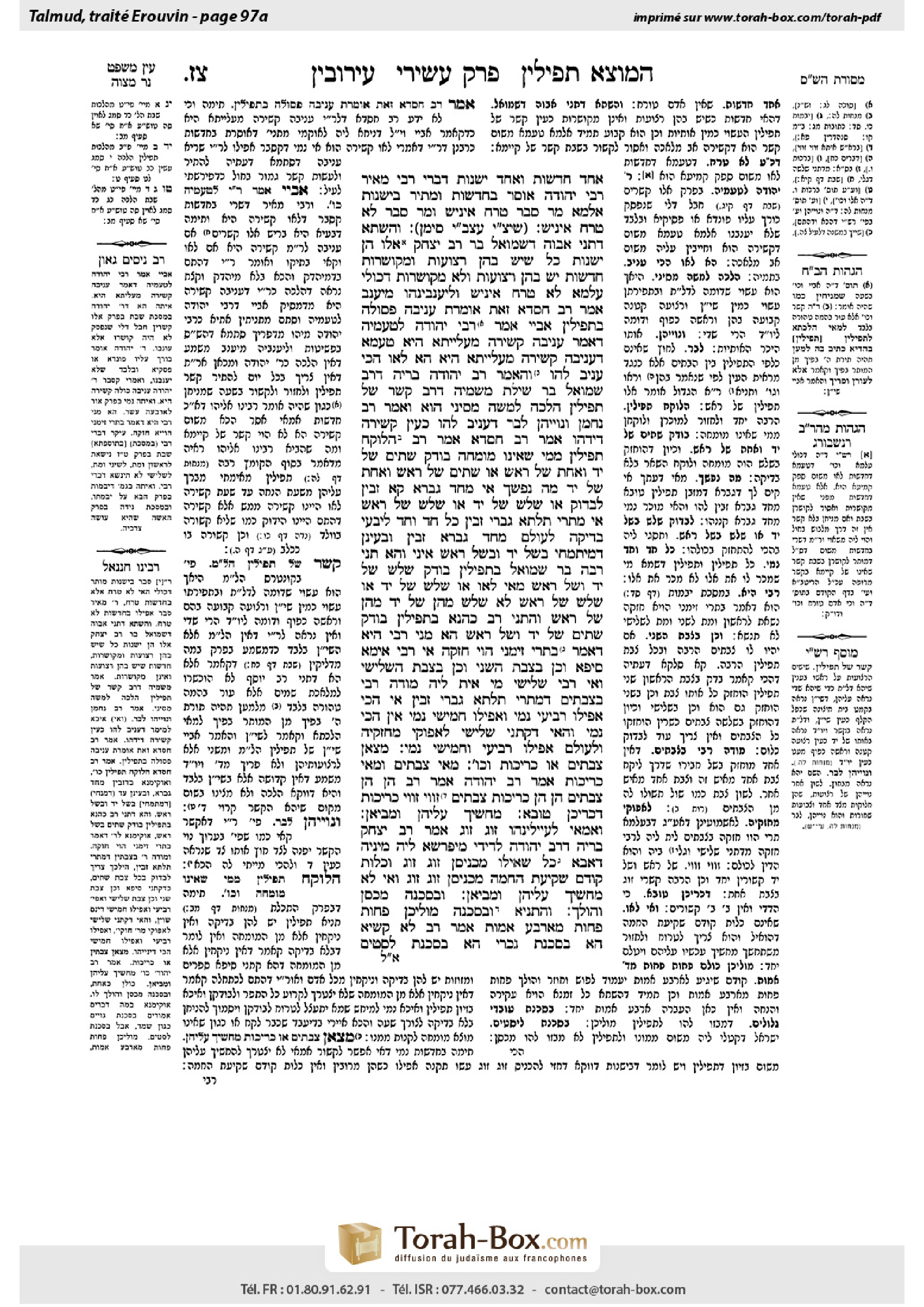
עירובין צ״ז א · Aramaic and Hebrew text
אֶחָד חֲדָשׁוֹת וְאֶחָד יְשָׁנוֹת, דִּבְרֵי רַבִּי מֵאִיר. רַבִּי יְהוּדָה אוֹסֵר בַּחֲדָשׁוֹת וּמַתִּיר בִּישָׁנוֹת. אַלְמָא מָר סָבַר טָרַח אִינִישׁ, וּמָר סָבַר לָא טָרַח אִינִישׁ.
(שיצ״י עצב״י סִימָן.) וְהַשְׁתָּא דְּתָנֵי אֲבוּהּ דִּשְׁמוּאֵל בַּר רַב יִצְחָק: אֵלּוּ הֵן יְשָׁנוֹת — כֹּל שֶׁיֵּשׁ בָּהֶן רְצוּעוֹת וּמְקוּשָּׁרוֹת, חֲדָשׁוֹת — יֵשׁ בָּהֶן רְצוּעוֹת וְלֹא מְקוּשָּׁרוֹת. דְּכוּלֵּי עָלְמָא לָא טָרַח אִינִישׁ.
וְלִיעְנְבִינְהוּ מִיעְנָב! אָמַר רַב חִסְדָּא: זֹאת אוֹמֶרֶת, עֲנִיבָה פְּסוּלָה בִּתְפִילִּין.
אַבָּיֵי אָמַר: רַבִּי יְהוּדָה לְטַעְמֵיהּ, דְּאָמַר: עֲנִיבָה קְשִׁירָה מְעַלַּיְיתָא הִיא.
טַעְמָא דַּעֲנִיבָה קְשִׁירָה מְעַלַּיְיתָא הִיא, הָא לָאו הָכִי — עָנֵיב לְהוּ, וְהָאָמַר רַב יְהוּדָה בְּרֵיהּ דְּרַב שְׁמוּאֵל בַּר שִׁילַת מִשְּׁמֵיהּ דְּרַב: קֶשֶׁר שֶׁל תְּפִילִּין הֲלָכָה לְמֹשֶׁה מִסִּינַי הוּא, וְאָמַר רַב נַחְמָן: וְנוֹיֵיהֶן לְבַר!
דְּעָנֵיב לְהוּ כְּעֵין קְשִׁירָה דִידְהוּ.
אָמַר רַב חִסְדָּא אָמַר רַב: הַלּוֹקֵחַ תְּפִילִּין מִמִּי שֶׁאֵינוֹ מוּמְחֶה — בּוֹדֵק שְׁתַּיִם שֶׁל יָד וְאַחַת שֶׁל רֹאשׁ, אוֹ שְׁתַּיִם שֶׁל רֹאשׁ וְאַחַת שֶׁל יָד.
מָה נַפְשָׁךְ: אִי מֵחַד גַּבְרָא קָא זָבֵין, לִבְדּוֹק אוֹ שָׁלֹשׁ שֶׁל יָד אוֹ שָׁלֹשׁ שֶׁל רֹאשׁ.
אִי מִתְּרֵי תְּלָתָא גַּבְרֵי זָבֵין, כׇּל חַד וְחַד לִיבְעֵי בְּדִיקָה. לְעוֹלָם מֵחַד גַּבְרָא זָבֵין, וּבָעֵינַן דְּמִיתְמַחֵי בְּשֶׁל יָד וּבְשֶׁל רֹאשׁ.
אִינִי?! וְהָא תָּנֵי רַבָּה בַּר שְׁמוּאֵל: בִּתְפִילִּין בּוֹדֵק שָׁלֹשׁ שֶׁל יָד וְשֶׁל רֹאשׁ, מַאי לָאו אוֹ שָׁלֹשׁ שֶׁל יָד אוֹ שָׁלֹשׁ שֶׁל רֹאשׁ! לָא: שָׁלֹשׁ, מֵהֶן שֶׁל יָד מֵהֶן שֶׁל רֹאשׁ.
וְהָתָנֵי רַב כָּהֲנָא: בִּתְפִילִּין בּוֹדֵק שְׁתַּיִם שֶׁל יָד וְשֶׁל רֹאשׁ! הָא מַנִּי רַבִּי הִיא, דְּאָמַר: בִּתְרֵי זִימְנֵי הָוֵי חֲזָקָה.
אִי רַבִּי, אֵימָא סֵיפָא: וְכֵן בַּצֶּבֶת הַשֵּׁנִי, וְכֵן בַּצֶּבֶת הַשְּׁלִישִׁי. וְאִי רַבִּי — שְׁלִישִׁי מִי אִית לֵיהּ?
מוֹדֶה רַבִּי בִּצְבָתִים, דְּמִתְּרֵי תְּלָתָא גַּבְרֵי זָבֵין. אִי הָכִי אֲפִילּוּ רְבִיעִי נָמֵי, וַאֲפִילּוּ חֲמִישִׁי נָמֵי!
אִין הָכִי נָמֵי. וְהַאי דְּקָתָנֵי שְׁלִישִׁי לְאַפּוֹקֵי מֵחֶזְקֵיהּ, וּלְעוֹלָם אֲפִילּוּ רְבִיעִי וַחֲמִישִׁי נָמֵי.
מְצָאָן צְבָתִים אוֹ כְרִיכוֹת וְכוּ׳. מַאי צְבָתִים וּמַאי כְּרִיכוֹת? אָמַר רַב יְהוּדָה אָמַר רַב: הֵן הֵן צְבָתִים, הֵן הֵן כְּרִיכוֹת. צְבָתִים — זָוֵוי זָוֵוי, כְּרִיכוֹת — דִּכְרִיכָן טוּבָא.
מַחְשִׁיךְ עֲלֵיהֶן וּמְבִיאָן. וְאַמַּאי? לְעַיְּילִינְהוּ זוּג זוּג! אָמַר רַב יִצְחָק בְּרֵיהּ דְּרַב יְהוּדָה: לְדִידִי מִיפָּרְשָׁא לֵיהּ מִינֵּיהּ דְּאַבָּא, כׇּל שֶׁאִילּוּ מַכְנִיסָן זוּג זוּג וְכָלוֹת קוֹדֶם שְׁקִיעַת הַחַמָּה, מַכְנִיסָן זוּג זוּג. וְאִי לָא, מַחְשִׁיךְ עֲלֵיהֶן וּמְבִיאָן.
וּבַסַּכָּנָה מְכַסָּן וְהוֹלֵךְ. וְהָתַנְיָא: וּבַסַּכָּנָה מוֹלִיכָן פָּחוֹת פָּחוֹת מֵאַרְבַּע אַמּוֹת! אָמַר רַב: לָא קַשְׁיָא: הָא — בְּסַכָּנַת גּוֹיִם, הָא — בְּסַכָּנַת לִסְטִים.
Eruvin 97a · English translation
and whether the phylacteries are new or old; this is the statement of Rabbi Meir. Rabbi Yehuda prohibits carrying new phylacteries but permits carrying old ones. Apparently, one Sage, Rabbi Yehuda, holds that a person exerts himself to fashion an amulet that looks like phylacteries, and one Sage, Rabbi Meir, holds that a person does not exert himself for this purpose, and therefore something that has the appearance of phylacteries must be phylacteries.
Shin, yod, tzadi, yod, ayin, tzadi, beit, yod is a mnemonic for the statements that follow. The Gemara adds: And now that the father of Shmuel bar Rav Yitzḥak has taught that these are deemed old phylacteries: Any that have straps that are permanently tied in the manner of phylacteries, and new phylacteries are those that have straps that are not tied, the conclusion is that everyone agrees that a person does not exert himself to fashion an amulet similar to phylacteries or string-like ritual fringes. They disagree with regard to new phylacteries that are not tied properly and cannot be donned in a manner typical of a weekday. The reason is that tying a permanent knot on Shabbat is prohibited by Torah law. Therefore, these phylacteries may not be donned, and Rabbi Zeira’s opinion is accepted.
The Gemara asks a question with regard to Rabbi Yehuda’s opinion that new phylacteries may not be brought into town because they lack a permanent knot: Why must one tie the phylacteries with a knot? Let him simply tie a bow, which is not prohibited on Shabbat, and place the phylacteries on his head and arm in that manner. Rav Ḥisda said: That is to say that a bow is invalid for phylacteries, as a proper knot is required.
Abaye said: This is not the correct interpretation. Rather, Rabbi Yehuda conforms to his standard line of reasoning, as he said: A bow is a full-fledged knot, and it is prohibited to tie it on Shabbat by Torah law.
The Gemara asks: The reason that it is prohibited to tie a bow is that a bow is a full-fledged knot. If that were not so, one could tie the phylacteries with a bow. But didn’t Rav Yehuda, son of Rav Shmuel bar Sheilat, say in the name of Rav: The form of the permanent knot of phylacteries is a halakha transmitted to Moses from Sinai; and Rav Naḥman said: And their decorative side, the side of the knot where the shape of the letter appears, must face outward. Apparently, a bow does not suffice for phylacteries, as an actual knot is required.
The Gemara rejects this contention: It is referring to a case where one tied a bow similar in form to a permanent knot, without actually tying a permanent knot.
Rav Ḥisda said that Rav said: One who purchases a large quantity of phylacteries from one who is not an expert, i.e., a person who has not proven to be a reliable manufacturer of phylacteries, the purchaser examines two phylacteries of the arm and one of the head, or two of the head and one of the arm, to see if they are valid and the individual reliable. If the three phylacteries are found to be valid upon examination, the seller is considered an expert and the rest of the phylacteries are presumed valid as well.
The Gemara asks: Whichever way you look at it, this ruling is problematic: If the buyer purchased all of the phylacteries from one person, who acquired them from somebody else, let him examine three phylacteries of the arm or three of the head, in accordance with the principle that presumptive status is established after three instances.
If he purchased the phylacteries from two or three people, each and every one of the phylacteries should require examination. The presumptive status of one pair of phylacteries does not apply to the others, as they might have been produced by a different person. The Gemara answers: Actually, this refers to a case where the buyer bought the phylacteries from one person, and we require that the seller prove himself to be an expert with regard to both the phylactery of the arm and the phylactery of the head.
The Gemara asks: Is that so? Didn’t Rabba bar Shmuel teach that with regard to phylacteries one examines three of the arm and three of the head? What, is it not that he examines either three phylacteries of the arm or three of the head? The Gemara rejects this explanation: No, it means that he examines three phylacteries in total, among them phylacteries of the arm and among them phylacteries of the head, as stated by Rav Ḥisda in the name of Rav.
The Gemara asks: But didn’t Rav Kahana teach that with regard to phylacteries one examines two of the arm and two of the head? This statement certainly contradicts Rav’s opinion. The Gemara explains: In accordance with whose opinion is this halakha? It is the opinion of Rabbi Yehuda HaNasi, who said: Presumptive status is established by two times. Although most Sages maintain that it takes three instances to establish a presumptive status, Rabbi Yehuda HaNasi rules that two cases suffice. Consequently, in the case of phylacteries, it is sufficient to examine two.
The Gemara asks: If this ruling is in accordance with the opinion of Rabbi Yehuda HaNasi, say the latter clause of that same baraita as follows: And he must likewise examine the second bundle of phylacteries, and likewise the third bundle. And if it is in accordance with Rabbi Yehuda HaNasi’s opinion, is he of the opinion that a third examination is necessary? Rabbi Yehuda HaNasi does not require a third examination to establish a presumptive status, as he maintains that the examination of two bundles suffices.
The Gemara answers: Rabbi Yehuda HaNasi concedes with regard to bundles, as one buys them from two or three different people. It can be assumed that the various bundles of phylacteries were not all manufactured by the same person. Consequently, the validity of one bundle does not establish a presumption with regard to another. The Gemara asks: If so, even the fourth bundle must be examined as well, and even the fifth as well. If the bundles were bought from different manufacturers, every one of them requires examination, not only the third.
The Gemara answers: Yes, it is indeed so; this is how one must proceed. And the reason that Rabbi Yehuda HaNasi teaches three bundles rather than four or five is to exclude the third bundle from its presumptive status. By stating that the third bundle must be examined, Rabbi Yehuda HaNasi indicates that in this case two examinations do not establish a presumption; rather, all of the bundles must be checked. And actually, even the fourth and fifth bundles require examination as well.
It was stated in the mishna that if one finds phylacteries tied in bundles or in wrapped piles, he sits there and waits with them until dark and then brings them in. The Gemara asks: What is the meaning of bundles in this context, and what is meant by wrapped piles? Rav Yehuda said that Rav said: The same types of objects are called bundles, and they are also called wrapped piles, i.e., both contain more than one pair of phylacteries. Bundles consist of many pairs of phylacteries arranged in pairs [zuvei] of a head phylactery with an arm phylactery, whereas wrapped piles indicates that many phylacteries are wrapped together in no particular arrangement.
We learned in the mishna that one sits there and waits with them until dark and then brings them in. The Gemara asks: And why must he do that? Let him bring them in pair by pair. Rav Yitzḥak, son of Rav Yehuda, said: This matter was explained to me personally by my father as follows: Any instance where there are few enough phylacteries that were he to bring them in pair by pair he would finish before sunset, he brings them in pair by pair. But if not, i.e., if there are so many pairs of phylacteries that were he to bring them in one pair at a time he would not bring them all in before sunset, he waits there with all of them until dark and then brings them in.
It was stated in the mishna that in a time of danger one covers the phylacteries and proceeds on his way. The Gemara asks: Wasn’t it taught in a different baraita: And in a time of danger he carries them less than four cubits at a time? The Gemara answers that Rav said: It is not difficult. In this mishna, which states that the finder covers the phylacteries, it is referring to the danger posed by gentiles, where the gentile authorities decreed against donning phylacteries and the finder is afraid to be seen carrying them. However, in that baraita, which teaches that one may carry them less than four cubits at a time, it is dealing with the danger posed by bandits [listim]. In that case he is afraid to remain there until dark, but he is not worried about taking the phylacteries with him. Consequently, he may carry them less than four cubits at a time.
Eruvin 97a · Traduction française (IA)
et s'il s'agit de phylactères nouveaux ou anciens ; c'est la déclaration du Rabbi Meir. Le Rabbi Yéhuda interdit de porter des phylactères nouveaux mais permet de porter des phylactères anciens. Apparemment, un Sage, le Rabbi Yéhuda, considère qu'une personne s'efforce de créer un amulet ressemblant aux phylactères, et un autre Sage, le Rabbi Meir, considère qu'une personne ne s'efforce pas pour cela, et par conséquent, tout ce qui ressemble aux phylactères doit être des phylactères.
Shin, Yod, Tsadi, Yod, Ayin, Tsadi, Beit, Yod est un mnémonique pour les déclarations qui suivent. La Guemara ajoute : Et maintenant que le père de Shmuel bar Rav Yitzhak a enseigné que ces-ci sont considérés comme des phylactères anciens : Tous ceux qui ont des attaches permanentes dans la manière des phylactères, et les phylactères nouveaux sont ceux qui n'ont pas d'attaches, la conclusion est que tout le monde convient qu'une personne ne s'efforce pas de créer un amulet semblable aux phylactères ou des franges rituelles semblables à des fils. Ils divergent concernant les phylactères nouveaux qui ne sont pas bien attachés et ne peuvent être portés de la manière typique d'un jour de semaine. La raison est que faire un nœud permanent le sabbat est interdit par la Loi divine. Par conséquent, ces phylactères ne peuvent pas être portés, et l'opinion de Rabbi Zéira est acceptée.
La Guemara pose une question concernant l'opinion du Rabbi Yéhuda qui considère que les phylactères nouveaux ne peuvent pas être apportés en ville car ils manquent d'un nœud permanent : Pourquoi doit-on attacher les phylactères avec un nœud ? Laissons-le simplement attacher un nœud en forme de boucle, qui n'est pas interdit le sabbat, et placer les phylactères sur sa tête et son bras ainsi. Rav Ḥisda a dit : Cela signifie que la boucle est invalide pour les phylactères, car un nœud approprié est requis.
Abaye a dit : Ce n'est pas l'interprétation correcte. Plutôt, le Rabbi Yéhuda suit sa ligne de raisonnement habituelle, car il a dit : Une boucle est un nœud complet, et il est interdit de le faire le sabbat par la Loi divine.
La Guemara pose une question : La raison pour laquelle il est interdit de faire une boucle est que la boucle est un nœud complet. Si ce n'était pas le cas, on pourrait attacher les phylactères avec une boucle. Mais n'a-t-il pas dit Rav Yéhuda, fils de Rav Shmuel bar Sheilat, en nom de Rav : La forme du nœud permanent des phylactères est une halakha transmise à Moïse depuis Sinaï ; et Rav Naḥman a dit : Et leur côté décoratif, le côté du nœud où la forme de la lettre apparaît, doit être tourné vers l'extérieur. Apparemment, la boucle ne suffit pas pour les phylactères, car un nœud réel est requis.
La Guemara rejette cette affirmation : Il s'agit d'un cas où l'on a fait une boucle semblable en forme à un nœud permanent, sans effectivement faire un nœud permanent.
Rav Ḥisda a dit que Rav a dit : Celui qui achète une grande quantité de phylactères d'une personne non experte, c'est-à-dire une personne qui n'a pas prouvé être un fabricant fiable de phylactères, examine deux phylactères du bras et un de la tête, ou deux de la tête et un du bras, pour vérifier leur validité et la fiabilité de la personne. Si les trois phylactères sont trouvés valides après examen, le vendeur est considéré comme un expert et les autres phylactères sont considérés comme valides par défaut.
La Guemara pose une question : Quel que soit le point de vue, cette décision est problématique : Si l'acheteur a acheté tous les phylactères d'une personne, qui les a acquis d'une autre personne, il doit examiner trois phylactères du bras ou trois de la tête, conformément au principe que le statut présomptif est établi après trois cas.
Si les phylactères ont été achetés auprès de deux ou trois personnes, chaque phylactère doit être examiné individuellement. Le statut présomptif d'un couple de phylactères ne s'applique pas aux autres, car ils pourraient avoir été produits par une personne différente. La Guemara répond : En réalité, cela fait référence à un cas où l'acheteur a acheté les phylactères auprès d'une seule personne, et nous exigeons que le vendeur prouve qu'il est expert concernant à la fois le phylactère du bras et celui de la tête.
La Guemara pose une question : Est-ce ainsi ? N’a-t-il pas enseigné Rabba bar Shmuel que concernant les phylactères, on examine trois du bras et trois de la tête ? Qu’est-ce que cela signifie, qu’il n’examine pas trois phylactères du bras ou trois de la tête ? La Guemara rejette cette explication : Non, cela signifie qu’il examine trois phylactères au total, parmi lesquels des phylactères du bras et des phylactères de la tête, comme l’a dit Rav Ḥisda en nom de Rav.
La Guemara pose une question : Mais n’a-t-il pas enseigné Rav Kahana que concernant les phylactères, on examine deux du bras et deux de la tête ? Cette déclaration contredit certainement l’opinion de Rav. La Guemara explique : Selon l’opinion de qui est cette halakha ? C’est l’opinion du Rabbi Yéhuda HaNasi, qui a dit : Le statut présomptif est établi par deux fois. Bien que la plupart des Sages maintiennent que trois cas sont nécessaires pour établir un statut présomptif, le Rabbi Yéhuda HaNasi décide que deux cas suffisent. Par conséquent, concernant les phylactères, il suffit d’examiner deux.
La Guemara pose une question : Si cette décision est selon l’opinion du Rabbi Yéhuda HaNasi, disons la dernière partie de ce même baraïta ainsi : Et il doit également examiner le deuxième paquet de phylactères, et de même le troisième paquet. Et si c’est selon l’opinion du Rabbi Yéhuda HaNasi, est-ce qu’il est de l’avis que l’examen du troisième paquet est nécessaire ? Le Rabbi Yéhuda HaNasi ne nécessite pas un troisième examen pour établir un statut présomptif, car il considère que l’examen de deux paquets suffit.
Le Guemara répond : Rabbi Yéhuda HaNasi admet, en ce qui concerne les ballots, car on les achète à deux ou trois personnes différentes. On peut supposer que les différents ballots de phylactères n'ont pas tous été fabriqués par la même personne. Par conséquent, la validité d'un ballot ne permet pas d'établir de présomption concernant un autre. Le Guemara demande : Si c'est ainsi, même le quatrième ballot doit être examiné, et même le cinquième. Si les ballots ont été achetés auprès de différents fabricants, chacun d'eux exige un examen, pas seulement le troisième.
Le Guemara répond : Oui, c'est effectivement ainsi ; c'est ainsi qu'on doit procéder. Et la raison pour laquelle Rabbi Yéhuda HaNasi enseigne trois ballots plutôt que quatre ou cinq est pour exclure le troisième ballot de son statut de présomption. En indiquant que le troisième ballot doit être examiné, Rabbi Yéhuda HaNasi signifie que dans ce cas deux examens ne suffisent pas à établir une présomption ; plutôt, tous les ballots doivent être vérifiés. Et en réalité, même les quatrième et cinquième ballots exigent un examen.
Il a été dit dans la mitsna que si l'on trouve des phylactères liés en ballots ou empilés en tas enveloppés, on reste là avec eux jusqu'au crépuscule et ensuite on les ramène. Le Guemara demande : Quelle est la signification des ballots dans ce contexte, et qu'entend-on par tas enveloppés ? Rav Yéhuda a dit que Rav a dit : Les mêmes types d'objets sont appelés ballots, et ils sont aussi appelés tas enveloppés, c'est-à-dire qu'ils contiennent tous plus d'un couple de phylactères. Les ballots consistent en plusieurs couples de phylactères disposés par paires [zuvei] d'un phylactère de tête avec un phylactère de bras, tandis que les tas enveloppés indiquent que plusieurs phylactères sont enveloppés ensemble sans arrangement particulier.
Nous avons appris dans la mitsna que l'on reste là avec eux jusqu'au crépuscule et ensuite on les ramène. La Guemara demande : Et pourquoi doit-il faire cela ? Laissons-le ramener les phylactères par couple. Rav Yitzḥak, fils de Rav Yehuda, a dit : Cette affaire m'a été expliquée personnellement par mon père ainsi : Tout cas où il y a assez peu de phylactères pour que, s'il les ramène par couple, il les termine avant le coucher du soleil, il les ramène par couple. Mais si ce n'est pas le cas, c'est-à-dire s'il y a autant de couples de phylactères que s'il les ramenait un couple à la fois il ne pourrait pas tous les ramener avant le coucher du soleil, il reste avec tous jusqu'au crépuscule et ensuite les ramène.
Il a été dit dans la mitsna que lors d'une situation de danger, on couvre les phylactères et on part. La Guemara demande : N'a-t-il pas été enseigné dans une autre baraïta : Et lors d'une situation de danger, il les transporte moins de quatre coudées à la fois ? La Guemara répond que Rav a dit : Ce n'est pas difficile. Dans cette mitsna, qui stipule que le trouvère couvre les phylactères, il s'agit du danger causé par les non-Juifs, où les autorités païennes ont interdit de porter les phylactères et le trouvère a peur d'être vu avec eux. Cependant, dans cette baraïta, qui enseigne qu'on peut les transporter moins de quatre coudées à la fois, il s'agit du danger causé par les bandits [listim]. Dans ce cas, il a peur de rester là jusqu'au crépuscule, mais il n'a pas peur de prendre les phylactères avec lui. Par conséquent, il peut les transporter moins de quatre coudées à la fois.
Traduction française générée par IA à partir de l’édition anglaise de Sefaria. Vérifie toujours un passage avec le texte source.
Text from Sefaria: William Davidson Edition - Vocalized Aramaic (CC BY NC); William Davidson Edition - English (CC BY NC).