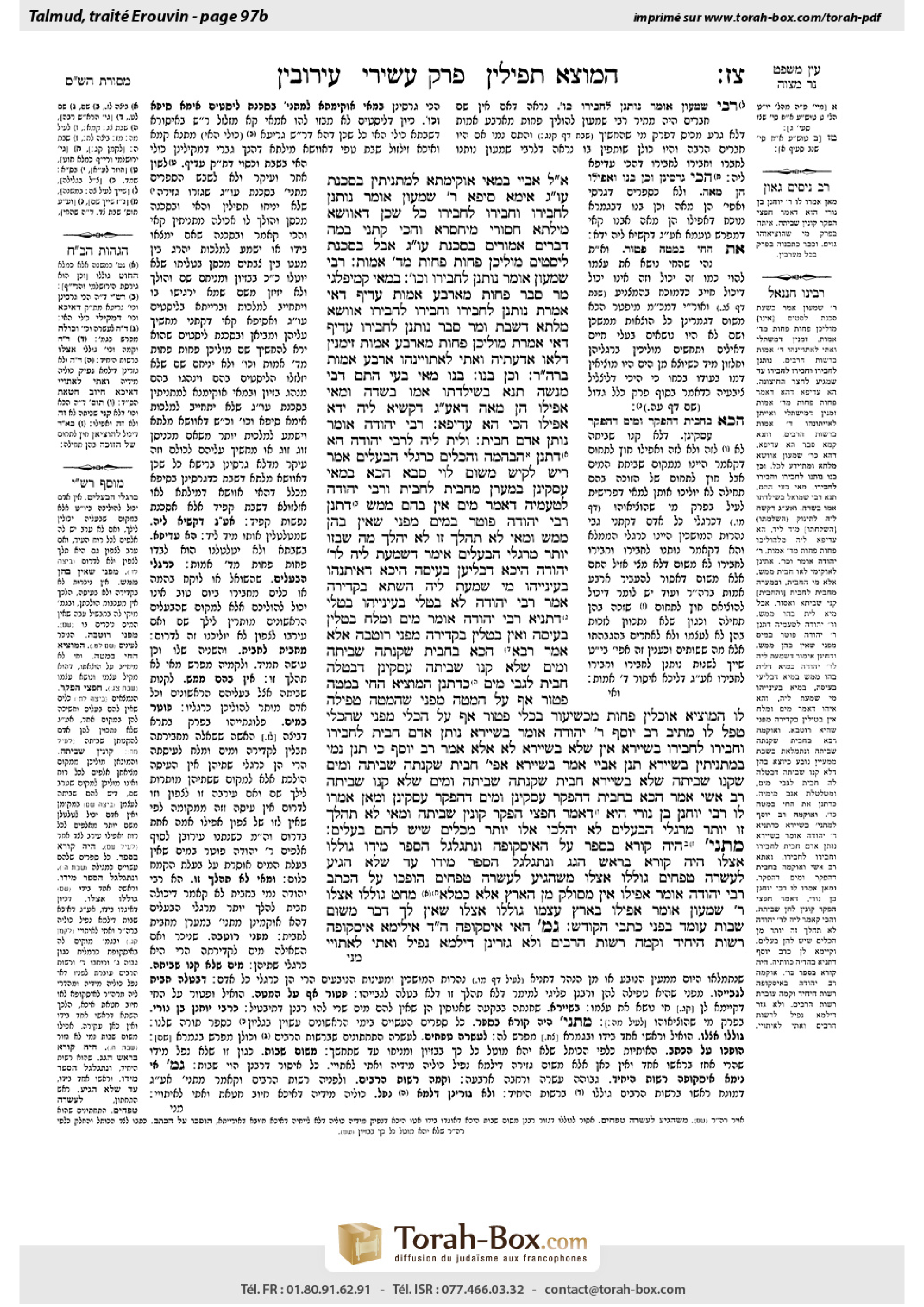
Eruvin 97b: Talmud study for Daf Yomi
Study the Talmud for Daf Yomi with scanned pages, Hebrew text, English translations from Sefaria and AI-generated French translations.
Passage selection and English or AI-generated French translation are available where the scan has annotations. Daf Study is independent of Torah-Box and Sefaria.
Browse Eruvin · עירובין · All tractatesEruvin 97b text and translations
This page of Eruvin includes the Aramaic text, an English translation and an AI-generated French translation, alongside the scan above.
עירובין צ״ז ב · Aramaic and Hebrew text
אֲמַר לֵיהּ אַבָּיֵי: בְּמַאי אוֹקֵימְתָּא לְמַתְנִיתִין, בְּסַכָּנַת גּוֹיִם? אֵימָא סֵיפָא, רַבִּי שִׁמְעוֹן אוֹמֵר: נוֹתְנָן לַחֲבֵירוֹ, וַחֲבֵירוֹ לַחֲבֵירוֹ. כׇּל שֶׁכֵּן דְּאָוְושָׁא מִילְּתָא!
חַסּוֹרֵי מִיחַסְּרָא, וְהָכִי קָתָנֵי: בַּמֶּה דְּבָרִים אֲמוּרִים — בְּסַכָּנַת גּוֹיִם, אֲבָל בְּסַכָּנַת לִיסְטִים — מוֹלִיכָן פָּחוֹת פָּחוֹת מֵאַרְבַּע אַמּוֹת.
רַבִּי שִׁמְעוֹן אוֹמֵר: נוֹתְנָן לַחֲבֵירוֹ וְכוּ׳. בְּמַאי קָמִיפַּלְגִי? מָר סָבַר: פָּחוֹת מֵאַרְבַּע אַמּוֹת עָדִיף, דְּאִי אָמְרַתְּ נוֹתְנָן לַחֲבֵירוֹ וַחֲבֵירוֹ לַחֲבֵירוֹ — אָוְושָׁא מִלְּתָא דְּשַׁבָּת.
וּמָר סָבַר: נוֹתְנָן לַחֲבֵירוֹ עָדִיף, דְּאִי אָמְרַתְּ מוֹלִיכָן פָּחוֹת מֵאַרְבַּע אַמּוֹת — זִימְנִין דְּלָאו אַדַּעְתֵּיהּ, וְאָתֵי לְאֵתוֹיִינְהוּ אַרְבַּע אַמּוֹת בִּרְשׁוּת הָרַבִּים.
וְכֵן בְּנוֹ. בְּנוֹ מַאי בָּעֵי הָתָם? דְּבֵי מְנַשֶּׁה תָּנָא: בְּשֶׁיְּלָדַתּוּ אִמּוֹ בַּשָּׂדֶה.
וּמַאי אֲפִילּוּ הֵן מֵאָה? דְּאַף עַל גַּב דְּקַשְׁיָא לֵיהּ יְדָא, אֲפִילּוּ הָכִי, הָא עֲדִיפָא.
רַבִּי יְהוּדָה אוֹמֵר: נוֹתֵן אָדָם חָבִית. וְלֵית לֵיהּ לְרַבִּי יְהוּדָה הָא דִּתְנַן הַבְּהֵמָה וְהַכֵּלִים כְּרַגְלֵי הַבְּעָלִים!
אָמַר רֵישׁ לָקִישׁ מִשּׁוּם לֵוִי סָבָא: הָכָא בְּמַאי עָסְקִינַן בִּמְעָרָן מֵחָבִית לְחָבִית. וְרַבִּי יְהוּדָה לְטַעְמֵיהּ, דְּאָמַר: מַיִם אֵין בָּהֶם מַמָּשׁ.
דִּתְנַן: רַבִּי יְהוּדָה פּוֹטֵר בְּמַיִם מִפְּנֵי שֶׁאֵין בָּהֶן מַמָּשׁ.
וּמַאי לֹא תְּהַלֵּךְ זוֹ — לֹא יְהַלֵּךְ מַה שֶּׁבְּזוֹ יוֹתֵר מֵרַגְלֵי הַבְּעָלִים.
אֵימַר דְּשָׁמְעַתְּ לֵיהּ לְרַבִּי יְהוּדָה הֵיכָא דִּבְלִיעָן בְּעִיסָּה, הֵיכָא דְּאִיתַנְהוּ בְּעֵינַיְיהוּ מִי שָׁמְעַתְּ לֵיהּ? הַשְׁתָּא בִּקְדֵירָה אָמַר רַבִּי יְהוּדָה לָא בָּטְלִי, בְּעֵינַיְיהוּ בָּטְלִי?! דְּתַנְיָא, רַבִּי יְהוּדָה אוֹמֵר: מַיִם וּמֶלַח בְּטֵלִין בָּעִיסָּה. וְאֵין בְּטֵלִין בַּקְּדֵירָה, מִפְּנֵי רוֹטְבָּהּ.
אֶלָּא אָמַר רָבָא, הָכָא בְּחָבִית שֶׁקָּנְתָה שְׁבִיתָה, וּמַיִם שֶׁלֹּא קָנוּ שְׁבִיתָה עָסְקִינַן. דְּבָטְלָה חָבִית לְגַבֵּי מַיִם.
כְּדִתְנַן: הַמּוֹצִיא הַחַי בְּמִטָּה — פָּטוּר אַף עַל הַמִּטָּה, מִפְּנֵי שֶׁהַמִּטָּה טְפֵילָה לוֹ.
הַמּוֹצִיא אוֹכָלִין פָּחוֹת מִכַּשִּׁיעוּר — בִּכְלִי פָּטוּר אַף עַל הַכְּלִי, מִפְּנֵי שֶׁהַכְּלִי טָפֵל לוֹ.
מֵתִיב רַב יוֹסֵף, רַבִּי יְהוּדָה אוֹמֵר: בִּשְׁיָירָא, נוֹתֵן אָדָם חָבִית לַחֲבֵירוֹ וַחֲבֵירוֹ לַחֲבֵירוֹ. בִּשְׁיָירָא אִין, שֶׁלֹּא בִּשְׁיָירָא לָא? אֶלָּא אָמַר רַב יוֹסֵף: כִּי תְּנַן נָמֵי בְּמַתְנִיתִין — בִּשְׁיָירָא תְּנַן.
אַבָּיֵי אָמַר: בִּשְׁיָירָא — אֲפִילּוּ חָבִית שֶׁקָּנְתָה שְׁבִיתָה וּמַיִם שֶׁקָּנוּ שְׁבִיתָה. שֶׁלֹּא בִּשְׁיָירָא — חָבִית שֶׁקָּנְתָה שְׁבִיתָה וּמַיִם שֶׁלֹּא קָנוּ שְׁבִיתָה.
רַב אָשֵׁי אָמַר: הָכָא בְּחָבִית דְּהֶפְקֵר עָסְקִינַן וּמַיִם דְּהֶפְקֵר עָסְקִינַן. וּמַאן אָמְרוּ לוֹ — רַבִּי יוֹחָנָן בֶּן נוּרִי הִיא, דְּאָמַר: חֶפְצֵי הֶפְקֵר קוֹנִין שְׁבִיתָה. וּמַאי ״לֹא תְּהַלֵּךְ זוֹ יוֹתֵר מֵרַגְלֵי הַבְּעָלִים״? לֹא יְהַלְּכוּ אֵלּוּ יוֹתֵר מִכֵּלִים שֶׁיֵּשׁ לָהֶם בְּעָלִים.
מַתְנִי׳ הָיָה קוֹרֵא בְּסֵפֶר עַל הָאִיסְקוּפָּה וְנִתְגַּלְגֵּל הַסֵּפֶר מִיָּדוֹ — גּוֹלְלוֹ אֶצְלוֹ.
הָיָה קוֹרֵא בְּרֹאשׁ הַגָּג וְנִתְגַּלְגֵּל הַסֵּפֶר מִיָּדוֹ, עַד שֶׁלֹּא הִגִּיעַ לַעֲשָׂרָה טְפָחִים — גּוֹלְלוֹ אֶצְלוֹ. מִשֶּׁהִגִּיעַ לַעֲשָׂרָה טְפָחִים — הוֹפְכוֹ עַל הַכְּתָב.
רַבִּי יְהוּדָה אוֹמֵר: אֲפִילּוּ אֵין מְסוּלָּק מִן הָאָרֶץ אֶלָּא כִּמְלֹא מַחַט — גּוֹלְלוֹ אֶצְלוֹ. רַבִּי שִׁמְעוֹן אוֹמֵר: אֲפִילּוּ בָּאָרֶץ עַצְמוֹ — גּוֹלְלוֹ אֶצְלוֹ, שֶׁאֵין לְךָ דָּבָר מִשּׁוּם שְׁבוּת עוֹמֵד בִּפְנֵי כִּתְבֵי הַקּוֹדֶשׁ.
גְּמָ׳ הַאי אִיסְקוּפָּה הֵיכִי דָמֵי? אִילֵּימָא אִיסְקוּפָּה רְשׁוּת הַיָּחִיד וְקָמָה רְשׁוּת הָרַבִּים, וְלָא גָּזְרִינַן דִּילְמָא נָפֵיל וְאָתֵי לְאֵתוֹיֵי.
Eruvin 97b · English translation
Abaye said to him: In what manner did you establish our mishna as dealing with the danger posed by gentiles? Say the latter clause of the mishna as follows: Rabbi Shimon says that one gives them to another and the other passes them to another. In that case, all the more so will the matter be conspicuous, and they should fear the decree issued by the gentiles.
The Gemara answers: The mishna is incomplete and is teaching the following: In what case is this statement that the finder covers the phylacteries said? It is where the concern is danger posed by gentiles. However, where the concern is danger posed by bandits, one carries them less than four cubits at a time. In that case Rabbi Shimon disagrees, maintaining that it is preferable that many people carry the phylacteries.
It is stated in the mishna that Rabbi Shimon says: One gives them to another and the other passes them to another. The Gemara asks: With regard to what principle do they disagree? One Sage, the first tanna, holds that having one person carrying the phylacteries less than four cubits at a time is preferable, as if you say that the finder gives them to another, and the other passes them to another, Shabbat desecration will be noticeable, thereby demeaning Shabbat’s character as a sacred day of rest.
And the other Sage, Rabbi Shimon, holds that the solution that one gives the phylacteries to another is preferable, as if you say that the finder carries them less than four cubits at a time, sometimes it is not in his thoughts and will unwittingly come to carry the phylacteries four cubits in the public domain. That is unlikely if there are numerous people together.
It was stated in the mishna: And the same is true with regard to one’s son. The Gemara is surprised: What is his son doing there in the field necessitating his retrieval in this way? The school of Menashe taught: It is referring to a case where his mother gave birth to him in a field, and he must be brought to town.
And what may be inferred from the mishna’s ruling that the baby is passed from one person to the next, even if it requires a hundred people? This teaches that although it is difficult for the child to be passed from hand to hand, even so, this method of transporting him is preferable to his being carried by one person less than four cubits at a time.
It was stated in the mishna that Rabbi Yehuda says: A person gives a barrel to another, and the other may pass it to another, and in that way they may take it even beyond the Shabbat limit. The Gemara asks: And is Rabbi Yehuda not of the opinion of that which we learned in a mishna: The distance that an animal and vessels may be taken is like the distance that the feet of the owners may go with regard to Shabbat limits?
Reish Lakish said in the name of Levi the Elder: With what are we dealing here? We are dealing with a case where one pours the water from one barrel to another barrel so that only the water, rather than the barrel itself, is taken beyond the limit. And Rabbi Yehuda follows his usual reasoning, as he said: Water has no substance, i.e., it is not significant enough for its transfer beyond the Shabbat limit to be prohibited.
As we learned in a mishna that discusses a dispute on this issue: If one person adds flour for dough while another adds the water, the Rabbis say that the dough may only be taken as far as both owners are permitted to go, whereas Rabbi Yehuda exempts water from any limit due to the fact that it has no substance.
And what, then, is the meaning of the Rabbis’ statement in the mishna: This may not go farther than the feet of the owners may go, which apparently refers to the barrel? It means: That which is in this barrel may not go farther than the feet of the owners may go.
The Gemara rejects this explanation. Say that you heard Rabbi Yehuda express his opinion that water has no substance in a case where it is absorbed in dough; but in a case where it is in its pure, unadulterated state did you hear him say so? Now, if with regard to water in a pot of cooked food Rabbi Yehuda said that it is not nullified, would it be nullified when it is in its pure, unadulterated state? That is clearly not the case, as it was taught in a baraita that Rabbi Yehuda says: Water and salt are nullified in dough, as they are absorbed into it and are not independently discernible. However, they are not nullified in a pot of cooked food, because the water and salt are discernible in its gravy.
Rather, Rava rejected this explanation and said: Here, we are dealing with a barrel that belonged to a particular individual who acquired residence at the start of Shabbat in a specific location, and water that did not remain in one place, i.e., spring or river water, and that does not belong to any individual who acquired residence. In that case, the barrel is nullified relative to the water, since the barrel is designated to hold the water.
As we learned in a mishna: One who carries out a living person on a bed from one domain to another on Shabbat is exempt even for carrying out the bed, due to the fact that the bed is secondary to the person. He is exempt for carrying out the living person because a living being carries itself, i.e., the person being carried lightens the load and thereby assists those bearing him.
Similarly, one who carries out an amount of food, less than the measure that determines liability for carrying out food on Shabbat, in a vessel is exempt, even for carrying out the vessel, due to the fact that the vessel is secondary to the food inside it. By the same reasoning, the barrel should be nullified relative to the water it contains.
Rav Yosef raised an objection from the following baraita. Rabbi Yehuda says: If members of a caravan camped in a field wish to drink, one person gives a barrel to another, and the other passes it to another. By inference: In a caravan, yes, it is permitted to do so due to exigent circumstances; however, in a case that is not a caravan, no, it is prohibited. Rather, Rav Yosef said: When we learned the case in the mishna as well, we learned it with regard to a caravan. The Sages were lenient in the case of a caravan due to the lack of water.
Abaye said that this explanation is unnecessary: In a caravan, even if the barrel acquired residence and the water acquired residence, it is permitted to move them. If one is not in a caravan, if the barrel acquired residence and the water did not acquire residence, it is prohibited to move them.
Rav Ashi said: Here, we are dealing with an ownerless barrel and ownerless water, neither of which acquired residence as they do not belong to anyone. And who is the tanna about whom it says in the mishna that they said to Rabbi Yehuda that it may not go farther than the feet of its owners may go? It is Rabbi Yoḥanan ben Nuri, who, consistent with his approach, said that ownerless objects acquire residence where they were located when Shabbat began, and it is prohibited to move them beyond their limit. And what is the meaning of the statement: This may not go farther than the feet of its owners may go, as it has no owner? It means that the barrel and water may not go farther than vessels that have owners, i.e., they may not be moved beyond their limit.
MISHNA: One who was reading a sacred book in scroll form on Shabbat on an elevated, wide threshold, and the book rolled from his hand into the public domain, he may roll it back to himself, since one of its ends remains in his hand.
If he was reading on top the roof, which is a full-fledged private domain, and the book rolled from his hand, as long as the edge of the book did not reach within ten handbreadths above the public domain, the book is still in its own domain, and he may roll it back to himself. However, once the book has reached within ten handbreadths above the public domain, it is prohibited to roll the book back to oneself. In that case, he may only turn it over onto the side with writing, so that the writing of the book will be facedown and not exposed and degraded.
Rabbi Yehuda says: Even if the scroll is removed only a needle breadth from the ground, he rolls it back to himself. Rabbi Shimon says: Even if the scroll is on the ground itself, he rolls it back to himself, as you have nothing that was instituted as a rabbinic decree to enhance the character of Shabbat as a day of rest that stands as an impediment before the rescue of sacred writings.
GEMARA: The Gemara questions the first clause of the mishna: What are the circumstances of this threshold? If you say it is referring to a threshold that is a private domain, and there is a public domain before it, and the mishna teaches that we do not issue a decree lest the entire scroll fall from one’s hand and he come to bring it from a public to a private domain,
Eruvin 97b · Traduction française (IA)
Abaye dit à lui : Dans quel sens avez-vous établi notre mitsna en ce qui concerne le danger posé par les non-Juifs ? Dites la dernière partie de la mitsna ainsi : Rabbi Shimon dit qu'on donne les phylactères à un autre et que l'autre les transmet à un autre. Dans ce cas, le fait sera encore plus évident, et ils devraient craindre l'édit émis par les non-Juifs.
Le Guemara répond : La mitsna est incomplète et enseigne ceci : Dans quel cas cette déclaration selon laquelle le trouvère couvre les phylactères est-elle dite ? C'est là où la préoccupation est le danger posé par les non-Juifs. Cependant, là où la préoccupation est le danger posé par des bandits, on transporte les phylactères moins de quatre cubits à la fois. Dans ce cas, Rabbi Shimon est d'avis contraire, affirmant que c'est préférable que plusieurs personnes transportent les phylactères.
Il est dit dans la mitsna que Rabbi Shimon dit : On donne les phylactères à un autre et que l'autre les transmet à un autre. Le Guemara demande : Sur quel principe ces sages s'opposent-ils ? Un sage, le premier tanna, maintient que faire transporter les phylactères par une seule personne moins de quatre cubits à la fois est préférable, car si vous dites que le trouvère les donne à un autre et que l'autre les transmet à un autre, la violation du sabbat sera visible, ce qui déshonore le caractère sacré du sabbat.
Et l'autre sage, Rabbi Shimon, affirme que la solution consistant à donner les phylactères à un autre est préférable, car si l'on dit que celui qui les trouve les transporte moins de quatre cubits à la fois, parfois ce n'est pas dans ses intentions et il pourrait inconsciemment les transporter de quatre cubits dans le domaine public. Cela est peu probable s'il y a de nombreuses personnes ensemble.
Il a été dit dans la mitsva : Et c'est pareil pour son fils. La Guemara est surprise : Qu'est-ce que son fils fait là dans le champ nécessitant ainsi son récupération ? L'école de Menashe enseigna : Il s'agit d'un cas où sa mère a donné naissance à lui dans un champ, et il doit être ramené en ville.
Et qu'en déduit-on de la décision de la mitsva selon laquelle le bébé est passé d'une personne à l'autre, même s'il faut cent personnes ? Cela enseigne que bien que ce soit difficile de passer le bébé d'une main à l'autre, même ainsi, cette méthode de transport est préférable à ce qu'il soit transporté par une seule personne moins de quatre cubits à la fois.
Il a été dit dans la Michna que Rabbi Yéhuda dit : Une personne donne un tonneau à un autre, et l'autre peut le transmettre à un autre, et ainsi on peut le transporter même au-delà de la limite du sabbat. La Guemara demande : Et Rabbi Yéhuda n'est-il pas de l'avis de ce que nous avons appris dans une Michna : La distance que l'on peut transporter un animal et des ustensiles est comme la distance que les pieds des propriétaires peuvent parcourir en ce qui concerne les limites du sabbat ?
Reish Lakish a dit en nom de Levi le Vieux : De quoi sommes-nous en train de parler ? Nous parlons d'un cas où l'on verse l'eau d'un tonneau dans un autre tonneau afin que seul l'eau, et non le tonneau lui-même, soit transporté au-delà de la limite. Et Rabbi Yéhuda suit sa raisonnement habituel, car il dit : L'eau n'a pas de substance, c'est-à-dire qu'elle n'est pas suffisamment importante pour que son transport au-delà de la limite du sabbat soit interdit.
Comme nous avons appris dans une Michna qui discute d'un débat sur ce sujet : Si une personne ajoute de la farine pour la pâte et que l'autre ajoute l'eau, les Rabbins disent que la pâte ne peut être transportée que jusqu'à la distance que les propriétaires peuvent parcourir, tandis que Rabbi Yéhuda exempt l'eau de toute limite en raison du fait qu'elle n'a pas de substance.
Et que signifie alors l'affirmation des Rabbins dans la Michna : Cela ne peut pas aller plus loin que les pieds des propriétaires peuvent parcourir, ce qui semble se référer au tonneau ? Cela signifie : Ce qui est dans ce tonneau ne peut pas aller plus loin que les pieds des propriétaires peuvent parcourir.
La Guemara rejette cette explication. Dites que vous avez entendu Rabbi Yéhuda exprimer son opinion selon laquelle l'eau n'a pas de substance dans un cas où elle est absorbée dans la pâte ; mais dans un cas où elle est dans son état pur, non altéré, avez-vous entendu cela ? Maintenant, si concernant l'eau dans une casserole de nourriture cuite Rabbi Yéhuda a dit qu'elle n'est pas annulée, serait-elle annulée lorsqu'elle est dans son état pur, non altéré ? Cela n'est clairement pas le cas, car cela a été enseigné dans une baraïta que Rabbi Yéhuda dit : L'eau et le sel sont annulés dans la pâte, car ils sont absorbés dans celle-ci et ne sont pas discernables indépendamment. Cependant, ils ne sont pas annulés dans une casserole de nourriture cuite, car l'eau et le sel sont discernables dans sa sauce.
Plutôt, Rava rejette cette explication et dit : Ici, nous parlons d'un tonneau appartenant à un individu qui a acquis un lieu de résidence au début du sabbat dans un lieu spécifique, et de l'eau qui n'a pas resté en un seul lieu, c'est-à-dire l'eau d'un puits ou d'un fleuve, et qui n'appartient à aucun individu ayant acquis une résidence. Dans ce cas, le tonneau est annulé par rapport à l'eau, car le tonneau est destiné à contenir l'eau.
Comme nous avons appris dans une mitsna : Celui qui transporte une personne vivante sur un lit d'un domaine à un autre le sabbat est exempt même pour le transport du lit, en raison du fait que le lit est secondaire par rapport à la personne. Il est exempt pour le transport de la personne vivante car une personne vivante se transporte elle-même, c'est-à-dire que la personne transportée allège le fardeau et aide ainsi ceux qui la portent.
De même, celui qui transporte une quantité de nourriture, inférieure à la mesure déterminant la responsabilité pour le transport de nourriture le sabbat, dans un récipient est exempt, même pour le transport du récipient, en raison du fait que le récipient est secondaire par rapport à la nourriture à l'intérieur. Par le même raisonnement, le récipient devrait être annulé par rapport à l'eau qu'il contient.
Rav Yosef a soulevé une objection à partir de la suivante baraïta. Rabbi Yehuda dit : Si des membres d'une caravane campés dans un champ souhaitent boire, une personne donne une barrique à une autre, et celle-ci la transmet à une autre. Par déduction : Dans une caravane, oui, il est permis de le faire en raison des circonstances pressantes ; cependant, dans un cas qui n'est pas une caravane, non, il est interdit. Cependant, Rav Yosef dit : Lorsque nous avons appris le cas dans la mitsna également, nous l'avons appris en référence à une caravane. Les Sages ont été indulgents dans le cas d'une caravane en raison du manque d'eau.
Abaye a dit que cette explication n'est pas nécessaire : Dans une caravane, même si la barrique a acquis un lieu de résidence et l'eau a acquis un lieu de résidence, il est permis de les déplacer. Si l'on n'est pas dans une caravane, si la barrique a acquis un lieu de résidence et l'eau n'a pas acquis un lieu de résidence, il est interdit de les déplacer.
Rav Ashi a dit : Ici, nous traitons d'une barrique et d'eau sans propriétaire, ni l'une ni l'autre n'ayant acquis un lieu de résidence, car ils n'appartiennent à personne. Et qui est le tanna dont il est dit dans la mitsva qu'ils ont dit à Rabbi Yehuda qu'il ne peut pas aller plus loin que les pieds de ses propriétaires ? C'est Rabbi Yoḥanan ben Nuri, qui, cohérent avec son approche, a dit que les objets sans propriétaire acquièrent un lieu de résidence là où ils se trouvaient au début du Shabbat, et il est interdit de les déplacer au-delà de leur limite. Et que signifie la déclaration : Ce n'est pas permis d'aller plus loin que les pieds de ses propriétaires, car il n'a pas de propriétaire ? Cela signifie que la barrique et l'eau ne peuvent pas aller plus loin que les objets qui ont des propriétaires, c'est-à-dire qu'ils ne peuvent pas être déplacés au-delà de leur limite.
MICHNA : Celui qui lisait un livre sacré en rouleau le sabbat sur une seuil élevé et large, et le livre tomba de sa main dans le domaine public, il peut le rouler de nouveau vers lui-même, car l'une de ses extrémités reste dans sa main.
Si l'on lisait sur le toit, qui est un domaine privé complet, et le livre tomba de sa main, tant que l'extrémité du livre n'avait pas atteint à dix paumes au-dessus du domaine public, le livre est encore dans son propre domaine, et il peut le rouler de nouveau vers lui-même. Cependant, une fois que le livre a atteint à dix paumes au-dessus du domaine public, il est interdit de le rouler de nouveau vers soi-même. Dans ce cas, il peut seulement le retourner sur le côté avec l'écriture, de sorte que l'écriture du livre soit face contre terre et non exposée et dégradée.
Rabbi Yehuda dit : Même si le rouleau est retiré seulement d'un cheveu de la terre, il le roule de nouveau vers lui-même. Rabbi Shimon dit : Même si le rouleau est sur la terre elle-même, il le roule de nouveau vers lui-même, car vous n'avez rien qui ait été institué comme un décret rabbinique pour améliorer la nature du sabbat comme jour de repos qui s'oppose à la sauvegarde des écritures sacrées.
GUEMARA : La Guemara interroge la première clause de la mitsna : Quelles sont les circonstances de ce seuil ? Si vous dites qu'il s'agit d'un seuil qui est un domaine privé, et qu'il y a un domaine public devant lui, et que la mitsna enseigne que nous ne décrétions pas que le rouleau tombe entièrement de la main de quelqu'un et qu'il vienne à le ramener du domaine public au domaine privé,
Traduction française générée par IA à partir de l’édition anglaise de Sefaria. Vérifie toujours un passage avec le texte source.
Text from Sefaria: William Davidson Edition - Vocalized Aramaic (CC BY NC); William Davidson Edition - English (CC BY NC).