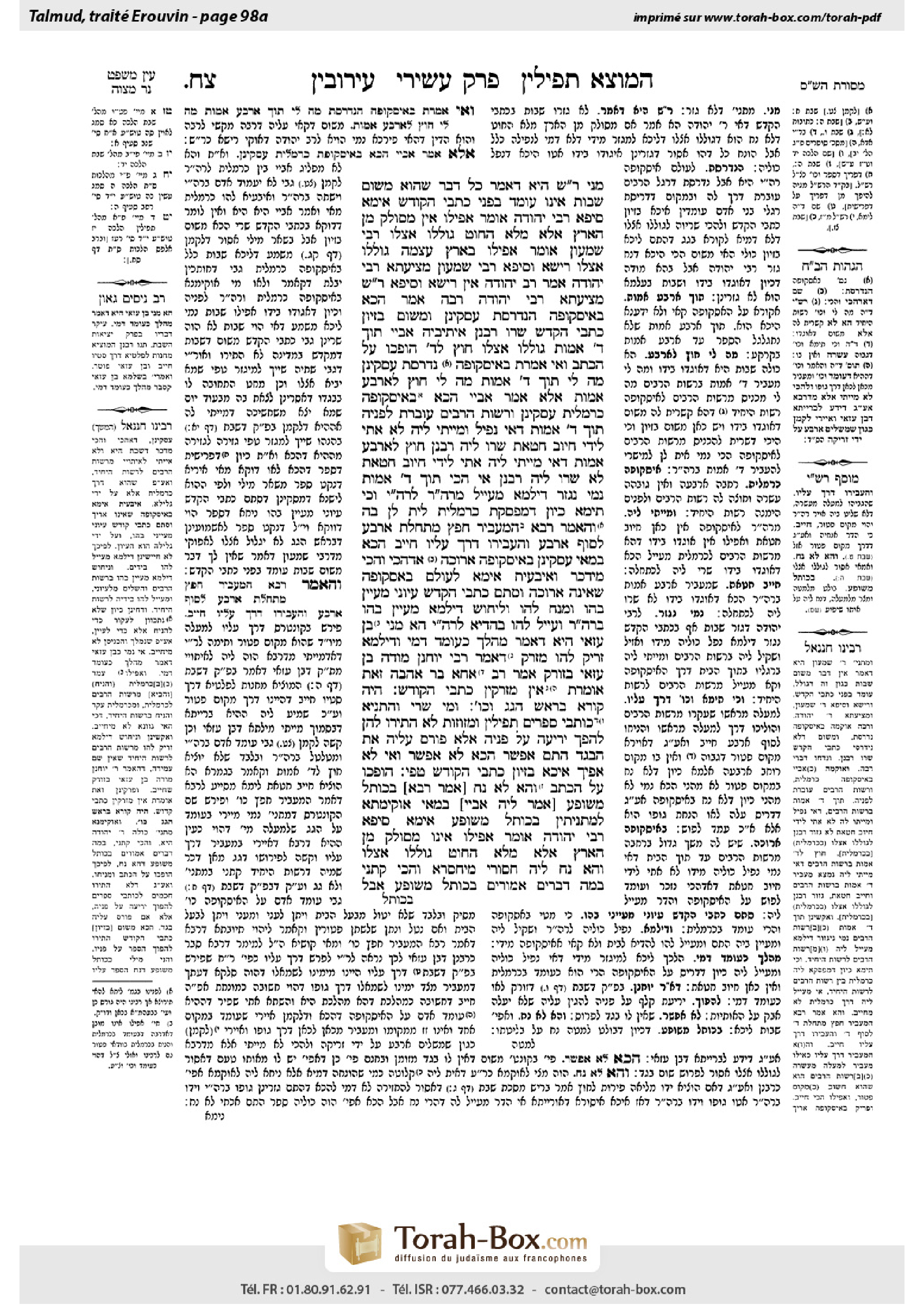
Eruvin 98a: Talmud study for Daf Yomi
Study the Talmud for Daf Yomi with scanned pages, Hebrew text, English translations from Sefaria and AI-generated French translations.
Passage selection and English or AI-generated French translation are available where the scan has annotations. Daf Study is independent of Torah-Box and Sefaria.
Browse Eruvin · עירובין · All tractatesEruvin 98a text and translations
This page of Eruvin includes the Aramaic text, an English translation and an AI-generated French translation, alongside the scan above.
עירובין צ״ח א · Aramaic and Hebrew text
מַנִּי? רַבִּי שִׁמְעוֹן הִיא, דְּאָמַר: כׇּל דָּבָר שֶׁהוּא מִשּׁוּם שְׁבוּת אֵינוֹ עוֹמֵד בִּפְנֵי כִּתְבֵי הַקּוֹדֶשׁ. אֵימָא סֵיפָא רַבִּי יְהוּדָה אוֹמֵר: אֲפִילּוּ אֵין מְסוּלָּק מִן הָאָרֶץ אֶלָּא מְלֹא הַחוּט גּוֹלְלוֹ אֶצְלוֹ. רַבִּי שִׁמְעוֹן אוֹמֵר: אֲפִילּוּ בָּאָרֶץ עַצְמָהּ גּוֹלְלוֹ אֶצְלוֹ —
רֵישָׁא וְסֵיפָא רַבִּי שִׁמְעוֹן, מְצִיעֲתָא רַבִּי יְהוּדָה! אָמַר רַב יְהוּדָה: אִין, רֵישָׁא וְסֵיפָא רַבִּי שִׁמְעוֹן, מְצִיעֲתָא רַבִּי יְהוּדָה.
רַבָּה אָמַר: הָכָא בְּאִיסְקוּפָּה הַנִּדְרֶסֶת עָסְקִינַן, וּמִשּׁוּם בִּזְיוֹן כִּתְבֵי הַקֹּדֶשׁ שְׁרוֹ רַבָּנַן.
אֵיתִיבֵיהּ אַבָּיֵי: תּוֹךְ אַרְבַּע אַמּוֹת — גּוֹלְלוֹ אֶצְלוֹ, חוּץ לְאַרְבַּע — הוֹפְכוֹ עַל הַכְּתָב. וְאִי אָמְרַתְּ בְּאִיסְקוּפָּה נִדְרֶסֶת עָסְקִינַן, מָה לִי תּוֹךְ אַרְבַּע אַמּוֹת מָה לִי חוּץ לְאַרְבַּע אַמּוֹת?
אֶלָּא אָמַר אַבָּיֵי: הָכָא בְּאִיסְקוּפָּה כַּרְמְלִית עָסְקִינַן, וּרְשׁוּת הָרַבִּים עוֹבֶרֶת לְפָנֶיהָ.
תּוֹךְ אַרְבַּע אַמּוֹת, דְּאִי נָפֵיל וּמַיְיתִי לֵיהּ לָא אָתֵי לִידֵי חִיּוּב חַטָּאת — שָׁרוּ לֵיהּ רַבָּנַן.
חוּץ לְאַרְבַּע אַמּוֹת, דְּאִי מַיְיתֵי לֵיהּ אָתֵי לִידֵי חִיּוּב חַטָּאת — לָא שָׁרוּ לֵיהּ רַבָּנַן.
אִי הָכִי, תּוֹךְ אַרְבַּע אַמּוֹת נָמֵי נִגְזַר דִּילְמָא מְעַיֵּיל מֵרְשׁוּת הָרַבִּים לִרְשׁוּת הַיָּחִיד. וְכִי תֵּימָא כֵּיוָן דְּמַפְסֶקֶת כַּרְמְלִית לֵית לַן בַּהּ, וְהָאָמַר רָבָא: הַמַּעֲבִיר חֵפֶץ מִתְּחִלַּת אַרְבַּע לְסוֹף אַרְבַּע, וְהֶעֱבִירוֹ דֶּרֶךְ עָלָיו — חַיָּיב.
הָכָא בְּמַאי עָסְקִינַן, בְּאִיסְקוּפָּה אֲרוּכָּה, אַדְּהָכִי וְהָכִי מִידְּכַר.
וְאִיבָּעֵית אֵימָא: לְעוֹלָם בְּאִסְקוּפָּה שֶׁאֵינָהּ אֲרוּכָּה, וּסְתָם כִּתְבֵי הַקֹּדֶשׁ עַיּוֹנֵי מְעַיֵּין בְּהוּ וּמַנַּח לְהוּ. וְלֵיחוּשׁ דִּילְמָא מְעַיֵּין בְּהוּ בִּרְשׁוּת הָרַבִּים וְעָיֵיל לְהוּ בְּהֶדְיָא לִרְשׁוּת הַיָּחִיד.
הָא מַנִּי בֶּן עַזַּאי הִיא, דְּאָמַר: מְהַלֵּךְ כְּעוֹמֵד דָּמֵי. וְדִילְמָא זָרֵיק לְהוּ מִזְרָק, דְּאָמַר רַבִּי יוֹחָנָן: מוֹדֶה בֶּן עַזַּאי בְּזוֹרֵק.
אָמַר רַב אַחָא בַּר אַהֲבָה: זֹאת אוֹמֶרֶת אֵין מְזָרְקִין כִּתְבֵי הַקּוֹדֶשׁ.
הָיָה קוֹרֵא בְּרֹאשׁ הַגָּג וְכוּ׳. וּמִי שְׁרֵי? וְהָתַנְיָא: כּוֹתְבֵי סְפָרִים תְּפִילִּין וּמְזוּזוֹת לֹא הִתִּירוּ לָהֶן לְהַפֵּךְ יְרִיעָה עַל פָּנֶיהָ, אֶלָּא פּוֹרֵס עָלֶיהָ אֶת הַבֶּגֶד!
הָתָם אֶפְשָׁר, הָכָא לָא אֶפְשָׁר, וְאִי לָא אָפֵיךְ אִיכָּא בִּזְיוֹן כִּתְבֵי הַקּוֹדֶשׁ טְפֵי.
הוֹפְכוֹ עַל הַכְּתָב? וְהָא לָא נָח! [אָמַר רָבָא:] בְּכוֹתֶל מְשׁוּפָּע.
[אֲמַר לֵיהּ אַבָּיֵי:] בְּמַאי אוֹקֵימְתָּא לְמַתְנִיתִין? בְּכוֹתֶל מְשׁוּפָּע, אֵימָא סֵיפָא, רַבִּי יְהוּדָה אוֹמֵר: אֲפִילּוּ אֵינוֹ מְסוּלָּק מִן הָאָרֶץ אֶלָּא מְלֹא הַחוּט — גּוֹלְלוֹ אֶצְלוֹ, וְהָא נָח לֵיהּ!
חַסּוֹרֵי מִיחַסְּרָא, וְהָכִי קָתָנֵי: בַּמֶּה דְּבָרִים אֲמוּרִים — בְּכוֹתֶל מְשׁוּפָּע, אֲבָל
Eruvin 98a · English translation
who is the tanna of the mishna? It is Rabbi Shimon, who said: Anything that is prohibited on Shabbat and its prohibition is not by Torah law, but rather is due to a rabbinic decree issued to enhance the character of Shabbat as a day of rest does not stand as an impediment before the rescue of sacred writings. But if it is the opinion of Rabbi Shimon, say the latter clause of the mishna as follows: Rabbi Yehuda says: Even if the scroll is removed only a needle breadth from the ground, he rolls it back to himself; and Rabbi Shimon says: Even if the scroll is on the ground itself, he rolls it back to himself.
Is it possible that the tanna cited in the first clause of the mishna is Rabbi Shimon, as claimed above, while it is explicitly stated that the last clause represents the opinion of Rabbi Shimon, and yet its middle clause reflects the opinion of Rabbi Yehuda? Rav Yehuda said: Yes, that is the correct, albeit unconventional, explanation. The first and last clauses are in accordance with the opinion of Rabbi Shimon, while the middle clause of the mishna reflects the opinion of Rabbi Yehuda.
Rabba said that the mishna may be understood differently. Here, we are dealing with a threshold that is trodden upon by the public, and due to the potential degradation of the sacred writings the Sages permitted one to violate the rabbinic decree. It would be disgraceful if people were to trample over sacred writings.
Abaye raised an objection to his explanation: It was taught that if the scroll rolled within four cubits, he rolls it back to himself; if it rolled beyond four cubits, he turns it over onto its writing. And if you say we are dealing with a threshold that is trodden on by the public, what difference is there to me whether it remained within four cubits and what difference is there to me if it rolled beyond four cubits? Since the prohibition is a rabbinic decree, not a Torah prohibition, why isn’t one permitted to move the scroll in both cases to prevent the degradation of the sacred writings?
Rather, Abaye said: Here, we are dealing with a threshold that is a karmelit, as the threshold is four handbreadths wide but is less than ten handbreadths high. Furthermore, on one side of the karmelit there is a private domain, and a public domain passes before it.
The reason for the different rulings is as follows: If the scroll rolled within four cubits, even if the entire scroll falls out of the one’s hand and he brings it back, he cannot incur liability to bring a sin-offering, as the prohibition against carrying from a public domain to a karmelit is a rabbinic decree. Consequently, the Sages permitted him to roll it back to himself, as there is no danger of transgressing a Torah prohibition.
However, if it rolled beyond four cubits, so that if he brings it back he incurs liability to bring a sin-offering, as carrying an object four cubits in the public domain is prohibited by Torah law, the Sages did not permit him to roll it back. In this case, if he forgot and carried the scroll instead of rolling it, he would be violating a severe prohibition.
The Gemara asks: If so, let us likewise issue a decree in the case where the scroll remained within four cubits, lest he bring the scroll in from the public domain to the private domain, i.e., to his house. And lest you say: Since a karmelit separates the public and private domains we have no problem with it, as nothing is directly carried from one domain to the other, didn’t Rava say: One who carries an object from the beginning of four cubits to the end of four cubits in the public domain, and he carried it by way of the airspace above his head, he is liable, even though the object remained more than ten handbreadths off the ground and passed from the beginning to the end of four cubits by way of an exempt zone? Here, too, one should be liable for carrying the scroll from the public domain to a private domain by way of a karmelit.
The Gemara answers: With what are we dealing here? We are dealing with an extended threshold. Consequently, in the meantime, while he is carrying the scroll along the length of the threshold, he will remember not to bring it into the private domain.
And if you wish, say instead: Actually, it is referring to a threshold that is not extended; however, ordinarily one peruses sacred writings and then puts them in their place. Consequently, there is no concern that he might pass directly from the public to the private domain, as he will pause on the threshold to read the scroll. The Gemara asks: According to this explanation too, let us be concerned lest he pause to peruse the scroll in the public domain, and subsequently carry it directly into the private domain without pausing in the karmelit.
The Gemara answers: In accordance with whose opinion is this mishna? It is the opinion of Ben Azzai, who said that walking is considered like standing. Consequently, one who passes through the karmelit is considered to have paused and stood there. Therefore, the object was not transferred directly from the public domain to the private domain, as he paused in the karmelit. The Gemara asks: But what of the concern lest he throw the scrolls inside, rather than carry them by hand, as Rabbi Yoḥanan said: Ben Azzai concedes that one who throws an object from the public domain to a private domain by way of an exempt domain is liable?
The Gemara answers that Rav Aḥa bar Ahava said: That is to say that one does not throw sacred writings, as this is demeaning to them. Consequently, there is no concern that one might throw the scrolls rather than carry them by hand.
It was stated in the mishna: If one was reading on top of the roof, which is a full-fledged private domain, and the scroll rolled from his hand, as long as the edge of the scroll did not reach ten handbreadths above the public domain, he may roll it back to himself. However, once the scroll reached within ten handbreadths above the public domain, it is prohibited to roll it back. In that case, he should turn it over, so that the writing of the scroll will be facedown and not be exposed and degraded. The Gemara asks: And is it permitted to do so? Wasn’t it taught in a baraita that with regard to writers of scrolls, phylacteries, and mezuzot who interrupt their work, the Sages did not permit them to turn the sheet of parchment facedown lest it become soiled? Rather, one spreads a cloth over it in a respectful manner.
The Gemara answers: There, with regard to scribes, it is possible to cover the parchment respectfully; here, it is not possible to do so. And if he does not turn the scroll over, it will be more degrading to the sacred writings. Consequently, although this is not an ideal solution, it is preferable to turn it over rather than leave the scroll exposed.
The mishna states: Once the scroll has reached within ten handbreadths above the public domain, it is prohibited to roll it back to oneself, and one turns it over onto the writing. The Gemara asks: But why is this prohibited? Since the scroll did not come to rest in the public domain, rolling it back to oneself should not be prohibited. Rava said: This teaching is referring to an inclined wall. Although the scroll did not reach the ground, it came to rest within the confines of the public domain.
Abaye said to him: In what manner did you establish that the mishna is referring to the case of an inclined wall? Say the latter clause of the mishna as follows: Rabbi Yehuda says: Even if the scroll is removed only a needle breadth from the ground, he rolls it back to himself. But didn’t the scroll come to rest in the public domain? It shouldn’t matter whether or not the scroll is in contact with the ground.
The Gemara answers: The mishna is incomplete and is teaching the following: In what case is this statement said? It is said in the case of an inclined wall. However,
Eruvin 98a · Traduction française (IA)
Qui est le tanna de la mitsna ? C'est Rabbi Shimon, qui dit : Tout ce qui est interdit le sabbat et dont l'interdiction n'est pas selon la Torah, mais plutôt est un décret rabbinique émis pour améliorer la qualité du sabbat comme jour de repos ne constitue pas un obstacle à la sauvegarde des écritures sacrées. Mais si c'est l'opinion de Rabbi Shimon, disons la seconde partie de la mitsna ainsi : Rabbi Yehuda dit : Même si le rouleau est retiré d'un seul cheveu du sol, il le ramène à lui ; et Rabbi Shimon dit : Même si le rouleau est sur le sol lui-même, il le ramène à lui.
Est-il possible que le tanna cité dans la première partie de la mitsna soit Rabbi Shimon, comme dit ci-dessus, alors qu'il est explicitement dit que la dernière partie représente l'opinion de Rabbi Shimon, et pourtant la partie centrale de la mitsna reflète l'opinion de Rabbi Yehuda ? Rav Yehuda dit : Oui, c'est l'explication correcte, bien qu'un peu inhabituelle. La première et la dernière parties sont conformes à l'opinion de Rabbi Shimon, tandis que la partie centrale de la mitsna reflète l'opinion de Rabbi Yehuda.
Rabba dit que la mitsna peut être comprise différemment. Ici, nous sommes en présence d'une porte qui est foulée par le public, et en raison du risque de dégradation des écritures sacrées, les Sages ont permis de violer le décret rabbinique. Il serait honteux que les gens foulent les écritures sacrées.
Abaye souleva une objection contre cette explication : Il a été enseigné que si le rouleau roulait dans un espace de quatre coudées, il le ramène à lui ; si le rouleau roulait au-delà de quatre coudées, il le retourne sur son écriture. Et si vous dites que nous sommes en présence d'une porte foulée par le public, quelle différence cela fait-il pour moi que le rouleau reste dans un espace de quatre coudées et quelle différence cela fait-il si le rouleau roulait au-delà de quatre coudées ? Puisque l'interdiction est un décret rabbinique, et non une interdiction de la Torah, pourquoi ne serait-il pas permis de déplacer le rouleau dans les deux cas pour prévenir la dégradation des écritures sacrées ?
Plutôt, Abaye dit : Ici, nous sommes en présence d'une porte qui est un karmelit, car la porte est large de quatre paumes mais moins haute de dix paumes. De plus, d'un côté du karmelit il y a un domaine privé, et un domaine public passe devant lui.
La raison des décisions différentes est la suivante : Si le rouleau roulait dans un espace de quatre coudées, même si l'ensemble du rouleau tombe de la main de la personne et qu'il le ramène, il ne peut pas être tenu responsable de présenter un sacrifice expiatoire, car l'interdiction de porter d'un domaine public à un karmelit est un décret rabbinique. Par conséquent, les Sages ont permis à la personne de le ramener à lui, car il n'y a pas de danger de transgresser une interdiction de la Torah.
Cependant, si le rouleau roulait au-delà de quatre coudées, de sorte que si la personne le ramène, elle est tenue responsable de présenter un sacrifice expiatoire, car porter un objet de quatre coudées dans un domaine public est interdit par la Torah, les Sages n'ont pas permis à la personne de le ramener. Dans ce cas, si la personne oublie et porte le rouleau au lieu de le ramener, elle commet une transgression grave.
La Guemara pose la question : Si c'est ainsi, pourquoi ne pas émettre un décret dans le cas où le rouleau reste dans un espace de quatre coudées, de peur qu'il ne ramène le rouleau du domaine public vers le domaine privé, c'est-à-dire vers sa maison. Et si vous dites : Puisque le karmelit sépare les domaines public et privé, nous n'avons pas de problème, car rien n'est transporté directement d'un domaine à l'autre, n'a-t-on pas dit que Rava a dit : Celui qui transporte un objet du début des quatre coudées à la fin des quatre coudées dans le domaine public, et qui le transporte par l'air au-dessus de sa tête, est tenu responsable, même si l'objet reste plus de dix paumes au-dessus du sol et passe du début à la fin des quatre coudées par une zone exemptée ? Ici aussi, on devrait être tenu responsable de transporter le rouleau du domaine public vers un domaine privé par le biais d'un karmelit.
La Guemara répond : Avec quels objets sommes-nous en présence ici ? Nous sommes en présence d'une porte étendue. Par conséquent, pendant qu'il transporte le rouleau le long de la longueur de la porte, il se souviendra de ne pas le ramener dans le domaine privé.
Et si vous le souhaitez, dites plutôt : En réalité, il s'agit d'une porte qui n'est pas prolongée ; cependant, habituellement, on lit les écritures sacrées et on les remet à leur place. Par conséquent, il n'y a pas de crainte qu'il passe directement du domaine public au domaine privé, car il s'arrêtera sur la porte pour lire le rouleau. La Guemara pose la question : Selon cette explication également, devons-nous nous inquiéter qu'il s'arrête pour lire le rouleau dans le domaine public, et ensuite le transporte directement dans le domaine privé sans s'arrêter dans le karmelit ?
La Guemara répond : Selon l'opinion de qui est cette mitsna ? C'est l'opinion de Ben Azzai, qui a dit que marcher est considéré comme être debout. Par conséquent, celui qui passe par le karmelit est considéré comme ayant s'arrêté et debout là. Par conséquent, l'objet n'a pas été transféré directement du domaine public au domaine privé, car il s'est arrêté dans le karmelit. La Guemara pose la question : Mais qu'en est-il de la crainte qu'il jette les rouleaux à l'intérieur, plutôt que de les porter à la main, comme Rabbi Yoḥanan a dit : Ben Azzai reconnaît que celui qui jette un objet du domaine public vers un domaine privé par le biais d'un domaine exempté est tenu responsable ?
La Guemara répond que Rav Aḥa bar Ahava a dit : Cela signifie que l'on ne jette pas les écritures sacrées, car cela est dégradant pour elles. Par conséquent, il n'y a pas de crainte que l'on jette les rouleaux plutôt que de les porter à la main.
Il a été dit dans la Michna : Si l'on lisait sur le toit, qui est un domaine privé complet, et que le rouleau tombait de sa main, tant que l'extrémité du rouleau ne parvenait pas à dix tefachim au-dessus du domaine public, il pouvait le ramener à lui-même. Cependant, une fois que le rouleau atteignait à dix tefachim au-dessus du domaine public, il était interdit de le ramener. Dans ce cas, il devait le retourner de sorte que l'écriture du rouleau soit face contre terre et non exposée et dégradée. La Guemara demande : Et est-il permis de le faire ? N'avait-on pas appris dans une baraïta que concernant les écrivains de rouleaux, de phylactères et de mezuzot qui interrompaient leur travail, les Sages n'ont pas permis qu'ils retournent la feuille de parchemin face contre terre de peur qu'elle ne se salisse ? Plutôt, on étend un linge sur elle de manière respectueuse.
La Guemara répond : Là, concernant les écrivains, il est possible de couvrir le parchemin de manière respectueuse ; ici, il n'est pas possible de le faire. Et si on ne retourne pas le rouleau, cela sera plus dégradant pour les écritures sacrées. Ainsi, bien que ce ne soit pas une solution idéale, il est préférable de le retourner plutôt que de laisser le rouleau exposé.
La Michna dit : Une fois que le rouleau a atteint à dix tefachim au-dessus du domaine public, il est interdit de le ramener à soi-même, et on le retourne sur l'écriture. La Guemara demande : Mais pourquoi est-ce interdit ? Puisque le rouleau n'a pas atteint le domaine public, il ne devrait pas être interdit de le ramener à soi-même. Rava dit : Cet enseignement fait référence à un mur incliné. Bien que le rouleau n'ait pas atteint le sol, il s'est arrêté dans les limites du domaine public.
Abaye dit à lui : Dans quel cas avez-vous établi que la mitsna fait référence au cas d'un mur incliné ? Dites la dernière partie de la mitsna ainsi : Rabbi Yehuda dit : Même si le rouleau est retiré d'une seule largeur de pointe du sol, il le ramène à lui-même. Mais n'avait-il pas atteint le domaine public ? Il ne devrait pas import er si le rouleau est en contact avec le sol ou non.
La Guemara répond : La mitsna est incomplète et enseigne ceci : Dans quel cas cette déclaration est-elle dite ? Elle est dite dans le cas d'un mur incliné. Cependant,
Traduction française générée par IA à partir de l’édition anglaise de Sefaria. Vérifie toujours un passage avec le texte source.
Text from Sefaria: William Davidson Edition - Vocalized Aramaic (CC BY NC); William Davidson Edition - English (CC BY NC).