Eruvin 98b: Talmud study for Daf Yomi
Study the Talmud for Daf Yomi with scanned pages, Hebrew text, English translations from Sefaria and AI-generated French translations.
Passage selection and English or AI-generated French translation are available where the scan has annotations. Daf Study is independent of Torah-Box and Sefaria.
Browse Eruvin · עירובין · All tractatesEruvin 98b text and translations
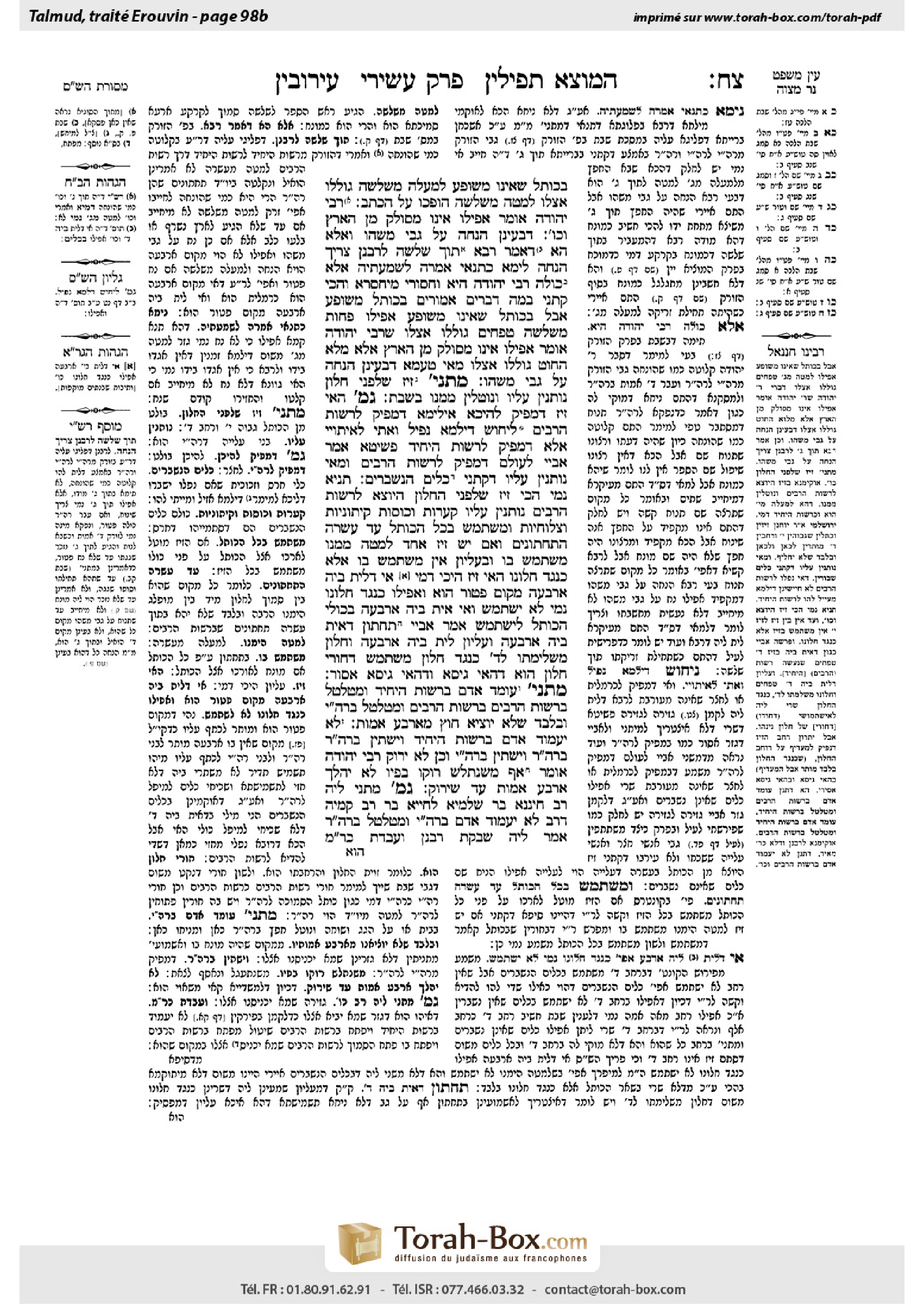
This page of Eruvin includes the Aramaic text, an English translation and an AI-generated French translation, alongside the scan above.
עירובין צ״ח ב · Aramaic and Hebrew text
בְּכוֹתֶל שֶׁאֵינוֹ מְשׁוּפָּע, לְמַעְלָה מִשְּׁלֹשָׁה — גּוֹלְלוֹ אֶצְלוֹ, לְמַטָּה מִשְּׁלֹשָׁה — הוֹפְכוֹ עַל הַכְּתָב.
רַבִּי יְהוּדָה אוֹמֵר אֲפִילּוּ אֵינוֹ מְסוּלָּק מִן הָאָרֶץ וְכוּ׳. דְּבָעֵינַן הַנָּחָה עַל גַּבֵּי מַשֶּׁהוּ.
וְאֶלָּא הָא דְּאָמַר רָבָא: תּוֹךְ שְׁלֹשָׁה לְרַבָּנַן צָרִיךְ הַנָּחָה, לֵימָא כְּתַנָּאֵי אַמְרַהּ לִשְׁמַעְתֵּיהּ?!
אֶלָּא: כּוּלַּהּ רַבִּי יְהוּדָה הִיא, וְחַסּוֹרֵי מִיחַסְּרָא, וְהָכִי קָתָנֵי: בַּמֶּה דְּבָרִים אֲמוּרִים — בְּכוֹתֶל מְשׁוּפָּע, אֲבָל בְּכוֹתֶל שֶׁאֵינוֹ מְשׁוּפָּע — אֲפִילּוּ פָּחוֹת מִשְּׁלֹשָׁה טְפָחִים גּוֹלְלוֹ אֶצְלוֹ. שֶׁרַבִּי יְהוּדָה אוֹמֵר: אֲפִילּוּ אֵינוֹ מְסוּלָּק מִן הָאָרֶץ אֶלָּא מְלֹא הַחוּט — גּוֹלְלוֹ אֶצְלוֹ.
מַאי טַעְמָא? דְּבָעֵינַן הַנָּחָה עַל גַּבֵּי מַשֶּׁהוּ.
מַתְנִי׳ זִיז שֶׁלִּפְנֵי חַלּוֹן — נוֹתְנִין עָלָיו וְנוֹטְלִין מִמֶּנּוּ בְּשַׁבָּת.
גְּמָ׳ הַאי זִיז דְּמַפֵּיק לְהֵיכָא? אִילֵּימָא דְּמַפֵּיק לִרְשׁוּת הָרַבִּים — לֵיחוּשׁ דִּילְמָא נָפֵיל, וְאָתֵי לְאֵיתוֹיֵי. אֶלָּא דְּמַפֵּיק לִרְשׁוּת הַיָּחִיד, פְּשִׁיטָא!
אָמַר אַבָּיֵי: לְעוֹלָם דְּמַפֵּיק לִרְשׁוּת הָרַבִּים, וּמַאי ״נוֹתְנִין עָלָיו״ דְּקָתָנֵי, כֵּלִים הַנִּשְׁבָּרִים.
תַּנְיָא נָמֵי הָכִי: זִיז שֶׁלִּפְנֵי הַחַלּוֹן הַיּוֹצֵא לִרְשׁוּת הָרַבִּים — נוֹתְנִין עָלָיו קְעָרוֹת וְכוֹסוֹת, קִיתוֹנִיּוֹת וּצְלוֹחִיּוֹת.
וּמִשְׁתַּמֵּשׁ בְּכׇל הַכּוֹתֶל עַד עֲשָׂרָה הַתַּחְתּוֹנִים. וְאִם יֵשׁ זִיז אֶחָד לְמַטָּה מִמֶּנּוּ — מִשְׁתַּמֵּשׁ בּוֹ, וּבָעֶלְיוֹן אֵין מִשְׁתַּמֵּשׁ בּוֹ אֶלָּא כְּנֶגֶד חַלּוֹנוֹ.
הַאי זִיז הֵיכִי דָּמֵי? אִי דְּלֵית בֵּיהּ אַרְבָּעָה — מְקוֹם פְּטוּר הוּא, וַאֲפִילּוּ כְּנֶגֶד חַלּוֹנוֹ נָמֵי לָא יִשְׁתַּמֵּשׁ. וְאִי אִית בֵּיהּ אַרְבָּעָה — בְּכוּלֵּי הַכּוֹתֶל לִישְׁתַּמֵּשׁ.
אָמַר אַבָּיֵי: תַּחְתּוֹן דְּאִית בֵּיהּ אַרְבָּעָה, וְעֶלְיוֹן לֵית בֵּיהּ אַרְבָּעָה וְחַלּוֹן מַשְׁלִימָתוֹ לְאַרְבָּעָה. כְּנֶגֶד חַלּוֹן — מִשְׁתַּמֵּשׁ, דְּחוֹרֵי חַלּוֹן הוּא. דְּהַאי גִּיסָא וּדְהַאי גִּיסָא — אָסוּר.
מַתְנִי׳ עוֹמֵד אָדָם בִּרְשׁוּת הַיָּחִיד וּמְטַלְטֵל בִּרְשׁוּת הָרַבִּים. בִּרְשׁוּת הָרַבִּים וּמְטַלְטֵל בִּרְשׁוּת הַיָּחִיד, וּבִלְבַד שֶׁלֹּא יוֹצִיא חוּץ מֵאַרְבַּע אַמּוֹת.
לֹא יַעֲמוֹד אָדָם בִּרְשׁוּת הַיָּחִיד וְיַשְׁתִּין בִּרְשׁוּת הָרַבִּים, בִּרְשׁוּת הָרַבִּים וְיַשְׁתִּין בִּרְשׁוּת הַיָּחִיד, וְכֵן לֹא יָרוֹק.
רַבִּי יְהוּדָה אוֹמֵר: אַף מִשֶּׁנִּתְלַשׁ רוּקּוֹ בְּפִיו, לֹא יְהַלֵּךְ אַרְבַּע אַמּוֹת עַד שֶׁיָּרוֹק.
גְּמָ׳ מַתְנֵי לֵיהּ רַב חִינָּנָא בַּר שֶׁלֶמְיָא לְחִיָּיא בַּר רַב קַמֵּיהּ דְּרַב: לֹא יַעֲמוֹד אָדָם בִּרְשׁוּת הַיָּחִיד וּמְטַלְטֵל בִּרְשׁוּת הָרַבִּים. אֲמַר לֵיהּ: שָׁבְקַתְּ רַבָּנַן וְעָבְדַתְּ כְּרַבִּי מֵאִיר?!
Eruvin 98b · English translation
with regard to a wall that is not inclined, the following distinction applies: If the end of the scroll is three handbreadths above the ground, he may roll it back to himself; but if it is below three handbreadths from the ground, it is considered as though the scroll is on the ground, and he must therefore turn it facedown onto the writing.
It was stated in the mishna that Rabbi Yehuda says: Even if the scroll is removed only a needle breadth from the ground, one rolls it back to himself. The Gemara explains: Rabbi Yehuda maintains that in order for an object to be deemed at rest, we require that it rest atop something. Consequently, a scroll that is not actually touching the ground is not considered resting and may be rolled back.
The Gemara asks: But consider that which Rava said with regard to an object located within three handbreadths of the ground. Rava said that according to the opinion of the Rabbis, who disagree with Rabbi Akiva and claim that something in the air is not considered to be at rest, nevertheless, for one to incur liability it is necessary for the object to rest on a surface. Let us say that he stated his halakha in accordance with only one of the tanna’im, but not in accordance with all of them. This is an unacceptable conclusion.
Rather, the Gemara rejects the previous explanation in favor of the following one: The mishna is all in accordance with Rabbi Yehuda, and it is incomplete and is teaching the following: In what case is this statement that once the end of the scroll is within ten handbreadths of the ground it may not be rolled back said? It was said in the case of an inclined wall. But with regard to a wall that is not inclined, even if the end of the scroll is less than three handbreadths from the ground, one may roll it back to himself, as Rabbi Yehuda says: Even if the scroll is removed only a needle breadth from the ground, he rolls it back to himself.
What is the reason for this ruling? The reasoning is that for an object to be considered at rest, we require that it rest atop some surface. Consequently, if the scroll is not actually touching the ground, it is not considered at rest, even if it is less than three handbreadths from the ground.
MISHNA: With regard to a ledge in front of a window, that is ten handbreadths high and four handbreadths wide, one may place objects upon it or remove them from it on Shabbat via the window.
GEMARA: The Gemara clarifies: This ledge, to where does it protrude? If you say that the ledge protrudes into a public domain, one should be prohibited to place an object on it, as we should be concerned lest the object fall and he will forget and come to bring it in from the public domain to a private domain. Rather, it must be that the ledge protrudes into a private domain; but if so, it is obvious that it is permitted to place objects on it and to remove them.
Abaye said: Actually, the mishna is dealing with a case where it protrudes into a public domain, and what is the meaning of that which it teaches: One may place objects upon it? This refers to fragile utensils, which would break instantly if they fell. Consequently, there is no concern that one might then bring them in from the public domain to the private domain.
The Gemara comments: That was also taught in a baraita: With regard to a ledge in front of a window that protrudes into a public domain, one may place on it bowls, cups, small cups [kitoniyot], and saucers. All of these utensils are made of fragile glass or earthenware, which supports Abaye’s opinion.
The baraita continues: And one may use this ledge along the entire length of the wall, if the ledge spans its length, whether in close proximity to the window or removed from it, until the lower ten handbreadths of the wall, but not if the ledge is lower than that. And if there is one other ledge below it but still ten handbreadths above the ground, one may use the lower ledge along the entire length of the wall; but with regard to the upper ledge, one may use it only opposite his window.
The Gemara asks: This upper ledge, what are its circumstances? If it is not four handbreadths deep, although it is an exempt domain with regard to the halakhot of Shabbat, which means it does not pose a problem in itself, one should nonetheless not be permitted to use it even opposite his window, as anything placed on this narrow ledge is likely to fall. Consequently, it is as though he has thrown the object directly to the ground. And if it is four handbreadths deep, let him use the ledge along the entire length of the ledge along the wall.
Abaye said: We are dealing with a case where the lower ledge is four handbreadths deep and the upper ledge is not four handbreadths deep, but the windowsill on the inside completes it to form a surface four handbreadths deep. Accordingly, one may use the part of the upper ledge opposite the window, as it is considered an extension of the window, but the parts to this side or to that side of the window are prohibited, as they are less than four handbreadths deep.
MISHNA: A person may stand in a private domain and move objects that are in a public domain, as there is no concern that he might mistakenly bring them into the private domain. Similarly, one may stand in a public domain and move objects in a private domain, provided that he does not carry them beyond four cubits in the public domain, which is prohibited on Shabbat.
However, a person may not stand in a private domain and urinate into a public domain, nor may one stand in a public domain and urinate into a private domain. And likewise, one may not spit in such a manner that the spittle passes from a private domain to a public domain or vice versa.
Rabbi Yehuda says: Even once a person’s spittle is gathered in his mouth, he may not walk four cubits in the public domain until he spits it out, for he would be carrying the accumulated spittle in his mouth, which is akin to carrying any other object.
GEMARA: Rav Ḥinnana bar Shelamiya would teach this mishna to Ḥiyya bar Rav before Rav as follows: A person may not stand in a private domain and move objects that are in a public domain. Rav said to him: Have you abandoned the majority opinion of the Rabbis and followed the solitary dissenting opinion of Rabbi Meir, who is stringent in this regard?
Eruvin 98b · Traduction française (IA)
Concernant un mur qui n'est pas incliné, la distinction suivante s'applique : Si la fin du rouleau est à trois tefachim au-dessus du sol, il peut le rouler vers lui-même ; mais si elle est en dessous de trois tefachim du sol, on considère que le rouleau est sur le sol, et il doit donc le retourner face contre terre.
Il a été dit dans la mitsna que Rabbi Yéhuda dit : Même si le rouleau est retiré d'une seule largeur d'aiguille du sol, on le roule vers lui-même. La Guemara explique : Rabbi Yéhuda maintient que pour qu'un objet soit considéré comme au repos, il faut qu'il repose sur quelque chose. Ainsi, un rouleau qui ne touche pas effectivement le sol n'est pas considéré comme au repos et peut être roulé vers lui-même.
La Guemara pose la question : Mais considérons ce que Rava a dit concernant un objet situé à trois tefachim du sol. Rava a dit que selon l'opinion des Rabbins, qui s'opposent à Rabbi Akiva et affirment qu'un objet dans l'air n'est pas considéré comme au repos, néanmoins, pour que l'on soit tenu responsable, il faut que l'objet repose sur une surface. Disons qu'il a formulé sa halakha selon un seul des tannaïm, mais pas selon tous. Cela est une conclusion inacceptable.
Plutôt, la Guemara rejette l'explication précédente au profit de celle-ci : La mitsva est entièrement selon Rabbi Yéhuda, et elle est incomplète et enseigne ceci : Dans quel cas cette déclaration que lorsque la fin du rouleau est à dix tefachim du sol, il ne peut pas être roulé vers lui-même est-elle dite ? C'était le cas d'un mur incliné. Mais concernant un mur qui n'est pas incliné, même si la fin du rouleau est moins de trois tefachim du sol, on peut le rouler vers lui-même, comme Rabbi Yéhuda dit : Même si le rouleau est retiré d'une seule largeur d'aiguille du sol, il le roule vers lui-même.
Quelle est la raison de cette décision ? La raison est que pour qu'un objet soit considéré comme au repos, il faut qu'il repose sur une surface. Ainsi, si le rouleau ne touche pas effectivement le sol, il n'est pas considéré comme au repos, même s'il est à moins de trois tefachim du sol.
MICHNA : Concernant un rebord devant une fenêtre, qui est à dix tefachim de haut et quatre tefachim de large, on peut poser des objets dessus ou les enlever par la fenêtre le sabbat.
LA GUÉMARA : La Guemara précise : Ce rebord, vers où s'étend-il ? Si vous dites qu'il s'étend dans un domaine public, on devrait interdire de poser un objet dessus, car on craint qu'il ne tombe et qu'on oublie de le ramener du domaine public vers le domaine privé. Plutôt, il faut que le rebond s'étende dans un domaine privé ; mais si c'est le cas, il est évident qu'on peut poser des objets dessus et les enlever.
Abaye dit : En réalité, la mitsna traite d'un cas où il s'étend dans un domaine public, et quelle est la signification de ce que la mitsna enseigne : On peut poser des objets dessus ? Cela fait référence aux ustensiles fragiles, qui cassent instantanément s'ils tombent. Ainsi, il n'y a pas de crainte qu'on puisse alors les ramener du domaine public vers le domaine privé.
La Guemara commente : Cela a également été enseigné dans une baraïta : Concernant un rebord devant une fenêtre qui s'étend dans un domaine public, on peut poser dessus des bols, des coupes, des petites coupes [kitoniyot], et des assiettes. Tous ces ustensiles sont en verre ou en terre fragile, ce qui soutient l'opinion d'Abaye.
La baraïta continue : Et on peut utiliser ce rebord tout le long de la longueur du mur, si le rebord s'étend sur toute la longueur, que ce soit près de la fenêtre ou éloigné d'elle, jusqu'aux dix tefachim inférieurs du mur, mais pas si le rebord est plus bas que cela. Et s'il y a un autre rebord en dessous mais toujours à dix tefachim du sol, on peut utiliser le rebord inférieur tout le long du mur ; mais concernant le rebord supérieur, on peut l'utiliser seulement opposé à sa fenêtre.
La Guemara pose la question : Ce rebord supérieur, quelles sont ses conditions ? Si il n'est pas quatre tefachim de profondeur, bien qu'il soit un domaine exempt concernant les halakhot du sabbat, ce qui signifie qu'il ne pose pas de problème en soi, on ne devrait pas néanmoins être autorisé à l'utiliser même opposé à sa fenêtre, car tout ce qui est posé sur ce rebord étroit a tendance à tomber. Ainsi, cela est comme si on lançait l'objet directement au sol. Et si il est quatre tefachim de profondeur, qu'on utilise le rebord tout le long de la longueur du mur.
Abaye dit : Nous traitons d'un cas où le rebord inférieur est quatre tefachim de profondeur et le rebord supérieur n'est pas quatre tefachim de profondeur, mais la fenêtre intérieure le complète pour former une surface de quatre tefachim de profondeur. Ainsi, on peut utiliser la partie du rebord supérieur opposée à la fenêtre, car elle est considérée comme une extension de la fenêtre, mais les parties à ce côté ou à l'autre de la fenêtre sont interdites, car elles sont moins de quatre tefachim de profondeur.
MICHNA : Une personne peut se tenir dans un domaine privé et déplacer des objets qui sont dans un domaine public, car il n'y a pas de crainte qu'elle puisse par erreur les amener dans le domaine privé. De même, on peut se tenir dans un domaine public et déplacer des objets dans un domaine privé, à condition qu'on ne les transporte pas au-delà de quatre coudées dans le domaine public, ce qui est interdit le sabbat.
Cependant, une personne ne peut pas se tenir dans un domaine privé et uriner dans un domaine public, ni se tenir dans un domaine public et uriner dans un domaine privé. De même, on ne peut pas cracher de manière à ce que la salive passe d'un domaine privé à un domaine public ou vice versa.
Rabbi Yéhuda dit : Même lorsque la salive d'une personne est accumulée dans sa bouche, il ne doit pas marcher quatre cubits dans le domaine public avant de l'éviter, car il transporte la salive accumulée dans sa bouche, ce qui est comparable à transporter tout autre objet.
GUEMARA : Rav Ḥinnana bar Shelamiya enseignait cette mésorah à Ḥiyya bar Rav devant Rav ainsi : Une personne ne doit pas se tenir dans un domaine privé et déplacer des objets qui se trouvent dans un domaine public. Rav lui dit : Avez-vous abandonné l'opinion majoritaire des Sages et suivi l'opinion isolée de Rabbi Meir, qui est strict sur ce point ?
Traduction française générée par IA à partir de l’édition anglaise de Sefaria. Vérifie toujours un passage avec le texte source.
Text from Sefaria: William Davidson Edition - Vocalized Aramaic (CC BY NC); William Davidson Edition - English (CC BY NC).