Eruvin 99a: Talmud study for Daf Yomi
Study the Talmud for Daf Yomi with scanned pages, Hebrew text, English translations from Sefaria and AI-generated French translations.
Passage selection and English or AI-generated French translation are available where the scan has annotations. Daf Study is independent of Torah-Box and Sefaria.
Browse Eruvin · עירובין · All tractatesEruvin 99a text and translations
This page of Eruvin includes the Aramaic text, an English translation and an AI-generated French translation, alongside the scan above.
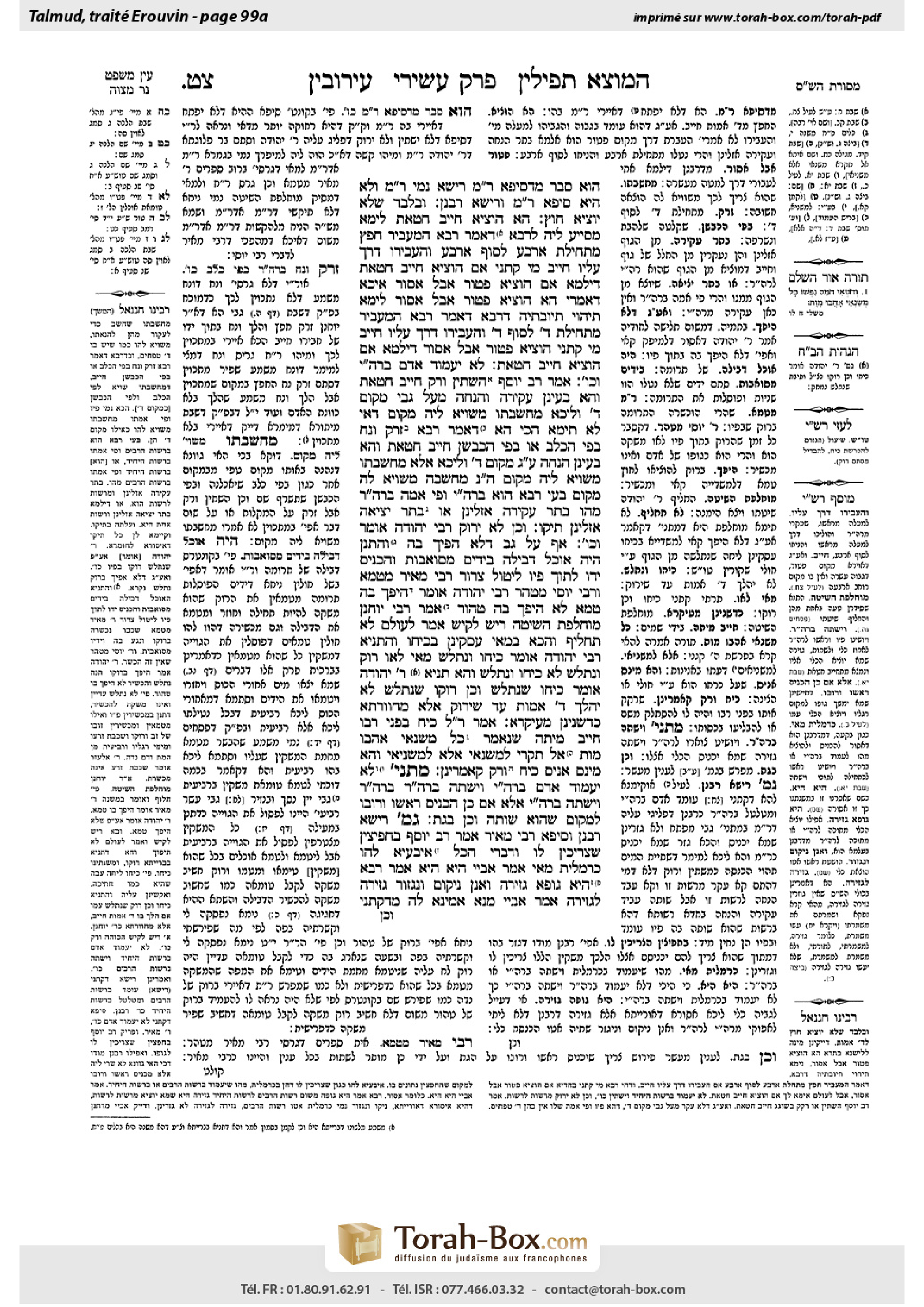
עירובין צ״ט א · Aramaic and Hebrew text
הוּא סָבַר: מִדְּסֵיפָא רַבִּי מֵאִיר, רֵישָׁא נָמֵי רַבִּי מֵאִיר. וְלָא הִיא: סֵיפָא רַבִּי מֵאִיר, וְרֵישָׁא רַבָּנַן.
וּבִלְבַד שֶׁלֹּא יוֹצִיא חוּץ. הָא הוֹצִיא חַיָּיב חַטָּאת. לֵימָא מְסַיַּיע לֵיהּ לְרָבָא, דְּאָמַר רָבָא: הַמַּעֲבִיר חֵפֶץ מִתְּחִילַּת אַרְבַּע לְסוֹף אַרְבַּע, וְהֶעֱבִירוֹ דֶּרֶךְ עָלָיו — חַיָּיב.
מִי קָתָנֵי: אִם הוֹצִיא חַיָּיב חַטָּאת? דִּילְמָא אִם הוֹצִיא — פָּטוּר אֲבָל אָסוּר.
אִיכָּא דְאָמְרִי: הָא הוֹצִיא פָּטוּר אֲבָל אָסוּר, לֵימָא תֶּיהְוֵי תְּיוּבְתֵּיהּ דְּרָבָא, דְּאָמַר רָבָא: הַמַּעֲבִיר מִתְּחִילַּת אַרְבַּע לְסוֹף אַרְבַּע וְהֶעֱבִירוֹ דֶּרֶךְ עָלָיו חַיָּיב! מִי קָתָנֵי ״הוֹצִיא פָּטוּר אֲבָל אָסוּר״? דִּילְמָא: אִם הוֹצִיא — חַיָּיב חַטָּאת.
לֹא יַעֲמוֹד אָדָם בִּרְשׁוּת הַיָּחִיד וְכוּ׳. אָמַר רַב יוֹסֵף: הִשְׁתִּין וְרָק — חַיָּיב חַטָּאת.
וְהָא בָּעִינַן עֲקִירָה וְהַנָּחָה מֵעַל גַּבֵּי מְקוֹם אַרְבָּעָה, וְלֵיכָּא!
מַחְשַׁבְתּוֹ מְשַׁוְּיָא לֵיהּ מָקוֹם. דְּאִי לָא תֵּימָא הָכִי, הָא דְּאָמַר רָבָא: זָרַק וְנָח בְּפִי הַכֶּלֶב אוֹ בְּפִי הַכִּבְשָׁן חַיָּיב חַטָּאת, וְהָא בָּעִינַן הַנָּחָה עַל גַּבֵּי מְקוֹם אַרְבָּעָה, וְלֵיכָּא!
אֶלָּא: מַחְשַׁבְתּוֹ מְשַׁוְּיָא לֵיהּ מָקוֹם, הָכִי נָמֵי מַחְשָׁבָה מְשַׁוְּיָא לָהּ מָקוֹם.
בָּעֵי רָבָא: הוּא בִּרְשׁוּת הַיָּחִיד וּפִי אַמָּה בִּרְשׁוּת הָרַבִּים, מַהוּ? בָּתַר עֲקִירָה אָזְלִינַן, אוֹ בָּתַר יְצִיאָה אָזְלִינַן? תֵּיקוּ.
וְכֵן לֹא יָרוֹק. רַבִּי יְהוּדָה אוֹמֵר וְכוּ׳. אַף עַל גַּב דְּלָא הַפֵּיךְ בָּהּ?
וְהָתְנַן: הָיָה אוֹכֵל דְּבֵילָה בְּיָדַיִם מְסוֹאָבוֹת, וְהִכְנִיס יָדוֹ לְתוֹךְ פִּיו לִיטּוֹל צְרוֹר — רַבִּי מֵאִיר מְטַמֵּא, וְרַבִּי יוֹסֵי מְטַהֵר.
רַבִּי יְהוּדָה אוֹמֵר: הִיפֵּךְ בָּהּ — טָמֵא. לֹא הִיפֵּךְ בָּהּ — טָהוֹר!
אָמַר רַבִּי יוֹחָנָן: מוּחְלֶפֶת הַשִּׁיטָה.
רֵישׁ לָקִישׁ אָמַר: לְעוֹלָם לָא תַּחְלֵיף, וְהָכָא בְּמַאי עָסְקִינַן? בְּכִיחוֹ.
וְהַתַּנְיָא, רַבִּי יְהוּדָה אוֹמֵר: כִּיחוֹ וְנִתְלַשׁ, מַאי לָאו — רוֹק וְנִתְלַשׁ! לָא, כִּיחוֹ וְנִתְלַשׁ. וְהָא תַּנְיָא, רַבִּי יְהוּדָה אוֹמֵר: כִּיחוֹ שֶׁנִּתְלַשׁ, וְכֵן רוּקּוֹ שֶׁנִּתְלַשׁ, לֹא יְהַלֵּךְ אַרְבַּע אַמּוֹת עַד שֶׁיָּרוֹק! אֶלָּא מְחַוַּורְתָּא כִדְשַׁנִּינַן מֵעִיקָּרָא.
אָמַר רֵישׁ לָקִישׁ: כִּיַּח בִּפְנֵי רַבּוֹ חַיָּיב מִיתָה, שֶׁנֶּאֱמַר ״כׇּל מְשַׂנְאַי אָהֲבוּ מָוֶת״ — אַל תִּקְרֵי ״לִמְשַׂנְאַי״, אֶלָּא ״לְמַשְׂנִיאַי״.
וְהָא מֵינָס אֲנִיס? כִּיַּח וְרָק קָאָמְרִינַן.
מַתְנִי׳ לֹא יַעֲמוֹד אָדָם בִּרְשׁוּת הַיָּחִיד וְיִשְׁתֶּה בִּרְשׁוּת הָרַבִּים, בִּרְשׁוּת הָרַבִּים וְיִשְׁתֶּה בִּרְשׁוּת הַיָּחִיד, אֶלָּא אִם כֵּן הִכְנִיס רֹאשׁוֹ וְרוּבּוֹ לִמְקוֹם שֶׁהוּא שׁוֹתֶה. וְכֵן בַּגַּת.
גְּמָ׳ רֵישָׁא רַבָּנַן, וְסֵיפָא רַבִּי מֵאִיר!
אָמַר רַב יוֹסֵף: בַּחֲפֵיצִין שֶׁצְּרִיכִין לוֹ, וְדִבְרֵי הַכֹּל.
אִיבַּעְיָא לְהוּ: כַּרְמְלִית, מַאי? אָמַר אַבָּיֵי: הִיא הִיא. אָמַר רָבָא: הִיא גּוּפָא גְּזֵירָה, וַאֲנַן נֵיקוּם וְנִגְזוֹר גְּזֵירָה לִגְזֵירָה?!
אָמַר אַבָּיֵי: מְנָא אָמֵינָא לַהּ, מִדְּקָתָנֵי
Eruvin 99a · English translation
The Gemara explains: Rav Ḥinnana maintains that from the fact that the latter clause of the mishna, was taught in accordance with the opinion of Rabbi Meir, it can be inferred that the first clause was likewise taught in accordance with the opinion of Rabbi Meir. But in fact that is not so: The latter clause is in accordance with the opinion of Rabbi Meir, while the first clause is in accordance with that of the Rabbis.
We learned in the mishna: One may move objects in a public domain when he is standing in a private domain, provided that he does not carry them beyond four cubits in the public domain. The Gemara infers: This teaching indicates that if he carried them beyond four cubits, he is liable to bring a sin-offering. The Gemara asks: Let us say that this ruling supports the opinion of Rava, as Rava said: With regard to one who carries an object in a public domain from the beginning of four cubits to the end of those four cubits, even if he carried it above his head, i.e., he lifted the object above his head so that it passed through an exempt place, he is nonetheless liable for carrying four cubits in a public domain. Here, too, although he is standing in an elevated private domain and carries the object at that elevated height, he is still liable.
The Gemara rejects this contention: Is the mishna teaching that if he carried the object beyond four cubits he is liable to bring a sin-offering? Perhaps the mishna means: If he carried the object beyond four cubits, he is exempt from bringing a sin-offering, but it is nevertheless prohibited by rabbinic decree to do so.
Some say a different version of the previous discussion: The Gemara’s initial inference was actually that if he carried the object beyond four cubits he is exempt from bringing a sin-offering, but it is prohibited by rabbinic decree to do so. The Gemara asks: If so, let us say that this is a conclusive refutation of Rava’s opinion, as Rava said: With regard to one who carries an object in a public domain from the beginning of four cubits to the end of those four cubits, even if he carried it above his head, he is liable. The Gemara rejects this suggestion: Is the mishna teaching that if he took it beyond four cubits he is exempt, but it is prohibited to do so? Perhaps the tanna means that if he carried it beyond four cubits, he is liable to bring a sin-offering.
The mishna states: A person may not stand in a private domain and urinate or spit into the public domain. Rav Yosef said: One who urinated or spat in this manner is liable to bring a sin-offering.
The Gemara raises a difficulty: But for an act of carrying to be considered a prohibited Shabbat labor that entails liability, we require that the lifting and placing of the object be performed from atop an area four by four handbreadths, the minimal size of significance with regard to the halakhot of carrying on Shabbat. And that is not the case here, as one’s mouth, which produces the spittle, is not four by four handbreadths in size.
The Gemara answers: One’s intent renders it an area of significance, i.e., as one certainly considers his mouth a significant area, it is regarded as four by four handbreadths in size. As, if you do not say so, that the size of an area is not the sole criterion, but that a person’s thoughts can also establish a place as significant, there is a difficulty with that which Rava said: If a person threw an object and it landed in the mouth of a dog or in the mouth of a furnace, he is liable to bring a sin-offering. But don’t we require that the object be placed on an area of four by four handbreadths? And that is not the case here.
Rather, the person’s intent to throw the object into the dog’s mouth renders it an area of significance. Here too, his intent renders his own mouth a significant area.
Rava raised a dilemma: If one is standing in a private domain, and the opening of his male member is in the public domain, and he urinates, what is the halakha? How should this case be regarded? Do we follow the domain where the urine is uprooted from the body, i.e., the bladder, which is in the private domain? Or do we follow the point of the urine’s actual emission from the body, and since the urine leaves his body through the opening of his member in the public domain, no prohibition has been violated? Since this dilemma was not resolved, the Gemara concludes: Let it stand unresolved.
The mishna states: And likewise, one may not spit from one domain to another. Rabbi Yehuda says: Once a person’s spittle is gathered in his mouth, he may not walk four cubits in the public domain until he removes it. The Gemara asks: Does this teaching mean that it is prohibited to do so even if he has not turned the spittle over in his mouth, i.e., after he has dredged up the saliva but before he has rolled it around in his mouth in preparation to spit it out?
Didn’t we learn in a mishna the halakha of one who was eating a dried fig of teruma with unwashed hands? By Torah law, only food that has come into contact with a liquid is susceptible to ritual impurity, and no liquid had ever fallen on this fig. The significance of the fact that his hands are unwashed is that by rabbinic law, unwashed hands have second degree ritual impurity status and therefore invalidate teruma. If this person inserted his hand into his mouth to remove a pebble, Rabbi Meir deems the dried fig impure, as it had been rendered liable to contract impurity by the spittle in the person’s mouth, and it subsequently became impure when it was touched by his unwashed hand. And Rabbi Yosei deems the fig ritually pure, as he maintains that spittle which is still in one’s mouth is not considered liquid that renders food liable to contract impurity; the spittle does so only after it has left the mouth.
Rabbi Yehuda says that there is a distinction between the cases: If he turned the spittle over in his mouth, it is like spittle that has been detached from its place, and therefore its legal status is that of a liquid, which means the fig is impure. However, if he had not yet turned the spittle over in his mouth, the fig is pure. This indicates that according to Rabbi Yehuda, spittle that has not yet been turned over in one’s mouth is not considered detached.
Rabbi Yoḥanan said: The attribution of the opinions is reversed, as the opinion attributed to Rabbi Yehuda is actually that of a different tanna, while Rabbi Yehuda himself maintains that the fig is ritually impure in either case.
Reish Lakish said: Actually, do not reverse the opinions, and the apparent contradiction can be reconciled in accordance with the original version of the text: With what we are dealing here in the mishna? We are dealing with his phlegm that is expelled through coughing.
The Gemara raises a difficulty against this resolution. Wasn’t it taught in a baraita that Rabbi Yehuda says: If one’s phlegm was detached, he may not walk four cubits in the public domain with it in his mouth? What, is it not the case that this halakha refers to spittle that was detached? The Gemara rejects this contention: No, this ruling applies only to one’s phlegm that was detached. The Gemara raises a difficulty: Wasn’t it taught in a baraita that Rabbi Yehuda says: If one’s phlegm was detached, and likewise, if his spittle was detached, he may not walk four cubits in the public domain before he spits it out, even if he has not yet turned it over. Rather, it is clear as we originally answered, that the opinions in the mishna with regard to spittle and ritual impurity must be reversed.
Having mentioned phlegm, the Gemara cites a related teaching: Reish Lakish said: One who expelled phlegm in front of his master has acted in a disrespectful manner and is liable for the punishment of death at the hand of Heaven, as it is stated: “All they who hate Me love death” (Proverbs 8:36). Do not read it as: “They who hate [mesanai] Me”; rather, read it as: “Those who make themselves hateful [masniai] to Me,” i.e., those who make themselves hateful by such a discharge.
The Gemara expresses surprise at this ruling: But doesn’t he do so involuntarily, as no one coughs and emits phlegm by choice; why should this be considered a transgression? The Gemara answers: We are speaking here of someone who had phlegm in his mouth and spat it out, i.e., one who had the opportunity to leave his master’s presence and spit outside.
MISHNA: A person may stand in a private domain and extend his head and drink in a public domain, and he may stand in a public domain and drink in a private domain, only if he brings his head and most of his body into the domain in which he drinks. And the same applies in a winepress, as will be explained in the Gemara.
GEMARA: The Gemara registers surprise at the mishna: It would seem that the first clause, i.e., the previous mishna, is in accordance with the opinion of the Rabbis, who maintain that a person located in one domain is permitted to move objects in another domain, whereas the latter clause, i.e., this mishna, is in accordance with the opinion of Rabbi Meir, who maintains that it is prohibited for a person in one domain to move objects in a different domain.
Rav Yosef said: This mishna is referring to objects that one needs, and the ruling is accepted by all. In this case, even the Rabbis concede that it is prohibited to move objects in another domain, lest one absent-mindedly draw the objects to him and thereby violate a Torah prohibition.
A dilemma was raised before the Sages: If one of the domains is a karmelit, what is the halakha? Abaye said: This case is equal to that case, i.e., in this situation a karmelit is governed by the same halakha that applies to a domain defined by Torah law. Just as the Sages prohibited one in the private domain from drinking from the public domain and vice versa, so too, they prohibited one in a karmelit from drinking in the same manner. Rava said: How can you say so? The prohibition against carrying to or from a karmelit is itself a rabbinic decree. And will we then proceed to issue a decree to prevent violation of another decree?
Abaye said in explanation of his opinion: From where do I say that halakha? From the fact that it is taught in the mishna:
Eruvin 99a · Traduction française (IA)
La Guemara explique : Rav Ḥinnana affirme que puisque la clause ultérieure de la mitsna a été enseignée selon l'opinion de Rabbi Meir, on peut en déduire que la clause première a également été enseignée selon l'opinion de Rabbi Meir. Cependant, en réalité, ce n'est pas le cas : la clause ultérieure est en conformité avec l'opinion de Rabbi Meir, tandis que la clause première est en conformité avec celle des Sages.
Nous avons appris dans la mitsna : On peut déplacer des objets dans un domaine public lorsqu'on est debout dans un domaine privé, à condition qu'on ne les transporte pas au-delà de quatre cubits dans le domaine public. La Guemara déduit : Cet enseignement indique que si l'on a transporté les objets au-delà de quatre cubits, l'on est tenu de présenter un sacrifice expiatoire. La Guemara pose la question : Disons que cette décision soutient l'opinion de Rava, car Rava a dit : En ce qui concerne celui qui transporte un objet dans un domaine public du début des quatre cubits à la fin de ceux-ci, même s'il le transporte au-dessus de sa tête, c'est-à-dire qu'il soulève l'objet au-dessus de sa tête de sorte qu'il traverse un lieu exempt, il est tout de même tenu responsable de transporter quatre cubits dans un domaine public. Ici aussi, bien qu'il soit debout dans un domaine privé élevé et transporte l'objet à cette hauteur élevée, il reste tenu responsable.
La Guemara rejette cette affirmation : La mitsna enseigne-t-elle que si l'on a transporté l'objet au-delà de quatre cubits, l'on est tenu de présenter un sacrifice expiatoire ? Peut-être la mitsna signifie-t-elle : Si l'on a transporté l'objet au-delà de quatre cubits, l'on est exempt de présenter un sacrifice expiatoire, mais il est tout de même interdit par un décret rabbinique de le faire.
Certains avancent une version différente de la discussion précédente : La déduction initiale de la Guemara était en réalité que si l'on avait transporté l'objet au-delà de quatre cubits, l'on était exempt de présenter un sacrifice expiatoire, mais il était interdit par un décret rabbinique de le faire. La Guemara pose la question : Si c'est ainsi, disons que cela constitue une réfutation définitive de l'opinion de Rava, car Rava a dit : En ce qui concerne celui qui transporte un objet dans un domaine public du début des quatre cubits à la fin de ceux-ci, même s'il le transporte au-dessus de sa tête, il est tenu responsable. La Guemara rejette cette suggestion : La mitsva enseigne-t-elle que si l'on a transporté l'objet au-delà de quatre cubits, l'on est exempt, mais il est interdit de le faire ? Peut-être le tanna signifie-t-il que si l'on a transporté l'objet au-delà de quatre cubits, l'on est tenu de présenter un sacrifice expiatoire ?
La mitsva stipule : Une personne ne doit pas se tenir dans un domaine privé et uriner ou cracher dans un domaine public. Rav Yosef a dit : Celui qui urine ou crache ainsi est tenu de présenter un sacrifice expiatoire.
La Guemara soulève une difficulté : Mais pour qu'un acte de transport soit considéré comme un travail interdit du Shabbat entraînant une responsabilité, nous exigeons que le levé et le posé de l'objet soient effectués depuis une surface de quatre par quatre tefachim, la taille minimale d'importance concernant les halakhot du transport le Shabbat. Et cela n'est pas le cas ici, car la bouche, qui produit la salive, n'a pas une taille de quatre par quatre tefachim.
La Guemara répond : L'intention de la personne rend ce lieu significatif, c'est-à-dire que comme l'on considère certainement sa bouche comme un lieu significatif, elle est regardée comme ayant une taille de quatre par quatre tefachim. Car, si l'on ne dit pas cela, c'est-à-dire que la taille d'un lieu n'est pas le seul critère, mais que les pensées d'une personne peuvent aussi établir un lieu comme significatif, il y a une difficulté avec ce que Rava a dit : Si une personne jette un objet et qu'il atterrit dans la bouche d'un chien ou dans la bouche d'un four, il est tenu de présenter un sacrifice expiatoire. Mais n'exige-t-on pas que l'objet soit placé sur un lieu de quatre par quatre tefachim ? Et cela n'est pas le cas ici.
Plutôt, l'intention de la personne de jeter l'objet dans la bouche du chien rend ce lieu significatif. Ici aussi, son intention rend sa propre bouche un lieu significatif.
Rava a soulevé un dilemme : Si l'on est debout dans un domaine privé et que l'ouverture de son membre masculin est dans le domaine public, et qu'il urine, quelle est la halakha ? Comment devons-nous considérer ce cas ? Suivons-nous le domaine où l'urine est arrachée du corps, c'est-à-dire la vessie, qui est dans le domaine privé ? Ou suivons-nous le point où l'urine est émise du corps, et puisque l'urine quitte son corps à travers l'ouverture de son membre dans le domaine public, aucun interdit n'a été violé ? Puisque ce dilemme n'a pas été résolu, la Guemara conclut : Laissons-le sans résolution.
La mitsva stipule : De même, on ne doit pas cracher d'un domaine à un autre. Rabbi Yehuda dit : Une fois que la salive d'une personne est réunie dans sa bouche, il ne doit pas marcher quatre cubits dans le domaine public avant de l'enlever. La Guemara pose la question : Cet enseignement signifie-t-il que cela est interdit même s'il n'a pas retourné la salive dans sa bouche, c'est-à-dire après qu'il ait soulevé la salive mais avant qu'il n'ait fait tourner la salive dans sa bouche en préparation à l'éternuer ?
N'avons-nous pas appris dans une mitsva la halakha concernant celui qui mangeait une figue sèche de terouma avec des mains non lavées ? Selon la loi divine, seul le nourriture qui a été en contact avec un liquide est susceptible de contracter une impureté rituelle, et aucun liquide n'avait jamais tombé sur cette figue. La signification du fait que ses mains sont non lavées est que selon la loi rabbinique, les mains non lavées ont un statut d'impureté rituelle de deuxième degré et invalident donc la terouma. Si cette personne a inséré sa main dans sa bouche pour enlever une pierre, Rabbi Meir considère la figue comme impure, car elle avait été rendue susceptible de contracter une impureté par la salive dans la bouche de la personne, et elle est ensuite devenue impure lorsqu'elle a été touchée par ses mains non lavées. Et Rabbi Yosei considère la figue comme pure, car il maintient que la salive qui est encore dans la bouche d'une personne n'est pas considérée comme un liquide capable de rendre le nourriture susceptible de contracter une impureté rituelle ; la salive ne le fait que lorsqu'elle a quitté la bouche.
Rabbi Yehuda dit qu'il y a une distinction entre les cas : Si l'homme a retourné la salive dans sa bouche, cela est comme de la salive détachée de son lieu, et donc son statut juridique est celui d'un liquide, ce qui signifie que la figue est impure. Cependant, si l'homme n'avait pas encore retourné la salive dans sa bouche, la figue est pure. Cela montre que selon Rabbi Yehuda, la salive qui n'a pas encore été retournée dans la bouche n'est pas considérée comme détachée.
Rabbi Yoḥanan dit : L'attribution des opinions est inversée, car l'opinion attribuée à Rabbi Yehuda est en réalité celle d'un autre tanna, tandis que Rabbi Yehuda lui-même maintient que la figue est impure dans les deux cas.
Reish Lakish dit : En réalité, ne reversez pas les opinions, et la contradiction apparente peut être résolue conformément au texte original : De quoi sommes-nous en train de parler ici dans la mitsna ? Nous parlons de sa salive expulsée par toux.
Le Guemara soulève une difficulté contre cette résolution. N'était-il pas enseigné dans une baraïta que Rabbi Yehuda dit : Si la salive d'une personne est détachée, il ne peut pas marcher quatre cubits dans le domaine public avec elle dans sa bouche ? Qu'est-ce que cela signifie, n'est-ce pas le cas que cette halakha concerne la salive détachée ? Le Guemara rejette cette affirmation : Non, cette décision s'applique uniquement à la salive détachée d'une personne. Le Guemara soulève une difficulté : N'était-il pas enseigné dans une baraïta que Rabbi Yehuda dit : Si la salive d'une personne est détachée, et de même si sa salive est détachée, il ne peut pas marcher quatre cubits dans le domaine public avant de l'avaler, même s'il n'a pas encore retourné la salive. En réalité, il est clair comme nous l'avons déjà répondu que les opinions dans la mitsna concernant la salive et l'impureté rituelle doivent être inversées.
Ayant mentionné la salive, le Guemara cite une enseignement connexe : Reish Lakish dit : Celui qui expulse de la salive devant son maître agit de manière impie et est puni de la mort à la main du Royaume des Cieux, car il est dit : « Tous ceux qui m'haïssent aiment la mort » (Proverbes 8:36). Ne le lisez pas comme : « Ceux qui haïssent [mesanai] Moi » ; lisez-le comme : « Ceux qui se rendent odieux [masniai] à Moi », c'est-à-dire ceux qui se rendent odieux par de tels éjections.
Le Guemara exprime une surprise à l'égard de cette décision : Mais ne fait-il pas cela involontairement, car personne ne touxhe et n'expulse de la salive volontairement ; pourquoi cette infraction devrait-elle être considérée ? Le Guemara répond : Nous parlons ici d'une personne qui avait de la salive dans sa bouche et l'a expulsée, c'est-à-dire celui qui avait l'opportunité de quitter la présence de son maître et d'expulser la salive à l'extérieur.
MICHNA : Une personne peut se tenir dans un domaine privé et étendre sa tête et boire dans un domaine public, et elle peut se tenir dans un domaine public et boire dans un domaine privé, à condition qu'elle amène sa tête et la plus grande partie de son corps dans le domaine où elle boit. Et cela s'applique également dans une vigne, comme sera expliqué dans la Guemara.
GUEMARA : La Guemara exprime une surprise à l'égard de la Michna : Il semble que la première clause, c'est-à-dire la Michna précédente, soit en conformité avec l'opinion des Rabbins, qui maintiennent qu'une personne située dans un domaine peut transporter des objets dans un autre domaine, tandis que la seconde clause, c'est-à-dire cette Michna, est en conformité avec l'opinion de Rabbi Meir, qui maintient que c'est interdit à une personne dans un domaine de transporter des objets dans un autre domaine.
Rav Yosef dit : Cette Michna parle des objets dont l'homme a besoin, et la décision est acceptée par tous. Dans ce cas, même les Rabbins reconnaissent qu'il est interdit de transporter des objets dans un autre domaine, de peur que l'homme ne transporte involontairement les objets vers lui et ne viole ainsi une interdiction divine.
Un dilemme a été soulevé devant les Sages : Si l'un des domaines est un karmelit, quelle est la halakha ? Abaye dit : Ce cas est équivalent à un autre cas, c'est-à-dire que dans cette situation, un karmelit est gouverné par la même halakha qui s'applique à un domaine défini par la loi divine. Comme les Sages ont interdit à une personne dans un domaine privé de boire dans un domaine public et vice versa, de même ils ont interdit à une personne dans un karmelit de boire de la même manière. Rava dit : Comment pouvez-vous dire cela ? L'interdiction de transporter des objets vers ou depuis un karmelit est elle-même un décret rabbinique. Et allons-nous alors procéder à l'émission d'un décret pour empêcher la violation d'un autre décret ?
Abaye explique son opinion en disant : D'où dis-je que cette halakha ? De la fait qu'il est enseigné dans la mitsna :
Traduction française générée par IA à partir de l’édition anglaise de Sefaria. Vérifie toujours un passage avec le texte source.
Text from Sefaria: William Davidson Edition - Vocalized Aramaic (CC BY NC); William Davidson Edition - English (CC BY NC).