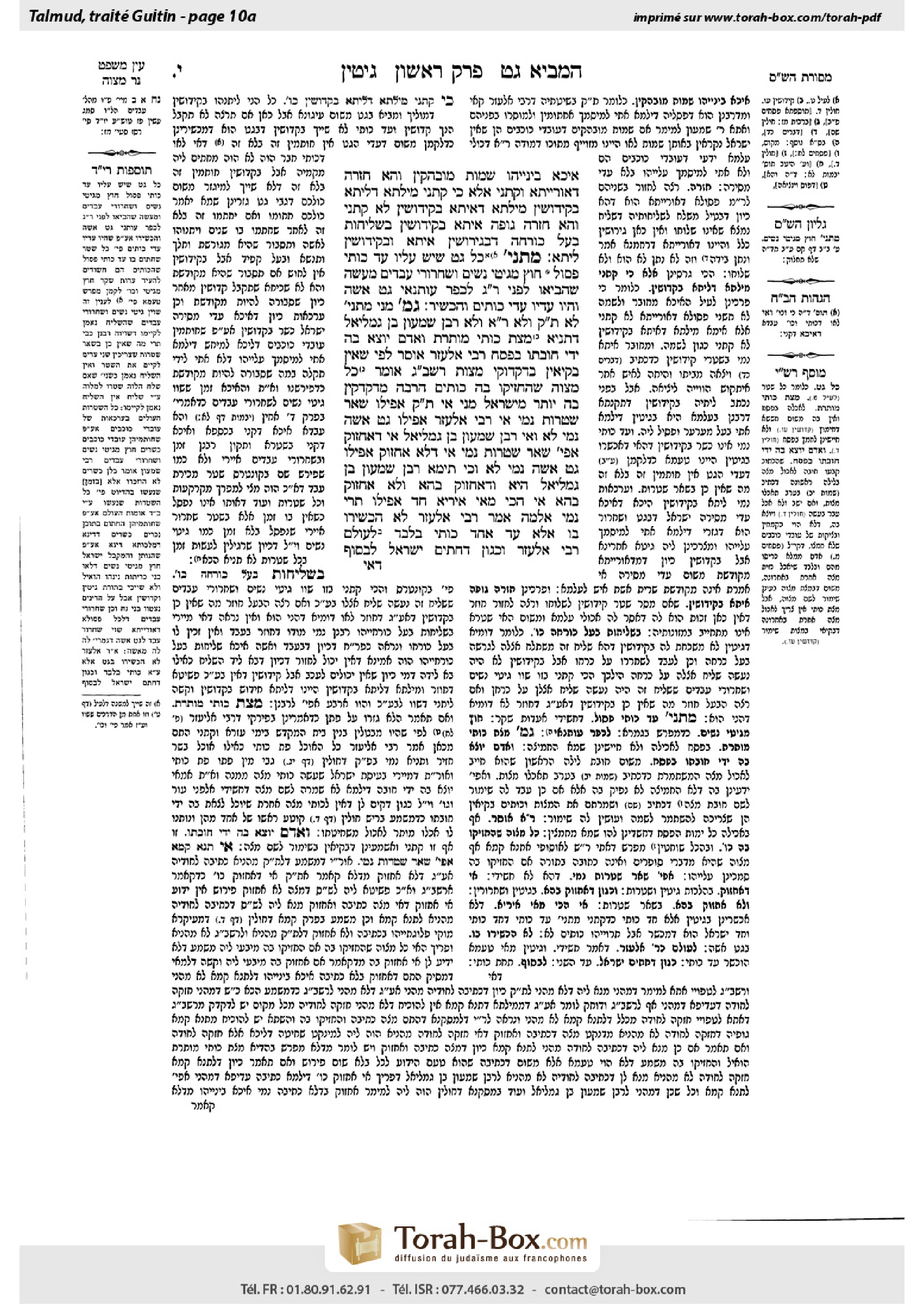
Gittin 10a: Talmud study for Daf Yomi
Study the Talmud for Daf Yomi with scanned pages, Hebrew text, English translations from Sefaria and AI-generated French translations.
Passage selection and English or AI-generated French translation are available where the scan has annotations. Daf Study is independent of Torah-Box and Sefaria.
Browse Gittin · גיטין · All tractatesGittin 10a text and translations
This page of Gittin includes the Aramaic text, an English translation and an AI-generated French translation, alongside the scan above.
גיטין י׳ א · Aramaic and Hebrew text
אִיכָּא בֵּינַיְיהוּ שֵׁמוֹת מוּבְהָקִין.
וְהָא חֲזָרָה דְּאוֹרָיְיתָא, וְקָתָנֵי!
אֶלָּא כִּי קָתָנֵי – מִילְּתָא דְּלֵיתַהּ בְּקִידּוּשִׁין, מִילְּתָא דְּאִיתַהּ בְּקִידּוּשִׁין – לָא קָתָנֵי.
וְהָא חֲזָרָה גּוּפַהּ אִיתָא בְּקִידּוּשִׁין! בִּשְׁלִיחוּת בְּעַל כּוֹרְחָהּ, דִּבְגֵירוּשִׁין אִיתַהּ וּבְקִידּוּשִׁין לֵיתַהּ.
מַתְנִי׳ כׇּל גֵּט שֶׁיֵּשׁ עָלָיו עֵד כּוּתִי – פָּסוּל, חוּץ מִגִּיטֵּי נָשִׁים וְשִׁחְרוּרֵי עֲבָדִים. מַעֲשֶׂה שֶׁהֵבִיאוּ לִפְנֵי רַבָּן גַּמְלִיאֵל לִכְפַר עוֹתְנַאי גֵּט אִשָּׁה, וְהָיוּ עֵדָיו עֵדֵי כוּתִים, וְהִכְשִׁיר.
גְּמָ׳ מַנִּי מַתְנִיתִין? לָא תַּנָּא קַמָּא, וְלָא רַבִּי אֶלְעָזָר, וְלָא רַבָּן שִׁמְעוֹן בֶּן גַּמְלִיאֵל!
דְּתַנְיָא: מַצַּת כּוּתִי – מוּתֶּרֶת, וְאָדָם יוֹצֵא בָּהּ יְדֵי חוֹבָתוֹ בַּפֶּסַח. רַבִּי אֶלְעָזָר אוֹסֵר, לְפִי שֶׁאֵין בְּקִיאִין בְּדִקְדּוּקֵי מִצְוֹת. רַבָּן שִׁמְעוֹן בֶּן גַּמְלִיאֵל אוֹמֵר: כׇּל מִצְוָה שֶׁהֶחֱזִיקוּ בָּהּ כּוּתִים – הַרְבֵּה מְדַקְדְּקִין בָּהּ, יוֹתֵר מִיִּשְׂרָאֵל.
מַנִּי? אִי תַּנָּא קַמָּא, אֲפִילּוּ שְׁאָר שְׁטָרוֹת נָמֵי! אִי רַבִּי אֶלְעָזָר, אֲפִילּוּ גֵּט אִשָּׁה נָמֵי לָא!
וְאִי רַבָּן שִׁמְעוֹן בֶּן גַּמְלִיאֵל; אִי דְּאַחְזוּק – אֲפִילּוּ שְׁאָר שְׁטָרוֹת נָמֵי, אִי דְּלָא אַחְזוּק – אֲפִילּוּ גֵּט אִשָּׁה נָמֵי לָא!
וְכִי תֵּימָא רַבָּן שִׁמְעוֹן בֶּן גַּמְלִיאֵל הִיא, וּדְאַחְזוּק בְּהָא וְלָא אַחְזוּק בְּהָא, אִי הָכִי, מַאי אִירְיָא חַד? אֲפִילּוּ תְּרֵי נָמֵי! אַלְּמָה אָמַר רַבִּי אֶלְעָזָר: לֹא הִכְשִׁירוּ בּוֹ אֶלָּא עֵד אֶחָד כּוּתִי בִּלְבָד?
לְעוֹלָם רַבִּי אֶלְעָזָר, וּכְגוֹן דְּחָתֵים יִשְׂרָאֵל לְבַסּוֹף,
Gittin 10a · English translation
The Gemara explains: It is possible that even the first tanna holds in accordance with the opinion of Rabbi Elazar that the witnesses who observe its transmission effect the divorce, and he does not dispute Rabbi Shimon on this point. Instead, the difference between the first tanna and Rabbi Shimon concerns a case where the signatures on the bill of divorce are unambiguous [muvhakin] gentile names. The first tanna holds that although a bill of divorce is valid if it was transmitted in the presence of valid witnesses, there is always a concern that it might have been transmitted in the presence of the same gentile witnesses who signed it. Therefore, it is rendered invalid by rabbinic law. Conversely, Rabbi Shimon holds that if it contained names that clearly belonged to gentiles it can be assumed that the bill of divorce was transmitted in the presence of two valid witnesses, and therefore it is valid.
The Gemara raises another difficulty: But the halakha of retraction applies by Torah law, as according to the opinion of Rabbi Meir the husband can retract his instruction to give the bill of divorce and the master can retract his instruction to give the bill of manumission by Torah law, thereby canceling the agency. And yet the baraita teaches it among the ways in which bills of divorce are equal to bills of manumission. This indicates that the tanna does not distinguish between a case that applies by Torah law and one that applies by rabbinic law.
Rather, the Gemara retracts from the previous explanation in favor of the following: When the baraita teaches the ways in which the two are equal it teaches only a matter that does not apply with regard to the halakhot of betrothal; however, it does not teach a matter that does apply with regard to the halakhot of betrothal.
The Gemara challenges: But retraction itself is also applicable with regard to betrothal, as one who sent a betrothal document with an agent can retract it. The Gemara says: The halakha of agency in the case of betrothal is not the same as that of divorce, as there is a difference with regard to agency undertaken to enact a matter against the recipient’s will. If one appointed an agent for a matter that the recipient does not want, e.g., to betroth a woman against her will or to free a slave against his will, as with regard to divorce, it is a valid agency, as a bill of divorce need not be given with the woman’s consent, but with regard to betrothal it is not a valid agency, as a woman can be betrothed only with her consent.
MISHNA: Any document that has a Samaritan witness signed on it is invalid, except for bills of divorce and bills of manumission. An incident occurred in which they brought a bill of divorce before Rabban Gamliel in the village of Otnai, and its witnesses were Samaritan witnesses, and he deemed it valid.
GEMARA: The Gemara asks: Whose opinion is expressed in the mishna? It is not the opinion of the first tanna, nor that of Rabbi Elazar, nor that of Rabban Shimon ben Gamliel, cited in the following baraita.
As it is taught in a baraita (Tosefta, Pesaḥim 1:15): The matza of a Samaritan is permitted on Passover, as there is no concern that it might be leaven, and a person fulfills his obligation to eat matza on the first night of Passover with it. Rabbi Elazar prohibits the consumption of the matza of a Samaritan because the Samaritans are not well-versed in the details of mitzvot. Rabban Shimon ben Gamliel says: On the contrary, with regard to any mitzva that the Samaritans embraced and accepted, they are more exacting in its observance than are Jews.
The Gemara elaborates: Whose opinion is expressed in the mishna? If it is the opinion of the first tanna in the baraita, then even other documents should be valid when signed by Samaritan witnesses. By ruling that one can fulfill his obligation with Samaritan matza, this tanna apparently holds that the status of Samaritans is the same as that of Jews. If so, that should be their status with regard to their testimony on any document. If the opinion in the mishna is that of Rabbi Elazar, who expresses the concern that Samaritans are not well versed in the details of mitzvot, they should not be fit to sign even a bill of divorce.
And if the opinion in the mishna is that of Rabban Shimon ben Gamliel, the halakha should depend on the following consideration: If they embrace and accept the mitzva associated with the subject of the document, even with regard to other documents their testimony should be valid; if they do not embrace and accept the mitzva associated with the subject of the document, they should not be rendered fit to sign even a bill of divorce.
And if you would say that the opinion in the mishna is that of Rabban Shimon ben Gamliel, and the Samaritans embrace this mitzva of bills of divorce, but they do not embrace this mitzva associated with the subject of other documents, if so, why is a bill of divorce valid specifically in a case where only one Samaritan witness signed it? The same would hold true even if two Samaritan witnesses signed the bill of divorce as well. Why, then, does Rabbi Elazar say: The Sages deemed it valid only when there is just one Samaritan witness signed on the bill of divorce?
The Gemara answers: Actually, the opinion expressed in the mishna is that of Rabbi Elazar, and as a rule, one may not rely on the testimony of a Samaritan on a document. And the mishna is referring to a case where a Jew signed the document last,
Gittin 10a · Traduction française (IA)
La Guemara explique : Il est possible que même le premier tanna soit d'accord avec l'opinion de Rabbi Elazar selon laquelle les témoins qui ont assisté à la transmission effectuent le divorce, et qu'il ne conteste pas Rabbi Shimon sur ce point. En revanche, la différence entre le premier tanna et Rabbi Shimon concerne un cas où les signatures sur le document de divorce sont des noms clairs de non-Juifs. Le premier tanna considère que bien qu'un document de divorce soit valide s'il a été transmis en présence de témoins valides, il y a toujours une préoccupation qu'il ait été transmis en présence des mêmes témoins non-Juifs qui ont signé. Par conséquent, il est rendu invalide par la loi rabbinique. À l'inverse, Rabbi Shimon considère que si les noms étaient clairement des noms de non-Juifs, on peut supposer que le document de divorce a été transmis en présence de deux témoins valides, et donc il est valide.
La Guemara soulève une autre difficulté : Mais la halakha de rétractation s'applique selon la loi de la Torah, car selon l'opinion de Rabbi Meir, le mari peut rétracter son ordre de donner le document de divorce et le maître peut rétracter son ordre de donner le document de manumission selon la loi de la Torah, annulant ainsi l'agence. Et pourtant, la baraïta enseigne qu'ils sont égaux en ce qui concerne les documents de divorce et les documents de manumission. Cela indique que le tanna ne distingue pas entre un cas applicable selon la loi de la Torah et un cas applicable selon la loi rabbinique.
Au contraire, la Guemara retire de l'explication précédente en faveur de la suivante : Lorsque la baraïta enseigne que les deux sont égaux, elle enseigne uniquement une matière qui ne s'applique pas en ce qui concerne les halakhot de l'engagement, toutefois elle ne s'applique pas à une matière qui s'applique en ce qui concerne les halakhot de l'engagement.
La Guemara questionne : Mais la rétractation elle-même s'applique également en ce qui concerne le mariage, car celui qui a envoyé un document de mariage avec un agent peut rétracter. La Guemara dit : La halakha de l'agence dans le cas de mariage n'est pas la même que celle du divorce, car il y a une différence en ce qui concerne l'agence entreprise pour accomplir une affaire contre la volonté du destinataire. Si l'on a désigné un agent pour une affaire que le destinataire ne veut pas, par exemple, pour marier une femme contre sa volonté ou pour manumettre un esclave contre sa volonté, comme c'est le cas du divorce, l'agence est valide, car un document de divorce n'a pas besoin d'être donné avec le consentement de la femme, mais en ce qui concerne le mariage, l'agence n'est pas valide, car une femme ne peut être mariée qu'avec son consentement.
MICHNA : Tout document signé par un témoin samaritain est invalide, sauf les documents de divorce et les documents de manumission. Il y a eu un incident où ils ont présenté un document de divorce devant Rabban Gamliel dans le village d'Otnai, et ses témoins étaient des témoins samaritains, et il l'a considéré comme valide.
GUEMARA : La Guemara pose une question : Quelle opinion est exprimée dans la mishna ? Ce n'est pas l'opinion du premier tanna, ni celle de Rabbi Elazar, ni celle de Rabban Shimon ben Gamliel, cité dans la baraïta suivante.
Comme il est enseigné dans une baraïta (Tosefta, Pesaḥim 1:15) : Le matza d'un samaritain est permis pendant la Pessah, car il n'y a pas de préoccupation qu'il soit levain, et une personne remplit son obligation de manger du matza la première nuit de Pessah avec cela. Rabbi Elazar interdit la consommation du matza d'un samaritain car les samaritains ne maîtrisent pas les détails des mitsvot. Rabban Shimon ben Gamliel dit : Au contraire, concernant toute mitsva que les samaritains ont adoptée et acceptée, ils sont plus exigeants dans son observance que les Juifs.
La Guemara développe : Quelle opinion est exprimée dans la mishna ? Si c'est l'opinion du premier tanna dans la baraïta, alors même d'autres documents devraient être valides lorsqu'ils sont signés par des témoins samaritains. En décidant que l'on peut remplir son obligation avec le matza samaritain, ce tanna semble considérer que le statut des samaritains est le même que celui des Juifs. Si c'est le cas, cela devrait être leur statut concernant leur témoignage sur tout document. Si l'opinion dans la mishna est celle de Rabbi Elazar, qui exprime la préoccupation que les samaritains ne maîtrisent pas les détails des mitsvot, ils ne devraient pas être considérés comme aptes à signer même un document de divorce.
Et si l'opinion dans la mishna est celle de Rabban Shimon ben Gamliel, la halakha devrait dépendre du suivant : Si ils adoptent et acceptent la mitsva associée à la matière du document, même concernant d'autres documents leur témoignage devrait être valide ; si ils n'adoptent pas et n'acceptent pas la mitsva associée à la matière du document, ils ne devraient pas être considérés comme aptes à signer même un document de divorce.
Et si vous affirmiez que l'opinion exprimée dans la Michna est celle de Rabban Shimon ben Gamliel, et que les Samaritains adoptent cette mitsva des documents de divorce, mais qu'ils n'adoptent pas cette mitsva liée à d'autres documents, alors pourquoi un document de divorce est-il valide spécifiquement dans le cas où seul un témoin samaritain l'a signé ? La même situation serait vraie même si deux témoins samaritains avaient signé le document de divorce. Pourquoi, alors, Rabbi Elazar dit-il : Les Sages ont jugé que ce document est valide uniquement lorsqu'il y a un seul témoin samaritain signataire ?
La Guemara répond : En réalité, l'opinion exprimée dans la Michna est celle de Rabbi Elazar, et en général, on ne peut pas se fier au témoignage d'un Samaritain concernant un document. Et la Michna fait référence à un cas où un Juif a signé le document en dernier.
Traduction française générée par IA à partir de l’édition anglaise de Sefaria. Vérifie toujours un passage avec le texte source.
Text from Sefaria: William Davidson Edition - Vocalized Aramaic (CC BY NC); William Davidson Edition - English (CC BY NC).