Gittin 10b: Talmud study for Daf Yomi
Study the Talmud for Daf Yomi with scanned pages, Hebrew text, English translations from Sefaria and AI-generated French translations.
Passage selection and English or AI-generated French translation are available where the scan has annotations. Daf Study is independent of Torah-Box and Sefaria.
Browse Gittin · גיטין · All tractatesGittin 10b text and translations
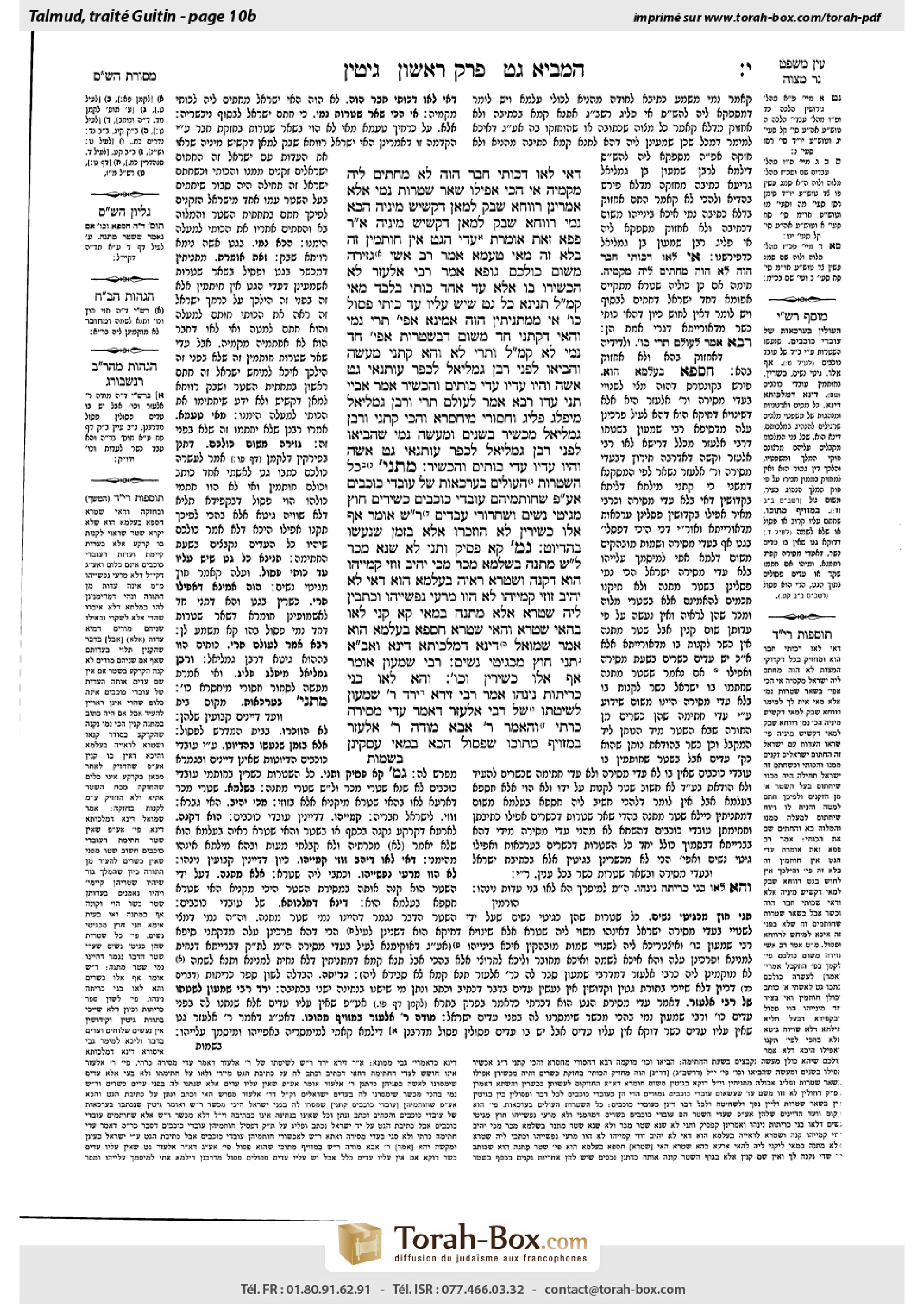
This page of Gittin includes the Aramaic text, an English translation and an AI-generated French translation, alongside the scan above.
גיטין י׳ ב · Aramaic and Hebrew text
דְּאִי לָאו דְּכוּתִי חָבֵר הֲוָה, לָא מַחְתֵּים לֵיהּ מִקַּמֵּיהּ. אִי הָכִי, אֲפִילּוּ שְׁאָר שְׁטָרוֹת נָמֵי!
אֶלָּא אָמְרִינַן רַוְוחָא שְׁבַק לְמַאן דְּקַשִּׁישׁ מִינֵּיהּ; הָכָא נָמֵי, רַוְוחָא שְׁבַק לְמַאן דְּקַשִּׁישׁ מִינֵּיהּ!
אָמַר רַב פָּפָּא, זֹאת אוֹמֶרֶת, עֵדֵי הַגֵּט אֵין חוֹתְמִין זֶה בְּלֹא זֶה.
מַאי טַעְמָא? אָמַר רַב אָשֵׁי: גְּזֵירָה מִשּׁוּם ״כּוּלְּכֶם״.
גּוּפָא, אָמַר רַבִּי אֶלְעָזָר: לֹא הִכְשִׁירוּ בּוֹ אֶלָּא עֵד אֶחָד כּוּתִי בִּלְבַד. מַאי קָא מַשְׁמַע לַן? תְּנֵינָא: כׇּל גֵּט שֶׁיֵּשׁ עָלָיו עֵד כּוּתִי – פָּסוּל כּוּ׳!
אִי מִמַּתְנִיתִין, הֲוָה אָמֵינָא אֲפִילּוּ תְּרֵי נָמֵי; וְהַאי דְּקָתָנֵי חַד, מִשּׁוּם דְּבִשְׁטָרוֹת אֲפִילּוּ חַד נָמֵי לָא, קָא מַשְׁמַע לַן.
וּתְרֵי לָא?! וְהָא קָתָנֵי: מַעֲשֶׂה וְהֵבִיאוּ לִפְנֵי רַבָּן גַּמְלִיאֵל לִכְפַר עוֹתְנַאי גֵּט אִשָּׁה, וְהָיוּ עֵדָיו עֵדֵי כוּתִים, וְהִכְשִׁיר! אָמַר אַבָּיֵי, תְּנִי: ״עֵדוֹ״.
רָבָא אָמַר: לְעוֹלָם תְּרֵי, וְרַבָּן גַּמְלִיאֵל מִיפְלָג פְּלִיג; וְחַסּוֹרֵי מִיחַסְּרָא, וְהָכִי קָתָנֵי: וְרַבָּן גַּמְלִיאֵל מַכְשִׁיר בִּשְׁנַיִם, וּמַעֲשֶׂה נָמֵי שֶׁהֵבִיאוּ לִפְנֵי רַבָּן גַּמְלִיאֵל לִכְפַר עוֹתְנַאי גֵּט אִשָּׁה, וְהָיוּ עֵדָיו עֵדֵי כוּתִים, וְהִכְשִׁיר.
מַתְנִי׳ כׇּל הַשְּׁטָרוֹת הָעוֹלִים בְּעַרְכָּאוֹת שֶׁל גּוֹיִם, אַף עַל פִּי שֶׁחוֹתְמֵיהֶם גּוֹיִם – כְּשֵׁירִים; חוּץ מִגִּיטֵּי נָשִׁים וְשִׁחְרוּרֵי עֲבָדִים. רַבִּי שִׁמְעוֹן אוֹמֵר: אַף אֵלּוּ כְּשֵׁירִין, לֹא הוּזְכְּרוּ אֶלָּא בִּזְמַן שֶׁנַּעֲשׂוּ בְּהֶדְיוֹט.
גְּמָ׳ קָא פָּסֵיק וְתָנֵי – לָא שְׁנָא מֶכֶר לָא שְׁנָא מַתָּנָה.
בִּשְׁלָמָא מֶכֶר, מִכִּי יָהֵיב זוּזֵי קַמַּיְיהוּ הוּא דִּקְנָה; וּשְׁטָרָא רְאָיָה בְּעָלְמָא הוּא – דְּאִי לָא יָהֵיב זוּזֵי קַמַּיְיהוּ, לָא הֲווֹ מַרְעִי נַפְשַׁיְיהוּ וְכָתְבִין לֵיהּ שְׁטָרָא.
אֶלָּא מַתָּנָה, בְּמַאי קָא קָנֵי – לָאו בְּהַאי שְׁטָרָא? וְהַאי שְׁטָרָא חַסְפָּא בְּעָלְמָא הוּא! אָמַר שְׁמוּאֵל: דִּינָא דְמַלְכוּתָא – דִּינָא.
וְאִיבָּעֵית אֵימָא, תָּנֵי ״חוּץ מִכְּגִיטֵּי נָשִׁים״.
רַבִּי שִׁמְעוֹן אוֹמֵר: אַף אֵלּוּ, כְּשֵׁירִין וְכוּ׳: וְהָא לָאו בְּנֵי כְרִיתוּת נִינְהוּ?
אָמַר רַבִּי זֵירָא: יָרַד רַבִּי שִׁמְעוֹן לְשִׁיטָתוֹ שֶׁל רַבִּי אֶלְעָזָר, דְּאָמַר עֵדֵי מְסִירָה כָּרְתִי.
וְהָאָמַר רַבִּי אַבָּא: מוֹדֶה רַבִּי אֶלְעָזָר בִּמְזוּיָּף מִתּוֹכוֹ, שֶׁפָּסוּל! הָכָא בְּמַאי עָסְקִינַן –
Gittin 10b · English translation
as, if not for the fact that the Samaritan was one devoted to the meticulous observance of mitzvot [ḥaver], the Jew would not have allowed him to sign the document before him. Therefore, one may rely on this Samaritan in this particular case. The Gemara asks: If so, that the mishna is referring to that case, then even other documents should be valid as well, if a Jew signed after the Samaritan.
Rather, this is not the case with regard to other documents, as we say that the fact that the Jew signed last does not prove that this Samaritan was a ḥaver, as perhaps in signing last he was leaving space above his signature for one who was older than he is in deference to the elder, and instead, a Samaritan came and signed the document. The Gemara asks: Here too, in the case of a bill of divorce, perhaps he was leaving space above his signature for one who was his elder. Why, then, are bills of divorce and bills of manumission valid while other documents are not?
Rav Pappa says: That is to say, in explanation of the difference between bills of divorce and manumission and other documents, that the witnesses of a bill of divorce and a bill of manumission may not sign one without the other; rather, each witness signs in the presence of the other. A Jew would be aware that a Samaritan was signing with him, and he would not sign unless he knew that the Samaritan was a valid witness. However, with regard to other documents, witnesses are not required to sign such documents in each other’s presence. Therefore, the signature of the Jew indicates nothing about the fitness of the Samaritan witness.
The Gemara asks: What is the reason that the witnesses must sign a bill of divorce and a bill of manumission together? Rav Ashi says: It is a rabbinic decree issued due to a case where the husband says: All of you are witnesses on this bill of divorce. In that case, if any one of them fails to sign the bill of divorce, it is invalid. Therefore, the Sages decreed that the witnesses must sign a bill of divorce together in all cases.
§ Since the Gemara mentioned the halakha stated by Rabbi Elazar, it analyzes the matter itself. Rabbi Elazar says: They deemed a bill of divorce valid only when just one witness is a Samaritan. The Gemara asks: What is he teaching us by this statement? We already learned in the mishna: Any document that has a Samaritan witness on it is invalid except for bills of divorce and bills of manumission. This indicates that those are valid only if they have the signature of one Samaritan witness, not two.
The Gemara responds: If it is learned from the mishna alone I would have said that even two Samaritan witnesses are also valid for a bill of divorce or a bill of manumission. And the fact that the mishna teaches one witness is because it wants to emphasize that for other documents even one Samaritan witness is also not valid. Therefore, Rabbi Eliezer teaches us that in the case of bills of divorce only one Samaritan witness is valid, but if both witnesses are Samaritans the bill of divorce is not valid.
The Gemara asks: And are two Samaritan witnesses not accepted on a bill of divorce? But the mishna teaches: An incident occurred in which they brought a bill of divorce before Rabban Gamliel in the village of Otnai, and its witnesses were Samaritan witnesses, and he deemed it valid. Abaye said that one should teach the mishna so that it does not read: Its witnesses, but rather: Its witness, i.e., Rabban Gamliel deemed valid a bill of divorce that had the signature of one Samaritan witness, as even he would invalidate a bill of divorce that included the signatures of two Samaritans.
Rava said: Actually, you do not need to say that the case was concerning one Samaritan witness, as it indeed is referring to two Samaritans witnesses, and Rabban Gamliel disagrees with the opinion of the first tanna. And the mishna is incomplete and this is what it is teaching: And Rabban Gamliel deems valid a bill of divorce that contains the signatures of two Samaritans, and an incident occurred in which they brought a bill of divorce before Rabban Gamliel in the village of Otnai, and its witnesses were Samaritan witnesses, and he deemed it valid.
MISHNA: With regard to all documents produced in gentile courts, even though their signatures are those of gentiles they are all valid, except for bills of divorce and bills of manumission. Rabbi Shimon says: Even these are valid, as these two types of documents are mentioned only when they are prepared by a common person, not in court.
GEMARA: With regard to the ruling of the mishna that all documents written in gentile courts are valid, the Gemara comments: The tanna categorically teaches a general halakha in the mishna, and it is no different if it is a document concerning a sale and it is no different if it is a document concerning a gift, the document is valid in both cases.
The Gemara asks: Granted, in the case of a sale this is reasonable, as from when the buyer gave money to the seller in the presence of the gentile judges he has acquired the property, since he has performed an act of acquisition. And the document is merely a proof for the acquisition. It must be that he already acquired the property in question, as if he had not given money in their presence the court would not act to its own detriment and write a document for him, as the document detailing the sale would not be accurate, and writing such a document would reflect poorly on them. Therefore, the document clearly serves as proof that the acquisition was performed in the correct manner.
However, with regard to a gift, by what means does the one who receives the gift acquire it from the giver? Is it not via this document? And yet this document is merely a shard, as a document written by gentiles is not considered a legal document according to halakha. Shmuel said: The law of the kingdom is the law, i.e., Jews must obey the laws of the state in which they live. Consequently, every form of property transfer accepted by local law is valid according to halakha as well.
And if you wish, say that one should emend the text of the mishna, and teach: They are all valid except for documents that are like bills of divorce. In other words, the distinction is between different types of documents: Documents that are meant to serve only as proof are valid even if they were produced in gentile courts, whereas documents that effect a legal act, such as bills of divorce, are invalid if they were written in a gentile court.
§ The mishna taught that Rabbi Shimon says: Even these bills of divorce and bills of manumission are valid if they were written in a gentile court and were signed by gentiles. The Gemara asks: How can Rabbi Shimon rule in this manner? But gentiles are not fit for this role, as they are not subject to the halakhot concerning scrolls of severance. Since the halakhot of marriage and divorce in the Torah are stated exclusively with regard to Jews, gentiles cannot serve in any capacity in cases of this kind.
Rabbi Zeira says: Rabbi Shimon follows the opinion of Rabbi Elazar, who says that the witnesses of the transmission of the bill of divorce effect the divorce. In other words, the signing of the bill of divorce is not essential to its effectiveness. Rather, the transfer of the bill of divorce completes the act of divorce, and therefore no attention is paid to who the signatories were.
The Gemara raises a difficulty: But doesn’t Rabbi Abba say that although he considers a bill of divorce valid even without the signature of witnesses, Rabbi Elazar concedes with regard to a document whose falsification is inherent in it that it is invalid despite the fact that it was properly transferred. In other words, notwithstanding the halakha that the signatures on a bill of divorce are unnecessary, a document that includes invalid signatures is thereby invalidated. The reason is that there is a concern that people will rely upon these witnesses. The Gemara answers: With what are we dealing here?
Gittin 10b · Traduction française (IA)
car, sans le fait que le Samaritain fût un homme dévoué à l'observation minutieuse des mitsvot [ḥaver], le Juif n'aurait pas permis à ce dernier de signer le document avant lui. Ainsi, on peut se fier à ce Samaritain dans ce cas particulier. La Guemara pose la question : Si c'est ainsi que la Michna fait référence à ce cas, alors d'autres documents devraient être également valides, si un Juif a signé après le Samaritain.
En réalité, ce n'est pas le cas pour d'autres documents, car nous disons que le fait que le Juif ait signé en dernier ne prouve pas que ce Samaritain était un ḥaver, car peut-être il laissait de la place au-dessus de sa signature pour un homme plus âgé qu'eux, en signe de respect, et c'est un Samaritain qui est venu signer le document. La Guemara pose la question : C'est pareil pour un acte de divorce, peut-être qu'il laissait de la place au-dessus de sa signature pour un homme plus âgé qu'eux. Pourquoi, alors, les actes de divorce et les actes de manumission sont-ils valides alors que d'autres documents ne le sont pas ?
Rav Pappa dit : Cela signifie que, pour expliquer la différence entre les actes de divorce et de manumission et d'autres documents, les témoins d'un acte de divorce et d'un acte de manumission ne peuvent pas signer l'un sans l'autre ; plutôt, chaque témoin signe en présence de l'autre. Un Juif serait conscient que le Samaritain signait avec lui, et il ne signerait pas sans savoir que le Samaritain était un témoin valide. Cependant, pour d'autres documents, les témoins ne sont pas tenus de signer ces documents en présence les uns des autres. Ainsi, la signature du Juif ne révèle rien sur la validité du témoin Samaritain.
La Guemara pose la question : Quel est le motif selon lequel les témoins doivent signer un acte de divorce et un acte de manumission ensemble ? Rav Ashi dit : C'est un décret rabbinique issu d'un cas où le mari dit : Tous les témoins êtes témoins de cet acte de divorce. Dans ce cas, si l'un d'eux ne signe pas l'acte de divorce, il est invalide. Ainsi, les Sages ont décrété que les témoins doivent signer un acte de divorce ensemble dans tous les cas.
§ Puisque la Guemara a mentionné la halakha énoncée par Rabbi Elazar, elle analyse la question elle-même. Rabbi Elazar dit : Ils ont considéré un acte de divorce valide uniquement lorsque seul un témoin est un Samaritain. La Guemara pose la question : Quel enseignement nous apporte-t-il par cette déclaration ? Nous avons déjà appris dans la Michna : Tout document qui a un témoin Samaritain est invalide, sauf les actes de divorce et les actes de manumission. Cela indique que ceux-ci sont valides uniquement s'ils ont la signature d'un seul témoin Samaritain.
La Guemara répond : Si j'avais appris cela uniquement à partir de la Michna, j'aurais dit que même deux témoins Samaritains sont également valides pour un acte de divorce ou un acte de manumission. Et le fait que la Michna enseigne un seul témoin est parce qu'elle veut souligner que pour d'autres documents même un seul témoin Samaritain n'est pas valide. Ainsi, Rabbi Eliezer nous enseigne que dans le cas d'un acte de divorce, seul un témoin Samaritain est valide, mais si les deux témoins sont Samaritains, l'acte de divorce n'est pas valide.
La Guemara pose la question : Et les deux témoins samaritains ne sont-ils pas rejetés pour un acte de divorce ? Mais la Michna enseigne : Il y a eu un cas où un acte de divorce a été présenté devant Rabban Gamliel dans la ville d'Otnai, et ses témoins étaient des témoins samaritains, et il l'a considéré comme valide. Abaye a dit qu'on devrait enseigner la Michna de sorte qu'elle ne lise pas : Ses témoins, mais plutôt : Son témoin, c'est-à-dire que Rabban Gamliel a considéré comme valide un acte de divorce qui avait la signature d'un seul témoin samaritain, car même lui aurait invalidé un acte de divorce qui comprenait les signatures de deux samaritains.
Rava a dit : En réalité, vous n'avez pas besoin de dire que le cas concernait un seul témoin samaritain, car il s'agit effectivement de deux témoins samaritains, et Rabban Gamliel est d'opinion contraire à celle du premier tanna. Et la Michna est incomplète, et c'est ce qu'elle enseigne : Et Rabban Gamliel considère comme valide un acte de divorce qui contient les signatures de deux samaritains, et un cas s'est produit où un acte de divorce a été présenté devant Rabban Gamliel dans la ville d'Otnai, et ses témoins étaient des témoins samaritains, et il l'a considéré comme valide.
MICHNA : Concernant tous les documents produits devant les tribunaux païens, même si leurs signatures sont celles de païens, ils sont tous valides, sauf les actes de divorce et les actes de manumission. Rabbi Shimon dit : Même ceux-ci sont valides, car ces deux types de documents sont mentionnés uniquement lorsqu'ils sont rédigés par un homme commun, pas devant un tribunal.
GUEMARA : Concernant la décision de la Michna que tous les documents rédigés devant les tribunaux païens sont valides, la Guemara commente : Le tanna enseigne clairement une halakha générale dans la Michna, et cela ne change rien si c'est un document concernant une vente ou un don, le document est valide dans les deux cas.
La Guemara pose la question : Cela est évident dans le cas d'une vente, car dès que l'acheteur a donné de l'argent au vendeur devant les juges païens, il a acquis la propriété, car il a accompli un acte d'acquisition. Et le document est simplement une preuve de cette acquisition. Il doit être que l'acquisition a eu lieu, car si l'acheteur n'avait pas donné d'argent devant eux, le tribunal ne ferait pas une action contre son propre intérêt et rédigerait un document pour lui, car le document détaillant la vente serait inexact, et rédiger un tel document refléterait mal sur eux. Ainsi, le document clairement sert de preuve que l'acquisition a eu lieu correctement.
Cependant, concernant un don, par quel moyen l'homme qui reçoit le don l'acquiert-il du donneur ? Ce n'est pas via ce document ? Et pourtant ce document est simplement un fragment, car un document rédigé par des païens n'est pas considéré comme un document légal selon la halakha. Shmuel a dit : La loi du royaume est la loi, c'est-à-dire que les Juifs doivent obéir aux lois de l'État où ils habitent. Ainsi, toute forme de transfert de propriété acceptée par la loi locale est valide selon la halakha également.
Et si tu veux, dis qu'on doive corriger le texte de la Michna et enseigner : Ils sont tous valides sauf les documents qui sont comme des parchemins de divorce. En d'autres termes, la distinction est entre différents types de documents : les documents qui servent uniquement à témoigner sont valides même s'ils ont été produits devant des tribunaux païens, tandis que les documents qui accomplissent un acte juridique, tels que les parchemins de divorce, sont invalides s'ils ont été rédigés devant un tribunal païen.
§ La Michna a enseigné que Rabbi Shimon dit : Même ces parchemins de divorce et ces parchemins de manumission sont valides s'ils ont été rédigés devant un tribunal païen et signés par des païens. La Guemara pose la question : Comment Rabbi Shimon peut-il prendre une telle position ? Mais les païens ne sont pas dignes de ce rôle, car ils ne sont pas soumis aux halakhot concernant les scrolls de séparation. Puisque les halakhot du mariage et du divorce dans la Torah sont énoncées uniquement en ce qui concerne les Juifs, les païens ne peuvent pas jouer un quelconque rôle dans des cas de cette nature.
Rabbi Zéira dit : Rabbi Shimon suit l'opinion de Rabbi Eléazar, qui dit que les témoins de la transmission du parchemin de divorce accomplissent le divorce. En d'autres termes, la signature du parchemin de divorce n'est pas essentielle à son efficacité. Plutôt, la transmission du parchemin de divorce complète l'acte de divorce, et par conséquent, on ne tient pas compte de qui sont les signataires.
La Guemara soulève une difficulté : Mais ne dit pas Rabbi Abba que bien qu'il considère un parchemin de divorce comme valide même sans la signature des témoins, Rabbi Eléazar reconnaît, en ce qui concerne un document dont la falsification est inhérente, qu'il est invalide malgré le fait qu'il ait été correctement transmis. En d'autres termes, malgré la halakha selon laquelle les signatures sur un parchemin de divorce sont inutiles, un document qui comporte des signatures invalides est ainsi invalidé. La raison est qu'il y a une crainte que les gens fassent confiance à ces témoins. La Guemara répond : Avec quels documents sommes-nous ici ?
Traduction française générée par IA à partir de l’édition anglaise de Sefaria. Vérifie toujours un passage avec le texte source.
Text from Sefaria: William Davidson Edition - Vocalized Aramaic (CC BY NC); William Davidson Edition - English (CC BY NC).