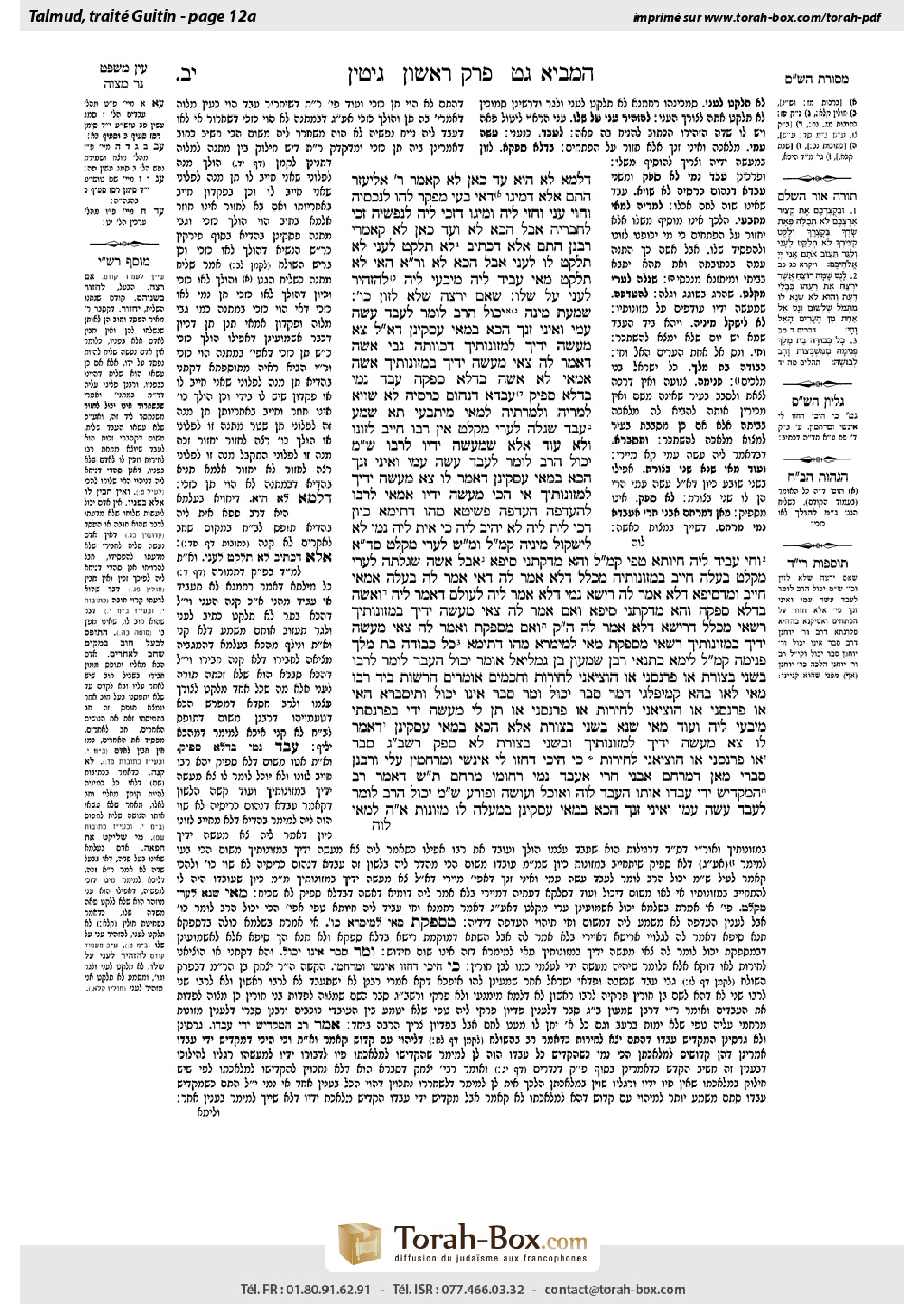
Gittin 12a: Talmud study for Daf Yomi
Study the Talmud for Daf Yomi with scanned pages, Hebrew text, English translations from Sefaria and AI-generated French translations.
Passage selection and English or AI-generated French translation are available where the scan has annotations. Daf Study is independent of Torah-Box and Sefaria.
Browse Gittin · גיטין · All tractatesGittin 12a text and translations
This page of Gittin includes the Aramaic text, an English translation and an AI-generated French translation, alongside the scan above.
גיטין י״ב א · Aramaic and Hebrew text
דִּלְמָא לָא הִיא; עַד כָּאן לָא קָאָמַר רַבִּי אֱלִיעֶזֶר הָתָם, אֶלָּא דְּמִיגּוֹ דְּאִי בָּעֵי מַפְקַר לְהוּ לְנִכְסֵיהּ, וְהָוֵי עָנִי וַחֲזֵי לֵיהּ – וּמִיגּוֹ דְּזָכֵי לֵיהּ לְנַפְשֵׁיהּ זָכֵי לְחַבְרֵיהּ; אֲבָל הָכָא, לָא.
וְעַד כָּאן לָא קָאָמְרִי רַבָּנַן הָתָם, אֶלָּא דִּכְתִיב: ״לֹא תְלַקֵּט לְעָנִי״ – לֹא תְלַקֵּט לוֹ לְעָנִי; אֲבָל הָכָא, לָא.
וְרַבִּי אֱלִיעֶזֶר, הַאי ״לֹא תְלַקֵּט״ – מַאי עָבֵיד לֵיהּ? מִיבְּעֵי לֵיהּ לְהַזְהִיר לְעָנִי עַל שֶׁלּוֹ.
שֶׁאִם יִרְצֶה שֶׁלֹּא לָזוּן כּוּ׳: שָׁמְעַתְּ מִינַּהּ, יָכוֹל הָרַב לוֹמַר לָעֶבֶד: ״עֲשֵׂה עִמִּי וְאֵינִי זָנָךְ״?
הָכָא בְּמַאי עָסְקִינַן – דַּאֲמַר לֵיהּ: ״צֵא מַעֲשֵׂה יָדֶיךָ לִמְזוֹנוֹתֶיךָ״.
דִּכְווֹתַהּ גַּבֵּי אִשָּׁה – דַּאֲמַר לַהּ: ״צְאִי מַעֲשֵׂה יָדַיִךְ בִּמְזוֹנוֹתַיִךְ״?! אִשָּׁה אַמַּאי לָא? אִשָּׁה – בִּדְלָא סָפְקָא.
עֶבֶד נָמֵי בִּדְלָא סָפֵיק! עַבְדָּא דִּנְהוֹם כְּרֵסֵיהּ לָא שָׁוֵיא, לְמָרֵיהּ וּלְמָרְתֵיהּ לְמַאי מִיתְבְּעֵי?
תָּא שְׁמַע: עֶבֶד שֶׁגָּלָה לְעָרֵי מִקְלָט אֵין רַבּוֹ חַיָּיב לְזוּנוֹ, וְלֹא עוֹד אֶלָּא שֶׁמַּעֲשֵׂה יָדָיו לְרַבּוֹ. שְׁמַע מִינַּהּ, יָכוֹל הָרַב לוֹמַר לָעֶבֶד ״עֲשֵׂה עִמִּי וְאֵינִי זָנָךְ״! הָכָא בְּמַאי עָסְקִינַן, דְּאָמַר לוֹ: ״צֵא מַעֲשֵׂה יָדֶיךָ לִמְזוֹנוֹתֶיךָ״.
אִי הָכִי, מַעֲשֵׂה יָדָיו אַמַּאי לְרַבּוֹ? לְהַעְדָּפָה.
הַעֲדָפָה, פְּשִׁיטָא! מַהוּ דְּתֵימָא, כֵּיוָן דְּכִי לֵית לֵיהּ לָא יָהֵיב לֵיהּ, כִּי אִית לֵיהּ נָמֵי לָא לִישְׁקוֹל מִינֵּיהּ, קָא מַשְׁמַע לַן.
וּמַאי שְׁנָא לְעָרֵי מִקְלָט? סָלְקָא דַּעְתָּךְ אָמֵינָא: ״וָחָי״ – עָבֵיד לֵיהּ חִיּוּתָא טְפֵי, קָא מַשְׁמַע לַן.
וְהָא מִדְּקָתָנֵי סֵיפָא: אֲבָל אִשָּׁה שֶׁגָּלְתָה לְעָרֵי מִקְלָט – בַּעְלָהּ חַיָּיב בִּמְזוֹנוֹתֶיהָ; מִכְּלָל דְּלָא אֲמַר לַהּ, דְּאִי אֲמַר לַהּ, בַּעְלַהּ אַמַּאי חַיָּיב?
וּמִדְּסֵיפָא דְּלָא אֲמַר לַהּ, רֵישָׁא נָמֵי דְּלָא אֲמַר לֵיהּ!
לְעוֹלָם דַּאֲמַר לֵיהּ, וְאִשָּׁה בִּדְלָא סָפְקָה.
וְהָא מִדְּקָתָנֵי סֵיפָא: וְאִם אָמַר לָהּ ״צְאִי מַעֲשֵׂה יָדַיִךְ בִּמְזוֹנוֹתַיִךְ״ – רַשַּׁאי, מִכְּלָל דְּרֵישָׁא דְּלָא אֲמַר לַהּ! הָכִי קָאָמַר: וְאִם מַסְפֶּקֶת, וְאָמַר לַהּ: ״צְאִי מַעֲשֵׂה יָדַיִךְ בִּמְזוֹנוֹתַיִךְ״ – רַשַּׁאי.
מַסְפֶּקֶת, מַאי לְמֵימְרָא? מַהוּ דְּתֵימָא: ״כׇּל כְּבוּדָּה בַת מֶלֶךְ פְּנִימָה״, קָא מַשְׁמַע לַן.
לֵימָא כְּתַנָּאֵי – רַבָּן שִׁמְעוֹן בֶּן גַּמְלִיאֵל אוֹמֵר: יָכוֹל הָעֶבֶד לוֹמַר לְרַבּוֹ בִּשְׁנֵי בַצּוֹרֶת: ״אוֹ פַּרְנְסֵנִי, אוֹ הוֹצִיאֵנִי לְחֵירוּת״. וַחֲכָמִים אוֹמְרִים: הָרְשׁוּת בְּיַד רַבּוֹ.
מַאי, לָאו בְּהָא קָמִיפַּלְגִי – דְּמָר סָבַר: יָכוֹל, וּמָר סָבַר: אֵינוֹ יָכוֹל?
וְתִיסְבְּרָא?! הַאי ״אוֹ פַּרְנְסֵנִי אוֹ הוֹצִיאֵנִי לְחֵירוּת״?! ״אוֹ פַּרְנְסֵנִי אוֹ תֵּן לִי מַעֲשֵׂה יָדַי בְּפַרְנָסָתִי״ מִיבְּעֵי לֵיהּ! וְעוֹד: מַאי שְׁנָא בִּשְׁנֵי בַצּוֹרֶת?
אֶלָּא הָכָא בְּמַאי עָסְקִינַן – דְּאָמַר לוֹ ״צֵא מַעֲשֵׂה יָדֶיךָ לִמְזוֹנוֹתֶיךָ״, וּבִשְׁנֵי בַצּוֹרֶת לָא סָפֵק;
רַבָּן שִׁמְעוֹן בֶּן גַּמְלִיאֵל סָבַר: אוֹ פַּרְנְסֵנִי אוֹ הוֹצִיאֵנִי לְחֵירוּת, כִּי הֵיכִי דְּחָזוּ לִי אִינָשֵׁי וּמְרַחֲמִין עֲלַי. וְרַבָּנַן סָבְרִי: מַאן דִּמְרַחֵם אַבְּנֵי חָרֵי, אַעֶבֶד נָמֵי רַחוֹמֵי מְרַחֵם.
תָּא שְׁמַע, דְּאָמַר רַב: הַמַּקְדִּישׁ יְדֵי עַבְדּוֹ, אוֹתוֹ הָעֶבֶד לֹוֶה וְאוֹכֵל, וְעוֹשֶׂה וּפוֹרֵעַ. שְׁמַע מִינַּהּ, יָכוֹל הָרַב לוֹמַר לָעֶבֶד: ״עֲשֵׂה עִמִּי וְאֵינִי זָנָךְ״!
הָכָא בְּמַאי עָסְקִינַן – בְּמַעֲלֶה לוֹ מְזוֹנוֹת. אִי הָכִי, לְמַאי
Gittin 12a · English translation
Perhaps that is not so. Perhaps this is not the point of dispute between Rabbi Eliezer and the Rabbis. There are two ways to explain why this might not be the case. First, it is possible that Rabbi Eliezer states his opinion only there, when the person took possession of the pe’a despite not being eligible to collect it for himself, since if the one who collected the produce desired, he could declare his property ownerless and become a poor person, and then the produce would have been fit for him to retain for himself. And since he could have acquired the pe’a for himself, he can likewise acquire it for another as well. However, here, where he seizes property on behalf of a creditor, he cannot seize this property for himself. Consequently, Rabbi Eliezer does not rule that he can do so when it is against the interests of another person.
Second, one can argue from the opposite perspective: The Rabbis state their opinion only there, that one cannot acquire on behalf of the poor person, as it is written: “The corner of your field you shall not reap and the gleaning of your harvest you shall not gather; for the poor you shall leave them” (Leviticus 23:22), and the Sages expounded this verse by reading it as though there were no break in the middle: You shall not gather for the poor, i.e., the poor person must collect the produce for himself. However, here, where one seizes property on behalf of a creditor, this verse does not apply, and therefore the Rabbis did not rule that the action of the third party is ineffective. Consequently, it is possible that the dispute between Rabbi Eliezer and the Rabbis is not with regard to the issue of whether one can seize property on behalf of a creditor in a case where it is to the detriment of others.
The Gemara asks: And as for Rabbi Eliezer, with regard to this verse: “You shall not gather,” what does he do with it? How does he interpret this phrase, from which the Rabbis derived that one may not collect pe’a on behalf of a poor person? The Gemara answers: He requires it to warn a poor person with regard to his own field, i.e., if a poor person had a field of his own he is not permitted to gather pe’a from it for himself, his poverty notwithstanding.
§ The mishna taught: As, if the master wishes not to sustain his slave he is allowed to act accordingly. The Gemara comments: Conclude from the mishna that the master is legally able to say to his slave: Work for me but I will not sustain you.
The Gemara rejects this claim: This is not a conclusive proof, as with what are we dealing here, in the mishna? We are dealing with a case where he said to the slave: Spend your earnings to sustain yourself. In other words, I will not provide for you; rather, you must work and earn money for your sustenance on your own. However, this does not mean that a master can force his slave to work for him without providing him with sustenance.
The Gemara asks: If so, in the corresponding situation in the mishna with regard to a wife, will one explain that he could have said to her: Spend your earnings to sustain yourself? The mishna rules that one cannot exempt himself from his obligation to provide sustenance for his wife. In the case of a wife, why may he not do so? It is certainly permitted for a husband to stipulate with his wife that she will keep her earnings and not receive sustenance from him, yet it is clear in the mishna that there is a difference between a slave and a wife with regard to his ability to refuse to provide sustenance. The Gemara answers: The wife mentioned in the mishna is one whose earnings are not sufficient for her sustenance, and in that case the husband may not stipulate in this manner.
The Gemara raises a difficulty: If so, the case of the slave also is referring to a situation where his earnings are not sufficient for his sustenance, and he is unable to sustain himself. Nevertheless, his master can refuse to sustain him. Therefore, one can conclude from the mishna that a master can say to his slave: Work for me but I will not sustain you. The Gemara explains: A slave who is not worth the bread that he consumes, for what is he needed by his master or his mistress? If the value of his labor does not even pay for the cost of his sustenance why is he needed at all? The mishna certainly does not refer to a case of this kind. By contrast, with regard to a wife, the marriage does not depend on her ability to provide for herself by means of her earnings. Consequently, one cannot prove from the mishna that a master can say to his slave: Work for me but I will not sustain you.
The Gemara suggests another proof: Come and hear a baraita (Tosefta, Makkot 2:8): With regard to a slave who unintentionally killed someone and was exiled to one of the cities of refuge, his master is not required to sustain him. And not only that, but his earnings in his city of refuge belong to his master. Conclude from the baraita that a master can say to his slave: Work for me but I will not sustain you, as in the case of a slave exiled to a city of refuge the master is entitled to his earnings despite not providing for him. The Gemara answers: With what are we dealing here? With a case where the master said to him: Spend your earnings to sustain yourself.
The Gemara raises a difficulty: If so, if the master said this to the slave, then why do his earnings belong to his master? After all, his master stipulated that he should sustain himself. The Gemara answers: This halakha is referring to his surplus earnings, i.e., if the slave works and earns more than the cost of his sustenance, his surplus income belongs to the master.
The Gemara asks: Isn’t it obvious that any surplus belongs to the master, as he owns the slave? The Gemara answers: This ruling is necessary, lest you say that since, when he does not work enough the master does not give him all he needs to eat, then when he has a surplus from his work the master should also not take it. Therefore, the baraita teaches us that despite this consideration the surplus belongs to the master.
The Gemara asks: And what is different with regard to a slave who was exiled to one of the cities of refuge, concerning whom the baraita was stated? According to this reasoning, the surplus should belong to the master no matter where the slave is located. The Gemara answers: It might enter your mind to say that as the verse states with regard to one who is exiled to a city of refuge: “And that fleeing to one of these cities he might live” (Deuteronomy 4:42), one should act for him so that he has extra life, i.e., in this specific case the slave should be allowed to retain any additional amount he earns. Therefore, the baraita teaches us that no special obligation of this kind applies even if the slave had been exiled to a city of refuge.
The Gemara raises another difficulty: But from the fact that the latter clause of that baraita teaches: However, with regard to a woman who was exiled to one of the cities of refuge, her husband is obligated in her sustenance, by inference the baraita is dealing with a case where he did not say to her: Spend your earnings to sustain yourself, which is why he must sustain her. As, if he said this to her, why is her husband obligated to provide her with sustenance?
And from the fact that the latter clause of the baraita is speaking about a case where he did not say this to her, it may be inferred that the first clause is also dealing with a situation where he did not say to the slave: Spend your earnings to sustain yourself. The two clauses of the baraita must be referring to similar cases or they would not be taught together.
The Gemara rejects this claim: Actually, the baraita is referring to a case where the master said to the slave: Spend your earnings to sustain yourself, and the husband issued a similar statement to his wife. However, in the case of a woman it is referring to a situation when her earnings are not sufficient for her sustenance.
The Gemara raises an objection: But from the fact that the last clause teaches: And if the husband said to her: Spend your earnings to sustain yourself, he is permitted to act accordingly, it may be inferred that the first half of the last clause is referring to a case where he did not say this to her. The Gemara explains that this is what the baraita is saying: And if her earnings suffice to pay for her sustenance, and he said to her: Spend your earnings to sustain yourself, it is permitted for him to say that.
The Gemara asks: If the baraita is referring to a case where her earnings suffice, what is the purpose of stating this halakha with regard to one who was exiled to a city of refuge? The same halakha applies to all wives. The Gemara answers: It is necessary, lest you say that in light of the verse: “All glorious is the king’s daughter within the palace” (Psalms 45:14), from which it is derived that it is improper for a wife to spend too much time outside her home, this woman’s husband should be concerned that while his wife is in a city of refuge she should not work out of the home, but only in the home. Therefore, the baraita teaches us that there is no need to be concerned about this matter, and her husband may say to her: Spend your earnings to sustain yourself, even in a city of refuge.
With regard to the question of whether a master can decide to cease providing sustenance for his slave while the slave continues to serve him, the Gemara suggests: Let us say that this matter is the subject of a dispute between tanna’im, as it was taught that Rabban Shimon ben Gamliel says: A slave can say to his master in years of famine: Either sustain me from your property or emancipate me. And the Rabbis say: His master has permission to retain his ownership over him without sustaining him.
What, is it not correct to say that they disagree about this issue, that one Sage, the Rabbis, holds that a master can say to his slave that he should work for him and he will not sustain him. Consequently, he is not required to emancipate him even when he cannot provide for him. And one Sage, Rabban Shimon ben Gamliel, holds that the master cannot say this, and therefore he is required to free him.
The Gemara responds: And can you understand the dispute that way? If so, this expression: Either sustain me or emancipate me, is inaccurate, as the baraita should have said: Either sustain me or give me my earnings for my sustenance. And furthermore, if the dispute concerns this general issue, what is different about years of famine? The same dispute should apply in all years.
Rather, with what are we dealing here? This baraita is referring to a case where the master said to the slave: Spend your earnings to sustain yourself, and subsequently, during years of famine, the slave’s earnings do not suffice to provide himself with sustenance, as prices are higher than usual.
And Rabban Shimon ben Gamliel holds that in this case the slave can say to his master: Either sustain me or emancipate me, so that people will see me in my helpless state, and they will have mercy on me and provide me with charity. And the Rabbis hold that this is not a justification for emancipating a slave, as those who have mercy on freemen will also have mercy on a slave. Consequently, it is not necessary for the slave to be emancipated for him to receive help from generous people. According to this interpretation, the baraita has no bearing on the question as to whether a master can say to his slave: Work for me but I will not sustain you.
The Gemara offers another suggestion: Come and hear a proof from a statement that Rav said: In the case of one who consecrates the hands of his slave, so that all the work he does becomes Temple property, preventing the slave from working on his own behalf, then that slave borrows and eats, and afterward performs work and repays what he borrowed, as will be explained. Conclude from Rav’s statement that the master is able to say to his slave: Work for me but I will not sustain you. In this case the master has prevented his slave from working for himself, and yet he is not required to provide for him.
The Gemara answers: With what are we dealing here? This is referring to a case where the master provides sustenance for him. The Gemara raises a difficulty: If so, for what reason
Gittin 12a · Traduction française (IA)
Peut-être que cela n'est pas ainsi. Peut-être que ce n'est pas le point de débat entre le maître Eliezer et les Sages. Il y a deux façons d'expliquer pourquoi cela pourrait ne pas être le cas. Premièrement, il est possible que le maître Eliezer exprime son opinion uniquement là où la personne a pris possession de la pe’a malgré ne pas être éligible à la récolter pour elle-même, car si celui qui a récolté les produits souhaitait le faire, il pouvait déclarer sa propriété sans propriétaire et devenir un pauvre, et alors les produits auraient été appropriés pour qu'il les garde pour lui. Et puisque il pouvait acquérir la pe’a pour lui-même, il pouvait également l'acquérir pour un autre. Cependant, ici, où il s'agit de saisir une propriété au nom d'un créancier, il ne peut pas saisir cette propriété pour lui-même. Ainsi, le maître Eliezer ne considère pas qu'il puisse le faire lorsqu'il s'agit de l'intérêt d'une autre personne.
Deuxièmement, on peut argumenter du point de vue opposé : les Sages expriment leur opinion uniquement là où l'on ne peut pas acquérir au nom du pauvre, car il est écrit : « Le coin de ton champ tu ne devras pas moissonner et la récolte de ton récolte tu ne devras pas réunir ; pour le pauvre tu le laisseras » (Lévitique 23:22), et les Sages ont expliqué cette verset en lisant comme s'il n'y avait pas de pause au milieu : Tu ne devras pas réunir pour le pauvre, c'est-à-dire que le pauvre doit lui-même récolter les produits. Cependant, ici, où l'on saisit une propriété au nom d'un créancier, ce verset ne s'applique pas, et donc les Sages n'ont pas jugé que l'action du tiers soit inefficace. Ainsi, il est possible que le débat entre le maître Eliezer et les Sages ne concerne pas la question de savoir si l'on peut saisir une propriété au nom d'un créancier dans un cas où cela nuit aux autres.
La Guemara pose la question : Et concernant le maître Eliezer, à propos de ce verset : « Tu ne devras pas réunir », comment l'interprète-t-il ? Comment interprète-t-il cette phrase, à partir de laquelle les Sages ont déduit que l'on ne peut pas récolter la pe'a au nom d'un pauvre ? La Guemara répond : Il exige cela pour avertir un pauvre concernant son propre champ, c'est-à-dire si un pauvre avait un champ propre, il n'est pas permis de récolter la pe'a de ce champ pour lui-même, même en raison de sa pauvreté.
§ La Michna enseigne : Si le maître souhaite ne pas subvenir aux besoins de son esclave, il est autorisé à agir ainsi. La Guemara commente : Concluez de la Michna que le maître est légalement en mesure de dire à son esclave : Travaille pour moi mais je ne te subviendrai pas.
La Guemara rejette cette affirmation : Ce n'est pas une preuve concluante, car à quoi nous sommes-nous affairés ici, dans la Michna ? Nous sommes affairés à un cas où il a dit à l'esclave : dépense tes revenus pour subvenir à tes besoins. En d'autres termes, je ne te subviendrai pas ; plutôt, tu dois travailler et gagner de l'argent pour ta subsistance. Cependant, cela ne signifie pas que le maître puisse forcer son esclave à travailler pour lui sans lui subvenir aux besoins.
La Guemara pose la question : Si tel est le cas, dans le cas correspondant de la Michna concernant une épouse, expliquera-t-on qu'il puisse avoir dit à elle : dépense tes revenus pour subvenir à tes besoins ? La Michna règle que l'on ne peut pas exempter soi-même de l'obligation de subvenir aux besoins de son épouse. Dans le cas d'une épouse, pourquoi ne peut-on pas le faire ? Il est certainement permis à un mari de stipuler avec son épouse qu'elle conservera ses revenus et ne recevra pas de subsistance de lui, toutefois il est clair dans la Michna qu'il y a une différence entre un esclave et une épouse concernant sa capacité à refuser de subvenir à ses besoins. La Guemara répond : L'épouse mentionnée dans la Michna est celle dont les revenus ne sont pas suffisants pour sa subsistance, et dans ce cas le mari ne peut pas stipuler ainsi.
La Guemara soulève une difficulté : Si tel est le cas, le cas de l'esclave également fait référence à un cas où ses revenus ne sont pas suffisants pour sa subsistance et qu'il est incapable de subvenir à ses besoins. Cependant, son maître peut refuser de le subvenir. Ainsi, on peut conclure de la Michna que le maître peut dire à son esclave : Travaille pour moi mais je ne te subviendrai pas. La Guemara explique : Un esclave dont la valeur ne suffit pas à couvrir le pain qu'il consomme, à quoi bon est-il utile à son maître ou à sa maîtresse ? Si la valeur de son travail ne paie même pas le coût de sa subsistance, à quoi bon est-il utile ? La Michna ne fait certainement pas référence à un cas de ce genre. En revanche, concernant une épouse, le mariage ne dépend pas de sa capacité à subvenir à ses besoins par ses revenus. Ainsi, on ne peut pas prouver de la Michna que le maître puisse dire à son esclave : Travaille pour moi mais je ne te subviendrai pas.
La Guemara suggère une autre preuve : Viens écouter une baraïta (Tosefta, Makkot 2:8) : Concernant un esclave qui a accidentellement tué quelqu'un et a été exilé dans l'une des villes de refuge, son maître n'est pas tenu de le subvenir. Et non seulement cela, mais ses revenus dans sa ville de refuge appartiennent à son maître. Concluez de cette baraïta que le maître peut dire à son esclave : Travaille pour moi mais je ne te subviendrai pas, car dans le cas d'un esclave exilé dans une ville de refuge, le maître est autorisé à garder ses revenus malgré le fait qu'il ne le subvienne pas. La Guemara répond : À quoi nous sommes-nous affairés ici ? À un cas où le maître a dit à lui : dépense tes revenus pour subvenir à tes besoins.
La Guemara soulève une difficulté : Si tel est le cas, pourquoi les revenus de l'esclave appartiennent-ils à son maître ? Après tout, le maître a stipulé qu'il devait subvenir à ses besoins. La Guemara répond : Cette halakha fait référence à ses revenus excédentaires, c'est-à-dire si l'esclave travaille et gagne plus que le coût de sa subsistance, ses revenus excédentaires appartiennent au maître.
La Guemara pose la question : N'est-ce pas évident que tout ce qui est en excédent appartient au maître, car il possède l'esclave ? La Guemara répond : Cette décision est nécessaire, afin que vous ne disiez pas que puisque, lorsqu'il ne travaille pas assez, le maître ne lui donne pas tout ce dont il a besoin, alors lorsqu'il a un excédent de travail, le maître ne devrait pas non plus le prendre. Ainsi, la baraïta nous apprend que malgré cette considération, l'excédent appartient au maître.
La Guemara pose la question : Et qu'est-ce qui diffère concernant un esclave expulsé dans l'une des villes de refuge, à propos duquel la baraïta a été énoncée ? Selon cette raisonnement, le surplus devrait appartenir au maître, peu importe où se trouve l'esclave. La Guemara répond : Il pourrait entrer en vous l'idée que, comme la Parashah dit concernant celui qui est expulsé dans une ville de refuge : « Et qu'il demeure dans l'une de ces villes pour y vivre » (Deutéronome 4:42), on doit agir envers lui de sorte qu'il ait une vie supplémentaire, c'est-à-dire, dans ce cas précis, l'esclave devrait être autorisé à conserver toute somme supplémentaire qu'il gagne. Ainsi, la baraïta nous apprend que telle obligation spéciale ne s'applique pas même si l'esclave avait été expulsé dans une ville de refuge.
La Guemara soulève une autre difficulté : Mais à partir du fait que la seconde partie de cette baraïta enseigne : Cependant, concernant une femme expulsée dans l'une des villes de refuge, son mari est tenu de lui fournir sa subsistance, par déduction, la baraïta traite d'un cas où il n'a pas dit à elle : Utilise tes revenus pour t'entretenir, c'est pourquoi il doit la sustenter. Car, si il avait dit cela à elle, pourquoi son mari est-il tenu de lui fournir sa subsistance ?
Et à partir du fait que la seconde partie de la baraïta parle d'un cas où il n'a pas dit cela à elle, on peut en déduire que la première partie est également concernant un cas où il n'a pas dit à l'esclave : Utilise tes revenus pour t'entretenir. Les deux parties de la baraïta doivent se référer à des situations similaires, sinon elles ne seraient pas enseignées ensemble.
La Guemara rejette cette affirmation : En réalité, la baraïta se réfère à un cas où le maître a dit à l'esclave : Utilise tes revenus pour t'entretenir, et le mari a émis une déclaration similaire à son épouse. Cependant, concernant la femme, il s'agit d'une situation où ses revenus ne suffisent pas à sa subsistance.
La Guemara soulève une objection : Mais à partir du fait que la dernière clause enseigne : Et si le mari a dit à elle : Utilise tes revenus pour t'entretenir, il est autorisé à agir ainsi, on peut en déduire que la première moitié de la dernière clause se réfère à un cas où il n'a pas dit cela à elle. La Guemara explique que c'est ce que la baraïta dit : Et si ses revenus suffisent pour payer sa subsistance, et qu'il a dit à elle : Utilise tes revenus pour t'entretenir, il est autorisé de dire cela.
La Guemara pose la question : Si la baraïta se réfère à un cas où ses revenus suffisent, à quoi sert d'énoncer cette halakha concernant une personne expulsée dans une ville de refuge ? La même halakha s'applique à toutes les épouses. La Guemara répond : Il est nécessaire, afin que vous ne disiez pas, en raison de la Parashah : « Toute la reine du roi est glorieuse dans le palais » (Psaumes 45:14), d'où on déduit que c'est inapproprié pour une épouse de passer trop de temps en dehors de chez elle, que le mari de cette femme devrait être préoccupé par le fait qu'elle travaille en dehors de chez elle pendant qu'elle est dans une ville de refuge, mais seulement à l'intérieur. Ainsi, la baraïta nous apprend que cela n'a pas besoin d'être un souci, et son mari peut dire à elle : Utilise tes revenus pour t'entretenir, même dans une ville de refuge.
Concernant la question de savoir si un maître peut décider de cesser de fournir sa subsistance à son esclave tout en continuant à le servir, la Guemara suggère : Disons que cette question est l'objet d'un débat entre les tannaïm, car il a été enseigné que Rabban Shimon ben Gamliel dit : Un esclave peut dire à son maître, en temps de famine : Sustente-moi de tes biens ou libère-moi. Et les Rabbins disent : Son maître a le droit de conserver sa propriété sans le sustenter.
Qu'est-ce que cela ne serait pas correct de dire, qu'ils discutent sur ce point, que l'un des Sages, les Rabbins, considère que le maître peut dire à son esclave qu'il doit travailler pour lui et qu'il ne le sustentera pas. Ainsi, il n'est pas tenu de le libérer même s'il ne peut pas le sustenter. Et l'autre Sage, Rabban Shimon ben Gamliel, considère que le maître ne peut pas dire cela, et donc il est tenu de le libérer.
La Guemara répond : Et pouvez-vous comprendre ce débat ainsi ? Si c'est le cas, cette expression : Sustente-moi ou libère-moi, est inexacte, car la baraïta aurait dû dire : Sustente-moi ou donne-moi mes revenus pour ma subsistance. Et de plus, si le débat concerne ce sujet général, à quoi sert l'année de famine ? Le même débat devrait s'appliquer à toutes les années.
Plutôt, avec quoi sommes-nous en train de traiter ici ? Cette baraïta se réfère à un cas où le maître a dit à l'esclave : Utilise tes revenus pour t'entretenir, et ensuite, durant les années de famine, les revenus de l'esclave ne suffisent pas à sa subsistance, car les prix sont plus élevés que d'habitude.
Et Rabban Shimon ben Gamliel considère que dans ce cas l'esclave peut dire à son maître : Soit me sustente ou me libère, afin que les gens voient mon état de détresse et aient pitié de moi et me donnent de l'aumône. Et les Rabbins considèrent que cela n'est pas une justification pour libérer un esclave, car ceux qui ont pitié des hommes libres auront aussi pitié d'un esclave. Ainsi, il n'est pas nécessaire de libérer l'esclave pour qu'il reçoive de l'aide de gens généreux. Selon cette interprétation, la baraïta n'a pas de lien avec la question de savoir si un maître peut dire à son esclave : Travaille pour moi mais je ne te sustenterai pas.
La Guemara propose une autre suggestion : Approchez-vous d'une preuve à partir d'une déclaration que Rav a dit : Dans le cas d'une personne qui consacre les mains de son esclave, de sorte que tout le travail qu'il fait devient propriété du Temple, empêchant l'esclave de travailler pour son propre compte, alors cet esclave emprunte et mange, et ensuite travaille et rembourse ce qu'il a emprunté, comme cela sera expliqué. Concluez à partir de la déclaration de Rav que le maître peut dire à son esclave : Travaille pour moi mais je ne te sustenterai pas. Dans ce cas, le maître a empêché son esclave de travailler pour lui-même, et pourtant il n'est pas tenu de le sustenter.
La Guemara répond : De quoi sommes-nous en train de parler ? Cela fait référence à un cas où le maître fournit un soutien alimentaire à l'élève. La Guemara soulève une difficulté : Si c'est ainsi, pourquoi
Traduction française générée par IA à partir de l’édition anglaise de Sefaria. Vérifie toujours un passage avec le texte source.
Text from Sefaria: William Davidson Edition - Vocalized Aramaic (CC BY NC); William Davidson Edition - English (CC BY NC).