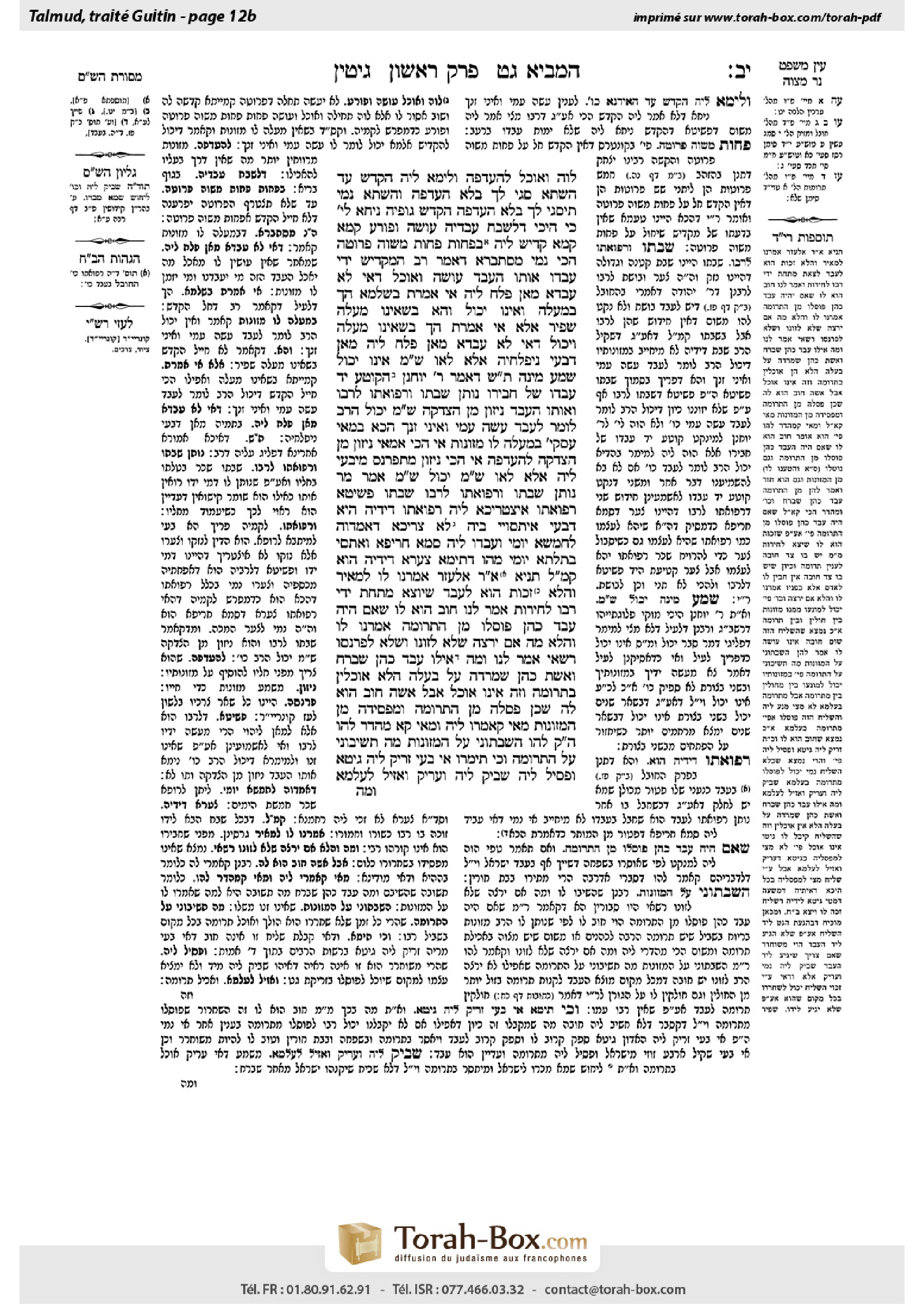
Gittin 12b: Talmud study for Daf Yomi
Study the Talmud for Daf Yomi with scanned pages, Hebrew text, English translations from Sefaria and AI-generated French translations.
Passage selection and English or AI-generated French translation are available where the scan has annotations. Daf Study is independent of Torah-Box and Sefaria.
Browse Gittin · גיטין · All tractatesGittin 12b text and translations
This page of Gittin includes the Aramaic text, an English translation and an AI-generated French translation, alongside the scan above.
גיטין י״ב ב · Aramaic and Hebrew text
לֹוֶה וְאוֹכֵל? לְהַעְדָּפָה.
וְלֵימָא לֵיהּ הֶקְדֵּשׁ: עַד הַשְׁתָּא סַגִּי לָךְ בְּלָא הַעֲדָפָה, וְהַשְׁתָּא נָמֵי תִּיסְגֵּי לָךְ בְּלָא הַעֲדָפָה! הֶקְדֵּשׁ גּוּפֵיהּ נִיחָא לֵיהּ, כִּי הֵיכִי דְּלַשְׁבַּח עַבְדֵּיהּ.
עוֹשֶׂה וּפוֹרֵעַ, קַמָּא קַמָּא קָדֵישׁ לֵיהּ! בְּפָחוֹת פָּחוֹת מִשָּׁוֶה פְּרוּטָה.
הָכִי נָמֵי מִסְתַּבְּרָא; דְּאָמַר רַב: הַמַּקְדִּישׁ יְדֵי עַבְדּוֹ – אוֹתוֹ הָעֶבֶד עוֹשֶׂה וְאוֹכֵל, דְּאִי לָא עַבְדָּא מַאן פָּלַח לֵיהּ.
אִי אָמְרַתְּ בִּשְׁלָמָא הָךְ בְּמַעֲלֶה וְאֵינוֹ יָכוֹל, וְהָא בְּשֶׁאֵינוֹ מַעֲלֶה, שַׁפִּיר.
אֶלָּא אִי אָמְרַתְּ הָךְ בְּשֶׁאֵינוֹ מַעֲלֶה, וְיָכוֹל, דְּאִי לָא עַבְדָּא מַאן פָּלַח לֵיהּ?! מַאן דְּבָעֵי נִיפְלְחֵיהּ!
אֶלָּא לָאו, שְׁמַע מִינַּהּ אֵינוֹ יָכוֹל! שְׁמַע מִינַּהּ.
תָּא שְׁמַע, דְּאָמַר רַבִּי יוֹחָנָן: הַקּוֹטֵעַ יַד עַבְדּוֹ שֶׁל חֲבֵירוֹ – נוֹתֵן שִׁבְתּוֹ וּרְפוּאָתוֹ לְרַבּוֹ, וְאוֹתוֹ הָעֶבֶד נִיזּוֹן מִן הַצְּדָקָה. שְׁמַע מִינַּהּ, יָכוֹל הָרַב לוֹמַר לָעֶבֶד: ״עֲשֵׂה עִמִּי וְאֵינִי זָנָךְ״!
הָכָא בְּמַאי עָסְקִינַן – בְּמַעֲלֶה לוֹ מְזוֹנוֹת. אִי הָכִי, אַמַּאי נִיזּוֹן מִן הַצְּדָקָה? לְהַעְדָּפָה.
אִי הָכִי, ״נִיזּוֹן״?! ״מִתְפַּרְנֵס״ מִיבְּעֵי לֵיהּ! אֶלָּא לָאו, שְׁמַע מִינַּהּ יָכוֹל! שְׁמַע מִינַּהּ.
אֲמַר מָר: נוֹתֵן שִׁבְתּוֹ וּרְפוּאָתוֹ לְרַבּוֹ. שִׁבְתּוֹ, פְּשִׁיטָא! רְפוּאָתוֹ אִיצְטְרִיכָא לֵיהּ.
רְפוּאָתוֹ דִּידֵיהּ הִיא, דְּבָעֵי אִיתַּסּוֹיֵי בֵּהּ! לָא צְרִיכָא, דְּאַמְדוּהּ לְחַמְשָׁא יוֹמֵי, וַעֲבַדוּ לֵיהּ סַמָּא חָרִיפָא וְאִתַּסִּי בִּתְלָתָא יוֹמֵי; מַהוּ דְּתֵימָא: צַעֲרָא – דִּידֵיהּ הוּא, קָא מַשְׁמַע לַן.
תַּנְיָא: אָמַר רַבִּי אֶלְעָזָר, אָמַרְנוּ לוֹ לְמֵאִיר: וַהֲלֹא זְכוּת הוּא לָעֶבֶד שֶׁיּוֹצֵא מִתַּחַת יְדֵי רַבּוֹ לְחֵירוּת! אָמַר לָנוּ: חוֹב הוּא לוֹ – שֶׁאִם הָיָה עֶבֶד כֹּהֵן, פּוֹסְלוֹ מִן הַתְּרוּמָה. אָמַרְנוּ לוֹ: וַהֲלֹא מָה אִם יִרְצֶה שֶׁלֹּא לְזוּנוֹ וְשֶׁלֹּא לְפַרְנְסוֹ, רַשַּׁאי!
אָמַר לָנוּ: וּמָה אִילּוּ עֶבֶד כֹּהֵן שֶׁבָּרַח, וְאֵשֶׁת כֹּהֵן שֶׁמָּרְדָה עַל בַּעְלָהּ – הֲלֹא אוֹכְלִין בִּתְרוּמָה; וְזֶה – אֵינוֹ אוֹכֵל. אֲבָל אִשָּׁה – חוֹב הוּא לָהּ, שֶׁכֵּן פֹּסְלָהּ מִן הַתְּרוּמָה וּמַפְסִידָהּ מִן הַמְּזוֹנוֹת.
מַאי קָאָמְרוּ לֵיהּ, וּמַאי קָא מַהְדַּר לְהוּ? הָכִי קָאָמַר לְהוּ: הֲשַׁבְתּוּנִי עַל הַמְּזוֹנוֹת, מַה תְּשִׁיבוּנִי עַל הַתְּרוּמָה?
וְכִי תֵּימְרוּ: אִי בָּעֵי, זָרֵיק לֵיהּ גִּיטָּא וּפָסֵיל לֵיהּ; שָׁבֵיק לֵיהּ וְעָרֵיק וְאָזֵיל לְעָלְמָא.
Gittin 12b · English translation
does he find it necessary to borrow and eat? After all, his master provides for him. The Gemara answers: This is referring to surplus food, i.e., additional food that the slave wants to eat.
The Gemara raises a difficulty: But if so, let the Temple treasurer say to him: Until now it was enough for you without a surplus; now too it should be enough for you without a surplus. Why do you seek more now? Consequently, the consecration should apply to this surplus as well. The Gemara answers: It is preferable to the Temple treasury itself that he work and eat more, so that the value of its slave will be enhanced when he consumes this extra amount, as he will become stronger.
§ It was stated that the slave borrows and eats and afterward performs work and repays the loan. The Gemara asks: But his work immediately becomes consecrated, as his hands have been consecrated. How, then, can he repay this loan? The Gemara answers: The slave performs work of less than the value of one peruta. Anything worth less than one peruta does not become consecrated. Therefore he can collect these small sums and repay his debt little by little.
The Gemara comments: So too, it is reasonable that Rav is referring to a case where the master provides sustenance for him. As Rav says: With regard to one who consecrates the hands of his slave, that slave works and eats, as, if the slave does not work for himself, who will work and provide for him? This ruling indicates that Rav maintains that consecration does not apply to the slave’s hands.
The Gemara explains: Granted, if you say that this earlier halakha that Rav said, that the slave borrows and repays, refers to a situation where his master provides sustenance for him, and this is because in general he cannot say to him: Work for me but I will not sustain you, and this second halakha is referring to a case where his master does not provide him with sustenance, and therefore he cannot consecrate the slave’s hands, it is well, as there is no contradiction between the two statements of Rav.
However, if you say that this first halakha is also speaking of a case where his master does not provide sustenance for him, and the consecration is effective because he can say to his slave: Work for me but I will not sustain you, then what is the meaning of the statement: As, if the slave does not work for himself who will work for him? Let whoever desires work for him, i.e., the slave will be compelled to sustain himself from charity, but this is not the master’s concern.
Rather, must one not conclude from here that Rav holds that a master cannot say to his slave: Work for me but I will not sustain you? The Gemara comments: Indeed conclude from here that this is the case.
The Gemara suggests: Come and hear another source concerning the same dilemma, as Rabbi Yoḥanan says: One who severs the hand of another’s slave must give compensation for his loss of livelihood, i.e., compensation for the slave’s inability to work as a result of his injury, and the slave’s medical costs to his master. And that slave, who can no longer work, is sustained from charity. Conclude from Rabbi Yoḥanan’s statement that the master is able to say to his slave: Work for me but I will not sustain you, as otherwise the master would not receive compensation for his time in the form of payment for the slave’s earnings while the slave lives off of charity.
The Gemara answers: With what are we dealing here? This is referring to a case where his master provides sustenance for him. The Gemara asks: If so, why is he sustained from charity? He already has sustenance. The Gemara answers: This is referring to surplus food, i.e., additional food that the slave wants to eat.
The Gemara raises a difficulty: If so, the phrase: Sustained from charity, is imprecise, as it indicates that he is provided only with enough for his basic needs. It should have said: He earns a living from charity. Rather, must one not conclude from his statement that Rabbi Yoḥanan maintains that the master can say to his slave: Work for me but I will not sustain you? The Gemara comments: Indeed, conclude from his statement that this is the case.
The Gemara discusses the aforementioned halakha. The Master says earlier: He must give compensation for the slave’s loss of livelihood and his medical costs to his master. The Gemara comments: With regard to compensation for loss of livelihood, it is obvious that this is the halakha, as the master incurs the loss when his slave does not work, and therefore it was necessary for the Sages to mention only that the compensation for his medical costs goes to his master.
The Gemara comments: Why is the payment for his medical costs given to his master? Shouldn’t the compensation for his medical costs belong to him, as he needs to be healed with it? The Gemara answers: No, it is necessary in a case where doctors estimated that the blow or wound would heal in five days and they made a strong medicine for him, and he was healed in three days instead of five. Lest you say: Since the pain suffered by the slave by taking the strong medicine that caused a decrease in the costs of healing was his, the money should belong to him, Rabbi Yoḥanan therefore teaches us that this is not the case, as even this money belongs to the master, not the slave.
§ With regard to the discussion in the mishna between Rabbi Meir and the Rabbis, it is taught in a baraita (Tosefta 1:5) that Rabbi Elazar said: We said to Meir: But isn’t it in the interest of a slave to leave his master to freedom? He said to us: It is to his detriment, as if he were the slave of a priest, then by emancipating him the master thereby disqualifies him from partaking of teruma. We said to him: But what would be if the master wishes not to sustain him and not to provide him with a living? He is permitted to do so. Therefore, the slave does not lose out when he is emancipated, as he was not guaranteed sustenance in any event.
Rabbi Meir said to us: Even if the master is not obligated to provide for him, it is still permitted for the slave to partake of teruma. The proof for this is the following case: And what would be if there were the slave of a priest, who fled from his master, or in the case of the wife of a priest, who rebelled against her husband, i.e., she refused to fulfill her obligations as a married woman? Are they not permitted to partake of teruma, although not the teruma belonging to the master or husband? They are permitted to partake of teruma. But this slave who was emancipated may not partake of teruma at all, even teruma that belongs to other priests. But in any event, in the case of a woman, a bill of divorce is to her detriment, as it disqualifies her from partaking of teruma and causes her to lose her sustenance.
The Gemara analyzes this baraita: What did the Rabbis say to Rabbi Meir, and what did he respond to them? In other words, the two sides do not appear to be discussing the same issue, as the Rabbis refer to sustenance while Rabbi Meir talks about teruma. The Gemara explains that this is what Rabbi Meir is saying to them: You have answered me about sustenance, that the master is not required to provide for his slave. However, what will you answer me about teruma?
And if you were to say that the acceptance of the document by the agent is not to the slave’s detriment, as in any event if the master desires, he can throw the bill of manumission within four cubits of the slave and thereby disqualify him from partaking of teruma; the slave can prevent this from occurring by leaving his master, and escaping and going out to the world. If he acts in this manner his master will be unable to emancipate him, and he can continue partaking of teruma.
Gittin 12b · Traduction française (IA)
Est-ce qu'il lui faut emprunter et manger ? Après tout, son maître le nourrit. La Guemara répond : Il s'agit de nourriture en surplus, c'est-à-dire de nourriture supplémentaire que l'esclave veut manger.
La Guemara soulève une difficulté : Mais si c'est ainsi, que le trésor du Temple dise à lui : Jusqu'à présent, il t'était suffisant sans surplus ; maintenant aussi, il devrait être suffisant sans surplus. Pourquoi cherches-tu davantage maintenant ? Ainsi, la consécration devrait s'appliquer à ce surplus également. La Guemara répond : Il est préférable au trésor du Temple lui-même qu'il travaille et mange davantage, afin que la valeur de son esclave soit augmentée lorsqu'il consomme cette quantité supplémentaire, car il deviendra plus fort.
§ On a dit que l'esclave emprunte et mange, puis travaille et rembourse l'emprunt. La Guemara pose une question : Mais son travail devient immédiatement consacré, car ses mains sont consacrées. Comment alors peut-il rembourser ce prêt ? La Guemara répond : L'esclave travaille à un montant inférieur à une peruta. Tout ce qui vaut moins d'une peruta ne devient pas consacré. Ainsi, il peut collecter ces petites sommes et rembourser sa dette petit à petit.
La Guemara commente : De même, il est raisonnable que Rav s'adresse à un cas où le maître nourrit l'esclave. Comme Rav dit : En ce qui concerne celui qui consacre les mains de son esclave, cet esclave travaille et mange, car, si l'esclave ne travaille pas pour lui-même, qui travaillera et le nourrira ? Cette décision indique que Rav maintient que la consécration ne s'applique pas aux mains de l'esclave.
La Guemara explique : Cela étant, si vous dites que cette halakha précédente que Rav a dite, selon laquelle l'esclave emprunte et rembourse, s'applique à un cas où son maître le nourrit, et cela est ainsi parce qu'en général il ne peut pas dire à lui : Travaille pour moi mais je ne te nourrirai pas, et cette deuxième halakha s'applique à un cas où son maître ne le nourrit pas, et donc il ne peut pas consacrer les mains de l'esclave, cela est bien, car il n'y a pas de contradiction entre les deux déclarations de Rav.
Cependant, si vous dites que cette première halakha s'applique également à un cas où son maître ne le nourrit pas, et la consécration est efficace parce qu'il peut dire à son esclave : Travaille pour moi mais je ne te nourrirai pas, alors que signifie la déclaration : Car, si l'esclave ne travaille pas pour lui-même, qui travaillera pour lui ? Laissez celui qui désire travailler pour lui, c'est-à-dire l'esclave sera contraint de se sustenter grâce aux charités, mais cela ne concerne pas le maître.
Plutôt, ne devons-nous pas conclure d'ici que Rav considère que le maître ne peut pas dire à son esclave : Travaille pour moi mais je ne te nourrirai pas ? La Guemara commente : En effet, concluez d'ici que c'est le cas.
La Guemara suggère : Venez entendre une autre source concernant le même dilemme, car Rabbi Yoḥanan dit : Celui qui coupe la main d'un esclave d'autrui doit indemniser la perte de revenu de l'esclave, c'est-à-dire l'indemnité pour l'incapacité de travailler en raison de sa blessure, ainsi que les frais médicaux à son maître. Et cet esclave, qui ne peut plus travailler, est nourri grâce aux charités. Concluez de la déclaration de Rabbi Yoḥanan que le maître est capable de dire à son esclave : Travaille pour moi mais je ne te nourrirai pas, car autrement le maître ne recevrait pas une compensation pour son temps sous la forme d'une rémunération pour les gains de l'esclave pendant que l'esclave vit grâce aux charités.
La Guemara répond : Avec quels éléments sommes-nous en train de travailler ici ? Il s'agit d'un cas où son maître nourrit l'esclave. La Guemara pose une question : Si c'est ainsi, pourquoi est-il nourri grâce aux charités ? Il a déjà de la nourriture. La Guemara répond : Il s'agit de nourriture en surplus, c'est-à-dire de nourriture supplémentaire que l'esclave veut manger.
La Guemara soulève une difficulté : Si c'est ainsi, la phrase : Nourri grâce aux charités, est imprecise, car elle indique qu'il est fourni seulement ce qui est nécessaire pour ses besoins de base. Il aurait dû dire : Il gagne sa vie grâce aux charités. Plutôt, ne devons-nous pas conclure de sa déclaration que Rabbi Yoḥanan maintient que le maître peut dire à son esclave : Travaille pour moi mais je ne te nourrirai pas ? La Guemara commente : En effet, concluez de sa déclaration que c'est le cas.
La Guemara discute de cette halakha mentionnée précédemment. Le Maître dit plus tôt : Il doit indemniser la perte de revenu de l'esclave et ses frais médicaux à son maître. La Guemara commente : En ce qui concerne l'indemnité pour la perte de revenu, il est évident que c'est la halakha, car le maître subit la perte lorsque son esclave ne travaille pas, et donc il était nécessaire aux Sages de mentionner seulement que l'indemnité pour ses frais médicaux va à son maître.
La Guemara commente : Pourquoi la rémunération pour ses frais médicaux va-t-elle à son maître ? Ne devrait-ce pas appartenir à lui, car il a besoin de se guérir avec cela ? La Guemara répond : Non, cela est nécessaire dans un cas où les médecins estimaient que la blessure ou la plaie guérirait en cinq jours et qu'ils préparaient un médicament puissant pour lui, et il guérissait en trois jours au lieu de cinq. De peur que vous disiez : Puisque la douleur subie par l'esclave en prenant ce médicament puissant a réduit les coûts de guérison, cette somme lui appartient, Rabbi Yoḥanan enseigne donc que ce n'est pas le cas, car même cette somme appartient au maître, pas à l'esclave.
§ En ce qui concerne la discussion dans la mitsna entre Rabbi Meir et les Rabbins, il est enseigné dans une baraïta (Tosefta 1:5) que Rabbi Elazar dit : Nous avons dit à Meir : Mais n'est-ce pas dans l'intérêt de l'esclave de quitter son maître pour l'émanciper ? Il a répondu à nous : C'est à son détriment, car s'il était l'esclave d'un prêtre, alors en l'émancipant, le maître le disqualifiait de participer à la terouma. Nous avons dit à lui : Mais que se passerait-il si le maître ne veut pas le nourrir et ne veut pas lui fournir un vivre ? Il est autorisé à le faire. Ainsi, l'esclave ne perd rien en étant émancipé, car il n'était pas assuré de la nourriture en tout cas.
Le Rabbi Meïr a dit à nos yeux : Même si le maître n'est pas tenu de le subsister, il est toutefois permis au serviteur de consommer la terouma. La preuve en est le cas suivant : Et que serait-ce si un serviteur d'un prêtre s'était enfui de son maître, ou si la femme d'un prêtre avait rebelle contre son mari, c'est-à-dire qu'elle avait refusé de remplir ses obligations en tant que femme mariée ? Sont-ils autorisés à consommer la terouma, même si ce n'est pas la terouma du maître ou du mari ? Ils sont autorisés à consommer la terouma. Mais ce serviteur qui a été libéré ne peut en aucun cas consommer la terouma, même celle appartenant à d'autres prêtres. Cependant, dans tous les cas, dans le cas d'une femme, un acte de divorce est à son préjudice, car il l'exclut de la consommation de la terouma et la prive de son alimentation.
La Guemara analyse ce baraïta : Qu'ont dit les Rabbins à Rabbi Meïr, et quelle a été sa réponse ? En d'autres termes, les deux parties ne semblent pas discuter du même sujet, puisque les Rabbins parlent de subsistance tandis que Rabbi Meïr aborde la question de la terouma. La Guemara explique que c'est ce que Rabbi Meïr dit à eux : Vous avez répondu à mon sujet concernant la subsistance, que le maître n'est pas tenu de subsister à son serviteur. Cependant, que répondrez-vous à mon sujet concernant la terouma ?
Et si l'on disait que l'acceptation du document par l'agent n'est pas à préjudice du serviteur, car, en tout cas, si le maître le désire, il peut jeter le document de manumission à quatre coudées du serviteur et ainsi l'exclure de la consommation de la terouma ; le serviteur peut empêcher cela en quittant son maître, en s'échappant et en allant dans le monde. S'il agit ainsi, son maître ne pourra plus le libérer, et il pourra continuer à consommer la terouma.
Traduction française générée par IA à partir de l’édition anglaise de Sefaria. Vérifie toujours un passage avec le texte source.
Text from Sefaria: William Davidson Edition - Vocalized Aramaic (CC BY NC); William Davidson Edition - English (CC BY NC).