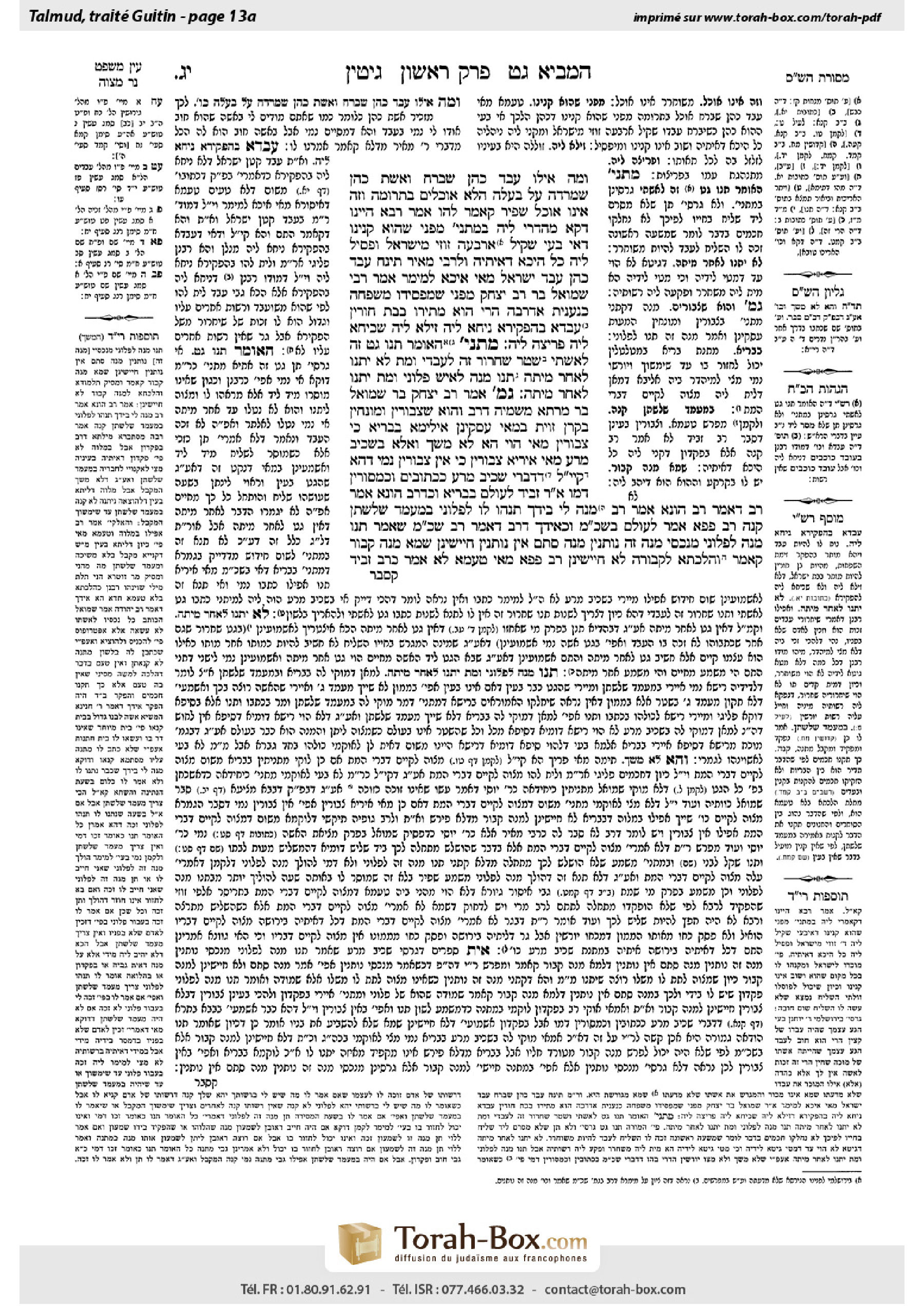
Gittin 13a: Talmud study for Daf Yomi
Study the Talmud for Daf Yomi with scanned pages, Hebrew text, English translations from Sefaria and AI-generated French translations.
Passage selection and English or AI-generated French translation are available where the scan has annotations. Daf Study is independent of Torah-Box and Sefaria.
Browse Gittin · גיטין · All tractatesGittin 13a text and translations
This page of Gittin includes the Aramaic text, an English translation and an AI-generated French translation, alongside the scan above.
גיטין י״ג א · Aramaic and Hebrew text
״וּמָה אִילּוּ עֶבֶד כֹּהֵן שֶׁבָּרַח וְאֵשֶׁת כֹּהֵן שֶׁמָּרְדָה עַל בַּעְלָהּ – הֲלֹא אוֹכְלִים בִּתְרוּמָה; וְזֶה – אֵינוֹ אוֹכֵל״ –
שַׁפִּיר קָאָמַר לְהוּ! אָמַר רָבָא: הַיְינוּ דְּקָא מַהְדְּרִי לֵיהּ בְּמַתְנִיתִין: מִפְּנֵי שֶׁהוּא קִנְיָנוֹ. דְּאִי בָּעֵי, שָׁקֵיל אַרְבָּעָה זוּזֵי מִיִּשְׂרָאֵל וּפָסֵיל לֵיהּ כֹּל הֵיכָא דְּאִיתֵיהּ.
וּלְרַבִּי מֵאִיר – תִּינַח עֶבֶד כֹּהֵן, עֶבֶד יִשְׂרָאֵל מַאי אִיכָּא לְמֵימַר? אָמַר רַבִּי שְׁמוּאֵל בַּר רַב יִצְחָק: מִפְּנֵי שֶׁמַּפְסִידוֹ מִשִּׁפְחָה כְּנַעֲנִית.
אַדְּרַבָּה, הֲרֵי הוּא מַתִּירוֹ בְּבַת חוֹרִין! עַבְדָּא בְּהֶפְקֵירָא נִיחָא לֵיהּ – זִילָא לֵיהּ, שְׁכִיחָא לֵיהּ, פְּרִיצָה לֵיהּ.
מַתְנִי׳ הָאוֹמֵר ״תְּנוּ גֵּט זֶה לְאִשְׁתִּי, שְׁטַר שִׁחְרוּר זֶה לְעַבְדִּי״, וּמֵת – לֹא יִתְּנוּ לְאַחַר מִיתָה. ״תְּנוּ מָנֶה לְאִישׁ פְּלוֹנִי״, וּמֵת – יִתְּנוּ לְאַחַר מִיתָה.
גְּמָ׳ אָמַר רַב יִצְחָק בַּר שְׁמוּאֵל בַּר מָרְתָּא מִשְּׁמֵיהּ דְרַב: וְהוּא שֶׁצְּבוּרִין וּמוּנָּחִין בְּקֶרֶן זָוִית.
בְּמַאי עָסְקִינַן? אִילֵימָא בְּבָרִיא, כִּי צְבוּרִין מַאי הָוֵי? הָא לָא מְשַׁךְ! וְאֶלָּא בִּשְׁכִיב מְרַע, מַאי אִירְיָא צְבוּרִין? כִּי אֵין צְבוּרִין נָמֵי, דְּהָא קַיְימָא לַן דְּדִבְרֵי שְׁכִיב מְרַע – כִּכְתוּבִים וְכִמְסוּרִין דָּמוּ!
אָמַר רַב זְבִיד: לְעוֹלָם בְּבָרִיא, וְכִדְרַב הוּנָא אָמַר רַב – דְּאָמַר רַב הוּנָא אָמַר רַב: ״מָנֶה לִי בְּיָדְךָ, תְּנֵהוּ לוֹ לִפְלוֹנִי״, בְּמַעֲמַד שְׁלָשְׁתָּן – קָנָה.
רַב פָּפָּא אָמַר: לְעוֹלָם בִּשְׁכִיב מְרַע, וּכְאִידַּךְ דְּרַב – דְּאָמַר רַב: שְׁכִיב מְרַע שֶׁאָמַר ״תְּנוּ מָנֶה לִפְלוֹנִי מִנְּכָסַי״; ״מָנֶה זֶה״ – נוֹתְנִין, ״מָנֶה״ סְתָם – אֵין נוֹתְנִין,
חָיְישִׁינַן שֶׁמָּא מָנֶה קָבוּר קָאָמַר.
וְהִלְכְתָא: לִקְבוּרָה לָא חָיְישִׁינַן. רַב פָּפָּא מַאי טַעְמָא לָא אָמַר כְּרַב זְבִיד?
Gittin 13a · English translation
And Rabbi Meir further said to the Rabbis: And what would be if there was the slave of a priest, who fled from his master, or the wife of a priest who rebelled against her husband, are they not permitted to partake of teruma, although not the teruma belonging to the master or husband? They are permitted to partake of teruma. But this slave who was emancipated may not partake of teruma at all, even teruma that belongs to other priests. Evidently, emancipation is to his detriment.
The Gemara asks: If so, then Rabbi Meir is saying and responding well to the Rabbis. How do the Rabbis counter his claim? Rava said: This is what they answered and said to him in the mishna: The master can disqualify his slave from partaking of teruma in any event, because he is his master’s acquisition. The implication of this statement is the following: As, if the master desires to disqualify his slave from partaking of teruma after he has fled, he can take four dinars from any Israelite in exchange for the slave, and he thereby disqualifies him from partaking of teruma anywhere that he is located.
The Gemara asks: And according to the opinion of Rabbi Meir, his explanation works out well with regard to the slave of a priest whose emancipation causes him to be disqualified from partaking of teruma, and therefore it is possible to argue that his emancipation is to his detriment. However with regard to the slave of an Israelite, what can be said? Rabbi Shmuel bar Rav Yitzḥak says: Emancipation is even to the detriment of a slave of an Israelite, because by freeing him his master causes him to lose the option of engaging in sexual intercourse with a Canaanite maidservant. Until this point it was permitted for him to engage in sexual intercourse with a Canaanite maidservant, but once he is emancipated these women are forbidden to him.
The Gemara raises a difficulty: On the contrary, by emancipating him the master renders it permitted for him to engage in sexual intercourse with a free woman. The Gemara answers: In the case of a slave, a life of licentiousness is preferable for him. Therefore, he would rather have the right to engage in sexual intercourse with a Canaanite maidservant, as she is lowly to him, she is available for him, she is unrestricted for him. None of these descriptions apply to a Jewish woman, and therefore he loses out on the benefit he could have received from being permitted to engage in sexual intercourse with a Canaanite maidservant. Consequently, Rabbi Meir maintains that his emancipation is to his detriment.
MISHNA: In the case of one who says: Give this bill of divorce to my wife, or: Give this bill of manumission to my slave, and then he dies, one does not give it after his death. The reason for this is that bills of divorce and manumission must be transferred by the husband or the master. Once he has died the document can no longer be given, and the agency he appointed for this purpose is likewise canceled. However, if he said: Give one hundred dinars to so-and-so, and then he died, one does give the recipient the money after his death.
GEMARA: Rav Yitzḥak bar Shmuel bar Marta says in the name of Rav: And this ruling, that one gives the one hundred dinars after the death of the owner, is the halakha only when those dinars are piled up and placed in a corner at the time of the command.
The Gemara asks: With what are we dealing? If we say that we are dealing with a healthy person who instructs others to give one hundred dinars, then when they are piled, what of it? After all, the recipient did not pull the money, and one must perform an act of acquisition to take possession of movable property. Rather, say that we are dealing with a person on his deathbed, in which case verbal instructions suffice. However, if that is so, why does this halakha apply specifically when the money is piled? The same should be the case when the coins are not piled as well, as we maintain that the statement of a person on his deathbed who distributes his property is considered as though it were written and delivered. If so, no other act of acquisition should be necessary.
Rav Zevid says: Actually, the mishna is dealing with a healthy person, and this ruling is in accordance with that which Rav Huna says that Rav says. As Rav Huna says that Rav says: With regard to one who says to another: I have one hundred dinars in your possession; give it to so-and-so, if this occurred in the presence of all three parties, that third person has acquired it. This type of acquisition applies only to money that is similar to a deposit, e.g., piled money.
Rav Pappa said: Actually, the mishna is dealing with a person on his deathbed, and it is in accordance with another ruling of Rav, as Rav says: With regard to a person on his deathbed who said: Give one hundred dinars to so-and-so from my property, the halakha depends on his precise wording. If he said: Give him this one hundred dinars, where the money is in a particular place, one gives the money to him. However, if he merely said: One hundred dinars, without specification, one does not give it to him.
Why does one not give the one hundred dinars if he did not add further specification? We are concerned that perhaps he spoke about a buried one hundred dinars. In other words, he might have been referring to a specific one hundred dinars whose location is unknown, and he did not intend to give him any other money. For this reason, Rav explains that the mishna is referring to money piled up in a designated place, which the one who gives the instruction is referring to explicitly.
The Gemara comments: And the halakha is that we are not concerned about a buried sum of one hundred dinars, i.e., the halakha is not in accordance with the opinion of Rav. The Gemara asks: What is the reason that Rav Pappa did not say an explanation that is in accordance with that of Rav Zevid with regard to Rav’s statement?
Gittin 13a · Traduction française (IA)
Et le maître Rabbi Meir dit encore aux Rabbins : Et si c'était un esclave d'un prêtre qui s'était enfui de son maître, ou une femme de prêtre qui avait rebelle contre son mari, ne sont-ils pas autorisés à consommer la terouma, même si ce n'est pas la terouma du maître ou du mari ? Ils sont autorisés à consommer la terouma. Mais cet esclave qui a été libéré ne peut pas consommer la terouma du tout, même la terouma appartenant à d'autres prêtres. Évidemment, la libération est à son détriment.
La Guemara pose la question : Si c'est ainsi, alors Rabbi Meir dit et répond bien aux Rabbins. Comment les Rabbins contredisent-ils son argument ? Rava dit : C'est ce que répondirent et dirent à lui dans la mitsva : Le maître peut disqualifier son esclave de la consommation de la terouma en tout cas, car il est la propriété du maître. L'implication de cette déclaration est la suivante : En effet, si le maître désire disqualifier son esclave de la consommation de la terouma après qu'il ait fui, il peut prendre quatre dinars d'un Israélite quelconque en échange de l'esclave, et ainsi le disqualifier de la consommation de la terouma partout où il se trouve.
La Guemara pose la question : Et selon l'opinion de Rabbi Meir, son explication s'applique bien au cas de l'esclave d'un prêtre dont la libération le disqualifie de la consommation de la terouma, et donc il est possible d'arguer que sa libération est à son détriment. Cependant, concernant l'esclave d'un Israélite, que peut-on dire ? Rabbi Shmuel bar Rav Yitzḥak dit : La libération est même à son détriment pour un esclave d'un Israélite, car en le libérant, son maître lui fait perdre l'option d'avoir des relations sexuelles avec une servante cananéenne. Jusqu'à ce point, il était autorisé à avoir des relations sexuelles avec une servante cananéenne, mais une fois libéré, ces femmes lui sont interdites.
La Guemara soulève une difficulté : Au contraire, en libérant l'esclave, le maître rend permis à l'esclave d'avoir des relations sexuelles avec une femme libre. La Guemara répond : Dans le cas d'un esclave, une vie de luxure est préférable pour lui. Il préfère donc avoir le droit d'avoir des relations sexuelles avec une servante cananéenne, car elle est inférieure à lui, elle est disponible pour lui, elle n'est pas limitée pour lui. Aucune de ces descriptions ne s'applique à une femme juive, et donc il perd le bénéfice qu'il pouvait recevoir en étant autorisé à avoir des relations sexuelles avec une servante cananéenne. Ainsi, Rabbi Meir maintient que sa libération est à son détriment.
MICHNA : Dans le cas d'une personne qui dit : Donne-moi ce divorce à ma femme, ou : Donne-moi ce certificat de manumission à mon esclave, et ensuite il meurt, on ne donne pas cela après sa mort. La raison de cela est que les certificats de divorce et de manumission doivent être transmis par le mari ou le maître. Une fois qu'il est mort, le document ne peut plus être donné, et l'agent qu'il a désigné pour cela est également annulé. Cependant, si il dit : Donne-moi cent dinars à tel et tel, et ensuite il meurt, on donne l'argent au bénéficiaire après sa mort.
GUEMARA : Rav Yitzḥak bar Shmuel bar Marta dit en nom de Rav : Et cette décision, que l'on donne cent dinars après la mort du propriétaire, est la halakha uniquement lorsque ces dinars sont empilés et placés dans un coin au moment de la commande.
La Guemara pose la question : Avec quoi sommes-nous en train de travailler ? Si nous disons que nous travaillons avec une personne en bonne santé qui instruit les autres à donner cent dinars, alors quand ils sont empilés, qu'y a-t-il ? En effet, le bénéficiaire n'a pas tiré l'argent, et l'on doit accomplir un acte d'acquisition pour prendre possession d'un bien mobile. Plutôt, disons que nous travaillons avec une personne sur son lit de mort, dans lequel cas les instructions verbales suffisent. Cependant, si c'est ainsi, pourquoi cette halakha s'applique-t-elle spécifiquement lorsque l'argent est empilé ? La même chose devrait s'appliquer lorsque l'argent n'est pas empilé, car nous maintenons que la déclaration d'une personne sur son lit de mort qui distribue ses biens est considérée comme si elle était écrite et remise. Si c'est ainsi, aucun autre acte d'acquisition ne devrait être nécessaire.
Rav Zevid dit : En réalité, la mitsna traite d'une personne en bonne santé, et cette décision s'inscrit selon ce que Rav Huna dit que Rav dit. Car Rav Huna dit que Rav dit : Concernant une personne qui dit à un autre : J'ai cent dinars en votre possession ; donnez-les à tel et tel, si cela s'est produit en présence des trois parties, la troisième personne a acquis cela. Ce type d'acquisition s'applique uniquement aux dinars semblables à un dépôt, c'est-à-dire des dinars empilés.
Rav Pappa dit : En réalité, la mitsna traite d'une personne sur son lit de mort, et elle s'inscrit selon un autre jugement de Rav, car Rav dit : Concernant une personne sur son lit de mort qui dit : Donne cent dinars à tel et tel de mes biens, la halakha dépend de son wording précis. Si il dit : Donne-lui ces cent dinars, où l'argent est dans un lieu particulier, on donne l'argent à lui. Cependant, si il dit simplement : Cent dinars, sans précision, on ne lui donne pas l'argent.
Pourquoi ne donne-t-on pas les cent dinars si on n'a pas ajouté de précision supplémentaire ? On craint que ce soit des cent dinars enterrés. En d'autres termes, il pourrait s'agir d'une somme spécifique de cent dinars dont la localisation est inconnue, et il n'avait pas l'intention de donner à l'autre personne d'autres dinars. Pour cette raison, Rav explique que la mitsva fait référence à de l'argent empilé dans un lieu désigné, auquel celui qui donne l'instruction fait référence explicitement.
La Guemara commente : Et la halakha est que nous ne craignons pas une somme enterrée de cent dinars, c'est-à-dire la halakha n'est pas selon l'opinion de Rav. La Guemara pose la question : Quelle est la raison que Rav Pappa n'a pas donné une explication qui s'inscrit selon celle de Rav Zevid concernant la déclaration de Rav ?
Traduction française générée par IA à partir de l’édition anglaise de Sefaria. Vérifie toujours un passage avec le texte source.
Text from Sefaria: William Davidson Edition - Vocalized Aramaic (CC BY NC); William Davidson Edition - English (CC BY NC).