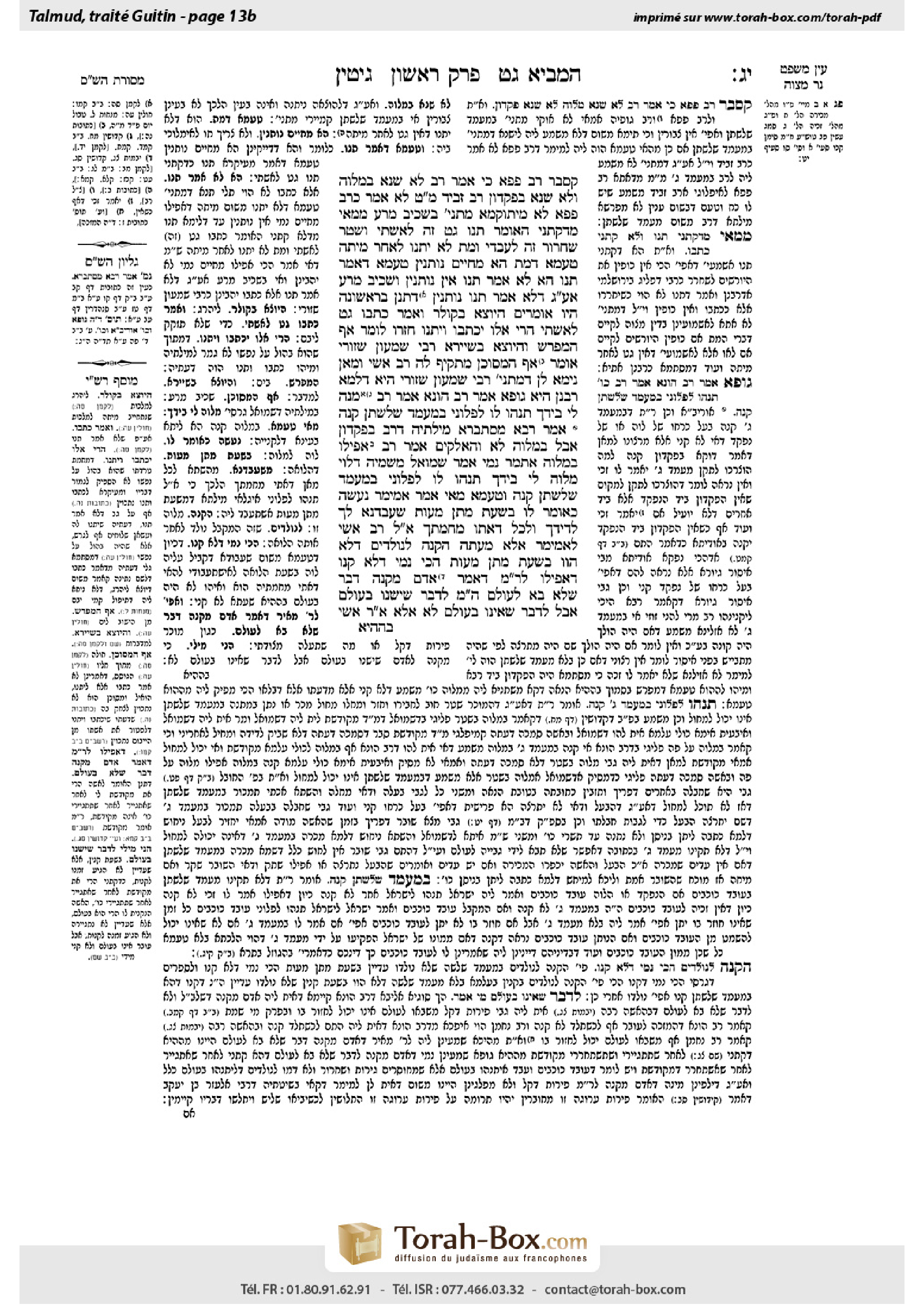
Gittin 13b: Talmud study for Daf Yomi
Study the Talmud for Daf Yomi with scanned pages, Hebrew text, English translations from Sefaria and AI-generated French translations.
Passage selection and English or AI-generated French translation are available where the scan has annotations. Daf Study is independent of Torah-Box and Sefaria.
Browse Gittin · גיטין · All tractatesGittin 13b text and translations
This page of Gittin includes the Aramaic text, an English translation and an AI-generated French translation, alongside the scan above.
גיטין י״ג ב · Aramaic and Hebrew text
קָסָבַר רַב פָּפָּא, כִּי אָמַר רַב – לָא שְׁנָא בְּמִלְוֶה, וְלָא שְׁנָא בְּפִקָּדוֹן.
רַב זְבִיד מַאי טַעְמָא לָא אָמַר כְּרַב פָּפָּא? לָא מִיתּוֹקְמָא מַתְנִיתִין בִּשְׁכִיב מְרַע. מִמַּאי? מִדְּקָתָנֵי: ״הָאוֹמֵר תְּנוּ גֵּט זֶה לְאִשְׁתִּי וּשְׁטַר שִׁחְרוּר זֶה לְעַבְדִּי״, וּמֵת – לֹא יִתְּנוּ לְאַחַר מִיתָה.
טַעְמָא דְּמֵת, הָא מֵחַיִּים – נוֹתְנִין; טַעְמָא דְּאָמַר ״תְּנוּ״, הָא לֹא אָמַר ״תְּנוּ״, אֵין נוֹתְנִין; וּשְׁכִיב מְרַע – אַף עַל גַּב דְּלָא אָמַר ״תְּנוּ״, נוֹתְנִין.
דִּתְנַן, בָּרִאשׁוֹנָה הָיוּ אוֹמְרִים: הַיּוֹצֵא בְּקוֹלָר, וְאָמַר ״כִּתְבוּ גֵּט לְאִשְׁתִּי״ – הֲרֵי אֵלּוּ יִכְתְּבוּ וְיִתְּנוּ. חָזְרוּ לוֹמַר, אַף הַמְפָרֵשׁ וְהַיּוֹצֵא בִּשְׁיָירָא.
רַבִּי שִׁמְעוֹן שֵׁזוּרִי אוֹמֵר: אַף הַמְסוּכָּן.
מַתְקֵיף לַהּ רַב אָשֵׁי: וּמַאן נֵימָא לַן דְּמַתְנִיתִין רַבִּי שִׁמְעוֹן שֵׁזוּרִי הִיא? דִּלְמָא רַבָּנַן הִיא!
גּוּפָא – אָמַר רַב הוּנָא אָמַר רַב: ״מָנֶה לִי בְּיָדְךָ, תְּנֵהוּ לוֹ לִפְלוֹנִי״, בְּמַעֲמַד שְׁלָשְׁתָּן – קָנָה. אָמַר רָבָא: מִסְתַּבְּרָא מִילְּתֵיהּ דְּרַב בְּפִקָּדוֹן, אֲבָל בְּמִלְוָה – לֹא.
וְהָאֱלֹהִים! אָמַר רַב: אֲפִילּוּ בְּמִלְוָה. אִתְּמַר נָמֵי, אָמַר שְׁמוּאֵל מִשְּׁמֵיהּ דְּלֵוִי: ״מִלְוָה לִי בְּיָדְךָ, תְּנֵהוּ לוֹ לִפְלוֹנִי״, בְּמַעֲמַד שְׁלָשְׁתָּן – קָנָה.
וְטַעְמָא מַאי? אָמַר אַמֵּימָר: נַעֲשָׂה כְּאוֹמֵר לוֹ בִּשְׁעַת מַתַּן מָעוֹת: שַׁעְבַּדְנָא לָךְ לְדִידָךְ וּלְכֹל דְּאָתוּ מֵחֲמָתָךְ.
אֲמַר לֵיהּ רַב אָשֵׁי לְאַמֵּימָר: אֶלָּא מֵעַתָּה, הִקְנָה לַנּוֹלָדִים – דְּלָא הֲווֹ בִּשְׁעַת מַתַּן מָעוֹת, הָכִי נָמֵי דְּלָא קָנוּ?!
דַּאֲפִילּוּ לְרַבִּי מֵאִיר, דְּאָמַר אָדָם מַקְנֶה דָּבָר שֶׁלֹּא בָּא לָעוֹלָם, הָנֵי מִילֵּי לְדָבָר שֶׁיֶּשְׁנוֹ בְּעוֹלָם, אֲבָל לְדָבָר שֶׁאֵינוֹ בָּעוֹלָם – לָא!
אֶלָּא אָמַר רַב אָשֵׁי:
Gittin 13b · English translation
The Gemara answers: Rav Pappa holds that when Rav said that a transfer in the presence of all three parties is effective, it is no different if this is referring to a loan from the first party to the second party, where it is an abstract monetary obligation that is transferred, and it is no different if it is referring to a deposit, where specific money is transferred. Just as the transfer is effective in the case of a loan, in which there is an abstract monetary obligation, it would be effective even if the money were not piled. For this reason, Rav Pappa explained that the mishna is referring to piled money due to the concern about a collection of a buried one hundred dinars.
The Gemara asks the reverse question: What is the reason that Rav Zevid did not say in accordance with the explanation of Rav Pappa? The Gemara answers: He holds that it is not possible to establish the mishna as referring to a person on his deathbed. From where does he learn this? It is from the fact that it teaches: In the case of one who says: Give this bill of divorce to my wife, or: Give this bill of manumission to my slave, and then he dies, one should not give it after his death.
The Gemara infers: The reason for this ruling is that the man died. However, if it was while he was still alive then one gives the document. The Gemara continues: Even during his lifetime the reason for the ruling is specifically that he said: Give, but if he did not say: Give, and merely commanded: Write a bill of divorce, then one does not give it. But this is not the case with regard to a person on his deathbed, as, although he did not say: Give, but simply commanded: Write, nevertheless, one gives the document. Evidently, this halakha cannot be referring to a person on his deathbed.
As we learned in a mishna (65b): Initially the Sages would say: With regard to one who is taken out in a neck chain to be executed and said: Write a bill of divorce for my wife, these people should write and give her the document. Although he did not explicitly say: Give, this is understood to have been his intention. They then said that this halakha applies even to one who sets sail and one who departs in a caravan to a far-off place. A bill of divorce is given to his wife under these circumstances even if her husband said just: Write.
Rabbi Shimon Shezuri says: Even in the case of one who is dangerously ill who gives that instruction, they write the bill of divorce and give it to his wife. This shows that a dying person need not say: Give. Rather, it is sufficient for him to say: Write. By contrast, the mishna indicates that it is referring to one who says: Give, and therefore it is certainly not speaking about a dying person.
Rav Ashi objects to this claim: And who says to us that the mishna is in accordance with the opinion of Rabbi Shimon Shezuri? Perhaps it is in accordance with the opinion of the Rabbis, who did not include a dangerously ill person in their list of those who are not required to say: Give. If so, it is possible that the mishna is referring to a person on his deathbed after all.
The Gemara discusses the matter itself. Rav Huna says that Rav says: With regard to one who says to another: I have one hundred dinars in your possession; give it to so-and-so, if this occurred in the presence of all three parties, that third person has acquired it. Rava said: It stands to reason that Rav’s statement is with regard to a deposit, when the owner of the deposit instructs its guardian to transfer specific money under his authority to someone else who is also present. However, in the case of a loan, no, one cannot dispense with an act of acquisition, as repayment of a loan does not involve specific money.
Rava himself adds, in the form of an oath: But by God, in truth, Rav said this halakha even with regard to a loan. The Gemara adds: It was also stated that Shmuel said in the name of Levi that if someone says to another: I have a loan in your possession, i.e., you owe me payment for a loan, give it to so-and-so, and this occurred in the presence of all three parties, that named person has acquired it.
The Gemara asks: And what is the reason for this? In what manner does he acquire it? Ameimar said: The case becomes like that of a borrower who says to a lender at the time of the giving of the money, when he receives a loan: I am beholden to you and to anyone who comes based on your authorization. In this case, the recipient is authorized by the lender to take the loan in the presence of all three parties.
Rav Ashi said to Ameimar: If that is so, that the borrower’s obligation to the third party went into effect at the time of the loan, then if he transferred it in the presence of the three parties to those who will be born, i.e., people who were not yet born when the money was initially given, the halakha should also be that the recipients do not acquire it. The reason is that at the time the lender gave the money to the borrower, the person to whom it would eventually be transferred did not yet exist, and therefore the borrower could not have become obligated to him at that point in time.
Rav Ashi elaborates: As, even according to the opinion of Rabbi Meir, who says that a person can transfer ownership of an entity that has not yet come into the world, this statement applies only when he transfers it to an entity, i.e., a person, that has come into the world. However, even Rabbi Meir agrees with regard to the transfer of ownership of an article to an entity that has not yet come into the world, that this is not possible. Since Rav issued his statement in a general manner without any limitations, evidently the method of a transfer in the presence of all three parties applies in all cases, regardless of whether the third party was born at the time when the loan was given.
Rather, Rav Ashi says that this is the reason for the matter:
Gittin 13b · Traduction française (IA)
Le Guemara répond : Rav Pappa affirme que lorsque Rav a dit qu'un transfert devant les trois parties est efficace, cela ne diffère pas si cela se réfère à un prêt du premier au second, où il s'agit d'une obligation monétaire abstraite qui est transférée, et cela ne diffère pas non plus si cela se réfère à un dépôt, où des fonds spécifiques sont transférés. Tout comme le transfert est efficace dans le cas d'un prêt, où il s'agit d'une obligation monétaire abstraite, il serait également efficace même si les fonds n'étaient pas empilés. C'est pourquoi Rav Pappa a expliqué que la Michna se réfère à des fonds empilés en raison de la crainte d'une collection d'un dinar enterré.
Le Guemara pose la question inverse : pourquoi Rav Zevid n'a-t-il pas dit selon l'explication de Rav Pappa ? Le Guemara répond : il considère que ce n'est pas possible d'établir la Michna comme se référant à une personne sur son lit de mort. D'où tire-t-il cela ? De ce fait qu'il enseigne : dans le cas d'une personne qui dit : donne ce divorce à ma femme, ou : donne ce manumission à mon esclave, et ensuite il meurt, on ne doit pas le donner après sa mort.
Le Guemara déduit : la raison de cette décision est que l'homme est mort. Cependant, si cela s'est produit alors qu'il était encore vivant, on donne le document. Le Guemara continue : même durant sa vie, la raison de cette décision est spécifiquement qu'il a dit : donne, mais si il n'a pas dit : donne, et simplement commandé : écris un divorce, alors on ne le donne pas. Cependant, cela n'est pas le cas d'une personne sur son lit de mort, car, bien qu'il n'ait pas dit : donne, mais simplement commandé : écris, on donne tout de même le document. Évidemment, cette halakha ne peut pas se référer à une personne sur son lit de mort.
Comme nous l'avons appris dans une Michna (65b) : d'abord les Sages disaient : concernant une personne qui est sortie en chaîne au cou pour être exécutée et qui a dit : écris un divorce pour ma femme, ces gens doivent écrire et lui donner le document. Bien qu'il n'ait pas explicitement dit : donne, cela est compris comme son intention. Ils ont ensuite dit que cette halakha s'applique même à une personne qui embarque et à une personne qui part en caravane vers un lieu éloigné. Un divorce est donné à sa femme dans ces circonstances même si son mari a dit seulement : écris.
Rabbi Shimon Shezuri dit : même dans le cas d'une personne gravement malade qui donne cet ordre, ils écrivent le divorce et le donnent à sa femme. Cela montre que la personne mourante n'a pas besoin de dire : donne. Il suffit qu'elle dise : écris. À l'inverse, la Michna indique qu'il s'agit d'une personne qui dit : donne, et par conséquent, elle ne parle certainement pas d'une personne mourante.
Rav Ashi s'oppose à cette affirmation : et qui nous dit que la Michna est selon l'opinion de Rabbi Shimon Shezuri ? Peut-être qu'elle est selon l'opinion des Sages, qui n'ont pas inclus une personne gravement malade dans leur liste de ceux qui ne doivent pas dire : donne. Si c'est le cas, il est possible que la Michna s'applique à une personne sur son lit de mort.
Le Guemara discute de la question elle-même. Rav Huna dit que Rav dit : concernant une personne qui dit à une autre : j'ai cent dinars en votre possession ; donnez-les à tel ou tel, si cela s'est produit devant les trois parties, la troisième personne a acquis cela. Rava dit : il est logique que l'affirmation de Rav soit concernant un dépôt, lorsque l'owner du dépôt ordonne à son gardien de transférer des fonds spécifiques sous son autorité à quelqu'un d'autre qui est également présent. Cependant, dans le cas d'un prêt, non, on ne peut pas dispenser d'un acte d'acquisition, car le remboursement d'un prêt ne concerne pas des fonds spécifiques.
Rava lui-même ajoute, sous la forme d'une serment : par Dieu, en vérité, Rav a dit cette halakha même concernant un prêt. Le Guemara ajoute : il a également été dit que Shmuel a dit au nom de Levi que si quelqu'un dit à un autre : j'ai un prêt en votre possession, c'est-à-dire que vous me devez le paiement d'un prêt, donnez-le à tel ou tel, et cela s'est produit devant les trois parties, la personne nommée a acquis cela.
Le Guemara pose la question : et quelle est la raison de cela ? De quelle manière acquiert-il cela ? Ameimar dit : le cas devient comme celui d'un prêteur qui dit à un prêteur au moment de la remise de l'argent, lorsqu'il reçoit un prêt : je suis tenu envers vous et envers quiconque vient sur votre autorisation. Dans ce cas, le destinataire est autorisé par le prêteur à prendre le prêt devant les trois parties.
Rav Ashi a dit à Ameimar : si c'est ainsi, que l'obligation du prêteur envers le tiers est entrée en vigueur au moment du prêt, alors si il transfère cela devant les trois parties à ceux qui seront nés, c'est-à-dire à des personnes qui n'étaient pas encore nées lors de la première remise de l'argent, la halakha devrait aussi être que les destinataires n'acquièrent pas cela. La raison est que lors du moment où le prêteur a donné l'argent au prêteur, la personne à qui il serait finalement transféré n'existait pas encore, et par conséquent, le prêteur ne pouvait pas avoir été tenu envers lui à ce moment-là.
Rav Ashi développe : car, même selon l'opinion de Rabbi Meir, qui dit qu'une personne peut transférer la propriété d'une entité qui n'a pas encore entré dans le monde, cette affirmation s'applique uniquement lorsqu'il transfère cela à une entité, c'est-à-dire une personne, qui est entrée dans le monde. Cependant, même Rabbi Meir est d'accord concernant le transfert de la propriété d'un objet à une entité qui n'a pas encore entré dans le monde, que cela n'est pas possible. Puisque Rav a formulé son affirmation de manière générale sans aucune limitation, il est évident que la méthode de transfert devant les trois parties s'applique à tous les cas, indépendamment du fait que le tiers soit né au moment où le prêt a été donné.
Rav Ashi dit plutôt que c'est la raison de la question :
Traduction française générée par IA à partir de l’édition anglaise de Sefaria. Vérifie toujours un passage avec le texte source.
Text from Sefaria: William Davidson Edition - Vocalized Aramaic (CC BY NC); William Davidson Edition - English (CC BY NC).