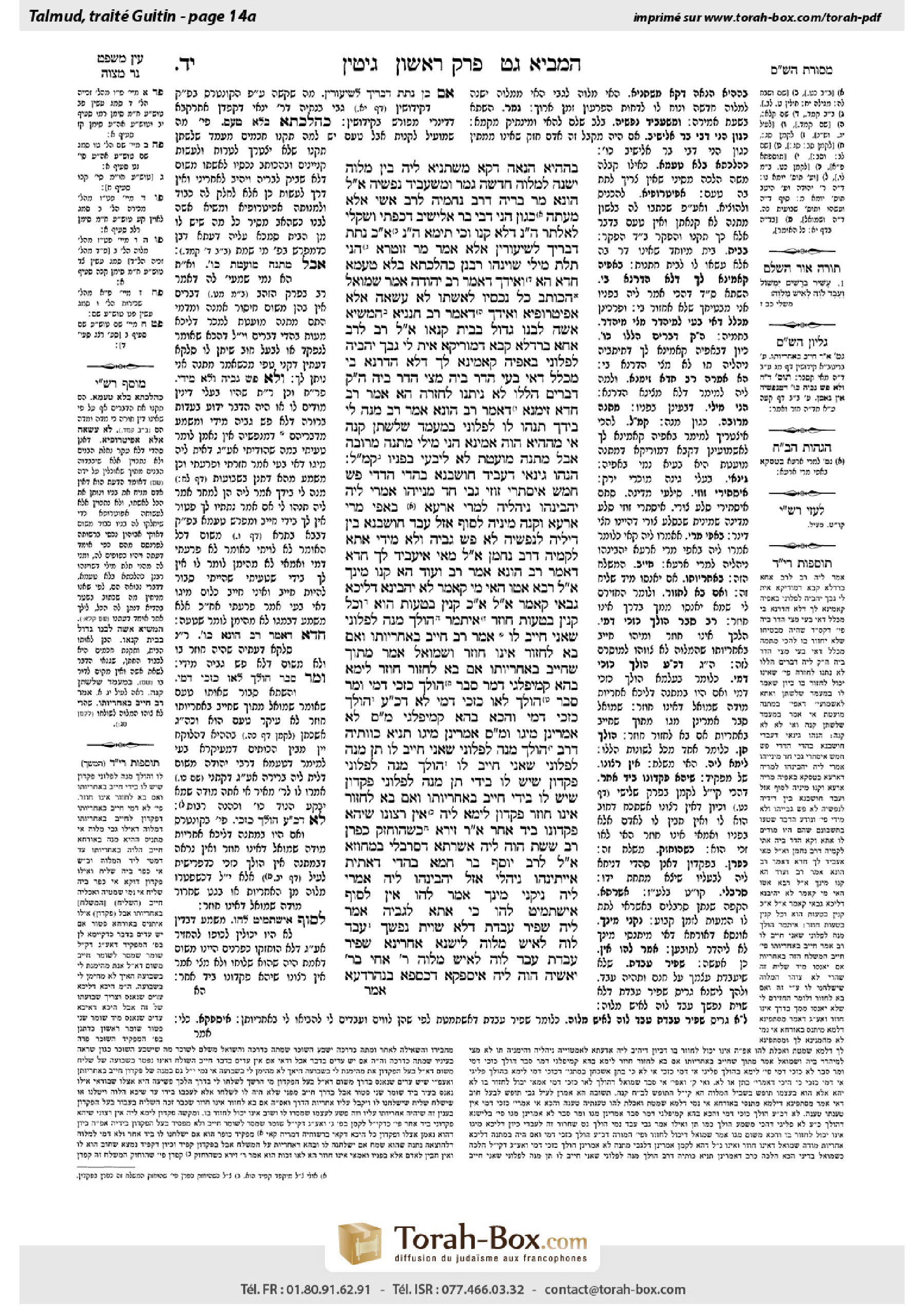
Gittin 14a: Talmud study for Daf Yomi
Study the Talmud for Daf Yomi with scanned pages, Hebrew text, English translations from Sefaria and AI-generated French translations.
Passage selection and English or AI-generated French translation are available where the scan has annotations. Daf Study is independent of Torah-Box and Sefaria.
Browse Gittin · גיטין · All tractatesGittin 14a text and translations
This page of Gittin includes the Aramaic text, an English translation and an AI-generated French translation, alongside the scan above.
גיטין י״ד א · Aramaic and Hebrew text
בְּהַהִיא הֲנָאָה דְּקָא מִשְׁתַּנְּיָא לֵיהּ בֵּין מִלְוָה יְשָׁנָה לְמִלְוָה חֲדָשָׁה, גָּמַר וּמְשַׁעְבֵּיד נַפְשֵׁיהּ.
אֲמַר לֵיהּ הוּנָא מָר בְּרֵיהּ דְּרַב נְחֶמְיָה לְרַב אָשֵׁי: אֶלָּא מֵעַתָּה, כְּגוֹן הָנֵי דְּבֵי בַּר אֶלְיָשִׁיב, דְּכָפְתִי וְשָׁקְלִי לְאַלְתַּר, הָכִי נָמֵי דְּלָא קָנוּ?!
וְכִי תֵּימָא הָכִי נָמֵי, אִם כֵּן נָתַתָּ דְּבָרֶיךָ לְשִׁיעוּרִין!
אֶלָּא אָמַר מָר זוּטְרָא: הָנֵי תְּלָת מִילֵּי שַׁוִּינְהוּ רַבָּנַן כְּהִלְכְתָא בְּלָא טַעְמָא: חֲדָא – הָא; וְאִידַּךְ – דְּאָמַר רַב יְהוּדָה אָמַר שְׁמוּאֵל: הַכּוֹתֵב כׇּל נְכָסָיו לְאִשְׁתּוֹ – לֹא עֲשָׂאָהּ אֶלָּא אַפִּיטְרוֹפְּיָא; וְאִידַּךְ – דְּאָמַר רַב חֲנַנְיָא: הַמַּשִּׂיא אִשָּׁה לִבְנוֹ גָּדוֹל בַּבַּיִת – קְנָאוֹ.
אֲמַר לֵיהּ רַב לְרַב אַחָא בַּרְדְּלָא: קַבָּא דְּמוֹרִיקָא אִית לִי גַּבָּךְ; יַהֲבֵיהּ לִפְלוֹנִי. בְּאַפֵּיהּ קָאָמֵינָא לָךְ דְּלָא הָדַרְנָא בִּי.
מִכְּלָל דְּאִי בָּעֵי הָדַר בֵּיהּ, מָצֵי הָדַר בֵּיהּ?! הָכִי קָאָמַר: דְּבָרִים הַלָּלוּ לֹא נִיתְּנוּ לַחֲזָרָה.
הָא אָמַר רַב חֲדָא זִימְנָא; דְּאָמַר רַב הוּנָא אָמַר רַב: ״מָנֶה לִי בְּיָדְךָ, תְּנֵהוּ לוֹ לִפְלוֹנִי״, בְּמַעֲמַד שְׁלָשְׁתָּן – קָנָה!
אִי מֵהַהִיא, הֲוָה אָמֵינָא הָנֵי מִילֵּי מַתָּנָה מְרוּבָּה, אֲבָל מַתָּנָה מוּעֶטֶת לָא לִיבְעֵי בְּפָנָיו, קָא מַשְׁמַע לַן.
הָנְהוּ גִּינָּאֵי דַּעֲבֻיד חוּשְׁבָּנָא בַּהֲדֵי הֲדָדֵי. פָּשׁ חֲמֵשׁ אִיסְתְּרֵי זוּזֵי גַּבֵּי חַד מִנַּיְיהוּ, אָמְרִי לֵיהּ: ״יַהֲבִינְהוּ נִיהֲלֵיהּ לְמָרֵי אַרְעָא״ – בְּאַפֵּי מָרֵי אַרְעָא, וּקְנֹה מִינֵּיהּ.
לְסוֹף אֲזַל עֲבַד חוּשְׁבָּנָא בֵּין דִּילֵיהּ לְנַפְשֵׁיהּ, לָא פָּשׁ גַּבֵּיהּ וְלָא מִידֵּי. אֲתָא לְקַמֵּיהּ דְּרַב נַחְמָן, אֲמַר לֵיהּ: מַאי אֶיעְבֵּיד לָךְ? חֲדָא, דְּאָמַר רַב הוּנָא אָמַר רַב. וְעוֹד, הָא קְנוֹ מִינָּךְ.
אֲמַר לֵיהּ רָבָא: אַטּוּ הַאי, מִי קָאָמַר ״לָא יָהֲבִינָא״?! ״דְּלֵיכָּא גַּבַּאי״ קָאָמַר! אֲמַר לֵיהּ: אִם כֵּן, קִנְיָן בְּטָעוּת הוּא, וְכׇל קִנְיָן בְּטָעוּת חוֹזֵר.
אִיתְּמַר: ״הוֹלֵךְ מָנֶה לִפְלוֹנִי שֶׁאֲנִי חַיָּיב לוֹ״, אָמַר רַב: חַיָּיב בְּאַחְרָיוּתוֹ; וְאִם בָּא לַחְזוֹר – אֵינוֹ חוֹזֵר. וּשְׁמוּאֵל אָמַר: מִתּוֹךְ שֶׁחַיָּיב בְּאַחְרָיוּתוֹ, אִם בָּא לַחְזוֹר – חוֹזֵר.
לֵימָא בְּהָא קָמִיפַּלְגִי – דְּמָר סָבַר: ״הוֹלֵךְ״ כִּ״זְכִי״ דָּמֵי, וּמָר סָבַר: ״הוֹלֵךְ״ לָאו כִּ״זְכִי״ דָּמֵי?
לָא; דְּכוּלֵּי עָלְמָא ״הוֹלֵךְ״ כִּ״זְכִי״ דָּמֵי, וְהָכָא בְּהָא קָמִיפַּלְגִי – מָר סָבַר: לָא אָמְרִינַן מִיגּוֹ. וּמָר סָבַר: אָמְרִינַן מִיגּוֹ.
תַּנְיָא כְּווֹתֵיהּ דְּרַב: ״הוֹלֵךְ מָנֶה לִפְלוֹנִי שֶׁאֲנִי חַיָּיב לוֹ״; ״תֵּן מָנֶה לִפְלוֹנִי שֶׁאֲנִי חַיָּיב לוֹ״; ״הוֹלֵךְ מָנֶה לִפְלוֹנִי – פִּקָּדוֹן שֶׁיֵּשׁ לוֹ בְּיָדִי״; ״תֵּן מָנֶה לִפְלוֹנִי – פִּקָּדוֹן שֶׁיֵּשׁ לוֹ בְּיָדִי״ – חַיָּיב בְּאַחְרָיוּתוֹ, וְאִם בָּא לַחְזוֹר – אֵינוֹ חוֹזֵר.
פִּקָּדוֹן, לֵימָא לֵיהּ: אֵין רְצוֹנוֹ שֶׁיְּהֵא פִּקְדוֹנוֹ בְּיַד אַחֵר! אָמַר רַבִּי זֵירָא: כְּשֶׁהוּחְזַק כַּפְרָן.
רַב שֵׁשֶׁת הֲוָה לֵיהּ אֲשַׁרְתָּא דְּסַרְבָּלֵי בְּמָחוֹזָא. אֲמַר לֵיהּ לְרַב יוֹסֵף בַּר חָמָא: בַּהֲדֵי דְּאָתֵית, אַיְיתִינְהוּ נִיהֲלִי. אֲזַל, יַהֲבִינְהוּ לֵיהּ. אָמְרִי לֵיהּ: נִיקְנֵי מִינָּךְ; אֲמַר לְהוּ: אִין.
לְסוֹף אִישְׁתְּמִיט לְהוּ. כִּי אֲתָא לְגַבֵּיהּ, אֲמַר לֵיהּ: שַׁפִּיר עֲבַדְתְּ, דְּלָא שַׁוִּית נַפְשָׁךְ ״עֶבֶד לֹוֶה לְאִישׁ מַלְוֶה״. לִישָּׁנָא אַחֲרִינָא: שַׁפִּיר עֲבַדְתְּ; ״עֶבֶד לֹוֶה לְאִישׁ מַלְוֶה״.
רַבִּי אַחַי בְּרַבִּי יֹאשִׁיָּה הֲוָה לֵיהּ אִיסְפְּקָא דְכַסְפָּא בִּנְהַרְדְּעָא,
Gittin 14a · English translation
With that benefit that the borrower receives when his debt changes from an old debt to a new debt, he fully pledges himself to the new lender. The borrower prefers to have a new lender from whom he can ask for an extension of the deadline for the repayment of his debt.
Huna Mar, son of Rav Neḥemya, said to Rav Ashi: If that is so, what about a case where the debt is transferred to these members of the house of bar Elyashiv? As, those implacable people bind debtors with handcuffs and take their money immediately when the time for repayment arrives. They certainly would not add to the time that the borrower has to repay the first loan, and he would not willingly pledge himself to them. So too, will you say that they do not acquire the money in the presence of all three parties, as the borrower would not agree to this arrangement?
And if you would say that indeed this method is not effective in a case of this kind, if so you have rendered your statement subject to circumstances. In other words, the application of the acquisition in the presence of all three parties is not absolute, and instead depends on whether in this particular case the borrower agrees to transfer his debt from one person to another.
Rather, the Gemara retracts the previous explanation in favor of that which Mar Zutra said: These three matters were instituted by the Sages as a halakha without a reason, i.e., they instituted these ordinances despite the fact that the logical mechanism by which they function is unclear: One is this case of an acquisition in the presence of all three parties. And another is that which Rav Yehuda says that Shmuel says: One who writes over all of his property to his wife as a gift has rendered her only a steward [eppitrofeya], but she does not become the owner. And another is that which Rav Ḥananya says: With regard to one who marries a woman to his eldest son, and the wedding takes place in his house, the son has acquired that house.
With regard to acquisition in the presence of all three parties, the Gemara relates: Rav said to Rav Aḥa Bardela: I have a kav of saffron [morika] with you that you owe me; give it to so-and-so. Rav added: I say this to you in his presence so that I will not retract from this statement.
The Gemara asks: Can one learn by inference that if he had not stipulated in this manner and wished to retract his statement he could in fact retract it? This would mean that a standard acquisition in the presence of all three parties is not fully effective. The Gemara answers that this is what Rav said: I am saying this to you in his presence because these types of statements issued in the presence of all three parties cannot be retracted, i.e., Rav was not adding a condition but explaining the halakha.
The Gemara asks: But why is this statement of Rav recorded at all? Rav already said this halakha once. As Rav Huna says that Rav says: With regard to one who says to another: I have one hundred dinars in your possession, give it to so-and-so, if this occurred in the presence of all three parties that third person has acquired it.
The Gemara explains: If the method of acquisition in the presence of all three parties was derived from that halakha alone, I would say that this matter, i.e., the need for the presence of the third party, applies only for the transfer of a large gift. However, in the case of a small gift one does not need to do this in the presence of the recipient. Instead, the giver can simply provide instructions and thereby transfer the gift to the other person, as there is no reason to think that he would retract. Therefore, Rav teaches us that this is not the case, as in all cases the transfer takes effect only in the presence of all three parties.
The Gemara relates: There were certain gardeners who made a calculation of money owed to each other, and there remained with one of them five isterei zuzei more than he should have received. The others said to him: Give the money to the owner of the land, and they said this in the presence of the owner of the land, and the owner of the land acquired the money from him. In other words, the owner of the land performed a proper act of acquisition obligating the gardener to pay that amount.
Ultimately, that gardener went and performed a calculation on his own and concluded that nothing extra had been left over with him. He came before Rav Naḥman to ask what to do. Rav Naḥman said to him: What can I do for you? The first issue is that Rav Huna said that Rav said that an acquisition in the presence of all three parties takes effect immediately, and therefore the owner of the land has already acquired the money. And additionally, he performed an actual act of acquisition and thereby acquired the money from you.
Rava said to Rav Naḥman: Is that to say that the gardener said: I will not give? In other words, he did not refuse to give a sum in which he was obligated. He actually said: Which is not in my possession, as his colleagues told him to give five isterei zuzei that remained in his possession, and he now claims that this money actually belongs to him. Rav Naḥman said to him: If so, it is an acquisition performed in error, and any acquisition performed in error reverts back to the previous owner.
§ It was stated that amora’im disagreed with regard to the following dilemma: If someone instructs an agent: Deliver one hundred dinars to so-and-so, as I owe him that sum, Rav says: The person who sends him the money bears financial responsibility for their loss. If the one hundred dinars are lost by the agent, the sender must give another one hundred dinars to repay his debt. But if the sender seeks to retract this repayment after he has given it to the agent, he cannot retract it. And Shmuel says: Since the sender bears financial responsibility for their loss, this indicates that the one hundred dinars are considered to be in his domain, which means that if he seeks to retract he can retract it.
The Gemara suggests: Let us say that they disagree about this issue, as one Sage, Rav, holds that saying: Deliver, is like saying: Acquire, and therefore the agent immediately acquires the money on behalf of the recipient. For this reason the sender cannot retract. And one Sage, Shmuel, holds that saying: Deliver, is not like saying: Acquire, and as the recipient has not yet acquired the money the sender can retract.
The Gemara rejects this: No; everyone agrees that saying: Deliver, is like saying: Acquire, and here, in this case, they disagree about this: One Sage, Rav, holds that we do not say that since the sender bears financial responsibility for the loss of the money he can retract. Therefore, he cannot retract. And one Sage, Shmuel, holds that we do say that since the sender bears financial responsibility for the loss of the money he can retract.
The Gemara comments: It is taught in a baraita in accordance with the opinion of Rav (Tosefta 1:6): If one said to another: Deliver one hundred dinars to so-and-so, as I owe him that sum, or if he said: Give one hundred dinars to so-and-so, as I owe him that sum, or if he said: Deliver one hundred dinars to so-and-so, as they are a deposit he has in my possession, or: Give one hundred dinars to so-and-so, as they are a deposit he has in my possession, in all these cases the sender bears financial responsibility for their loss, but if he seeks to retract he cannot retract.
The Gemara asks with regard to this baraita: In a case where the agent accepts upon himself to bring a deposit to its owners, let the sender, who is the bailee of the deposit, say to the agent: It is not the will of the owner of the deposit that his deposit will be in the possession of another. Since this transfer is not in the interests of the owner of the deposit, the money should remain fully in the possession of the sender, and therefore he should be able to retract. Rabbi Zeira says: This is referring to a case where the sender, the bailee of the deposit, is established as a denier of financial obligations. For this reason, the owner of the deposit prefers the money to be transferred to someone else, and the sender cannot claim that it is not the will of the owner of the deposit that his deposit will be in the possession of another.
The Gemara relates: Rav Sheshet had a credit [asharta] of cloaks [sarbelei] in the city of Meḥoza, i.e., he had a set agreement with merchants that he would give them cloaks to sell in the city of Meḥoza and they would later reimburse him. Rav Sheshet said to Rav Yosef bar Ḥama: When you come here from Meḥoza, bring me the money. Rav Yosef went and brought the money to him. Those who gave him the money said to him: Let us make an acquisition for what you have received, so that if something happens to the money, you will be responsible. He said to them: Yes.
Ultimately, he escaped them and did not perform the act of acquisition. When Rav Yosef came before Rav Sheshet and told him what had occurred, Rav Sheshet said to him: You did well, as you did not render yourself the subject of the verse: “The borrower is a slave to the lender” (Proverbs 22:7), by obligating yourself for no reason. In another version of this incident Rav Sheshet said to Rav Yosef: You did well, as the verse states: “The borrower is a slave to the lender,” i.e., the merchants who borrowed from me must bear responsibility to ensure that the money will reach me.
The Gemara further relates: Rabbi Aḥai, son of Rabbi Yoshiya, had a silver vessel [ispeka] in the city of Neharde’a.
Gittin 14a · Traduction française (IA)
Avec ce bénéfice que le débiteur obtient lorsqu'un prêt ancien devient un prêt nouveau, il s'engage pleinement envers le nouveau prêteur. Le débiteur préfère avoir un nouveau prêteur auprès duquel il peut demander un report du paiement de sa dette.
Huna Mar, fils de Rav Néhemya, dit à Rav Ashi : Si c'est ainsi, que dire d'un cas où la dette est transférée à ces membres de la maison de bar Elyashiv ? Car ces gens impitoyables attachent des menottes aux débiteurs et prennent leur argent immédiatement à l'échéance. Ils ne prolongeraient certainement pas le délai pour le remboursement du premier prêt, et le débiteur ne s'engagerait pas volontairement envers eux. De même, vous direz-vous qu'ils n'acquièrent pas l'argent en présence des trois parties, car le débiteur ne serait pas d'accord avec ce dispositif ?
Et si vous dites que cette méthode n'est pas efficace dans un cas tel que celui-ci, si c'est ainsi, vous avez rendu votre déclaration conditionnelle. En d'autres termes, l'application de l'acquisition en présence des trois parties n'est pas absolue, mais dépend de savoir si, dans ce cas précis, le débiteur accepte de transférer sa dette d'une personne à une autre.
Au contraire, la Guemara retire l'explication précédente en faveur de celle que Mar Zutra a dite : Ces trois affaires ont été instituées par les Sages comme une halakha sans raison, c'est-à-dire qu'ils ont institué ces ordonnances malgré le fait que le mécanisme logique par lequel elles fonctionnent est inconnu : l'une est ce cas d'acquisition en présence des trois parties. Une autre est celle que Rav Yéhuda rapporte que Shmuel dit : Celui qui donne tout son bien à sa femme en cadeau lui rend seulement un administrateur [éppitrofeya], mais elle ne devient pas propriétaire. Une autre est celle que Rav Hananyah dit : En ce qui concerne celui qui épouse une femme à son fils aîné, et la cérémonie a lieu chez lui, le fils aîné a acquis cette maison.
En ce qui concerne l'acquisition en présence des trois parties, la Guemara rapporte : Rav dit à Rav Acha Bardela : J'ai un kav de safran [morika] avec vous que vous me devez ; donnez-le à tel et tel. Rav ajoute : Je dis cela à vous en sa présence afin que je ne révoque pas cette déclaration.
La Guemara pose la question : Peut-on en déduire par analogie que si l'on n'avait pas stipulé ainsi et qu'on souhaitait révoquer sa déclaration, on pourrait le faire ? Cela signifierait que l'acquisition normale en présence des trois parties n'est pas pleinement efficace. La Guemara répond que c'est ce que Rav dit : Je dis cela à vous en sa présence car ce type de déclarations faites en présence des trois parties ne peuvent pas être révoquées, c'est-à-dire que Rav n'ajoutait pas une condition mais expliquait la halakha.
La Guemara pose la question : Mais pourquoi cette déclaration de Rav est-elle enregistrée ? Rav a déjà dit cette halakha une fois. Comme Rav Huna dit que Rav dit : En ce qui concerne celui qui dit à un autre : J'ai cent dinars en votre possession, donnez-les à tel et tel, si cela s'est produit en présence des trois parties, ce troisième personnage a acquis cela.
La Guemara explique : Si la méthode d'acquisition en présence des trois parties était dérivée de cette halakha seule, je dirais que cette affaire, c'est-à-dire la nécessité de la présence du tiers, s'applique uniquement pour le transfert d'un grand cadeau. Cependant, dans le cas d'un petit cadeau, on n'a pas besoin de faire cela en présence du destinataire. Au contraire, le donneur peut simplement donner des instructions et ainsi transférer le cadeau à la personne, car il n'y a pas de raison de penser qu'il révoque. Par conséquent, Rav nous enseigne que ce n'est pas le cas, car dans tous les cas, le transfert prend effet uniquement en présence des trois parties.
La Guemara rapporte : Il y avait certains jardiniers qui faisaient un calcul des dettes mutuelles, et il restait avec l'un d'eux cinq isterei zuzei de plus qu'il ne devait. Les autres lui dirent : Donnez l'argent à l'propriétaire de la terre, et ils dirent cela en présence de l'propriétaire de la terre, et l'propriétaire de la terre acquit l'argent de lui. En d'autres termes, l'propriétaire de la terre a accompli une bonne action d'acquisition engageant le jardinier à payer cette somme.
Finalement, ce jardinier alla faire un calcul lui-même et conclut que rien n'avait été laissé en trop. Il vint devant Rav Naḥman pour demander ce qu'il devait faire. Rav Naḥman lui dit : Que puis-je faire pour vous ? La première question est que Rav Huna a dit que Rav avait dit que l'acquisition en présence des trois parties prend effet immédiatement, et donc l'propriétaire de la terre a déjà acquis l'argent. Et en plus, il a accompli une action d'acquisition réelle et a ainsi acquis l'argent de vous.
Rava dit à Rav Naḥman : Est-ce que cela signifie que le jardinier a dit : Je ne donnerai pas ? En d'autres termes, il n'a pas refusé de donner une somme à laquelle il était obligé. Il a en réalité dit : Ce qui n'est pas en mon possession, car ses collègues lui dirent de donner cinq isterei zuzei qui restaient en son possession, et il affirme maintenant que cet argent appartient réellement à lui. Rav Naḥman lui dit : Si c'est ainsi, c'est une acquisition faite en erreur, et toute acquisition faite en erreur revoit à l'ancien propriétaire.
§ Il a été dit que les amoraïm s'opposaient sur le dilemme suivant : Si quelqu'un instruit un agent : Faites parvenir cent dinars à tel et tel, comme je lui dois cette somme, Rav dit : La personne qui envoie l'argent assume la responsabilité financière de la perte. Si les cent dinars sont perdus par l'agent, l'expéditeur doit donner un autre cent dinars pour rembourser sa dette. Mais si l'expéditeur cherche à révoquer ce remboursement après avoir donné l'argent à l'agent, il ne peut pas le révoquer. Et Shmuel dit : Puisque l'expéditeur assume la responsabilité financière de la perte, cela indique que les cent dinars sont considérés comme étant dans son domaine, ce qui signifie que s'il cherche à révoquer, il peut le faire.
La Guemara suggère : Disons que les Sages s'opposent sur ce point, car un Sage, Rav, affirme que dire : « Délivre », est comme dire : « Acquière », et par conséquent l'agent acquiert immédiatement l'argent au nom du destinataire. Pour cette raison, l'expéditeur ne peut pas récuser. Et un autre Sage, Shmuel, affirme que dire : « Délivre », n'est pas comme dire : « Acquière », et comme le destinataire n'a pas encore acquis l'argent, l'expéditeur peut récuser.
La Guemara rejette cette opinion : Non ; tout le monde convient que dire : « Délivre », est comme dire : « Acquière », et ici, dans ce cas, ils s'opposent sur ce point : un Sage, Rav, affirme que nous ne disons pas que puisque l'expéditeur assume la responsabilité financière de la perte de l'argent, il peut récuser. Par conséquent, il ne peut pas récuser. Et un autre Sage, Shmuel, affirme que nous disons que puisque l'expéditeur assume la responsabilité financière de la perte de l'argent, il peut récuser.
La Guemara commente : Il est enseigné dans une baraïta selon l'opinion de Rav (Tosefta 1:6) : Si l'un dit à l'autre : « Délivre cent dinars à tel ou tel, car je dois cette somme à lui », ou s'il dit : « Donne cent dinars à tel ou tel, car je dois cette somme à lui », ou s'il dit : « Délivre cent dinars à tel ou tel, car ils sont un dépôt qu'il a en mon possession », ou : « Donne cent dinars à tel ou tel, car ils sont un dépôt qu'il a en mon possession », dans tous ces cas, l'expéditeur assume la responsabilité financière de leur perte, mais s'il tente de récuser, il ne peut pas récuser.
La Guemara pose la question concernant cette baraïta : Dans un cas où l'agent accepte de porter un dépôt à ses propriétaires, que l'expéditeur, qui est le dépositaire du dépôt, dise à l'agent : Ce n'est pas le vœu du propriétaire du dépôt que son dépôt soit en possession d'un autre. Puisque cette transaction n'est pas dans l'intérêt du propriétaire du dépôt, l'argent devrait rester entièrement en possession de l'expéditeur, et par conséquent, il devrait pouvoir récuser. Rabbi Zeira dit : Cela se réfère à un cas où l'expéditeur, le dépositaire du dépôt, est établi comme un déni de responsabilité financière. Pour cette raison, le propriétaire du dépôt préfère que l'argent soit transféré à quelqu'un d'autre, et l'expéditeur ne peut pas affirmer que ce n'est pas le vœu du propriétaire du dépôt que son dépôt soit en possession d'un autre.
La Guemara rapporte : Rav Sheshet avait un crédit [asharta] de manteaux [sarbelei] dans la ville de Meḥoza, c'est-à-dire qu'il avait un accord fixe avec des marchands qu'il leur donnerait des manteaux à vendre dans la ville de Meḥoza et qu'ils lui rétribueraient plus tard. Rav Sheshet dit à Rav Yosef bar Ḥama : Quand tu viendras ici depuis Meḥoza, apporte-moi l'argent. Rav Yosef alla et apporta l'argent à lui. Ceux qui lui avaient donné l'argent lui dirent : Faisons une acquisition pour ce que tu as reçu, afin que si quelque chose arrive à l'argent, tu sois responsable. Il dit à eux : Oui.
Finalement, il s'échappa d'eux et ne réalisa pas l'acte d'acquisition. Quand Rav Yosef vint devant Rav Sheshet et lui raconta ce qui s'était passé, Rav Sheshet dit à lui : Tu as bien fait, car tu n'as pas rendu toi-même sujet au verset : « Le prêteur est un esclave du créancier » (Proverbes 22:7), en t'engageant sans raison. Dans une autre version de cet incident, Rav Sheshet dit à Rav Yosef : Tu as bien fait, car le verset dit : « Le prêteur est un esclave du créancier », c'est-à-dire les marchands qui m'ont prêté de l'argent doivent porter la responsabilité de s'assurer que l'argent me parvienne.
La Guemara rapporte davantage : Rabbi Aḥai, fils de Rabbi Yoshiya, avait un vase en argent [ispeka] dans la ville de Neharde’a.
Traduction française générée par IA à partir de l’édition anglaise de Sefaria. Vérifie toujours un passage avec le texte source.
Text from Sefaria: William Davidson Edition - Vocalized Aramaic (CC BY NC); William Davidson Edition - English (CC BY NC).