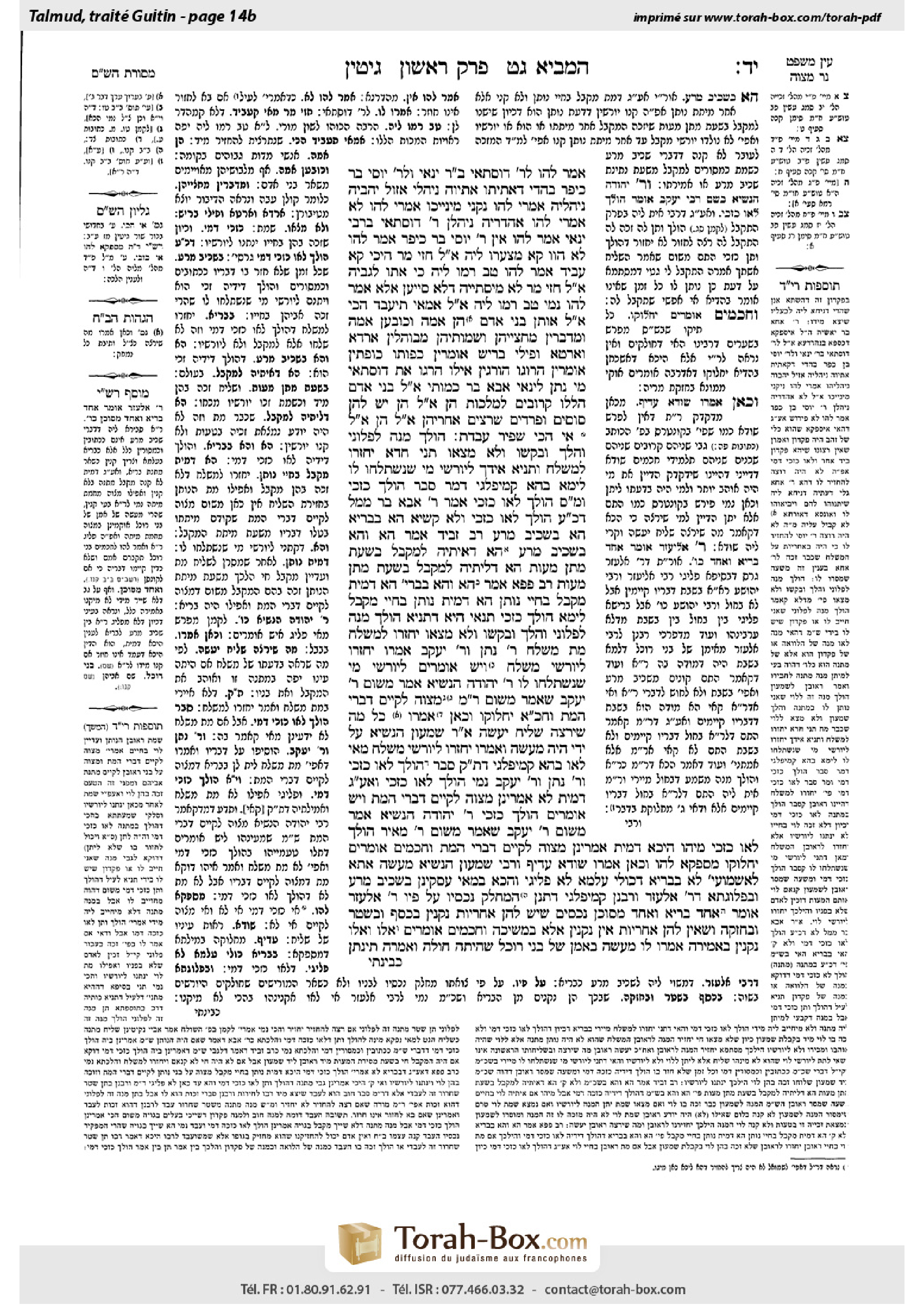
Gittin 14b: Talmud study for Daf Yomi
Study the Talmud for Daf Yomi with scanned pages, Hebrew text, English translations from Sefaria and AI-generated French translations.
Passage selection and English or AI-generated French translation are available where the scan has annotations. Daf Study is independent of Torah-Box and Sefaria.
Browse Gittin · גיטין · All tractatesGittin 14b text and translations
This page of Gittin includes the Aramaic text, an English translation and an AI-generated French translation, alongside the scan above.
גיטין י״ד ב · Aramaic and Hebrew text
אֲמַר לְהוּ לְרַבִּי דּוֹסְתַּאי בַּר רַבִּי יַנַּאי וּלְרַבִּי יוֹסֵי בַּר כֵּיפַר: בַּהֲדֵי דְּאָתֵיתוּ, אַתְיוּהּ נִיהֲלִי. אֲזוּל, יַהֲבֵיהּ נִיהֲלֵיהּ. אָמְרִי לְהוּ: נִקְנֵי מִינַּיְיכוּ; אָמְרִי לְהוּ: לָא. אָמְרִי לְהוּ: אַהְדְּרֵיהּ נִיהֲלַן.
רַבִּי דּוֹסְתַּאי בְּרַבִּי יַנַּאי אֲמַר לְהוּ: אִין; רַבִּי יוֹסֵי בַּר כֵּיפַר אֲמַר לְהוּ: לָא. הֲווֹ קָא מְצַעֲרוּ לֵיהּ, אֲמַר לֵיהּ: חֲזִי מָר הֵיכִי קָא עָבֵיד! אֲמַר לְהוּ: טָב רְמוֹ לֵיהּ.
כִּי אֲתוֹ לְגַבֵּיהּ, אֲמַר לֵיהּ: חֲזִי מָר, לָא מִיסָּתְיֵיהּ דְּלָא סַיְּיעַן, אֶלָּא אֲמַר לְהוּ נָמֵי ״טָב רְמוֹ לֵיהּ״! אֲמַר לֵיהּ: אַמַּאי תֶּיעְבֵּד הָכִי?
אֲמַר לֵיהּ: אוֹתָן בְּנֵי אָדָם – הֵן אַמָּה, וְכוֹבָעָן אַמָּהּ, וּמְדַבְּרִין מֵחֶצְיֵיהֶן, וּשְׁמוֹתֵיהֶן מְבוֹהָלִין: ׳אַרְדָּא׳ וְ׳אַרְטָא׳ וּ׳פִילֵי בְּרֵישׁ׳; אוֹמְרִין ״כְּפוֹתוּ״ – כּוֹפְתִין; אוֹמְרִין ״הֲרוֹגוּ״ – הוֹרְגִין; אִילּוּ הָרְגוּ אֶת דּוֹסְתַּאי, מִי נָתַן לְיַנַּאי אַבָּא בַּר כְּמוֹתִי.
אֲמַר לֵיהּ: בְּנֵי אָדָם הַלָּלוּ קְרוֹבִים לַמַּלְכוּת הֵן? אָמַר לֵיהּ: הֵן. יֵשׁ לָהֶן סוּסִים וּפְרָדִים שֶׁרָצִים אַחֲרֵיהֶן? אֲמַר לֵיהּ: הֵן. אֲמַר לֵיהּ: אִי הָכִי, שַׁפִּיר עֲבַדְתְּ.
״הוֹלֵךְ מָנֶה לִפְלוֹנִי״, וְהָלַךְ וּבִקְּשׁוֹ וְלֹא מְצָאוֹ – תָּנֵי חֲדָא: יַחְזְרוּ לַמְשַׁלֵּחַ; וְתַנְיָא אִידַּךְ: לְיוֹרְשֵׁי מִי שֶׁנִּשְׁתַּלְחוּ לוֹ.
לֵימָא בְּהָא קָמִיפַּלְגִי – דְּמָר סָבַר: ״הוֹלֵךְ״ כִּ״זְכִי״, וּמָר סָבַר: ״הוֹלֵךְ״ לָאו כִּ״זְכִי״?
אָמַר רַבִּי אַבָּא בַּר מֶמֶל: דְּכוּלֵּי עָלְמָא ״הוֹלֵךְ״ לָאו כִּ״זְכִי״; וְלָא קַשְׁיָא – הָא בְּבָרִיא, הָא בִּשְׁכִיב מְרַע.
רַב זְבִיד אָמַר: הָא וְהָא בִּשְׁכִיב מְרַע; הָא – דְּאִיתֵיהּ לִמְקַבֵּל בִּשְׁעַת מַתַּן מָעוֹת, הָא – דְּלֵיתֵיהּ לִמְקַבֵּל בִּשְׁעַת מַתַּן מָעוֹת.
רַב פָּפָּא אָמַר: הָא וְהָא בְּבָרִיא; הָא – דְּמִית מְקַבֵּל בְּחַיֵּי נוֹתֵן, הָא – דְּמִית נוֹתֵן בְּחַיֵּי מְקַבֵּל.
לֵימָא ״הוֹלֵךְ״ כִּ״זְכִי״ תַּנָּאֵי הִיא? דְּתַנְיָא: ״הוֹלֵךְ מָנֶה לִפְלוֹנִי״, וְהָלַךְ וּבִקְּשׁוֹ וְלֹא מְצָאוֹ, יַחְזְרוּ לַמְשַׁלֵּחַ. מֵת מְשַׁלֵּחַ – רַבִּי נָתָן וְרַבִּי יַעֲקֹב אָמְרוּ: יַחְזְרוּ לְיוֹרְשֵׁי מְשַׁלֵּחַ, וְיֵשׁ אוֹמְרִים: לְיוֹרְשֵׁי מִי שֶׁנִּשְׁתַּלְחוּ לוֹ.
רַבִּי יְהוּדָה הַנָּשִׂיא אָמַר מִשּׁוּם רַבִּי יַעֲקֹב, שֶׁאָמַר מִשּׁוּם רַבִּי מֵאִיר: מִצְוָה לְקַיֵּים דִּבְרֵי הַמֵּת. וַחֲכָמִים אוֹמְרִים: יַחְלוֹקוּ. וְכָאן אָמְרוּ: כֹּל מַה שֶּׁיִּרְצֶה שָׁלִיחַ – יַעֲשֶׂה. אָמַר רַבִּי שִׁמְעוֹן הַנָּשִׂיא: עַל יָדִי הָיָה מַעֲשֶׂה, וְאָמְרוּ: יַחְזְרוּ לְיוֹרְשֵׁי מְשַׁלֵּחַ.
מַאי, לָאו בְּהָא קָמִיפַּלְגִי – דְּתַנָּא קַמָּא סָבַר: ״הוֹלֵךְ״ לָאו כִּ״זְכִי״; וְרַבִּי נָתָן וְרַבִּי יַעֲקֹב נָמֵי – ״הוֹלֵךְ״ לָאו כִּ״זְכִי״, וְאַף עַל גַּב דְּמִית, לָא אָמְרִינַן ״מִצְוָה לְקַיֵּים דִּבְרֵי הַמֵּת״; וְיֵשׁ אוֹמְרִים – ״הוֹלֵךְ״ כִּ״זְכִי״;
רַבִּי יְהוּדָה הַנָּשִׂיא אָמַר מִשּׁוּם רַבִּי יַעֲקֹב שֶׁאָמַר מִשּׁוּם רַבִּי מֵאִיר – ״הוֹלֵךְ״ לָאו כִּ״זְכִי״, מִיהוּ, הֵיכָא דְּמִית, אָמְרִינַן מִצְוָה לְקַיֵּים דִּבְרֵי הַמֵּת;
וַחֲכָמִים אוֹמְרִים: יַחְלוֹקוּ – מְסַפְּקָא לְהוּ; וְכָאן אָמְרוּ – שׁוּדָא עָדִיף; וְרַבִּי שִׁמְעוֹן הַנָּשִׂיא – מַעֲשֶׂה אֲתָא לְאַשְׁמוֹעִינַן.
לָא, בְּבָרִיא דְּכוּלֵּי עָלְמָא לָא פְּלִיגִי; וְהָכָא בְּמַאי עָסְקִינַן – בִּשְׁכִיב מְרַע, וּבִפְלוּגְתָּא דְּרַבִּי אֶלְעָזָר וְרַבָּנַן קָמִיפַּלְגִי.
דִּתְנַן: הַמְחַלֵּק נְכָסָיו עַל פִּיו, רַבִּי אֶלְעָזָר אוֹמֵר: אֶחָד בָּרִיא וְאֶחָד מְסוּכָּן; נְכָסִים שֶׁיֵּשׁ לָהֶן אַחְרָיוּת – נִקְנִין בְּכֶסֶף וּבִשְׁטָר וּבַחֲזָקָה, וְשֶׁאֵין לָהֶן אַחְרָיוּת – אֵין נִקְנִין אֶלָּא בִּמְשִׁיכָה. וַחֲכָמִים אוֹמְרִים: אֵלּוּ וָאֵלּוּ נִקְנִין בַּאֲמִירָה.
אָמְרוּ לוֹ: מַעֲשֶׂה בְּאִמָּן שֶׁל בְּנֵי רוֹכֵל שֶׁהָיְתָה חוֹלָה, וְאָמְרָה: ״תִּינָּתֵן
Gittin 14b · English translation
Rabbi Aḥai said to Rabbi Dostai bar Rabbi Yannai and to Rabbi Yosei bar Keifar: When you come from Neharde’a bring the vessel to me. They went to Neharde’a and the people who were in possession of the vessel gave it to them. After handing over the vessel, those people said to them: Let us perform an act of acquisition with you, so that you will be responsible for the vessel until you reach Rabbi Aḥai. The agents said to them: No; we do not want to do this. They said to them: If so, return the vessel to us, as we do not wish to transfer it in such a manner that we retain responsibility.
Rabbi Dostai, son of Rabbi Yannai, said to them: Yes, I am willing to return it. However, Rabbi Yosei bar Keifar said to them: No, as you do not have the right to retract in this situation. They tormented Rabbi Yosei bar Keifar to force him to agree to return the vessel. Rabbi Yosei bar Keifar said to Rabbi Dostai: See, my Master, what they are doing to me. Rabbi Dostai said to them: You are acting well; hit him.
When these two agents came before Rabbi Aḥai, Rabbi Yosei bar Keifar said to him: See, my Master, not only did Rabbi Dostai not support me; rather, he even said to them: You are acting well; hit him. Rabbi Aḥai said to Rabbi Dostai: Why did you do this?
Rabbi Dostai said to him: Those people who were in possession of the vessel, they are the size of a cubit, and their hats were a cubit, and they spoke from their midpoints, and their names were frightening: Arda and Arta and Pili Bereish. If one were to say to them: Restrain this person, they would restrain him. If one were to say to them: Kill him, they would kill. Had they killed Dostai, i.e., me, who would give Yannai, my father, another son like me?
Rabbi Aḥai said to him: Are these people close to the government? Rabbi Dostai said to him: Yes. Rabbi Aḥai asked him: Do they have horses and mules that run after them, i.e., do they have servants to perform their bidding? Rabbi Dostai said to them: Yes. Rabbi Aḥai said to him: If so, you acted well, as the situation was entirely out of your control.
§ The Gemara discusses the meaning of the expression: Deliver, in relation to a gift. With regard to one who said to his agent: Deliver one hundred dinars to so-and-so, and the agent went and searched for that person but did not find him, as he had died, it is taught in one baraita: The money should be returned to the sender. And it is taught in another baraita: The money should be given to the heirs of the one to whom it was sent.
The Gemara suggests: Let us say that they disagree about this, as one Sage, in the second baraita, holds that in the case of a gift, saying: Deliver, is like saying: Acquire, and consequently the agent took possession of the money on behalf of the one to whom it was sent. Therefore, the heirs inherit this item. And one Sage, in the first baraita, holds that in the case of a gift, saying: Deliver, is not like saying: Acquire, and therefore the agent must return the money to the sender.
Rabbi Abba bar Memel said: No; everyone agrees that in the case of a gift, saying: Deliver, is not like saying: Acquire, and the apparent contradiction between the two baraitot is not difficult: This baraita, which says that the agent must return the money to the sender, is dealing with a case where the giver was a healthy person when he issued the instructions. Such a gift is acquired by the recipient only once it reaches his possession, and this recipient died before the gift reached him. Conversely, that baraita, which says that he should give it to the heirs of the one to whom it was sent, deals with the instructions of a person on his deathbed. Since the gift of a dying person is immediately acquired by the recipient, this recipient acquired it straightaway, and therefore it must be given to his heirs.
Rav Zevid said: It is possible to say that saying: Deliver, is not like saying: Acquire, and that both this baraita and that baraita are dealing with a case where the giver was a person on his deathbed. Instead, the difference between the two sources is that this baraita, which states that he should give it to the recipient’s heirs, is referring to a case where the recipient was alive at the time of the giving of the money. Consequently, when the sender gives the money to the agent the recipient immediately acquires it, and his heirs claim it in his stead. That baraita, which says that the agent must return the money to the sender, is referring to a case where the recipient was not alive at the time of the giving of the money, and consequently the agent could not acquire the money on his behalf.
Rav Pappa said yet another explanation of the baraita: This baraita and that baraita are both dealing with a healthy person who subsequently died. The difference is that this baraita, which said that the agent must return the money to the sender, is dealing with a case where the recipient died in the lifetime of the giver, and as he did not acquire the money himself his heirs do not take possession of it either. By contrast, that baraita, which states that the money should be given to the heirs of the recipient, is dealing with a case where the giver died in the lifetime of the recipient. Once he dies it is a mitzva to fulfill his wishes, and therefore the recipient, and his heirs after him, are entitled to the money.
The Gemara further suggests: Shall we say that the issue of whether saying: Deliver, is like saying: Acquire, is a dispute between tanna’im? This is as it is taught in a baraita, that if one person said to another: Deliver one hundred dinars to so-and-so, and he went and searched for him but did not find him, as he had died, the money should be returned to the sender. If the sender died, Rabbi Natan and Rabbi Ya’akov said: The money should be returned to the heirs of the sender. And some say: It should be given to the heirs of the one to whom it was sent.
The baraita continues: Rabbi Yehuda HaNasi said in the name of Rabbi Ya’akov, who said this in the name of Rabbi Meir: It is a mitzva to fulfill the statement of the dead. Therefore the money should be given to the heirs of the one to whom it was sent. And the Rabbis say: Due to the uncertainty, they should divide it. And here, in Babylonia, they said: Whatever the agent wishes to do he may do. Rabbi Shimon HaNasi said: When an incident of this kind occurred under my jurisdiction I inquired into how to proceed, and the Sages said to me: The money should be returned to the heirs of the sender.
The Gemara suggests: What, is it not correct to say that they disagree about this issue, that the first tanna holds that saying: Deliver, is not like saying: Acquire, and therefore the money should be returned to the sender? And Rabbi Natan and Rabbi Ya’akov also hold that saying: Deliver, is not like saying: Acquire, but they add that even though the sender died, one does not say: It is a mitzva to fulfill the statement of the dead. Consequently, the money is returned to the sender’s heirs. And the Sages in the clause beginning: Some say, claim that saying: Deliver, is like saying: Acquire. Therefore the recipient takes possession of the money immediately, and it is given to his heirs.
And Rabbi Yehuda HaNasi, who said in the name of Rabbi Ya’akov, who said this in the name of Rabbi Meir, also holds that saying: Deliver, is not like saying: Acquire. However, in a case where the sender died we say that it is a mitzva to fulfill the statement of the dead. Therefore, the one hundred dinars should be given to the recipient or his heirs.
And the Rabbis say: They should divide it, because they are uncertain about the halakha in this situation. And the Sages in the clause beginning: Here they said, maintain that in this case the discretion [shuda] of the agent is preferable to an even division between the parties. And Rabbi Shimon HaNasi does not offer an opinion of his own; rather, he came to teach us an incident in which this case was decided in practice.
The Gemara rejects this suggestion: No; it is possible that in a case where the giver was a healthy person when he appointed the agent everyone agrees that saying: Deliver, is not like saying: Acquire, and with what are we dealing here? We are dealing with a person on his deathbed who sent these one hundred dinars, and they disagree in the dispute between Rabbi Elazar and the Rabbis.
This is as we learned in a mishna (Bava Batra 156a): With regard to one who divides his property orally, Rabbi Elazar says: Both in the case of a healthy person and that of a dangerously ill person, property that serves as a guarantee, i.e., land, is acquired by means of money, through a document, or by taking possession. And property that does not serve as a guarantee, i.e., movable property, can be acquired only through pulling. And the Rabbis say: If the giver is on his deathbed, then both this property and that property can be acquired through speech, and there is no need for an additional act of acquisition.
They said to Rabbi Elazar: Didn’t an incident of this kind occur with regard to the mother of the family of the sons of Rokhel, who was ill, and she said: Give
Gittin 14b · Traduction française (IA)
Rabbi Aḥai dit à Rabbi Dostai fils de Rabbi Yannai et à Rabbi Yosei fils de Keifar : Quand vous serez revenus de Neharde’a, apportez-moi le vase. Ils allèrent à Neharde’a et les gens qui possédaient le vase le leur donnèrent. Après avoir remis le vase, ces gens dirent à eux : Faisons une acquisition avec vous, afin que vous soyez responsables du vase jusqu’à ce que vous arriviez à Rabbi Aḥai. Les agents dirent à eux : Non ; nous ne voulons pas faire cela. Ils dirent à eux : Si c’est ainsi, remettez-nous le vase, car nous ne voulons pas transférer le vase de cette manière afin de rester responsables.
Rabbi Dostai, fils de Rabbi Yannai, dit à eux : Oui, je suis prêt à le remettre. Cependant, Rabbi Yosei fils de Keifar dit à eux : Non, car vous n’avez pas le droit de rétracter dans cette situation. Ils perséverèrent à torturer Rabbi Yosei fils de Keifar pour le forcer à accepter de remettre le vase. Rabbi Yosei fils de Keifar dit à Rabbi Dostai : Voyez, mon Maître, ce qu’ils font à moi. Rabbi Dostai dit à eux : Vous agissez bien ; frappez-le.
Quand ces deux agents vinrent devant Rabbi Aḥai, Rabbi Yosei fils de Keifar dit à lui : Voyez, mon Maître, non seulement Rabbi Dostai n’a pas soutenu moi, mais il a même dit à eux : Vous agissez bien ; frappez-le. Rabbi Aḥai dit à Rabbi Dostai : Pourquoi avez-vous fait cela ?
Rabbi Dostai dit à lui : Ces gens qui possédaient le vase, ils mesuraient un cubit, leurs chapeaux mesuraient un cubit, ils parlaient depuis leur milieu, et leurs noms étaient effrayants : Arda et Arta et Pili Bereish. Si l’on disait à eux : Restreignez cette personne, ils la restreignaient. Si l’on disait à eux : Tue-le, ils le tuaient. S’ils avaient tué Dostai, c’est-à-dire moi, qui donnerait à Yannai, mon père, un autre fils comme moi ?
Rabbi Aḥai dit à lui : Ces gens sont-ils proches du gouvernement ? Rabbi Dostai dit à lui : Oui. Rabbi Aḥai demanda : Ont-ils des chevaux et des mules qui les suivent, c’est-à-dire des serviteurs pour exécuter leurs ordres ? Rabbi Dostai dit à eux : Oui. Rabbi Aḥai dit à lui : Si c’est ainsi, vous avez agi bien, car la situation était entièrement hors de votre contrôle.
§ La Guemara discute du sens de l’expression : Délivre, en relation avec un don. En ce qui concerne celui qui dit à son agent : Délivre cent dinars à tel et tel, et l’agent va chercher cette personne mais ne la trouve pas, car elle est morte, il est enseigné dans une baraïta : L’argent doit être rendu au donneur. Et il est enseigné dans une autre baraïta : L’argent doit être donné aux héritiers de celui à qui il était destiné.
La Guemara suggère : Disons qu’ils sont en désaccord sur cela, car un tanna, dans la deuxième baraïta, affirme que dans le cas d’un don, dire : Délivre, est comme dire : Acquière, et par conséquent l’agent a acquis l’argent au nom de celui à qui il était destiné. Ainsi, les héritiers héritent de cet objet. Et un tanna, dans la première baraïta, affirme que dans le cas d’un don, dire : Délivre, n’est pas comme dire : Acquière, et par conséquent l’agent doit rendre l’argent au donneur.
Rabbi Abba fils de Memel dit : Non ; tout le monde convient que dans le cas d’un don, dire : Délivre, n’est pas comme dire : Acquière, et la contradiction apparente entre ces deux baraïtotes n’est pas difficile : cette baraïta, qui dit que l’argent doit être rendu au donneur, traite d’un cas où le donneur était un homme en bonne santé lorsqu’il a donné les instructions. Un tel don est acquis par le destinataire seulement une fois qu’il est en possession de l’objet, et ce destinataire est mort avant que le don ne lui arrive. À l’inverse, cette baraïta, qui dit qu’il doit être donné aux héritiers du destinataire, traite des instructions d’un homme sur son lit de mort. Puisque le don d’un mourant est immédiatement acquis par le destinataire, ce destinataire a acquis l’objet dès la première minute, et par conséquent il doit être donné à ses héritiers.
Rav Zevid dit : Il est possible de dire que dire : Délivre, n’est pas comme dire : Acquière, et que ces deux baraïtotes traitent d’un cas où le donneur était un homme sur son lit de mort. Au contraire, la différence entre ces deux sources est que cette baraïta, qui dit qu’il doit être donné aux héritiers du destinataire, traite d’un cas où le destinataire était vivant au moment de la transmission de l’argent. Par conséquent, quand le donneur donne l’argent à l’agent, le destinataire l’acquiert immédiatement, et ses héritients réclament l’argent à sa place. Cette autre baraïta, qui dit que l’agent doit rendre l’argent au donneur, traite d’un cas où le destinataire n’était pas vivant au moment de la transmission de l’argent, et par conséquent l’agent n’a pas pu acquérir l’argent au nom du destinataire.
Rav Pappa dit une autre explication de la baraïta : Cette baraïta et celle-ci traitent tous deux d’un homme en bonne santé qui est ensuite mort. La différence est que cette baraïta, qui dit que l’argent doit être rendu au donneur, traite d’un cas où le destinataire est mort pendant la vie du donneur, et comme il n’a pas acquis l’argent lui-même, ses héritiers ne peuvent pas non plus en prendre possession. À l’inverse, cette autre baraïta, qui dit que l’argent doit être donné aux héritiers du destinataire, traite d’un cas où le donneur est mort pendant la vie du destinataire. Une fois qu’il meurt, il est un mitsva de remplir ses souhaits, et par conséquent le destinataire, et ses héritiers après lui, sont autorisés à l’argent.
La Guemara suggère encore : Devons-nous dire que la question de savoir si dire : Délivre, est comme dire : Acquière, est un débat entre les tannaïm ? C’est comme il est enseigné dans une baraïta, que si une personne dit à une autre : Délivre cent dinars à tel et tel, et il va chercher cette personne mais ne la trouve pas, car elle est morte, l’argent doit être rendu au donneur. Si le donneur est mort, Rabbi Natan et Rabbi Ya’akov dirent : L’argent doit être rendu aux héritiers du donneur. Et certains disent : Il doit être donné aux héritiers de celui à qui il était destiné.
La baraïta continue : Rabbi Yéhuda HaNasi a dit au nom de Rabbi Ya’akov, qui a dit cela au nom de Rabbi Méir : Il est une mitsva de remplir la parole du défunt. Par conséquent, l’argent doit être donné aux héritiers de celui à qui il était adressé. Et les Sages disent : En raison de l’incertitude, il doit être divisé. Et ici, en Babylonie, ils disaient : Tout ce que l’agent souhaite faire, il peut le faire. Rabbi Shim’on HaNasi a dit : Lors qu’un cas de ce genre s’est produit sous ma juridiction, j’ai interrogé sur la manière de procéder, et les Sages m’ont dit : L’argent doit être rendu aux héritiers du destinataire.
Le Guemara suggère : Qu’est-ce que cela signifie, n’est-ce pas correct de dire qu’ils divergent sur ce point, que le premier tanna considère que dire : Donne, n’est pas comme dire : Achète, et par conséquent l’argent doit être rendu au destinataire ? Et Rabbi Natan et Rabbi Ya’akov aussi considèrent que dire : Donne, n’est pas comme dire : Achète, mais ils ajoutent que même si le destinataire est mort, on ne dit pas : Il est une mitsva de remplir la parole du défunt. Par conséquent, l’argent est rendu aux héritiers du destinataire. Et les Sages dans la clause commençant par : Certains disent, affirment que dire : Donne, est comme dire : Achète. Par conséquent, le destinataire prend possession de l’argent immédiatement, et il est donné à ses héritiers.
Et Rabbi Yéhuda HaNasi, qui a dit au nom de Rabbi Ya’akov, qui a dit cela au nom de Rabbi Méir, considère aussi que dire : Donne, n’est pas comme dire : Achète. Cependant, dans le cas où le destinataire est mort, on dit que c’est une mitsva de remplir la parole du défunt. Par conséquent, les cent dinars doivent être donnés au destinataire ou à ses héritiers.
Et les Sages disent : Ils doivent le diviser, car ils sont incertains sur la halakha dans ce cas. Et les Sages dans la clause commençant par : Ici ils dirent, maintiennent que dans ce cas, la discrétion [shuda] de l’agent est préférable à une division égale entre les parties. Et Rabbi Shim’on HaNasi ne formule pas d’opinion personnelle ; plutôt, il est venu nous enseigner un cas où cette question a été décidée en pratique.
Le Guemara rejette cette suggestion : Non ; il est possible que dans le cas où le donneur était un homme en bonne santé lorsqu’il a désigné l’agent, tout le monde convient que dire : Donne, n’est pas comme dire : Achète, et avec quoi sommes-nous en train de nous occuper ici ? Nous sommes en train de nous occuper d’un homme sur son lit de mort qui a envoyé ces cent dinars, et ils divergent dans le débat entre Rabbi Eléazar et les Sages.
C’est comme nous avons appris dans une mitsna (Bava Batra 156a) : En ce qui concerne celui qui divise ses biens oralement, Rabbi Eléazar dit : Que ce soit dans le cas d’un homme en bonne santé ou d’un homme gravement malade, la propriété qui sert de garantie, c’est-à-dire la terre, est acquise par l’argent, par un document ou par la possession. Et la propriété qui ne sert pas de garantie, c’est-à-dire la propriété mobile, peut être acquise uniquement par la prise. Et les Sages disent : Si le donneur est sur son lit de mort, alors cette propriété et celle-ci peuvent être acquises par la parole, et il n’est pas nécessaire d’agir en plus.
On a dit à Rabbi Eléazar : N’est-ce pas qu’un cas de ce genre s’est produit concernant la mère de la famille des fils de Rokhel, qui était malade, et elle a dit : Donne
Traduction française générée par IA à partir de l’édition anglaise de Sefaria. Vérifie toujours un passage avec le texte source.
Text from Sefaria: William Davidson Edition - Vocalized Aramaic (CC BY NC); William Davidson Edition - English (CC BY NC).