Gittin 15a: Talmud study for Daf Yomi
Study the Talmud for Daf Yomi with scanned pages, Hebrew text, English translations from Sefaria and AI-generated French translations.
Passage selection and English or AI-generated French translation are available where the scan has annotations. Daf Study is independent of Torah-Box and Sefaria.
Browse Gittin · גיטין · All tractatesGittin 15a text and translations
This page of Gittin includes the Aramaic text, an English translation and an AI-generated French translation, alongside the scan above.
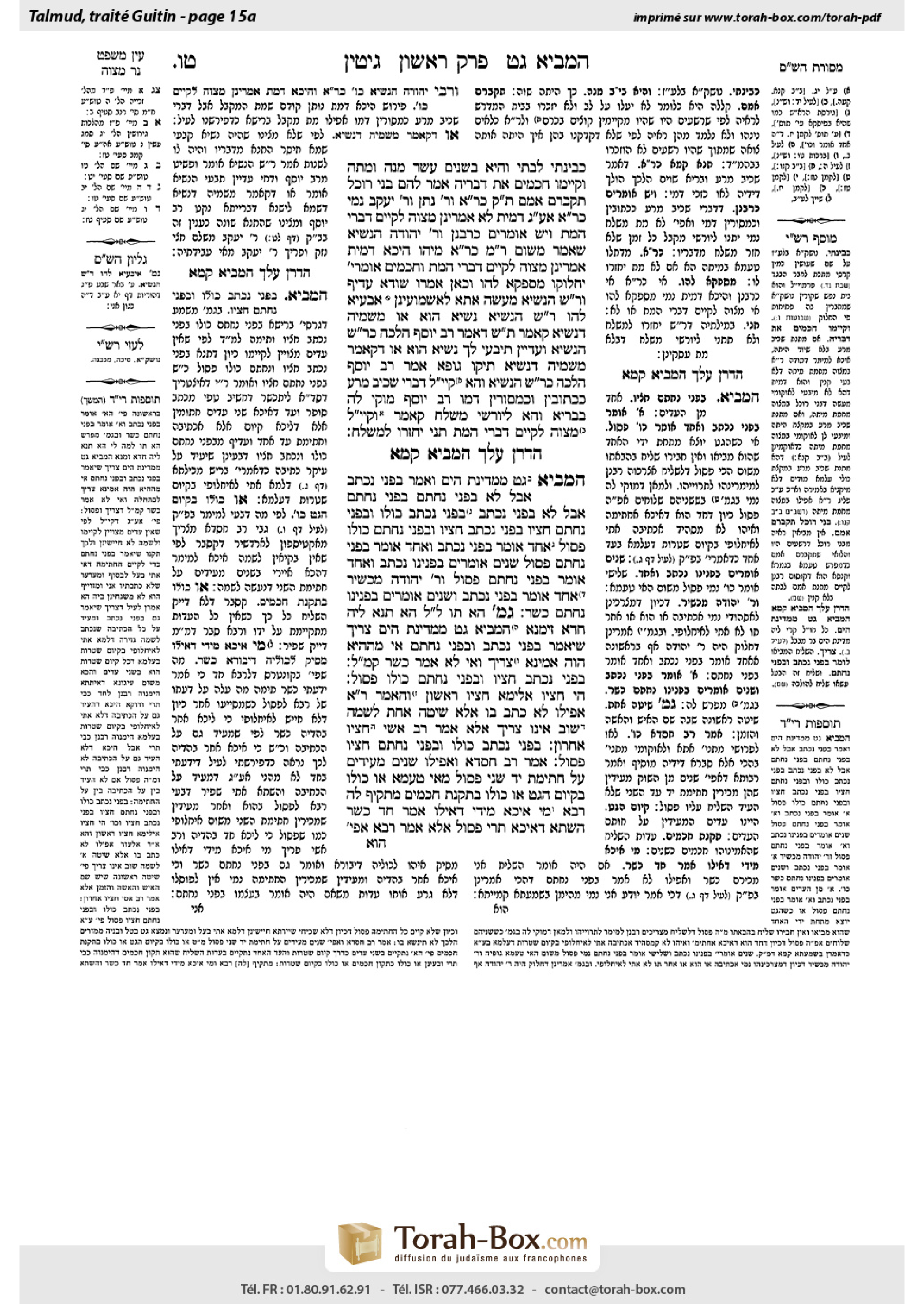
גיטין י״ה א · Aramaic and Hebrew text
כְּבִינְתִּי לְבִתִּי, וְהִיא בִּשְׁנֵים עָשָׂר מָנֶה״, וּמֵתָה, וְקִיְּימוּ חֲכָמִים אֶת דְּבָרֶיהָ! אָמַר לָהֶם: בְּנֵי רוֹכֵל תִּקְבְּרֵם אִמָּם.
תַּנָּא קַמָּא כְּרַבִּי אֶלְעָזָר; וְרַבִּי נָתָן וְרַבִּי יַעֲקֹב נָמֵי כְּרַבִּי אֶלְעָזָר – אַף עַל גַּב דְּמִית, לָא אָמְרִינַן מִצְוָה לְקַיֵּים דִּבְרֵי הַמֵּת; וְ״יֵשׁ אוֹמְרִים״ – כְּרַבָּנַן;
וְרַבִּי יְהוּדָה הַנָּשִׂיא שֶׁאָמַר מִשּׁוּם רַבִּי מֵאִיר – כְּרַבִּי אֶלְעָזָר, מִיהוּ הֵיכָא דְּמִית אָמְרִינַן מִצְוָה לְקַיֵּים דִּבְרֵי הַמֵּת; וַחֲכָמִים אוֹמְרִים: יַחְלוֹקוּ – מְסַפְּקָא לְהוּ; וְכָאן אָמְרוּ – שׁוּדָא עֲדִיף; וְרַבִּי שִׁמְעוֹן הַנָּשִׂיא – מַעֲשֶׂה אֲתָא לְאַשְׁמוֹעִינַן.
אִבַּעְיָא לְהוּ: רַבִּי שִׁמְעוֹן הַנָּשִׂיא; נָשִׂיא הוּא, אוֹ מִשְּׁמֵיהּ דְּנָשִׂיא קָאָמַר? תָּא שְׁמַע, דְּאָמַר רַב יוֹסֵף: הֲלָכָה כְּרַבִּי שִׁמְעוֹן הַנָּשִׂיא. וַעֲדַיִין תִּיבְּעֵי לָךְ: נָשִׂיא הוּא, אוֹ דְּקָאָמַר מִשְּׁמֵיהּ דְּנָשִׂיא? תֵּיקוּ.
גּוּפָא – אָמַר רַב יוֹסֵף: הֲלָכָה כְּרַבִּי שִׁמְעוֹן הַנָּשִׂיא. וְהָא קַיְימָא לַן דִּבְרֵי שְׁכִיב מְרַע כִּכְתוּבִין וְכִמְסוּרִין דָּמוּ!
רַב יוֹסֵף מוֹקֵי לַהּ בְּבָרִיא. וְהָא לְיוֹרְשֵׁי מְשַׁלֵּחַ קָאָמַר, וְקַיְימָא לַן: מִצְוָה לְקַיֵּים דִּבְרֵי הַמֵּת! תְּנִי: יַחְזְרוּ לִמְשַׁלֵּחַ.
הֲדַרַן עֲלָךְ הַמֵּבִיא קַמָּא
הַמֵּבִיא גֵּט מִמְּדִינַת הַיָּם, וְאָמַר: ״בְּפָנַי נִכְתַּב אֲבָל לֹא בְּפָנַי נֶחְתַּם״; ״בְּפָנַי נֶחְתַּם אֲבָל לֹא בְּפָנַי נִכְתַּב״; ״בְּפָנַי נִכְתַּב כּוּלּוֹ וּבְפָנַי נֶחְתַּם חֶצְיוֹ״; ״בְּפָנַי נִכְתַּב חֶצְיוֹ וּבְפָנַי נֶחְתַּם כּוּלּוֹ״ – פָּסוּל.
אֶחָד אוֹמֵר ״בְּפָנַי נִכְתַּב״ וְאֶחָד אוֹמֵר ״בְּפָנַי נֶחְתַּם״, פָּסוּל. שְׁנַיִם אוֹמְרִים ״בְּפָנֵינוּ נִכְתַּב״ וְאֶחָד אוֹמֵר ״בְּפָנַי נֶחְתַּם״, פָּסוּל; וְרַבִּי יְהוּדָה מַכְשִׁיר. אֶחָד אוֹמֵר ״בְּפָנַי נִכְתַּב״ וּשְׁנַיִם אוֹמְרִים ״בְּפָנֵינוּ נֶחְתַּם״, כָּשֵׁר.
גְּמָ׳ הָא תּוּ לְמָה לִי? הָא תְּנָא לֵיהּ חֲדָא זִימְנָא – הַמֵּבִיא גֵּט מִמְּדִינַת הַיָּם, צָרִיךְ שֶׁיֹּאמַר ״בְּפָנַי נִכְתַּב וּבְפָנַי נֶחְתַּם״! אִי מֵהַהִיא הֲוָה אָמֵינָא: צָרִיךְ, וְאִי לָא אָמַר כָּשֵׁר; קָא מַשְׁמַע לַן.
״בְּפָנַי נִכְתַּב חֶצְיוֹ וּבְפָנַי נֶחְתַּם כּוּלּוֹ״, פָּסוּל. הֵי חֶצְיוֹ? אִלֵּימָא חֶצְיוֹ רִאשׁוֹן, וְהָאָמַר רַבִּי אֶלְעָזָר: אֲפִילּוּ לֹא כָּתַב בּוֹ אֶלָּא שִׁיטָה אַחַת לִשְׁמָהּ, שׁוּב אֵינוֹ צָרִיךְ! אֶלָּא אָמַר רַב אָשֵׁי: חֶצְיוֹ אַחֲרוֹן.
״בְּפָנַי נִכְתַּב כּוּלּוֹ וּבְפָנַי נֶחְתַּם חֶצְיוֹ״, פָּסוּל. אָמַר רַב חִסְדָּא: וַאֲפִילּוּ שְׁנַיִם מְעִידִים עַל חֲתִימַת יַד שֵׁנִי – פָּסוּל. מַאי טַעְמָא?
אוֹ כּוּלּוֹ בְּקִיּוּם הַגֵּט, אוֹ כּוּלּוֹ בְּתַקָּנַת חֲכָמִים.
מַתְקֵיף לַהּ רָבָא: מִי אִיכָּא מִידֵּי דְּאִילּוּ אָמַר חַד, כָּשֵׁר; הַשְׁתָּא דְּאִיכָּא תְּרֵי, פָּסוּל?! אֶלָּא אָמַר רָבָא: אֲפִילּוּ
Gittin 15a · English translation
my brooch [kevinati] to my daughter, and the brooch is worth twelve hundred dinars. And this woman subsequently died, and the Sages fulfilled her statement. Rabbi Elazar said to them that the sons of Rokhel should be buried by their mother, i.e., he cursed them. Rabbi Elazar meant that it is not possible to bring a proof from this incident, as these sons were wicked people. Consequently, when dealing with them the Sages did not act in accordance with the halakha, but allowed their mother to give this valuable piece of jewelry to their sister, circumventing the halakhot of inheritance.
The Gemara states: The first tanna holds in accordance with the opinion of Rabbi Elazar, who holds that there must be an actual act of acquisition or the money still belongs to the giver. And Rabbi Natan and Rabbi Ya’akov also hold in accordance with the opinion of Rabbi Elazar. However, they add that even though the giver died one does not say: It is a mitzva to fulfill the statement of the dead. And the Sages in the clause beginning: Some say, hold in accordance with the opinion of the Rabbis, who say that the statement of a person on his deathbed effects acquisition through mere speech.
And Rabbi Yehuda HaNasi, who said his opinion in the name of Rabbi Meir, holds in accordance with the opinion of Rabbi Elazar. However, he maintains that where the giver died we say: It is a mitzva to fulfill the statement of the dead. And the Rabbis say: They should divide it, because they are uncertain about the halakha in this situation. And according to the Sages in the clause beginning: Here they said, the discretion of the agent is preferable. And Rabbi Shimon HaNasi came to teach us a relevant incident but does not express an additional opinion.
A dilemma was raised before those studying this issue: Is the Rabbi Shimon HaNasi mentioned here himself a Nasi, or does the baraita mean that he spoke in the name of the Nasi? The Gemara suggests: Come and hear that which Rav Yosef, who was precise in his statements, says: The halakha is in accordance with the opinion of Rabbi Shimon HaNasi. This indicates that he was an actual Nasi. But you can still raise the dilemma: Is he a Nasi, or does the baraita mean that he spoke in the name of the Nasi, as Rav Yosef may merely be quoting the above baraita? The Gemara has no answer for this question, and states that the dilemma shall stand unresolved.
The Gemara returns to the matter itself: Rav Yosef says: The halakha is in accordance with the opinion of Rabbi Shimon HaNasi, that the money should be returned to the heirs of the sender. The Gemara raises a difficulty: But don’t we maintain that the statement of a person on his deathbed is considered written and delivered? If so, the agent should give the money to the heirs of the recipient.
The Gemara answers: Rav Yosef establishes this halakha with regard to a healthy person, not someone on his deathbed. The Gemara asks: But he said that the money should be returned to the heirs of the sender, and we maintain that it is a mitzva to fulfill the statement of the dead, even if he issued these instructions when he was healthy. The Gemara answers: Emend Rabbi Shimon HaNasi’s statement and teach: Return the money to the sender, not to his heirs, as this is referring to a case where the sender had not died.
MISHNA: With regard to one who brings a bill of divorce from a country overseas and says: The bill of divorce was written in my presence but it was not signed in my presence; or if he said: It was signed in my presence but it was not written in my presence; or: All of it was written in my presence and half of it was signed in my presence, i.e., he observed the signing of only one witness; or: Half of it was written in my presence and all of it was signed in my presence, in all these cases the document is invalid.
If one agent bringing a bill of divorce says: It was written in my presence, and one other agent says: It was signed in my presence, it is invalid. If two agents say: It was written in our presence, and one says: It was signed in my presence, it is invalid. And Rabbi Yehuda deems the document valid. If one agent says: It was written in my presence, and two agents say: It was signed in our presence, it is valid.
GEMARA: The Gemara asks with regard to the entire mishna: Why do I need all these further examples? Didn’t it teach these halakhot once, as the mishna states (2a): One who brings a bill of divorce from a country overseas is required to say: It was written in my presence and it was signed in my presence? This indicates that if one did not state this declaration, then the bill of divorce is invalid. The Gemara explains: If the halakha were derived from that mishna alone, I would say: He is required to issue this statement ab initio, but if he did not say it the bill of divorce is nevertheless valid after the fact. Therefore, this mishna teaches us that the bill of divorce is invalid.
§ The mishna taught that if the agent said: Half of it was written in my presence and all of it was signed in my presence, the document is invalid. The Gemara asks: With regard to which half of the bill of divorce did he claim he saw written? If we say that he saw its first half written, but didn’t Rabbi Elazar say: Even if the husband or scribe wrote only one line of it for her sake, the agent is no longer required to check if the rest of the bill of divorce was written properly? Rather, Rav Ashi said: He testifies that he saw that its latter half was written, and he does not testify with regard to the first half, which is the primary section of the bill of divorce.
§ The mishna taught that if he said: All of it was written in my presence and half of it was signed in my presence, i.e., the agent observed the signing of only one of the witnesses, it is invalid. Rav Ḥisda says: And even if two people testify to the signature of the second witness, and the court ratifies this signature, nevertheless it is invalid. What is the reason for this ruling? After all, the court has the agent’s testimony with regard to one signature and the confirmation of two witnesses for the second signature.
The Gemara answers: The document must be authenticated either entirely through the process of the ratification of a bill of divorce, i.e., the bill of divorce must be ratified like any other legal document, by two people attesting to the validity of the signatures of both witnesses, or it must be entirely ratified via the rabbinic decree that the agent is deemed credible when he states: It was written in my presence and it was signed in my presence.
Rava objects to this: Is there any situation in which if one person said it, the document is valid, i.e., if the agent would have attested to the signature of the second witness the bill of divorce would be valid, and now that there are two witnesses who attest to the signatures it is invalid? Rather, Rava says: Even if
Gittin 15a · Traduction française (IA)
Mon broche [kevinati] à ma fille, et la broche vaut mille deux cents dinars. Et cette femme est décédée ultérieurement, et les Sages ont accompli sa déclaration. Rabbi Elazar a dit à ceux-ci que les fils de Rochel devaient être enterrés par leur mère, c'est-à-dire qu'il les a maudits. Rabbi Elazar voulait dire que l'on ne peut pas établir une preuve à partir de cet incident, car ces fils étaient des gens méchants. Par conséquent, lorsqu'ils traitaient d'eux, les Sages n'ont pas agi conformément à la halakha, mais ont permis à leur mère de donner cette pièce précieuse de bijoux à leur sœur, contournant ainsi les halakhot de l'héritage.
La Guemara dit : Le premier tanna suit l'opinion de Rabbi Elazar, qui considère qu'il faut un acte réel d'acquisition ou que l'argent reste chez le donneur. Et Rabbi Natan et Rabbi Ya'akov suivent également l'opinion de Rabbi Elazar. Cependant, ils ajoutent que même si le donneur est décédé, on ne dit pas : Il est un mitsva de remplir la déclaration du mort. Et les Sages, dans la clause qui commence par : Certains disent, suivent l'opinion des Rabbins, qui affirment que la déclaration d'une personne sur son lit de mort produit l'acquisition par simple parole.
Et Rabbi Yehuda HaNasi, qui exprimait son opinion en nom de Rabbi Meir, suit l'opinion de Rabbi Elazar. Cependant, il maintient que lorsque le donneur est décédé, on dit : Il est un mitsva de remplir la déclaration du mort. Et les Rabbins disent : Ils doivent le diviser, car ils sont incertains quant à la halakha dans cette situation. Et selon les Sages, dans la clause qui commence par : Ici, la discrétion de l'agent est préférable. Et Rabbi Shimon HaNasi est venu nous enseigner un incident pertinent mais n'exprime pas un avis supplémentaire.
Un dilemme a été soulevé devant ceux qui étudient cette question : Le Rabbi Shimon HaNasi mentionné ici est-il lui-même un Nasi, ou la baraïta signifie-t-elle qu'il a parlé en nom du Nasi ? La Guemara suggère : Venez entendre ce que dit Rav Yosef, qui était précis dans ses déclarations : La halakha suit l'opinion du Rabbi Shimon HaNasi. Cela indique qu'il était un Nasi réel. Mais vous pouvez toujours soulever le dilemme : Est-ce qu'il est un Nasi, ou la baraïta signifie-t-elle qu'il a parlé en nom du Nasi, comme Rav Yosef pourrait simplement citer la baraïta ci-dessus ? La Guemara n'a pas de réponse à cette question et affirme que le dilemme restera sans réponse.
La Guemara retourne à la question elle-même : Rav Yosef dit : La halakha suit l'opinion du Rabbi Shimon HaNasi, que l'argent doit être rendu aux héritiers du donneur. La Guemara soulève une difficulté : Mais ne maintenons-nous pas que la déclaration d'une personne sur son lit de mort est considérée comme écrite et transmise ? Si c'est le cas, l'agent devrait donner l'argent aux héritiers du destinataire.
La Guemara répond : Rav Yosef établit cette halakha concernant une personne en bonne santé, pas quelqu'un sur son lit de mort. La Guemara demande : Mais il a dit que l'argent doit être rendu aux héritiers du donneur, et nous maintenons que c'est un mitsva de remplir la déclaration du mort, même s'il a donné ces instructions lorsqu'il était en bonne santé. La Guemara répond : Corrigez la déclaration du Rabbi Shimon HaNasi et enseignez : Rendez l'argent au donneur, pas à ses héritiers, car cela se réfère à un cas où le donneur n'avait pas décédé.
MICHNA : Concernant celui qui apporte un acte de divorce d'un pays étranger et dit : L'acte de divorce a été rédigé en ma présence mais il n'a pas été signé en ma présence ; ou s'il dit : Il a été signé en ma présence mais pas rédigé en ma présence ; ou : Tout a été rédigé en ma présence et la moitié a été signé en ma présence, c'est-à-dire qu'il a observé la signature d'un seul témoin ; ou : La moitié a été rédigée en ma présence et tout a été signé en ma présence, dans tous ces cas l'acte de divorce est invalide.
Si un agent apportant un acte de divorce dit : Il a été rédigé en ma présence, et un autre agent dit : Il a été signé en ma présence, l'acte de divorce est invalide. Si deux agents disent : Il a été rédigé en notre présence, et un dit : Il a été signé en ma présence, l'acte de divorce est invalide. Et Rabbi Yehuda considère l'acte de divorce comme valide. Si un agent dit : Il a été rédigé en ma présence, et deux agents disent : Il a été signé en notre présence, l'acte de divorce est valide.
GUEMARA : La Guemara pose la question concernant l'ensemble de la mishna : Pourquoi ai-je besoin de tous ces exemples supplémentaires ? N'avait-elle pas déjà enseigné ces halakhot une fois, comme la mishna mentionne (2a) : Celui qui apporte un acte de divorce d'un pays étranger est tenu de dire : Il a été rédigé en ma présence et il a été signé en ma présence ? Cela indique que si l'on n'a pas formulé cette déclaration, l'acte de divorce est invalide. La Guemara explique : Si la halakha était dérivée uniquement de cette mishna, je dirais : Il est tenu de faire cette déclaration dès le début, mais si il n'a pas dit cela, l'acte de divorce reste valide après coup. Par conséquent, cette mishna nous enseigne que l'acte de divorce est invalide.
§ La Michna enseigne que si l'agent dit : La moitié a été écrite en ma présence et tout a été signé en ma présence, le document est invalide. La Guemara pose la question : Concernant quelle moitié du divorce a-t-il affirmé avoir vu l'écriture ? Si nous disons qu'il a vu la première moitié écrite, mais n'a-t-on pas dit que Rabbi Elazar affirmait : Même si le mari ou le scribe a écrit une seule ligne pour sa raison, l'agent n'est plus tenu de vérifier si le reste du divorce a été correctement écrit ? Plutôt, Rav Ashi a dit : Il témoigne qu'il a vu que la seconde moitié a été écrite, et il ne témoigne pas concernant la première moitié, qui est la section principale du divorce.
§ La Michna enseigne que si l'on dit : Tout a été écrit en ma présence et la moitié a été signé en ma présence, c'est-à-dire que l'agent a observé la signature d'un seul témoin, le document est invalide. Rav Ḥisda dit : Et même si deux personnes témoignent de la signature du second témoin et que le tribunal valide cette signature, il reste invalide. Quelle est la raison de cette décision ? Après tout, le tribunal a le témoignage de l'agent concernant une signature et la confirmation de deux témoins pour la deuxième signature.
La Guemara répond : Le document doit être authentifié soit entièrement par le processus de ratification d'un acte de divorce, c'est-à-dire que l'acte de divorce doit être ratifié comme tout autre document juridique, par deux personnes attestant de la validité des signatures des deux témoins, soit entièrement par le décret rabbinique selon lequel l'agent est considéré comme crédible lorsqu'il déclare : « Il a été écrit en ma présence et il a été signé en ma présence. »
Rava s'oppose à cela : Y a-t-il une situation où si une seule personne l'a dit, le document est valide, c'est-à-dire si l'agent aurait attesté de la signature du deuxième témoin, l'acte de divorce serait valide, et maintenant que deux témoins attestent des signatures, il est invalide ? Plutôt, Rava dit : Même si
Traduction française générée par IA à partir de l’édition anglaise de Sefaria. Vérifie toujours un passage avec le texte source.
Text from Sefaria: William Davidson Edition - Vocalized Aramaic (CC BY NC); William Davidson Edition - English (CC BY NC).