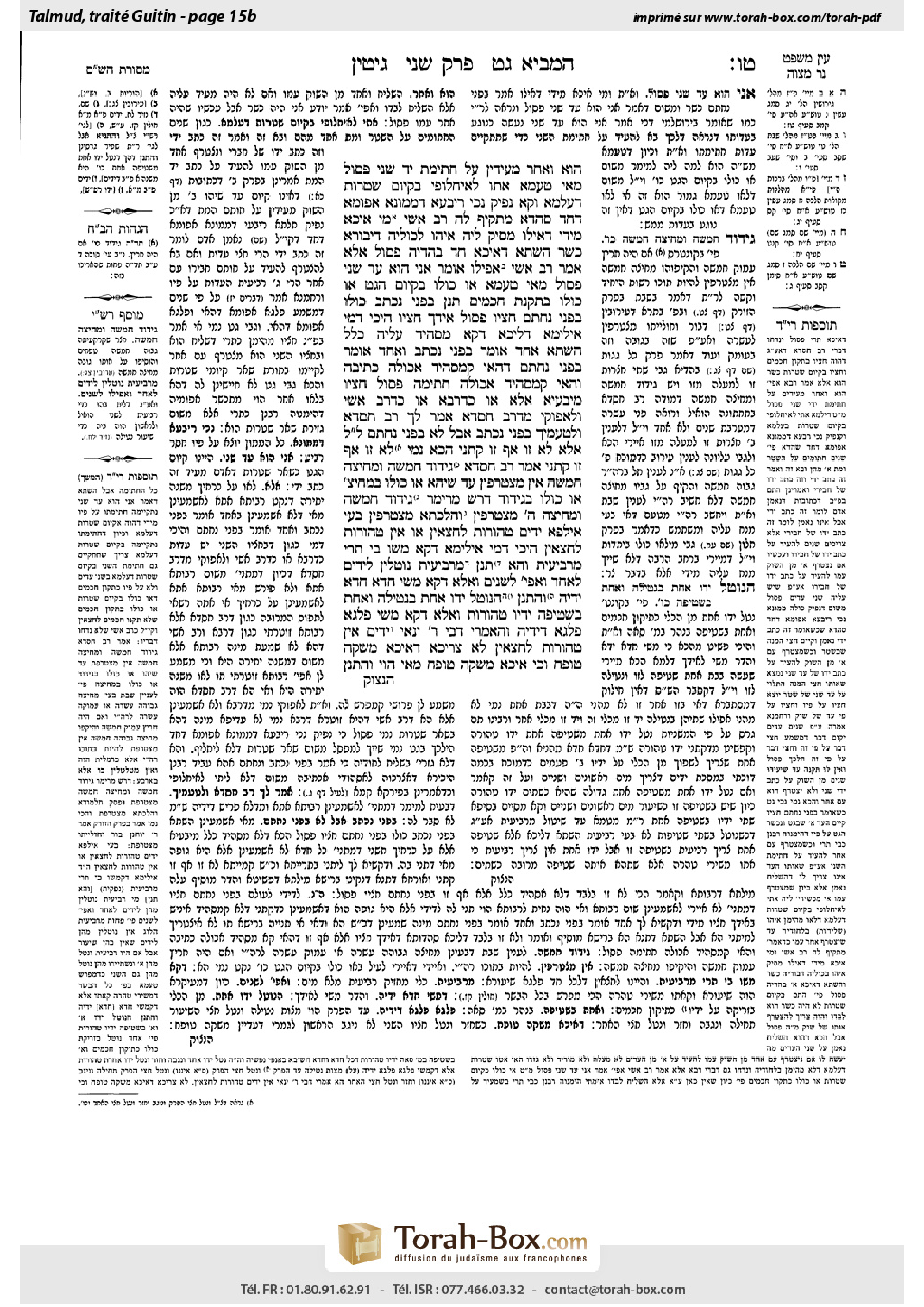
Gittin 15b: Talmud study for Daf Yomi
Study the Talmud for Daf Yomi with scanned pages, Hebrew text, English translations from Sefaria and AI-generated French translations.
Passage selection and English or AI-generated French translation are available where the scan has annotations. Daf Study is independent of Torah-Box and Sefaria.
Browse Gittin · גיטין · All tractatesGittin 15b text and translations
This page of Gittin includes the Aramaic text, an English translation and an AI-generated French translation, alongside the scan above.
גיטין י״ה ב · Aramaic and Hebrew text
הוּא וְאַחֵר מְעִידִין עַל חֲתִימַת יַד שֵׁנִי – פָּסוּל. מַאי טַעְמָא? אָתוּ לְאִיחַלּוֹפֵי בְּקִיּוּם שְׁטָרוֹת דְּעָלְמָא, וְקָא נָפֵיק נְכֵי רִיבְעָא דְמָמוֹנָא אַפּוּמָּא דְּחַד סָהֲדָא.
מַתְקֵיף לַהּ רַב אָשֵׁי: מִי אִיכָּא מִידֵּי, דְּאִילּוּ מַסֵּיק לֵיהּ אִיהוּ לְכוּלֵּיהּ דִּיבּוּרָא, כָּשֵׁר; הַשְׁתָּא דְּאִיכָּא חַד בַּהֲדֵיהּ, פָּסוּל?!
אֶלָּא אָמַר רַב אָשֵׁי: אֲפִילּוּ אוֹמֵר ״אֲנִי הוּא עֵד שֵׁנִי״ – פָּסוּל. מַאי טַעְמָא? אוֹ כּוּלּוֹ בְּקִיּוּם הַגֵּט, אוֹ כּוּלּוֹ בְּתַקָּנַת חֲכָמִים.
תְּנַן: ״בְּפָנַי נִכְתַּב כּוּלּוֹ, בְּפָנַי נֶחְתַּם חֶצְיוֹ״, פָּסוּל. אִידַּךְ חֶצְיוֹ הֵיכִי דָמֵי? אִילֵּימָא דְּלֵיכָּא דְּקָא מַסְהֵיד עֲלֵיהּ כְּלָל; הַשְׁתָּא אֶחָד אוֹמֵר ״בְּפָנַי נִכְתַּב״ וְאֶחָד אוֹמֵר ״בְּפָנַי נֶחְתַּם״, דְּהַאי קָמַסְהֵיד אַכּוּלַּהּ כְּתִיבָה וְהַאי קָמַסְהֵיד אַכּוּלַּהּ חֲתִימָה, פָּסוּל; חֶצְיוֹ מִיבַּעְיָא?!
אֶלָּא אוֹ כִּדְרָבָא אוֹ כִּדְרַב אָשֵׁי,
וּלְאַפּוֹקֵי מִדְּרַב חִסְדָּא.
אָמַר לְךָ רַב חִסְדָּא: וּלְטַעְמָיךְ, ״בְּפָנַי נִכְתַּב אֲבָל לֹא בְּפָנַי נֶחְתַּם״ לָמָּה לִי? אֶלָּא לֹא זוֹ אַף זוֹ קָתָנֵי,
הָכָא נָמֵי לָא זוֹ אַף זוֹ קָתָנֵי.
אָמַר רַב חִסְדָּא: גִּידּוּד חֲמִשָּׁה וּמְחִיצָה חֲמִשָּׁה – אֵין מִצְטָרְפִין, עַד שֶׁיְּהֵא אוֹ כּוּלּוֹ בִּמְחִיצָה אוֹ כּוּלּוֹ בְּגִידּוּד.
דָּרֵשׁ מָרִימָר: גִּידּוּד חֲמִשָּׁה וּמְחִיצָה חֲמִשָּׁה – מִצְטָרְפִין. וְהִלְכְתָא: מִצְטָרְפִין.
בָּעֵי אִילְפָא: יָדַיִם – טְהוֹרוֹת לַחֲצָאִין, אוֹ אֵין טְהוֹרוֹת לַחֲצָאִין? הֵיכִי דָּמֵי? אִילֵּימָא דְּקָא מָשׁוּ בֵּי תְרֵי מֵרְבִיעִית, וְהָא תְּנַן: מֵרְבִיעִית נוֹטְלִין לַיָּדַיִם, לְאֶחָד וַאֲפִילּוּ לִשְׁנַיִם!
וְאֶלָּא דְּקָא מָשֵׁי חֲדָא חֲדָא יְדֵיהּ, וְהָתְנַן: הַנּוֹטֵל יָדוֹ אַחַת בִּנְטִילָה, וְאַחַת בִּשְׁטִיפָה, יָדָיו טְהוֹרוֹת!
וְאֶלָּא דְּקָא מָשֵׁי פַּלְגָא פַּלְגָא דְּיָדֵיהּ, וְהָאָמְרִי דְּבֵי רַבִּי יַנַּאי: יָדַיִם – אֵין טְהוֹרוֹת לַחֲצָאִין! לָא צְרִיכָא, דְּאִיכָּא מַשְׁקֶה טוֹפֵחַ.
וְכִי אִיכָּא מַשְׁקֶה טוֹפֵחַ מַאי הָוֵי? וְהָתְנַן:
Gittin 15b · English translation
he, i.e., the agent, and another person testify with regard to the signature of the second witness, the bill of divorce is invalid. What is the reason for this? Perhaps people will come to confuse it with the typical case of ratification of legal documents, and will rely on one witness who testifies about his own signature and that of the other signatory, while another witness joins with him to testify with regard to the other signature. And as a result of this, the full sum of money, minus a quarter, will be extracted based upon the testimony of one witness. In order to ratify legal documents in general, two witnesses must testify as to the validity of each of the signatures. If the Sages were to allow one witness to testify about his own signature and another witness to join him in testifying about the other signature in the case of a bill of divorce, it may lead to the same method being employed with regard to other legal documents.
Rav Ashi objects to this: Is there any situation in which if he himself would complete his entire statement by saying: It was written in my presence and it was signed in my presence, the document would be valid, and now that there is another one who testifies with him, the bill of divorce is invalid?
Rather, Rav Ashi says that even if the agent says: I am the second witness who signed the bill of divorce, it is invalid. What is the reason for this? A bill of divorce cannot be validated by a combination of two types of credibility. It must be authenticated either entirely through the ratification of the bill of divorce, in the manner that other documents are ratified, or it must be entirely ratified via the rabbinic decree, in which case the testimony of the agent is considered equivalent to that of two people who ratify the signatures.
The Gemara cites a proof for this claim: We learned in the mishna that if an agent for a bill of divorce said: All of it was written in my presence and half of it was signed in my presence, this bill of divorce is invalid. The Gemara clarifies: What are the circumstances with regard to the other half of the bill of divorce? If we say that there is no one who testifies about it at all, this is problematic: Now the mishna taught that if one agent says: It was written in my presence, and one agent says: It was signed in my presence, in which case this agent testifies with regard to all the writing and that agent testifies with regard to all the signing, it is invalid. When the agent testifies that only half of it was signed in his presence, is it necessary to say that the document is invalid?
Rather, the mishna must be teaching that the bill of divorce is invalid even if there is additional testimony with regard to the second signature. This novelty can be explained either in accordance with the opinion of Rava, who holds that the agent joins with another person to testify about the second signature, or in accordance with the opinion of Rav Ashi, who holds that he testifies about his own signature.
The Gemara adds: And this is to exclude the opinion of Rav Ḥisda, who declares that the document is invalid even when there is a full ratification of the second signature. Because the mishna merely alludes to the novelty in this clause, without specifying it, one may infer only the lesser novelty. Since Rav Ḥisda’s novelty is greater than that of the other two Sages, had the mishna been taught for that purpose, it should have issued an explicit statement to that effect.
The Gemara rejects this suggestion: Rav Ḥisda could have said to you: And according to your reasoning, why do I need the ruling of the mishna which states that if the agent said: It was written in my presence but it was not signed in my presence, the bill of divorce is invalid? The mishna could simply have stated: If he said: All of it was written in my presence and half of it was signed in my presence, it is invalid. One would have inferred that it is invalid all the more so if one does not testify with regard to the signature at all. Rather, one must say that the tanna teaches the mishna employing the style: Not only this but also that, i.e., each ensuing statement adds something novel.
If so, here too the tanna teaches the mishna employing the style: Not only this but also that. In other words, Rav Ḥisda would answer that the above inference, i.e., that the clause dealing with: It was written in my presence but it was not signed in my presence, must be teaching an additional novelty, is incorrect. This is because it is a stylistic feature of the Mishna to teach a less novel case followed by a more novel one, regardless of the fact that had it taught the more novel case first, there would have been no need to mention the less novel case at all. Therefore, there is no need to infer a special, unstated novelty from this clause at all, which means it cannot be cited as proof against Rav Ḥisda’s greater novelty.
§ Tangentially, the Gemara cites a discussion that involves a similar underlying principle. Rav Ḥisda says, with regard to Shabbat domains: An embankment, i.e., a height disparity between two surfaces, of five handbreadths and an additional partition of five handbreadths, do not join together to form a partition of ten handbreadths, which is the minimum height for a partition to enclose a private domain. A halakhic partition is regarded as being composed of ten handbreadths only if it is composed entirely of a partition, e.g., a fence, or entirely of the embankment, e.g., a pit or incline.
Mareimar taught: An embankment of five handbreadths and a partition of five handbreadths do join together to form a partition of ten handbreadths. The Gemara comments: And the halakha is that they join together. Rav Ḥisda’s opinion is analogous to the aforementioned case that a bill of divorce must be either entirely upheld by the agent or entirely upheld by the ratification of its signatures, although the halakha is ruled differently in the case of Shabbat domains.
The Gemara cites another case that is based on the same principle. Ilfa raised a dilemma: With regard to ritual washing, can one’s hands be ritually pure in halves, or can they not be ritually pure in halves? The Gemara asks: What are the circumstances of this case? If we say that two people wash with the requisite one quarter-log of water, and therefore in actuality each one of them washes with only half of a quarter-log, but didn’t we learn explicitly in a mishna (Yadayim 1:1): With the amount of a quarter-log one can wash the hands of one person and even of two? A quarter-log of water suffices for one person to wash his hands before eating bread, and even two may wash their hands simultaneously with this amount, if they do so in the correct manner.
But rather, Ilfa is referring to a case where one washed his two hands one by one, not both hands at the same time. The Gemara asks: But didn’t we learn in a mishna (Yadayim 2:1): With regard to one who purifies one hand by washing with a vessel and one hand by immersing it in a river, his hands are ritually pure? This mishna indicates that there is no need for both hands to be washed simultaneously.
But rather, Ilfa’s dilemma refers to a case where he washes his hand in two halves, i.e., he first washes one half of his hand and next washes the second half of that same hand. The Gemara asks: But didn’t the Sages from the school of Rabbi Yannai say: Hands cannot be rendered ritually pure in halves? If so, one who washes half of his hand and pauses before washing the second half has not performed the act of washing the hands at all. The Gemara answers: No, Ilfa’s question is necessary only for a case where there is liquid that is still moist on his hand. When one washes the second half of his hand, some moisture remains on the portion of his hand that he already washed, and therefore one might think that this liquid joins with the water with which he washes the second half of his hand.
The Gemara asks: And when there is liquid that rendered one’s hand moist, what of it? Is this a relevant factor? But didn’t we learn in a mishna (Teharot 8:9):
Gittin 15b · Traduction française (IA)
Il, c'est-à-dire l'agent, et une autre personne témoignent concernant la signature du second témoin, le divorce est invalide. Quelle est la raison de cela ? Peut-être que les gens pourraient confondre cela avec le cas typique de validation de documents légaux, et s'appuieraient sur un seul témoin qui témoigne de sa propre signature et de celle de l'autre signataire, tandis qu'un autre témoin s'associe à lui pour témoigner concernant l'autre signature. Et en conséquence de cela, la totalité de l'argent, moins un quart, serait extraite sur la base du témoignage d'un seul témoin. Afin de valider les documents légaux en général, deux témoins doivent témoigner de la validité de chaque signature. Si les Sages avaient permis à un témoin de témoigner de sa propre signature et à un autre témoin de s'associer à lui pour témoigner de l'autre signature dans le cas d'un divorce, cela pourrait entraîner l'emploi de la même méthode concernant d'autres documents légaux.
Rav Ashi s'oppose à cela : Est-ce qu'il y a un cas où, s'il disait lui-même toute son déclaration en disant : C'était écrit en ma présence et c'était signé en ma présence, le document serait valide, et maintenant qu'il y a un autre qui témoigne avec lui, le divorce est invalide ?
Rav Ashi dit plutôt que même si l'agent dit : Je suis le second témoin qui a signé le divorce, il est invalide. Quelle est la raison de cela ? Un divorce ne peut être validé par une combinaison de deux types de crédibilité. Il doit être authentifié soit entièrement par la validation du divorce, dans la manière dont les autres documents sont validés, soit entièrement par le décret rabbinique, dans lequel cas le témoignage de l'agent est considéré équivalent à celui de deux personnes qui valident les signatures.
La Guemara cite une preuve pour cette affirmation : Nous avons appris dans la mitsna que si un agent pour un divorce disait : Tout a été écrit en ma présence et la moitié a été signée en ma présence, ce divorce est invalide. La Guemara clarifie : Quelles sont les circonstances concernant la moitié restante du divorce ? Si nous disons qu'il n'y a personne qui témoigne à son sujet, cela est problématique : Maintenant, la mitsna a enseigné que si un agent dit : C'était écrit en ma présence, et un autre agent dit : C'était signé en ma présence, dans ce cas, l'agent témoigne concernant toute l'écriture et l'autre agent témoigne concernant toute la signature, il est invalide. Lorsque l'agent témoigne que seulement la moitié a été signée en sa présence, est-il nécessaire de dire que le document est invalide ?
Rath, la mitsna doit enseigner que le divorce est invalide même s'il y a un témoignage supplémentaire concernant la deuxième signature. Cette nouveauté peut être expliquée soit conformément à l'opinion de Rava, qui considère que l'agent s'associe à une autre personne pour témoigner concernant la deuxième signature, soit conformément à l'opinion de Rav Ashi, qui considère qu'il témoigne de sa propre signature.
La Guemara ajoute : Et cela est pour exclure l'opinion de Rav Ḥisda, qui déclare que le document est invalide même lorsqu'il y a une validation complète de la deuxième signature. Parce que la mitsna ne mentionne simplement que la nouveauté dans cette clause, sans la spécifier, on peut inférer seulement la nouveauté moindre. Puisque l'opinion de Rav Ḥisda est plus grande que celle des deux autres Sages, si la mitsna avait été enseignée à cet effet, elle aurait dû émettre une déclaration explicite à cet égard.
La Guemara rejette cette suggestion : Rav Ḥisda aurait pu dire à l'audience : Et selon votre raisonnement, pourquoi ai-je besoin de la décision de la mitsna qui stipule que si l'agent dit : C'était écrit en ma présence mais ce n'était pas signé en ma présence, le divorce est invalide ? La mitsna aurait pu simplement dire : S'il dit : Tout a été écrit en ma présence et la moitié a été signée en ma présence, il est invalide. On aurait pu inférer que c'est encore plus invalide si personne ne témoigne concernant la signature. Plutôt, on doit dire que le tanna enseigne la mitsna en utilisant le style : Non seulement cela mais aussi cela, c'est-à-dire que chaque déclaration suivante ajoute quelque chose de nouveau.
Si c'est ainsi, ici aussi le tanna enseigne la mitsna en utilisant le style : Non seulement cela mais aussi cela. En d'autres termes, Rav Ḥisda répondrait que l'inférence ci-dessus, c'est-à-dire que la clause concernant : C'était écrit en ma présence mais ce n'était pas signé en ma présence, doit enseigner une nouveauté supplémentaire, est incorrecte. Cela est dû au fait que c'est une caractéristique stylistique de la Michna d'enseigner un cas moins nouveau suivi d'un cas plus nouveau, indépendamment du fait que, si elle avait enseigné le cas plus nouveau en premier, il n'aurait pas été nécessaire de mentionner le cas moins nouveau. Par conséquent, il n'est pas nécessaire d'inférer une nouveauté spéciale non déclarée de cette clause, ce qui signifie qu'elle ne peut pas être citée comme preuve contre l'opinion plus novatrice de Rav Ḥisda.
§ De manière tangentielle, la Guemara cite une discussion qui implique un principe sous-jacent similaire. Rav Ḥisda dit, concernant les domaines de Shabbat : Une butte, c'est-à-dire une différence de hauteur entre deux surfaces, de cinq tefachim et une partition supplémentaire de cinq tefachim, ne se joignent pas pour former une partition de dix tefachim, qui est la hauteur minimale pour une partition qui enferme un domaine privé. Une partition halakhique est considérée comme étant composée de dix tefachim uniquement si elle est composée entièrement d'une partition, par exemple une clôture, ou entièrement de la butte, par exemple un fond ou une pente.
Mareimar enseigna : Une butte de cinq tefachim et une partition de cinq tefachim se joignent pour former une partition de dix tefachim. La Guemara commente : Et la halakha est que cela se joigne. L'opinion de Rav Ḥisda est analogue au cas précédent où un divorce doit être entièrement soutenu par l'agent ou entièrement soutenu par la validation des signatures, bien que la halakha soit différente dans le cas des domaines de Shabbat.
La Guemara cite un autre cas basé sur le même principe. Ilfa pose un dilemme : En ce qui concerne le lavage rituel, peut-on considérer que les mains sont rituellement pures en deux moitiés, ou pas ? La Guemara demande : Quelles sont les circonstances de ce cas ? Si nous disons que deux personnes lavent avec la quantité requise d'un quart de log, et donc en réalité chacune d'entre elles lave avec seulement la moitié d'un quart de log, n'avons-nous pas appris explicitement dans une mitsva (Yadayim 1:1) : Avec la quantité d'un quart de log, on peut laver les mains d'une personne et même de deux ? Une quantité d'un quart de log suffit à une personne pour laver ses mains avant de manger du pain, et même deux peuvent laver leurs mains simultanément avec cette quantité, à condition qu'ils le fassent correctement.
Mais plutôt, Ilfa fait référence à un cas où une personne a lavé ses deux mains une par une, et non les deux en même temps. La Guemara demande : Mais n'avons-nous pas appris dans une mitsva (Yadayim 2:1) : En ce qui concerne celui qui purifie une main en la lavant avec un récipient et l'autre en la plongeant dans un fleuve, ses mains sont rituellement pures ? Cette mitsva indique qu'il n'est pas nécessaire que les deux mains soient lavées simultanément.
Mais plutôt, le dilemme d'Ilfa fait référence à un cas où il lave sa main en deux moitiés, c'est-à-dire qu'il lave d'abord la moitié de sa main, puis la seconde moitié de la même main. La Guemara demande : Mais n'avons-nous pas appris que les Sages de la maison de Rabbi Yannai dirent : Les mains ne peuvent pas être rendues rituellement pures en moitiés ? Si c'est le cas, celui qui lave la moitié de sa main et pause avant de laver la seconde moitié n'a pas accompli l'acte de laver ses mains. La Guemara répond : Non, la question d'Ilfa est nécessaire uniquement dans un cas où il y a un liquide qui rend la main humide. Lorsqu'on lave la seconde moitié de sa main, il reste de la moiteur sur la partie de la main déjà lavée, et donc on pourrait penser que ce liquide s'ajoute à l'eau avec lequel on lave la seconde moitié de la main.
La Guemara demande : Et lorsqu'il y a un liquide qui rend la main humide, qu'en est-il ? Cela a-t-il une importance ? Mais n'avons-nous pas appris dans une mitsva (Téharot 8:9) :
Traduction française générée par IA à partir de l’édition anglaise de Sefaria. Vérifie toujours un passage avec le texte source.
Text from Sefaria: William Davidson Edition - Vocalized Aramaic (CC BY NC); William Davidson Edition - English (CC BY NC).