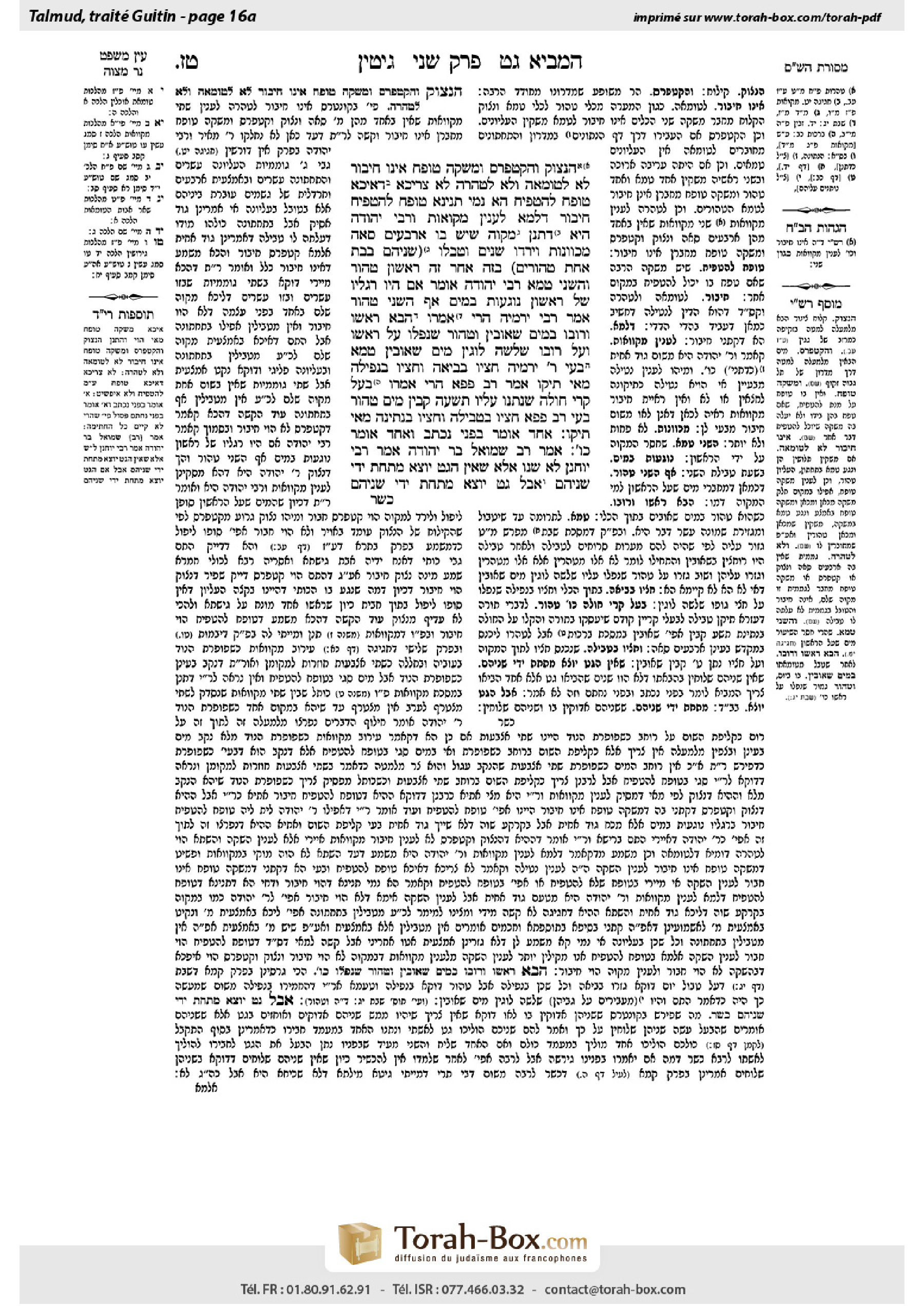
Gittin 16a: Talmud study for Daf Yomi
Study the Talmud for Daf Yomi with scanned pages, Hebrew text, English translations from Sefaria and AI-generated French translations.
Passage selection and English or AI-generated French translation are available where the scan has annotations. Daf Study is independent of Torah-Box and Sefaria.
Browse Gittin · גיטין · All tractatesGittin 16a text and translations
This page of Gittin includes the Aramaic text, an English translation and an AI-generated French translation, alongside the scan above.
גיטין י״ו א · Aramaic and Hebrew text
הַנִּצּוֹק, וְהַקָּטַפְרֵס, וּמַשְׁקֶה טוֹפֵחַ – אֵינוֹ חִיבּוּר לֹא לְטוּמְאָה וְלֹא לְטׇהֳרָה!
לָא צְרִיכָא, דְּאִיכָּא טוֹפֵחַ לְהַטְפִּיחַ. הָא נָמֵי תְּנֵינָא: טוֹפֵחַ לְהַטְפִּיחַ – חִיבּוּר!
דִּלְמָא לְעִנְיַן מִקְוָאוֹת, וְרַבִּי יְהוּדָה הִיא. דִּתְנַן: מִקְוֶה שֶׁיֵּשׁ בּוֹ אַרְבָּעִים סְאָה מְכוּוָּנוֹת, וְיָרְדוּ שְׁנַיִם וְטָבְלוּ (שְׁנֵיהֶם בְּבַת אַחַת – טְהוֹרִים),
בְּזֶה אַחַר זֶה – רִאשׁוֹן טָהוֹר, וְהַשֵּׁנִי טָמֵא.
רַבִּי יְהוּדָה אוֹמֵר: אִם הָיוּ רַגְלָיו שֶׁל רִאשׁוֹן נוֹגְעוֹת בַּמַּיִם – אַף הַשֵּׁנִי טָהוֹר.
אָמַר רַבִּי יִרְמְיָה, הֲרֵי אָמְרוּ: הַבָּא רֹאשׁוֹ וְרוּבּוֹ בְּמַיִם שְׁאוּבִין, וְטָהוֹר שֶׁנָּפְלוּ עַל רֹאשׁוֹ וְעַל רוּבּוֹ שְׁלֹשָׁה לוּגִּין מַיִם שְׁאוּבִין – טָמֵא; בָּעֵי רַבִּי יִרְמְיָה: חֶצְיוֹ בְּבִיאָה וְחֶצְיוֹ בִּנְפִילָה, מַאי? תֵּיקוּ.
אָמַר רַב פָּפָּא, הֲרֵי אָמְרוּ: בַּעַל קֶרִי חוֹלֶה, שֶׁנָּתְנוּ עָלָיו תִּשְׁעָה קַבִּין מַיִם – טָהוֹר; בָּעֵי רַב פָּפָּא: חֶצְיוֹ בִּטְבִילָה וְחֶצְיוֹ בִּנְתִינָה, מַאי? תֵּיקוּ.
אֶחָד אוֹמֵר ״בְּפָנַי נִכְתַּב״ וְאֶחָד אוֹמֵר כּוּ׳: אָמַר רַב שְׁמוּאֵל בַּר יְהוּדָה אָמַר רַבִּי יוֹחָנָן: לֹא שָׁנוּ אֶלָּא שֶׁאֵין הַגֵּט יוֹצֵא מִתַּחַת יְדֵי שְׁנֵיהֶם, אֲבָל גֵּט יוֹצֵא מִתַּחַת יְדֵי שְׁנֵיהֶם –
Gittin 16a · English translation
A stream of water, and water descending an incline [katafres], and liquid that rendered an item moist do not connect, neither for ritual impurity nor for purity. These liquids do not connect for impurity, e.g., if impure water is in one place and becomes attached to another source of water pouring from above it, the water above is not considered attached to the impure water and is not rendered impure. They also do not connect for purity, e.g., if two collections of water are attached via the pouring of a stream, they do not join together to form the amount of water necessary to form a valid ritual bath, through which people and items can become ritually pure. If so, liquid that rendered a hand moist should not serve to attach the two halves of one’s hand when they are washed.
The Gemara answers: No, this dilemma is necessary in a case where there is liquid that rendered an item moist enough to render another item moist. In other words, the half of the hand that was washed is not merely slightly moist, it is moist enough to render something else moist. The Gemara asks: We already learned this as well: With regard to liquid that rendered an item moist enough to render another item moist, it connects with other liquid. What, then, is Ilfa’s dilemma?
The Gemara suggests: Perhaps the halakha that liquid rendered an item moist enough to render another item moist joins with other liquid is stated only with regard to the issue of ritual baths, and this is in accordance with the opinion of Rabbi Yehuda. As we learned in a mishna (Mikvaot 7:6): In the case of a ritual bath that contains precisely forty se’a of water, and two people descended and immersed in it, if both of them immersed at the same time they are ritually pure.
If they immersed sequentially, then the first person is ritually pure, as he immersed in a ritual bath that contains the requisite amount of water, but the second person is impure, because some of the water must certainly have clung to the first individual as he left the ritual bath. Consequently, after the first person’s immersion the ritual bath contained slightly less than the requisite forty se’a of water.
Rabbi Yehuda says: If the first person’s feet were still touching the water in the ritual bath when the second person immersed, then the second person is also ritually pure. According to the opinion of Rabbi Yehuda, the water left on the body of the person who has immersed connects with the water in the ritual bath to constitute the requisite amount of water. Clearly, in Rabbi Yehuda’s opinion, liquid that rendered an item moist enough to render another item moist joins together with other liquid. However, this halakha was stated only with regard to a ritual bath. It remains unclear whether liquid that rendered an item moist enough to render another item moist joins with the water used to wash the second half of one’s hand. Perhaps this is the dilemma raised by Ilfa.
The Gemara cites another question with regard to this issue. Rabbi Yirmeya says: They said in a mishna (Zavim 5:12): In the case of one whose head and most of his body enter into drawn water after he immersed himself in a ritual bath to purify himself, and a ritually pure person concerning whom three log of drawn water fell on his head and most of his body, both of these people are ritually impure. With regard to this mishna, Rabbi Yirmeya raises a dilemma: If half of a person became purified by entering into drawn water and half of him became purified by having water fall on him, what is the halakha? Do these acts join together to render him ritually impure or not? No answer is found, and therefore the Gemara says that the dilemma shall stand unresolved.
Similarly, Rav Pappa says: They said in a mishna (Mikvaot 3:4): In the case of a sick person who experienced a seminal emission, who had nine kav of drawn water poured over him, this is sufficient to render him ritually pure. He need not immerse himself in a ritual bath. Rav Pappa raises a dilemma: If half of him is purified by immersion and half of him through this act of pouring, what is the halakha? No answer is found for this dilemma either, and the Gemara says that it shall stand unresolved.
§ The mishna taught that if one says: It was written in my presence, and one says: It was signed in my presence, the bill of divorce is invalid. Rav Shmuel bar Yehuda says that Rabbi Yoḥanan says: They taught that the document is invalid only if the bill of divorce was not produced by both of them in court. In other words, this halakha applies only if they were not both agents for bringing this bill of divorce. Rather, one of them alone fulfilled this role and he did not say: It was written in my presence and it was signed in my presence, in accordance with the rabbinic decree. However, if the bill of divorce was produced by both of them,
Gittin 16a · Traduction française (IA)
Un courant d'eau, et l'eau descendant une pente [katafres], et un liquide qui rend un objet humide ne se connectent pas, ni pour l'impureté rituelle ni pour la pureté. Ces liquides ne se connectent pas pour l'impureté, par exemple, si l'eau impure est dans un lieu et s'attache à une autre source d'eau qui coule au-dessus d'elle, l'eau au-dessus n'est pas considérée comme attachée à l'eau impure et n'est pas rendue impure. Ils ne se connectent pas non plus pour la pureté, par exemple, si deux collections d'eau sont connectées par le coulant d'un cours d'eau, elles ne forment pas la quantité d'eau nécessaire pour former un bain rituel valide, par lequel les personnes et les objets peuvent devenir purement rituellement. Si tel est le cas, un liquide qui a rendu la main humide ne devrait pas servir à attacher les deux moitiés de la main lorsqu'elles sont lavées.
Le Guemara répond : Non, ce dilemme est nécessaire dans le cas où il y a un liquide qui a rendu un objet suffisamment humide pour rendre un autre objet humide. En d'autres termes, la moitié de la main qui a été lavée n'est pas simplement humide, elle est suffisamment humide pour rendre quelque chose d'autre humide. Le Guemara demande : Nous avons déjà appris cela aussi : concernant un liquide qui a rendu un objet suffisamment humide pour rendre un autre objet humide, il se connecte avec d'autres liquides. Qu'est-ce alors que le dilemme d'Ilfa ?
Le Guemara suggère : Peut-être que la halakha selon laquelle un liquide qui a rendu un objet suffisamment humide pour rendre un autre objet humide se connecte avec d'autres liquides est énoncée uniquement concernant la question des bains rituels, et cela est selon l'opinion du Rabbi Yéhuda. Comme nous avons appris dans une mitsva (Mikvaot 7:6) : Dans le cas d'un bain rituel contenant précisément quarante se'a d'eau, et deux personnes descendant et s'immergeant dedans, si les deux s'immergent en même temps, ils sont rituellement purs.
Si ils s'immergent successivement, alors la première personne est rituellement pure, car elle s'est immergée dans un bain rituel contenant la quantité requise d'eau, mais la deuxième personne est impure, car certainement une partie de l'eau s'est attardée sur le premier individu lorsqu'il est sorti du bain rituel. Ainsi, après l'immersion de la première personne, le bain rituel contenait légèrement moins de la quantité requise de quarante se'a d'eau.
Le Rabbi Yéhuda dit : Si les pieds de la première personne étaient encore en contact avec l'eau du bain rituel lors de l'immersion de la deuxième personne, alors la deuxième personne est également rituellement pure. Selon l'opinion du Rabbi Yéhuda, l'eau restant sur le corps de la personne qui a immergé se connecte avec l'eau du bain rituel pour constituer la quantité requise d'eau. Évidemment, selon l'opinion du Rabbi Yéhuda, un liquide qui a rendu un objet suffisamment humide pour rendre un autre objet humide se connecte avec d'autres liquides. Cependant, cette halakha a été énoncée uniquement concernant un bain rituel. Il reste indéterminé si un liquide qui a rendu un objet suffisamment humide pour rendre un autre objet humide se connecte avec l'eau utilisée pour laver la deuxième moitié de la main d'une personne. Peut-être est-ce le dilemme soulevé par Ilfa.
Le Guemara cite une autre question concernant cette question. Le Rabbi Yirmeya dit : Ils ont dit dans une mitsva (Zavim 5:12) : Dans le cas d'une personne dont la tête et la plus grande partie de son corps entrent dans l'eau tirée après qu'il s'est immergé dans un bain rituel pour se purifier, et d'une personne rituellement pure concernant laquelle trois log d'eau tirée sont tombés sur sa tête et la plus grande partie de son corps, les deux personnes sont rituellement impures. Concernant cette mitsva, le Rabbi Yirmeya soulève un dilemme : Si la moitié d'une personne est purifiée en entrant dans l'eau tirée et la moitié d'elle est purifiée en ayant de l'eau tomber sur elle, quelle est la halakha ? Ces actes se joignent-ils pour rendre lui rituellement impur ou non ? Aucune réponse n'est trouvée, et donc le Guemara dit que ce dilemme restera sans réponse.
De même, Rav Pappa dit : Ils ont dit dans une mitsva (Mikvaot 3:4) : Dans le cas d'une personne malade qui a eu une émission sémencière, qui a eu neuf kav d'eau tirée vers lui, cela est suffisant pour le rendre rituellement pur. Il n'a pas besoin de s'immerger dans un bain rituel. Rav Pappa soulève un dilemme : Si la moitié de lui est purifiée par l'immersion et la moitié de lui par cet acte de verser de l'eau, quelle est la halakha ? Aucune réponse n'est trouvée pour ce dilemme non plus, et le Guemara dit qu'il restera sans réponse.
§ La mitsva a enseigné que si l'on dit : Cela a été écrit devant moi, et l'on dit : Cela a été signé devant moi, le divorce est invalide. Rav Shmuel bar Yéhuda dit que Rabbi Yoḥanan dit : Ils ont enseigné que le document est invalide uniquement si le divorce n'a pas été produit par les deux d'entre eux en cour. En d'autres termes, cette halakha s'applique uniquement si ils n'étaient pas tous deux agents pour apporter ce divorce. Plutôt, l'un d'entre eux seul a rempli ce rôle et il n'a pas dit : Cela a été écrit devant moi et cela a été signé devant moi, conformément au décret rabbinique. Cependant, si le divorce a été produit par les deux d'entre eux,
Traduction française générée par IA à partir de l’édition anglaise de Sefaria. Vérifie toujours un passage avec le texte source.
Text from Sefaria: William Davidson Edition - Vocalized Aramaic (CC BY NC); William Davidson Edition - English (CC BY NC).