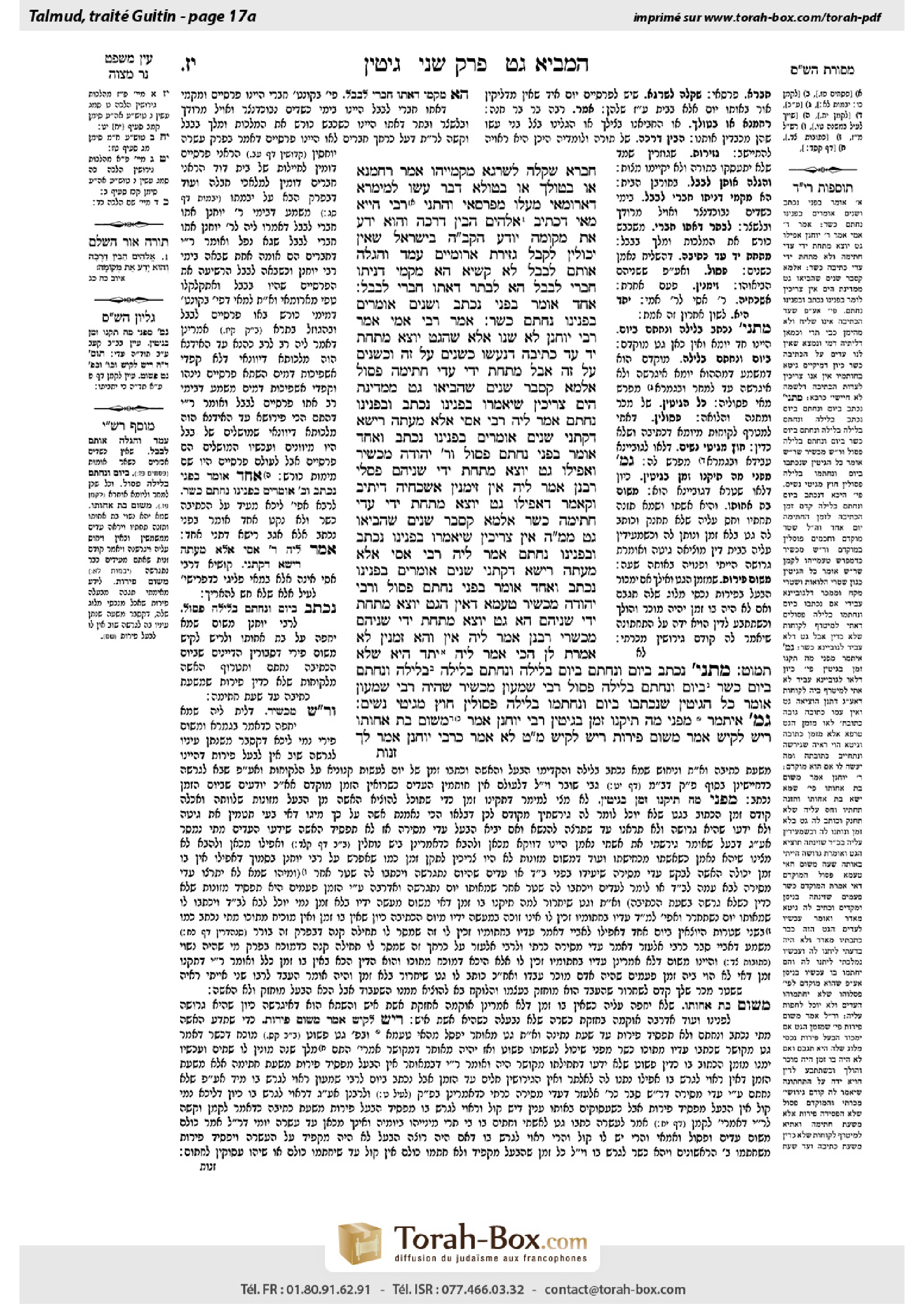
Gittin 17a: Talmud study for Daf Yomi
Study the Talmud for Daf Yomi with scanned pages, Hebrew text, English translations from Sefaria and AI-generated French translations.
Passage selection and English or AI-generated French translation are available where the scan has annotations. Daf Study is independent of Torah-Box and Sefaria.
Browse Gittin · גיטין · All tractatesGittin 17a text and translations
This page of Gittin includes the Aramaic text, an English translation and an AI-generated French translation, alongside the scan above.
גיטין י״ז א · Aramaic and Hebrew text
חַבְרָא, שְׁקַלָה לִשְׁרָגָא מִקַּמַּיְיהוּ. אֲמַר: רַחֲמָנָא! אוֹ בְּטוּלָּךְ, אוֹ בְּטוּלָּא דְּבַר עֵשָׂו.
לְמֵימְרָא דְּרוֹמָאֵי מְעַלּוּ מִפָּרְסָאֵי?! וְהָתָנֵי רַבִּי חִיָּיא, מַאי דִּכְתִיב: ״אֱלֹהִים הֵבִין דַּרְכָּהּ וְהוּא יָדַע אֶת מְקוֹמָהּ״? יוֹדֵעַ הַקָּדוֹשׁ בָּרוּךְ הוּא בְּיִשְׂרָאֵל שֶׁאֵין יְכוֹלִין לְקַבֵּל גְּזֵירַת רוֹמִיִּים, עָמַד וְהִגְלָה אוֹתָם לְבָבֶל.
לָא קַשְׁיָא; הָא מִקַּמֵּי דְּנֵיתוֹ חַבָּרֵי לְבָבֶל, הָא לְבָתַר דַּאֲתוֹ חַבָּרֵי לְבָבֶל.
אֶחָד אוֹמֵר ״בְּפָנַי נִכְתַּב״ וּשְׁנַיִם אוֹמְרִים ״בְּפָנֵינוּ נֶחְתַּם״ – כָּשֵׁר: אָמַר רַבִּי אַמֵּי אָמַר רַבִּי יוֹחָנָן: לֹא שָׁנוּ אֶלָּא שֶׁהַגֵּט יוֹצֵא מִתַּחַת יַד עֵד כְּתִיבָה, דְּנַעֲשׂוּ כִּשְׁנַיִם עַל זֶה וְכִשְׁנַיִם עַל זֶה; אֲבָל מִתַּחַת יְדֵי עֵדֵי חֲתִימָה – פָּסוּל.
אַלְמָא קָסָבַר: שְׁנַיִם שֶׁהֵבִיאוּ גֵּט מִמְּדִינַת הַיָּם, צְרִיכִין שֶׁיֹּאמְרוּ: ״בְּפָנֵינוּ נִכְתַּב וּבְפָנֵינוּ נֶחְתַּם״. אֲמַר לֵיהּ רַבִּי אַסִּי, אֶלָּא מֵעַתָּה, רֵישָׁא דְּקָתָנֵי: שְׁנַיִם אוֹמְרִים ״בְּפָנֵינוּ נִכְתַּב״ וְאֶחָד אוֹמֵר ״בְּפָנַי נֶחְתַּם״ – פָּסוּל, וְרַבִּי יְהוּדָה מַכְשִׁיר; וַאֲפִילּוּ גֵּט יוֹצֵא מִתַּחַת יְדֵי שְׁנֵיהֶם – פָּסְלִי רַבָּנַן?! אֲמַר לֵיהּ: אִין.
זִימְנִין אַשְׁכְּחֵיהּ דְּיָתֵיב וְקָאָמַר, דַּאֲפִילּוּ גֵּט יוֹצֵא מִתַּחַת יְדֵי עֵדֵי חֲתִימָה – כָּשֵׁר. אַלְמָא קָסָבַר: שְׁנַיִם שֶׁהֵבִיאוּ גֵּט מִמְּדִינַת הַיָּם, אֵין צְרִיכִין שֶׁיֹּאמְרוּ: ״בְּפָנֵינוּ נִכְתַּב וּבְפָנֵינוּ נֶחְתַּם״.
אֲמַר לֵיהּ רַבִּי אַסִּי: אֶלָּא מֵעַתָּה, רֵישָׁא דְּקָתָנֵי: שְׁנַיִם אוֹמְרִים ״בְּפָנֵינוּ נִכְתַּב״ וְאֶחָד אוֹמֵר ״בְּפָנַי נֶחְתַּם״ – פָּסוּל, וְרַבִּי יְהוּדָה מַכְשִׁיר; טַעְמָא דְּאֵין הַגֵּט יוֹצֵא מִתַּחַת יְדֵי שְׁנֵיהֶם, הָא גֵּט יוֹצֵא מִתַּחַת יְדֵי שְׁנֵיהֶם – מַכְשְׁרִי רַבָּנַן?!
אֲמַר לֵיהּ: אִין. וְהָא זִמְנִין לָא אֲמַרְתְּ לַן הָכִי! אֲמַר לֵיהּ: יָתֵד הִיא שֶׁלֹּא תָּמוּט.
מַתְנִי׳ נִכְתַּב בַּיּוֹם וְנֶחְתַּם בַּיּוֹם; בַּלַּיְלָה וְנֶחְתַּם בַּלַּיְלָה; בַּלַּיְלָה וְנֶחְתַּם בַּיּוֹם – כָּשֵׁר. בַּיּוֹם וְנֶחְתַּם בַּלַּיְלָה – פָּסוּל; רַבִּי שִׁמְעוֹן מַכְשִׁיר.
שֶׁהָיָה רַבִּי שִׁמְעוֹן אוֹמֵר: כׇּל הַגִּיטִּין שֶׁנִּכְתְּבוּ בַּיּוֹם וְנֶחְתְּמוּ בַּלַּיְלָה – פְּסוּלִין; חוּץ מִגִּיטֵּי נָשִׁים.
גְּמָ׳ אִיתְּמַר: מִפְּנֵי מָה תִּיקְּנוּ זְמַן בְּגִיטִּין? רַבִּי יוֹחָנָן אָמַר: מִשּׁוּם בַּת אֲחוֹתוֹ.
רֵישׁ לָקִישׁ אָמַר: מִשּׁוּם פֵּירוֹת.
רֵישׁ לָקִישׁ, מַאי טַעְמָא לָא אָמַר כְּרַבִּי יוֹחָנָן? אָמַר לָךְ:
Gittin 17a · English translation
Persian priest [ḥabbara] and took the lamp [sheragga] from before them. It was a Persian holiday on which the Persians prohibited the public from maintaining light outside their temple. Rabba, who was from Eretz Yisrael, said: Merciful One! Let us live either in Your shadow or in the shadow of the descendants of Esau, the Romans.
The Gemara asks: Is this to say that the Romans are preferable to the Persians? But didn’t Rabbi Ḥiyya teach: What is the meaning of that which is written: “God understands its way and He knows its place” (Job 28:23)? This means that the Holy One, Blessed be He, knows with regard to the Jewish people that they are unable to accept and live under Roman decrees, and therefore He arose and exiled them to Babylonia. This indicates that living under Babylonian rule is preferable to living under Roman rule.
The Gemara explains: This is not difficult, as this interpretation of Rabbi Ḥiyya refers to the period before the Persians reached Babylonia, when life there was very comfortable. That statement of Rabba was issued after the Persians reached Babylonia, when the situation changed and living there became more difficult.
§ The mishna taught that if one person says: It was written in my presence, and two say: It was signed in our presence, it is valid. Rabbi Ami says that Rabbi Yoḥanan says: They taught that the document is valid only when the bill of divorce is produced by the witness to the writing, i.e., the one who observed the writing is the agent of the bill of divorce, as they become as two witnesses for this act, the writing, and two for that act, the signing. The agent for the bill of divorce is considered like two witnesses when he testifies with regard to the writing. However, if the bill of divorce was produced by the signatory witnesses it is invalid. This is because only one witness, who is not an agent for the bill of divorce, testifies with regard to its writing.
The Gemara comments: Apparently, Rabbi Yoḥanan holds that two people who brought a bill of divorce from a country overseas are required to say: It was written in our presence and it was signed in our presence, and if they do not state this declaration the bill of divorce is invalid. Rabbi Asi said to Rabbi Ami: If that is so, how do you explain the first clause of the mishna, which teaches: If two people say: It was written in our presence, and one says: It was signed in my presence, then it is invalid, and Rabbi Yehuda deems it valid? But do the Rabbis invalidate the document even when the bill of divorce is produced by both of them? Rabbi Ami said to him: Yes.
The Gemara relates: Another time Rabbi Asi found Rabbi Ami sitting and saying that even if the bill of divorce is produced by the signatory witnesses it is valid. The Gemara notes: Apparently, Rabbi Yoḥanan, in whose name Rabbi Ami stated this halakha, holds that in the case of two people who brought a bill of divorce from a country overseas, they are not required to say: It was written in our presence and it was signed in our presence.
Rabbi Asi said to him: However, if that is so, how do you explain the first clause of the mishna, which teaches: If two people say: It was written in our presence, and one says: It was signed in my presence, it is invalid, and Rabbi Yehuda deems it valid? The Gemara elaborates: The reason it is invalid is that the bill of divorce is not produced by both of them, from which it may be inferred that if the bill of divorce is produced by both of them the Sages would deem it valid.
Rabbi Ami said to him: Yes. Rabbi Asi replied: But the other time you did not say this to us. You issued a ruling that indicated the opposite conclusion, and when I asked if that was the correct inference you affirmed that my reasoning was correct. Rabbi Ami said to him: What I am now telling you is a spike that will not move; you can rely on this ruling, and I retract my previous statement.
MISHNA: If a bill of divorce was written during the day and signed on the same day; or if it was written at night and signed on that same night; or if it was written at night and signed on the following day, then it is valid. The new calendar day begins at night, so that in all of these cases the writing and the signing were performed on the same date. However, if it was written during the day and signed on that same night, it is invalid, as the writing and the signing were not on the same calendar day. Rabbi Shimon deems the bill of divorce valid.
The mishna explains the ruling of Rabbi Shimon: As Rabbi Shimon would say: All documents that were written during the day and signed at night are invalid because the date recorded in the document is a day prior to the day the document takes effect, except for women’s bills of divorce. Since a bill of divorce is not used to collect money, it is of no concern if the date that appears on it is before the time when it was signed.
GEMARA: It was stated that the amora’im disagreed with regard to the following question: For what reason did the Sages institute the writing of a date on bills of divorce? Why must the date be written if this document is not intended to be used to collect money? Rabbi Yoḥanan says: Due to the daughter of his sister. The Sages were concerned that a man may claim that his divorce occurred earlier than it actually did. For example, if one was married to his niece, and she committed adultery, he may nevertheless desire to protect her judicial sanction and claim that they were already divorced at the time of her infidelity. In order to prevent this from happening, the Sages instituted an ordinance that bills of divorce must be dated.
Reish Lakish says: The ordinance was instituted due to the produce of her usufruct property. A husband owns the produce of the fields belonging to his wife up to the moment the divorce takes effect. The Sages instituted an ordinance that bills of divorce must be dated because she needs to be able to establish the time of the divorce in case the husband sold or consumed the produce of fields that belong to her after the divorce. If there is no date on the bill of divorce, he will be able to claim that the produce was sold or consumed before the divorce took place.
The Gemara asks: What is the reason that Reish Lakish did not say in accordance with the opinion of Rabbi Yoḥanan? The Gemara answers: Reish Lakish could have said to you:
Gittin 17a · Traduction française (IA)
Un prêtre perse [ḥabbara] prit la lampe [sheragga] devant eux. Il s'agissait d'un jour férié perse où les Perses interdisaient au public de maintenir une lumière en dehors de leur temple. Rabba, originaire d'Eretz Yisrael, dit : Seigneur Miséricordieux ! Que nous vivions soit dans Votre ombre ou dans l'ombre des descendants d'Ésaü, les Romains.
La Guemara demande : Est-ce que cela signifie que les Romains sont préférables aux Perses ? Mais n'avait-il pas Rabbi Ḥiyya enseigné : Qu'entend-on par « Dieu connaît son chemin et Il connaît son lieu » (Job 28:23) ? Cela signifie que le Saint, le Très Haut, connaît envers le peuple juif qu'ils ne peuvent pas accepter et vivre sous les décrets romains, et par conséquent Il est monté et les a exilés en Babylone. Cela indique que vivre sous la domination babylonienne est préférable à vivre sous la domination romaine.
La Guemara explique : Ce n'est pas difficile, car cette interprétation de Rabbi Ḥiyya se réfère à la période avant que les Perses n'atteignent Babylone, lorsque la vie y était très confortable. Cette déclaration de Rabba a été faite après que les Perses aient atteint Babylone, lorsque la situation s'était transformée et que vivre là devenait plus difficile.
§ La mitsva enseigne que si une personne dit : Cela a été écrit devant moi, et deux disent : Cela a été signé devant nous, cela est valide. Rabbi Ami dit que Rabbi Yoḥanan dit : Ils enseignent que le document est valide uniquement lorsque le divorce est produit par le témoin du testament, c'est-à-dire celui qui a observé le testament est l'agent du divorce, car ils deviennent comme deux témoins pour cet acte, le testament, et deux pour cet acte, la signature. L'agent du divorce est considéré comme deux témoins lorsqu'il témoigne concernant le testament. Cependant, si le divorce a été produit par les témoins signataires, il est invalide. Cela est dû au fait qu'un seul témoin, qui n'est pas l'agent du divorce, témoigne concernant son testament.
La Guemara commente : Apparemment, Rabbi Yoḥanan considère que deux personnes qui apportent un divorce d'un pays étranger doivent dire : Cela a été écrit devant nous et cela a été signé devant nous, et si elles ne font pas cette déclaration, le divorce est invalide. Rabbi Asi dit à Rabbi Ami : Si c'est ainsi, comment expliques-tu la première clause de la mitsna, qui enseigne : Si deux personnes disent : Cela a été écrit devant nous, et une dit : Cela a été signé devant moi, alors cela est invalide, et Rabbi Yehuda considère cela comme valide ? Mais les Rabbins invalident le document même lorsque le divorce est produit par les deux ? Rabbi Ami dit à lui : Oui.
La Guemara rapporte : Une autre fois, Rabbi Asi trouva Rabbi Ami assis et disant que même si le divorce est produit par les témoins signataires, il est valide. La Guemara note : Apparemment, Rabbi Yoḥanan, dont Rabbi Ami a exprimé cette halakha, considère que dans le cas de deux personnes qui apportent un divorce d'un pays étranger, ils ne sont pas requis de dire : Cela a été écrit devant nous et cela a été signé devant nous.
Rabbi Asi dit à lui : Cependant, si c'est ainsi, comment expliques-tu la première clause de la mitsna, qui enseigne : Si deux personnes disent : Cela a été écrit devant nous, et l'une dit : Cela a été signé devant moi, cela est invalide, et Rabbi Yehuda considère cela comme valide ? La Guemara développe : La raison pour laquelle cela est invalide est que le document de divorce n'est pas produit par les deux, d'où on peut en déduire que si le document de divorce est produit par les deux, les Sages le considéreraient comme valide.
Rabbi Ami dit à lui : Oui. Rabbi Asi répondit : Mais l'autre fois tu n'as pas dit cela à nous. Tu as émis un avis indiquant la conclusion opposée, et lorsque j'ai demandé si c'était la bonne déduction, tu as confirmé que ma raison était correcte. Rabbi Ami dit à lui : Ce que je te dis maintenant est une épingle qui ne bougera pas ; tu peux compter sur ce jugement, et je retire mon déclaration précédente.
MITSNA : Si un document de divorce a été écrit pendant la journée et signé le même jour ; ou s'il a été écrit la nuit et signé la même nuit ; ou s'il a été écrit la nuit et signé le lendemain, alors il est valide. Le nouveau jour calendrier commence à la nuit, de sorte que dans tous ces cas, l'écriture et la signature ont été effectuées le même jour. Cependant, si l'écriture a été faite pendant la journée et la signature le même soir, il est invalide, car l'écriture et la signature n'étaient pas le même jour calendrier. Rabbi Shimon considère le document de divorce comme valide.
La mitsva explique la décision de Rabbi Shimon : Comme Rabbi Shimon disait : Tous les documents écrits pendant la journée et signés la nuit sont invalides, car la date inscrite dans le document est un jour avant la date à laquelle le document entre en vigueur, sauf pour les billets de divorce des femmes. Puisque le billet de divorce n'est pas utilisé pour collecter de l'argent, il n'est pas important que la date qui y figure soit antérieure au moment de sa signature.
GUEMARA : Il a été dit que les amora’im étaient en désaccord concernant la question suivante : Pourquoi les Sages ont-ils institué l'écriture d'une date sur les billets de divorce ? Pourquoi doit-elle être écrite si ce document n'est pas destiné à être utilisé pour collecter de l'argent ? Rabbi Yoḥanan dit : À cause de la fille de sa sœur. Les Sages étaient préoccupés par le fait qu'un homme puisse affirmer que son divorce s'est produit plus tôt qu'il ne l'a réellement fait. Par exemple, si l'on était marié à sa nièce et qu'elle a commis un adultère, il pourrait néanmoins souhaiter la protéger juridiquement et affirmer qu'ils étaient déjà divorcés à l'époque de son infidélité. Afin d'éviter cela, les Sages ont institué une ordonnance selon laquelle les billets de divorce doivent être datés.
Reish Lakish dit : L'ordonnance a été instituée en raison des produits de la propriété de usufruit. Le mari possède les produits des champs appartenant à sa femme jusqu'au moment où le divorce prend effet. Les Sages ont institué une ordonnance selon laquelle les actes de divorce doivent être datés, car elle a besoin de pouvoir établir le moment du divorce en cas où le mari a vendu ou consommé les produits des champs qui lui appartiennent après le divorce. S'il n'y a pas de date sur l'acte de divorce, il pourra affirmer que les produits ont été vendus ou consommés avant que le divorce ne soit entré en vigueur.
La Guemara demande : Quelle est la raison pour laquelle Reish Lakish n'a pas dit selon l'opinion de Rabbi Yoḥanan ? La Guemara répond : Reish Lakish aurait pu dire à vous :
Traduction française générée par IA à partir de l’édition anglaise de Sefaria. Vérifie toujours un passage avec le texte source.
Text from Sefaria: William Davidson Edition - Vocalized Aramaic (CC BY NC); William Davidson Edition - English (CC BY NC).