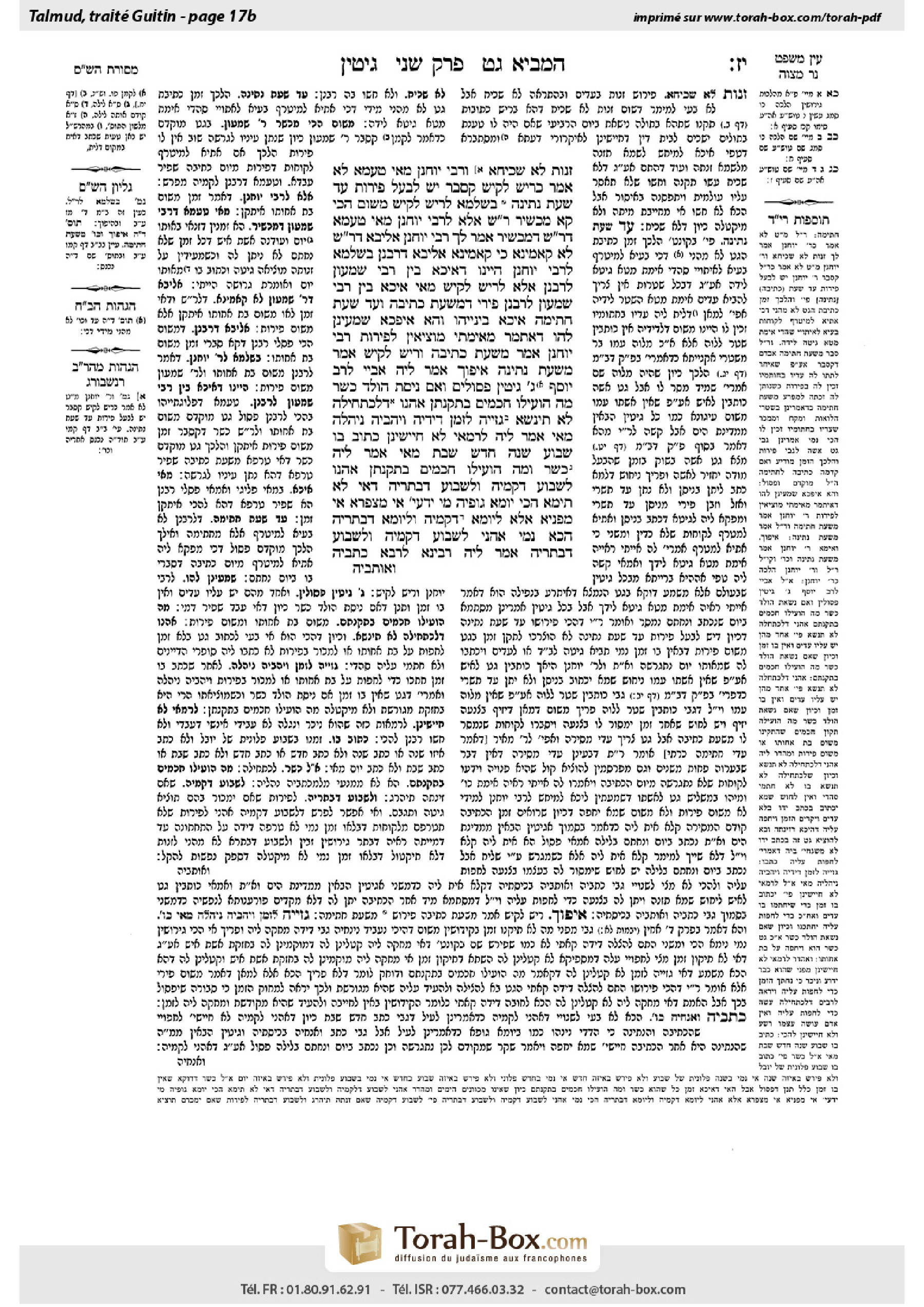
Gittin 17b: Talmud study for Daf Yomi
Study the Talmud for Daf Yomi with scanned pages, Hebrew text, English translations from Sefaria and AI-generated French translations.
Passage selection and English or AI-generated French translation are available where the scan has annotations. Daf Study is independent of Torah-Box and Sefaria.
Browse Gittin · גיטין · All tractatesGittin 17b text and translations
This page of Gittin includes the Aramaic text, an English translation and an AI-generated French translation, alongside the scan above.
גיטין י״ז ב · Aramaic and Hebrew text
זְנוּת לָא שְׁכִיחָא.
וְרַבִּי יוֹחָנָן, מַאי טַעְמָא לָא אָמַר כְּרֵישׁ לָקִישׁ? קָסָבַר: יֵשׁ לְבַעַל פֵּירוֹת עַד שְׁעַת נְתִינָה.
בִּשְׁלָמָא לְרֵישׁ לָקִישׁ, מִשּׁוּם הָכִי קָא מַכְשַׁיר רַבִּי שִׁמְעוֹן. אֶלָּא לְרַבִּי יוֹחָנָן, מַאי טַעְמָא דְּרַבִּי שִׁמְעוֹן – דְּמַכְשַׁיר?
אָמַר לָךְ רַבִּי יוֹחָנָן: אַלִּיבָּא דְּרַבִּי שִׁמְעוֹן לָא קָאָמֵינָא, כִּי קָאָמֵינָא אַלִּיבָּא דְּרַבָּנַן.
בִּשְׁלָמָא לְרַבִּי יוֹחָנָן, הַיְינוּ דְּאִיכָּא בֵּין רַבִּי שִׁמְעוֹן לְרַבָּנַן; אֶלָּא לְרֵישׁ לָקִישׁ, מַאי אִיכָּא בֵּין רַבִּי שִׁמְעוֹן לְרַבָּנַן?
פֵּירֵי דְּמִשְּׁעַת כְּתִיבָה וְעַד שְׁעַת חֲתִימָה אִיכָּא בֵּינַיְיהוּ.
וְהָא אִיפְּכָא שָׁמְעִינַן לְהוּ! דְּאִתְּמַר: מֵאֵימָתַי מוֹצִיאִין לְפֵירוֹת? רַבִּי יוֹחָנָן אָמַר: מִשְּׁעַת כְּתִיבָה, וְרֵישׁ לָקִישׁ אָמַר: מִשְּׁעַת נְתִינָה!
אֵיפוֹךְ.
אֲמַר לֵיהּ אַבָּיֵי לְרַב יוֹסֵף: שְׁלֹשָׁה גִּיטִּין פְּסוּלִים, וְאִם נִיסַּת – הַוָּלָד כָּשֵׁר; מָה הוֹעִילוּ חֲכָמִים בְּתַקָּנָתָן? אַהֲנוֹ דִּלְכַתְּחִילָּה לָא תִּינָּשֵׂא.
גַּזְיֵיהּ לִזְמַן דִּידֵיהּ, וְיַהֲבֵיהּ נִיהֲלַהּ, מַאי? אֲמַר לֵיהּ: לְרַמַּאי לָא חָיְישִׁינַן.
כָּתוּב בּוֹ שָׁבוּעַ, שָׁנָה, חֹדֶשׁ, שַׁבָּת, מַאי? אֲמַר לֵיהּ: כָּשֵׁר. וּמָה הוֹעִילוּ חֲכָמִים בְּתַקָּנָתָן?
אַהְנוֹ לְשָׁבוּעַ דְּקַמֵּיהּ וּלְשָׁבוּעַ דְּבָתְרֵיהּ. דְּאִי לָא תֵּימָא הָכִי, יוֹמָא גּוּפֵיהּ – מִי יָדְעִינַן אִי מִצַּפְרָא אִי מִפַּנְיָא?! אֶלָּא לְיוֹמָא דְּקַמֵּיהּ וּלְיוֹמָא דְּבָתְרֵיהּ; הָכָא נָמֵי, אַהְנִי לְשָׁבוּעַ דְּקַמֵּיהּ וּלְשָׁבוּעַ דְּבָתְרֵיהּ.
אֲמַר לֵיהּ רָבִינָא לְרָבָא: כַּתְבֵיהּ
Gittin 17b · English translation
Adultery is infrequent, and the Sages would not institute the dating of a bill of divorce to avoid an infrequent problem.
The Gemara asks: And what is the reason that Rabbi Yoḥanan did not say in accordance with the reason of Reish Lakish? The Gemara answers that he holds the produce belongs to the husband until the time of the giving of the bill of divorce, and only afterward does the woman have the rights to the produce of her property. If she attempts to collect the value of the produce sold after her divorce, she will be asked to prove when she received the bill of divorce. Therefore, in terms of assisting her to collect these monies, the dating of the bill of divorce does not serve any purpose.
The Gemara continues and asks: Granted, according to Reish Lakish, due to that reason Rabbi Shimon deems valid a bill of divorce that was signed on the day after it was written, because he holds that the rights to the produce of usufruct property revert to the woman the moment the bill of divorce is written. She is therefore within her rights to collect these monies from the date written in the bill of divorce, even if it was given at a later date. However, according to Rabbi Yoḥanan, who holds that the reason for writing the date is to prevent the husband from shielding his wife from punishment for her infidelity, what is the reason that Rabbi Shimon deems it valid? There is still a concern that he will have the bill of divorce written and dated earlier in order to protect her.
The Gemara answers: Rabbi Yoḥanan could have said to you: I am not speaking in accordance with the opinion of Rabbi Shimon, as he clearly is not concerned with the husband’s shielding his wife from punishment. When I speak, it is in accordance with the opinion of the Rabbis, who hold that if the bill of divorce was signed on the night following its writing, it is invalid.
The Gemara asks: Granted, according to Rabbi Yoḥanan, this is the difference between the opinion of Rabbi Shimon and the opinion of the Rabbis. However, according to Reish Lakish, what difference is there between Rabbi Shimon and the Rabbis?
The Gemara answers: The practical difference between them pertains to the produce of the wife’s property from the time of the writing until the time of the signing. According to the Rabbis, the rights to the produce revert to the wife only once the bill of divorce is signed, and the bill of divorce must be dated then. According to Rabbi Shimon, the woman’s rights to the produce go into effect the moment the bill of divorce is written, and the date on which it was signed is irrelevant.
The Gemara challenges the explanation as to why Rabbi Yoḥanan does not agree with Reish Lakish: But didn’t we hear Rabbi Yoḥanan and Reish Lakish say the opposite of this? As it is stated that they had a dispute with regard to the question: From when does the court remove the property from the possession of the husband, i.e., when does he lose his right to the produce? Rabbi Yoḥanan said: From the time of the writing of the bill of divorce, and Reish Lakish said: From the time of the giving of the bill of divorce. This does not accord with what was stated above, that Rabbi Yoḥanan holds that the husband retains the rights to the produce until the bill of divorce is given and Reish Lakish holds that the wife regains the rights beforehand. Here, their opinions are the opposite of the way the Gemara explained earlier.
The Gemara answers: Reverse the opinions in this final dispute so that it is Reish Lakish who holds that the rights to the produce revert to the woman at the time of writing and it is Rabbi Yoḥanan who holds that it is at the time of giving the divorce.
§ The Gemara records a series of questions with regard to the parameters of the ordinance that bills of divorce should be dated. Abaye said to Rav Yosef: It was taught in a mishna (86a): Three bills of divorce are invalid, but if a woman married after she received one of these bills of divorce then the offspring is of unflawed lineage, meaning that the husband and wife are divorced after the fact. One of the three bills of divorce listed is a bill of divorce that does not have a date. Abaye asks: Being that the divorce does take effect, what did the Sages accomplish with their ordinance requiring that the date appear on a bill of divorce? Either way the bill of divorce is valid after the fact without a date. The Gemara answers: It is effective in that she may not marry ab initio as a result of receiving this bill of divorce, which consequently limits the usage of such a bill of divorce.
Abaye continued to ask of Rav Yosef: If the husband cut out its date after the dated bill of divorce was written and gave it to her, what is the halakha? May the bill of divorce be used ab initio? He said to him: We are not concerned about a deceiver. The ordinance requiring that the bill of divorce be dated does not apply in this case, as it was dated when it was written.
Abaye continued and asked: If the date written in the bill of divorce made reference only to the seven-year Sabbatical cycle in which it was written, or only to the year, or only to the month, or only to the week, but the precise date was not recorded, then what is the halakha? May such a bill of divorce be used ab initio? He said to him: It is valid to be used ab initio. Abaye asked him: If so, what did the Sages accomplish with their ordinance requiring the dating of the bill of divorce? Regardless of the reason for recording the date, such vague dating will not ameliorate the problem.
Rav Yosef answered: It helps for the seven-year period before it and the seven-year period after it. If witnesses testify that the woman committed adultery before this seven-year period, then she is liable; if the husband sells produce after this seven-year period, then the woman can recover it. The reason for this is because if you do not say so, i.e., that a limited benefit is enough to justify the ordinance, then on that day itself, do we know if it was written in the morning or in the evening? All of the issues that were mentioned before could apply also to that day itself. Rather, the date is effective for the day before it and the day after it. Here also, writing the seven-year period is effective for the seven-year period before it and the seven-year period after it.
Ravina said to Rava: If he writes the bill of divorce,
Gittin 17b · Traduction française (IA)
L'adultère est rare, et les Sages ne mettraient pas en place la datation d'un acte de divorce pour éviter un problème rare.
La Guemara demande : Et pourquoi Rabbi Yoḥanan n'a-t-il pas dit selon la raison de Reish Lakish ? La Guemara répond que celui-ci considère que les produits appartiennent au mari jusqu'au moment de la remise de l'acte de divorce, et que la femme ne récupère les droits sur ses biens qu'après. Si elle tente de récupérer la valeur des produits vendus après son divorce, elle devra prouver la date de réception de l'acte de divorce. Ainsi, en termes d'aide à la récupération de ces fonds, la datation de l'acte de divorce n'a aucun effet.
La Guemara continue et demande : D'accord, selon Reish Lakish, en raison de cela Rabbi Shimon considère comme valide un acte de divorce signé le jour suivant sa rédaction, car il considère que les droits sur les produits de la propriété en usufruit reviennent à la femme dès la rédaction de l'acte de divorce. Elle a donc le droit de récupérer ces fonds à partir de la date inscrite dans l'acte de divorce, même si celui-ci a été remis plus tard. Cependant, selon Rabbi Yoḥanan, qui considère que la raison de la datation est d'empêcher le mari de protéger sa femme de la punition pour son infidélité, quelle est la raison selon laquelle Rabbi Shimon considère cela comme valide ? Il reste une préoccupation qu'il puisse faire rédiger et dater l'acte de divorce plus tôt pour la protéger.
La Guemara répond : Rabbi Yoḥanan aurait pu te dire : Je ne parle pas selon l'opinion de Rabbi Shimon, car il n'est pas préoccupé par la protection du mari de sa femme. Lorsque je parle, je parle selon l'opinion des Sages, qui considèrent que si l'acte de divorce est signé la nuit suivant sa rédaction, il est invalide.
La Guemara demande : D'accord, selon Rabbi Yoḥanan, c'est la différence entre l'opinion de Rabbi Shimon et celle des Sages. Cependant, selon Reish Lakish, quelle est la différence entre Rabbi Shimon et les Sages ?
La Guemara répond : La différence pratique entre eux concerne les produits de la propriété de la femme entre le moment de la rédaction et celui de la signature. Selon les Sages, les droits sur les produits reviennent à la femme uniquement une fois l'acte de divorce signé, et l'acte de divorce doit être daté à ce moment. Selon Rabbi Shimon, les droits de la femme sur les produits entrent en vigueur dès la rédaction de l'acte de divorce, et la date de la signature est sans importance.
La Guemara conteste l'explication donnée sur le fait que Rabbi Yoḥanan ne s'accorde pas avec Reish Lakish : Mais n'avons-nous pas entendu Rabbi Yoḥanan et Reish Lakish dire l'opposé de cela ? Comme il est dit qu'ils ont eu un débat concernant la question : À partir de quel moment le tribunal retire la propriété du mari, c'est-à-dire quand il perd ses droits sur les produits ? Rabbi Yoḥanan a dit : À partir du moment de la rédaction de l'acte de divorce, et Reish Lakish a dit : À partir du moment de la remise de l'acte de divorce. Cela ne correspond pas à ce qui a été dit plus haut, que Rabbi Yoḥanan considère que le mari conserve les droits sur les produits jusqu'à la remise de l'acte de divorce et que Reish Lakish considère que la femme récupère les droits avant. Ici, leurs opinions sont l'opposé de ce que la Guemara a expliqué plus tôt.
La Guemara répond : Inversez les opinions dans ce débat final afin que ce soit Reish Lakish qui considère que les droits sur les produits reviennent à la femme au moment de la rédaction et Rabbi Yoḥanan qui considère que c'est au moment de la remise de l'acte de divorce.
§ La Guemara enregistre une série de questions concernant les paramètres de l'ordonnance exigeant que les actes de divorce soient datés. Abaye dit à Rav Yosef : Il a été enseigné dans une michna (86a) : Trois actes de divorce sont invalides, mais si une femme s'est mariée après avoir reçu l'un de ces actes de divorce, alors l'enfant est d'une lignée sans défaut, c'est-à-dire que le mari et la femme sont divorcés après coup. L'un des trois actes de divorce mentionnés est un acte de divorce sans date. Abaye demande : Puisque le divorce prend effet, que les Sages ont-ils accompli avec leur ordonnance exigeant que l'acte de divorce soit daté ? Quoi qu'il en soit, l'acte de divorce est valide après coup sans date. La Guemara répond : Il est efficace dans la mesure où elle ne peut pas se marier dès le début en raison de cet acte de divorce, ce qui limite l'utilisation de tels actes de divorce.
Abaye continua à demander à Rav Yosef : Si le mari a effacé la date après que l'acte de divorce daté ait été rédigé et l'a donné à elle, quelle est la halakha ? L'acte de divorce peut-il être utilisé dès le début ? Il lui dit : Nous ne nous inquiétons pas d'un menteur. L'ordonnance exigeant que l'acte de divorce soit daté ne s'applique pas dans ce cas, car il a été daté lors de sa rédaction.
Abaye continua et demanda : Si la date inscrite dans l'acte de divorce faisait référence uniquement au cycle sabbatique de sept ans dans lequel il a été rédigé, ou uniquement à l'année, ou uniquement au mois, ou uniquement à la semaine, mais la date précise n'était pas enregistrée, quelle est la halakha ? L'acte de divorce peut-il être utilisé dès le début ? Il lui dit : Il est valide pour être utilisé dès le début. Abaye demanda : Si c'est ainsi, que les Sages ont-ils accompli avec leur ordonnance exigeant la datation de l'acte de divorce ? Quoi qu'il en soit, une datation vague ne résoudra pas le problème.
Rav Yosef répondit : Cela est utile pour la période de sept ans avant et la période de sept ans après. Si des témoins affirment que la femme a commis l'adultère avant cette période de sept ans, alors elle est redevable ; si l'époux vend des produits après cette période de sept ans, alors la femme peut les récupérer. La raison en est que si l'on ne dit pas cela, c'est-à-dire que le bénéfice limité suffit à justifier l'ordonnance, alors ce jour même, savons-nous si cela a été écrit à l'aube ou en fin de journée ? Toutes les questions mentionnées auparavant pourraient s'appliquer également à ce jour même. En revanche, la date est efficace pour le jour précédent et le jour suivant. Ici aussi, l'écriture de la période de sept ans est efficace pour la période de sept ans avant et la période de sept ans après.
Ravina dit à Rava : Si l'on écrit le document de divorce,
Traduction française générée par IA à partir de l’édition anglaise de Sefaria. Vérifie toujours un passage avec le texte source.
Text from Sefaria: William Davidson Edition - Vocalized Aramaic (CC BY NC); William Davidson Edition - English (CC BY NC).